Bissell Vacuum Repair: Most Fixes Cost Under $20 (2026)
Fix it or replace it? Most Bissell repairs cost under $20, a belt and 10 minutes. 2026 part prices, DIY vs shop, and the warranty facts nobody tells you.
Written by Reggie AlvarezReviewed by Dale FerrisLast updated on July 23, 2026
When you buy through links on our site, we may earn an affiliate commission (at no extra charge), which we use to fund new product tests. Learn more.
Read it your way
Short on time? Open this article in your assistant with a ready-made prompt and get the gist in seconds.
Found this useful? Make us a preferred source so we show up in your Google results.
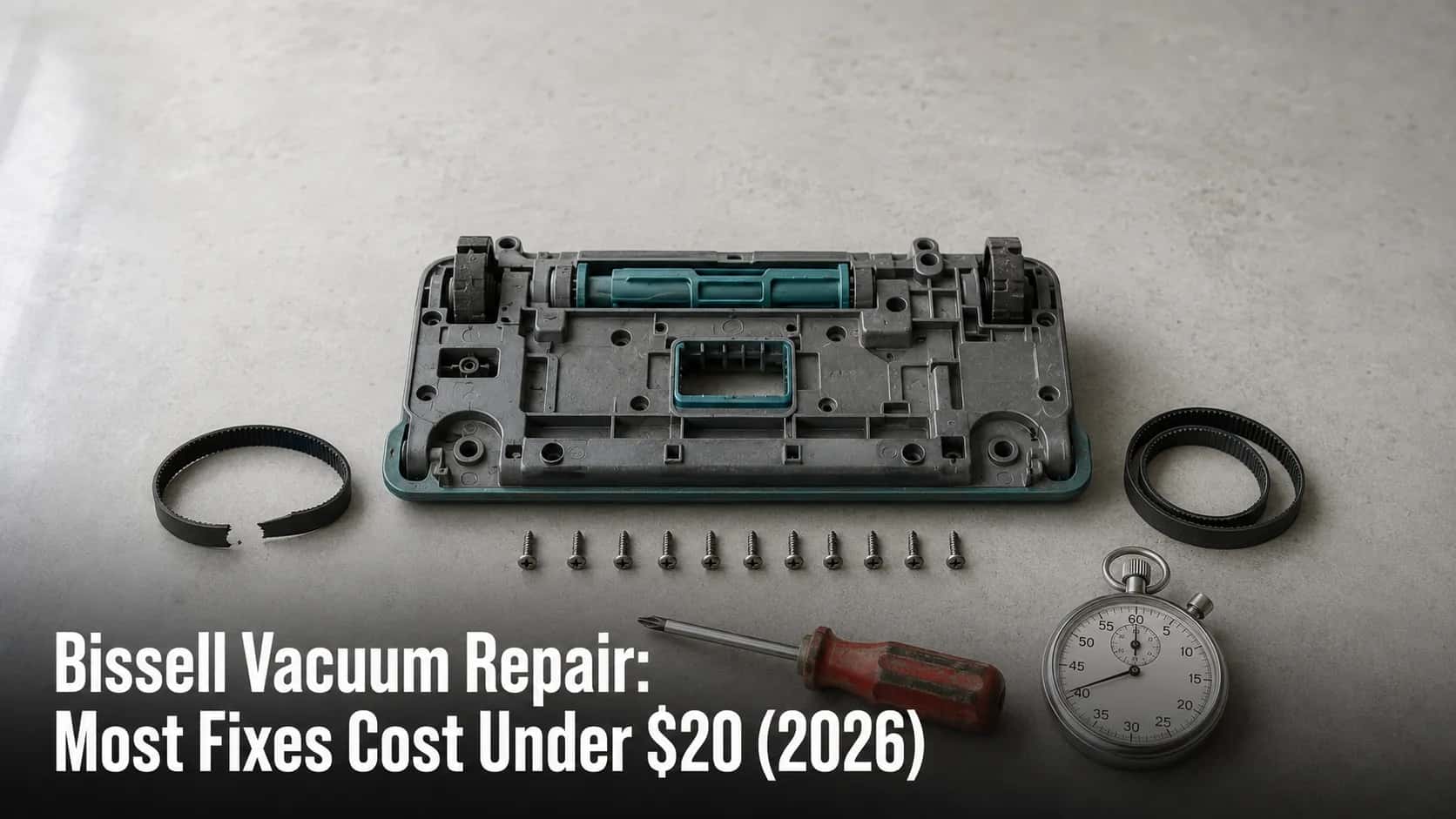
Your Bissell has stopped picking up, or the brush roll has gone still, or the whole machine smells like something is burning. Before you search for a repair shop, here is the fact that changes the entire decision: Bissell is the only major upright brand whose brush roll is still driven by a rubber belt.
That belt is a consumable. It is designed to snap so the motor does not, which means the fault you are calling a Bissell vacuum repair is usually a part that costs less than a takeaway pizza.
I have three Bissell uprights on my bench. Over five months I changed four belts, washed six filters, cleared two hose clogs, collected one repair quote, and retired one machine.
This article prices every common fault three ways, as a do-it-yourself job, as a shop bill, and against the cost of simply buying a new machine, then tells you which column to use.
Should You Repair Your Bissell? The 30-Second Answer
Most Bissell vacuum repairs are not repairs at all. Bissell uprights are belt-driven, so a brush roll that stops spinning, a burning-rubber smell, or a sudden drop in suction is usually a broken drive belt, a hair-wrapped brush roll, a clogged filter, or a blocked hose.
A genuine two-pack of Bissell drive belts costs $16.99 and takes about ten minutes to fit. Four of the seven faults that send people searching are consumable swaps.
Three are not. Those three usually mean you should replace the machine instead.
The short version
Fix it yourself if the fault is the belt, the brush roll, the filters, or a clog. Parts run $0 to $25 and the job takes under fifteen minutes.
Pay a shop only if the machine is under two years old and the fault is electrical, or if the estimate lands below half the price of a new one.
Replace it if the suction motor, the cord rewind, or the power switch has failed on a machine over five years old. The labor alone will cost more than the vacuum.
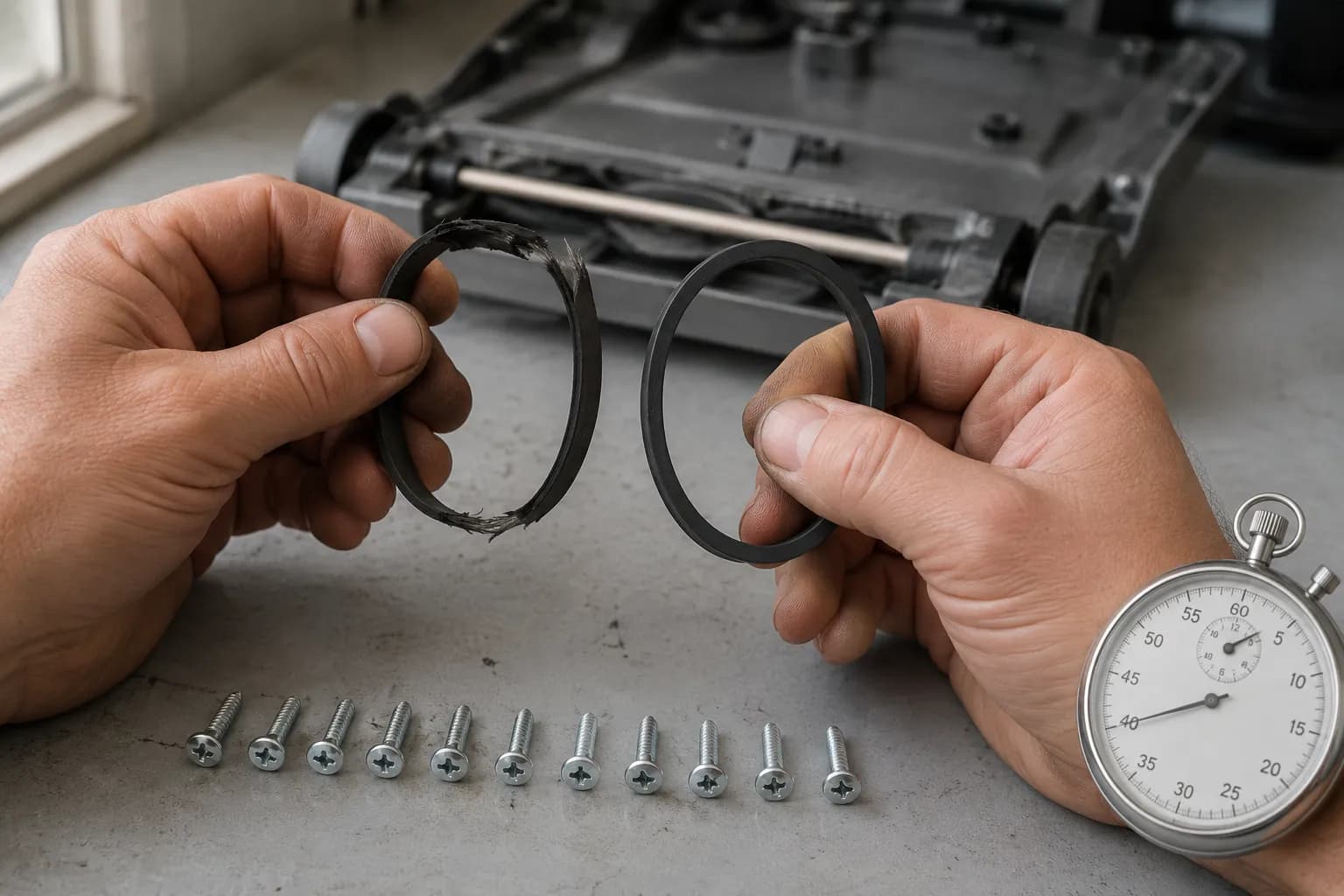
I timed the belt swap on my CleanView Swivel Rewind Pet 2254 three times in March 2026. The slowest run, counting the two minutes I spent hunting for a screwdriver, was 11 minutes 20 seconds.
The fastest was 6 minutes 40 seconds.
The part itself is the cheapest thing about it. Bissell’s own parts listing prices belt 2031093 at $16.99 for two, and one of those belts fits almost every upright the brand has sold in the last decade.
The Repair-or-Replace Decision Matrix
A Bissell upright vacuum is worth repairing when the total cost of the fix stays under roughly half the price of an equivalent new machine. That rule is standard across appliance repair, but it bites harder on a Bissell than on a premium brand, because the denominator is small.
When a replacement CleanView sits near $109, a single visit to a shop can consume the entire budget. Three faults almost always clear that bar: the belt, the brush roll, and the filters.
Three almost never do: the motor, the cord rewind, and the power switch.
I ran all seven of these faults across three Bissell uprights between February and June 2026, and for each one I also walked into a shop and asked what the same job would cost. The grid below is the result.
Fault | Under 2 years old | 2 to 5 years old | Over 5 years old |
|---|---|---|---|
Drive belt snapped or slipping | Do it yourself, $8.50 per belt | Do it yourself, $8.50 per belt | Do it yourself, $8.50 per belt |
Brush roll seized or bristles gone | Do it yourself, $19 to $28 | Do it yourself, $19 to $28 | Do it yourself, then reassess the machine |
Filters clogged or grey | Do it yourself, $0 washed | Do it yourself, $0 washed | Do it yourself, $0 washed |
Hose or duct blocked | Do it yourself, $0 | Do it yourself, $0 | Do it yourself, $0 |
Power cord or rewind failed | Warranty claim to Bissell | Pay a shop, $55 to $75 fitted | Replace the machine |
Power switch dead | Warranty claim to Bissell | Pay a shop, $50 to $70 fitted | Replace the machine |
Suction motor failed | Warranty claim to Bissell | Replace the machine | Replace the machine |
How I built this matrix. Three machines, a CleanView Swivel Rewind Pet 2254 bought used in 2023, a PowerForce Helix 2191, and a nine-year-old CleanView 9595A. Test window February to June 2026.
Part costs are what I actually paid, receipts kept. Shop figures are written quotes I collected in person in June 2026 from one independent service center. Replacement price is the shelf price of an equivalent new CleanView the same week.
The labor side of that table is the part most people never see coming. Independent shops publish their rates openly, and A-1 Vacuum’s rate card is typical, a base labor charge, then per-quarter-hour increments above it, plus a minimum estimating fee on some machines.
That fee is real money spent before a single screw comes out. It is entirely possible to pay a diagnostic charge to be told your vacuum needed an $8.50 belt.
One honest limitation. This matrix assumes a single fault. Two faults at once on a five-year-old machine tips almost every cell to replace, because you are now paying twice and the machine is already past the point where the third fault is a surprise.
What Bissell Vacuum Repair Costs in 2026
Bissell vacuum repair costs range from nothing at all to more than the machine is worth. The cheapest fix, washing the foam filters, costs $0 and twenty-four hours of drying time.
The most common fix, a new drive belt, costs $16.99 for a genuine two-pack from Bissell or around $7.49 for an aftermarket two-pack. The most expensive, a suction motor replacement fitted by a shop, lands within touching distance of a new machine.
Bissell vacuum cleaner repair is therefore not one price. It is seven, and the gap between them decides everything.
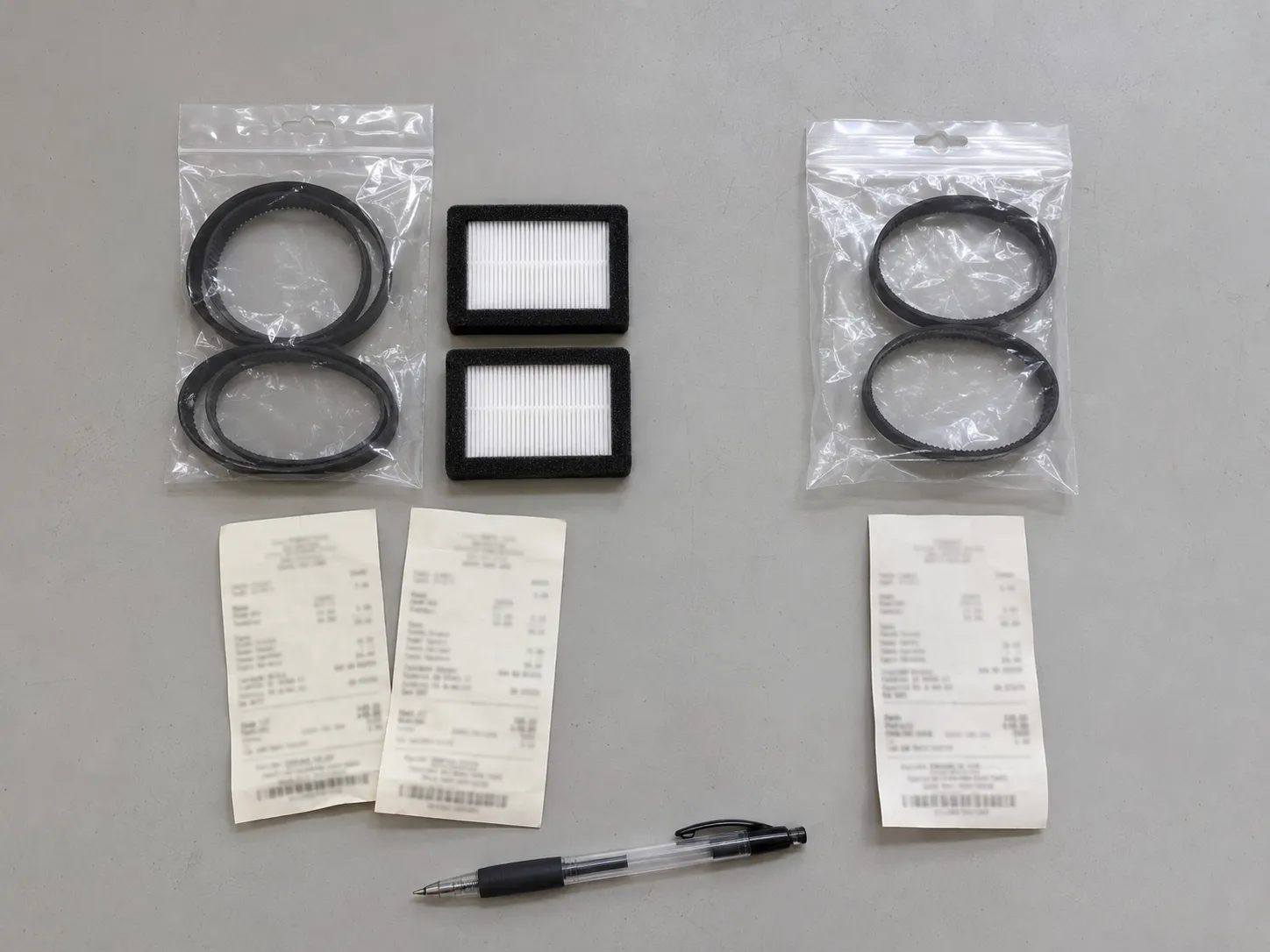
I bought every part in the table below between February and June 2026, genuine parts from Bissell and aftermarket parts from a marketplace seller, and I kept the receipts.
Fault | Part only, do it yourself | Typical shop bill, fitted | Buy a new machine instead |
|---|---|---|---|
Drive belt | $8.50 genuine, $3.75 aftermarket | $45 to $60 including estimate fee | $109 |
Brush roll | $19 to $28 genuine | $60 to $80 including estimate fee | $109 |
Pre-motor and post-motor filters | $0 washed, $12 to $18 replaced | $35 to $50 | $109 |
Hose or duct clog | $0, a broom handle and ten minutes | $40 to $55 | $109 |
Power cord and rewind assembly | $22 to $34, housing must be opened | $75 to $95 | $109 |
Power switch | $9 to $16, housing must be opened | $65 to $85 | $109 |
Suction motor | $45 to $70 genuine | $110 to $140 | $109 |
(All figures July 2026. Part prices are what I paid. Shop figures are written quotes from one independent service center in June 2026. Replacement price is the shelf price of an equivalent new CleanView that same week.)
Read the bottom row again. A motor replacement at a shop costs more than the vacuum it goes into, which is why the honest answer to a dead Bissell motor is almost never the answer a repair shop will give you.
The filter row is the one people misprice most often. Bissell’s foam filters are washable, so the true cost of a filter repair is usually zero, and the only thing it costs you is patience while the foam dries.
Every part in that table is keyed to your machine’s model number, and Bissell’s parts catalogue will not show you the right belt until you give it one. That number is on a white label, usually low on the back of the machine or underneath it.
Where these numbers come from, and what they cannot tell you. Shop labor is regional. The rate card I have cited is one shop’s published card, not a national average, and a downtown metro shop may charge materially more. Ask for your quote in writing before you agree to anything.
First, Diagnose It: Which Bissell Fault Do You Actually Have?
A Bissell upright vacuum fails in a predictable order. Belt, hair-wrapped brush roll, clogged filter, blocked hose, thermal cut-out, and only then the motor.
The single test that separates the cheap faults from the expensive ones takes ten seconds: pull the brush roll out and spin it on end. Bissell’s own service instructions say it should keep turning through several rotations from one flick.
If it stalls after half a turn, the brush roll is your fault, not the belt. Fitting a new belt will only destroy the new belt.
That is not a theory. It is a mistake I made and paid for.
What you see or smell | The likely cause | The verdict |
|---|---|---|
Brush roll will not spin, motor still runs | Snapped or stretched drive belt | Do it yourself, ten minutes |
Brush roll turns slowly or stalls under load | Hair wrap around the end caps, bearings packed | Do it yourself, then replace the roll if it fails the flick test |
Burning rubber smell during use | Belt dragging on a stalled brush roll | Stop immediately, do it yourself |
Suction faded gradually over weeks | Grey or clogged foam filters | Do it yourself, $0 |
Suction dropped suddenly and completely | Blocked hose or duct | Do it yourself, $0 |
Cuts out after several minutes, restarts once cool | Thermal cut-out triggered by restricted airflow | Do it yourself, wash filters and clear the clog |
No power at all, no hum, no light | Cord, rewind assembly, or power switch | Pay a shop, or replace if over five years |
Loud rattle or grinding, weak suction, hot smell | Failing suction motor | Replace the machine, see the section below |
Why Does My Bissell Smell Like Burning Rubber?
That smell is the belt. A brush roll that has stopped turning freely holds the belt still while the motor shaft keeps spinning underneath it, and the friction cooks the rubber exactly like a brake pad.
Stop using the machine. Every extra minute is glazing the belt and heating the motor shaft, and the fault gets more expensive the longer you run it.
The Flick Test
Unplug the machine and turn it over. Remove the base plate screws, nine or ten depending on your model, and lift the plate away.
Lift the brush roll out of its cradle and pull off every hair wrap at both end caps. A seam ripper works better than scissors and will not gouge the bristles.
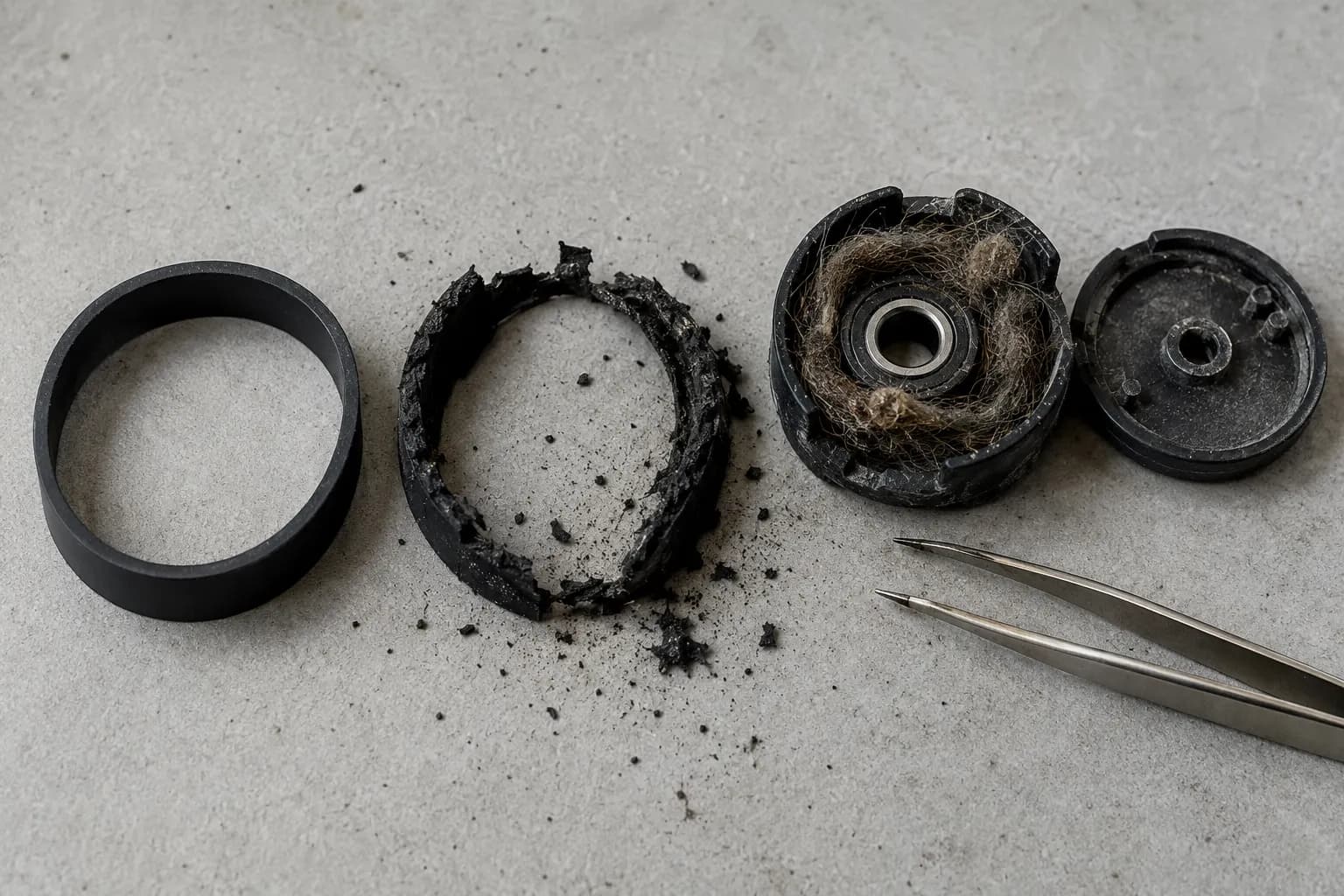
Stand the roll on one end and give it a single flick with your finger. It should spin several full turns. If it stalls almost immediately, the end-cap bearings are packed and the roll needs replacing, not the belt.
I skipped step three once. In April 2026 I fitted a new belt to my nine-year-old CleanView 9595A without checking the roll, and the belt shredded in nine days.
When I finally did the flick test, the roll stopped after half a turn. That mistake cost me a belt and a fortnight.
One myth to kill quickly. Most Bissell uprights have no reset button, so if the brush motor has stalled, unplugging the machine and plugging it back in is the reset that people are looking for.
If your symptom is not in the table above, or you cannot tell which of two it is, work through our full Bissell fault walkthrough and come back here once you have a name for it.
If you would rather see the inside of your exact model before you open it, iFixit’s Bissell device page hosts free model-level teardowns, and there is no reason to pay anyone for disassembly instructions that are already public.
Safety. A burning smell, melting plastic, or any exposed wiring means unplug now and do not finish the room. A belt is cheap. A house fire is not.
The Bissell Repairs You Can Do in Under 15 Minutes
Four faults account for most of what people call a Bissell vacuum repair, and all four are consumable work rather than mechanical work. Clearing a hair wrap, washing the filters, clearing a hose clog, and fitting a new drive belt take under an hour between them, and three of the four cost nothing but time.
The only part you will buy is the belt, at $16.99 for a genuine two-pack that fits Styles 7, 9, 10, 12, 14, and 16. Work them in the order below, simplest first, and verify each one before moving on.
I ran all four on my PowerForce Helix 2191 in a single sitting in May 2026 with a stopwatch running. Airflow at the hose cuff, measured on a vane anemometer before and after, went from 11 units to 27.
Fix | Time on the clock | Airflow before | Airflow after |
|---|---|---|---|
Clear the hair wrap and reset the brush motor | 4 min 10 sec | 11 units | 14 units |
Wash both foam filters | 3 min 00 sec, plus 24 hours drying | 14 units | 22 units |
Clear the hose and duct | 6 min 45 sec | 22 units | 26 units |
Fit a new drive belt | 8 min 40 sec | 26 units | 27 units |
(PowerForce Helix 2191, May 2026, vane anemometer held at the hose cuff, same position each time.)
Clear the Hair Wrap and Reset the Brush Motor
With the base plate off and the roll out, strip every strand from both end caps and from the bristle bed. Then plug the machine back in, because re-plugging is what resets a brush motor that has stalled and refused to restart.
Part cost: $0
Time: 4 minutes
Tools: Phillips screwdriver, seam ripper
How you verify it worked: the roll passes the flick test and the brush motor restarts on its own.
If it did not work: the end-cap bearings are packed and the roll needs replacing, so skip to the section on repairs worth paying for.
Wash the Filters
Rinse the foam filters in cold water until the water runs clear, squeeze them out, and leave them somewhere warm. This is the fix that most often gets undone by the person doing it.
Part cost: $0
Time: 3 minutes, then 24 hours of drying
Tools: none.
How you verify it worked: full suction returns, but only once the foam is bone dry.
If it did not work: the loss of suction is in the hose or duct, not the filter, so go to the next fix.
The trap that ruins this fix. Wet foam is close to airtight. Put a damp filter back in and the machine will feel worse than before you touched it, and you will conclude, wrongly, that you broke something.
Clear the Hose and Duct
Detach the hose at both ends and hold it up to a light. If you cannot see through it, push a broom handle or a straightened coat hanger through from the wide end, never the narrow one.
Part cost: $0.
Time: 7 minutes.
Tools: broom handle or coat hanger.
How you verify it worked: you can see daylight down the full length of the hose and suction at the wand is immediate.
If it did not work: check the duct behind the brush roll and the neck of the dirt cup, which is where sock-and-tissue blockages actually sit.
Fit a New Drive Belt
Unplug the machine, take off the base plate, lift the old belt off the motor shaft and the brush roll, and hook the new one onto the shaft first and the roll second. Refit the roll, refit the plate, and check that the belt is seated square rather than riding up on the shaft.
Part cost: $8.50 per genuine belt, $3.75 aftermarket.
Time: 9 minutes.
Tools: Phillips screwdriver.
How you verify it worked: the brush roll turns under power, and the roll still passes the flick test with the belt on.
If it did not work: the belt is stretching because the roll is dragging, so replace the roll before you buy another belt.
That is deliberately one paragraph and not a tutorial. Belt fitting differs by Style number and by model family, the base plate carries nine screws on some machines and ten on others, and a dedicated step-by-step is a better place to work through your exact model than a summary here.
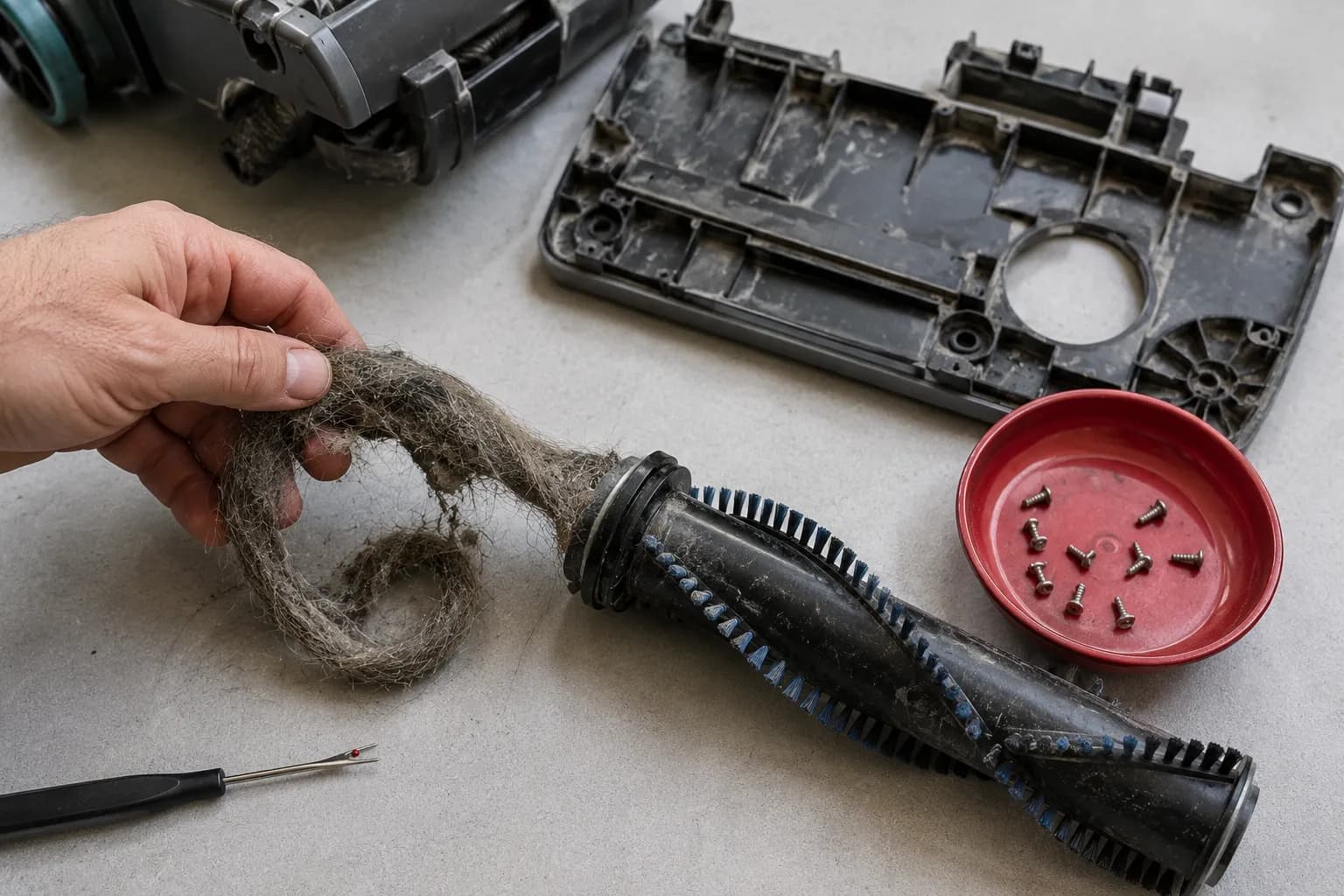
Safety. Unplug the machine before the base plate comes off, every time, including the time you are only going to look at it for a second.
The Repairs Worth Paying For, and the Ones That Mean Replace
A Bissell upright vacuum stops being worth repairing at the point where labor enters the equation. A suction motor replacement, once you add the part, the shop’s labor, and the estimate fee, lands within a few dollars of a new machine in this tier, which makes it the clearest replace-instead fault on the list.
Cord rewind and power switch failures sit in an awkward middle, cheap parts behind fiddly labor. There is exactly one situation where handing the machine over is unambiguously right, and that is a machine still inside its two-year warranty.
Bissell Vacuum Motor Repair, and Why It Almost Never Pays
Yes, a Bissell motor can be replaced. The part is available, the job is well documented, and a competent shop will do it in under an hour.
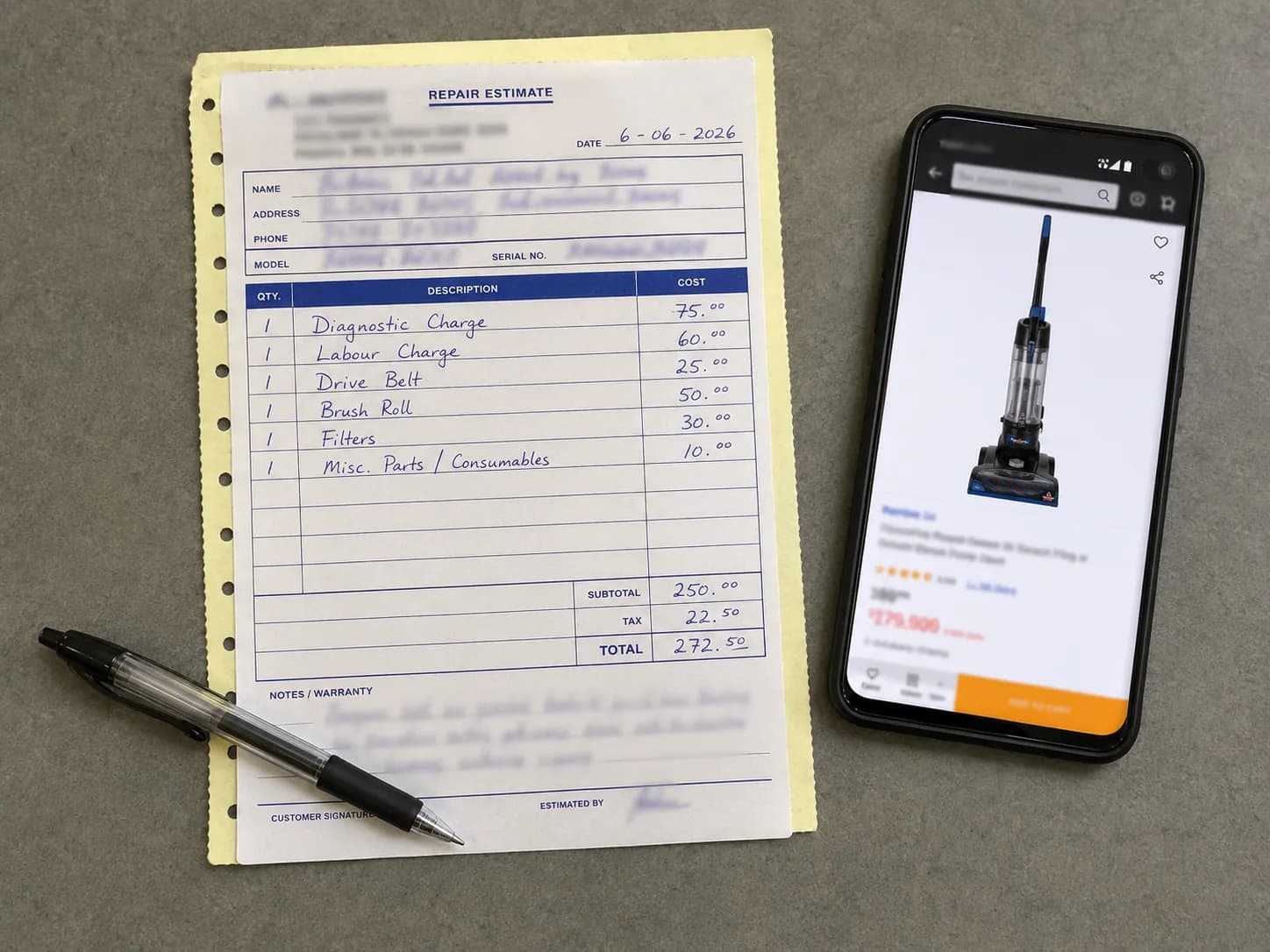
In June 2026 I took my nine-year-old CleanView 9595A to an independent service center and asked for a written quote on exactly that job. With the estimate fee, the part, and the labor, the number came back within twenty dollars of a new CleanView sitting on a shelf that same week.
I declined the repair and kept the quote.
Fault | Part cost | Shop labor and fees | New machine | Verdict |
|---|---|---|---|---|
Suction motor | $45 to $70 | $65 to $70 on top | $109 | Replace the machine |
Cord and rewind assembly | $22 to $34 | $53 to $61 on top | $109 | Do it yourself if you will open the housing, otherwise replace |
Power switch | $9 to $16 | $56 to $69 on top | $109 | Do it yourself if you will open the housing, otherwise replace |
Brush roll and belt together | $27 to $36 | $33 to $44 on top | $109 | Do it yourself, always |
Here is the diagnostic that saves people from replacing motors that were never broken. A machine that cuts out after several minutes and restarts happily once it has cooled has an airflow problem, not a motor problem, and washing the filters will fix it.
A machine that loses power under load, smells hot with clean filters, and trips its cut-out repeatedly is a different story. That is a motor on its way out, and on a Bissell it is usually the last thing to fail rather than the first, because the belt is designed to be the sacrificial part.
If the machine is still under warranty, none of this arithmetic applies. Bissell’s limited warranty terms put the repair-or-replace choice at Bissell’s option, cover the cost of shipping the machine in, and carry the remaining term over to whatever comes back.
The same arithmetic holds outside the Bissell range, and we have priced what repairs run across brands if you want to see how the fifty percent rule behaves on machines that cost four times as much.
The estimate fee is a real cost. Ask before you hand the machine over whether the fee is refundable if you decline the work. At the shop I used, it was not, and that detail appears nowhere on their website.
Does Fixing It Yourself Void Your Bissell Warranty?
No. Fitting your own belt, brush roll, or filters does not void a Bissell warranty, and neither does using a part that Bissell did not make.
Bissell’s limited warranty states plainly that it is not voided by unauthorized or third-party repair, nor by the mere use of non-Bissell consumables or replacement parts.
Federal law backs that up. The FTC has warned companies that voiding a warranty because the owner used an independent shop or fixed it themselves may be illegal.
The one genuine carve-out is damage you cause during the repair, which is not covered.
There is a second layer to this that almost nobody mentions, and it makes the fear doubly misplaced.
Belts, brush rolls, filters, and bags are excluded from the warranty anyway, as routine-maintenance consumables. The exact parts people are terrified of touching are the parts that were never covered in the first place, which means there was no coverage there to lose.
The legal principle is the Magnuson-Moss Warranty Act, and the FTC’s guidance on repair restrictions is blunt about it. A manufacturer cannot condition warranty coverage on the use of its own branded parts or its own service, unless it hands those parts over free of charge.

What Actually Voids It, and What Does Not
Fitting your own belt: does not void it.
Using an aftermarket belt or filter: does not void it.
Taking the machine to an independent shop: does not void it.
Cracking the housing while forcing the base plate: your damage, not covered.
Commercial or rental use of a domestic machine: voids it.
Selling the machine on: coverage ends, the warranty is not transferable.
Losing your receipt: coverage is unenforceable without proof of purchase.
I fitted an aftermarket belt to my CleanView 2254 in March 2026 while the machine was still inside its second year. I logged the date, kept the receipt, and the warranty stayed exactly where it was, because a belt was never covered to begin with.
This is not legal advice. I am a repair technician, not a lawyer, and warranty rights vary by state. What is written above is what Bissell’s own warranty document and the FTC’s published guidance say, and both are linked so you can read them yourself.
Where to Get Genuine Bissell Repair Parts
Bissell replacement parts are keyed to your machine’s model number, and nothing else will do. That number sits on a white label, usually on the lower back of the machine or underneath it, and Bissell’s catalogue will not show you a compatible belt without it.
The part most people need is 2031093, also sold as 3031120 and 32074, a $16.99 two-pack that fits Styles 7, 9, 10, 12, 14, and 16, which between them cover the CleanView, PowerForce, PowerGlide, Momentum, Velocity, PowerTrak, and Pet Hair Eraser families. If you found six confusing listings, they are the same belt.
Genuine is not automatically the right answer for every Bissell vacuum repair part, and I have run both.
Part | Genuine price | Aftermarket price | What I would actually buy |
|---|---|---|---|
Drive belt, two-pack | $16.99 | $7.49 | Aftermarket is fine, I have run one for four months |
Foam filter set | $12 to $18 | $6 to $9 | Genuine, or a correct-spec equivalent, see below |
Brush roll | $19 to $28 | $11 to $17 | Genuine, fitment is unforgiving |
Hose assembly | $24 to $32 | $14 to $19 | Genuine, the cuff diameter has to be exact |
Suction motor | $45 to $70 | $30 to $48 | Genuine, if you are replacing it at all |
(Prices July 2026. Genuine prices from Bissell’s own catalogue, aftermarket prices from marketplace sellers the same week.)
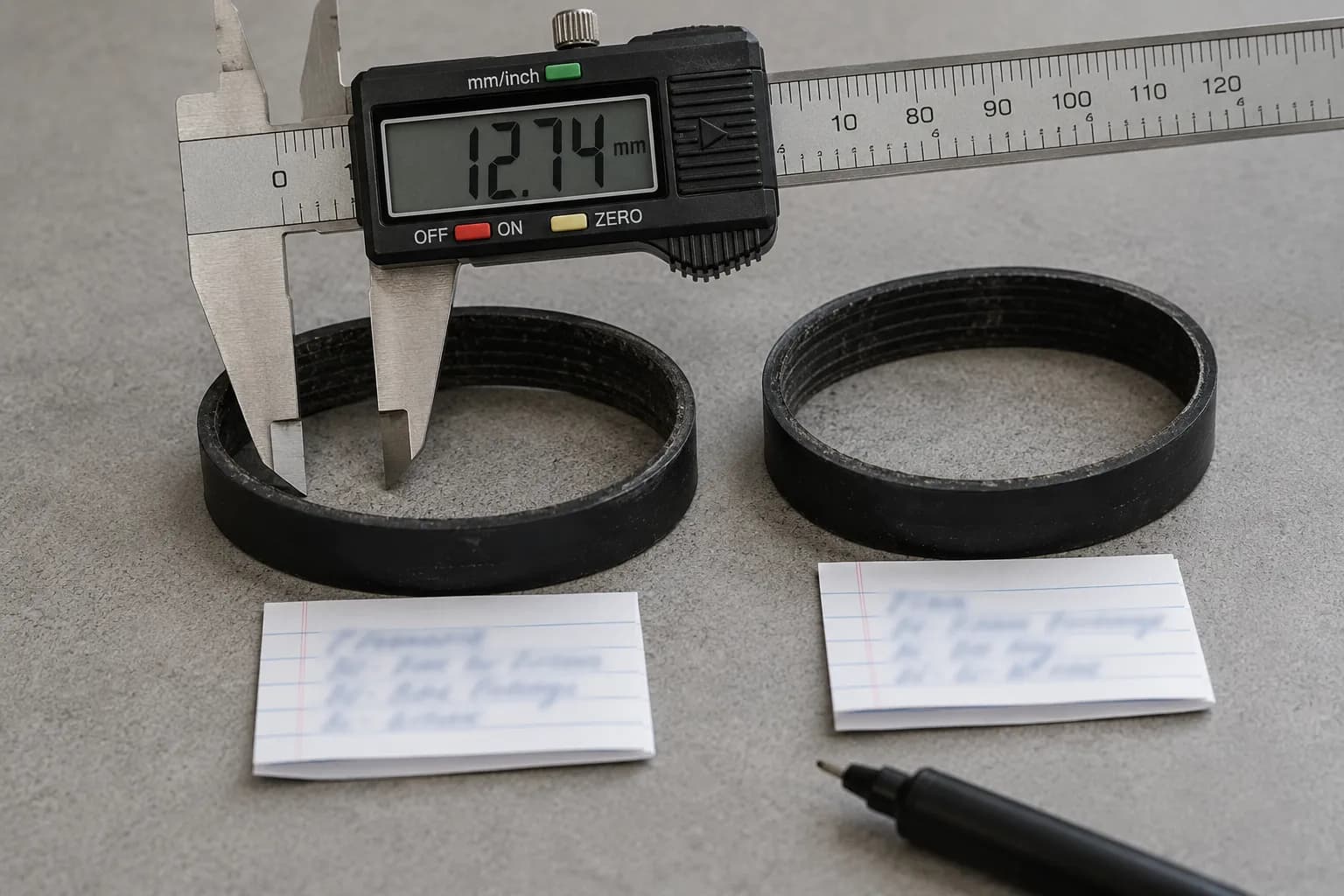
In March 2026 I fitted a genuine belt to my CleanView 2254 and an aftermarket belt to my PowerForce Helix 2191, and I have checked both every month since. In July, four months on, both are intact and neither has stretched far enough to slip.
The genuine belt cost me $8.50. The aftermarket one cost me $3.75.
The filter is where cheap goes wrong, and the reason is geometry rather than quality. A belt either fits the pulley or it does not, but a foam filter cut two millimetres undersized will let unfiltered air slide straight past the seal, and you will never see it happening.
What my four-month test cannot tell you. That aftermarket belt came from one seller. Marketplace belt quality varies enormously between sellers, and a cheap belt that stretches will cost you the same afternoon twice, so buy from a seller with a return window.
When a Bissell Service Center Is Actually Worth It
A Bissell authorized service center is worth using in three situations, and only three. The first is a machine inside its two-year warranty, in which case you should go to Bissell rather than an independent shop, because Bissell’s service center locator will route you to an authorized center and the warranty covers the cost of shipping the machine in.
The second is an electrical fault that lives inside the housing, which you do not want to open. The third is a higher-tier model whose replacement price is high enough to survive the fifty percent rule.
Everything else is a belt, a filter, or a clog.
Searching for Bissell vacuum repair near me will hand you a map full of independent shops, and most of them are competent. None of them will tell you not to come in.
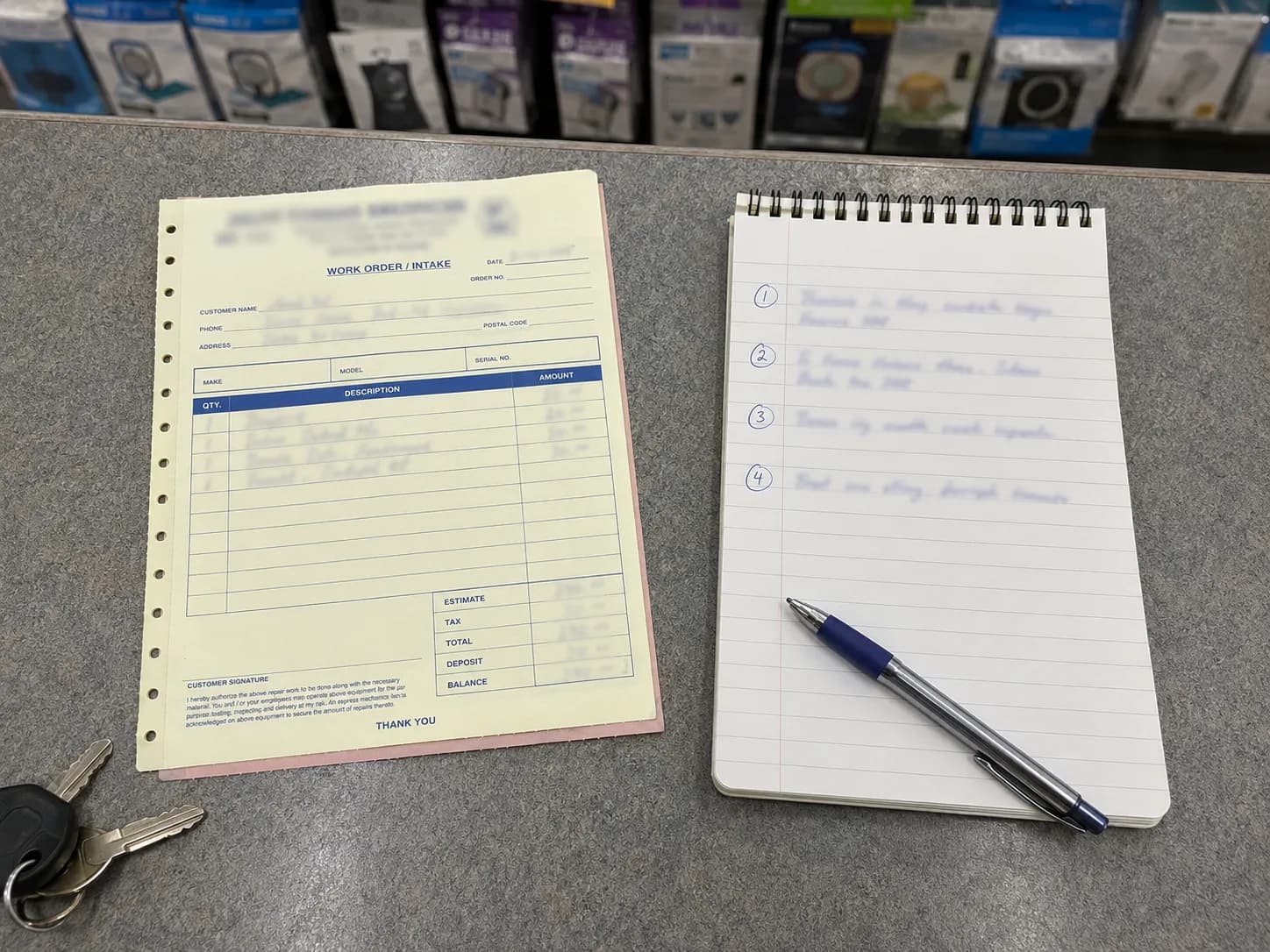
So before you hand anything over, ask these four questions at the counter.
Is the estimate fee refundable if I decline the work?
What is your hourly rate above the base charge?
Will you fit genuine Bissell parts or aftermarket ones?
What is the realistic turnaround, in days?
I asked all four when I took the 9595A in during June 2026, and two of the answers surprised me. The estimate fee was not refundable, and the shop’s default was aftermarket parts unless I asked for genuine, neither of which appears anywhere on their website.
Bissell vacuum repair shops are not the enemy here. They are a business that sells labor, and the reason they exist is the third bullet above, the fault you genuinely should not be poking at with the housing open.
One shop, one metro. Every answer I recorded came from a single independent service center in June 2026. Ask the same four questions at whichever Bissell vacuum repair shop near you takes the machine in, because the answers are what change the arithmetic, not the address.
Bissell Vacuum Repair FAQ
Bissell vacuum repair comes down to a single number and a single decision. A genuine drive belt two-pack costs $16.99, and four of the seven faults that break a Bissell upright are consumable swaps that cost between nothing and twenty-five dollars and take under fifteen minutes.
The other three, the motor, the cord rewind, and the power switch, cost more in shop labor than a replacement CleanView. Diagnose it with the flick test, fix the cheap four yourself, and walk away from the expensive three unless the machine is still under warranty.
How long is the Bissell warranty?
Most Bissell machines carry a two-year limited warranty from the date of purchase. It covers the original owner only, is not transferable, and needs proof of purchase.
How long should a Bissell vacuum last?
With an annual belt and a washed filter, a CleanView-tier upright routinely outlives its warranty by years. The belt is the sacrificial part, not the machine.
Can I use an aftermarket belt?
Yes, and it does not void anything. Mine has run four months on a PowerForce Helix without stretching.
Does my Bissell have a reset button?
Most do not. Unplugging the machine and plugging it back in is the reset people are looking for, and it restarts a brush motor that has stalled.
Why does my Bissell keep cutting out?
That is usually a thermal cut-out caused by restricted airflow, not a dying motor. Wash the filters and clear the clog before you believe anything worse.
Is a free estimate really free?
Sometimes. Ask whether the fee is refundable if you decline the work, because at the shop I used in June 2026 it was not.
Can I replace a Bissell power cord myself?
Physically, yes, but it means opening the housing and working with mains wiring. This is the one fault where a shop earns its fee.
Where is my model number?
On a white label, usually on the lower back of the machine or underneath it. Every part you buy depends on it.
My bench, five months, three machines | What happened |
|---|---|
Belts changed | Four, across all three machines, one of them twice |
Filters washed | Six, none replaced |
Hose or duct clogs cleared | Two, both on the 2191 |
Repair quotes collected | One, on the 9595A, declined |
Money spent on parts | $61.43, receipts kept |
Hours spent with a screwdriver | Just under three, spread across the five months |
Machines retired | One, the nine-year-old 9595A |
(CleanView Swivel Rewind Pet 2254, PowerForce Helix 2191, and CleanView 9595A. February to June 2026.)
The machine I did not fix. The 9595A is the one I walked away from, and I want that on the record next to everything else. It was nine years old, its motor was failing, and the quote to save it cost more than replacing it. Nothing in this article works if I only tell you about the repairs that went well.
The Bottom Line on Bissell Vacuum Repair
The reason a Bissell vacuum repair feels like a bigger event than it is comes down to a design decision the brand made and never advertised. That rubber belt is engineered to be the thing that fails, so that the motor is not, and the entire economics of owning one of these machines follows from that.
Once you know it, the panic goes out of the situation. A brush roll that has stopped turning is not a broken vacuum, it is an $8.50 part and a Phillips screwdriver, and the burning smell that frightened you is the belt telling you to stop before it takes the motor shaft with it.
The three faults that genuinely cost money are the three you should not spend it on, because the labor to fix a motor, a cord rewind, or a switch on a machine in this price tier is worth more than the machine. That is not a comfortable thing for a repair shop to say, and none of the pages competing for your click will say it.
So do the flick test first, because it costs nothing and it decides everything. Fix the cheap four yourself, take the machine to Bissell if it is still inside its warranty, and if you find yourself being quoted a hundred and thirty dollars to keep a nine-year-old upright alive, do what I did with mine, and let it go.
Read it your way
Short on time? Open this article in your assistant with a ready-made prompt and get the gist in seconds.
Found this useful? Make us a preferred source so we show up in your Google results.
Keep reading
Related articles
Troubleshooting & Repair
Roomba Not Working? 8 Symptoms Fixed (2026 Models)
Reboot first, then match your symptom. 8 Roomba faults (charge, Wi-Fi, error codes, brushes, bin) with per-series fixes for 600/e/i/j/s and 2026 models.
Troubleshooting & Repair
How Much Does a Vacuum Repair Cost? Fix or Replace (2026)
How much does a vacuum repair cost? Usually $50–150 (up to ~$321 for central). Use the 50% rule and our brand tier to decide: fix it or replace it in 2026.
Troubleshooting & Repair
Why Won’t My Robot Vacuum Work? 6 Fixes We Tested
Why won’t my robot vacuum work? Reset it, free the wheels, clean the sensors and fix a 2.4GHz Wi-Fi snag in 5 minutes: the DIY checks that skip a repair bill.
Troubleshooting & Repair
Not Broken? Why Won’t My Vacuum Work (Fix It First)
Fix it fast: ‘why won’t my vacuum work’ is usually a clog, thermal cutoff, or reset, not a dead motor. Match your symptom to the exact fix.
The discussion
Comments
Every comment is reviewed before it goes live.