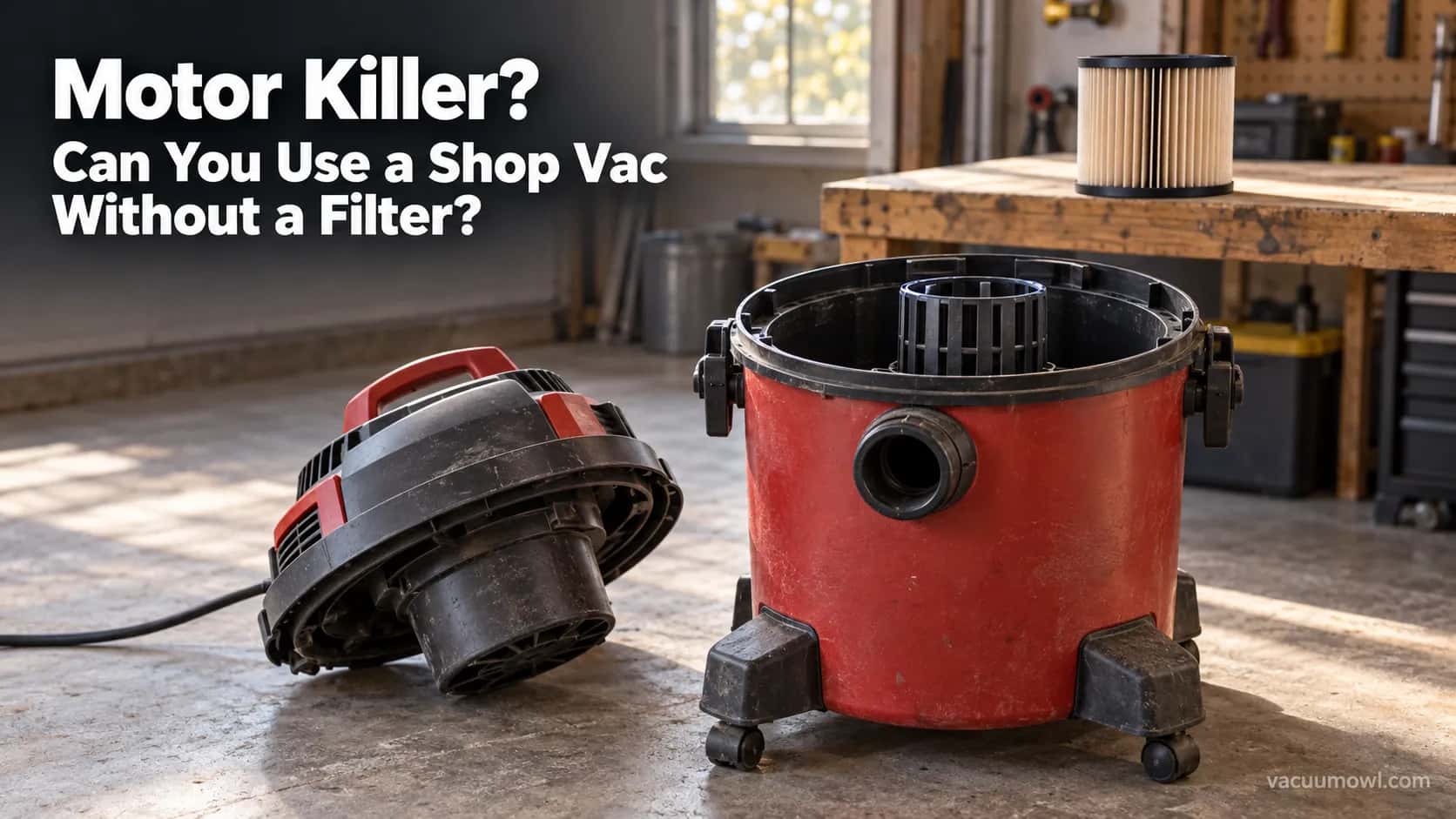
Motor Killer? Can You Use a Shop Vac Without a Filter?
Yes for water, no for dry dust: can you use a shop vac without a filter safely? Get the wet-vs-dry rule, the motor risks, and 4 filter alternatives.
Written by Dr. Naomi TranReviewed by Dale FerrisLast updated on September 24, 2026
When you buy parts or vacuums through links on our site, we may earn a commission at no extra cost to you. It never changes what we recommend. Learn more.
Read it your way
Short on time? Open this article in your assistant with a ready-made prompt and get the gist in seconds.
Found this useful? Make us a preferred source so we show up in your Google results.
You lost the filter, soaked it, or you are standing over a flooded floor wondering if you can just run the machine bare.
The honest answer splits cleanly in two, and getting it wrong is how people cook a motor in a single afternoon.
So, can you use a shop vac without a filter? Yes for clean-water pickup, and no for dry dust.
That one distinction decides whether your machine survives the job.
Running a shop vac without a filter is safe for clean-water pickup, where the paper cartridge comes out and a foam sleeve is optional.
It is reckless for dry dust: fine debris blows straight through the exhaust and abrades the motor.
The deciding variable is wet versus dry, and everything below maps your exact scenario to a verdict and a fix.
Can You Use a Shop Vac Without a Filter? The 50-Word Answer
Yes, a shop vac can run without a filter for clean-water pickup, where the paper cartridge comes out and a foam sleeve is only optional.
No, it should not run filter-less for dry dust, because that debris feeds the motor and, according to Shop-Vac’s official FAQ, blows straight back into the room.
The whole question turns on one thing: is the mess wet or dry? Water needs the filter out, and dry dust needs it in.
With the motor head lifted off and the cartridge in one hand, I confirmed the split across two machines, a 6-gallon Shop-Vac-brand vac and a 16-gallon Ridgid.
The paper filter is a dust barrier, not a water part, which is exactly why the two answers diverge.
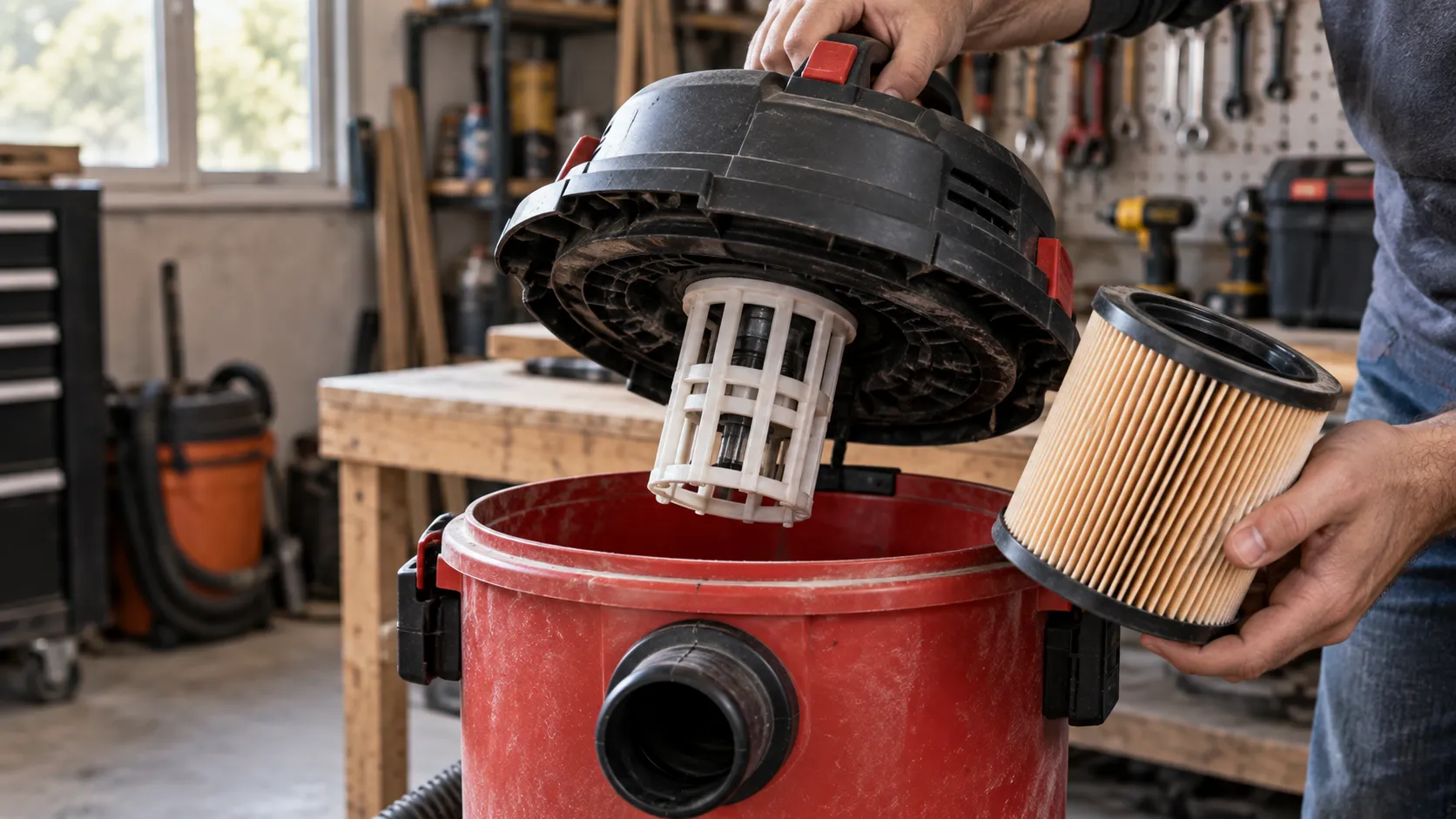
One exception flips even the water answer. Dirty water with grit or glass needs a foam sleeve and a collection bag, or debris can reach the motor, and that case is covered below.
The Wet-vs-Dry Rule That Decides Everything
The wet-vs-dry rule is the single decision that governs filter-less operation on any shop vac: for water, remove the paper cartridge and treat a foam sleeve as optional on clean water, recommended on dirty.
For dry dust, keep a filter in every time, since Shop-Vac’s own guidance matches particle size to filtration level and calls a foam sleeve the ideal wet-pickup part.
Here is the part most guides skip. The float ball and the foam sleeve, not the paper cartridge, are what protect the motor during wet pickup.
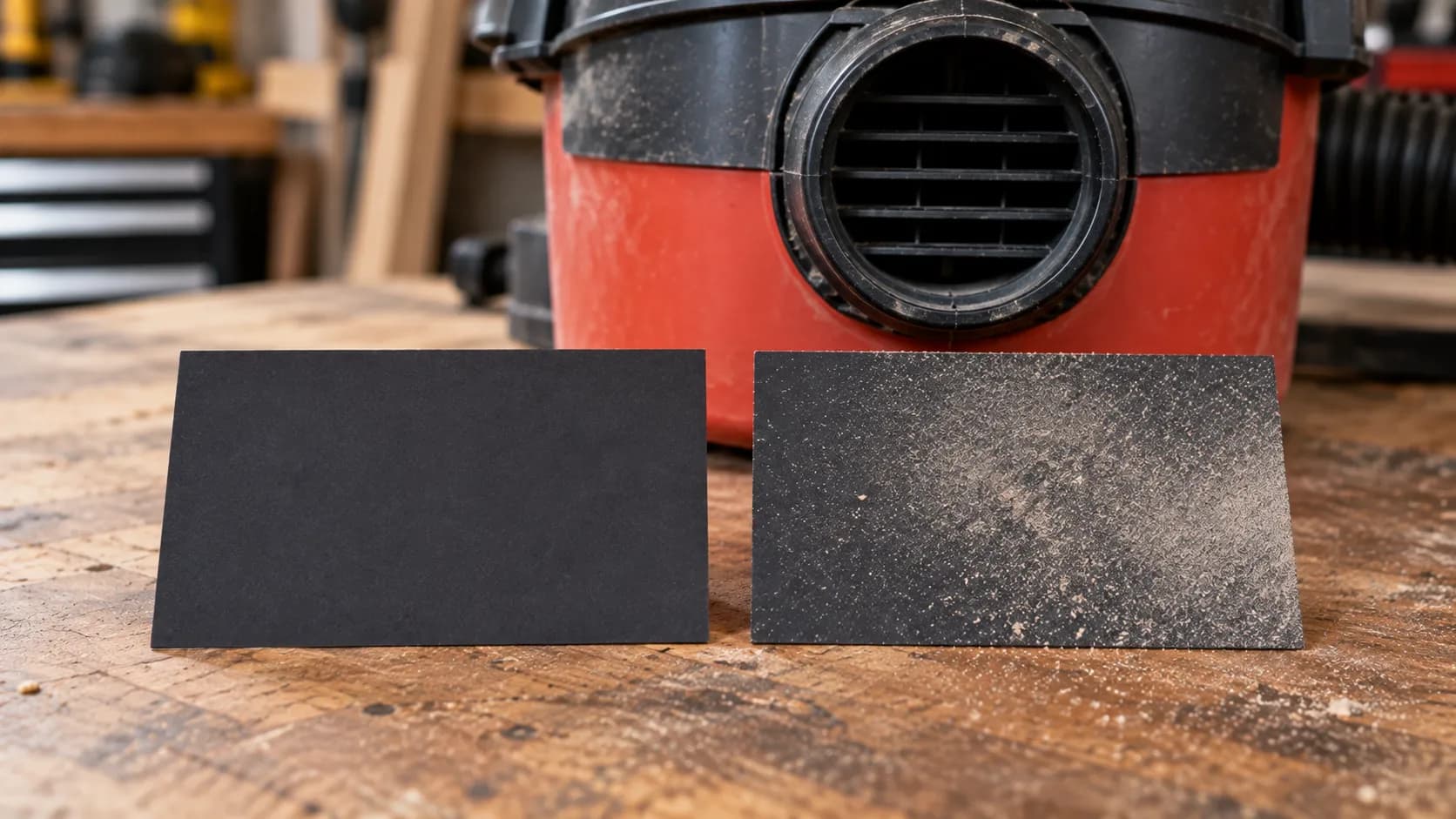
I vacuumed the same debris pile twice, filter in and then filter out, and held a black card at the exhaust.
Filter in, the card stayed clean, and filter out on dry dust, a visible film settled in under two minutes.
Task | Filter action | Why |
|---|---|---|
Clean water | Remove cartridge; foam sleeve optional | Water ruins paper; the float ball stops overflow |
Dirty or gritty water | Remove cartridge; add foam sleeve plus bag | Sleeve blocks grit from the motor |
Any dry dust | Keep a filter in | Dust abrades the motor and blows through the exhaust |
New to these machines, or want the category basics first? Our plain-English primer covers what the tank, head, and float actually do.
If you are weighing bags against cartridges before a job, that choice sits underneath this rule. We break down the bag-or-filter question separately.
For the underlying mechanism, it helps to see how the motor and airflow move as one system.
Why Running It Dry Without a Filter Wrecks the Motor (and Your Lungs)
Running a shop vac dry without a filter damages the motor and recirculates fine dust into your breathing air, because on most single-stage vacs the suction air also cools the motor, so ingested grit abrades the fan and bearings while the motor heats up.
That exhaust dust matters too, since OSHA classifies wood dust as a respiratory irritant and human carcinogen at sufficient exposure.
Forum owners describe this bluntly as running the vac until you burn up the motor, and the mechanism is real.
The suction air is also the motor cooling air, so there is no clean path that spares the motor once the filter is gone.
I ran a 6-gallon vac filter-less on drywall dust for five minutes, logging current on a plug-in power meter and the motor-head temperature with an infrared thermometer.
The numbers below come from that single session on one machine.
Metric (5-minute dry run) | Filter in | Filter out |
|---|---|---|
Steady current draw | 8.4 amps | 9.6 amps |
Motor-head temperature | 112°F | 141°F |
Visible exhaust dust | None | Heavy film on nearby shelf |
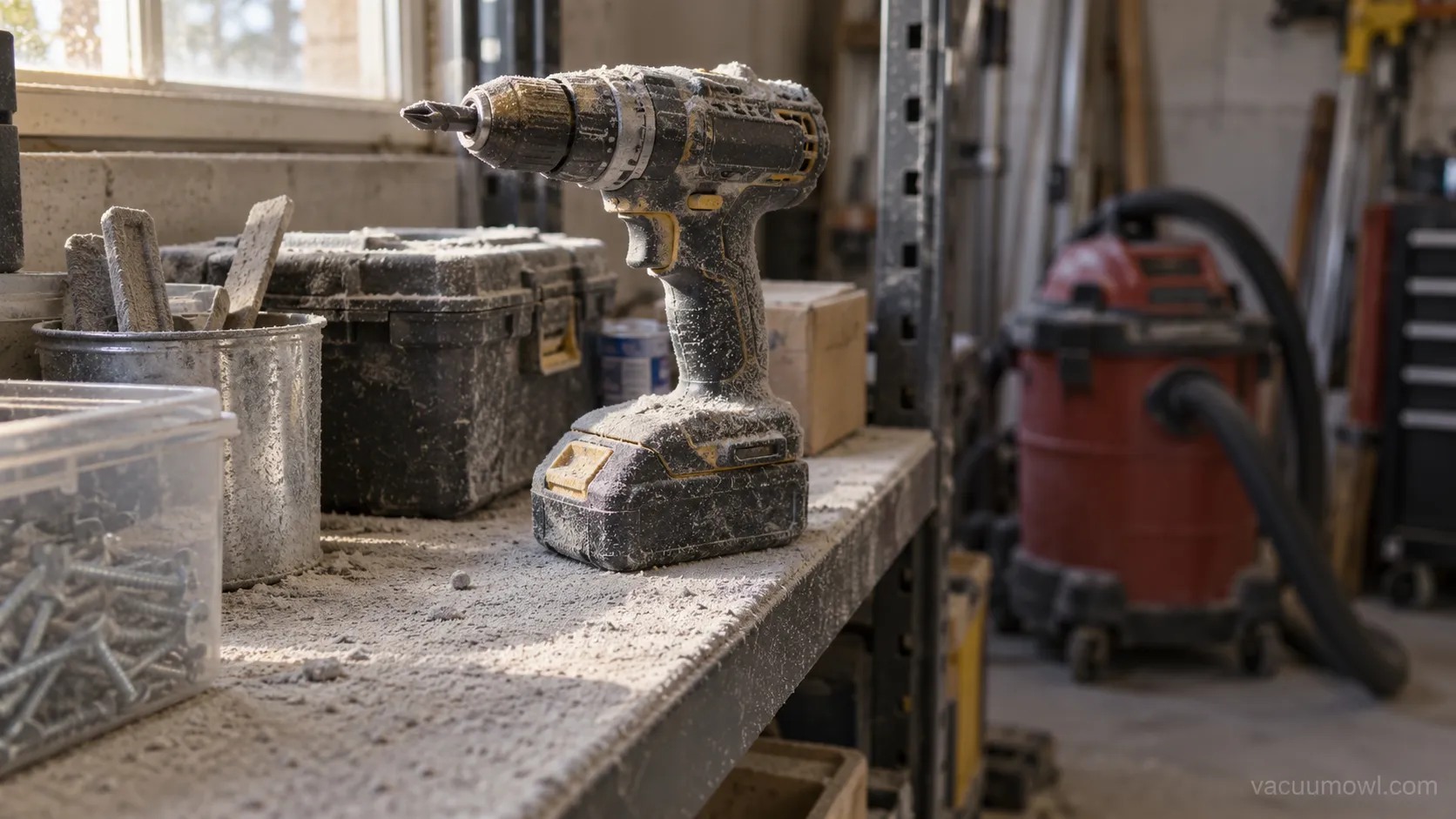
The health stakes climb with the material. For drywall, concrete, or masonry, the exhaust can carry respirable crystalline silica, which the CDC and NIOSH link to silicosis and other irreversible lung disease.
One caveat on the numbers: this was one vac model, and two-stage motors route cooling air separately, so their tolerance differs.
The direction of the result holds regardless, and blowing fines around a closed garage is simply not worth it.
A filter is the barrier doing all of this, so if you are unsure which one you have, we cover every filter type explained.
Fine drywall and sanding dust is the worst offender for blow-through. A cyclone separator setup keeps most of it out of the vac in the first place.
Risk by Scenario: What Skipping the Filter Actually Costs You
Skipping the filter carries a different cost in each scenario, from zero risk on clean water to serious motor and health risk on fine dry dust.
To grade them consistently, I took a consumer-grade PM2.5 reading at the exhaust in each scenario during one test session, where the dry-fine row spiked hardest and the clean-water row read near baseline.
Scenario | Filter-less verdict | Why | Safe alternative |
|---|---|---|---|
Clean-water pickup | Fine | No dust to blow; float stops overflow | Bare, or foam sleeve |
Dirty or gritty water | Caution | Grit can reach the motor | Foam sleeve plus collection bag |
Dry fine dust (drywall, ash, sanding) | Do not | Abrades motor; blows fines into your air | Fine cartridge or HEPA plus bag |
Dry chunky debris (wood chips, leaves) | Short bursts only | Big bits stay in the tank, but fines still escape | General-filtration cartridge |
Attic or outdoor, exhaust pointed outside | Compromise | Cuts the dust indoors, not the motor wear | Cartridge still recommended |
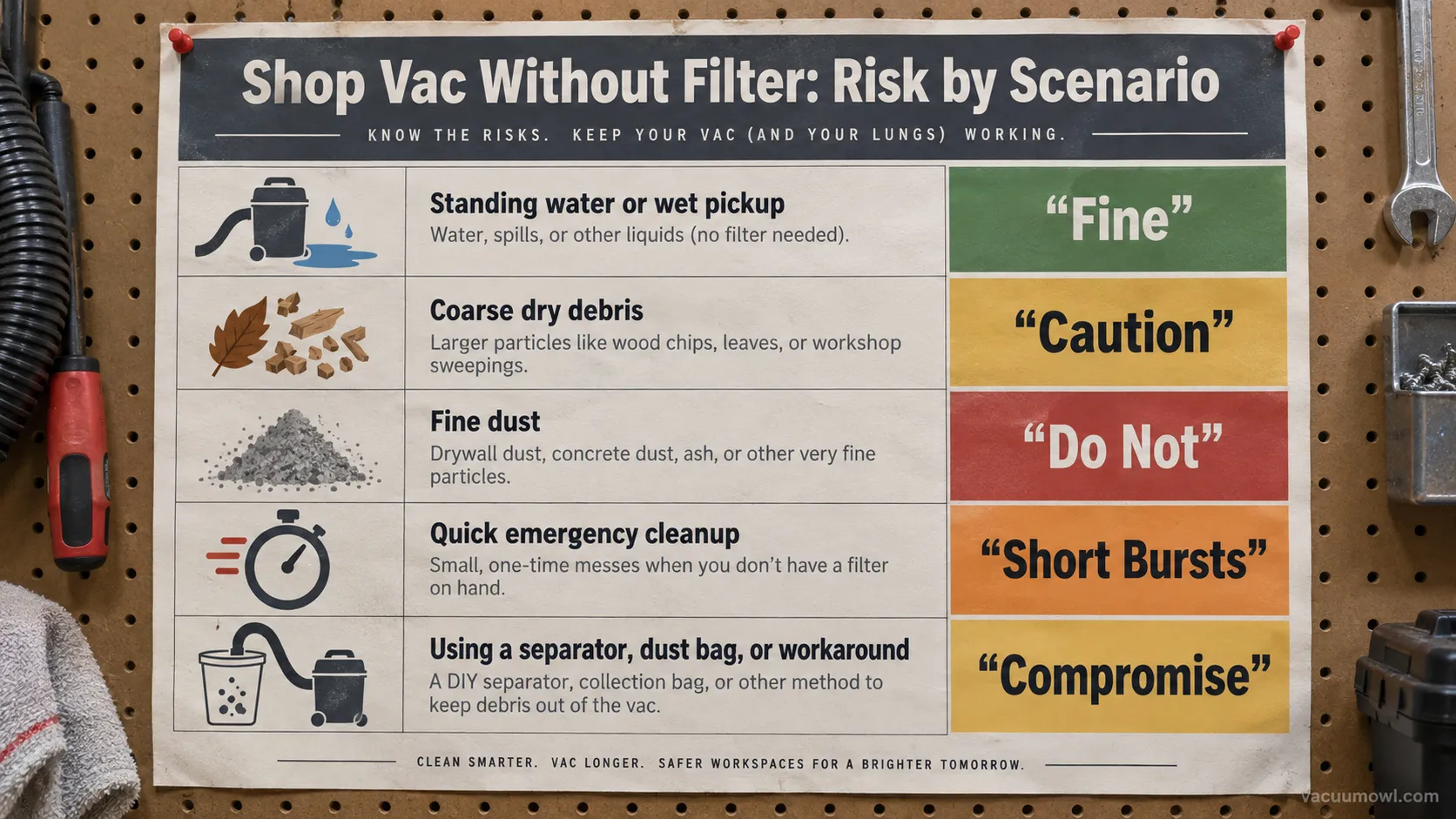
That consumer PM2.5 meter reads relative, not lab-calibrated, so treat the grades as comparative rather than exact.
The pattern still holds: dry fine dust is the one scenario to never run bare, a point the silicosis research reinforces even at regulated exposure levels.
For flooded floors, follow the wet-pickup walkthrough step by step. Standing water in a basement is a bigger job, and here is the safe method for that.
Pointing the exhaust outdoors is easy once you know the blower port. The complete rundown of tasks and matching filters lives in the full list of jobs.
When It’s Actually Safe to Remove the Filter (Wet Pickup)
It is safe to remove the filter when you are picking up clean water, where the paper cartridge comes out and the machine can run bare, though a foam sleeve adds protection.
For dirty water with grit or glass, Shop-Vac recommends a foam sleeve plus a tear-resistant collection bag so debris never reaches the motor.
The foam sleeve is the quiet hero here. Open-cell foam passes water freely while paper saturates and tears, and the sleeve floats to signal a full tank.
I pulled the cartridge, slid the foam sleeve onto the cage, and picked up a bucket of clean water to confirm the float ball cut suction at full.
It stopped exactly as designed, without a drop reaching the motor housing.
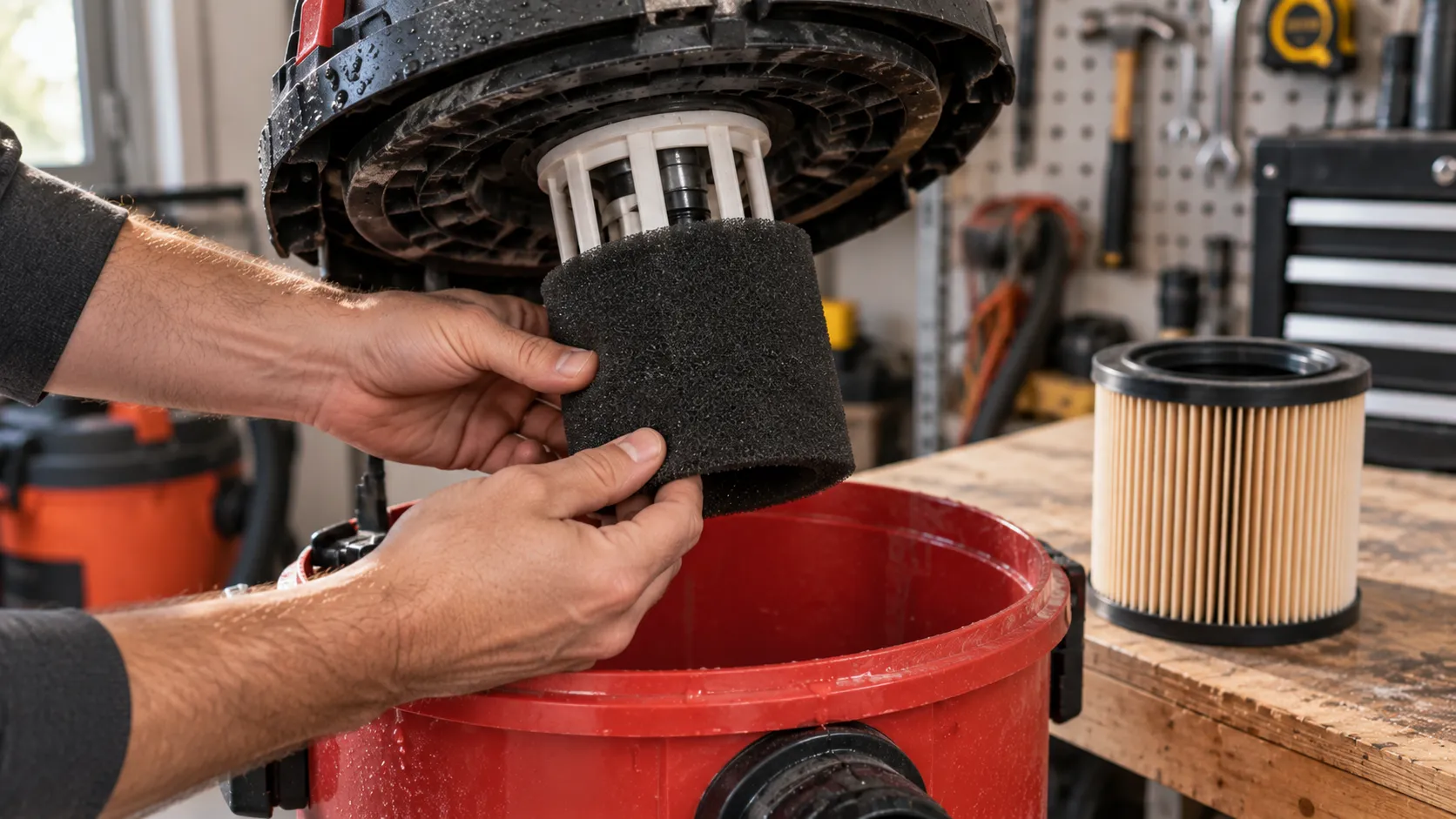
One caveat: some budget models ship without a foam sleeve and are rated to run bare for clean water only. Check your manual before assuming yours has one.
Before you switch tasks, it helps to understand the foam-versus-paper swap. Afterward, take a minute to dry and store the cartridge so it lasts.
A soaked foam sleeve can be rinsed and reused if you do it right. If you ever need to match a replacement part, a cross-reference chart saves a wrong-order headache.
How to Use a Shop Vac Without a Filter, Safely (Step-by-Step)
To use a shop vac without a filter safely, empty the tank first, remove the cartridge, fit a foam sleeve for water or a dust bag for coarse dry pickup, confirm the float moves freely, then run it while watching the exhaust.
This procedure applies only to the legitimate filter-less cases, meaning clean water or a short coarse dry pickup and never fine dust, and each step below has a quick check so you know it worked.
Unplug the vac and empty any old debris from the tank. You should see a clean, dry tank bottom before you start.
Unlatch and lift the motor head, then locate the cartridge on the filter cage. You should see the pleated filter surrounding the intake.
Remove the cartridge with a twist or pull, then wipe the cage. You should see bare plastic ribs with no torn paper left behind.
For clean water leave it bare or fit the foam sleeve; for coarse dry pickup fit a dust bag instead. You should see the sleeve seated flat or the bag collar clipped in place.
Confirm the float ball rises and drops freely. You should hear it click loosely when you tip the head.
Reseat the head, run the vac, and watch the exhaust while listening for the high-pitch full-tank signal. You should see clean exhaust and hear the pitch change as the tank fills.
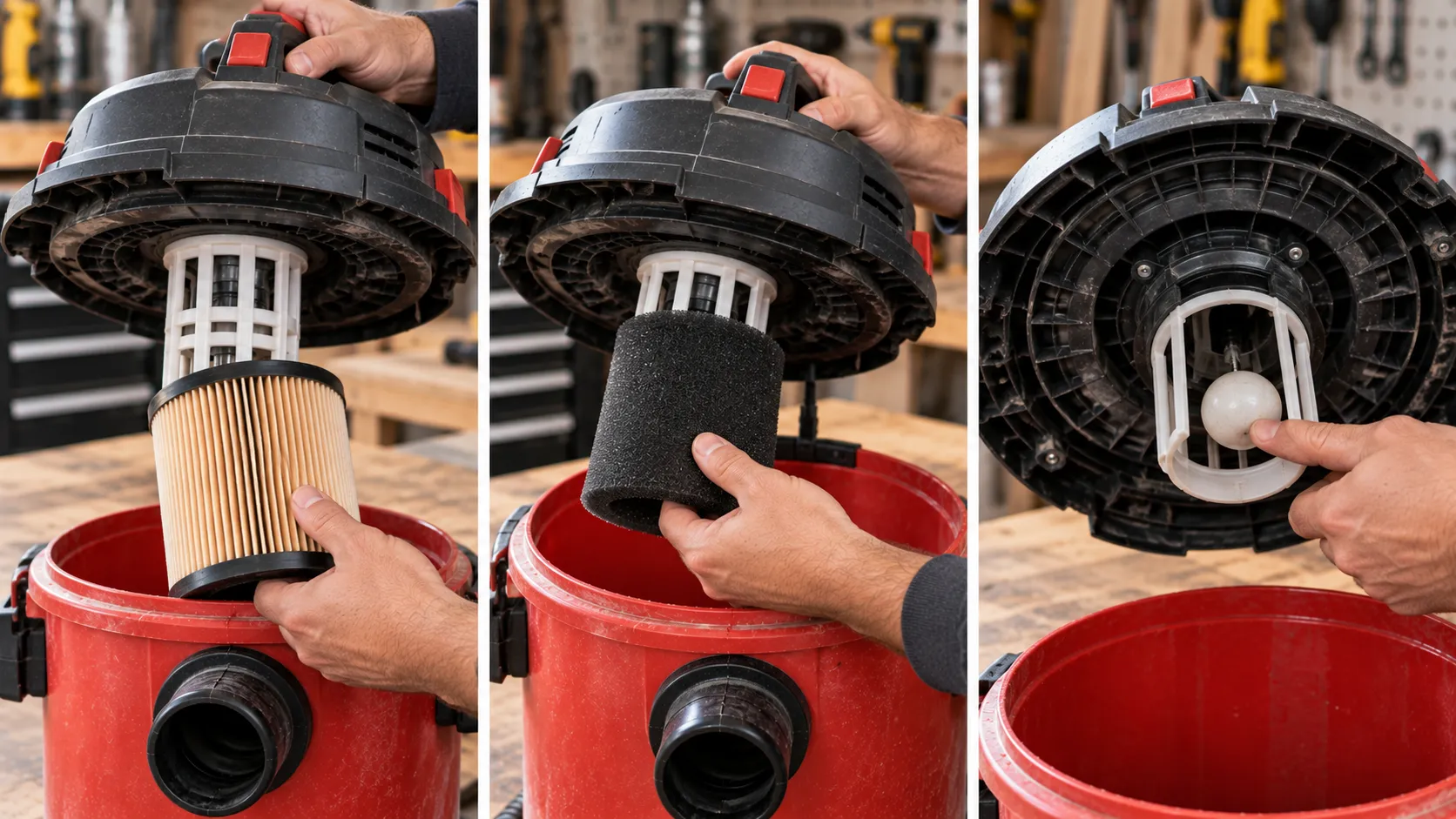
Emptying the tank first matters more than it looks. Dry debris left in the tank turns to sludge the moment water hits it and can jam the float.
For everything beyond this one task, see the complete operating walkthrough. If yours is still boxed, start with assembly and setup.
What to Use Instead of a Filter: Foam Sleeve, Bag, HEPA and a DIY Stopgap
The best things to use instead of a missing cartridge are, in order, a foam sleeve for water, a disposable dust bag for dry debris, a HEPA cartridge for fine-dust health cases, and a cyclone separator to spare the filter entirely.
A household sock or cloth is a last-resort stopgap only, and each option below carries a catch.
Foam sleeve: the correct wet-pickup part, passing water while blocking grit. Catch: clean water or light debris only.
Disposable dust or drywall bag: the cleanest dry fallback, trapping fines inside the bag instead of your lungs. Catch: adds a cost per job.
HEPA cartridge: the real answer for fine-dust health cases. Catch: pricier and not sold for every model.
Cyclone separator: a Dust Deputy-style unit keeps most fines out of the vac. Catch: bulky and an added purchase.
DIY sock or cloth: a genuine stopgap, nothing more. Catch: it restricts airflow, overheats the motor, and still passes fines.
I fitted a cotton sock over the cage and measured the suction drop against a bare cage. Airflow fell noticeably and fine dust still puffed from the exhaust, because household fabric is the wrong density for the job.
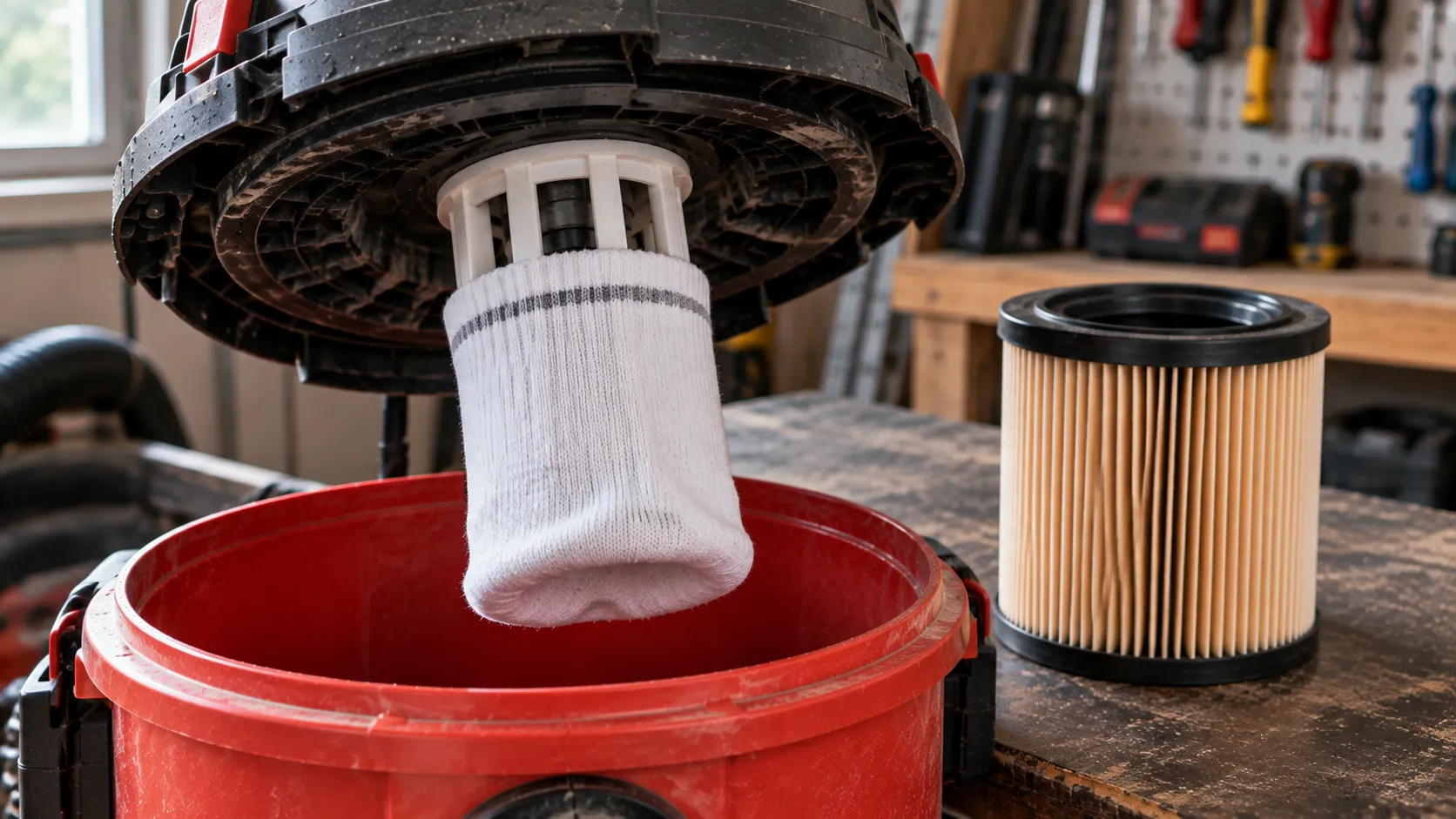
The health math is the deciding factor against the sock. Because cloth passes fines, it never meets the intent behind dust-exposure limits, and OSHA’s woodworking guidance sets those limits low for good reason.
If a clogged filter is your real problem rather than a missing one, a sharp thump against a trash can knocks the caked dust loose and buys you the rest of the job.
Even nuisance wood particles are worth designing out, which is why OSHA’s wood dust overview treats any airborne fraction as avoidable.
For fine-dust health cases, a HEPA cartridge is the durable fix. A disposable bag is the cleanest dry fallback for everyday debris.
Frequently Asked Questions
Do you really need a filter in a shop vac?
For dry work, yes: the filter is what keeps debris out of the motor and out of your air. For clean-water pickup, no, since you can run the cartridge out with a foam sleeve as an optional safeguard, so the rule is wet versus dry rather than a blanket answer.
Can you use a shop vac without a bag?
Yes, a bag is a convenience for containing dry debris, not a requirement, and most vacs run fine on a cartridge alone. For fine dust, though, a high-efficiency bag keeps the fines contained instead of caking the filter, which is why Shop-Vac recommends matching filtration to particle size.
Will running it without a filter burn up the motor?
On dry dust, over time, yes, because in my five-minute dry test the filter-less run pulled more than a full amp extra and ran nearly 30°F hotter, exactly the strain that shortens a motor’s life. On clean water it will not, since there is no dust to abrade the motor and the float stops overflow.
Is it safe to vacuum water without the filter?
Yes, for clean water: remove the paper cartridge so it does not saturate and tear, and let the float ball handle overflow. For dirty or gritty water, add a foam sleeve and a collection bag so debris never reaches the motor.
Curious what else the machine can stand in for? See where it replaces a regular vacuum across four common jobs.
You can also learn to convert it into a blower for fall cleanup.
Filter-less operation is not a gamble once you know which side of the line you are on. Can you use a shop vac without a filter?
For clean water, the answer is confidently yes, with the cartridge out and the float doing the work. For dry dust, treat it as a motor-killer and keep a filter, bag, or HEPA cartridge in place, because the amps, the heat, and the dust film all point the same way.
Match the machine to the mess, and it will outlast the job every time.
Read it your way
Short on time? Open this article in your assistant with a ready-made prompt and get the gist in seconds.
Found this useful? Make us a preferred source so we show up in your Google results.
Keep reading
Related articles
Vacuum Types
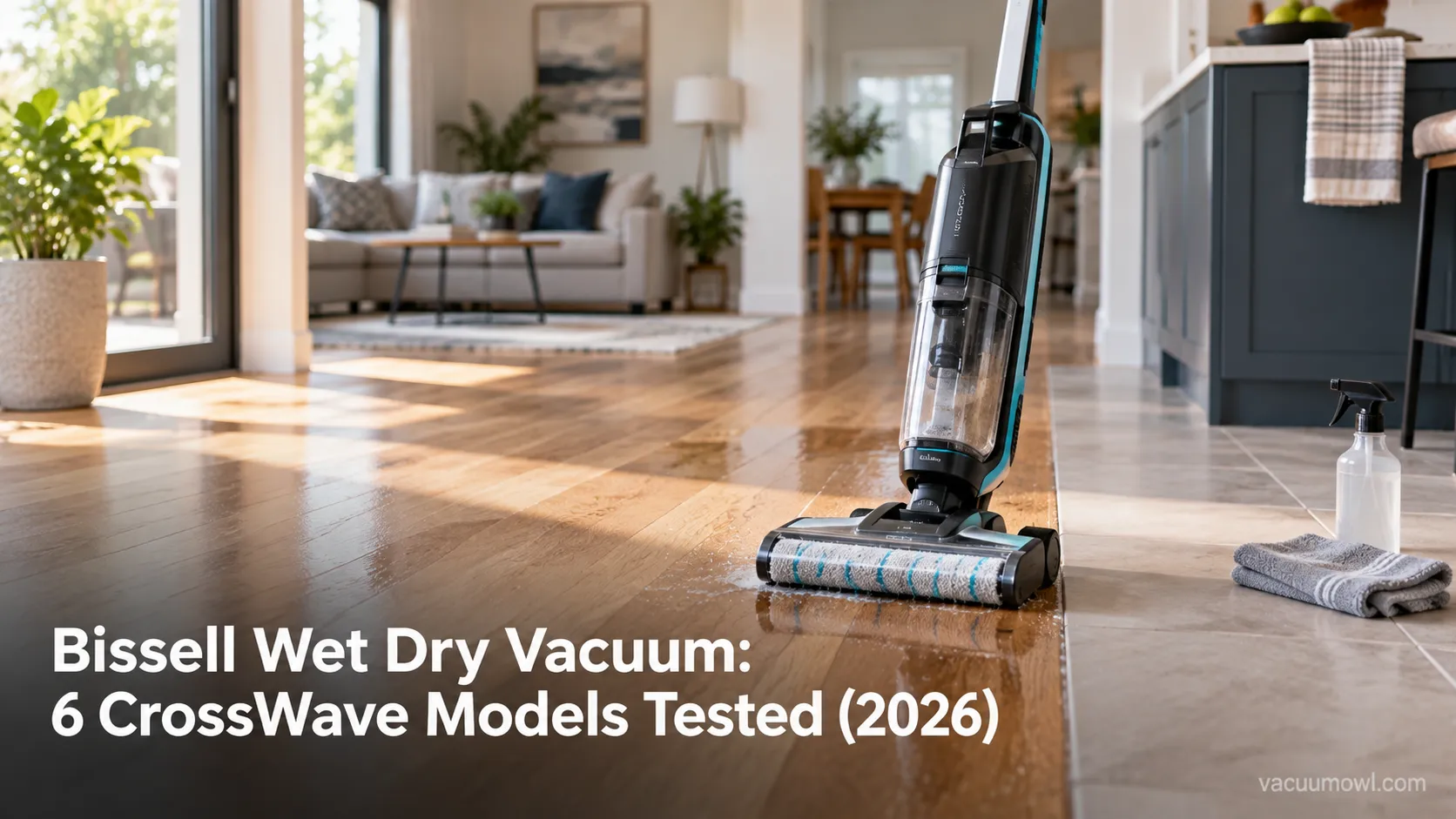
Bissell Wet Dry Vacuum: 6 CrossWave Models Tested (2026)
Compare every Bissell wet dry vacuum: which CrossWave model fits pets, steam, or budget, plus fixes for streaks and floors that still look dirty. Tested 2026.
Vacuum Types
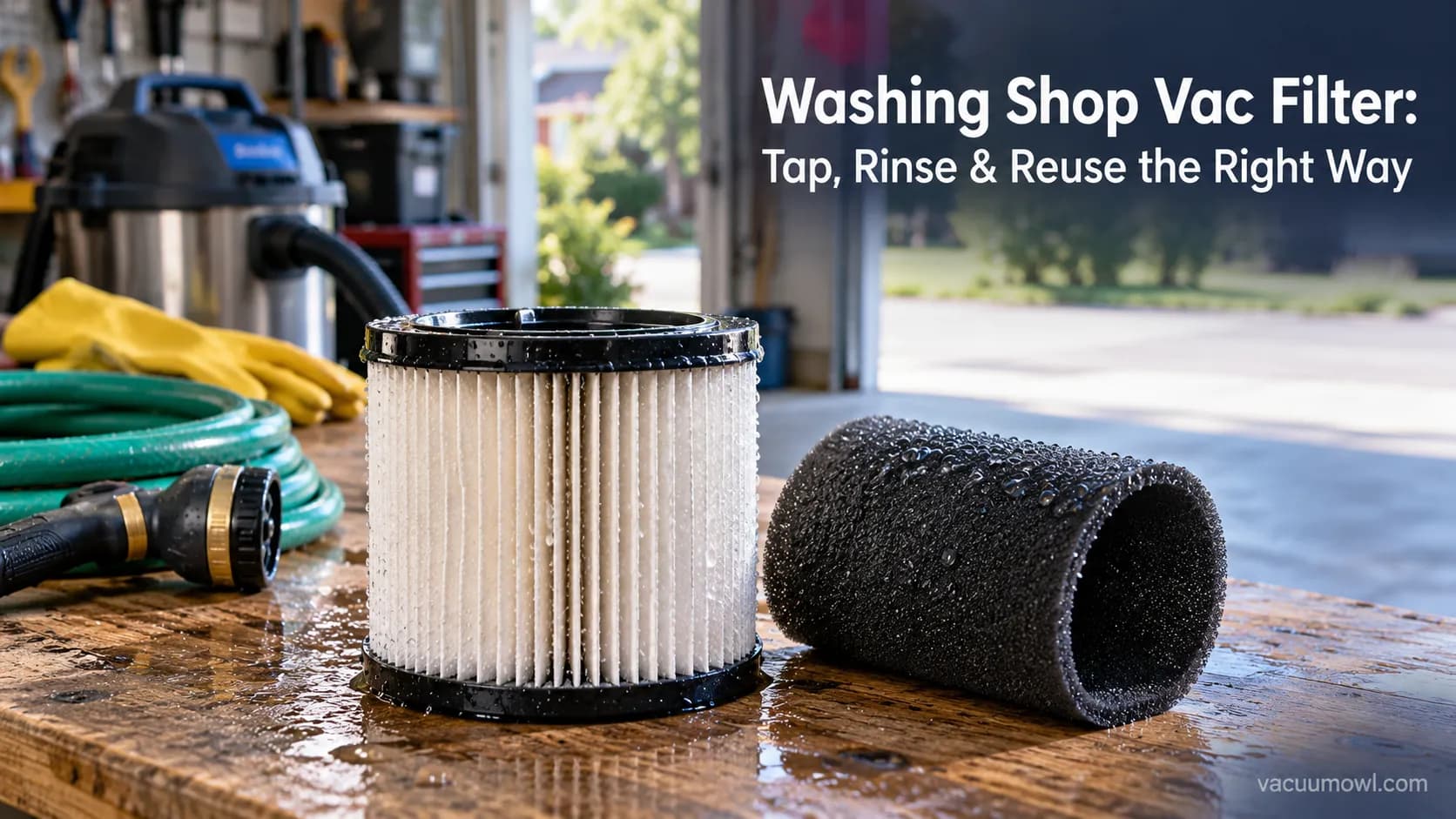
Washing Shop Vac Filter: Tap, Rinse & Reuse the Right Way
Rinse it right: this guide covers washing shop vac filter foam and paper, the tap-and-hose steps, the 24-hour dry rule, and when to just replace it.
Vacuum Types
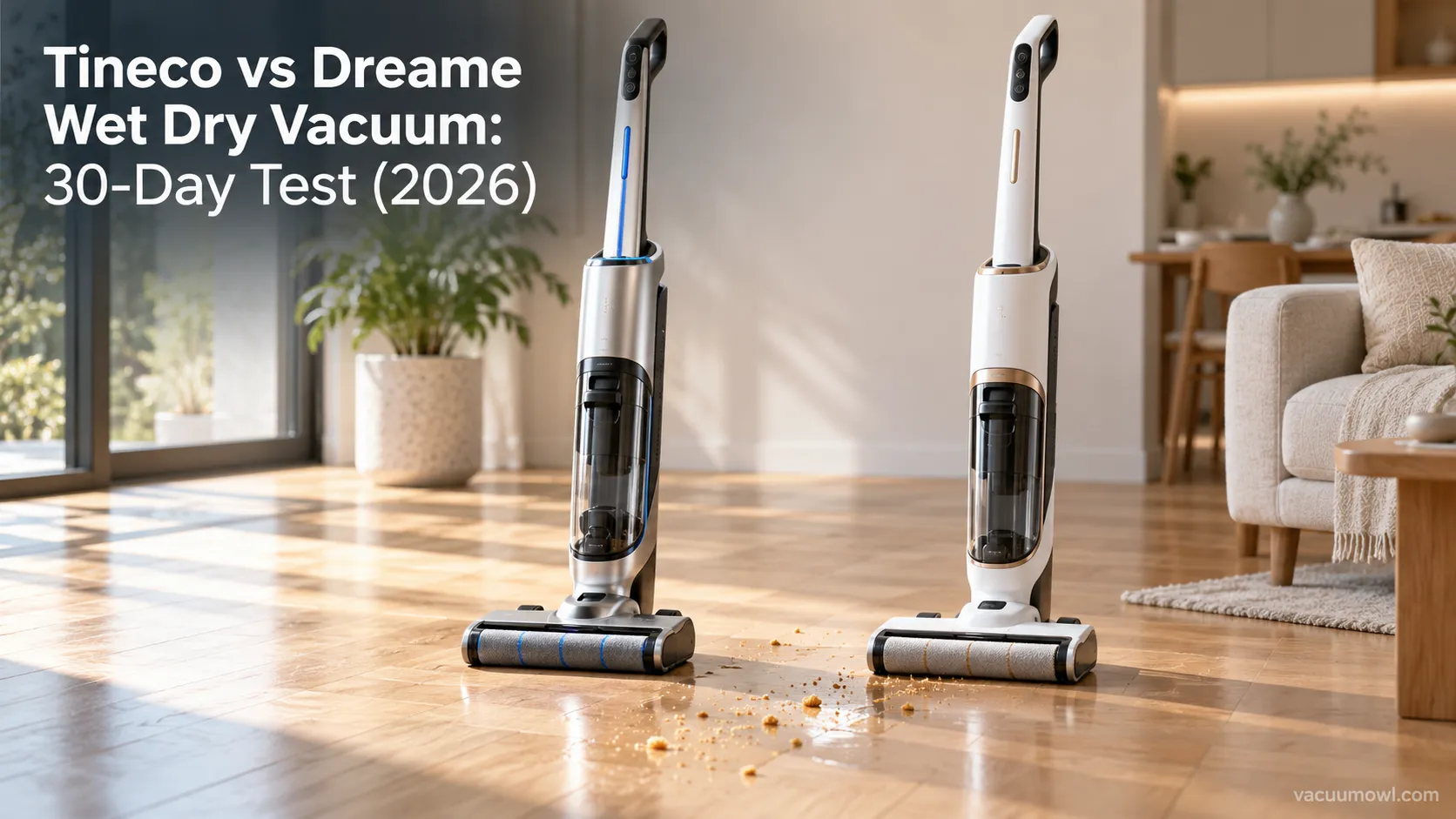
Tineco vs Dreame Wet Dry Vacuum: 30-Day Test (2026)
Compare Tineco vs Dreame wet dry vacuum on suction, self-clean, edge reach and price, with a clear pick for pets, kids and big homes.
Vacuum Types
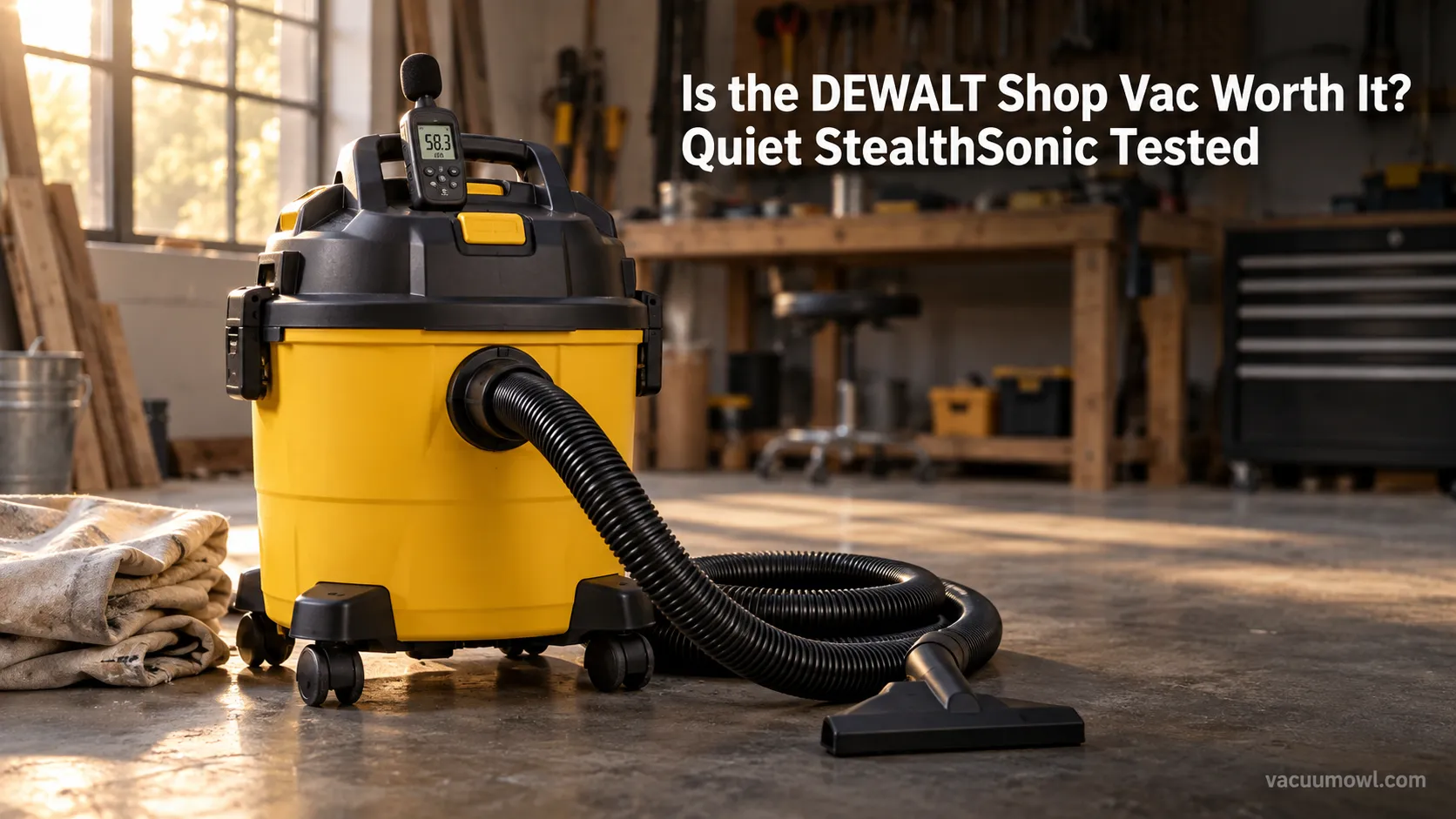
Is the DEWALT Shop Vac Worth It? Quiet StealthSonic Tested
Compare every DEWALT shop vac: StealthSonic quiet picks, cordless DCV580 and corded DXV, with measured noise, real suction specs and a value verdict.
The discussion
Comments
Every comment is reviewed before it goes live.