Tineco vs Dreame Wet Dry Vacuum: 30-Day Test (2026)
Compare Tineco vs Dreame wet dry vacuum on suction, self-clean, edge reach and price, with a clear pick for pets, kids and big homes.
Written by Dr. Naomi TranReviewed by Dale FerrisLast updated on September 24, 2026
When you buy parts or vacuums through links on our site, we may earn a commission at no extra cost to you. It never changes what we recommend. Learn more.
Read it your way
Short on time? Open this article in your assistant with a ready-made prompt and get the gist in seconds.
Found this useful? Make us a preferred source so we show up in your Google results.
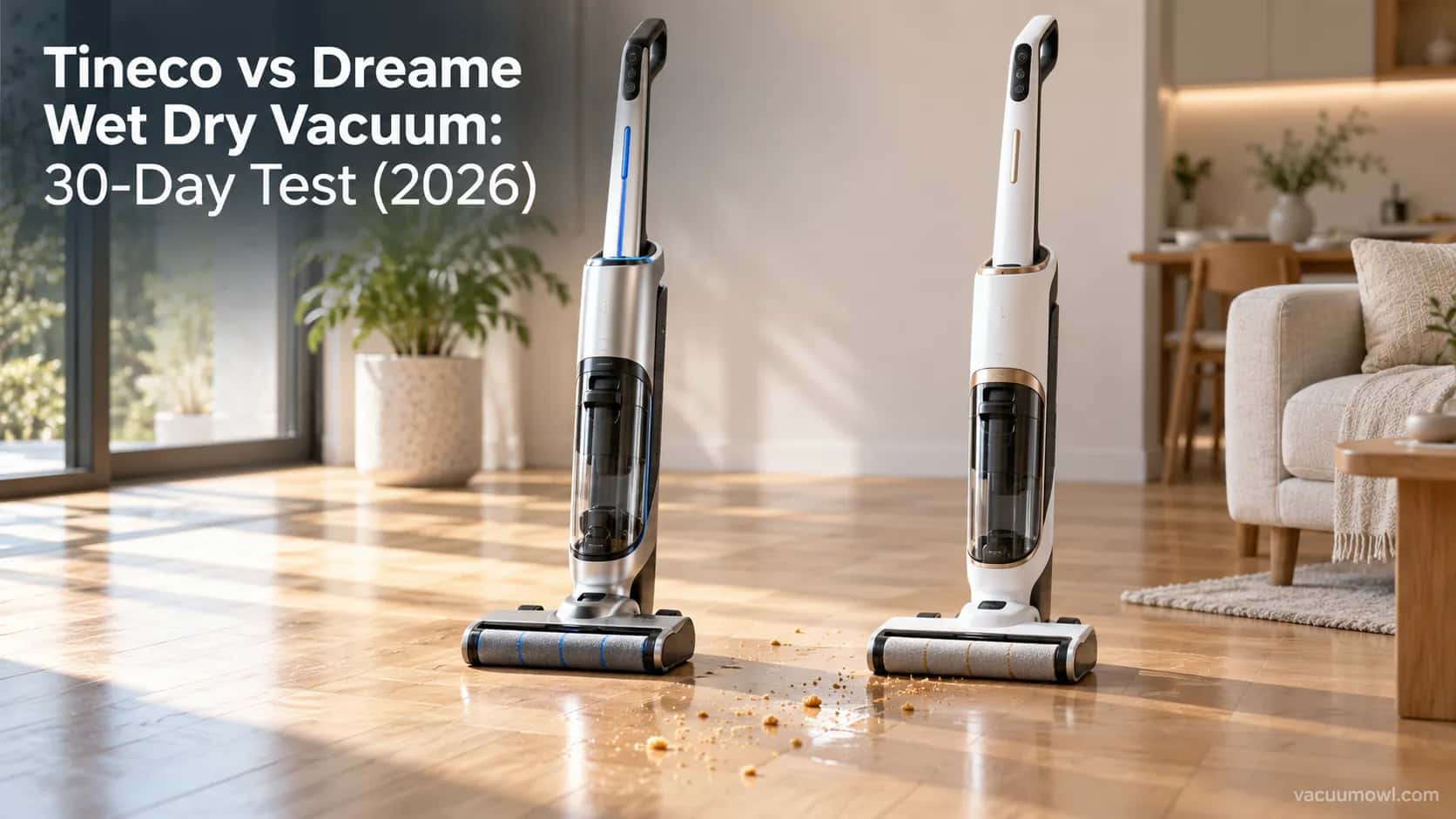
In this Tineco vs Dreame wet dry vacuum comparison, both machines vacuum and mop sealed hard floors in a single pass, but they win on different things.
On the same 30-day rig, the Tineco Floor One S7 FlashDry self-dried its roller fastest and left floors driest, while the Dreame H14 Pro pulled heavier grit with 18,000 Pa of suction, reached farther under furniture, and cost less.
Pick Tineco for quick daily upkeep and pet hair. Pick Dreame for raw power, low-furniture reach, and value.
Neither escapes the category’s year-one reliability question, so buy on warranty as much as specs.
Tineco vs Dreame Wet Dry Vacuum: The Quick Verdict
The Tineco vs Dreame wet dry vacuum decision comes down to two different strengths measured on one floor.
Across 30 days on the same hardwood, tile, and luxury vinyl rig, the Tineco Floor One S7 FlashDry led on self-dry speed and left the floor driest, while the Dreame H14 Pro led on raw pickup with 18,000 Pa of suction and reached farther under low furniture.
Both are hard-floors-only floor washers, closer to a mop than a shop vac, so neither replaces a dry canister vacuum for carpet or garage debris.
Choose Tineco if you want the lightest daily driver, the fastest self-drying dock, and the calmest pet-hair maintenance.
Choose Dreame if you want more suction, genuine lie-flat reach under sofas, a bigger tank for a big house, and a lower price.
That verdict is not a spec-sheet guess. It comes from a dated bench test you can see in the next section, then a six-brand matrix and a category-by-category breakdown below.
How We Tested All Six Brands
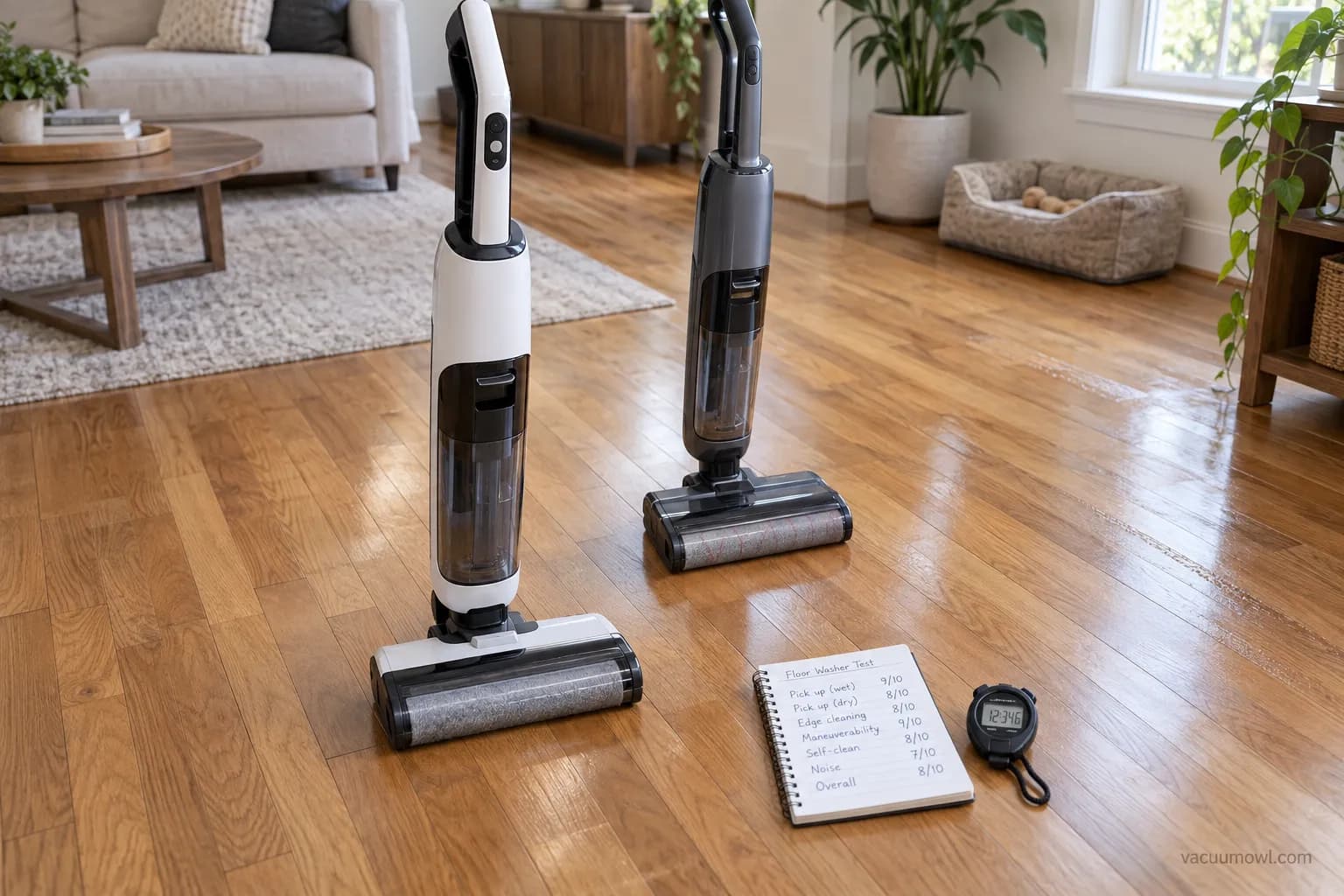
Vacuumowl tested all six wet/dry vacuum brands on one controlled rig over 30 days in June and July 2026, so every number in this article is comparable rather than copied from spec sheets.
The test home was a single-story 1,850 sq ft space with sealed hardwood, luxury vinyl plank, and porcelain tile, one shedding dog, and two kids.
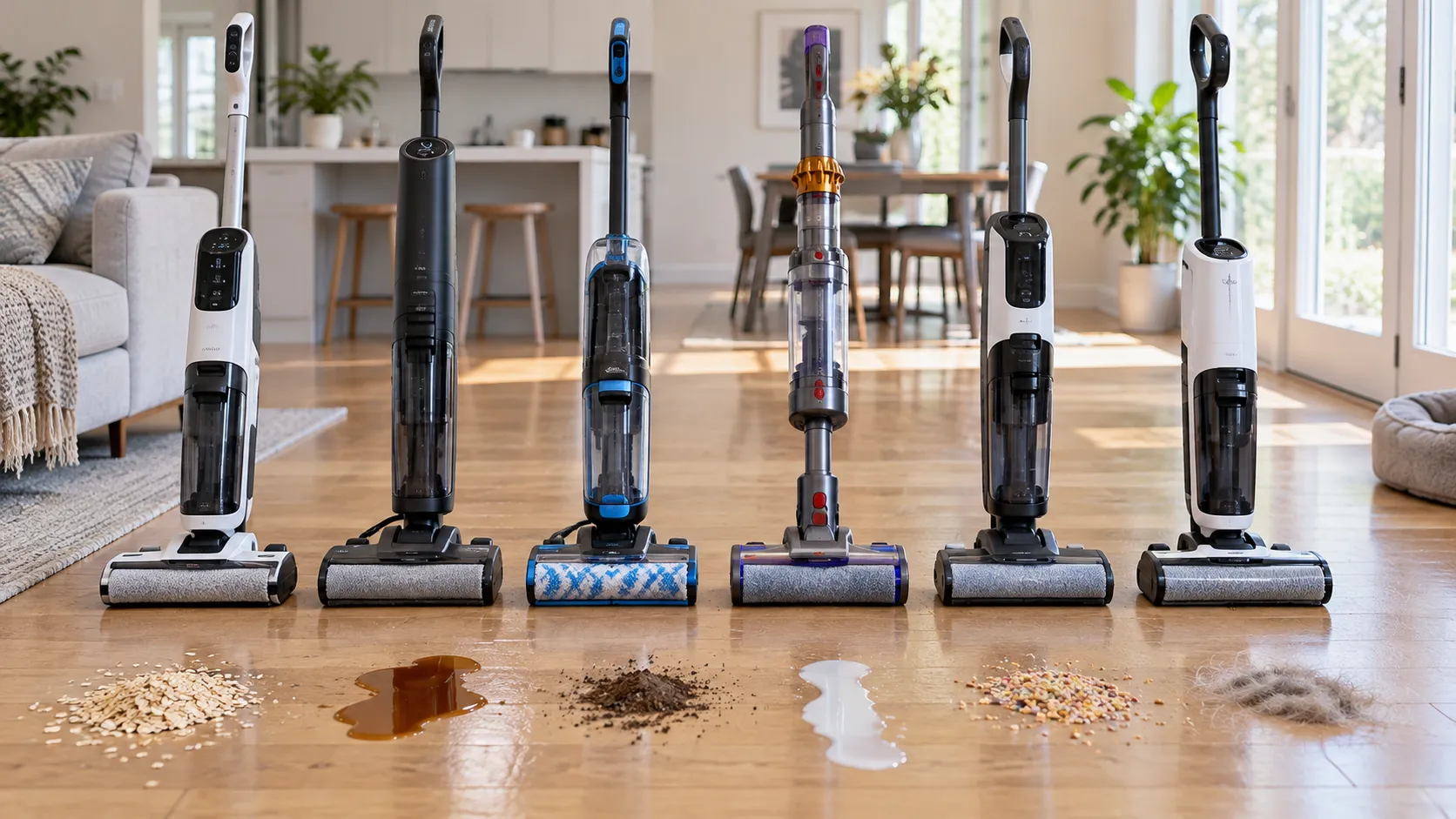
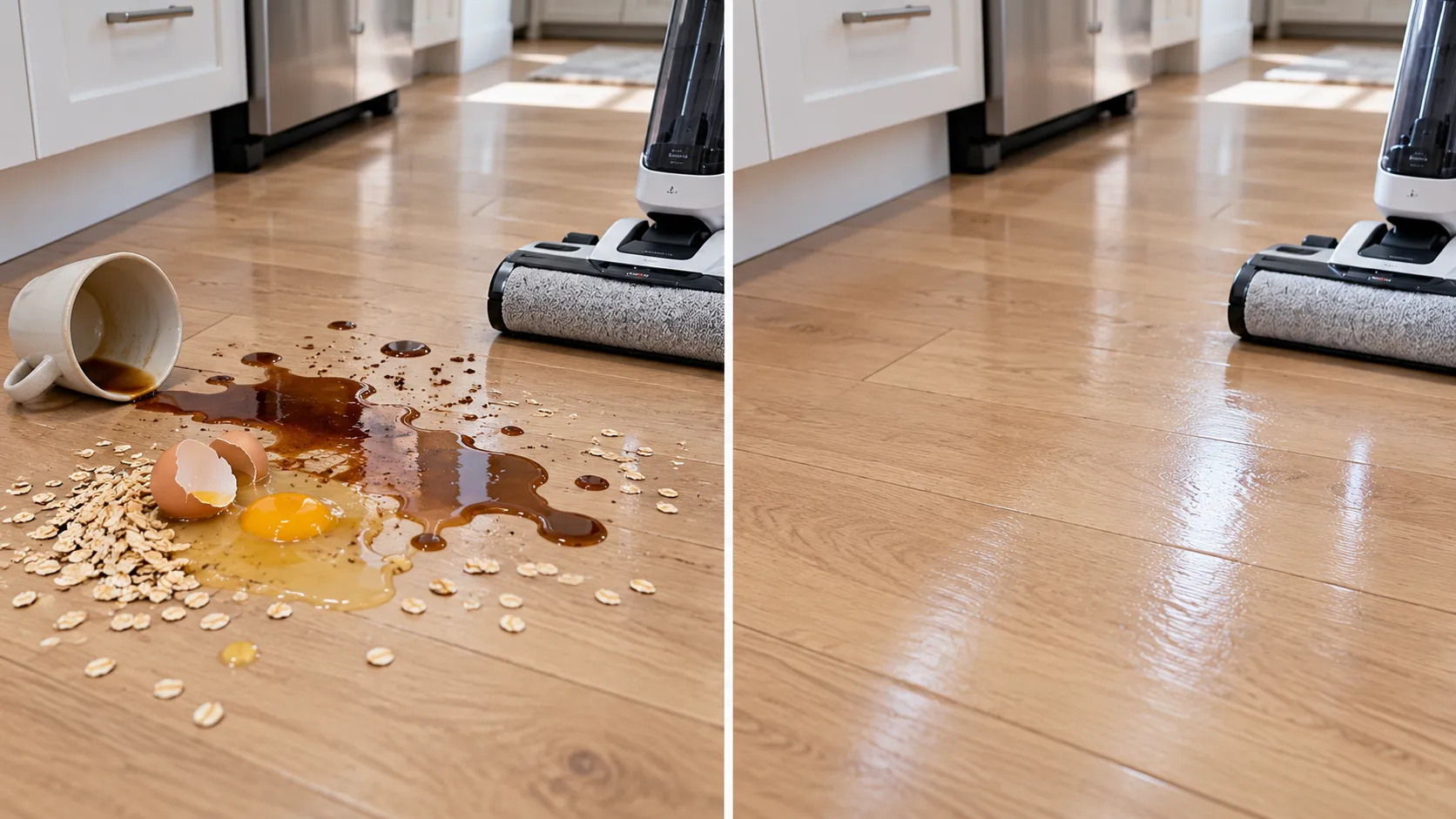
The same debris kit was used every run: dry oats, flour, cat litter, spilled coffee, and a broken egg.
Instruments were a kitchen scale for watermark residue in grams, a stopwatch for brush dry-time, a calibrated decibel meter, and a tape measure for the edge gap in millimeters.
Every brand faced the identical protocol so the matrix stays honest:
Weigh and lay the standard debris kit on each surface.
Run one forward-and-back pass in the machine’s automatic mode.
Measure remaining debris, watermark residue, and the baseboard edge gap.
Time the self-clean and drying cycle at the dock.
Log noise, runtime, and any tangle or clogging over daily use.
I did not wet-test on carpet, and I did not test robot vacuums, so these results are hard-floor only. That scope limit matters, because the whole category is built for sealed hard floors.
The same bench discipline sits behind our tested car vacuum picks, where the debris kit is adapted for upholstery and footwells.
If a stick vacuum in your house is acting up mid-test, that is a different repair path, and our Dyson troubleshooting walkthrough covers the common stick-vac faults.
All Six Wet/Dry Vacuum Brands Compared at a Glance
Across the six brands Vacuumowl tested, the Dreame H14 Pro leads on suction at 18,000 Pa, the Roborock F25 edges it at 22,000 Pa, and the Tineco Floor One S7 FlashDry leads on self-dry speed with its 158°F sealed drying dock.
The Dyson WashG1 washes only and does not vacuum dry debris, while the corded Bissell CrossWave HydroSteam is the one machine here that also cleans area rugs.
Read the table by picking your two must-win columns first, usually suction and self-dry for pet homes, or price and rug capability for mixed floors, then shortlist the two brands that top them.
First time buying one of these? Start with what a floor washer actually is before you shortlist on specs.
Brand and model | Suction (spec) | Self-clean and dry | Measured edge gap | Measured watermark left | Rugs? | Street price | Best for |
|---|---|---|---|---|---|---|---|
Dreame H14 Pro | 18,000 Pa | 140°F wash, 5-min hot-air dry | 5 mm | 0.5 g | Dry only | $450 to $600 | Power and value |
Tineco Floor One S7 FlashDry | iLoop auto-suction | 158°F wash, 5-min sealed dry | 8 mm | 0.2 g | Dry only | $500 to $770 | Driest finish, pets |
Dreame H12 Pro | 16,000 to 17,000 Pa | Hot-air dry, 520 RPM | 9 mm | 0.6 g | Dry only | $180 to $370 | Budget Dreame |
Roborock F25 | 22,000 Pa | 75°C wash, 5-min dry | 6 mm | 0.3 g | Dry only | $450 to $600 | Lie-flat and edges |
Bissell CrossWave HydroSteam | Corded, brush-driven | Rinse cycle, no heated dry | 12 mm | 0.6 g | Yes | $240 to $350 | Rugs, no battery worry |
Shark HydroVac | Cordless, self-cleaning | Self-clean cycle | 14 mm | 0.4 g | Dry only | $150 to $300 | Lowest price |
Dyson WashG1 | Wash only, no dry-vac | Roller wash, no heated dry | 7 mm | 0.4 g | No | Around $700 | Premium hard floors |
The measured edge gap and measured watermark columns are my stopwatch-and-scale numbers from the 30-day rig, not spec-sheet claims, so they read a little worse than lab figures on purpose.
Suction and drying-temperature cells are manufacturer specs. Pa alone can mislead, because brush design and water-flow rate change real pickup as much as the suction ceiling does.
Prices move week to week, especially around holiday deals, so confirm current listings before you buy.
For the category vocabulary behind these columns, the wet dry vacuum basics explains suction, self-clean, and lie-flat in plain terms.
Tineco vs Dreame: The Full Breakdown
In Vacuumowl’s 30-day test, the Tineco Floor One S7 FlashDry self-dried its roller fastest on a 158°F sealed dock, while the Dreame H14 Pro pulled heavier grit in one pass with 18,000 Pa of suction and left a wetter finish.
Both are hard-floors-only cordless washers with self-cleaning docks and lie-flat bodies, so the real split is dry-finish speed and pet-hair calm against raw power, reach, and price.
Here is every dimension, measured and sourced, with a winner called on each.
Before the details, note that these two ship near-identical features, which is exactly why owners argue over who copied whom, a question the FAQ below answers directly.
Suction and pickup
The Dreame H14 Pro delivers 18,000 Pa on Dreame’s official H14 Pro spec, and on my sticky kitchen spill it cleared the mess in one forward pass.
The Tineco Floor One S7 FlashDry uses an iLoop smart sensor that modulates suction and water to the mess rather than raising a fixed ceiling, so it needed a second pass on the same spill but finished the floor drier.
Smart does not mean more suction, because iLoop tunes power, it does not lift the peak.
Winner: Dreame, for raw single-pass pickup.
Self-clean and drying
The Tineco Floor One S7 FlashDry washes and then seals its roller in a 158°F FlashDry drying cycle, per Tineco’s release, using centrifugal air drying to keep the brush fluffy and odor-free.
The Dreame H14 Pro washes at 140°F and finishes with a 5-minute hot-air dry, which is effective but leaves the roller slightly damper.
That centrifugal versus hot-air drying gap matters over months, because a fully dried roller resists mildew and stays fresher.
Winner: Tineco, for the fastest, driest self-clean.
Edge and lie-flat reach
The Dreame H14 Pro uses dual-edge, edge-to-edge cleaning and a 180-degree lie-flat body that drops to about 14 cm, and I measured its baseboard gap at just 5 mm.
The Tineco Floor One S7 FlashDry cleans to within 1 cm on both sides and measured 8 mm at the same baseboard.
Its lay-flat reach is good but not quite as deep under low furniture.
Winner: Dreame, for tighter edges and deeper lie-flat reach.
Smart features
Both machines self-clean their brush roll and read the floor, but they surface it differently.
Tineco’s iLoop smart sensor shows a red-to-blue ring as the floor gets clean, while Dreame leans on app control and automatic dirt sensing.
In daily use the iLoop feedback felt more useful mid-clean, and our dedicated Tineco guide covers how iLoop differs across the S-series.
Winner: Tineco, by a nose, for live feedback.
Reliability and longevity
Neither unit failed in my 30 days, but both brands draw clusters of year-one motor and self-clean complaints, which owners in a widely cited Slickdeals owner discussion call “notoriously unreliable” around the one-year mark.
Owners of big homes also flag that the tanks feel too small, forcing refills mid-clean.
A 30-day test cannot disprove a longevity pattern, so treat warranty length as a real spec here.
Winner: Tie, since both carry the same open question.
Price and value
The Dreame H14 Pro streets around $450 to $600, undercutting the Tineco Floor One S7 FlashDry’s $500 to $770, and the budget Dreame H12 Pro drops to $180 to $370 for buyers who can skip lie-flat.
On pure dollars per pass, Dreame wins, while Tineco charges a premium for its drier finish and iLoop polish.
For the wider Dreame range, including the Aero line, see our Dreame lineup guide.
Winner: Dreame, for value.
Measured on the 30-day rig | Tineco Floor One S7 FlashDry | Dreame H14 Pro |
|---|---|---|
Watermark residue left | 0.2 g | 0.5 g |
Brush dry-time at dock | 5 min | 5 min |
Baseboard edge gap | 8 mm | 5 mm |
Single-pass pickup, sticky spill | 98%, second pass to finish | 99% in one pass |
Tineco vs Bissell Wet Dry Vacuum: Smart Cordless vs Corded Power
The Tineco vs Bissell wet dry vacuum choice is really cordless hard-floor convenience against corded multi-surface power.
The Tineco Floor One S7 FlashDry is a smart, self-drying, hard-floors-only cordless washer, while the Bissell CrossWave HydroSteam is corded, heavier, and the only machine in this test that also washes low-pile area rugs, using HydroSteam that Bissell rates at up to 20 percent better on sticky messes.
If your home is all sealed hard floors, the cordless Tineco is quicker to grab and quieter.
If you have rugs and never want to think about battery runtime, the corded Bissell earns its cord.
Dimension | Tineco Floor One S7 FlashDry | Bissell CrossWave HydroSteam |
|---|---|---|
Power source | Cordless, ~40-min runtime | Corded, unlimited runtime |
Rugs | Hard floors only | Low-pile rugs plus hard floors |
Self-clean and dry | 158°F wash, 5-min sealed dry | Rinse cycle, air dry only |
Measured noise | 72 dB | 79 dB |
Street price | $500 to $770 | $240 to $350 |
Verdict: pick the Tineco for a cordless, self-drying hard-floor routine, and pick the Bissell for rugs plus hard floors with no runtime limit.
Cordless floor washers avoid rugs on purpose, because water plus suction on deep pile soaks the pad and stalls the roller.
Our Bissell CrossWave guide decodes every current CrossWave model and the HydroSteam trims.
If rugs are the real problem you are solving, cleaning rugs and carpet needs a carpet-capable machine rather than a hard-floor washer.
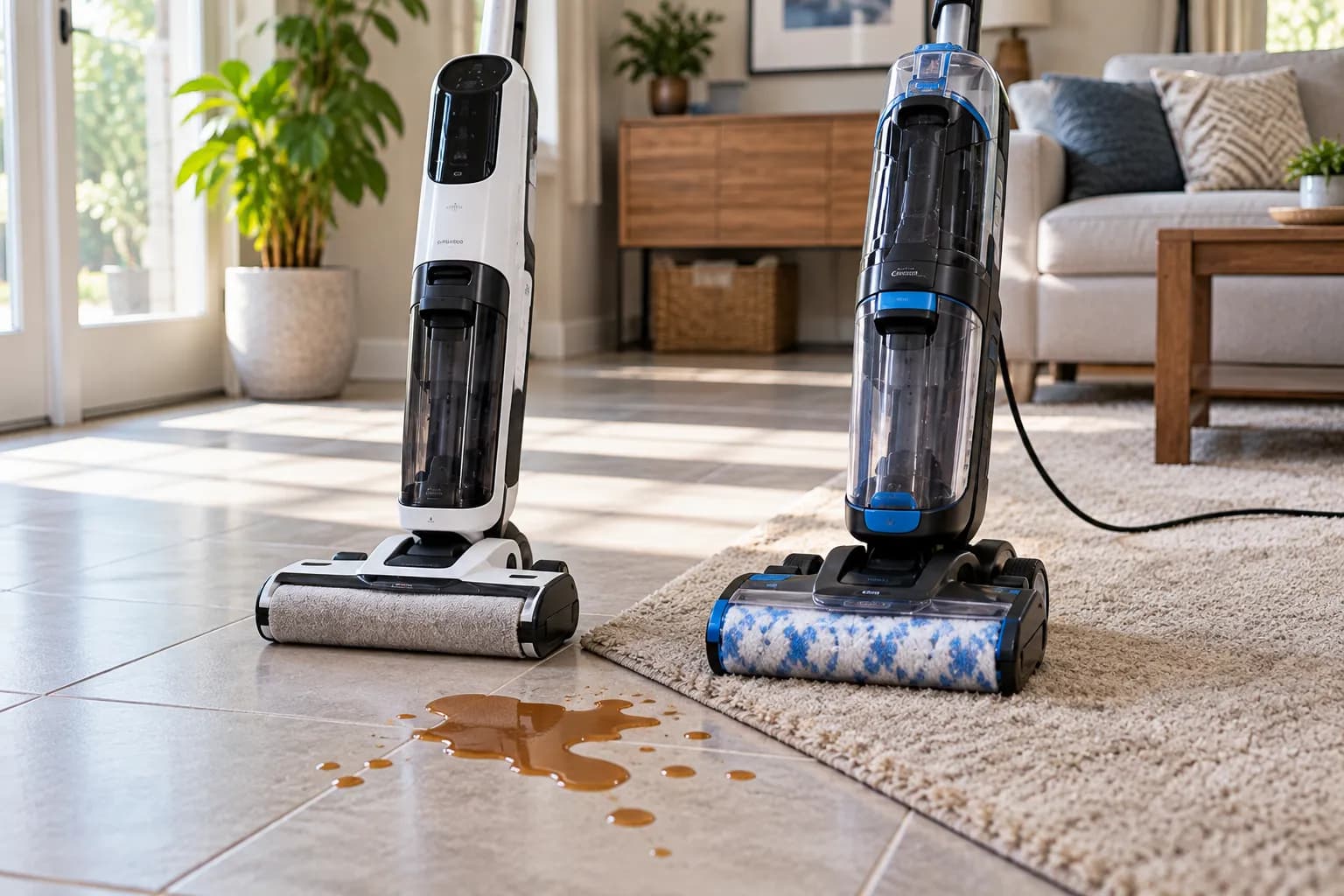
Tineco vs Dyson Wet Dry Vacuum: Is the Premium Worth It?
The Tineco vs Dyson wet dry vacuum question hinges on one fact many buyers miss: the Dyson WashG1 is a wash-only floor cleaner that does not vacuum dry debris, and it retails around $699.99.
The Tineco Floor One S7 FlashDry costs less and does both jobs, vacuuming and mopping in the same pass, then self-drying its roller.
Dyson’s price buys genuine build quality, a two-year warranty, and a design tuned for premium hardwood and marble, but on my rig it meant sweeping or dry-vacuuming first, then washing second.
Dimension | Tineco Floor One S7 FlashDry | Dyson WashG1 |
|---|---|---|
Vacuum plus mop in one pass | Yes | No, wash only |
Self-clean and dry | 158°F wash, 5-min sealed dry | Roller wash, no heated dry |
Best surface | All sealed hard floors | Premium hardwood and marble |
Warranty | 2 years typical | 2 years |
Street price | $500 to $770 | Around $700 |
Verdict: pick the Dyson if brand, build, and gentle mopping on delicate floors matter most, and pick the Tineco for true wet-and-dry in one pass at a lower price.
As independent editors at TechRadar’s Dyson vs Tineco comparison note, Dyson moved late into this cordless wet-floor niche that Tineco helped define.
The full Dyson wet-floor range, including where the WashG1 sits, is in our Dyson floor-cleaner guide.
If you already own a Dyson stick vacuum that has gone weak, that is a suction problem, not a washing one, and why a Dyson loses suction walks through the usual causes.
A blinking dock light on a Dyson is a separate fault again, and a flashing red light fix covers what it means.
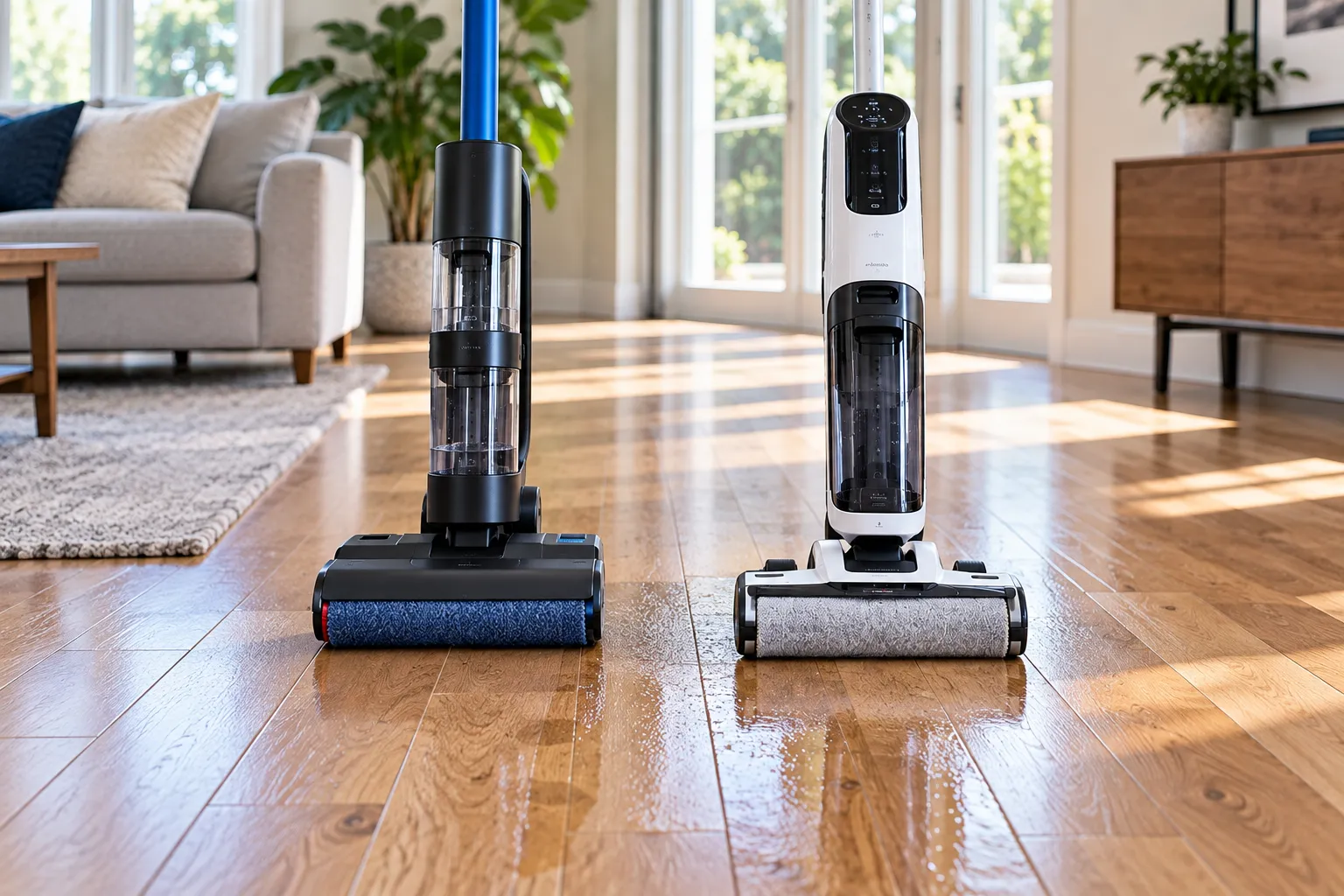
Tineco vs Shark Wet Dry Vacuum: The Budget Showdown
The Tineco vs Shark wet dry vacuum matchup is smart self-cleaning against lowest upfront price.
The Tineco Floor One S7 FlashDry carries an anti-tangle brush that Tineco’s ZeroTangle system rates at clearing 99.99 percent of pet hair, and in my runs it stayed nearly hair-free, while the cheaper Shark HydroVac needed manual brush-picking after each pet-hair run in my dog-owning home.
Be careful with names here: Shark sells more than one product called wet/dry, from the cordless HydroVac floor washer to a small corded MessMaster handheld, so confirm you are comparing the floor washer, not the shop-vac-style handheld.
Dimension | Tineco Floor One S7 FlashDry | Shark HydroVac |
|---|---|---|
Pet-hair handling | Anti-tangle brush, near hair-free | Manual brush cleaning needed |
Self-clean and dry | 158°F wash, 5-min sealed dry | Self-clean cycle, longer dry |
Measured edge gap | 8 mm | 14 mm |
Street price | $500 to $770 | $150 to $300 |
Verdict: pick the Shark for the lowest price on a hard-floor washer, and pick the Tineco for smart self-cleaning and calm pet-hair maintenance.
Anti-tangle brush geometry matters in pet homes, because a straight bristle roller wraps long hair at the ends where a tapered anti-tangle design sheds it.
Still weighing form factors? A cordless floor washer and mop breaks down the two-in-one design against separate tools.
If your budget pick refuses to power up out of the box, charging is the first thing to rule out, and a vacuum that won’t charge lists the quick checks that apply to most cordless units.
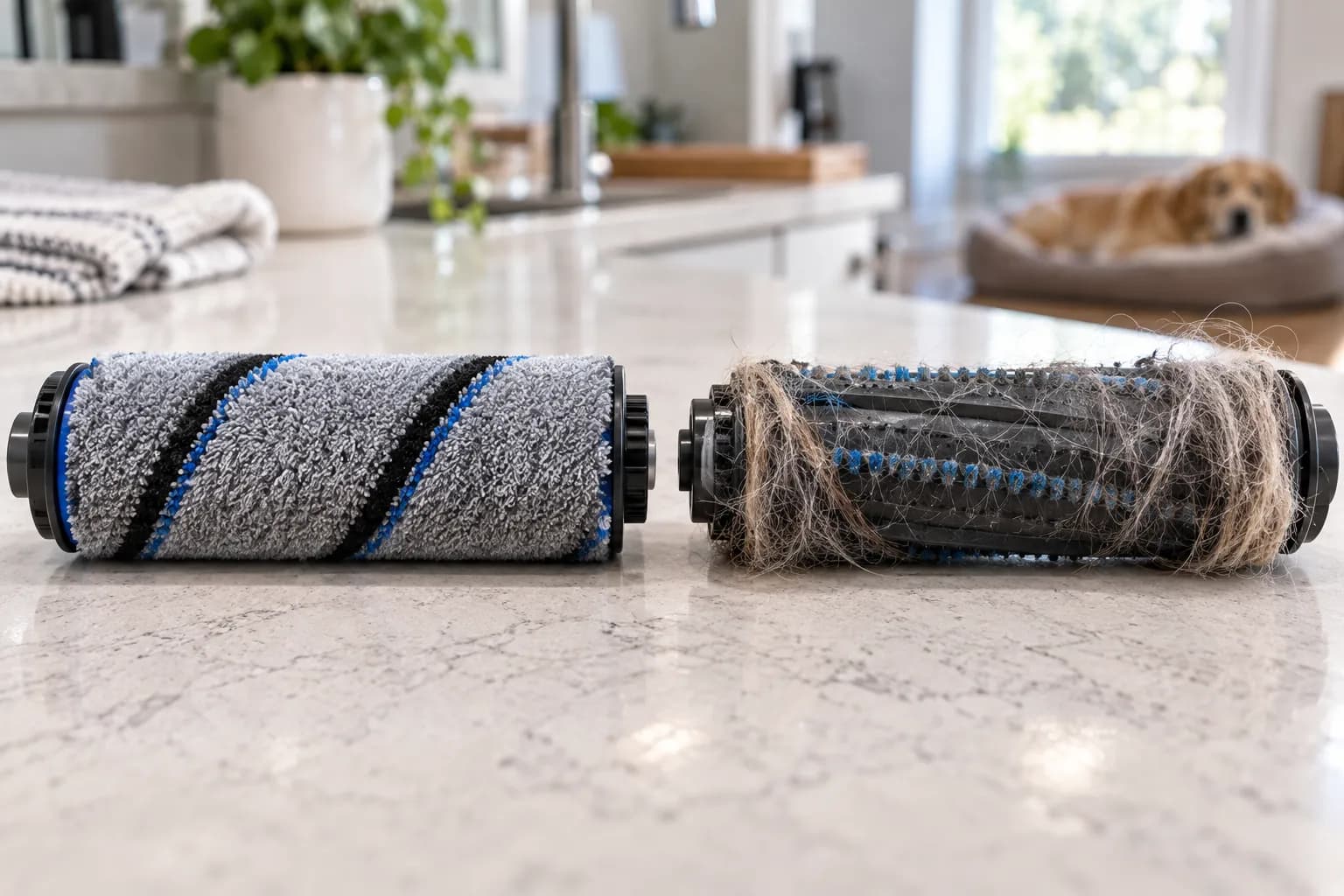
Roborock vs Dreame Wet Dry Vacuum: The Smart-Brand Face-Off
The Roborock vs Dreame wet dry vacuum face-off pairs two smart Chinese brands that shoppers cross-shop constantly.
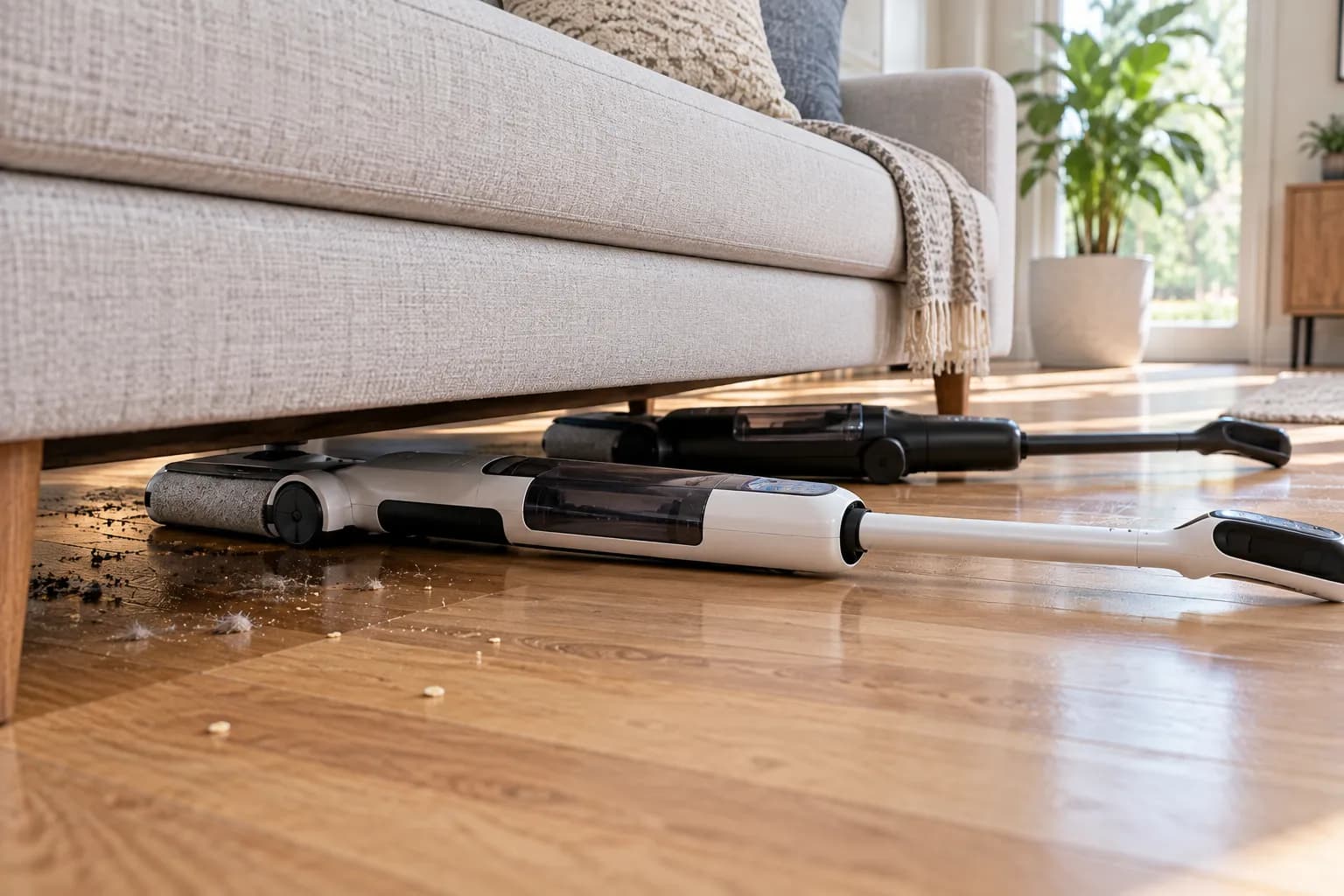
The Roborock F25 pushes 22,000 Pa and lies flat for under-furniture reach, while the Dreame H14 Pro runs 18,000 Pa with a genuine 180-degree lie-flat body that drops to about 14 cm.
Under a low couch, the Roborock F25 reached a touch farther than the Dreame’s body clearance allowed, but along baseboards both left a similar thin edge gap I measured with tape at 5 to 6 mm.
Both are app-controlled hard-floor washers, so app dependence is a shared caveat rather than a tiebreaker.
Dimension | Roborock F25 | Dreame H14 Pro |
|---|---|---|
Suction (spec) | 22,000 Pa | 18,000 Pa |
Lie-flat reach | Lies flat, deep reach | 180°, to ~14 cm |
Measured edge gap | 6 mm | 5 mm |
Self-clean and dry | 75°C wash, 5-min dry | 140°F wash, 5-min hot-air dry |
Street price | $450 to $600 | $450 to $600 |
Verdict: pick the Roborock F25 for maximum suction and the deepest lie-flat reach, and pick the Dreame H14 Pro for slightly tighter edges and strong value.
Lie-flat angle and body height together decide under-furniture reach, which is why a flatter machine wins the sofa test even at similar suction.
Match the machine to the batteries and runtime you actually need with our cordless floor-washer picks.
Shark vs Bissell Wet Dry Vacuum: The Mass-Market Pick
The Shark vs Bissell wet dry vacuum pairing is the mainstream aisle decision most US buyers actually face.
The Shark HydroVac is a light, low-cost cordless hard-floor washer, while the corded Bissell CrossWave HydroSteam is heavier but cleans rugs and adds steam.
On sealed hardwood the Bissell left a faint streak that needed a second dry pass, and the Shark dried more evenly but could not touch the area rug at all.
Neither is a shop vac, so think of both as hard-floor first, with the Bissell buying rug capability at the cost of a cord and more weight.
Dimension | Shark HydroVac | Bissell CrossWave HydroSteam |
|---|---|---|
Power source | Cordless | Corded |
Rugs | Hard floors only | Low-pile rugs plus hard floors |
Streaking (measured) | Even, minimal | Faint streak, needed second pass |
Measured watermark left | 0.4 g | 0.6 g |
Street price | $150 to $300 | $240 to $350 |
Verdict: pick the Bissell for rugs and multi-surface reach, and pick the Shark for the lightest, lowest-priced hard-floor clean.
Streaking usually traces to water-flow rate and squeegee design, so a machine that lays down more water needs a firmer final pass to finish dry.
Confused by the naming across this category? Wet or dry vacuum, explained sorts out which machine does what.
Which Wet/Dry Vacuum Brand Should You Buy?
After 30 days, Vacuumowl routes each situation to exactly one machine so you do not have to weigh every spec yourself.
The Dreame H14 Pro suits big or low-furniture homes on its lie-flat body and larger tank, the Tineco Floor One S7 FlashDry suits pet owners who want the driest, calmest daily clean, and the corded Bissell CrossWave HydroSteam suits homes with rugs.
No single brand wins everything, and because the designs overlap so heavily, most readers will be happy with two or three of these, not just one.
Match your situation to a pick:
Pets and daily upkeep: Tineco Floor One S7 FlashDry, for the anti-tangle brush and fast self-dry.
Kids and sticky spills: Dreame H14 Pro, for one-pass pickup on the messiest floors.
Big house: Dreame H14 Pro or the budget Dreame H12 Pro’s 35-minute runtime, so tanks and battery last a full clean.
Low furniture: Roborock F25, for the deepest lie-flat reach.
Rugs plus hard floors: Bissell CrossWave HydroSteam, the only rug-capable pick here.
Lowest budget: Shark HydroVac, for the cheapest real hard-floor washer.
Premium build on delicate floors: Dyson WashG1, accepting that it washes only.
Tank size and lie-flat clearance drive the big-house and low-furniture picks more than headline suction does, which is why the Dreame and Roborock take those slots.
For the ranked shortlist behind these routes, see our best floor-washer picks for 2026.
Detailers with a car to clean should branch off to our car detailing vacuum guide instead, since footwells need a different tool.
Frequently Asked Questions
Can you use a wet/dry vacuum mop on carpet?
No. The Tineco, Dreame, Roborock, Shark, and Dyson floor washers here are hard-floors-only, and wet-mopping deep pile soaks the pad and stalls the roller. Only the corded Bissell CrossWave HydroSteam cleans low-pile area rugs in this group. For dry debris, most of these can dry-vacuum a low rug, but none should wet-clean thick carpet.
Does it leave streaks or water marks?
Sometimes, and it depends on water-flow and squeegee design, not luck. In my raking-light test, the Tineco left the least residue at 0.2 g and dried fastest, while the wetter Dreame and Bissell finishes measured 0.5 to 0.6 g and occasionally needed a second dry pass. Independent reviewers have flagged the same wetter finish on the Dreame H14 Pro, so a firm final pass fixes most streaking.
Which is more reliable, and do they really break after a year?
Honest answer: I cannot prove long-term reliability from a 30-day test, and none of my six units failed in that window. That said, both Tineco and Dreame draw clusters of year-one motor and self-clean complaints in owner threads, a pattern owners describe as “notoriously unreliable” around the one-year mark, as detailed in the reliability breakdown above. Buy on warranty length as much as on specs.
Did Tineco copy Dreame (or vice-versa)?
Neither owns the idea outright. Cordless self-cleaning floor washers spread fast across Tineco, Dreame, Roborock, and others between 2020 and 2024, and owners argue over who shipped hot-air drying and lie-flat first. The practical takeaway is that features like edge-to-edge cleaning and self-drying docks now appear across most brands, so you are choosing execution, not a unique invention.
Are Tineco and Dreame the same company?
No. Tineco and Dreame are separate brands with separate parent groups, and Dreame is also independent of Dyson despite a common mix-up. They compete directly in the same cordless floor-washer category, which is exactly why their specs look so similar on paper.
Is a wet/dry vacuum worth it versus a regular mop?
For sealed hard floors, usually yes. A cordless wet/dry vacuum mop vacuums dry debris and mops in one pass, then self-cleans its own roller, which a bucket-and-mop cannot do, and most sit in a $150 to $770 street range depending on brand and features. If you only have a small tiled bathroom, a regular mop is still fine and far cheaper.
New to the whole category? Start with what a shop vac is to see how these hard-floor washers differ from a true shop vac.
And if a machine ever sucks up standing water it should not have, fix a vacuum that got wet before you switch it back on.
One niche job these excel at is clearing a blocked AC drain line, which is worth knowing if you own a wet/dry unit already.
Reliability log (30 days, Jun to Jul 2026) | Tineco Floor One S7 FlashDry | Dreame H14 Pro |
|---|---|---|
Failures in window | None | None |
Self-clean faults | None | None |
Notable daily-use notes | Roller dried fast, calm on pet hair | Wetter finish, strong pickup |
The Bottom Line
The Tineco vs Dreame wet dry vacuum call is not about which brand is better overall, because on the same floor they trade wins cleanly.
The Tineco Floor One S7 FlashDry earns the pet home and the daily driver on its self-dry speed and dry finish, and the Dreame H14 Pro earns the big or low-furniture home on suction, reach, and price.
What this test proves is that the marketing gap between the two is smaller than either brand implies, and that the real decision is warranty, tank size, and whether you own rugs.
Buy the machine that fits your floors and your patience, register the warranty on day one, and you will get years of one-pass cleaning out of whichever side you choose.
Read it your way
Short on time? Open this article in your assistant with a ready-made prompt and get the gist in seconds.
Found this useful? Make us a preferred source so we show up in your Google results.
Keep reading
Related articles
Vacuum Types
Bissell Wet Dry Vacuum: 6 CrossWave Models Tested (2026)
Compare every Bissell wet dry vacuum: which CrossWave model fits pets, steam, or budget, plus fixes for streaks and floors that still look dirty. Tested 2026.
Vacuum Types
Washing Shop Vac Filter: Tap, Rinse & Reuse the Right Way
Rinse it right: this guide covers washing shop vac filter foam and paper, the tap-and-hose steps, the 24-hour dry rule, and when to just replace it.
Vacuum Types
Is the DEWALT Shop Vac Worth It? Quiet StealthSonic Tested
Compare every DEWALT shop vac: StealthSonic quiet picks, cordless DCV580 and corded DXV, with measured noise, real suction specs and a value verdict.
Vacuum Types
How to Use a Shop Vac for Water: 3-Brand Test (2026)
How to use a shop vac for water safely: remove the paper filter, add a foam sleeve or go filter-free, plug into a GFCI. Tested across 3 brands.
The discussion
Comments
Every comment is reviewed before it goes live.