Fried Motor? Shop Vac Wet Filter: Foam vs Paper
Use a shop vac wet filter (foam sleeve) for water, never paper. Get the 30-second dry-to-wet swap, the float-valve check, and what fries your motor.
Written by Dr. Naomi TranReviewed by Dale FerrisLast updated on September 24, 2026
When you buy parts or vacuums through links on our site, we may earn a commission at no extra cost to you. It never changes what we recommend. Learn more.
Read it your way
Short on time? Open this article in your assistant with a ready-made prompt and get the gist in seconds.
Found this useful? Make us a preferred source so we show up in your Google results.
For wet pickup, a shop vac needs a foam sleeve fitted over the bare filter cage, never the paper cartridge, which clogs and can burn out the motor.
Clean water often needs no filter at all, because the float valve, not the filter, guards the motor.
For debris-heavy water, add a foam sleeve plus a tear-resistant bag. Shop-Vac and RIDGID both specify foam for wet pickup only.
Shop Vac Wet Filter: The 30-Second Answer
Grab the wrong filter for a flooded basement and you can choke the motor in under a minute.
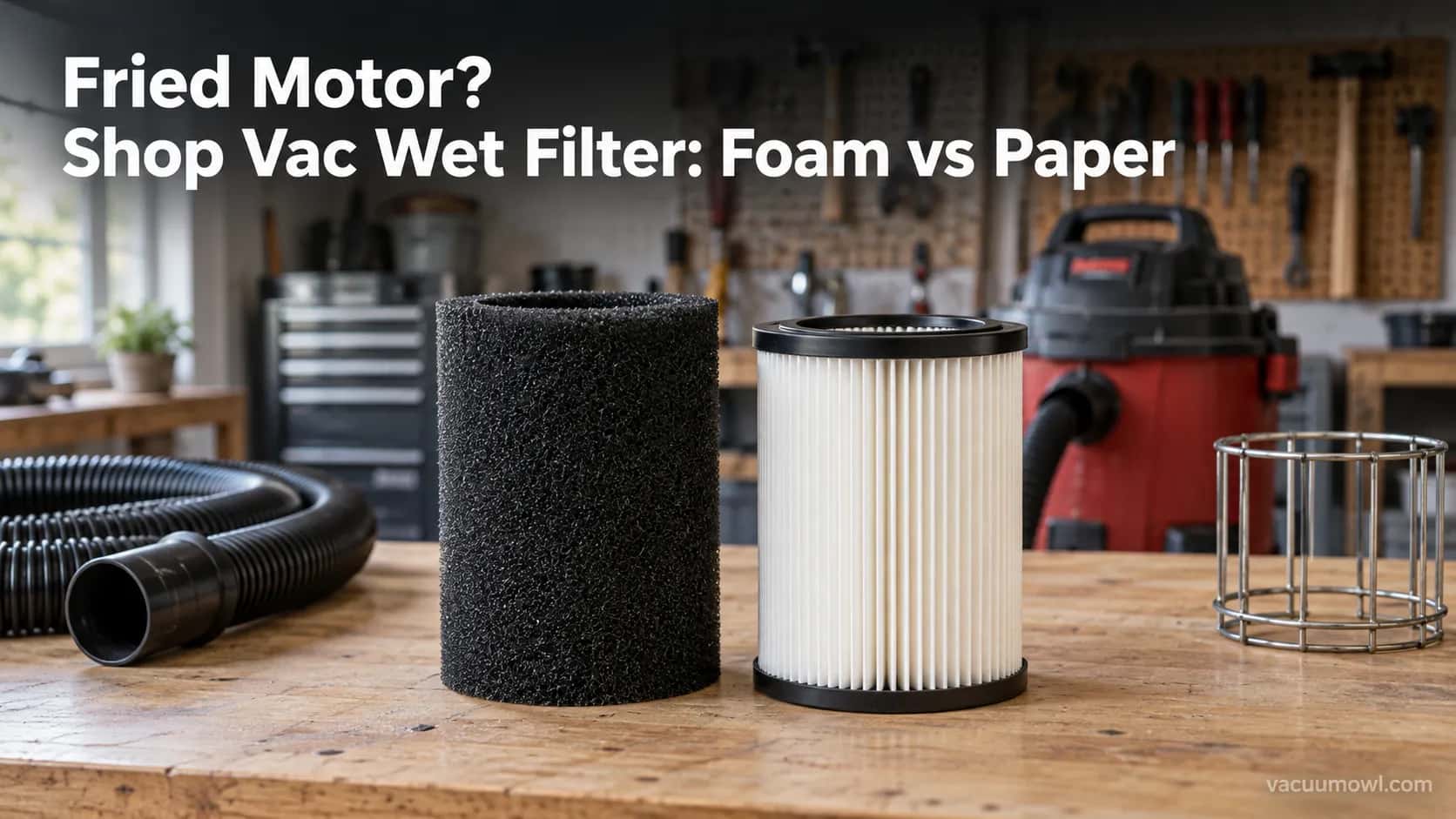
A shop vac wet filter is simply a foam sleeve that slides over the filter cage for liquid pickup, while the pleated paper cartridge stays in only for dry work.
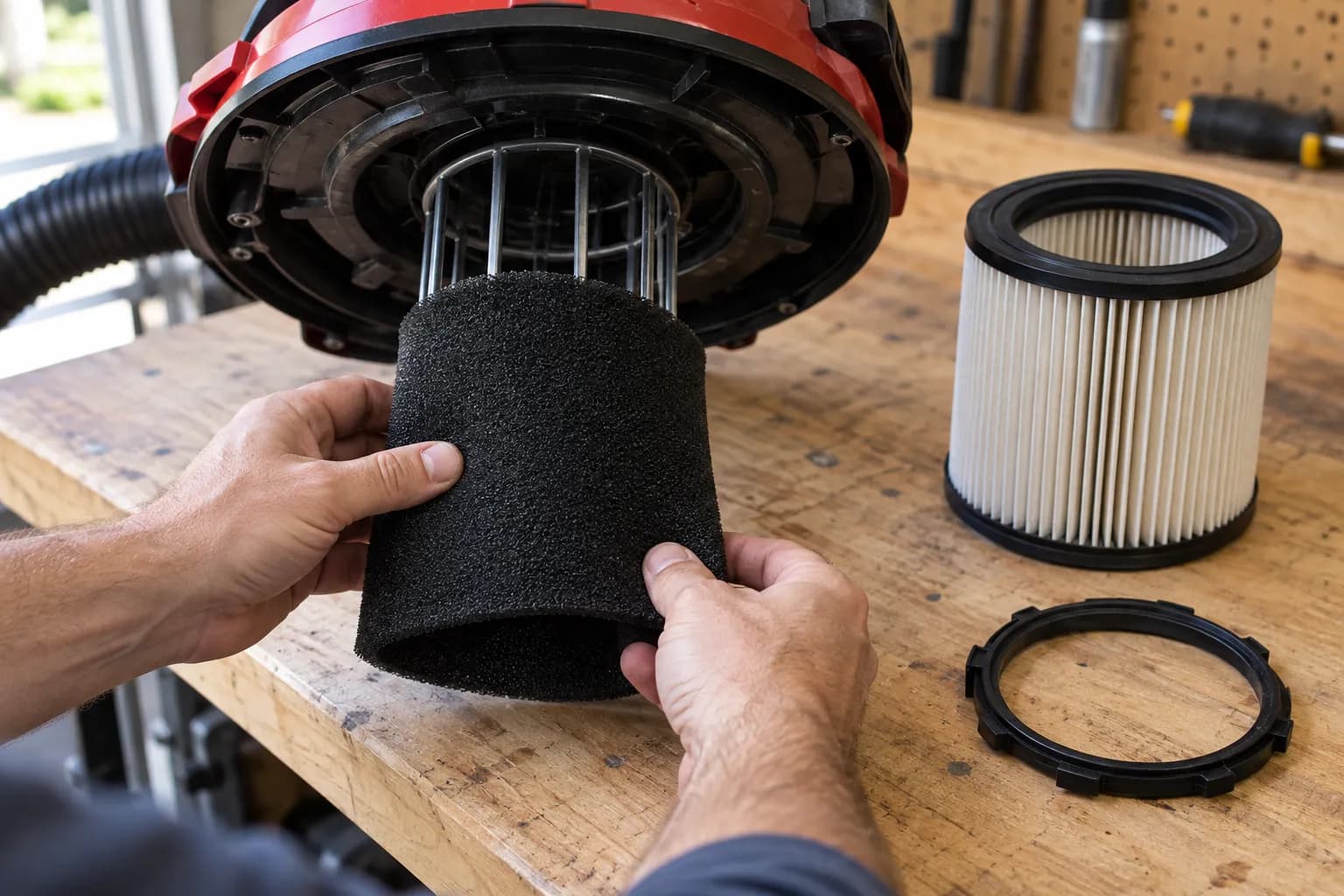
For water, take out the paper cartridge and slide the foam sleeve over the bare filter cage.
For clean water, many models need no filter at all, since the float valve protects the motor on its own.
Never run the paper cartridge on water. Shop-Vac’s guidance names the foam sleeve as the filter for wet pickup.
Get this wrong and the repair is a $60 to $200 motor, not a $12 filter. The rest of this guide shows the swap, the two mistakes that fry motors, and the one case where you can skip the filter entirely.
Foam Sleeve vs Paper Cartridge: What Each Is For
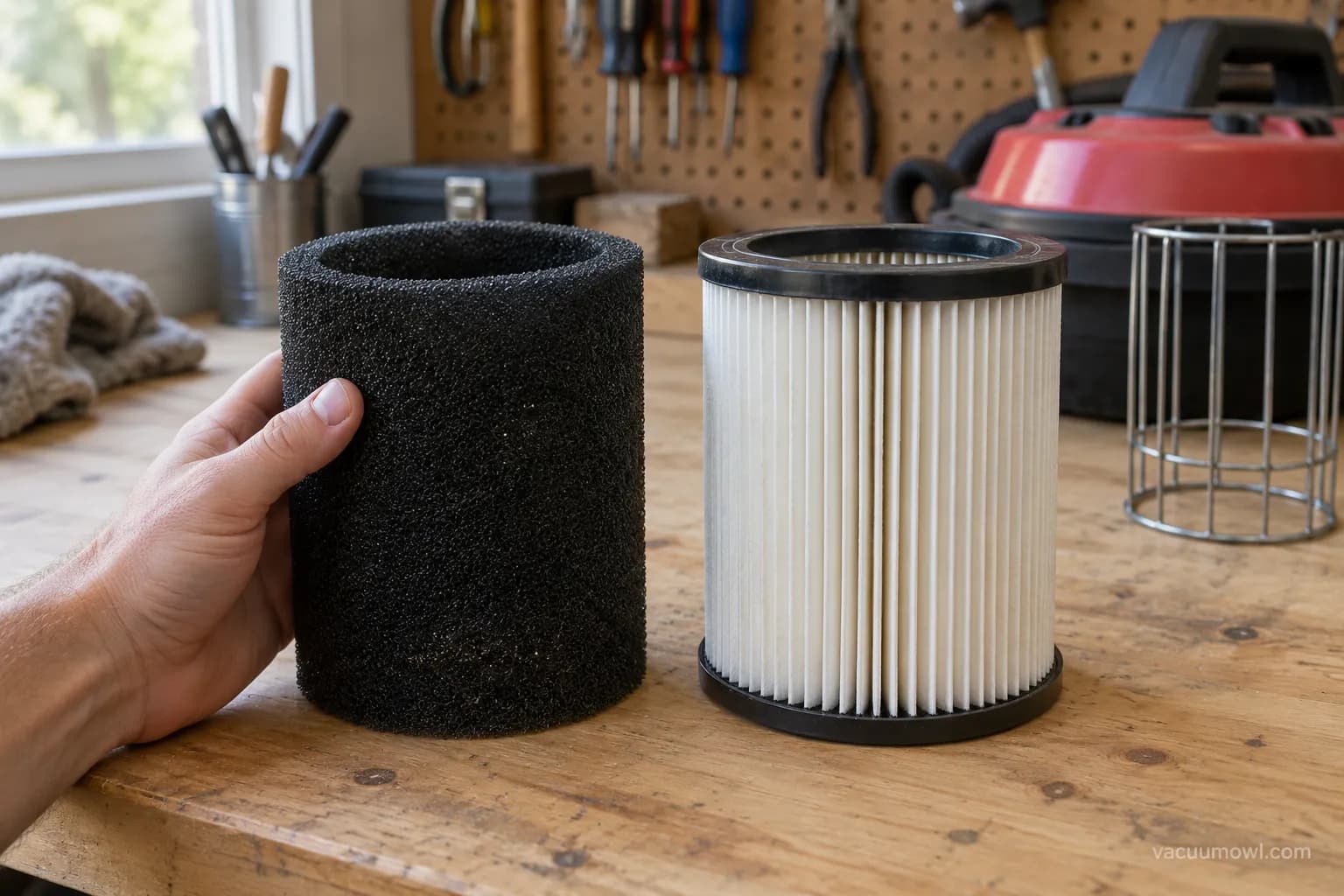
A foam sleeve and a paper cartridge do opposite jobs.
The foam sleeve is open-cell, so water passes straight through while grit stays out, while the pleated paper cartridge traps fine dry dust but collapses the moment it gets wet.
Shop-Vac’s filter guide sorts its filters by the debris you are picking up, and foam is the one built for liquids. Here is the whole menu on one screen.
Filter type | Best for | Wet or dry | What ruins it | Washable? |
|---|---|---|---|---|
Foam sleeve | Dirty or flood water | Wet only | Running it on fine dry dust; storing it damp | Yes, rinse and air-dry |
Pleated paper cartridge | General dry debris | Dry only | Any water, it clogs and collapses | No, tap out or replace |
Fine-dust or HEPA cartridge | Drywall dust, allergens | Dry only | Water; heavy chips tear it | Some, check your model |
Collection bag with foam | Debris-heavy water | Wet or dry | Sharp stones without a tear-resistant bag | No, disposable |
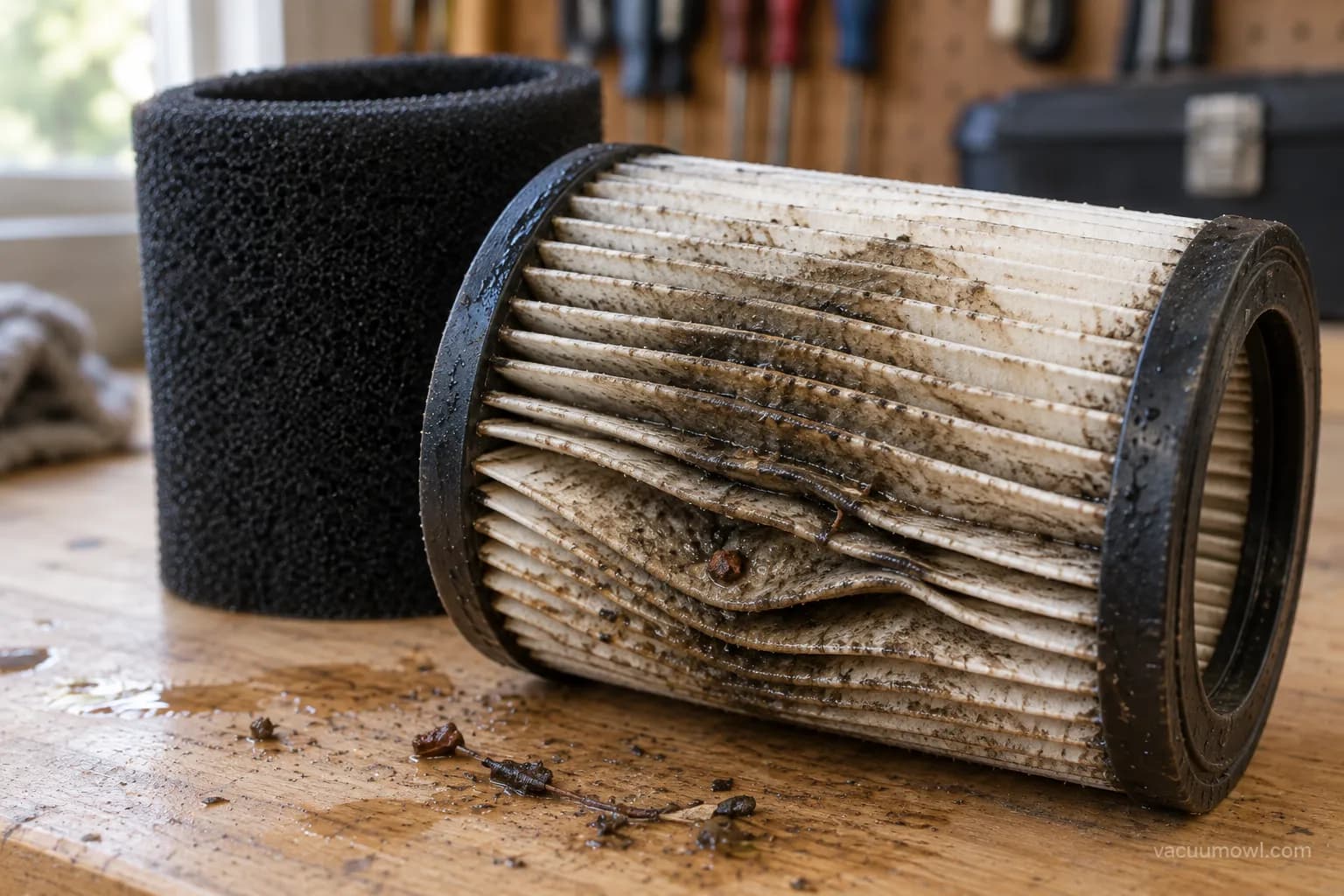
That “what ruins it” column is the part no spec sheet prints. After one wet job with the paper cartridge left in, my pleats stayed grey and smelled sour, and that cartridge never filtered clean again.
The foam sleeve from the same job rinsed out in under a minute and went back on the shelf.
Paper cartridge or foam: which do you use for water?
Foam, every time, seated over the bare cage. The paper cartridge is dry-only, and for the full menu of cartridge, fine-dust and HEPA options, see which filter you need.
For debris-heavy water, foam alone still lets fine grit through, so a bag earns its place.
Whether you reach for a bag or a filter for a given job is its own decision, covered in our bag versus filter breakdown.
Even a budget machine like a Stanley budget wet/dry vac uses this same foam-over-cage design, so the rule travels across brands.
Do You Even Need a Wet Filter? Clean vs Dirty Water
Not always, and this is the step most guides skip. For clean, clear water, many shop vacs need no filter at all, because the float valve is what stops the motor at fill, not the media.
The manufacturer’s Q&A confirms clean-water pickup can run filterless on many models. Dirty or debris-laden water still wants the foam sleeve to keep grit out of the motor.
Think of it as a three-way decision, sorted by how dirty the water is.
The water | The setup that worked for me | Why |
|---|---|---|
Clean sink or tub overflow | No filter, float only | Clear water carries no debris; the float stops the motor at fill |
Muddy basement or yard water | Foam sleeve over the cage | Silt and grit would reach the motor without the foam |
Debris-heavy flood with leaves and grit | Foam sleeve plus a tear-resistant bag | The bag traps stones and leaves before they hit the tank base |
I have run all three. For a clean sink overflow I vacuumed bare and just watched the float; for muddy basement water I fitted the foam sleeve; for a leaf-clogged flood I added the bag on top.
One rule holds across all three: never leave the paper cartridge in for any of them.
There is also the separate question of running without a filter or bag entirely, which has its own safe and unsafe cases.
Check your manual first. Models differ, and a few require the foam sleeve even for clean water. Thirty seconds in the manual beats a guess.
For debris-heavy water a collection bag does real work, and knowing when to use a bag saves you from draining sludge out of the tank by hand.
How to Fit a Shop Vac Wet Filter (Dry-to-Wet Swap)
Fitting a shop vac wet filter takes about 30 seconds and no tools. Remove the paper cartridge, slide the foam sleeve over the bare filter cage, confirm the float moves, and reseat the lid.
RIDGID’s wet filter spec confirms the foam wet filter is for wet pickup only, and its job is keeping water-borne debris out of the blower wheel. The one mistake to avoid is seating the foam over the cartridge instead of the cage.
Before you start: unplug the vac, empty the tank, and have the foam sleeve on hand.
New to the machine itself? Start with how to operate a shop vac and come back.
Unplug and open the power head. Release the latches and lift the motor lid off the tank. You should see the filter assembly hanging underneath.
Remove the paper cartridge. Twist the retainer counter-clockwise, then pull the cartridge straight down and off. Take out any collection bag too.
Find the filter cage. With the cartridge gone, the bare plastic or metal cage sits exposed on the underside of the lid.
Slide the foam sleeve over the cage. Push it straight down until the rim seats flat against the lid, with no gap at the base. On a RIDGID, the Qwik-Lock foam snaps on instead. The foam goes over the cage, not over the cartridge.
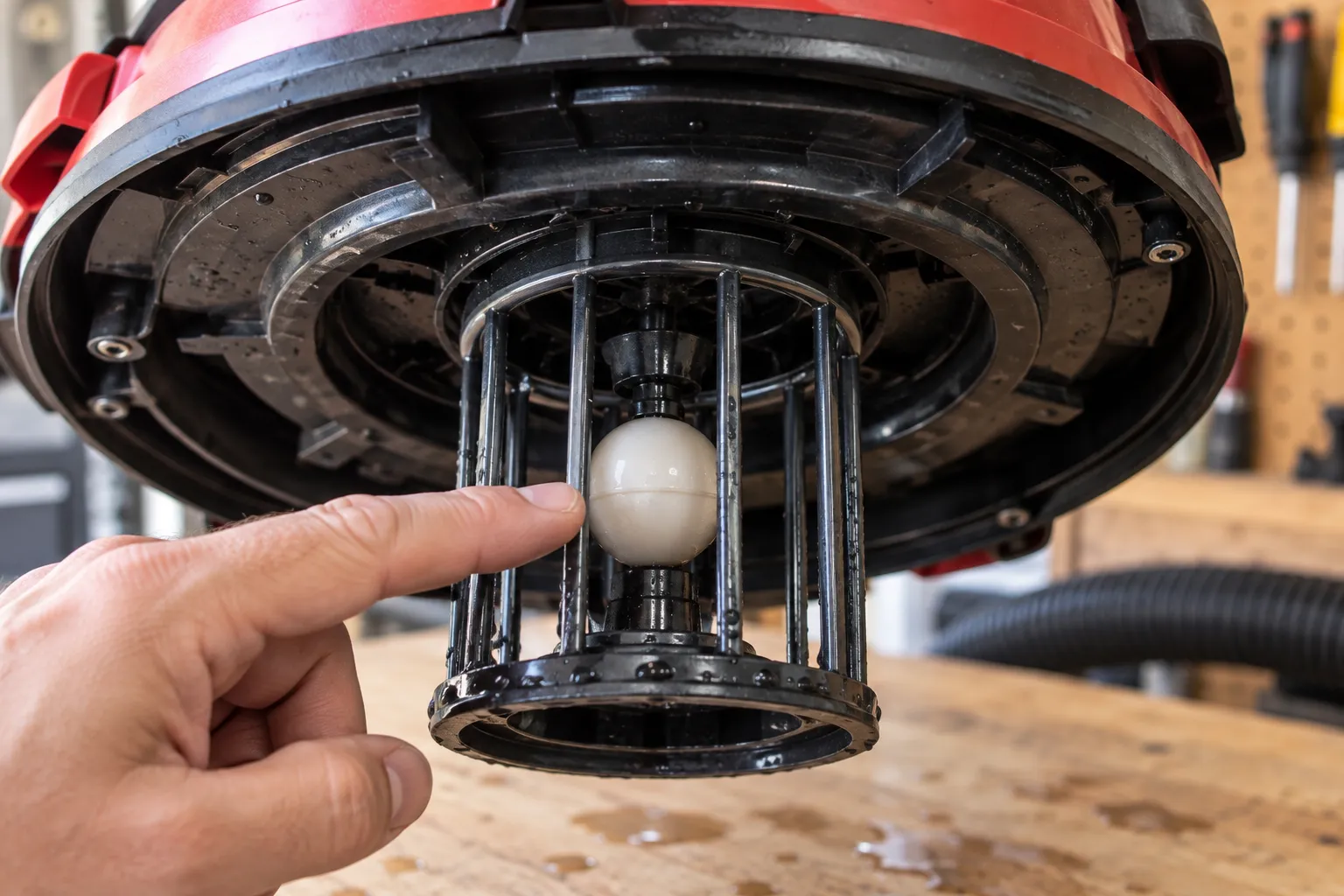
Check the float moves freely. Nudge the float ball inside the cage and make sure it rises and drops without sticking. More on why this matters below.
Reseat the lid and test suction. Latch the power head back on, plug in, and run for ten seconds. Suction should feel strong right away.
If the foam will not seat, stop.
A sleeve that will not slide on, or a snap-on that will not click, is almost always the wrong size for your tank.
Do not force it; match the part to your model instead.
For the full wet-pickup routine, from safety to draining the tank, follow our wet pickup step by step walkthrough.
Cordless owners can see how the same swap works on a RYOBI ONE+ wet/dry vac.
The Float Valve: The Motor Guard Your Filter Doesn’t Replace
The float valve is the real motor guard, and it is not the filter. Inside the cage sits a light plastic ball that rides up as the tank fills and cuts the airflow once the water reaches the top, which is why clean water can be vacuumed with no filter at all.
A wet/dry vac forum teardown describes the same floating ball rising with the water and blocking the intake to keep water out of the impeller.
You will hear it before you see it.
The moment the float seats, the motor pitch climbs to a high whine, and that sound is your cue to switch off and empty the tank, not a sign of a fault.
The whole wet/dry vacuum basics explainer covers how the two-mode machine works if the naming still trips you up.
Does the foam sleeve replace the float valve?
No. The foam sleeve filters debris out of the water; the float valve stops the motor when the tank is full.
They are two separate protections doing two separate jobs, and you want both working.
Keep the float clean and free-moving, because a stuck float can let water climb past it and into the motor.
The category hub explains how a shop vac works end to end if you want the full picture.
What Ruins Each Filter (and Your Motor)
Two mistakes cause almost every ruined filter and most burned-out motors, and both are the wrong filter for the water.
Run the paper cartridge on water and it clogs in seconds; run the foam sleeve on fine dry dust and grit blows straight through to the motor.
Detailers on Auto Geek describe both failure modes plainly: foam alone is too coarse for dry work, and paper on wet clogs immediately.
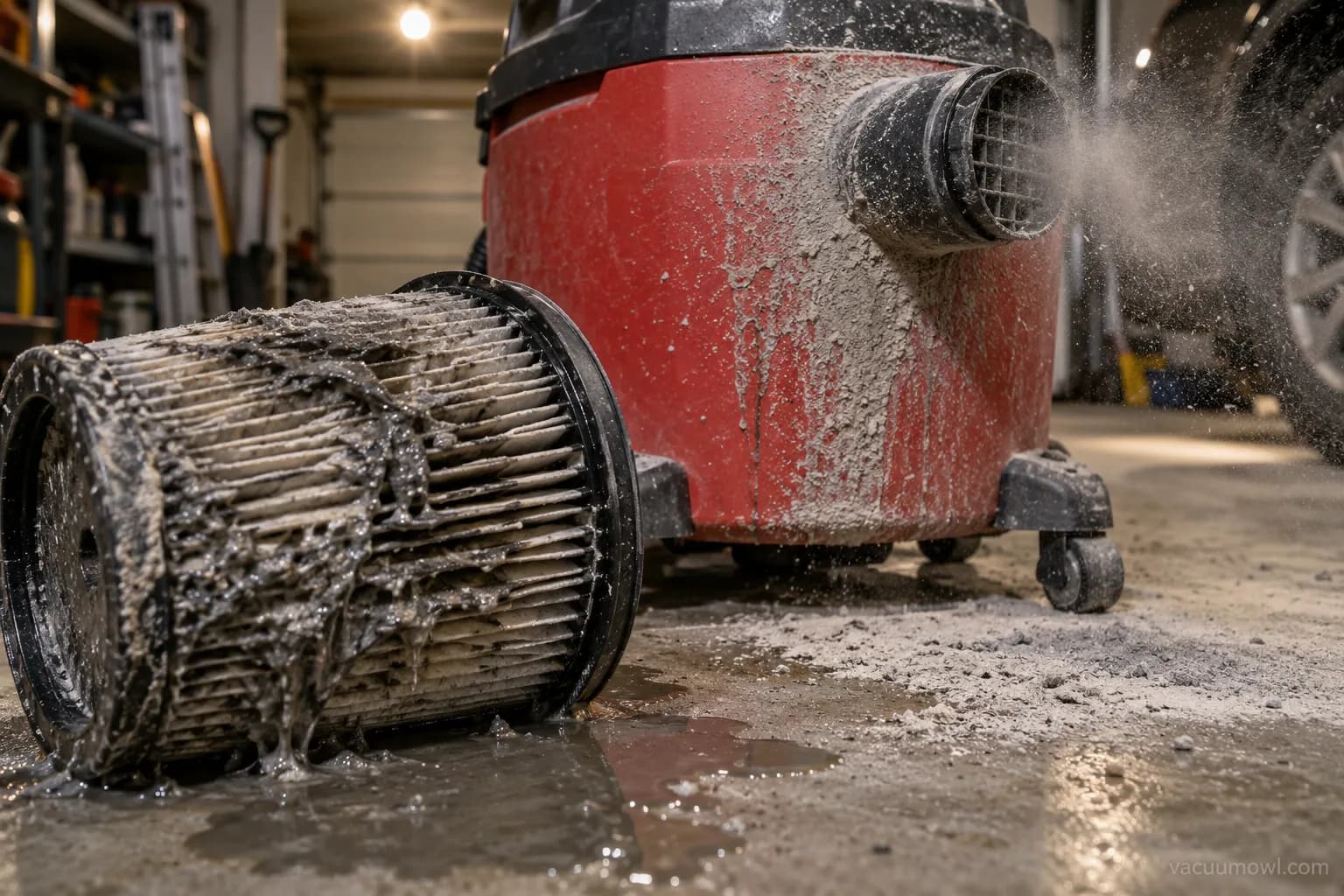
Failure one: paper cartridge on water. The pleats saturate, airflow drops to nothing, and the strained motor can trip its thermal cutoff and shut down. I let a soaked cartridge run one more pass once, and the exhaust spat a grey mist across the floor before the vac cut out on its own. That grey spitball on the exhaust side is the classic sign you left the paper in.
Failure two: foam sleeve on dry dust. Open-cell foam is built to pass water, so fine drywall or sanding dust sails through it and coats the motor and your shop air. For fine dust you want HEPA for fine dust, which is a different tool entirely.
Watch for three symptoms: dust or mist from the exhaust, suction that fades mid-job, and a hot or burnt smell.
Any one of them means stop and swap, not push through, because the filter is already ruined either way.
If a filter has clogged but not torn, cleaning a clogged filter can sometimes bring it back.
Honest limit. Even the right filter is not airtight. A shop vac is not an air purifier, so for the finest dust, expect some fines through the exhaust.
Brand pages rarely spell this out, and neither does the range from DeWalt’s wet/dry range, so the symptom-to-cause link is worth keeping in your head.
After-Use Care: Rinse, Dry & Store to Stop Mold
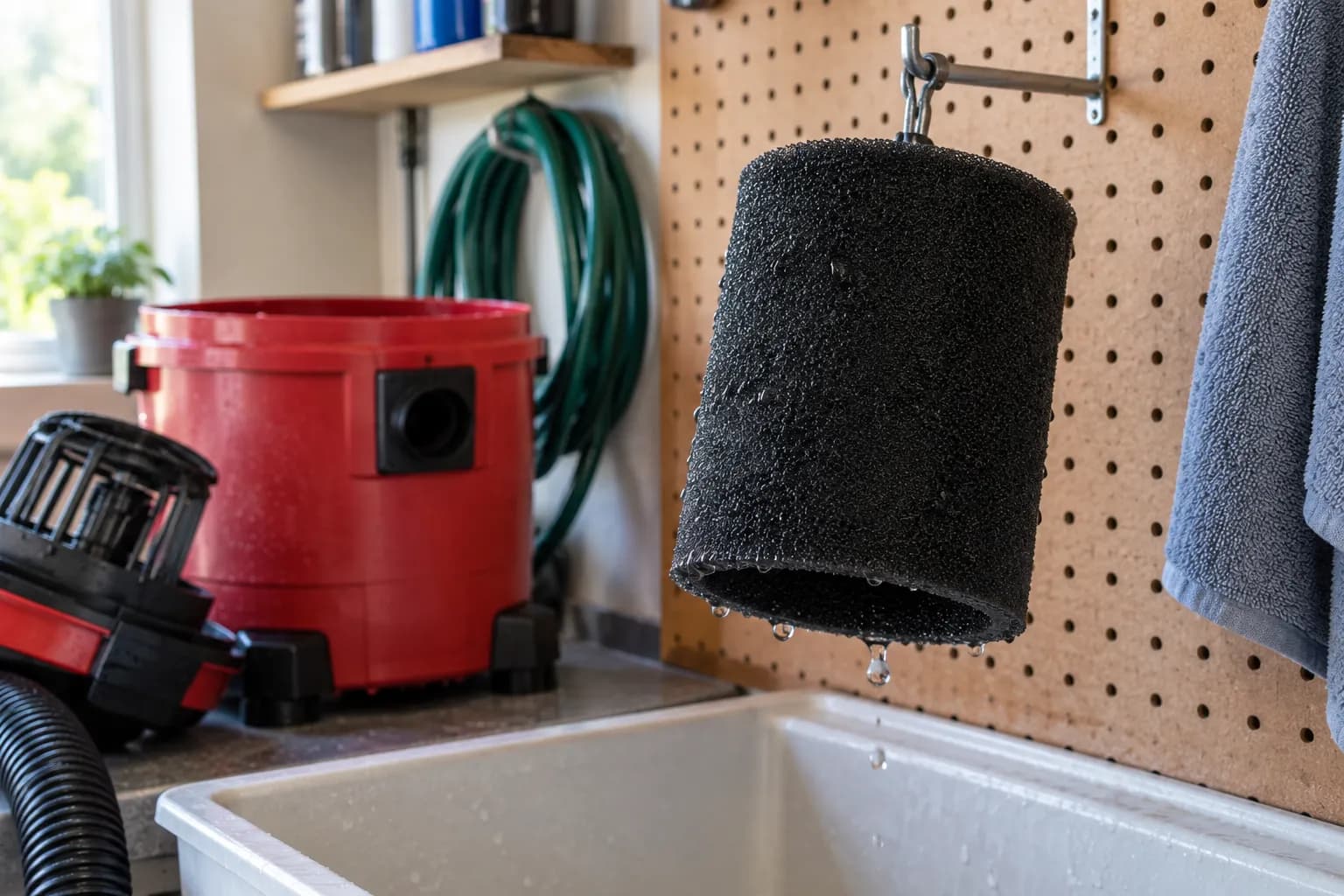
Caring for a foam wet filter is three steps: rinse, dry fully, store dry. The foam is washable and reusable, and RIDGID’s care notes confirm the wet filter can be washed and, if dried properly, used again.
The step people skip is the drying, and that is exactly what causes the moldy smell.
Empty the tank right away. Standing water grows odor fast, so drain and wipe the tank the moment you finish.
Rinse the foam sleeve with water. Plain water rinses the trapped grit out; skip the pressure washer and harsh solvents, which break the foam down.
Air-dry it fully, about 24 hours. Hang it or stand it somewhere airy until there is no damp left, and never store it wet.
Store it dry with the lid off. Leave the tank and lid open to air out so nothing musts up between jobs.
I stored a sleeve damp exactly once. The next job, the exhaust smelled of mildew all afternoon, and now the sleeve dries on a hook for a day before it goes away.
Paper and cartridge filters have their own routine, covered in washing dry cartridge filters.
Replace it when it tears. A torn foam sleeve stops protecting the motor, so retire it rather than patch it.
Different jobs call for different filters, and the what a shop vac can do roundup maps which setup suits which mess.
Brand Differences: Shop-Vac Sleeve, RIDGID Snap-On & Craftsman
Wet filters do the same job but fit differently by brand, so the part that fits your neighbor’s vac may not fit yours.
Shop-Vac uses a slip-over foam sleeve, RIDGID uses a snap-on Qwik-Lock foam with a structured core, and Craftsman has you pull the cartridge and add a foam sleeve.
As of 2026, RIDGID’s small-vac filter is the VF3700 for 3 to 4.5 gallon vacs, while the VF7000 covers 5 gallon and larger.
Brand | Wet-filter type | Example part | Fits |
|---|---|---|---|
Shop-Vac | Slip-over foam sleeve | 90585 (5 gal and up), 90526 (small) | Most Shop-Vac wet/dry vacs |
RIDGID | Snap-on Qwik-Lock foam | VF7000 (5–20 gal), VF3700 (3–4.5 gal) | RIDGID and many Husky vacs |
Craftsman | Cartridge off, foam sleeve on | Multi-fit foam sleeve | Craftsman wet/dry vacs |
The feel in the hand is different too. A RIDGID Qwik-Lock foam clicks on where my old Shop-Vac needed the sleeve stretched over the cage, same job, different fit.
Match the part to your tank size and model number. If you are weighing the brand overall, see whether is RIDGID worth it for your kind of work.
Generic replacements exist and fit most vacs, but confirm the fitment before you buy. The Craftsman wet/dry vacs line shares a parts logic worth knowing.
The same fit rules hold for Milwaukee wet/dry vacs, where the wet foam still seats over the cage.
Frequently Asked Questions
The short answers below pull together the questions that come up most on wet pickup. Shop-Vac and RIDGID both limit the foam wet filter to liquid pickup, the paper cartridge stays dry-only, and the float valve does the motor protecting when there is no filter at all.
Do you need a wet filter for a shop vac?
Sometimes. For clean, clear water many models need no filter, since the float valve stops the motor at fill.
For dirty or debris-laden water, fit the foam sleeve, and for the messiest water add a tear-resistant bag as well.
Do you take the paper filter out for wet pickup?
Yes. Twist off the retainer and pull the pleated paper cartridge straight down and out before you vacuum any liquid, since leaving it in is the most common way people ruin a filter and strain the motor.
Hose diameter trips people up just as often, so our which hose diameter fits guide is worth a look.
Can you use a paper filter for water?
No. The pleats saturate and clog within seconds, suction dies, and the motor can overheat and trip its cutoff.
You will often see grey mist spat from the exhaust as it fails, so swap to foam instead.
Does the foam sleeve replace the float valve?
No. The foam sleeve filters debris; the float valve shuts off suction when the tank is full.
They are separate protections, and you want both working on every wet job.
How do you clean and dry a foam wet filter?
Rinse it with plain water to flush the grit, then air-dry it fully for about 24 hours before storing it. Never put it away damp, or it will grow mold and smell on the next job.
Attachments fit by the same diameter logic, so browse picking the right attachments when you restock.
Bottom Line: The Right Wet Filter for Your Next Job
The whole decision comes down to the water in front of you. A shop vac wet filter means a foam sleeve over the bare cage for dirty water, nothing but the float for clean water, and foam plus a bag when the water is full of debris.
The paper cartridge is for dry work only.
Two habits save the motor: swap the cartridge out before any liquid touches the tank, and keep the float clean so it can cut off at fill.
The swap that once cost me a filter now takes 30 seconds before every wet job, and it is the difference between a $12 part and a fried motor. Check your model, fit the right foam, and your vac will handle the next flood without complaint.
Read it your way
Short on time? Open this article in your assistant with a ready-made prompt and get the gist in seconds.
Found this useful? Make us a preferred source so we show up in your Google results.
Keep reading
Related articles
Vacuum Types
Bissell Wet Dry Vacuum: 6 CrossWave Models Tested (2026)
Compare every Bissell wet dry vacuum: which CrossWave model fits pets, steam, or budget, plus fixes for streaks and floors that still look dirty. Tested 2026.
Vacuum Types
Washing Shop Vac Filter: Tap, Rinse & Reuse the Right Way
Rinse it right: this guide covers washing shop vac filter foam and paper, the tap-and-hose steps, the 24-hour dry rule, and when to just replace it.
Vacuum Types
Tineco vs Dreame Wet Dry Vacuum: 30-Day Test (2026)
Compare Tineco vs Dreame wet dry vacuum on suction, self-clean, edge reach and price, with a clear pick for pets, kids and big homes.
Vacuum Types
Is the DEWALT Shop Vac Worth It? Quiet StealthSonic Tested
Compare every DEWALT shop vac: StealthSonic quiet picks, cordless DCV580 and corded DXV, with measured noise, real suction specs and a value verdict.
The discussion
Comments
Every comment is reviewed before it goes live.