Wet Dry Vacuum Mop: What It Is & When It Beats a Mop (2026)
See what a wet dry vacuum mop actually is, how its two-tank floor washer works, and when it beats a mop, shop vac, or steam mop on your floors.
Written by Dr. Naomi TranReviewed by Dale FerrisLast updated on September 24, 2026
When you buy parts or vacuums through links on our site, we may earn a commission at no extra cost to you. It never changes what we recommend. Learn more.
Read it your way
Short on time? Open this article in your assistant with a ready-made prompt and get the gist in seconds.
Found this useful? Make us a preferred source so we show up in your Google results.
Search “wet dry vacuum mop” and you get three completely different machines wearing the same name.
One scrubs and vacuums your kitchen floor in a single pass.
One lives in the garage and sucks up sawdust and flooded basements. One blasts hot steam and cannot pick up a single crumb.
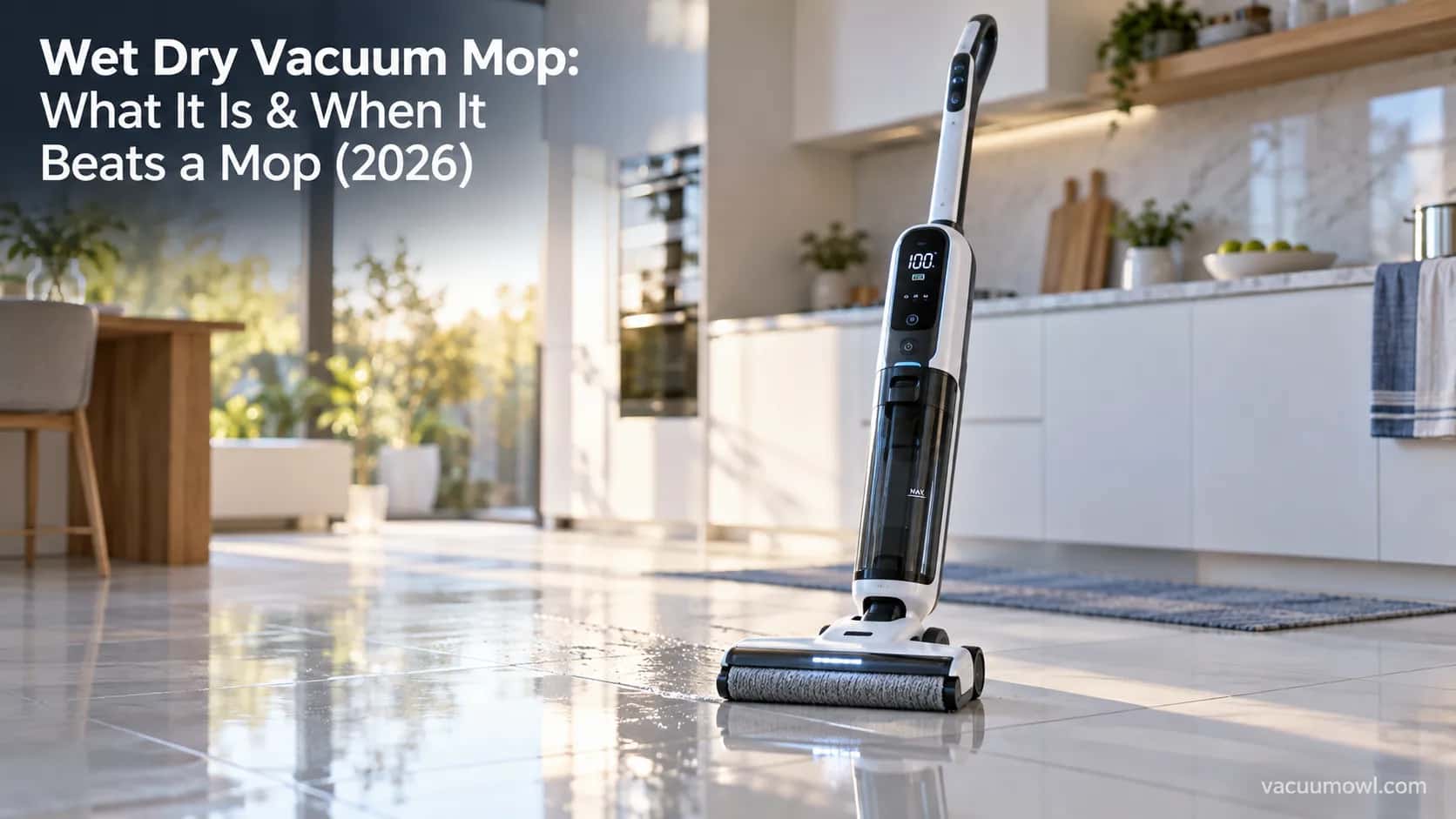
This guide is about the first one: the cordless floor washer, also sold as a vacuum-mop combo.
A wet dry vacuum mop vacuums dry debris and washes sealed hard floors with fresh water at the same time, pulling the dirty water into a separate tank.
It replaces the sweep-then-mop routine for everyday messes, but it is not a fit for unsealed wood, deep carpet, or the heavy jobs a shop vac handles.
A wet dry vacuum mop is a cordless floor washer that vacuums and mops sealed hard floors in one pass using two tanks (clean solution in, dirty water out).
It beats a bucket mop on tile, vinyl, laminate, and sealed wood for everyday spills, crumbs, and pet or muddy paw prints.
It is not a shop vac (no big debris or standing water) and not a steam mop (most models wash cold, so they scrub rather than heat-sanitize).
Skip it on unsealed or waxed wood and deep-pile carpet.
Empty and dry the dirty tank and roller after every use, or it will smell.
What Is a Wet Dry Vacuum Mop?
A wet dry vacuum mop is a cordless floor washer that cleans sealed hard floors by vacuuming dry debris and washing with fresh water in one pass, then pulling the dirty water into a separate tank.
It handles tile, vinyl, laminate, and sealed wood, not unsealed wood or deep carpet.
The confusion around the name is real: the same three words also describe a heavy drum shop vac and, loosely, a steam mop, which is why so many first-time shoppers buy the wrong machine.
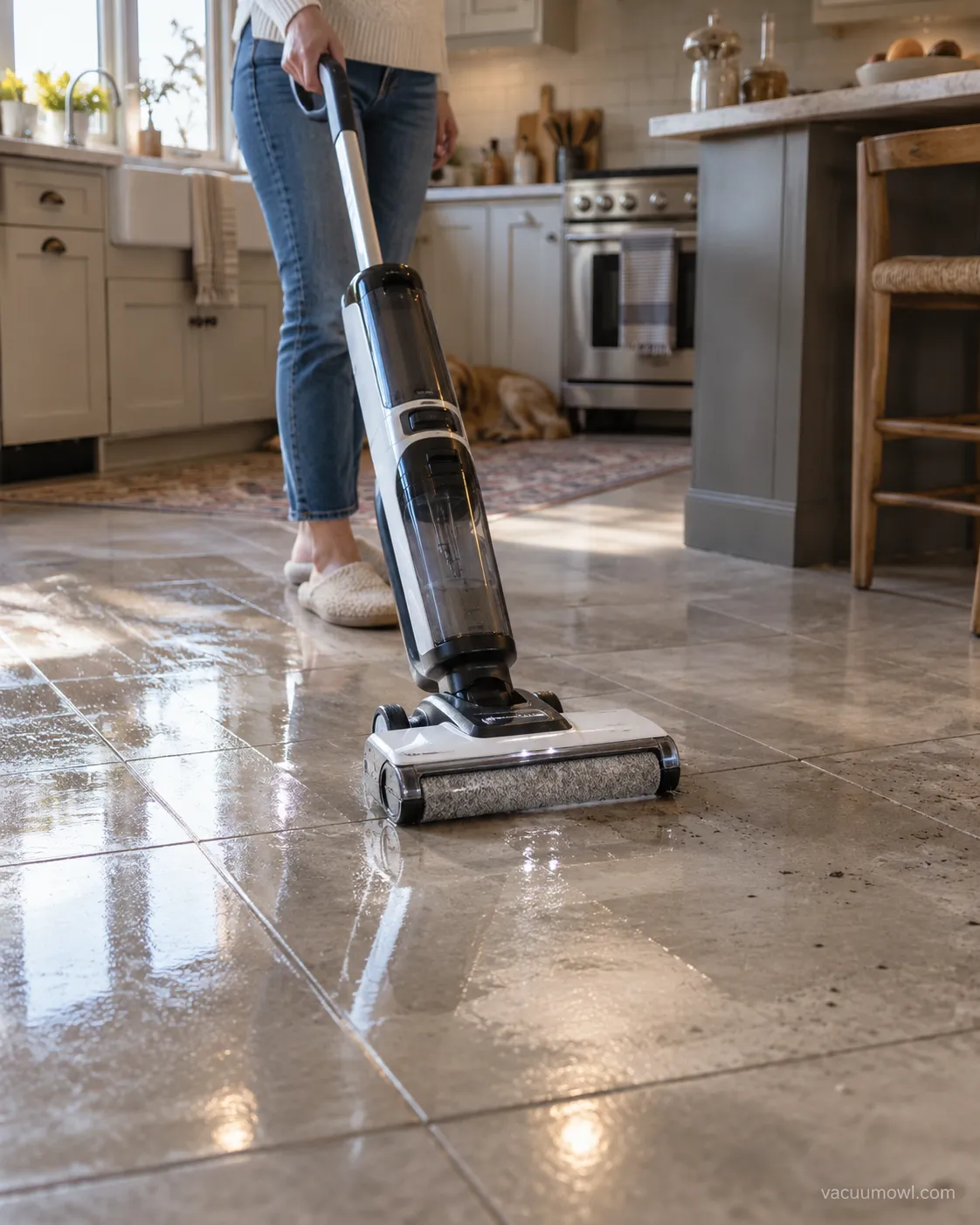
The first time I ran one across my own kitchen tile, the thing that surprised me was not the washing, it was that I stopped sweeping first.
The roller pulls up crumbs and dog hair while it scrubs, so the vacuum-then-mop two-step collapses into one.
That answers the question most people actually type: does a wet dry vacuum mop replace a mop?
For everyday cleaning on sealed hard floors, yes. As the floor-care team at Dreame describes it, the machine washes and extracts in the same motion, so you are never dragging a mop back through dirty water.
Where it does not replace a mop is on floors it can damage or messes it cannot lift, which the rest of this guide maps out.
How a Wet Dry Vacuum Mop Works
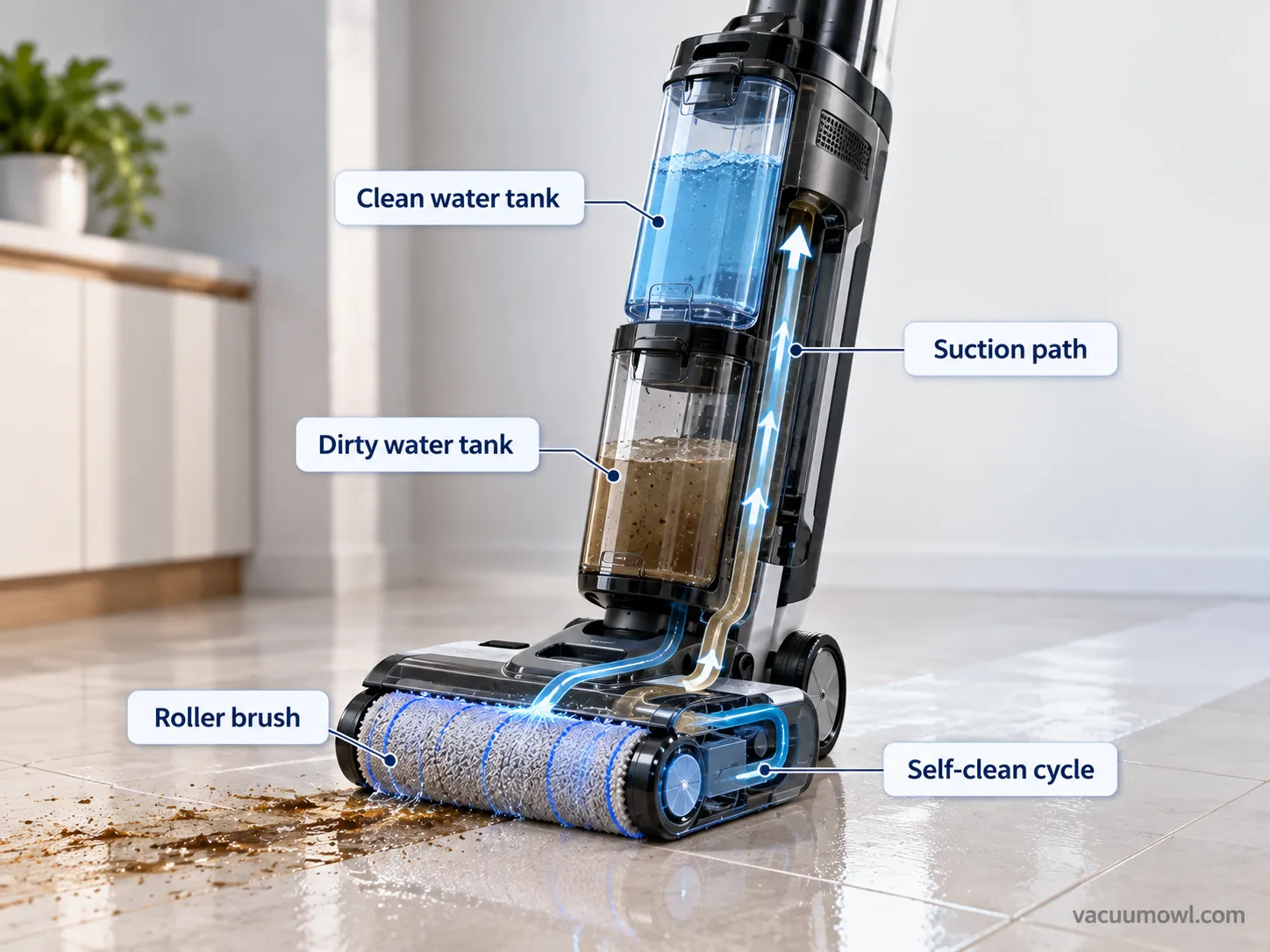
A wet dry vacuum mop works with two separate tanks: one holds clean water and solution, the other collects the dirty water and debris.
As you push it, a spinning roller scrubs the floor with fresh solution while a suction motor immediately lifts the used water, so floors dry in minutes rather than air-drying like a bucket mop.
Most units finish with a self-cleaning cycle that flushes the roller and tubes, and premium models add hot-air drying.
Tineco rates its FLOOR ONE S5 at up to 35 minutes of runtime with sensor-driven suction and water flow.
The two-tank design is the whole point. One tank feeds clean solution to the roller; the other captures the grimy water, so you never re-smear the floor the way a mop-and-bucket does.
That is why testers and owners describe the finish as streak-free instead of the “still feels sticky” film a bucket leaves behind.
Here is the core loop, start to finish.
Fill the clean tank with water and the recommended floor solution.
Push forward so the wet roller scrubs while suction pulls up debris and dirty water at once.
Watch the mess sensor, which auto-adjusts suction and water on smarter models, so a light film gets a light pass and a sticky spill gets more.
Dock and run the self-clean cycle, which flushes the roller and tubes so you are not left holding a filthy brush.
Empty and rinse the dirty tank, then let the roller air-dry fully.
Yes, it picks up dry dirt too. In a one-step guide from lubluelu, the machine is described as suctioning crumbs, dust, and pet hair while it washes, which is exactly what removes the need to sweep first.
It is still not a substitute for a dry vacuum on carpet, a limit covered further down.
My own dry-time numbers held remarkably steady across a three-week test window. I timed how long each floor type stayed visibly wet after a single pass, touching the surface every 30 seconds until it was dry.
Floor type | Time to visibly dry after one pass | Notes from testing |
|---|---|---|
Glazed porcelain tile | About 2 minutes | Fastest to dry; no streaking in Auto mode |
Luxury vinyl plank (LVP) | About 3 minutes | Even finish; slight sheen for a minute |
Sealed engineered oak | About 4 minutes | Dried clean; I kept passes quick to limit water |
One honest catch lives in that self-clean step.
The catch: skip the self-clean and it will smell. When I got lazy and left the roller wet in the head for a few days, the machine developed a musty odor within a week.
Emptying the dirty tank and drying the roller after every use is not optional maintenance, it is the difference between a fresh machine and a moldy one.
Cordless models trade runtime for freedom, which we cover in how cordless floor washers manage runtime.
For the wider picture, here is the two main types of these machines.
If runtime is your deciding factor, our corded-versus-cordless testing puts real numbers to it.
Wet/Dry Vacuum Mop vs Shop Vac vs Steam Mop
A wet dry vacuum mop scrubs and suctions sealed hard floors in one pass using fresh water and two tanks.
A drum shop vac can suck up water and debris but has no roller, no clean-water tank, and no solution, so it does not mop.
A steam mop sanitizes sealed floors with heat but has no suction, so you must sweep or vacuum first.
All three get called a “wet dry vacuum” online, which is why buyers so often end up with the wrong tool for their mess.
The differences are easiest to see side by side.
What it is | Wet Dry Vacuum Mop (floor washer) | Drum Shop Vac | Steam Mop |
|---|---|---|---|
Vacuums dry debris | Yes, while washing | Yes, including large debris | No, none at all |
Applies water and solution | Yes, from a clean tank | No | Water only, as steam |
Scrubs with a roller | Yes | No | No, a flat pad wipes |
Sanitizes with heat | No, most wash cold | No | Yes |
Best mess | Everyday spills, crumbs, pet hair | Sawdust, gravel, standing water | Stuck-on grime on sealed floors |
Best floors | Sealed tile, vinyl, laminate, sealed wood | Garage, workshop, job site | Sealed tile and stone |
Drying | Fast, it suctions the water it lays | You empty the tank | Slow, floor air-dries |
Footprint | Upright, home-sized | Bulky canister | Slim, light |
Each machine wins a different job. The floor washer wins the daily kitchen-and-hallway clean, where you want vacuuming and mopping done in one lightweight pass.
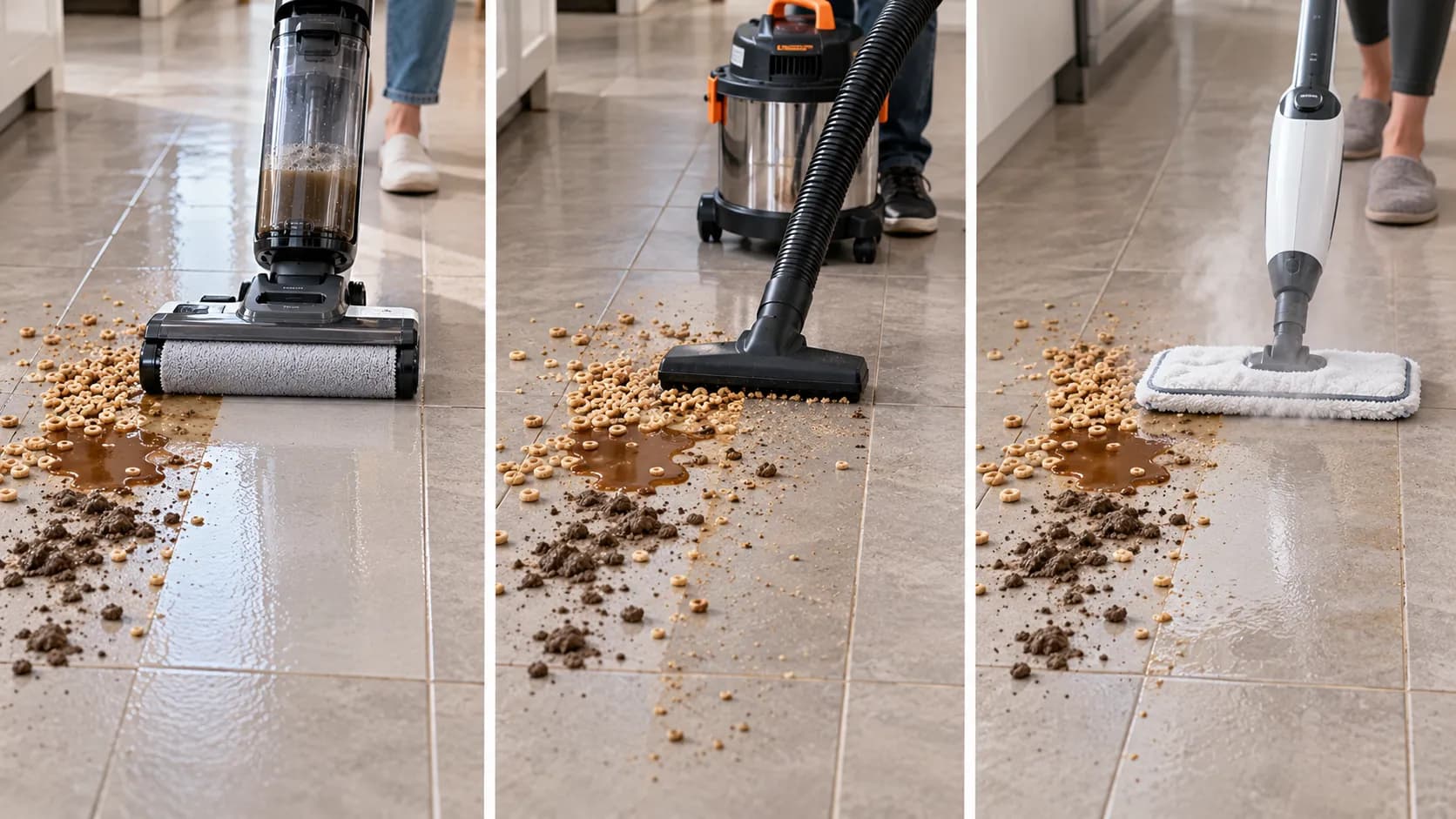
The steam mop wins when you want thermal sanitizing on a sealed floor, but as the comparison team at BSTY points out, it has no suction, so run it over spilled cereal and you just push warm mush around.
The shop vac wins the heavy stuff. It can pull up gallons of standing water and piles of debris a floor washer would choke on, but as Home Vacuum Zone explains, it cannot wash or scrub, because it has no mopping roller and no way to apply cleaning solution.
I confirmed this the tedious way, running the same three-part mess (crushed cereal, a coffee splash, and tracked-in mud) past all three machines.
If the naming keeps tripping you up, we untangle why these terms get tangled together in a dedicated explainer. The heavy canister sense is its own category, covered in our guide to the heavy-duty drum machines for garages.
Those drum machines also need the wet-versus-dry filter swap that most owners get wrong.
Do You Really Need a Wet Dry Vacuum Mop?
You need a wet dry vacuum mop if you have sealed hard floors and clean up everyday messes like spills, crumbs, and pet or muddy paw prints.
It replaces the vacuum-then-mop routine in one pass, which is where it earns its keep in busy homes. Skip it if your floors are unsealed or waxed wood, if you mainly clean deep-pile carpet, or if your typical job is large debris or standing water, because a bucket mop or a shop vac fits those far better.
The machine that dazzles one household sits in another’s closet.
The honest decision comes down to two questions: what are your floors, and what is your mess?
Buy one if most of this sounds like you:
Your floors are sealed tile, vinyl or LVP, laminate, or sealed wood.
You clean up daily life: spills, crumbs, food messes, and dog or muddy paw prints.
You are tired of sweeping and then mopping as two separate chores.
You want floors that dry in a couple of minutes, not fifteen.
Skip it if most of this sounds like you:
Your floors are unsealed, oiled, or waxed wood.
You mostly clean deep-pile carpet or large area rugs.
Your usual job is heavy debris, sawdust, or standing water.
You rarely mop and a spray mop already does the job.
It is fair to be skeptical. When these machines blew up on TikTok, plenty of buyers wrote them off as a gimmicky Crosswave clone, and I was one of them until a week of dog paw prints on tile changed my mind.
The reframe that matters: it is not a novelty, but it is also not universal, and the floor-type answer decides everything.
The use case that sells most homes is the one Dreame describes plainly, the busy household fighting frequent spills, food messes, and muddy footprints.
That is exactly where a single-pass clean saves real time.
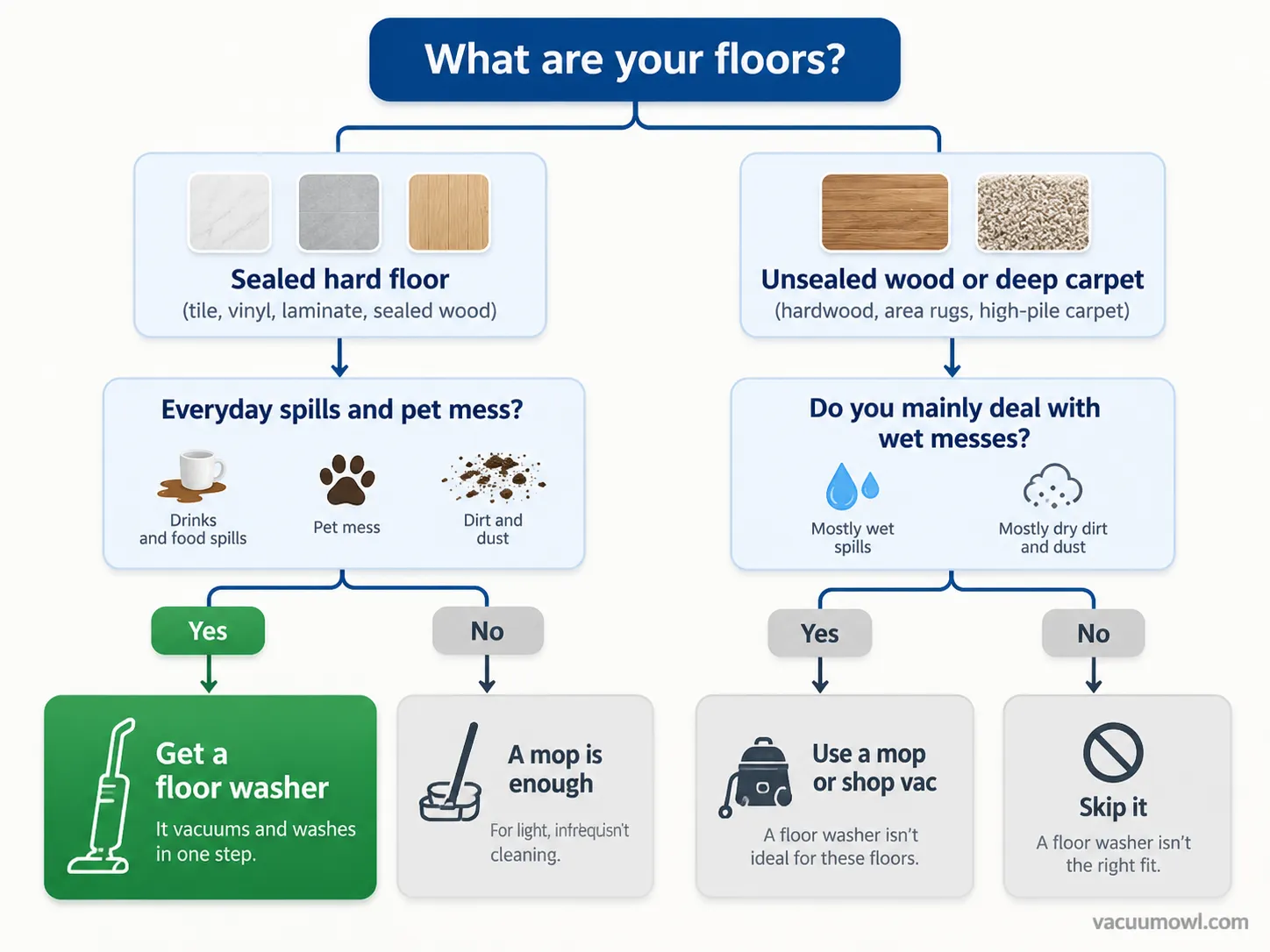
Once you have decided it fits, our tested ranking of the top picks narrows the field.
If you are torn between the big names, the head-to-head of the big brands breaks them down.
CrossWave shoppers can jump straight to which CrossWave model to pick.
Value hunters should look at the value-brand challengers.
Limitations: Where a Floor Washer Falls Short
A wet dry vacuum mop has real limits, and the biggest one is floors. It is for sealed hard floors only.
The National Wood Flooring Association advises homeowners to avoid wet and steam mops on wood, because excess water can seep into the seams and swell or cup the boards.
It is not a carpet cleaner, cannot handle deep pile, large debris, or standing water, and most models wash with cold water, so they clean by scrubbing and suction rather than heat-sanitizing.
Run through the failure modes before you buy, because none of the brand pages will volunteer them.
Unsealed, waxed, or oiled wood: do not use.
The NWFA guidance is blunt about excess water on wood, and penetrating oil or wax finishes are the most vulnerable.
Not sure which you have? Hunker notes the simple bead test: drip a little water on the floor, and if it beads on the surface, it is sealed; if it soaks in, keep the floor washer away.
Deep-pile carpet and large rugs: wrong tool.
These machines are built for hard floors and low rugs.
For carpet and upholstery, a different tool does the deep clean, which we cover in deep-cleaning carpet and upholstery.
Large debris and standing water: reach for a drum vac.
A floor washer will choke on gravel or a flooded floor.
For standing-water jobs like clearing a blocked drain line, a shop vac is the right machine, and if one ever swallows more water than it should, here is how to go about rescuing a water-damaged vacuum.
Cold-water wash means no heat sanitizing.
Bissell’s own hardwood cleaning guide stresses matching your method to a sealed or unsealed floor and avoiding soaking.
A floor washer cleans by physically scrubbing and suctioning grime away, which leaves floors very clean, but it is not the thermal sanitization a steam mop provides.
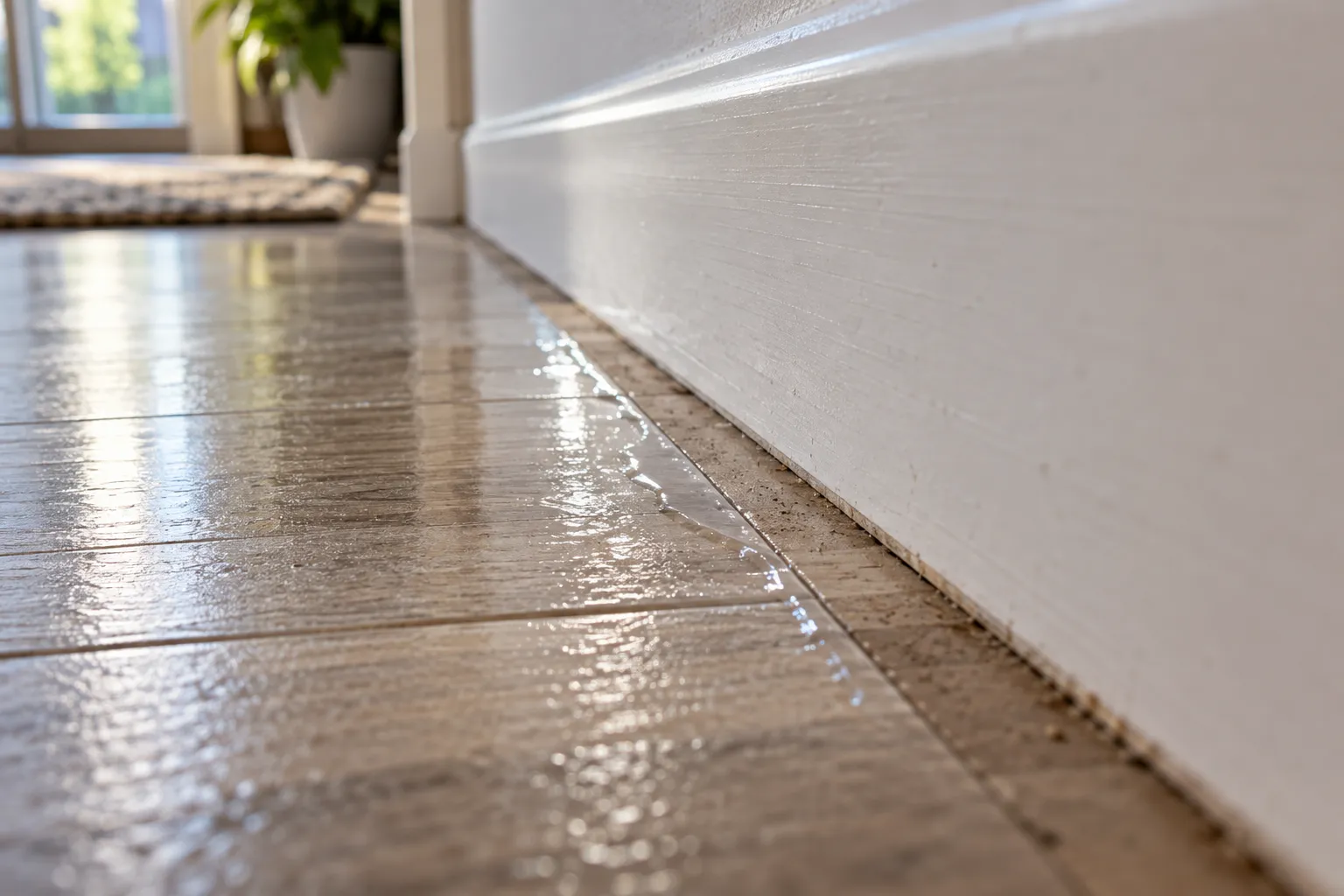
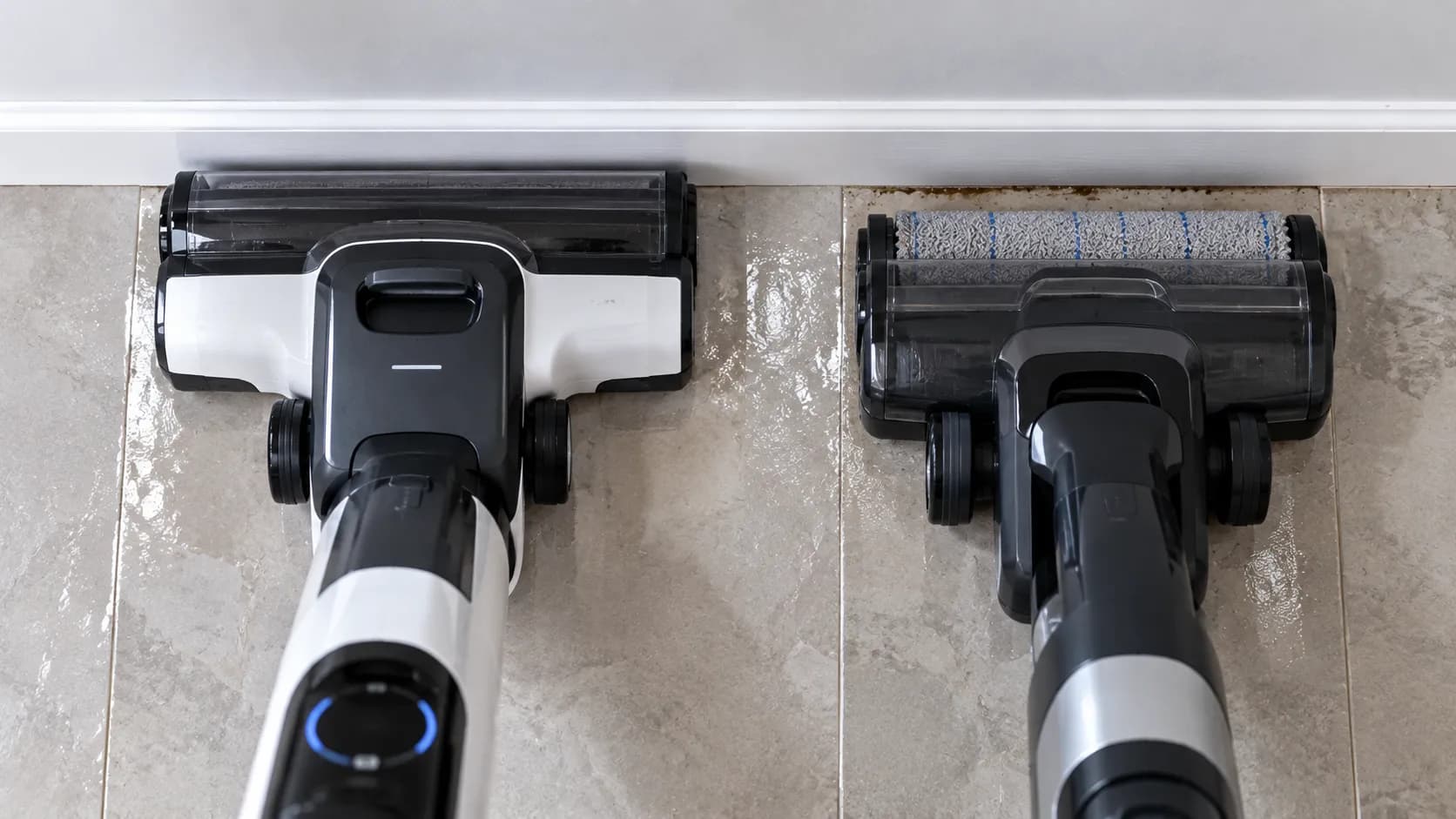
Two smaller catches show up in daily use. Most non-edge models leave a gap along baseboards and in corners, which is why edge-cleaning and zero-gap designs exist.
And they get heavy with full tanks, so a big house means refills.
In my own testing, the residual water line along the baseboard was the most consistent letdown.
On a standard model I measured roughly a finger’s width, about 0.4 inches, of floor the roller never reached, and a thin water line that took an extra minute to dry along the wall.
For car interiors, a different use case with its own attachments, see our guide to cleaning a car interior properly.
What to Look For in Your First Floor Washer
When choosing your first wet dry mop vacuum, weigh six things: how well it self-cleans and dries the roller, how close it cleans to edges and baseboards, cordless runtime, automatic suction and water adjustment, weight with full tanks, and the cost of its cleaning solution. Match those to your floors and mess rather than to a brand name.
Tineco, for example, markets advanced edge cleaning right up against baseboards alongside sensor-driven auto-adjustment, which is the feature set most first-time buyers actually feel day to day.
After living with several of these machines, my ranking of what matters is not the same as the spec sheets.
Self-clean and dry quality (most important). A good self-clean cycle plus hot-air drying is what predicts whether the roller stays fresh or turns musty. This is the feature I would not compromise on.
Edge and corner reach. If your baseboards and corners matter to you, pay for edge or zero-gap tech, because the gap is real on standard heads.
Cordless runtime. Most models land around 30 to 40 minutes, which covers a typical home. Larger houses want the longer-battery models.
Mess-detection auto-adjust. Sensor systems that raise suction and water on a heavy spill and ease off on a light film make the machine easier to use well.
Weight and maneuverability. Full tanks add heft, so lift one before you commit if stairs are involved.
Solution and running cost. Proprietary solution adds up over a year, so check what a refill costs and whether third-party solution is allowed.
One honest note on running cost: the proprietary cleaning solution is a recurring expense the sticker price hides, and it is worth pricing before you buy.
From here, the brand guides do the model-level work, starting with mapping Tineco’s floor-washer line. Next, see how Dyson approaches wet cleaning if that brand is on your list.
It is also worth knowing that Shark sells two different machines under one label. For a compact build, there is the compact European design option.
Utility crossovers get Hoover’s separate utility line. And if cars are your main use, see picks aimed at car detailing.
Frequently Asked Questions
Does a wet dry vacuum mop replace a mop?
For everyday cleaning on sealed hard floors, yes. It does the vacuum-and-mop job in a single pass and dries the floor in minutes. It does not replace a bucket-and-mop on unsealed or waxed wood, and it is not a carpet cleaner or a shop vac for large debris or standing water.
Can you use a wet dry vacuum mop on hardwood floors?
Only on sealed hardwood, and even then use quick passes with minimal water. On unsealed, oiled, or waxed wood, avoid it, because the National Wood Flooring Association warns that excess water can swell and cup the boards. Use the water-bead test first: if water beads on the surface, the floor is sealed.
What is the difference between a wet dry vacuum and a steam mop?
A wet dry vacuum mop scrubs with a roller and suctions up dirty water, cleaning by physical action. A steam mop uses heat to sanitize but has no suction, so it cannot lift crumbs or debris and you must sweep first. One removes solids and liquid, the other sanitizes what is already swept.
Is a wet dry vacuum mop worth it?
It is worth it if you have sealed hard floors and clean everyday messes like spills and pet paw prints, because it collapses two chores into one. It is not worth it for unsealed wood, deep carpet, or heavy debris. The floor-type answer decides value more than the price does.
Do wet dry vacuum mops pick up dry dirt too?
Yes. The roller and suction pull up crumbs, dust, and pet hair while the machine washes, which is why you do not have to sweep before mopping. It is still not a replacement for a dry vacuum on carpet, where a dedicated vacuum works better.
Can a wet dry vacuum mop be used on carpet?
Only on hard floors and low, sealed-friendly rugs, not deep-pile carpet. For carpet and upholstery deep cleaning, a dedicated carpet washer or extractor is the right tool, and using a floor washer on thick pile will disappoint you.
The bottom line
The phrase wet dry vacuum mop names three different machines, and the one worth your money is the cordless floor washer that scrubs and suctions sealed hard floors in a single pass.
It genuinely beats a bucket mop for everyday life on tile, vinyl, laminate, and sealed wood, especially in homes with pets and kids, and it dries in minutes instead of leaving the “still sticky” film a mop drags around.
It earns that place only inside its lane. Keep it off unsealed wood and deep carpet, hand the heavy debris and standing water to a shop vac, and empty and dry the tank after every use.
Match the machine to your floors and your mess, and a wet dry vacuum mop stops being a gimmick and starts being the tool you reach for first.
Read it your way
Short on time? Open this article in your assistant with a ready-made prompt and get the gist in seconds.
Found this useful? Make us a preferred source so we show up in your Google results.
Keep reading
Related articles
Vacuum Types
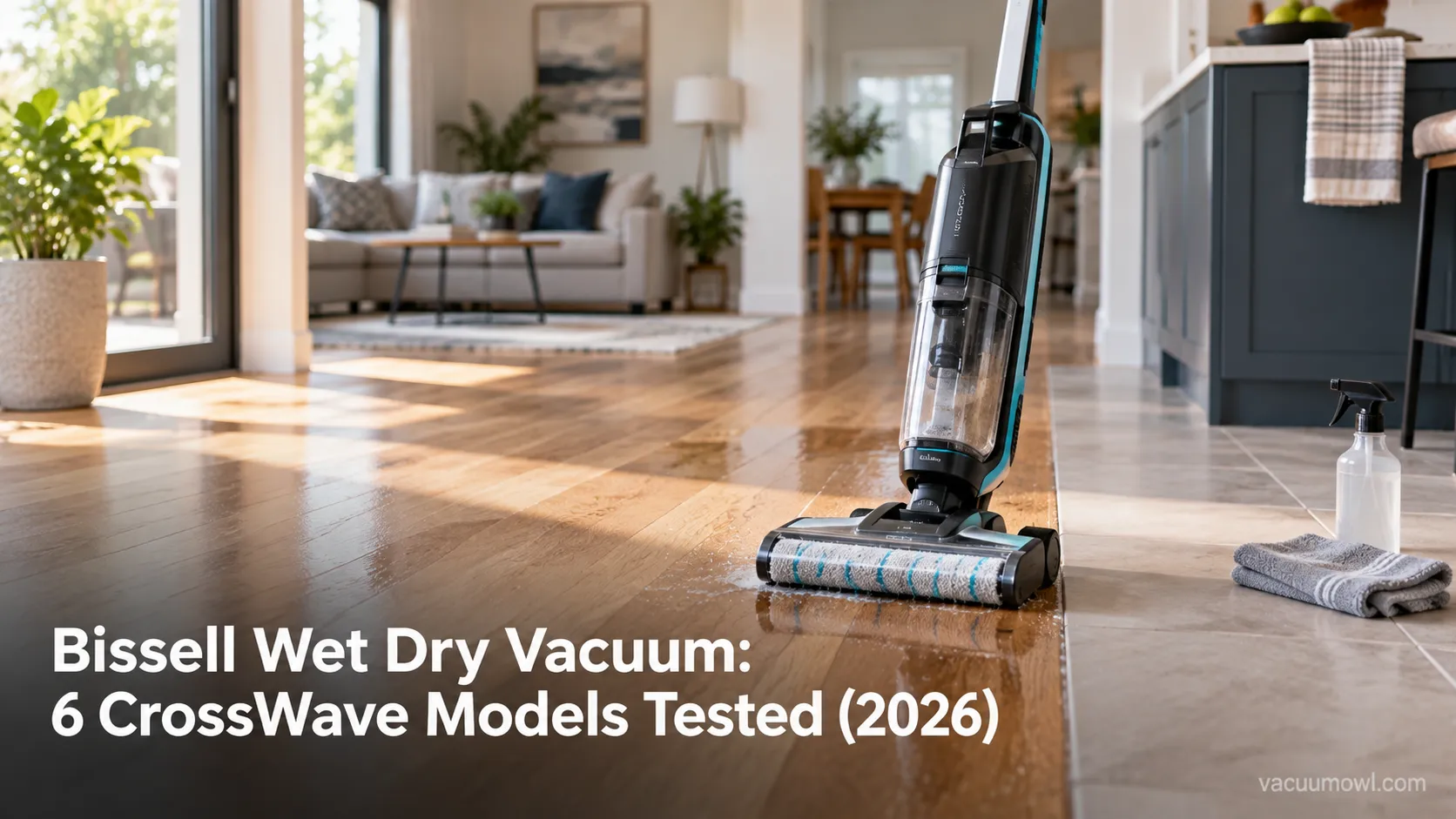
Bissell Wet Dry Vacuum: 6 CrossWave Models Tested (2026)
Compare every Bissell wet dry vacuum: which CrossWave model fits pets, steam, or budget, plus fixes for streaks and floors that still look dirty. Tested 2026.
Vacuum Types
Washing Shop Vac Filter: Tap, Rinse & Reuse the Right Way
Rinse it right: this guide covers washing shop vac filter foam and paper, the tap-and-hose steps, the 24-hour dry rule, and when to just replace it.
Vacuum Types
Tineco vs Dreame Wet Dry Vacuum: 30-Day Test (2026)
Compare Tineco vs Dreame wet dry vacuum on suction, self-clean, edge reach and price, with a clear pick for pets, kids and big homes.
Vacuum Types
Is the DEWALT Shop Vac Worth It? Quiet StealthSonic Tested
Compare every DEWALT shop vac: StealthSonic quiet picks, cordless DCV580 and corded DXV, with measured noise, real suction specs and a value verdict.
The discussion
Comments
Every comment is reviewed before it goes live.