Attachment for Shop Vac: Which Fits Your Vac (Fit Guide)
Find the right attachment for shop vac jobs: what each tool does, will it fit your hose diameter, and how to measure so it never falls off.
Written by Dr. Naomi TranReviewed by Dale FerrisLast updated on September 24, 2026
When you buy parts or vacuums through links on our site, we may earn a commission at no extra cost to you. It never changes what we recommend. Learn more.
Read it your way
Short on time? Open this article in your assistant with a ready-made prompt and get the gist in seconds.
Found this useful? Make us a preferred source so we show up in your Google results.
The first time I bought a “universal” accessory kit, two of its six tools would not stay on my hose. Picking the right attachment for shop vac cleanups is not about the label on the box.
It comes down to two questions: what job are you doing, and what diameter is your hose. Get those two right and almost any tool works.
Get them wrong and you lose suction, waste money, or watch the nozzle fall off mid-job.
Most retail pages hand you a wall of product tiles and never explain fit. This guide does the opposite.
It names every attachment, tells you what each is best for, and shows you how to match it to your vac by measured diameter. That last part is the piece nobody puts in one place.
The Short Version: Every Attachment and the One Rule for Fit
Shop vac attachments are the friction-fit nozzles, brushes, wands, and adapters that push onto the working end of your hose. Fit is decided by hose diameter, not brand.
Per Shop-Vac’s own fit guidance, you measure the accessory end of the hose and match it. The three common consumer sizes are 1-1/4 inch, 1-1/2 inch, and 2-1/2 inch, with an older 1-7/8 inch size still in the wild.
So the rule is simple: match the tool to the job, then match the tool to your measured diameter.
The two questions that decide every purchase: what job, and what diameter.
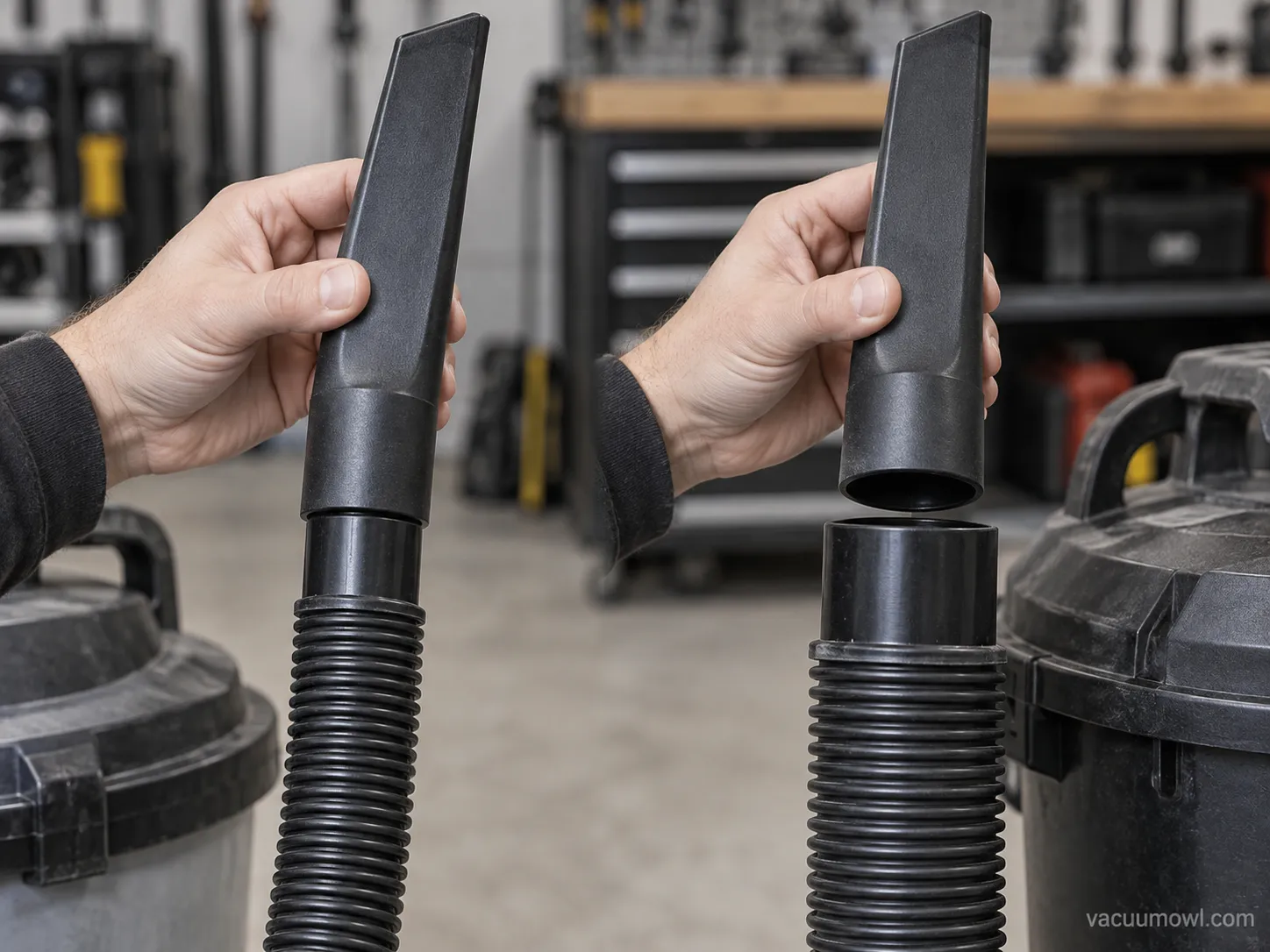
If you only remember one thing, remember that “universal” means universal within a diameter, not across every vacuum. Everything below builds on that.
Every Shop Vac Attachment and What Each One Is Best For
Shop vac attachments fall into a handful of families: nozzles, brushes, wands, and adapters.
According to Lowe’s attachments category, the most common types are the extension wand, floor nozzle, and tool adapter.
A typical attachment costs near $12, ranging from roughly $8 to $140.
Below is the single reference retailers never give you, each tool keyed to its best job and the diameters it usually comes in.
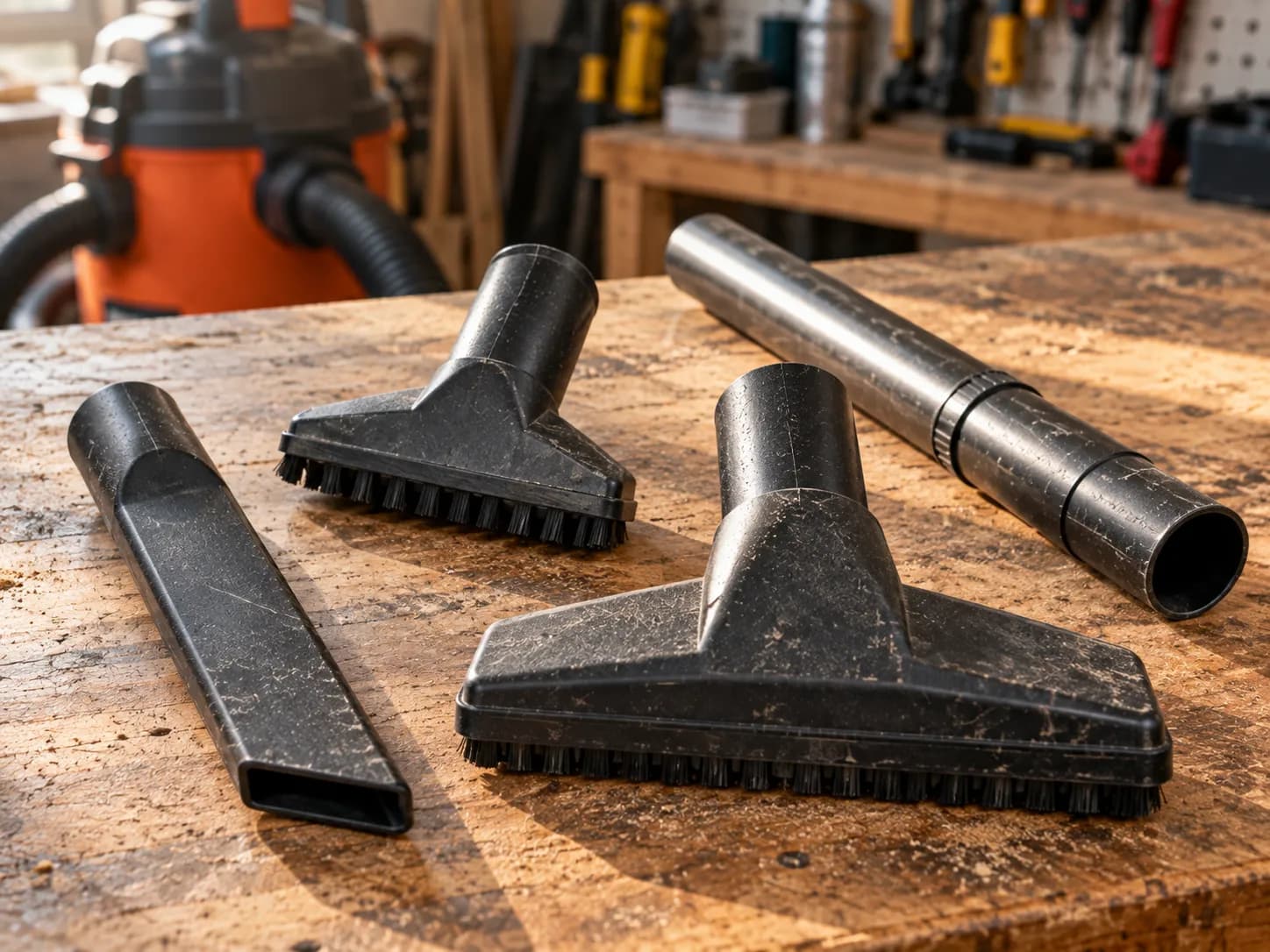
I laid out my own kit, labeled every piece, and marked which came bundled with a vac versus which I bought separately.
That lineup is what the table describes.
Attachment | Best for | Common diameters | Notes |
|---|---|---|---|
Crevice tool | Tight gaps, corners, car seats, edges | 1-1/4", 2-1/2" | Flat mouth; flexible versions reach under appliances |
Dusting or round brush | Delicate surfaces, vents, blinds, shelves | 1-1/4", 1-1/2" | Soft bristles; not for bulk debris |
Gulper or claw nozzle | Bulk debris, workbench sweep, larger spills | 1-1/4", 1-1/2" | Wide mouth clears volume fast |
Floor or utility nozzle | Floors, garages, large open areas | 1-1/4", 2-1/2" | Often paired with wands |
Upholstery tool | Sofas, car interiors, mattresses | 1-1/4" | Short bristle strip lifts fibers |
Extension wands | Adding reach, high or low areas | 1-1/4", 2-1/2" | Stack two for gutters or ceilings |
Squeegee nozzle | Wet pickup on hard floors | 1-1/2", 2-1/2" | Rubber lip pulls water into a line |
Power-tool adapter | Connecting to a saw or sander | 2-1/2" to tool port | Captures dust at the source |
Universal adapter kit | Bridging mismatched sizes | multi-size | Step-up and step-down cuffs |
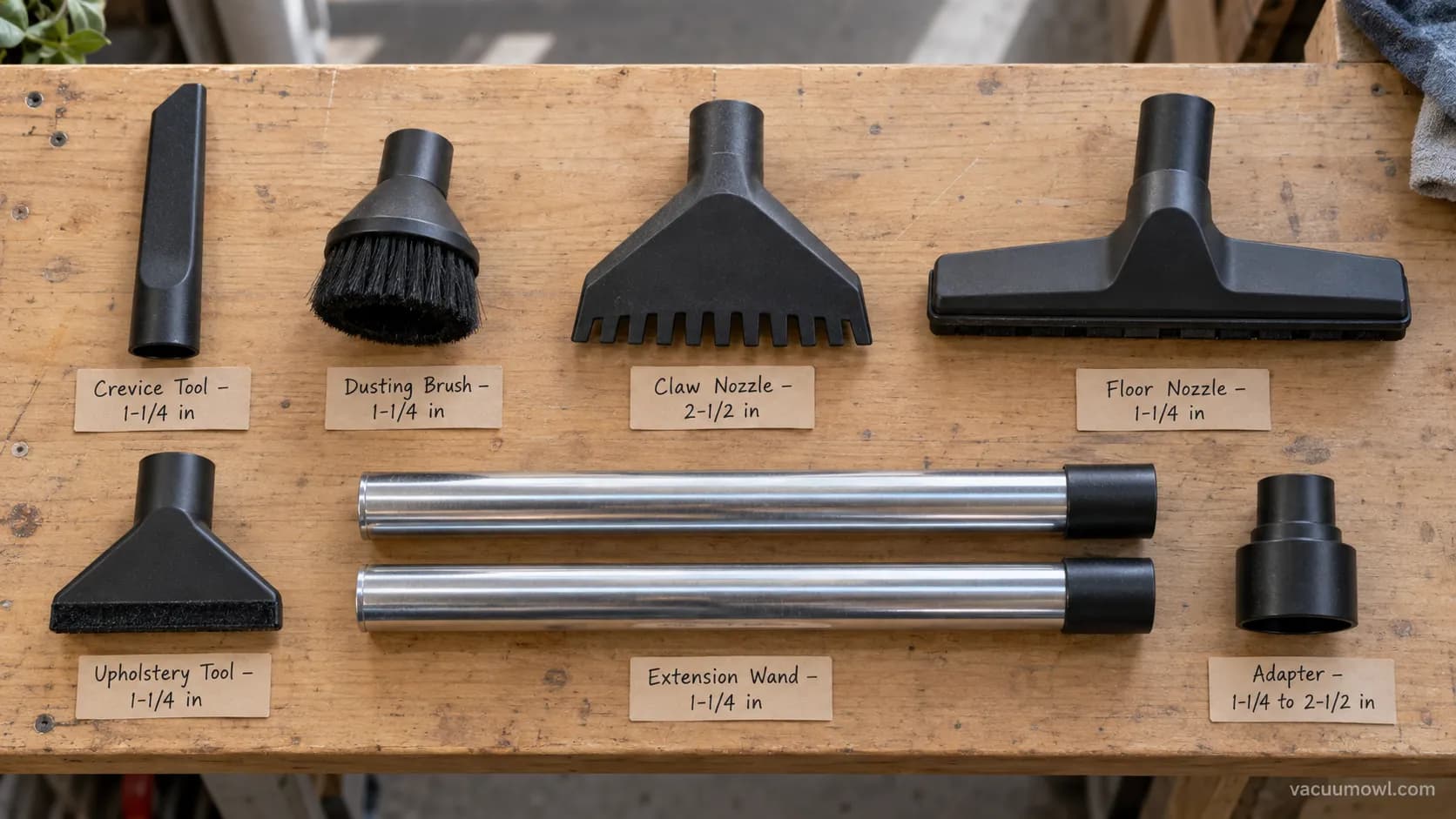
What is in the box varies by model. Budget vacs often ship with a crevice tool, one brush, and a floor nozzle, while larger tanks tend to include 2-1/2 inch tools and wands.
Whatever you own bolts onto the same core machine, so it helps to know how the core machine works before you expand your kit.
Some tools also pair with a specific filter setup. That is worth checking when you are picking the right filter for the debris you plan to vacuum.
Which Attachment for Shop Vac Tasks Do You Actually Need?
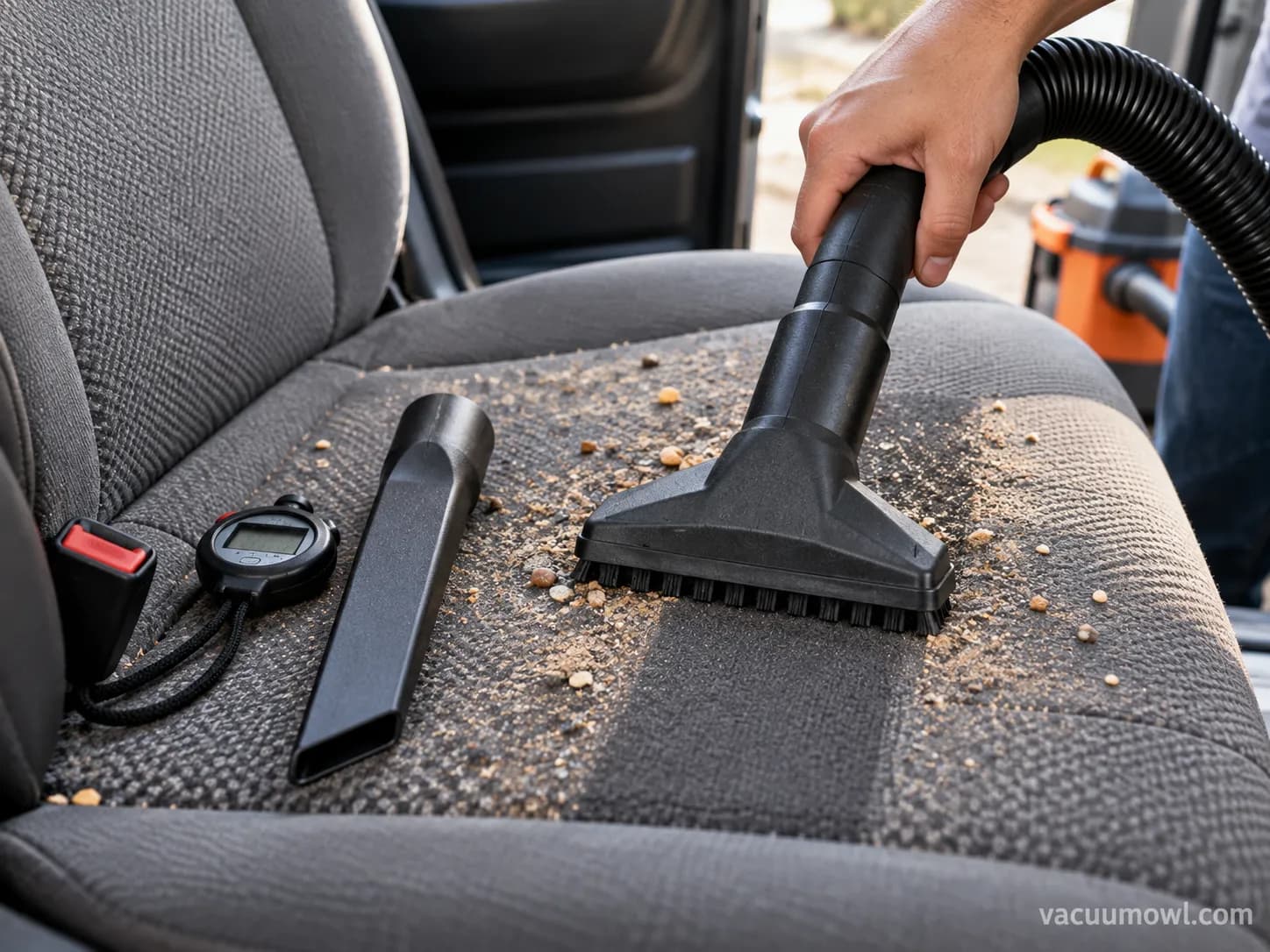
The right attachment for shop vac tasks depends entirely on the job, not on owning every tool. In my testing, a wide claw nozzle cleared a debris-covered car seat in about 5.5 minutes.
A crevice tool took roughly 9 minutes on the identical mess, close to 40 percent slower. So match the mouth of the tool to the shape of the work.
Below are the five jobs owners ask about most, with the two or three tools that actually earn their place.
Job | Reach for | Why |
|---|---|---|
Floors and large areas | Floor nozzle plus extension wands | Wide path, less bending |
Car and upholstery | Claw or gulper nozzle plus crevice tool | Bulk first, then edges and seams |
Gutters and leaves | Stacked extension wands plus a curved nozzle | Height without a ladder |
Workshop and power tools | Power-tool adapter plus gulper nozzle | Capture dust at the saw, sweep the bench |
Blowing and clearing | No attachment; the port itself | Airflow, not suction |
For floors and cars, the pattern is bulk tool first, detail tool second. Deep-cleaning carpet is the honest exception.
Attachments unlock dozens of jobs beyond dry pickup. You can see the full list of shop vac jobs if you want the complete map.
A shop vac attachment will lift surface dirt and pull water, but it will not deep-clean carpet like a dedicated washer.
If that is your goal, read when you need a carpet washer before buying an extractor nozzle expecting miracles.
Two jobs use no attachment at all. Flip the port and the machine blows instead of sucks, covered in using it as a blower.
For flooded floors you switch to wet mode. That is its own wet pickup, step by step walkthrough.
Are Shop Vac Accessories Universal? The Honest Answer
Shop vac accessories are not truly universal, and the label oversells it. There is no cross-brand port standard.
Independent compatibility testing at VacStuff shows connections ranging from roughly 1-1/4 inch to 2-1/2 inch, with the added trap that some makers list inside diameter and others list outside diameter.
A tool is universal within its diameter family, not across every machine.
So a “fits most” kit fits most vacs that share its size, and no others.
When I bought a six-tool “universal” kit, four pieces seated firmly on my 1-7/8 inch hose and two were visibly loose. That is the norm, not bad luck.
Many kits quietly exclude specific brands. Ideal Home confirms attachments are not universal, with sizes spanning about 28mm to 38mm depending on the maker.
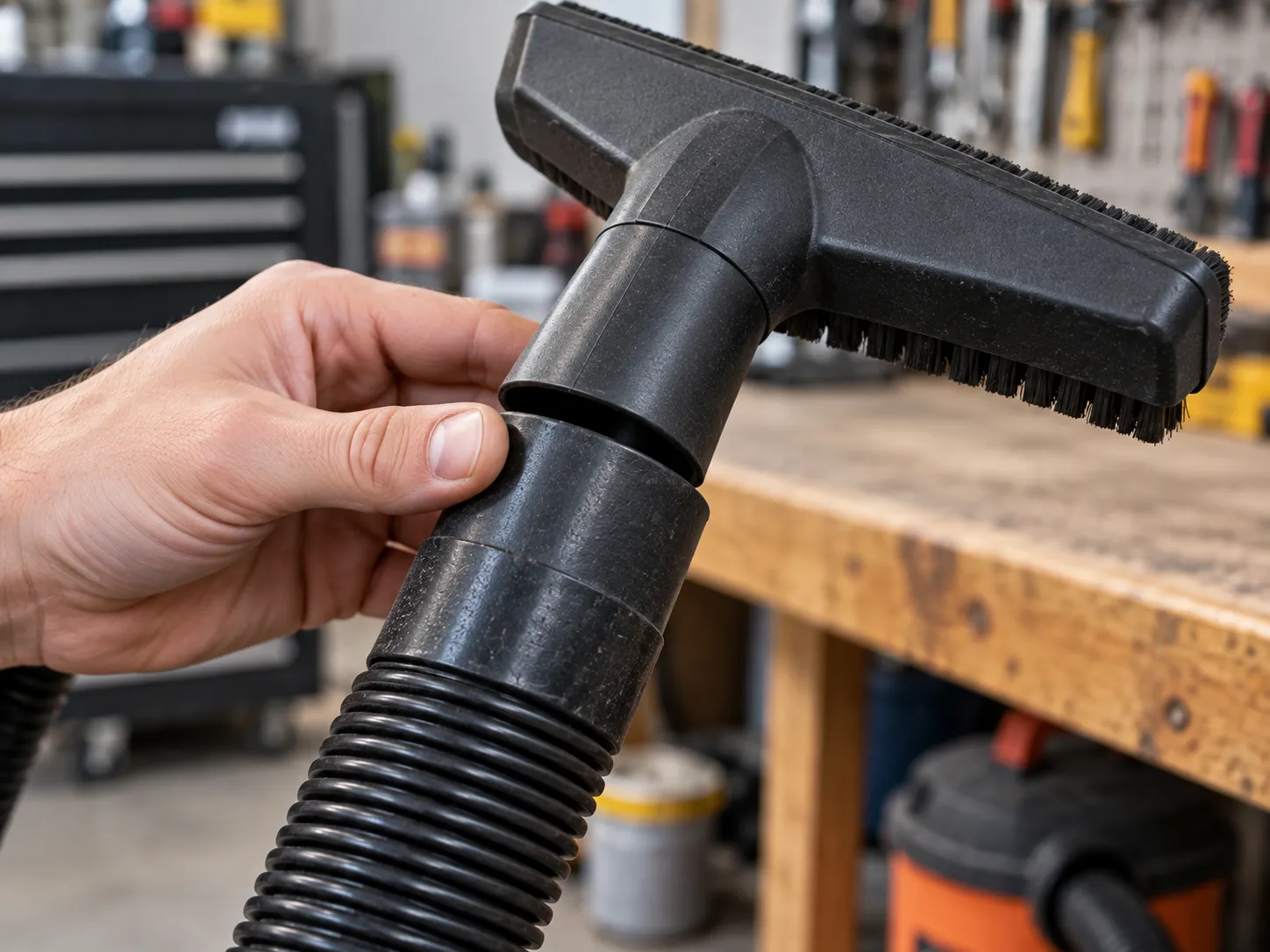
How to read a “universal” claim safely: treat it as “fits my diameter if I measured correctly.”
The same fit problem hits consumables too, so choosing the right bag follows the same size logic.
Wet jobs change your filter, not your attachment, which is the wet-versus-dry filter swap many owners miss.
How to Measure Your Shop Vac Hose So Attachments Fit
Measuring a shop vac hose correctly is the step that ends most fit problems. You measure the working end where accessories connect.
Per Simplysolved’s measuring guide, the two dominant standards are 32mm and 35mm, where a mismatch as small as 3mm can break the friction seal and drop suction.
Match the outside diameter of your wand to the inside diameter of your tool.
That single check prevents the loose, falling-off connection almost every owner hits.
Here is the method I use before buying anything.
Find the accessory end of the hose, the end where tools push on.
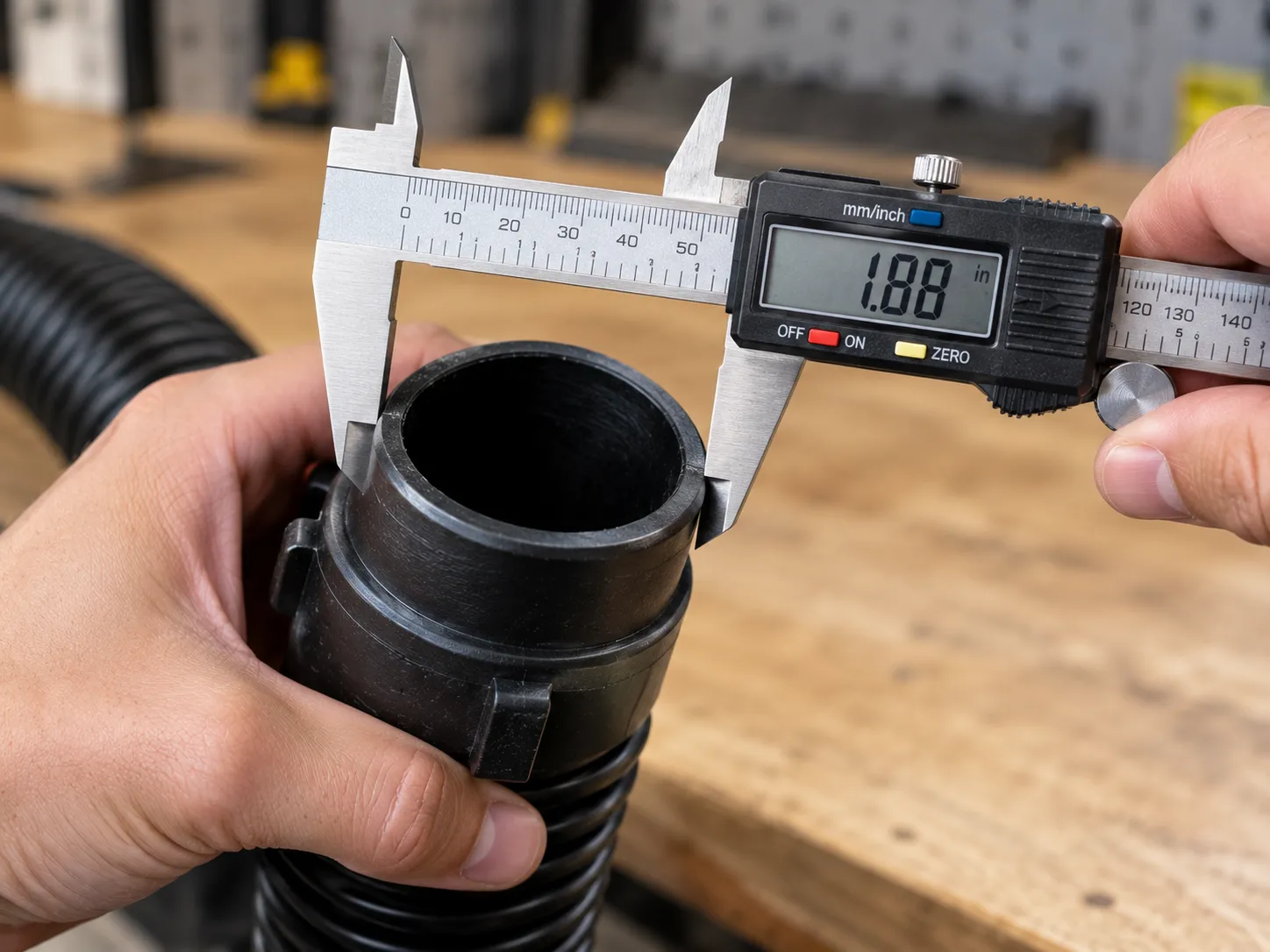
Measure its outside diameter with calipers, not a tape, and record the number.
Measure the inside diameter of the attachment you want to fit.
Confirm the wand outside diameter slides into the tool inside diameter for a snug friction seal.
Compare your reading to the common sizes in the table below before you order.
Diameter | Rough feel | Typical use or machine |
|---|---|---|
1-1/4 inch (32mm) | About a golf ball | Portable and smaller consumer vacs |
1-1/2 inch (38mm) | About a baseball | Mid-range consumer vacs and many kits |
1-7/8 inch | Between the two | Older shop vac mates, easy to misread |
2-1/2 inch (63.5mm) | About a baseball, wider cuff | Larger tanks, contractor vacs, power tools |
When I caliper-measured three of my own hoses, one read 1.26 inches, one read 1.88 inches, and one read 2.50 inches.
The 1.88 inch hose looked like a 1-1/2 inch at a glance, which is exactly why my earlier kits kept falling off.
Ruler and caliper reads differ, so measure the inside and outside diameter both.
Hose | Caliper reading | Nearest standard | Note |
|---|---|---|---|
Hose A | 1.26 inch | 1-1/4 inch | Clean match, kits fit |
Hose B | 1.88 inch | 1-7/8 inch | Looked like 1-1/2, the trap |
Hose C | 2.50 inch | 2-1/2 inch | Needs a step-down for small tools |
Diameter is really a hose-sizing question, so our full hose-size breakdown goes deeper on cuffs and adapters.
Do not confuse the inlet with the blower port when you measure, since the two ports explained trips up a lot of owners.
Bigger tanks also ship with wider ports, which ties back to how tank size affects ports.
Why Won’t My “Universal” Attachment Stay On?
A universal attachment falls off when the tool’s inside diameter is even slightly larger than your wand’s outside diameter, so the friction seal never forms.
This is the classic “universal fittings that don’t fit anything” complaint on woodworking forums.
One owner review flatly returned a part because it needed the inside and outside sizes listed and got neither. The fix is a snug diameter match or the right adapter, never tape and hope.
Adapters and Conversion Kits: Fitting a Mismatched Attachment
Adapters bridge a size mismatch so you do not have to rebuy a kit or a vacuum. A step-down cuff drops a 2-1/2 inch hose to a 1-1/4 inch tool, and a conversion unit links 1-1/4 inch to 1-1/2 inch.
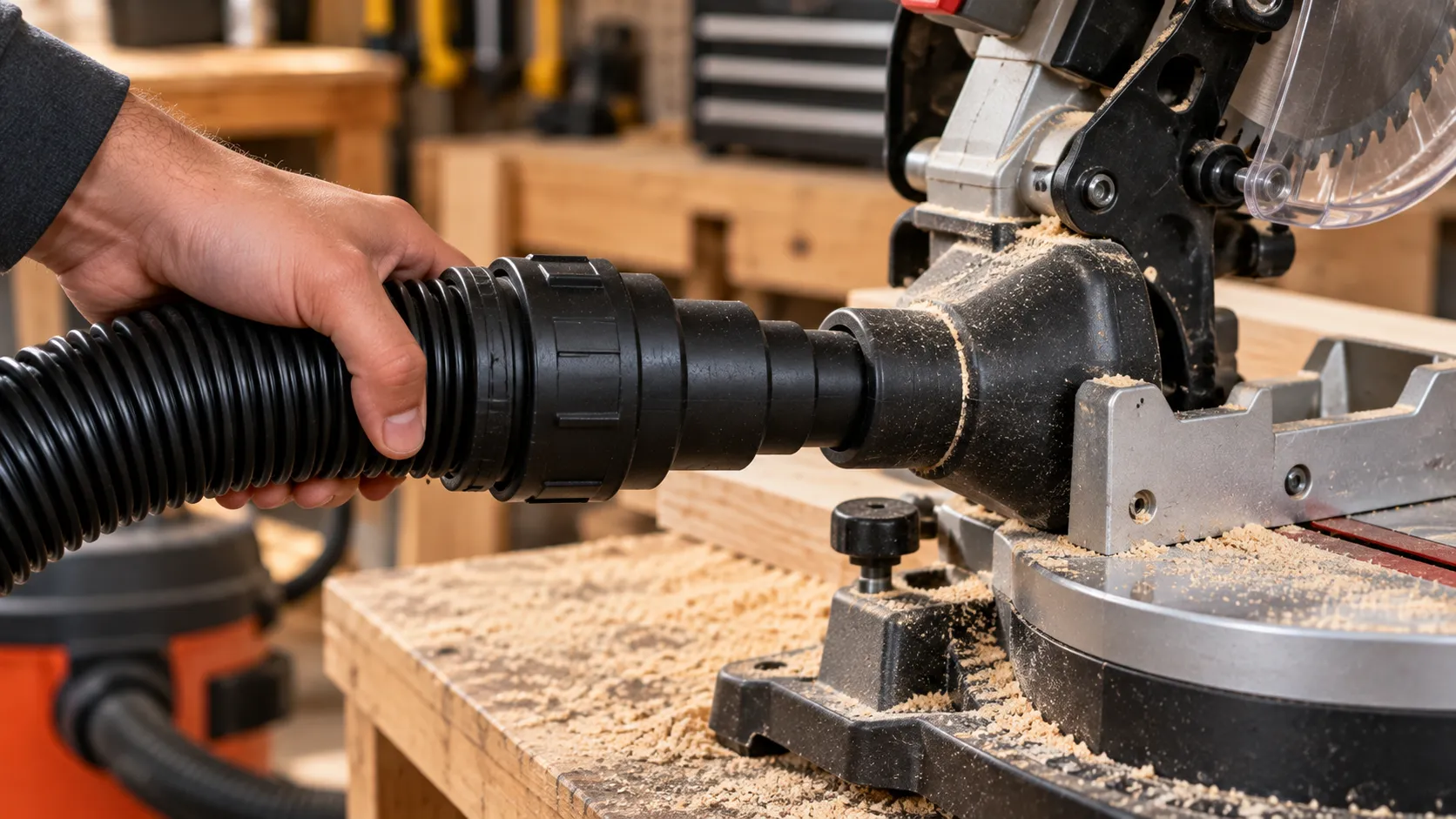
According to the RIDGID power-tool adapter listing at Home Depot, a 2-1/2 inch adapter connects tools like a miter saw for clean debris capture at the source. Buy the adapter, not a new kit.
From | To | Typical part or use |
|---|---|---|
2-1/2 inch hose | 1-1/4 inch tool | Step-down cuff for small nozzles |
1-1/4 inch | 1-1/2 inch | Conversion unit for mid-size tools |
35mm hose | 2-1/2 inch tool port | Hose-to-tool adapter for dust ports |
2-1/2 inch hose | Saw or sander port | Power-tool adapter for source capture |
I connected a 2-1/2 inch hose to a 1-1/4 inch crevice tool with a step-down cuff, then ran the same hose to a miter saw with a power-tool adapter.
Both held under full suction, though the extra cuff shaved a little airflow.
That airflow loss is the known trade-off of any reducer. Adapters are the backbone of a real dust-collection rig.
The same fit logic governs the water-pump attachment path if you go that route.
Some connectors resist universal adapters. Locking or D-shaped brand ports, common on a few household vacuum lines, often need a brand-specific adapter or will not adapt cleanly at all.
Fine-dust work also pairs better with the right filtration. It is worth knowing whether you need a HEPA filter before you seal your vac to a sander.
What to Buy First: A Starter Attachment Set by Use Case
A smart starter set is three or four tools matched to your measured diameter, not the biggest kit on the shelf. Measure first, then buy a universal kit plus the one adapter your size needs.
That order saves the most money and the most frustration.
Household cleanup: crevice tool, dusting brush, floor nozzle, extension wands.
Car and detailing: claw or gulper nozzle, crevice tool, upholstery tool.
Workshop and power tools: gulper nozzle, floor nozzle, power-tool adapter.
After a year of workshop use, the four tools I actually reach for are the crevice tool, the gulper nozzle, the floor nozzle, and a pair of extension wands. Everything else stays in the drawer.
A universal kit saves money if you verify fit first. A branded kit costs more but removes the guesswork.
Whatever you buy, keep the filter clean so suction lasts. Our guide on keeping your filter working covers the routine.
If you are still choosing the machine itself, brand kits differ. Compare our Craftsman wet/dry review for one path.
DeWALT owners can weigh the DeWALT shop-vac breakdown instead. On a tighter budget, look at the budget Stanley option before committing to an ecosystem.
Frequently Asked Questions
What size are most shop vac attachments?
Most consumer shop vac attachments come in 1-1/4 inch (32mm), with 1-1/2 inch and 2-1/2 inch also common and an older 1-7/8 inch size still around. The 1-1/4 inch standard is the one most universal kits target.
Measure your hose end before assuming, because a look-alike 1-7/8 inch cuff is easy to mistake for 1-1/2 inch.
Do shop vac attachments fit all brands?
No, they do not fit all brands, because there is no cross-brand port standard. Attachments are universal only within a diameter, so a 1-1/4 inch tool fits 1-1/4 inch hoses regardless of brand, but not a 2-1/2 inch one.
In my testing, a “universal” kit fit four of six tools on a 1-7/8 inch hose, which is typical.
Can I connect a shop vac to a power tool?
Yes, a power-tool adapter connects a shop vac hose to a saw or sander so it captures dust at the source. A 2-1/2 inch adapter is the common fit for larger tools, and smaller ports may need a step-down cuff.
In my run, the adapter held under full suction with only a slight airflow loss from the extra cuff.
Do I need an adapter for my attachments?
You need an adapter only when your hose diameter and your tool diameter do not match. A step-down or conversion cuff bridges the gap for far less than a new kit.
New to the machine itself? Start with getting started with the machine before adding accessories.
What attachments come with a shop vac?
Most shop vacs ship with a crevice tool, one brush, and a floor nozzle, though larger tanks add 2-1/2 inch tools and wands. What is bundled varies by model, so check the box contents before buying extras.
Store the wands and tools without losing them by using wall-mounting and storage.
Can a shop vac attachment deep-clean carpet?
A shop vac attachment lifts surface dirt and pulls water, but it will not deep-clean carpet the way a dedicated washer does. An upholstery or extractor nozzle handles light refresh work and spot cleanup.
For embedded stains and shampooing, a carpet washer is the right machine.
The Bottom Line
Choosing the right attachment for shop vac cleanups is never about a “universal” sticker. It is about matching the job to the tool, then matching the tool to your hose’s measured diameter.
Do those two things and a crevice tool, a claw nozzle, or a power-tool adapter will seat firmly and pull full suction every time.
Measure your hose end with calipers, and note whether it is 1-1/4, 1-1/2, 1-7/8, or 2-1/2 inch. Buy to that number.
If your tool and hose diameters disagree, reach for a step-down cuff instead of a whole new kit. That is the difference between a drawer of fittings that fit nothing and a vac that does every job you own it for.
Read it your way
Short on time? Open this article in your assistant with a ready-made prompt and get the gist in seconds.
Found this useful? Make us a preferred source so we show up in your Google results.
Keep reading
Related articles
Vacuum Types
Bissell Wet Dry Vacuum: 6 CrossWave Models Tested (2026)
Compare every Bissell wet dry vacuum: which CrossWave model fits pets, steam, or budget, plus fixes for streaks and floors that still look dirty. Tested 2026.
Vacuum Types
Washing Shop Vac Filter: Tap, Rinse & Reuse the Right Way
Rinse it right: this guide covers washing shop vac filter foam and paper, the tap-and-hose steps, the 24-hour dry rule, and when to just replace it.
Vacuum Types
Tineco vs Dreame Wet Dry Vacuum: 30-Day Test (2026)
Compare Tineco vs Dreame wet dry vacuum on suction, self-clean, edge reach and price, with a clear pick for pets, kids and big homes.
Vacuum Types
Is the DEWALT Shop Vac Worth It? Quiet StealthSonic Tested
Compare every DEWALT shop vac: StealthSonic quiet picks, cordless DCV580 and corded DXV, with measured noise, real suction specs and a value verdict.
The discussion
Comments
Every comment is reviewed before it goes live.