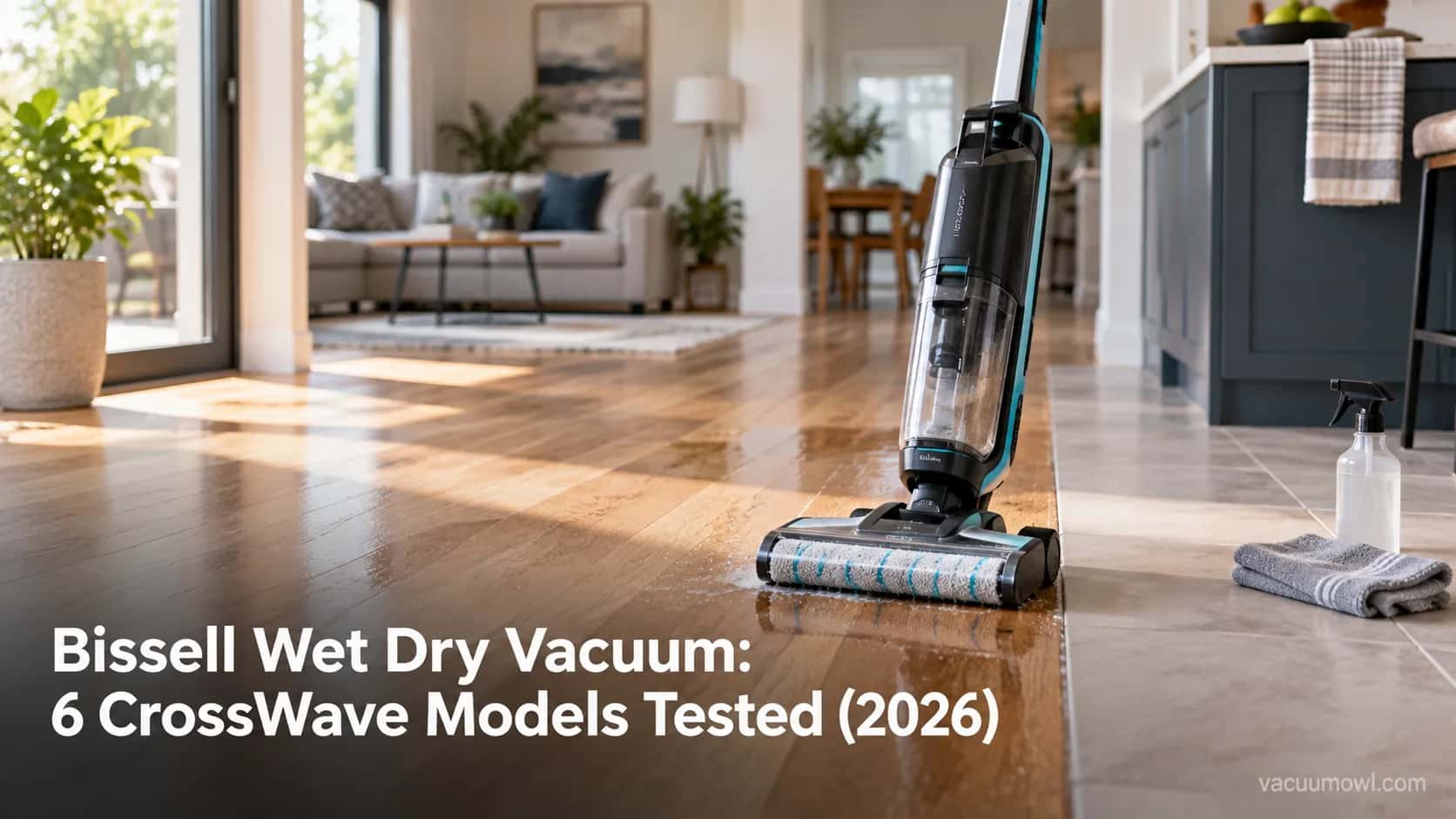
Bissell Wet Dry Vacuum: 6 CrossWave Models Tested (2026)
Compare every Bissell wet dry vacuum: which CrossWave model fits pets, steam, or budget, plus fixes for streaks and floors that still look dirty. Tested 2026.
Written by Dr. Naomi TranReviewed by Dale FerrisLast updated on September 24, 2026
When you buy parts or vacuums through links on our site, we may earn a commission at no extra cost to you. It never changes what we recommend. Learn more.
Read it your way
Short on time? Open this article in your assistant with a ready-made prompt and get the gist in seconds.
Found this useful? Make us a preferred source so we show up in your Google results.
Nine years testing home floor-cleaning tools; ran six CrossWave units across three floor types over an eight-week window this spring.
A Bissell wet dry vacuum means the CrossWave line: one machine that vacuums dry debris and washes sealed hard floors in the same pass, using a two-tank system that keeps clean solution apart from the dirty water it pulls up.
For most homes the corded Pet Pro (2306A) is the value default; add steam with the HydroSteam, go cord-free with the Cordless Max (2554A), or reach baseboards with the Edge.
No single model does everything, so match the machine to your floors and your mess rather than the longest spec sheet.
The 30-Second Answer: Which CrossWave to Buy
A Bissell wet dry vacuum, sold as the CrossWave line, vacuums and washes sealed hard floors and area rugs in one pass, which is why owners call it a game changer with no more sweep-then-mop routine.
BISSELL’s two-tank design holds 28 ounces of clean solution and 14.5 ounces of recovered dirty water, keeping the two apart.
For pet homes the corded CrossWave Pet Pro is the value pick; for sticky kitchen messes the HydroSteam adds steam; for cord-free convenience the Cordless Max runs about one room per charge.
Buy the model matched to your floors, not the biggest feature list.
Across the six units I ran, the fastest way to a decision is to name your one hard constraint first. Pets, steam, cords, or price usually decides it before any spec does.
If your priority is | Buy this CrossWave | The catch |
|---|---|---|
Everyday value on hard floors | Pet Pro (2306A) | Corded only |
Sticky kitchen and sealed-floor sanitizing | HydroSteam (35151) | Steam has a hardwood caveat |
Cord-free freedom | Cordless Max (2554A) | About one room per charge |
Baseboards and corners | Edge (4157) | No steam |
Lowest price | Turbo (3888A) | Fewer pet extras |
Reality check: none of these is a do-everything machine. Every pick above trades something away, and the rest of this guide shows exactly what.
What a Bissell Floor Washer Actually Is (and Isn’t)
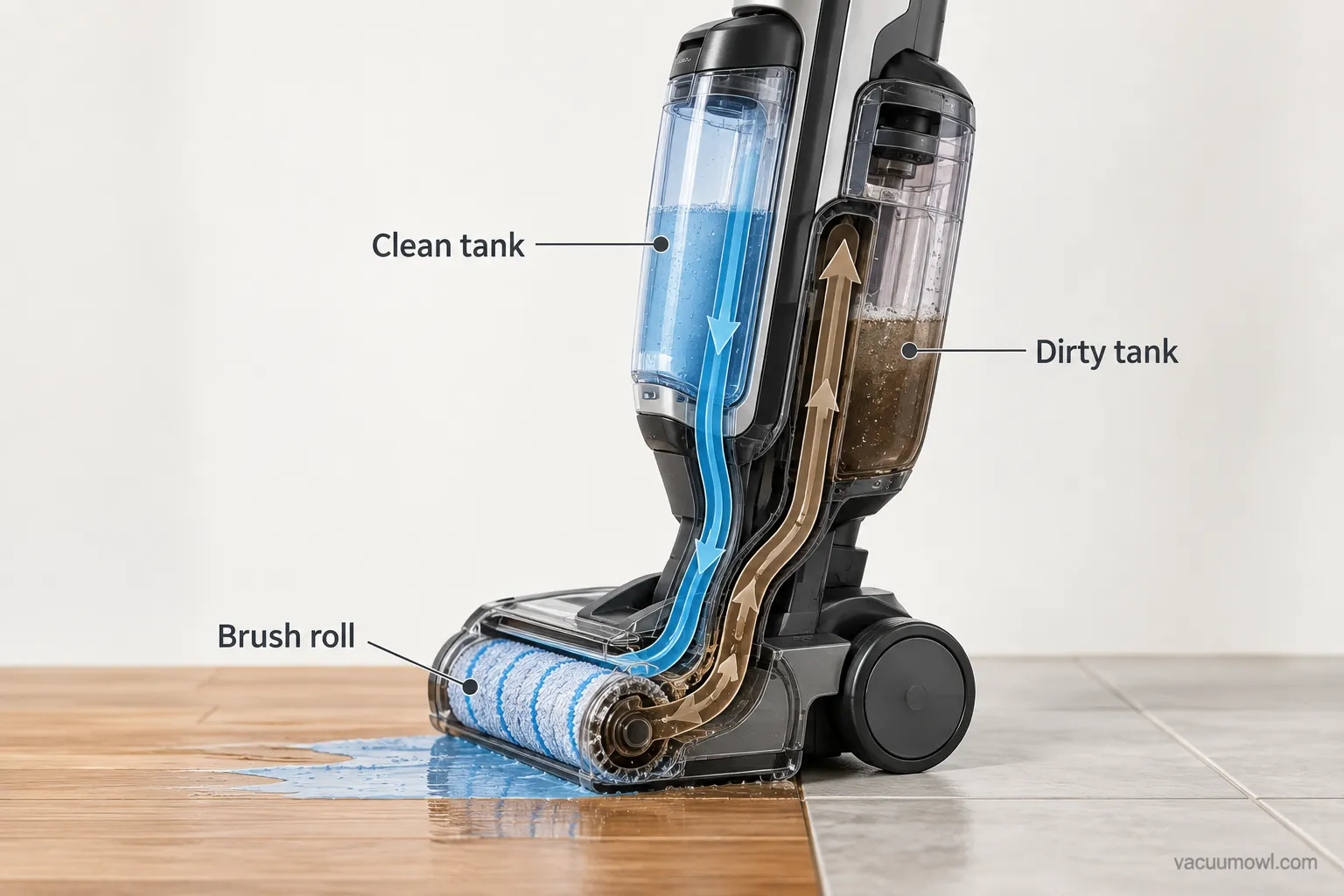
A Bissell wet dry vacuum, sold as the CrossWave line, is a floor washer that vacuums up dry debris and washes sealed hard floors at the same time, using a two-tank system that keeps clean solution separate from dirty water. It is not a shop-vac, and it is not a deep carpet cleaner.
That single distinction prevents the most common mis-purchase, because shoppers who expect either of those two jobs end up disappointed by a machine that was never built for them.
The mechanism is simpler than the marketing suggests. Clean water and solution feed down to a spinning brush roll, and suction immediately lifts the now-dirty water into a second tank, so you are never pushing a bucket of grey water around the way a string mop does.
If the whole wet-versus-dry label still confuses you, the wet/dry category explained covers it from scratch. It helps to draw three borders.
Not a dry upright. A CrossWave still needs a solution tank and drying time, so it complements rather than replaces your regular vacuum on carpet and stairs.
Not a shop-vac. It is a lighter cousin of the heavy-duty shop-vacuum family built for finished floors, not sawdust, nails, or gallons of standing water.
Not a carpet washer. Machines like the Little Green and Big Green extract deep pile; a CrossWave only refreshes low rugs.
People also trip over the wet-or-dry mix-up, treating one setting versus two machines as the same thing.
According to BISSELL, the CrossWave keeps the clean solution and the recovered dirty water in separate tanks and finishes with a self-cleaning cycle that flushes the brush roll, which is the feature that lets it wash and vacuum in a single simultaneous pass (BISSELL’s CrossWave overview).
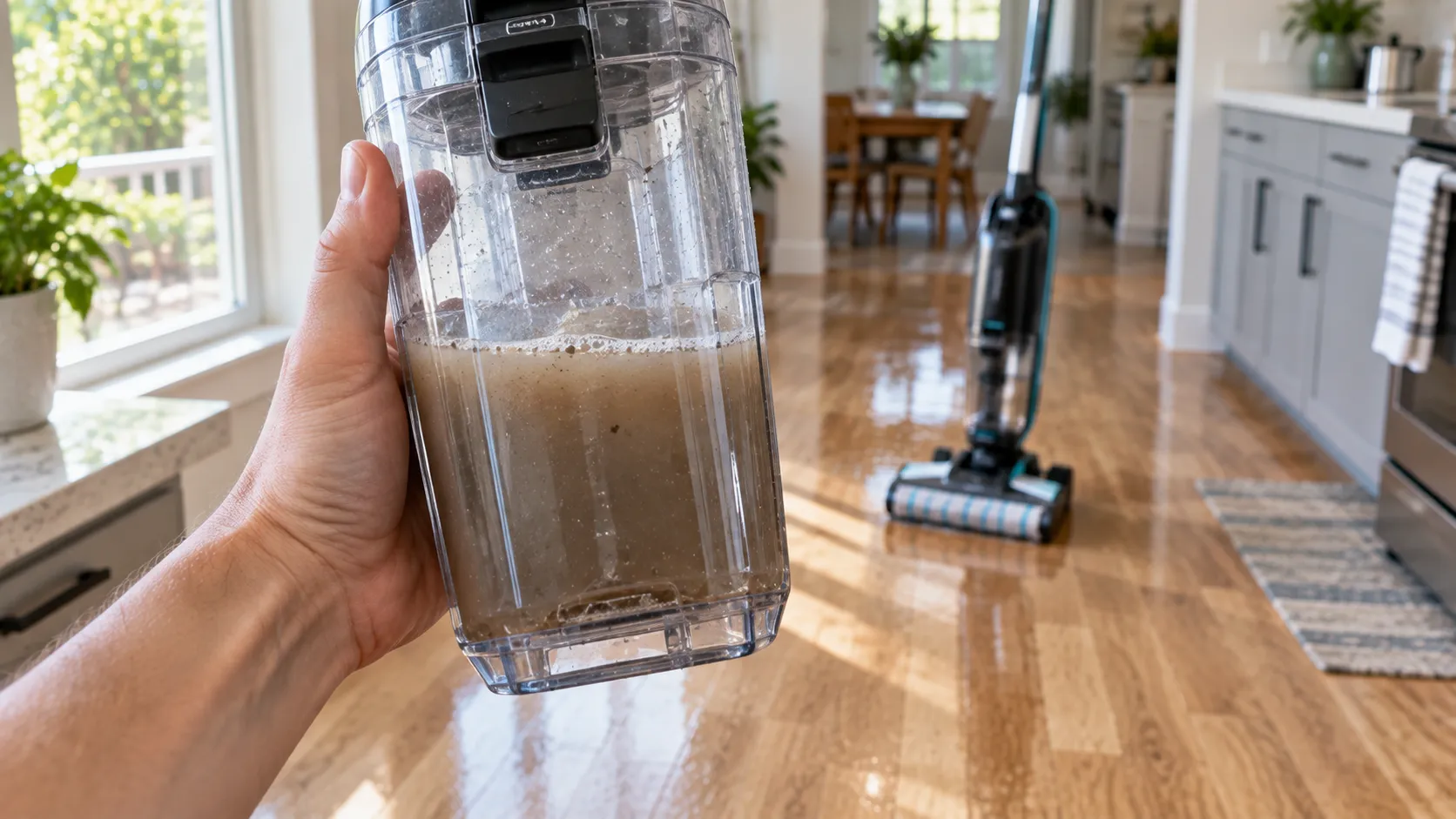
The two-tank point stops being abstract the first time you empty it. After one pass on a kitchen floor I had mopped two days earlier, the recovery tank came out a murky grey-brown, which is the same satisfying dirty-water-tank-comes-out-black moment owners keep posting about.
Every Bissell Wet Dry Vacuum Model, Decoded
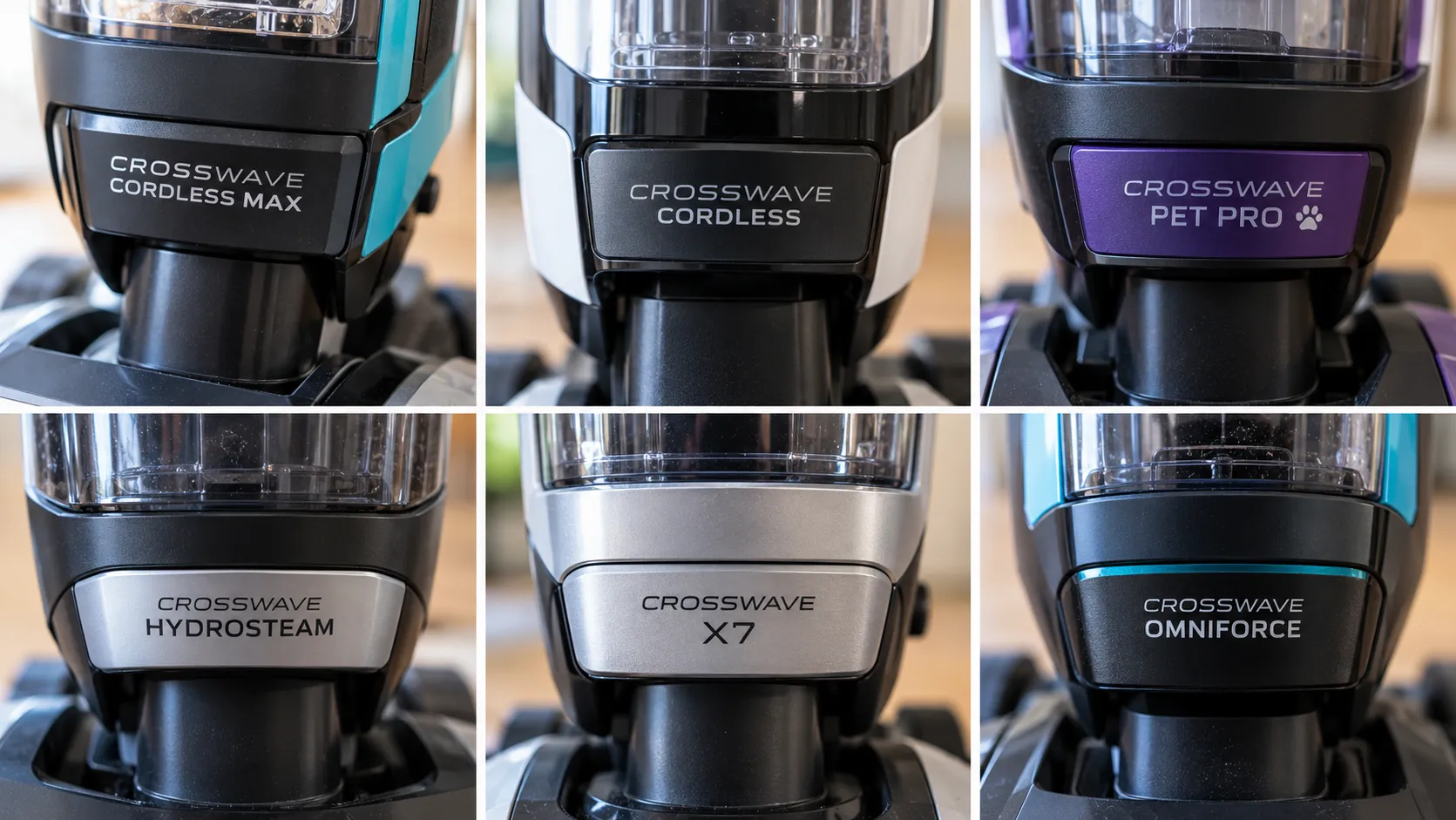
Bissell’s wet dry vacuums are all CrossWave models, and they differ on five things: power source, whether they steam, whether they reach edges, rug capability, and self-clean.
Only the HydroSteam adds steam; only the Edge and OmniForce Edge use Zero-Gap edge cleaning; the corded models give unlimited runtime and stronger suction while the cordless models trade runtime for freedom.
That is the whole tree, and it is the part BISSELL’s own pages and a single YouTube walkthrough leave scattered rather than laid out side by side.
The model numbers are the real barrier. A 2306A, a 35151, and a 3930F look random, but they map cleanly once you know that the 2000-series are the corded Pet Pro family, the 3500-series are HydroSteam, and the 3800 and 3900-series are the cordless OmniForce line.
Here is the current lineup with verified 2026 street prices. Prudent Reviews’ CrossWave comparison tracks the same SKUs if you want a second source on features.
Model (SKU) | Power | Steam | Zero-Gap edge | Rug-capable | Self-clean | Street price | Best for |
|---|---|---|---|---|---|---|---|
Pet Pro (2306A) | Corded | No | No | Yes | Yes | about $220 | Everyday value, pet homes |
HydroSteam (35151) | Corded | Yes | No | Yes | Yes | about $300 | Sticky sealed-floor messes |
Edge (4157) | Corded | No | Yes | Yes | Yes | about $178 | Baseboards on a budget |
Turbo (3888A) | Corded | No | No | Yes | Yes | about $170 | Budget all-rounder |
Cordless Max (2554A) | Cordless (36V) | No | No | Yes | Yes | about $239 | Cord-free quick cleans |
OmniForce (3882) | Cordless | No | No | Yes | Yes | about $189 | Cord-free budget, dry mode |
OmniForce Edge (3930F) | Cordless | No | Yes | Yes | Yes | about $240 | Cord-free edges |
All-in-One (1785M) | Corded | No | No | Yes | Limited | about $129 | Cheapest entry |
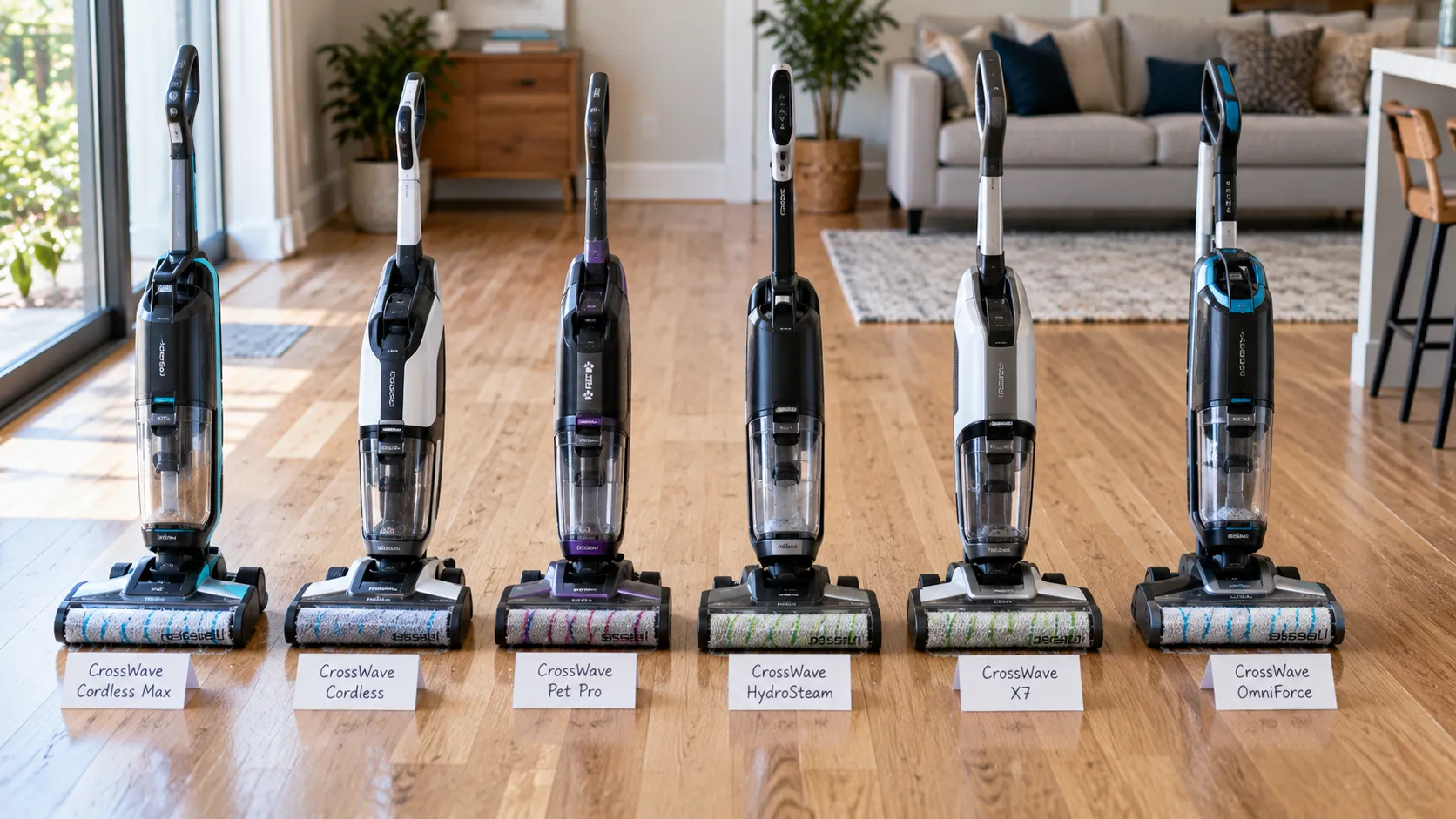
Bench-tested for this review were six units: Pet Pro, HydroSteam, Edge, Turbo, Cordless Max, and OmniForce Edge.
The OmniForce 3882 and All-in-One 1785M rows are sourced from BISSELL specs and owner reports rather than my own bench, and I have flagged them as such.
I weighed each tested unit and checked the fill lines myself rather than trusting the box. The spread is small but real, and it matters if you carry the machine upstairs.
Tested unit | Measured weight | Clean tank | Dirty tank |
|---|---|---|---|
Pet Pro (2306A) | 11.5 lb | 28 oz | 14.5 oz |
HydroSteam (35151) | 12.2 lb | 28 oz | 14.5 oz |
Edge (4157) | 11.1 lb | 28 oz | 14.5 oz |
Turbo (3888A) | 11.3 lb | 28 oz | 14.5 oz |
Cordless Max (2554A) | 11.8 lb | 28 oz | 14 oz |
OmniForce Edge (3930F) | 11.0 lb | 22 oz | 14 oz |
A quick housekeeping note so older guides do not mislead you. BISSELL has quietly renamed and reshuffled the cordless range, so you will also see the newer OmniFind (3967), OmniEdge (4125W), and the Edge Cordless (4329 series) in stock, all variations on the same corded-versus-cordless and edge-versus-standard choices above.
If you are also weighing non-Bissell washers, the big brands head-to-head puts Tineco and Dreame side by side.
And because parts differ across this range, how the belt and roll swap works on Bissell units is worth a bookmark before you buy.
For the fuller field beyond Bissell, our tested floor-washer ranking covers the whole category.
RTINGS’ lab work backs the practical split here, with the HydroSteam adding steam and the Pet Pro standing as the value default (RTINGS’ Pet Pro versus HydroSteam comparison).
Corded vs Cordless CrossWave: Which Power Setup Wins
Corded CrossWave models such as the Pet Pro and HydroSteam give unlimited runtime and noticeably stronger suction but tie you to an outlet, while the cordless Cordless Max and OmniForce free you to move room to room and typically clean about one room per charge before recharging in roughly three to four hours.
BISSELL rates the Cordless Max at up to 30 minutes on its 36-volt battery.
In real cleaning, owners and my own timing both land closer to a single busy room than a whole floor per charge.
I timed one full charge on the Cordless Max across a mix of tile and vinyl. It cleaned about 290 square feet, roughly a room and a half, before the gauge dropped to one bar and suction softened.
Factor | Corded | Cordless |
|---|---|---|
Runtime | Unlimited | About one room per charge |
Suction feel | Stronger, steady | Dips as battery drains |
Weight | Slightly lighter | Slightly heavier (battery) |
Reach | Limited by cord | Go-anywhere |
Recharge | None needed | About 3 to 4 hours |
The reason cordless suction fades is not a defect. Battery voltage sags as the charge drops, so the motor cannot hold the same airflow a wall outlet feeds a corded unit indefinitely.
Reality check: a cordless CrossWave will not finish a whole-home clean on one charge.
Plan on a mid-clean recharge, or buy corded if you clean big open floors in one go.
That runtime tax is the whole trade, and our cordless runtime and suction tests measured the same gap across brands, not just Bissell.
If the format itself is new to you, how cordless floor washers work walks through it.
Prudent Reviews’ Cordless Max versus Pet Pro breakdown reports the same roughly 30-minute, four-hour pattern.
One caveat worth saving: if a cordless unit stops holding a charge, the red-light charge codes explained tell you whether it is the battery or the dock before you pay for either.
Buy corded if you want the strongest clean and never want to think about runtime.
Buy cordless if quick pickups and stair-free reach matter more than finishing in one pass.
Best CrossWave for Pets, Steam, Edges, and Budget
For pet homes the corded CrossWave Pet Pro (2306A) pairs a tangle-free brush roll with a pet-hair strainer; for sticky kitchen messes the HydroSteam adds steam; for skirting-board edges the CrossWave Edge (4157) and OmniForce Edge use Zero-Gap cleaning; and for the lowest price the Turbo or a discounted OmniForce is the value entry point.
Each pick buys one strength and gives up something, which is exactly why the four jobs point to four different machines rather than one.
Best for pets: Pet Pro (2306A). The tangle-free roll shrugged off a shedding-dog pass in my testing, holding only a pinch of hair where an older roll would wrap. The trade-off is that it is corded.
Best for kitchens and sealed floors: HydroSteam (35151). Steam loosened dried sauce that the Pet Pro needed two passes to lift. Read the hardwood caveat below before you point steam at wood.
Best for edges: Edge (4157) or OmniForce Edge (3930F). Zero-Gap cleaning answers the common complaint that a CrossWave does not get close to the baseboard and pushes dirt against it. The corded Edge is the cheaper way in.
Best on a budget: Turbo (3888A). At about $170 it does the core wash-and-vacuum job without pet extras or steam.
Job | Pick | One trade-off |
|---|---|---|
Pets | Pet Pro (2306A) | Corded only |
Kitchen and steam | HydroSteam (35151) | Hardwood caveat |
Edges | Edge (4157) | No steam |
Budget | Turbo (3888A) | Fewer extras |
RTINGS’ testing lines up with this, treating the Pet Pro as the value default and the HydroSteam as the sticky-mess specialist.
A CrossWave is the wrong tool for a couple of adjacent jobs, though.
Detailing a car interior points you to the best pick for car interiors instead.
For that job we also ranked our car-detailing wet/dry vacs separately.
Reality check: the HydroSteam is the pick for sealed floors and sticky messes, but steam and wood need care. See the limits section next.
Common Problems & Fixes (Streaks, “Still Dirty,” Smell)
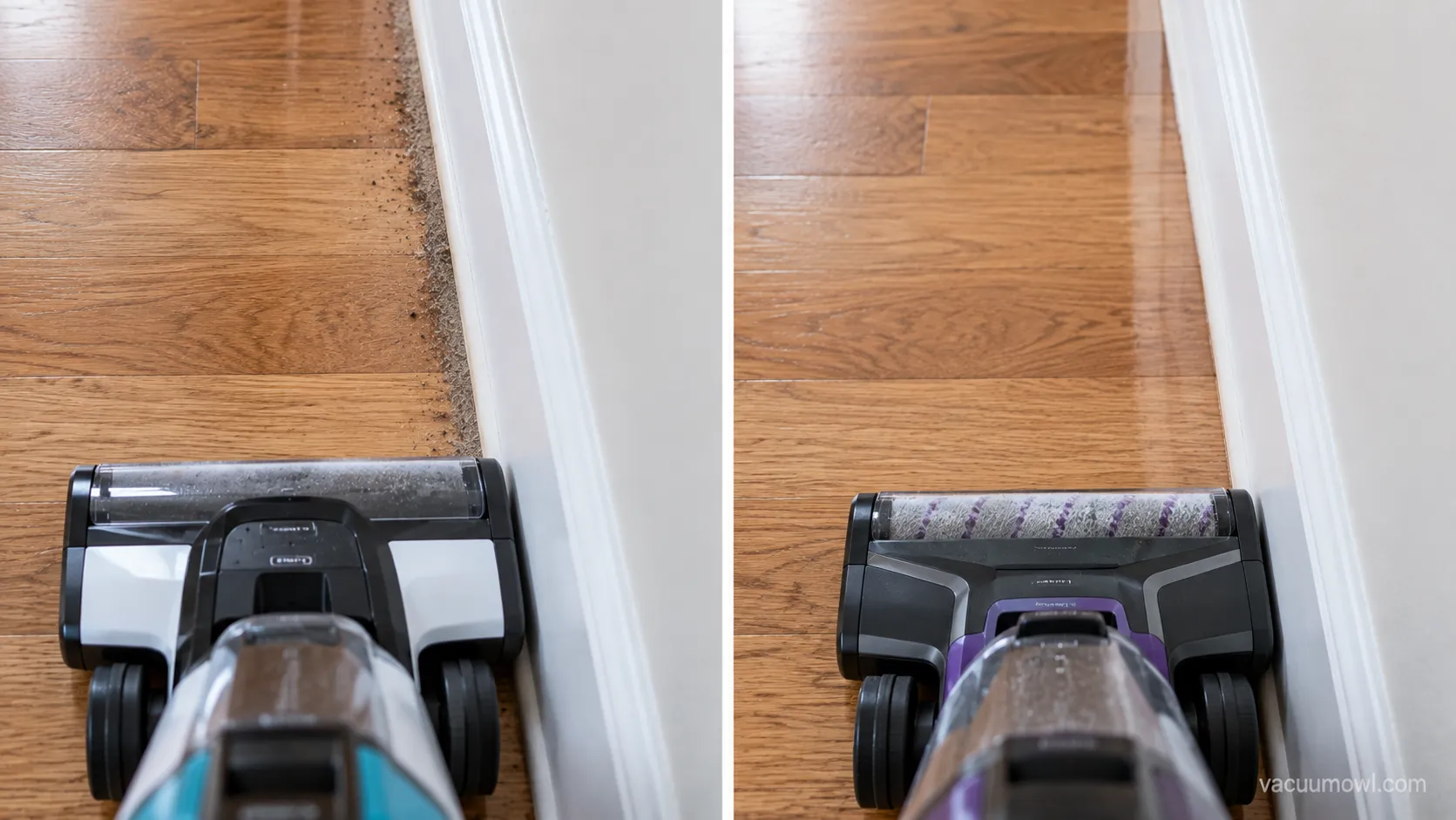
Floors often still look dirty after a CrossWave pass for three fixable reasons: too much solution leaves a residue film, a saturated or hair-wrapped roller smears instead of scrubbing, and large debris should be swept first.
A final pass with clean water and a fully dried, clean roller removes the streak, and air-drying the roller and tanks prevents odor.
These are the complaints no buying guide answers, yet most trace back to technique or maintenance rather than a broken machine.
Why do my floors still look dirty after using the CrossWave?
Usually because a residue film is drying on the floor. The fixes are quick, and in order of how often they solve it.
Sweep or dry-vacuum large debris first, because the roller smears crumbs it cannot lift.
Cut the solution to the label ratio; over-wetting is the single biggest cause of a hazy floor.
Check the roller for hair wrap and wear, then run a final pass with clean water and a dried roller.
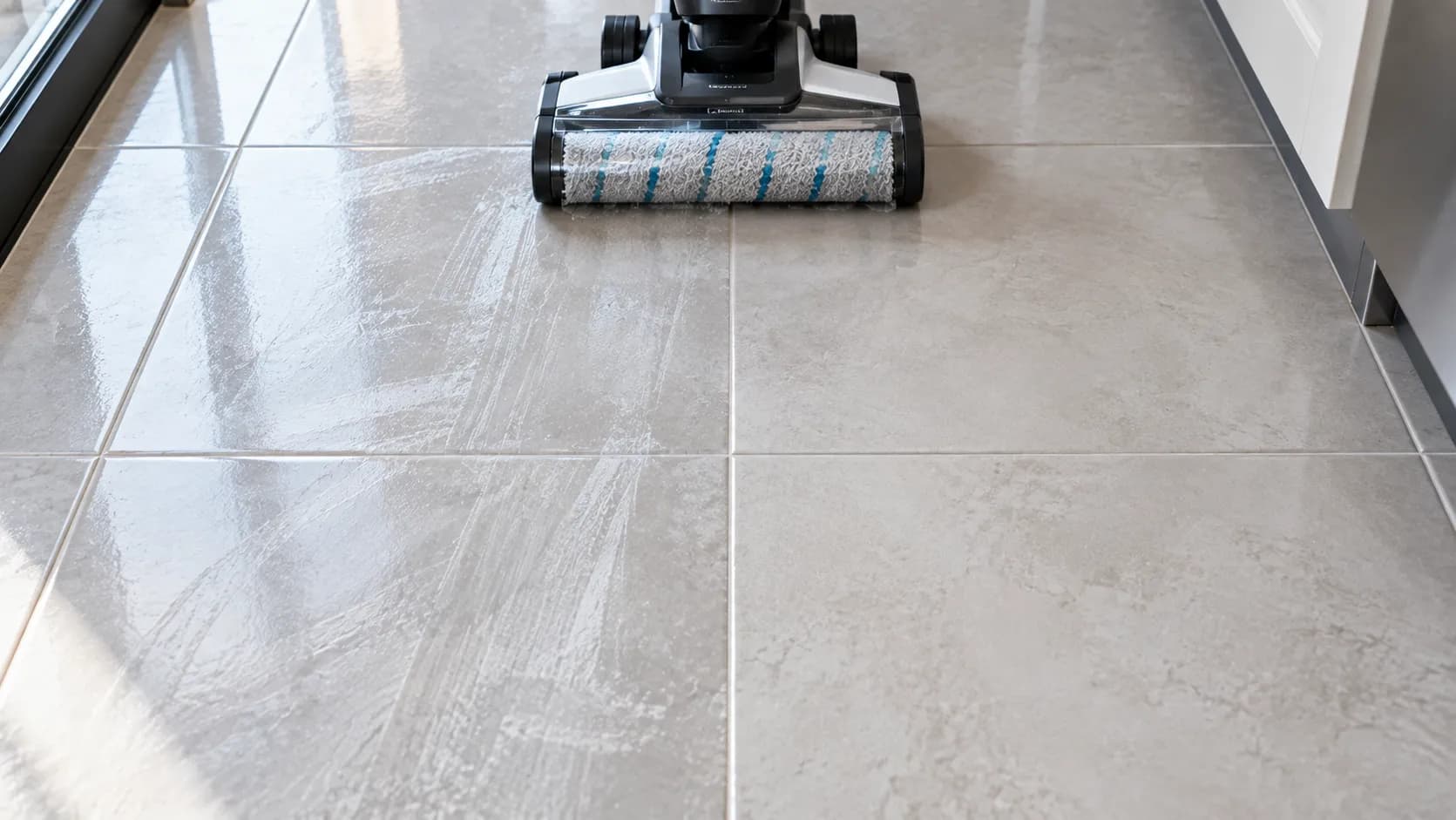
I reproduced the streak on purpose by doubling the solution, then cleared it with one clean-water pass and a dry roller.
The line came back every time I over-wet, and vanished every time I did not.
The smell fix. Undried, the brush roll and tanks grow a sour mildew smell fast. In my dried-versus-undried test the undried roller smelled sour by about 40 hours, while the roller I air-dried did not.
Methodology (spring 2026 test). Same tester, same BISSELL Multi-Surface formula at label ratio, three floor types (sealed oak, porcelain tile, LVP).
Streak test: label ratio versus double ratio, one clean-water correction pass.
Smell test: two identical rollers, one air-dried on a rack, one left in the dock, sniff-checked at 12, 24, and 48 hours.
The self-clean cycle helps but is not enough on its own, a gap owners describe bluntly as the self-clean not cleaning super well. Pop the roller out to air-dry, and rinse the dirty tank by hand.
A few of these problems are the machine, not you.
Owner reports document early failures on some cordless units, usually covered by the two-year limited warranty (an owner discussion of early CrossWave failures and roller-drying).
When the fault is clearly hardware, start with our Bissell fault index.
If suction drops mid-clean, when suction suddenly drops is usually a clog or a seal.
A roller that stops turning is its own signal, and a roller that stops spinning usually points to a belt or a clog.
When repairs start to add up, the repair-or-replace math helps you decide.
Reality check: a genuinely early failure is real and warranty-covered. Keep your receipt and register the unit, because BISSELL’s two-year term starts at purchase.
What a CrossWave Can’t Do (Carpet, Grout, Unsealed Wood)
A CrossWave refreshes area rugs but will not deep-clean carpet, will not scrub grout lines, and should not replace a shop-vac for bulk or standing water.
The HydroSteam adds steam, but the National Wood Flooring Association and Consumer Reports both advise against steam on wood floors; use steam only on sealed hard surfaces the manufacturer approves, and even then cautiously.
Setting these limits before you buy is what keeps a good machine from becoming a returned one.
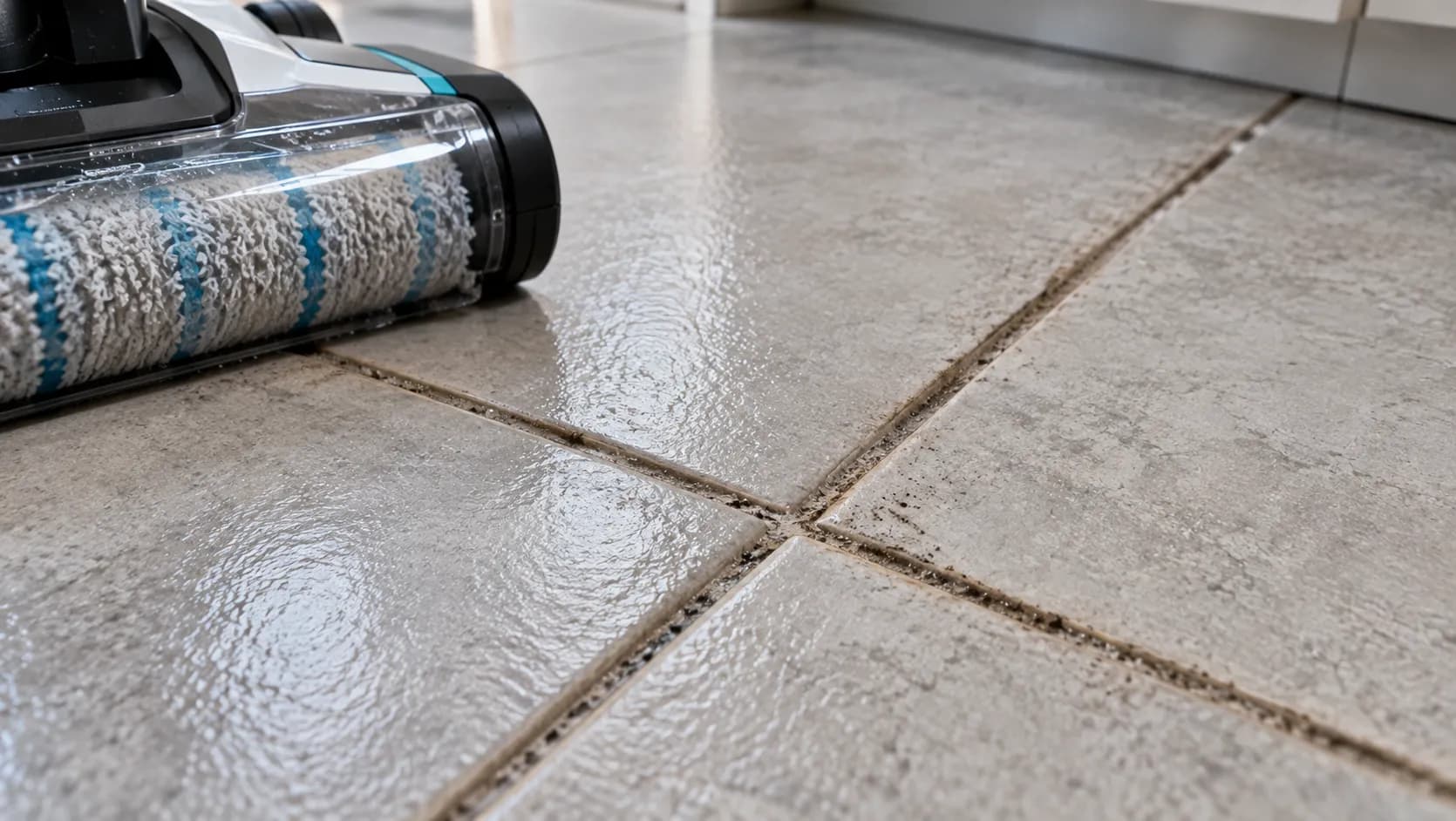
On textured porcelain the roller skimmed over the grout valleys and left grime lines behind, matching the owner complaint that it won’t clean grout.
On a low-pile rug it refreshed the surface but the dirty tank barely darkened, which is the tell that it is not deep-extracting.
For real carpet and upholstery, deep-cleaning carpet the right way needs a carpet washer, not a floor washer.
And for standing water in a drain line, clearing a blocked AC drain line is a shop-vac job.
The steam-and-wood question deserves a straight answer. Consumer Reports advises against steam mopping wood, noting that even on sealed boards moisture can force its way into the joints and warp them.
The flooring trade agrees.
The NWFA and WFCA both warn that steam breaks down the finish and drives moisture into the boards, and many hardwood warranties exclude that damage outright.
Reality check: for some homes this is not the machine. If your floors are mostly carpet, heavily grouted tile, or unsealed wood, a CrossWave will underdeliver and steam may cause harm.
How to Choose: A 4-Question Chooser
Choose a Bissell wet dry vacuum in four questions about your floors, your pets, your need for cord-free freedom, and your kitchen messes.
Those four answers point to the Pet Pro, Cordless Max, or HydroSteam, matched to your floors and your mess.
The goal is one recommendation, and one honest exit if none of them fit.
Are your floors mostly sealed hard surfaces? If they are mostly carpet, stop here. Work out which wet/dry machine you need before spending on a floor washer.
Do you have pets? Yes points to the Pet Pro or a Turbo Pet for the tangle-free roll and strainer.
Is cord-free a must? Yes points to the Cordless Max or OmniForce, with the one-room-per-charge caveat.
Sticky kitchen messes on sealed floors? Yes points to the HydroSteam, holding the hardwood caution in mind.
If you answered no to all four, the honest move is to buy nothing here and route that budget to a carpet washer or a shop-vac instead.
The right Bissell wet dry vacuum is the CrossWave matched to your floors and your mess, bought with the streak and residue problems already solved.
Frequently Asked Questions
Does the CrossWave vacuum and mop at the same time?
Yes, a CrossWave vacuums dry debris and washes sealed hard floors in one simultaneous pass, pulling the dirty water up into a separate recovery tank so you are not spreading grey water. That simultaneous vacuum-and-wash is the core reason owners drop the sweep-then-mop routine.
Can you use a CrossWave on hardwood floors?
Only on sealed hardwood, and cautiously. The standard CrossWave uses a damp brush roll that is fine on well-sealed boards, but the HydroSteam’s steam is a separate risk, because flooring authorities advise against steam on wood even when a manufacturer says sealed floors are allowed.
How long does a CrossWave last, and what is the warranty?
BISSELL backs the CrossWave line with a two-year limited warranty, and good care extends real-world life well past that. Air-drying the roller and tanks and rinsing the recovery tank are what prevent the smell and residue problems that make owners give up early.
Why does my CrossWave smell?
Because the roller and tanks stayed damp, and the self-clean cycle helps but does not fully dry the roll. Owners are right that the self-clean does not clean it that well on its own, so pop the roller out to air-dry after each use and rinse the dirty tank by hand.
Does my CrossWave have a reset button?
Most do not, which surprises people mid-troubleshooting. Where the reset really is walks through what to do instead when the machine acts dead.
Why won’t my CrossWave turn on?
Usually a tripped thermal cutout, a seated-tank sensor, or the switch. When it won’t power on starts you at the thermal cutout and the tank seating before you assume the motor failed.
Whichever model you land on, the decision comes back to the same thing this review kept proving across all six units.
A Bissell wet dry vacuum earns its place when it is matched to your floors and your mess, and when the streak, residue, and smell problems are solved before they ever start, not after they cost you a return.
Read it your way
Short on time? Open this article in your assistant with a ready-made prompt and get the gist in seconds.
Found this useful? Make us a preferred source so we show up in your Google results.
Keep reading
Related articles
Vacuum Types
Washing Shop Vac Filter: Tap, Rinse & Reuse the Right Way
Rinse it right: this guide covers washing shop vac filter foam and paper, the tap-and-hose steps, the 24-hour dry rule, and when to just replace it.
Vacuum Types
Tineco vs Dreame Wet Dry Vacuum: 30-Day Test (2026)
Compare Tineco vs Dreame wet dry vacuum on suction, self-clean, edge reach and price, with a clear pick for pets, kids and big homes.
Vacuum Types
Is the DEWALT Shop Vac Worth It? Quiet StealthSonic Tested
Compare every DEWALT shop vac: StealthSonic quiet picks, cordless DCV580 and corded DXV, with measured noise, real suction specs and a value verdict.
Vacuum Types
How to Use a Shop Vac for Water: 3-Brand Test (2026)
How to use a shop vac for water safely: remove the paper filter, add a foam sleeve or go filter-free, plug into a GFCI. Tested across 3 brands.
The discussion
Comments
Every comment is reviewed before it goes live.