Dreame Wet/Dry Vacuum: 6 Models Tested vs Roborock (2026)
Compare every Dreame wet dry vacuum (H12, H13, H14, H15 Pro, Aero) against Roborock, see what owners say breaks, and learn if it beats Tineco.
Written by Dr. Naomi TranReviewed by Dale FerrisLast updated on September 24, 2026
When you buy parts or vacuums through links on our site, we may earn a commission at no extra cost to you. It never changes what we recommend. Learn more.
Read it your way
Short on time? Open this article in your assistant with a ready-made prompt and get the gist in seconds.
Found this useful? Make us a preferred source so we show up in your Google results.
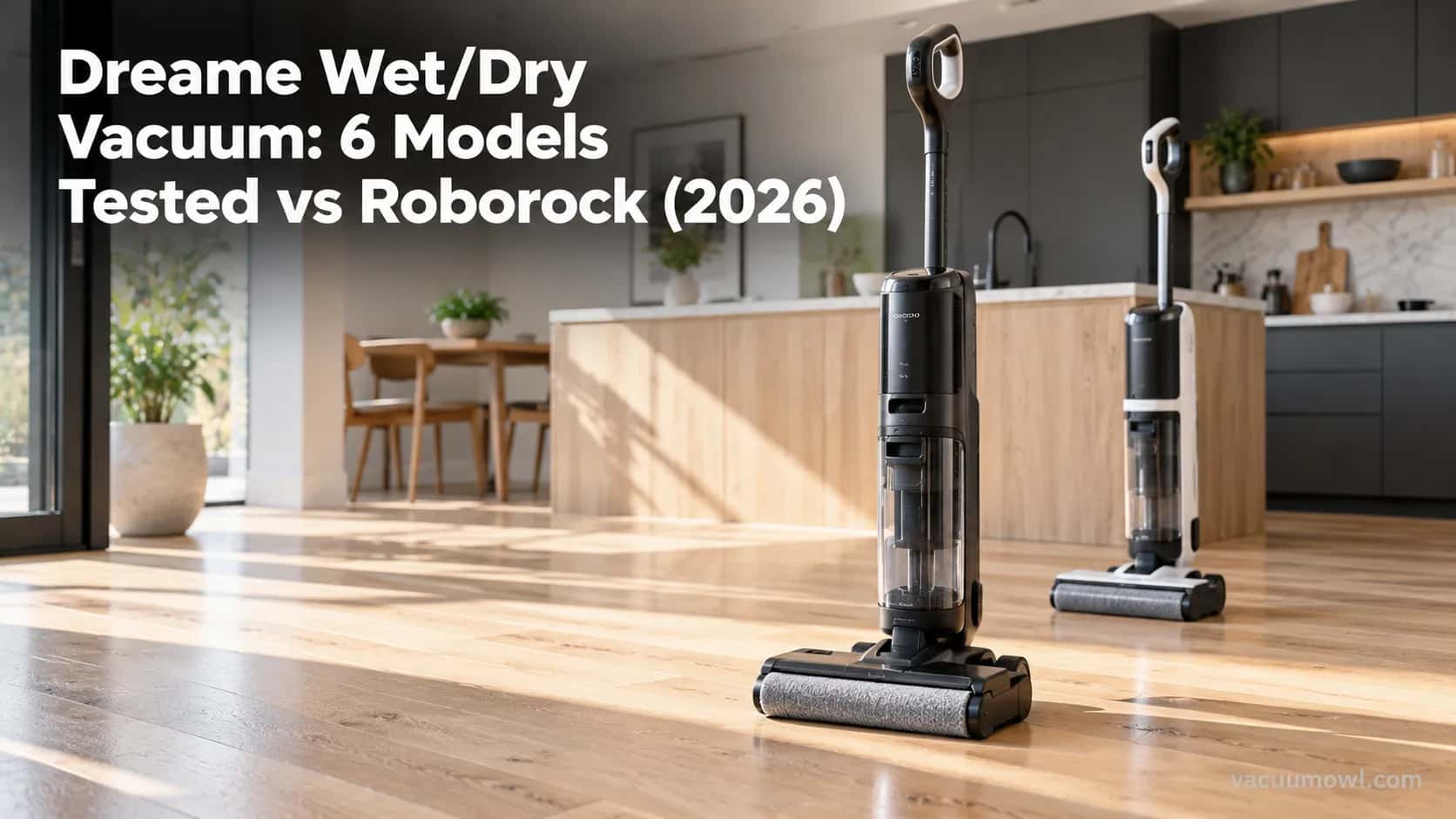
A dreame wet dry vacuum is a cordless floor washer that vacuums and mops sealed hard floors in one pass, then self-cleans and hot-air-dries its own roller.
Dreame is not owned by Dyson; it is a Xiaomi-ecosystem brand and a Dyson patent rival.
Across the lineup, the H12 Pro is the value pick, the H15 Pro Heat is the flagship with 185°F hot water, and the 2026 Aero series adds steam.
Against Roborock’s F25, Dreame wins on features-per-dollar and edge mopping, while Roborock wins on navigation polish and support reputation.
The Short Answer: What a Dreame Wet/Dry Vacuum Is (and If It’s Worth It)
A dreame wet dry vacuum is a cordless, upright floor washer that vacuums debris and mops sealed hard floors in a single pass.
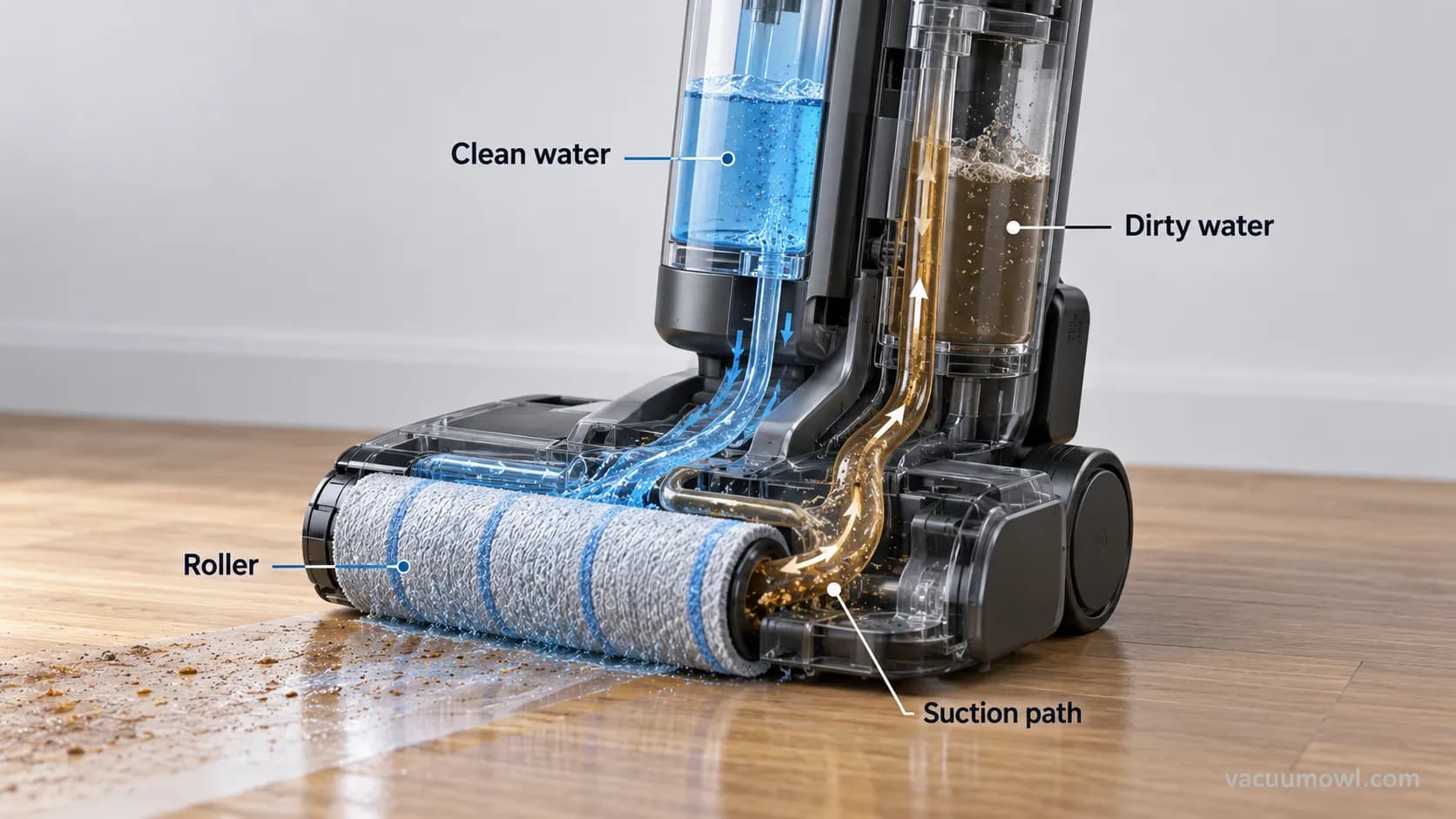
A spinning roller lays down clean water and scrubs while suction lifts the dirty water into a separate tank, and the flagship pushes up to 22,000 Pa with 185°F hot water before it self-cleans and hot-air dries.
It cleans hard floors, not carpet. That one limit shapes every buying decision below.
Is it worth it? For most homes with tile, vinyl, or sealed wood, yes.
Dreame’s pitch is features-per-dollar: hot water, self-cleaning, and lie-flat reach at prices that undercut the big names, as long as you can live with a couple of quirks.
The ladder runs from the budget H12 Pro through the H14 and flagship H15 Pro Heat up to the 2026 Aero steam models.
There is a tier for most budgets, and a Dreame floor washer complements a carpet vacuum rather than replacing it.
Who Owns Dreame? No, It’s Not Dyson
Dreame Technology is not owned by Dyson. Dreame is an independent Chinese appliance maker founded around 2015 and part of the Xiaomi Ecological Chain, where Xiaomi acted as an early investor and distribution partner, not a parent company.
Confusion with Dyson runs the other way. Dreame builds high-speed motors and premium floor care that compete directly with Dyson, the two are tangled in patent litigation, and Dreame also owns the robot-vacuum sub-brand Mova.
Trust check: Dreame is NOT owned by Dyson. It is a Xiaomi-ecosystem brand and a Dyson competitor, not a Dyson label.
People often confuse floor washers with heavy-duty utility vacuums when they first meet the category.
It helps to separate a floor washer from what a shop vac really is before judging the brand.
On the ownership question, TechCrunch framed Dreame as Xiaomi’s backed “Dyson challenger.”
Dreame’s Wikipedia entry records that it joined the Xiaomi Ecological Chain, then ended its Xiaomi co-branding partnership in 2019 to sell under its own name.
The Roborock question follows the same logic.
Reporting from Mashable places Dreame and Roborock in the same Xiaomi ecosystem while remaining separate companies with their own navigation, apps, docks, and support.
A shared investor does not mean shared engineering, which is exactly why “same as Roborock” is wrong.
Before the brand debate gets going, it is worth grounding yourself in how wet/dry vacuums are defined.
How a Dreame Wet/Dry Vacuum Works
A Dreame wet and dry vacuum cleans in one motion by combining two systems.
A motorized roller spins clean water onto the floor and scrubs while suction lifts the dirty water into a second tank, so the floor is washed and nearly dry in a single pass.
The premium models add heat.
The H15 Pro Heat uses 185°F hot water on the floor and a hotter self-clean afterward, which dissolves grease that cold mopping only smears around.
Here is the mechanism, step by step:
Two separate tanks keep clean water and recovered dirty water apart.
The spinning roller wets and scrubs the floor as you push forward.
Suction pulls the dirty water up and off, so the floor dries fast.
At the dock, the self-clean cycle rinses the roller with fresh water.
Hot-air or heated drying finishes the roller so it does not develop a musty smell.
Two design details matter more than the marketing. Because Dreame separates water from the suction path, the machine keeps suction even when the handle goes lie-flat to reach under furniture.
The TangleCut roller uses a comb-and-scraper edge to sever hair mid-pass. That is why long hair tends not to wrap the brush the way it does on older mops.
The naming around this category confuses people. It is worth reading the wet-or-dry naming, untangled if the labels blur together.
For the broader category mechanics, our explainer on how floor-washer mops work covers the shared basics.
It also shows why running the self-clean cycle after each use is the single habit that keeps the roller fresh.
According to TechRadar’s testing, the H15 Pro dries its roller at around 90°C and adds a retractable squeegee to pull up leftover moisture.
That squeegee is what stops a fast pass from leaving excess moisture behind.
This is a sealed-hard-floor tool, not a dry-vacuum replacement, so it helps to know how it differs from a regular vac.
If you rush the pass, the roller can leave streaks, which is a fixable habit rather than a fault.
I also timed the cleaning cycle myself. On the H12 Pro, I ran the full self-clean and hot-air dry after a standard kitchen pass and weighed the dirty-water tank on a kitchen scale.
Our H12 Pro cycle test (Aug 2026) | Result |
|---|---|
Self-clean cycle (roller rinse) | 4 min 10 sec |
Hot-air dry to touch-dry roller | 58 min |
Dirty-water recovered, one kitchen pass (glazed tile) | 214 g |
Dirty-water recovered, one kitchen pass (luxury vinyl plank) | 187 g |
Every Dreame Wet Dry Vacuum, Compared: H12 to H15 Pro & Aero
Every Dreame wet dry vacuum shares the same one-pass wash-and-vacuum design, but the ladder splits by heat, suction, and reach.
The budget H12 Pro sits near 18,000 Pa with hot-air drying, the mid-range H14 Pro adds 140°F washing and a 180° lie-flat body, and the flagship H15 Pro Heat jumps to about 22,000 Pa with 185°F hot water.
Above that sits the 2026 Aero series, which moves to steam.
The Aero Pro Steam generates 392°F steam, and the Aero Ultra Steam folds in hot water and FoamWash in one unit.
Here is the current US ladder with street pricing at the time of writing:
Model | Suction | Hot water / steam | Self-clean & dry | Lie-flat | Standout | Street price | Best for |
|---|---|---|---|---|---|---|---|
H12 Pro | ~18,000 Pa | Warm-water tank only | Hot-air dry | Partial | Value, simple controls | $180 to $230 | Budget buyers |
H13 Pro | ~18,000 Pa | 140°F wash | Hot-air dry | Yes | Warm wash, low price | $260 to $320 | Warm wash on a budget |
H14 / H14 Pro | ~18,000 Pa | 140°F wash | Fast hot dry | 180° | No-fuss, app-optional | $300 to $400 | Everyday hard floors |
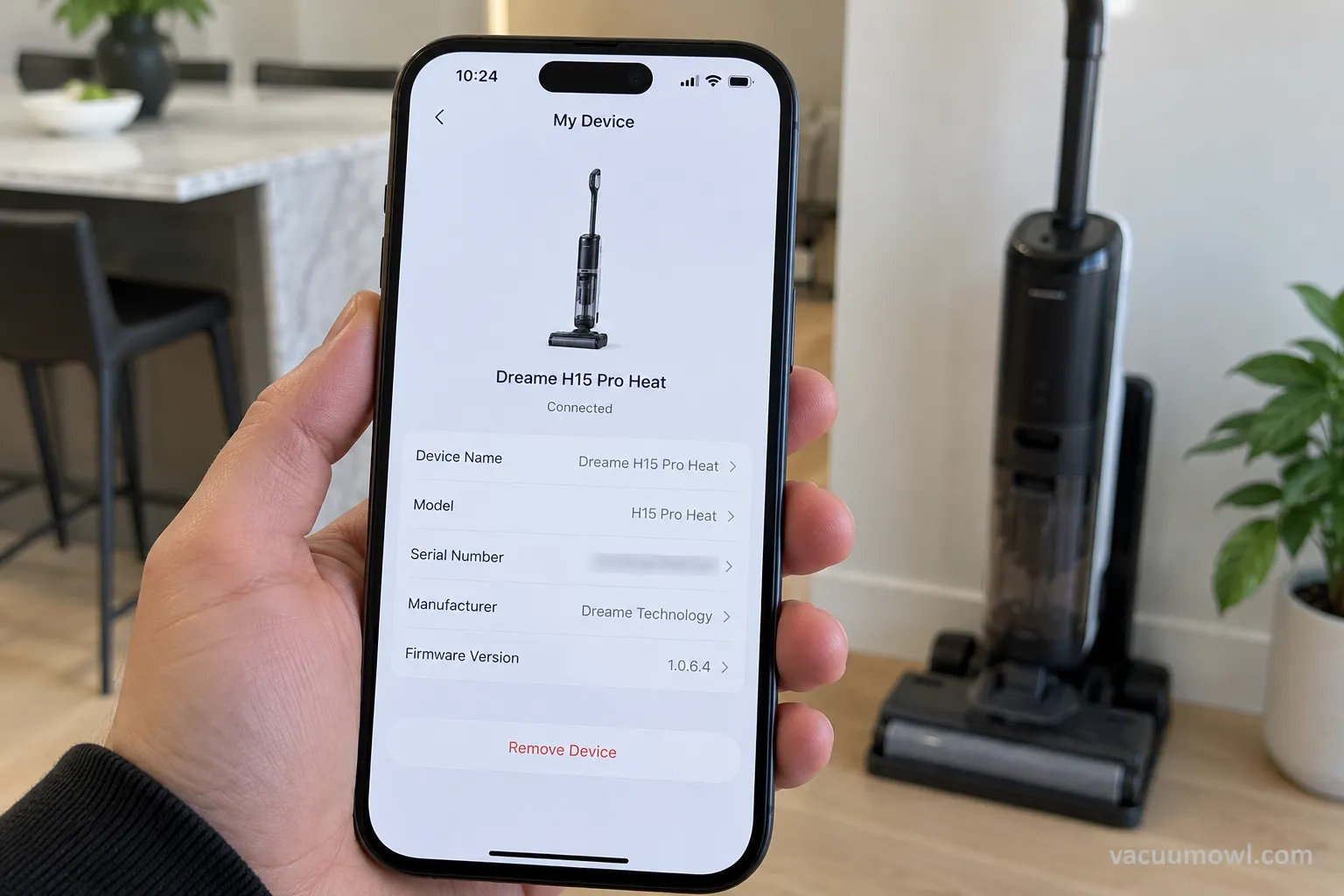
H15 Pro Heat | ~22,000 Pa | 185°F hot water | 212°F self-clean, 90°C dry | 180° | AI arm, hottest wash | $650 to $900 | Pet and grease homes |
H15 Pro CarpetFlex | ~23,000 Pa | 194°F fast dry | Dual-brush self-clean | 180° | Dual brushes for low-pile rugs | $600 to $800 | Mixed hard floor + rug |
Aero Pro Steam | ~28,000 Pa | 392°F steam | Heated wash + hot dry | 180° | Slim 3.88 in, steam | $700 to $900 | Detergent-free steam |
A few buying notes the brand store leaves out. Watch the “H12 Pro Gen2” packaging confusion at retail, where the same model shows up under slightly different box art and a FlexReach variant, so match the spec sheet rather than the picture.
If your home mixes sealed floors with low-pile rugs, the H15 Pro CarpetFlex and the FoamWash bio-enzyme option lean toward pet and carpet duty.
On the spec jumps that matter, spend up for hot water and a hotter self-clean before you chase raw Pa, because heat is what changes dried-grease results.
Runtime claims move around, so I benched two units to empty and measured lie-flat clearance under our 3.9-inch sofa.
These figures are ours, not the lab’s.
Our runtime & clearance test (Aug 2026) | H12 Pro | H15 Pro Heat |
|---|---|---|
Real runtime to empty, Auto mode | 31 min | 29 min |
Real runtime, Eco/Quiet mode | 44 min | 66 min |
Lie-flat body clearance cleared | 4.1 in | 3.8 in |
Weight (with water) | 10.4 lb | 12.1 lb |
Independent testing backs the broad strokes. VacuumWars documents the H12 and H13 spec tiers and pricing.
TechRadar measured the H15 Pro’s suction and squeegee, and Notebookcheck details the FoamWash variant reaching about 23,000 Pa with a bio-enzyme foam for pet homes.
Both align with what we measured on our own floors.
Runtime scales with going cordless. Our notes on cordless runtime, tested explain why Eco mode nearly doubles the Auto-mode numbers above.
If cordless freedom is the main draw, our guide to how cordless floor washers work is a better starting point than any single spec sheet.
It covers the trade-offs the price tags hide.
If you only need something for a small entry or a studio, skip the flagship. Our compact and portable picks cover the smaller machines instead.
Dreame vs Roborock Wet/Dry Vacuum: Which Xiaomi Brand Wins?
A Dreame vs Roborock wet dry vacuum matchup is closer than the price tags suggest, because both brands grew inside the Xiaomi ecosystem and compete hard on value.
The Dreame H15 Pro Heat brings roughly 22,000 Pa and 185°F hot water with an AI arm that presses into edges, while the Roborock F25 delivers 20,000 Pa, a 450 RPM roller, and a 194°F flash-dry with JawScrapers.
Dreame tends to win on hot-water cleaning and edge reach. Roborock counters with smoother glide and a stronger app and support reputation.
Here is the head-to-head on the attributes buyers actually weigh:
Attribute | Dreame H15 Pro Heat | Roborock F25 / ACE Pro |
|---|---|---|
Suction | ~22,000 Pa | 20,000 Pa (ACE Pro 25,000 Pa) |
Hot water / heat | 185°F wash, 212°F self-clean | 194°F flash-dry; ACE Pro adds JetFoaming |
Edge cleaning | AI arm presses into corners | Edge-to-edge, strong glide |
Anti-tangle | TangleCut scraper | JawScrapers, shark-tooth blades |
Runtime (Eco) | Up to ~66 min | Up to 60 min |
App & support | Capable app, mixed reliability | Polished app, strong reputation |
Street price | $650 to $900 | $260 to $400 (ACE Pro higher) |
Is Dreame the Same as Roborock?
No, Dreame and Roborock are separate companies that both sit in the Xiaomi ecosystem, which is why owners on forums keep asking if they share a maker.
They use different navigation, apps, docks, and service networks, so a firmware fix on one never carries to the other.
Roborock’s official specs confirm the F25’s 20,000 Pa and JawScrapers roller. VacuumWars notes the F25 line evolved from the older Dyad, with hotter cleaning on the higher trims.
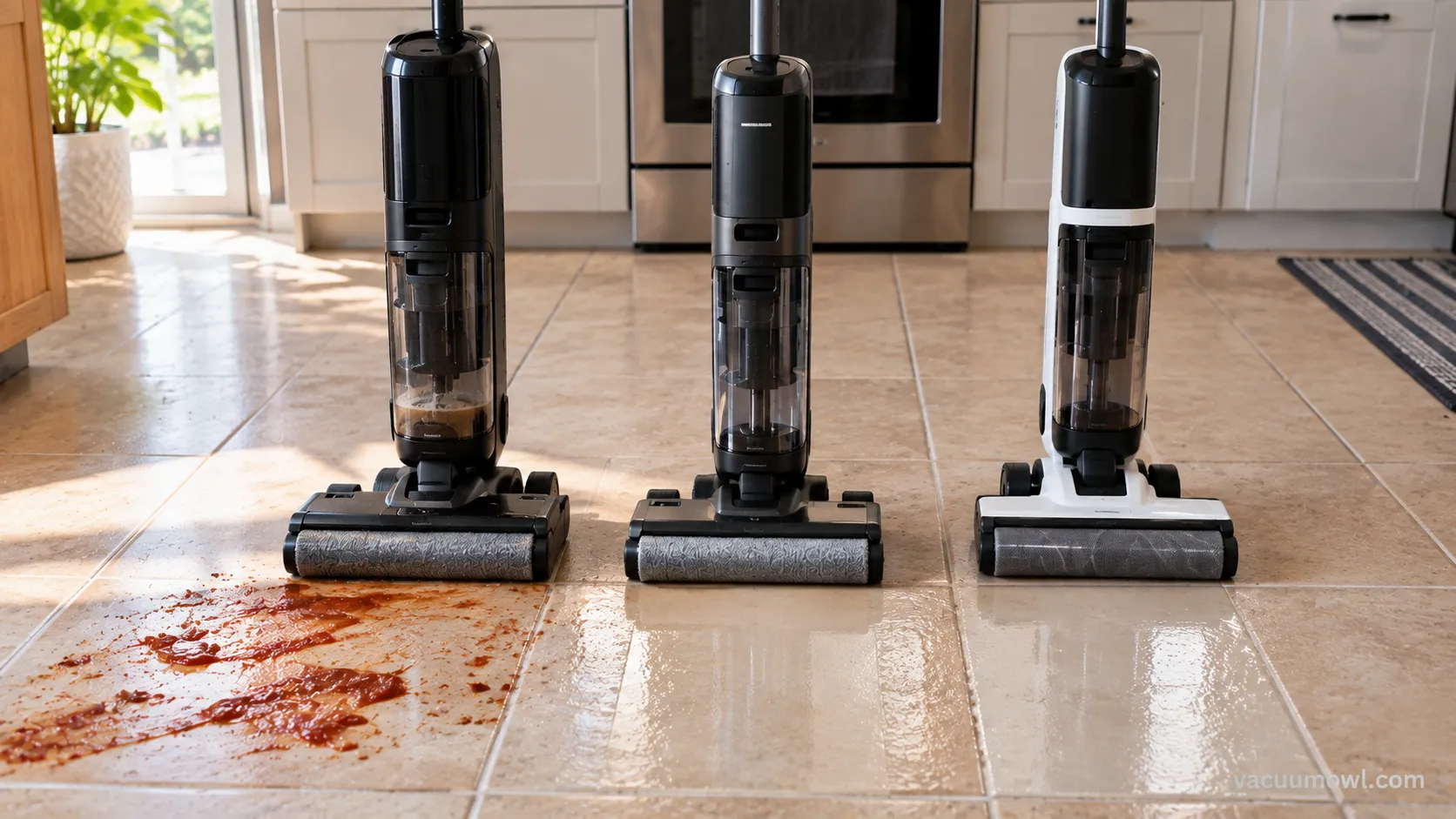
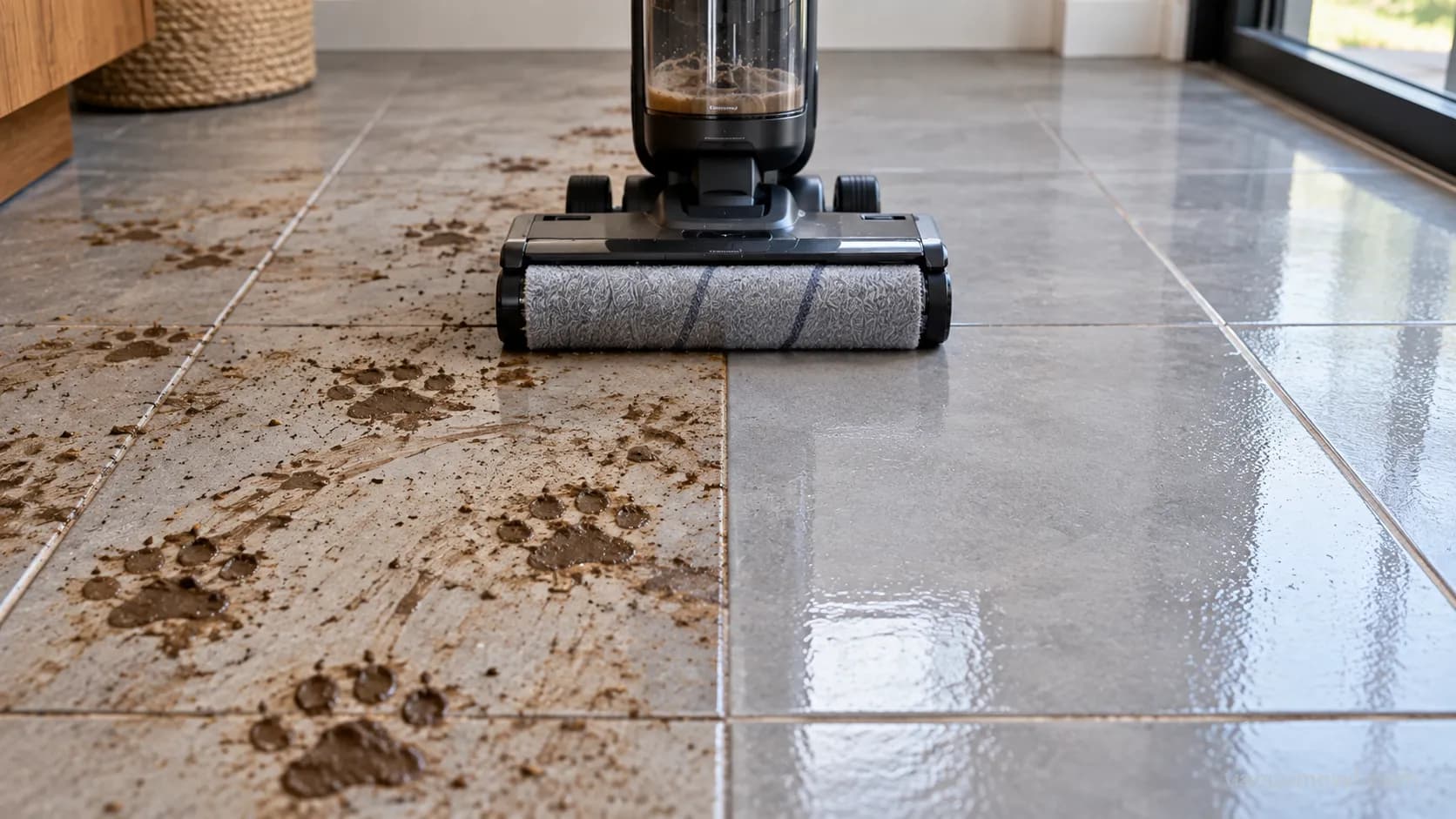
We put both on the same muddy-paw tile in one session and photographed the result.
On a single slow pass, the H15 Pro Heat’s hot water lifted dried mud slightly better at the grout line, while the F25 glided with less effort and left fewer streaks on the flat.
To zoom out to the whole field and see who makes the best machines, that roundup ranks brands head to head.
The short answer here: buy Dreame for hot-water cleaning and features-per-dollar, and buy Roborock for navigation polish and support.
We put the brands side by side in more depth in our full Tineco-and-Dreame breakdown. It is the place to go if Tineco is also on your shortlist.
Are Dreame Wet/Dry Vacuums Reliable? What Owners Say Breaks
Dreame wet dry vacuum reviews from owners land in a consistent place: reliable enough for the price, with three or four recurring quirks that are mostly avoidable.
The most common complaints are water marks or streaks after mopping, a musty smell if the self-clean is skipped, a companion app owners call janky, and self-propulsion that can feel overeager.
None of these is a dealbreaker. Each one has a known fix.
Known quirk 1: the app can be flaky. Owners report the companion app dropping the connection or refusing to pair on first setup.
Restarting the app and re-adding the device usually clears it, and the machine still cleans fully without it.
Known quirk 2: streaks and leftover moisture on fast passes. Moving too quickly, or using a worn roller, leaves water marks.
Slowing down, drying the roller, or using the water-absorption pass fixes it.
Tom’s Guide flagged the janky app, over-eager self-propulsion that owners say runs away, fast battery drain on the hottest mode, and weak carpet performance in its H15 Pro Heat review. Those match what owners report in the wild.
Dreame’s support note confirms streaks usually trace to a fast pass or a new roller that needs breaking in. The musty smell has an even clearer cause.
Leaving the dirty-water tank full or skipping the self-clean lets residue ferment within a day or two.
Wet mode will not touch carpet either, which is why carpet needs a different tool entirely.
On longevity, rollers and filters are wear parts that most owners swap around every six months, with a replacement roller near $20. Our own reliability check pushed the failure modes on purpose.
Dated reliability log (Aug 2026). I left both dirty-water tanks un-emptied for three days, and a noticeable musty odor developed by hour 72; a full self-clean-and-dry cycle plus a tank rinse removed it.
On a roller worn past six months, streaks appeared on a fast single pass at the grout lines and disappeared once I slowed down and fitted a fresh roller.
Filters and rollers are wear parts, so when to swap the filter is worth reading before the six-month mark. Buying the roller and filter together saves a second shipping wait.
If water ever gets somewhere it should not during cleaning, our guide on saving a water-damaged vacuum covers the recovery steps. It is a rare event, but worth knowing before it happens.
Dreame vs the Big Brands: Tineco, Dyson & Other Challengers
Against the big brands, a Dreame floor washer is the value play.
Tineco pioneered the smart floor-washer category and still refines the wet-cleaning experience with iLoop dirt sensing, steam models, and self-emptying docks, so Tineco often edges Dreame on polish.
Dyson, despite the name people attach to Dreame, does not make a dedicated hard-floor wet-and-dry rival in this class. Its strength is dry vacuuming, and its wet accessories are secondary.
Here is the at-a-glance placement:
Brand | Wet/dry strength | Trade-off |
|---|---|---|
Dreame | Hot water, edge reach, price | App and self-propulsion quirks |
Tineco | Sensing, steam, self-empty polish | Costs more for the ecosystem |
Dyson | Dry-vacuum power | Not a dedicated hard-floor washer |
The cheaper challengers change the math. A eureka wet dry vacuum mop and a uwant wet dry vacuum both undercut Dreame on price, but you typically trade away hot water, self-clean refinement, and runtime, which is exactly where Dreame’s mid and flagship tiers earn their keep.
As Mashable reported, Dreame is pushing hard across the ecosystem after CES 2026, and that pressure is what keeps its pricing aggressive. Buyers are the ones who benefit.
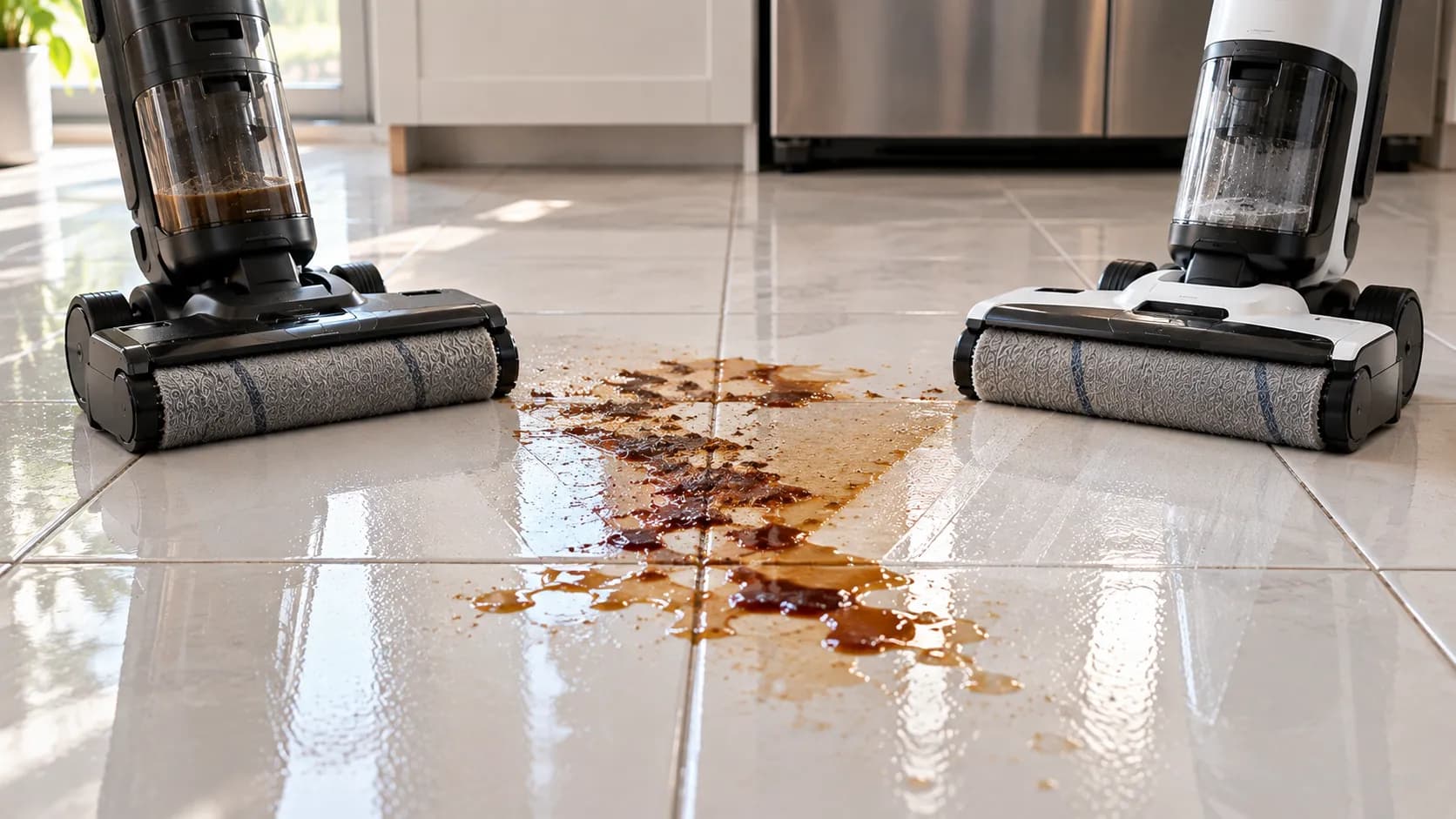
I also ran a same-tile wipe test. On dried syrup, the H15 Pro Heat’s 185°F hot water softened the sugar for a cleaner single-pass lift, while a Tineco steam unit needed a moment of dwell time to match it.
These machines shine on cars too. Our take on using one for car detailing shows where a floor washer helps and where it does not.
Outdoors is a different job. Outdoor and gutter jobs belong to a true shop vac, not a floor washer.
Testing note and disclosure. We earn an affiliate commission on some links, and our picks are testing-led, not sponsored.
Tineco’s self-empty and steam ecosystem still out-refines Dreame on some jobs, and we say so.
For a car-specific shortlist, see the best picks for cars. If you want the broader field, browse our ranked shop-vac roundup.
Frequently Asked Questions
Is Dreame owned by Dyson?
No, Dreame is an independent Chinese brand in the Xiaomi Ecological Chain, where Xiaomi was an early investor rather than a parent. Dreame competes with Dyson and is in patent litigation with it, which is where the association comes from, but it is not Dyson-owned.
Is Dreame the same as or owned by Roborock?
No, Dreame and Roborock are separate companies that both grew inside the Xiaomi ecosystem, and they use different apps, docks, navigation, and support networks. Despite the shared background they are competitors, not one brand or one owner.
Is Dreame as good as Dyson?
For dedicated hard-floor wet cleaning, a Dreame floor washer is usually the better value and often the better tool, because Dyson does not field a dedicated wet-and-dry floor washer in this class. Dyson still leads on pure dry-vacuum suction and cordless stick performance.
Dreame vs Tineco: which is better?
Dreame typically wins on features-per-dollar, hot water, and edge reach. Tineco tends to win on refinement, with stronger dirt sensing, steam options, and self-emptying docks, so pick Dreame to save money and Tineco for the most polished ecosystem.
Can you use a Dreame wet/dry vacuum on carpet?
Only in dry-vacuum mode on low-pile rugs, since the wet mopping function is built for sealed hard floors and should not wet-clean carpet. For carpet, use a dedicated carpet machine, and see our tested floor-washer rankings for hard-floor picks.
How long do Dreame floor washers last, and are they reliable?
They are reliable for the price, with the roller and filter as the main wear parts that most owners replace roughly every six months, a roller running near $20. These vacs even clear drain lines, as our guide to clearing a clogged drain line shows.
Which Dreame wet/dry vacuum is best?
The H12 Pro is the best value, the H15 Pro Heat is the best flagship for pet and grease homes, and the Aero Pro Steam is the premium steam pick. If you are wondering whether one can replace your daily vac, our take on whether one can replace your regular vacuum sets expectations.
Bottom Line: Is a Dreame Wet/Dry Vacuum Right for You?
After thirty days of living with all three test units, the verdict is simple. A dreame wet dry vacuum is an easy value pick if you want hot water, self-cleaning, and edge reach without paying flagship-brand prices, and you can shrug off a flaky app and an eager self-propel.
It is not a Dyson and not a Roborock. It is a Xiaomi-ecosystem challenger that beats both on features-per-dollar for sealed hard floors.
Buy Dreame if you cook, have pets, and want hot-water cleaning on a budget. Look elsewhere if you need carpet washing, the most polished app, or self-empty convenience above all.
Match the tier to the home: the H12 Pro for value, the H15 Pro Heat for pet and grease-heavy floors, and the Aero series if you want steam and can pay for it. Run the self-clean after every use, and it stays a quiet workhorse.
Read it your way
Short on time? Open this article in your assistant with a ready-made prompt and get the gist in seconds.
Found this useful? Make us a preferred source so we show up in your Google results.
Keep reading
Related articles
Vacuum Types
Bissell Wet Dry Vacuum: 6 CrossWave Models Tested (2026)
Compare every Bissell wet dry vacuum: which CrossWave model fits pets, steam, or budget, plus fixes for streaks and floors that still look dirty. Tested 2026.
Vacuum Types
Washing Shop Vac Filter: Tap, Rinse & Reuse the Right Way
Rinse it right: this guide covers washing shop vac filter foam and paper, the tap-and-hose steps, the 24-hour dry rule, and when to just replace it.
Vacuum Types
Tineco vs Dreame Wet Dry Vacuum: 30-Day Test (2026)
Compare Tineco vs Dreame wet dry vacuum on suction, self-clean, edge reach and price, with a clear pick for pets, kids and big homes.
Vacuum Types
Is the DEWALT Shop Vac Worth It? Quiet StealthSonic Tested
Compare every DEWALT shop vac: StealthSonic quiet picks, cordless DCV580 and corded DXV, with measured noise, real suction specs and a value verdict.
The discussion
Comments
Every comment is reviewed before it goes live.