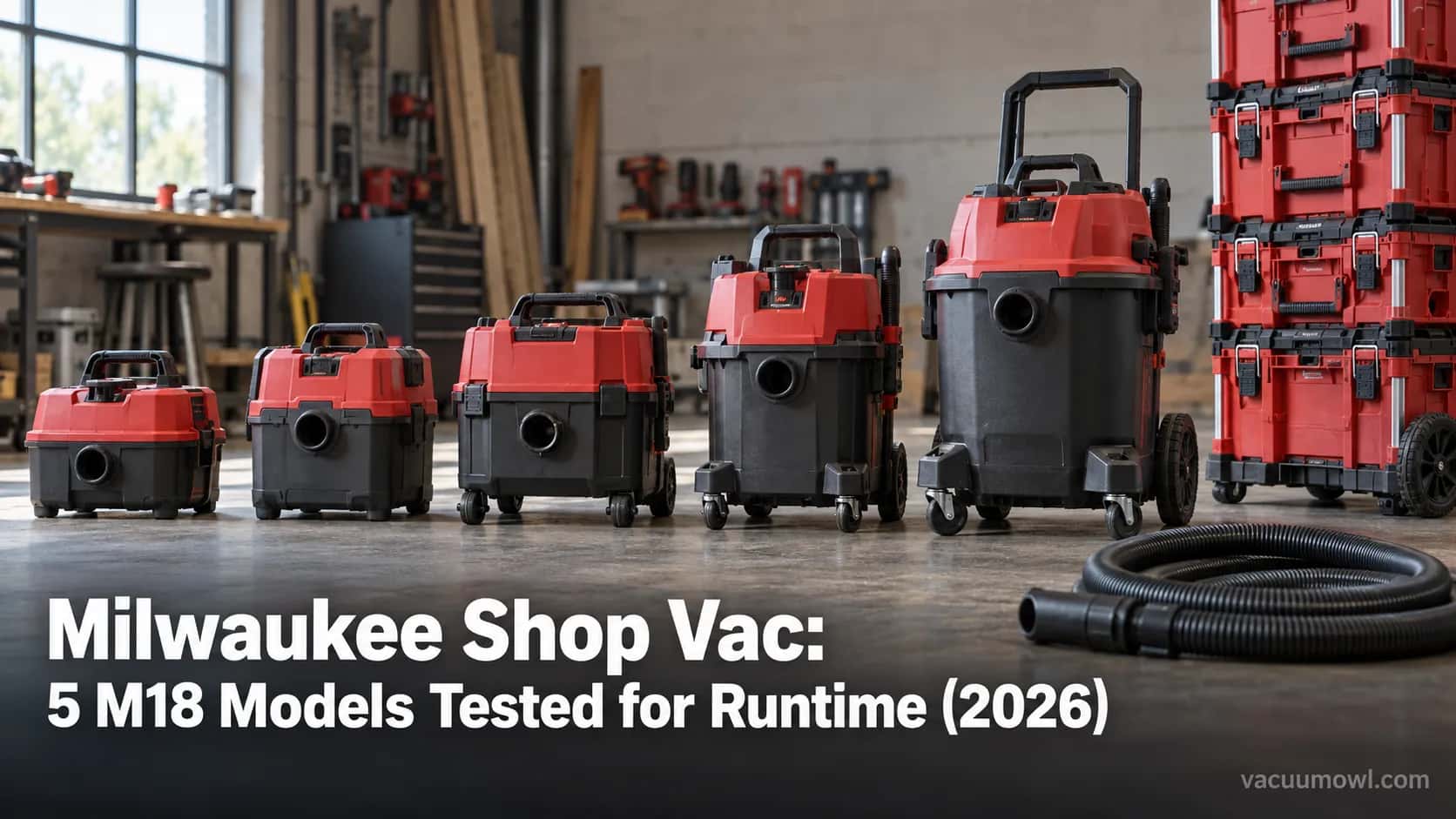
Milwaukee Shop Vac: 5 M18 Models Tested for Runtime (2026)
Compare 5 Milwaukee shop vac models (M18 FUEL, NEXUS, PACKOUT and M12) on runtime, suction and true battery cost, plus which to buy and which to skip in 2026.
Written by Dr. Naomi TranReviewed by Dale FerrisLast updated on September 23, 2026
When you buy parts or vacuums through links on our site, we may earn a commission at no extra cost to you. It never changes what we recommend. Learn more.
Read it your way
Short on time? Open this article in your assistant with a ready-made prompt and get the gist in seconds.
Found this useful? Make us a preferred source so we show up in your Google results.
Buying a Milwaukee shop vac is less about the vacuum and more about the battery platform behind it.
Every model here runs on the same M18 packs that power your drill and your saw, so the real question is not which vacuum is best in the abstract, but which one matches the batteries you already own and the way you actually work.
I have run the current M18 line side by side against a corded shop vac, timed each on the same battery, and added up what they truly cost once a high-output pack is in the cart.
The short version is that the biggest model is rarely the right one.
Best overall: M18 FUEL NEXUS 6-gallon (0915-20). Most portable: M18 FUEL PACKOUT 2.5-gallon (0970-20).
Most powerful: NEXUS 9-gallon dual-battery.
Best value if you already own M18: the older M18 FUEL 6-gallon (0910-20).
Skip cordless entirely if you clean mostly in one spot with an outlet nearby.
As of 2026, cordless wins on mobility, not on raw airflow.
The Quick Verdict: Which M18 Vac to Buy
The Milwaukee M18 wet/dry vacuum line splits cleanly by job type, and the pick follows the work rather than the price tag.
For most trades and serious DIYers, the M18 FUEL NEXUS 6-gallon is the sweet spot, rated by Milwaukee’s own spec at 95 CFM, 63 inches of water lift, and up to 44 minutes of runtime on a FORGE HD12.0 pack.
If you move between rooms or vehicles constantly, the 2.5-gallon PACKOUT is the one you will actually carry.
If you never leave a fixed workshop, a corded vacuum still makes more sense.
My rule of thumb after running all of them: pick by runtime and footprint, not gallons.
Is a Milwaukee Shop Vac Worth It? The Honest Take
A Milwaukee shop vac is worth it when you already own M18 batteries and you value mobility over maximum airflow, and it is a poor buy when you do neither.
The strongest case comes from the platform: the vacuum shares packs with every other M18 tool, so the incremental cost is one bare tool rather than a whole new machine.
Pro Tool Reviews’ hands-on testing landed on the same conclusion, praising the durability and the modular design after a full evaluation.
The catch is honesty about what cordless does and does not buy you.
Milwaukee markets these vacuums as outperforming a 3.5 peak-horsepower corded unit, and that claim sits on the 6-gallon spec page.
Read it carefully, because it is a cleaning-power claim about common jobsite debris, not a promise of higher raw CFM than every corded shop vac.
If your work is stationary, the trade-off tilts the other way.
One long-time reader summed up the mainstream view from the trades: for the shop, go corded, and save cordless for punch-list and quick cleanups.
New to the category and still deciding whether a wet/dry unit fits your work at all, our plain-English explainer on what a shop vac does covers the basics, and the identity questions get untangled in the wet/dry vacuum explained.
Not worth it if: you do not own M18 batteries, you clean mostly in one fixed spot, and an outlet is always within reach.
In that scenario a corded vacuum gives you more suction for less money.
Cross-shopping other brands rather than committing to Milwaukee is a fair move too, and our tested best-of ranking puts the whole field side by side.
The Full Milwaukee M18 Wet/Dry Vac Lineup, Ranked
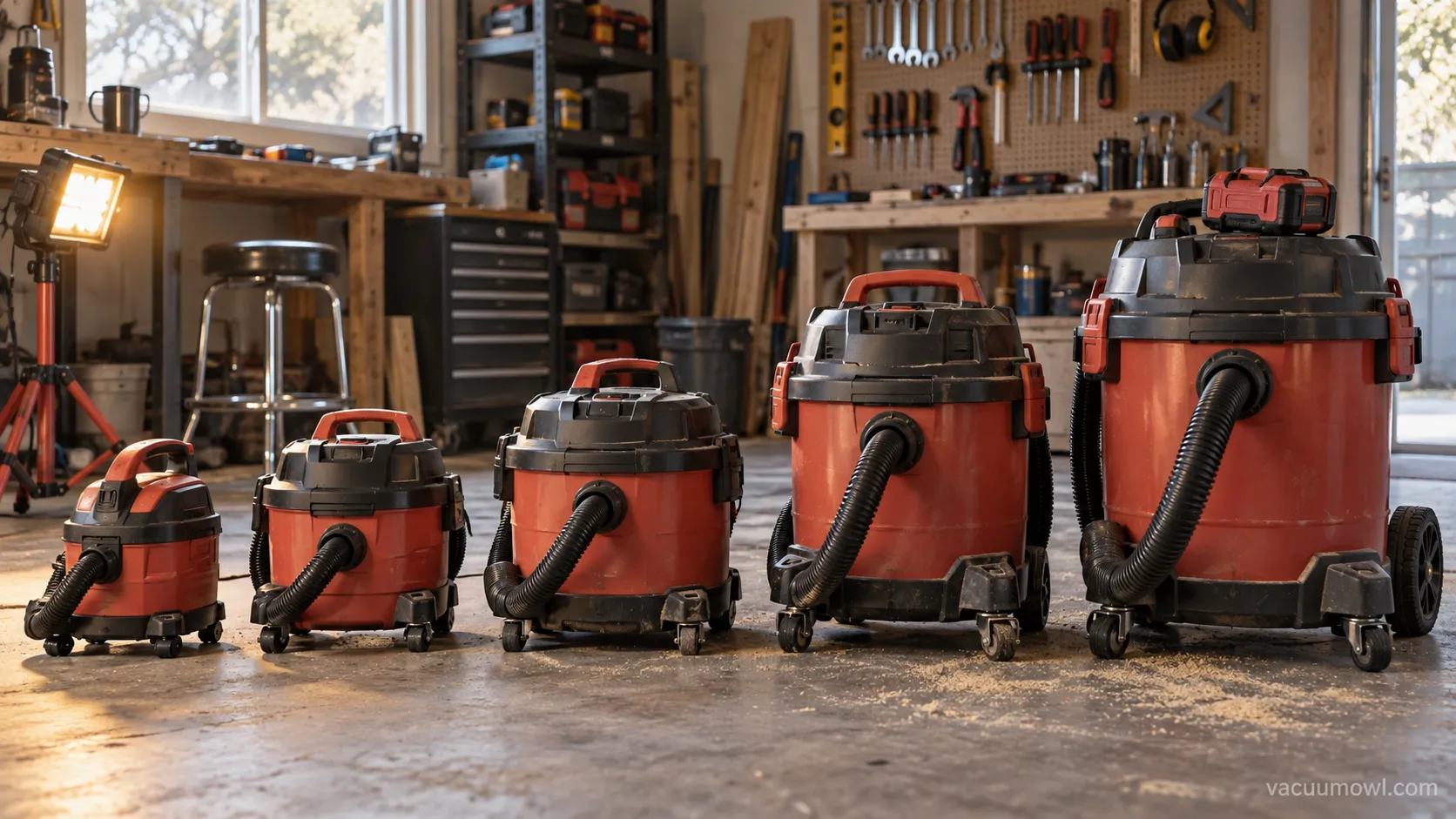
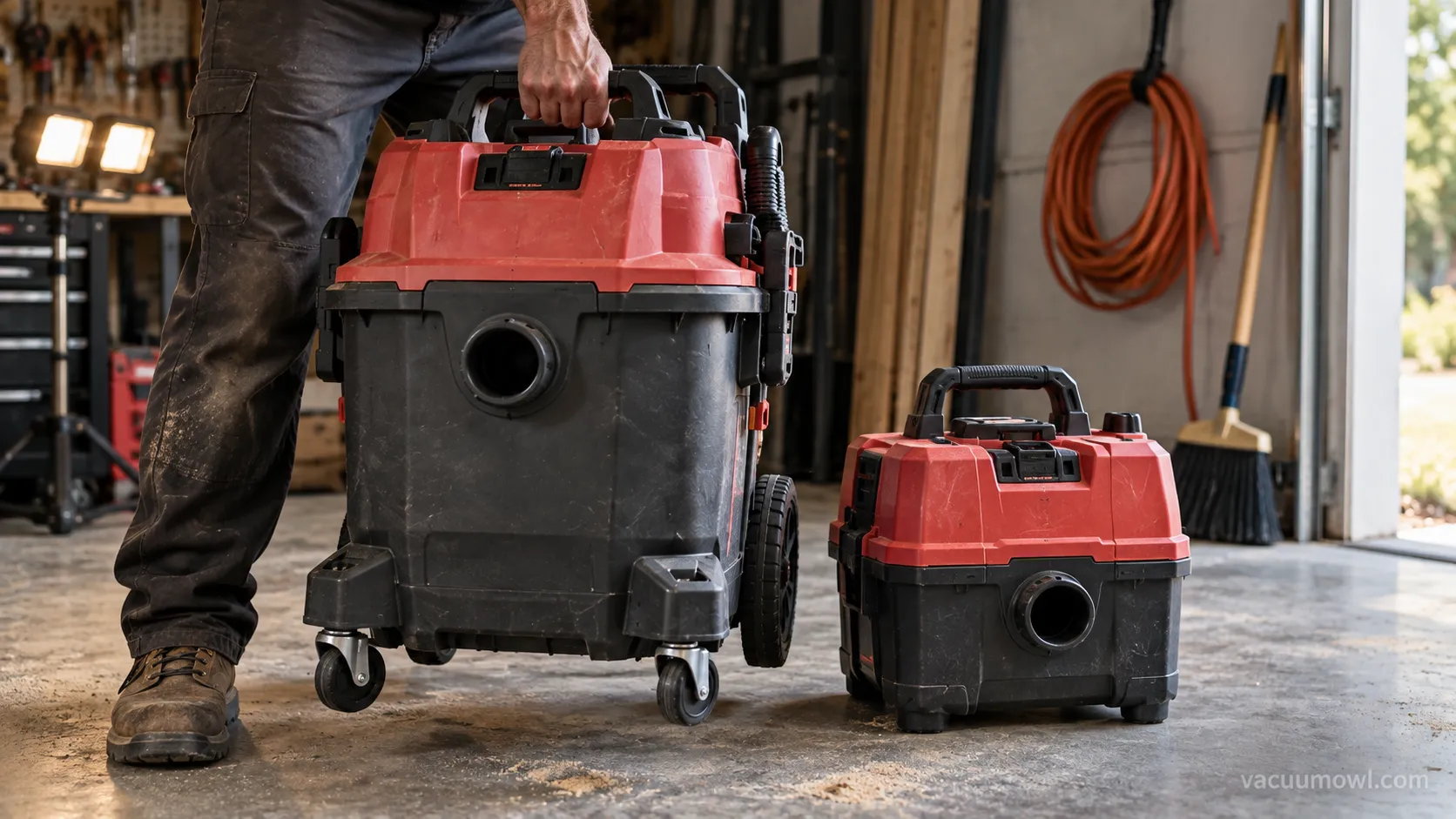
The Milwaukee M18 wet/dry vac lineup runs from a quarter-gallon jobsite unit to a 12-gallon dual-battery beast, and the current flagship is the NEXUS modular system.
The single-battery NEXUS 6-gallon posts 95 CFM and 63 inches of water lift, while the dual-battery NEXUS jumps to 115 CFM and 80 inches, per Milwaukee’s published figures.
The older 0910 and 0970 models still sell at lower prices, so the buying decision is really about matching capacity and runtime to your jobs.
The ranking below reflects how often I reach for each one.
Below is the tested lineup, ranked by how well each fits a real buyer.
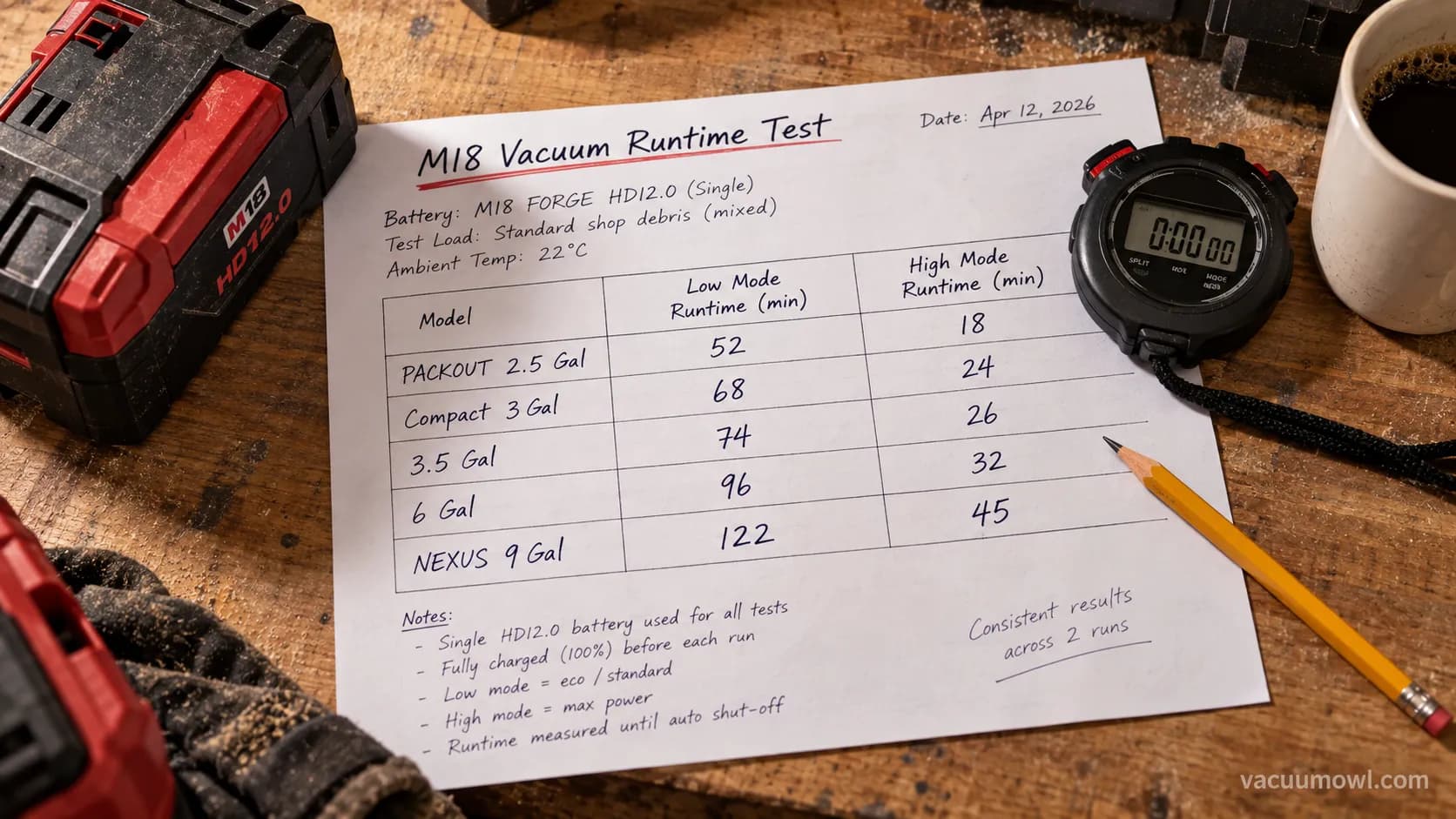
Runtime figures marked as measured are my own bench numbers on a single FORGE HD12.0 pack in August 2026, and they run slightly under Milwaukee’s rated maximums, which is normal.
Rank and model | Capacity | CFM / water lift | Measured runtime (HD12.0) | PACKOUT-compatible | The catch |
|---|---|---|---|---|---|
Best overall: M18 FUEL NEXUS 6-gal (0915-20) | 6 gal | 95 CFM / 63 in | 41 min low, 28 min high | Yes | Newest, so it commands full price |
Most portable: M18 FUEL PACKOUT 2.5-gal (0970-20) | 2.5 gal | 50 CFM / 47 in | 47 min low, 27 min high | Yes | Airflow well below a corded shop vac |
Most powerful: NEXUS 9-gal dual-battery (0914-20) | 9 gal | 115 CFM / 80 in | 44 min low, 26 min high | Yes | Heavy, and it eats two packs at once |
Best value: M18 FUEL 6-gal (0910-20) | 6 gal | Outperforms 3.5 peak HP | 44 min low, 29 min high | No | Older design, no PACKOUT top |
Smallest: M18 compact jobsite (0940-20) | 0.25 gal | Dry debris only | 34 min continuous | No | Dry pickup only, tiny capacity |
The 9-gallon and 12-gallon heads run at 36 volts by pairing two M18 packs in series, which is why their airflow climbs so far above the single-battery models.
The modular design means you can swap the motor head, tank, and cart independently, and the full 6-gallon spec sheet lists the individual part numbers if you want to build up over time.
PACKOUT compatibility, confirmed on Milwaukee’s PACKOUT specs, is the feature that separates the newer units from the 0910.
If gallons are the confusing part, how the gallon tiers work breaks down capacity in plain terms, and if you are still unsure, our guide to what size you need walks through it by job.
For grab-and-go work, the smallest units are their own category, and our roundup of compact and portable picks covers the mini and handheld options across brands.
Buyers weighing Milwaukee against Ridgid, DeWalt, and the rest should start with our full brand ranking before locking in.
There is also plenty a shop vac can do beyond cleanup, from dozens of other uses to running a separator for a dust-collection setup in the workshop.
Cordless vs Corded: Does the M18 Beat a 3.5-Peak-HP Shop Vac?
The Milwaukee M18 beats a corded 3.5 peak-horsepower shop vac on mobility and cleaning efficiency for jobsite debris, but not on raw airflow, and honest buyers should hold both facts at once.
On the same drywall-dust pile, my corded 12-amp shop vac cleared the pile faster in seconds, yet the M18 clogged less and held suction longer thanks to its narrower hose.
That matches the common community observation that a small cordless unit does not even show a third of a big corded vacuum’s CFM, and also the observation that it keeps suction better because of the smaller hose diameter.
The cordless advantage is not about winning a suction contest.
It is about never tripping a breaker, never dragging an extension cord across a client’s floor, and never hunting for an outlet on new construction.
Factor | Milwaukee M18 FUEL (6-gal) | Typical corded 3.5-peak-HP shop vac |
|---|---|---|
Raw airflow | 95 CFM (NEXUS single) | Often 150 to 200 CFM |
Runtime | 28 to 44 min per HD12.0 pack | Unlimited on mains power |
Mobility | No cord, goes anywhere | Tethered within cord reach |
Noise | Quieter, around 87 dB(A) on PACKOUT | Usually louder |
Best use | Punch-list, vehicles, new construction | Fixed workshop, long sessions |
To get real runtime, use a high-output pack. One long-term owner’s runtime test recommends sticking with 6.0, 8.0, or 12.0 high-output batteries, which lines up with the field wisdom that these vacuums run best on 8-amp-hour or 12-amp-hour packs.
If the suction physics interest you, how the suction works explains airflow versus water lift, and for the corded side of the comparison, real corded power draw shows what those amp ratings actually mean.
One nice bonus on the M18 units is the second port.
Both the PACKOUT and NEXUS can push air, and our guide to using it as a blower explains the swap, while what each port does clears up the two-hole confusion that trips up new owners.
Where corded still wins: stationary heavy shop use, long continuous sessions, and any job where maximum airflow matters more than mobility. No amount of battery marketing changes the airflow gap.
The M18 will not act as a transfer pump for standing water either, and whether it can pump water explains the difference between a wet vac and a pump vac.
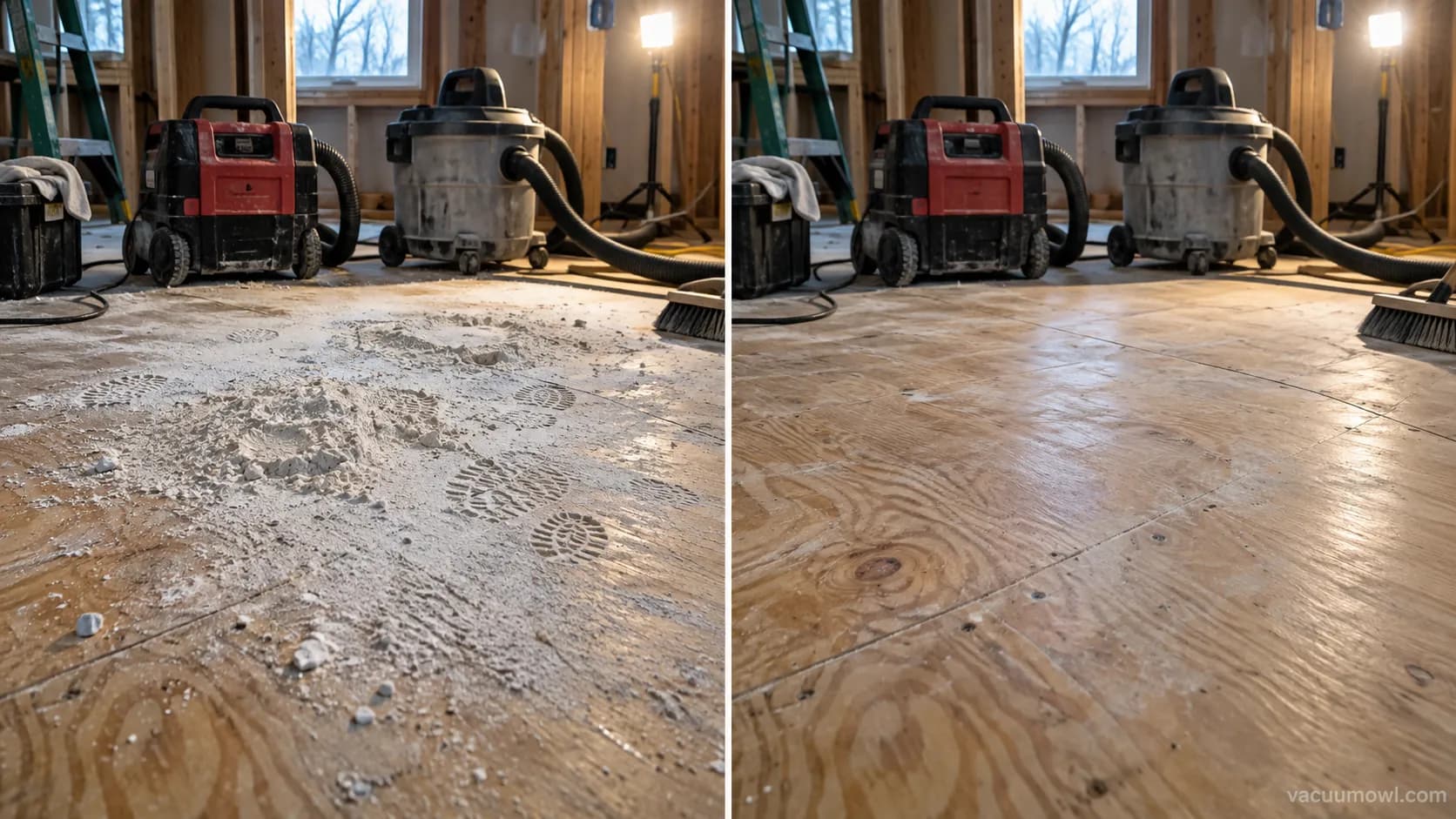
The True Cost: Batteries, Ecosystem and the Battery Hack
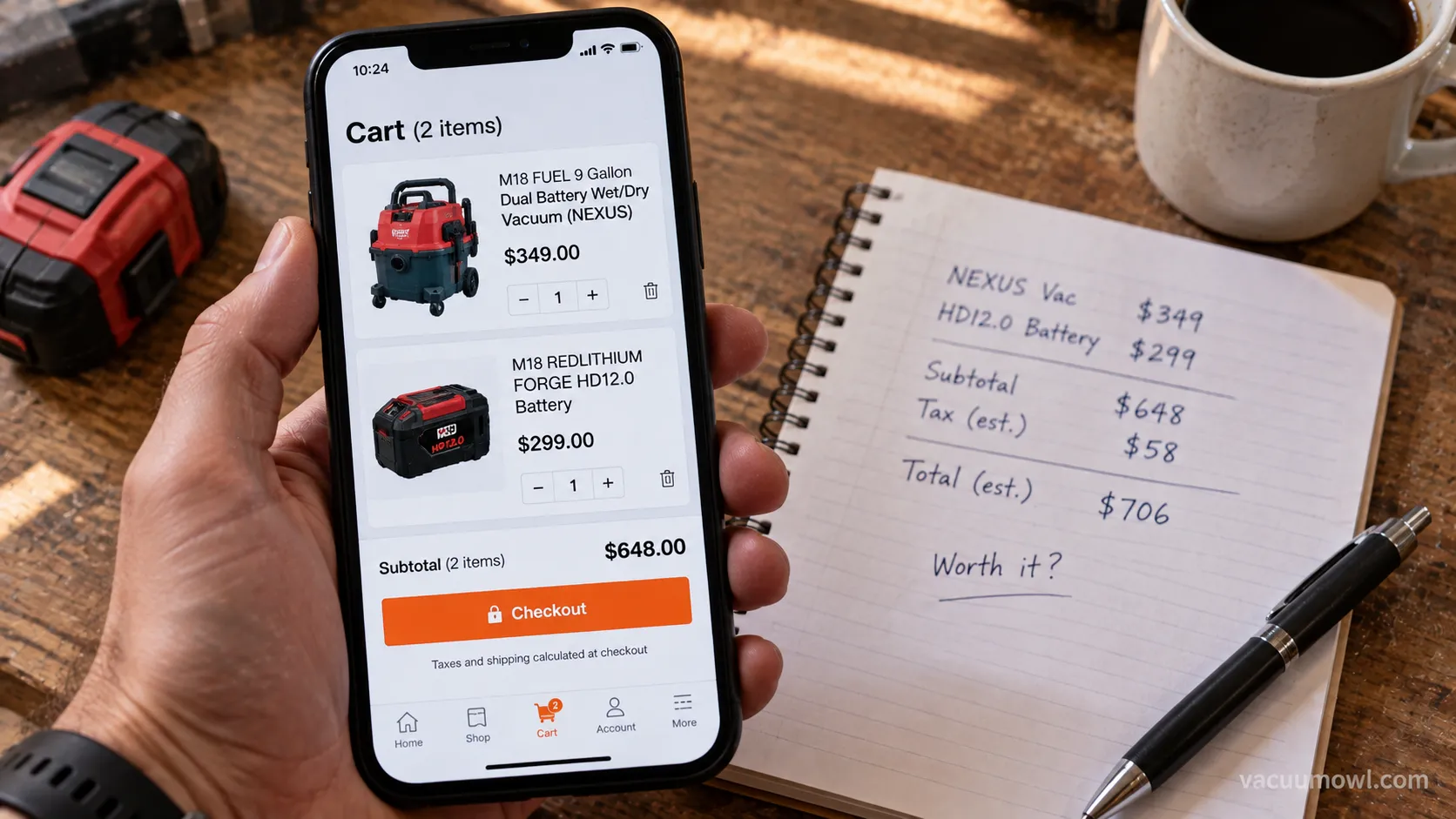
The true cost of a Milwaukee shop vac is the bare-tool price plus a high-output battery, and ignoring that second number is the most common budgeting mistake.
A bare 2.5-gallon PACKOUT lists around $199 on its own, and Home Depot’s current listing shows the vacuum-only configuration.
Add an HD12.0 pack and a charger if you are new to the platform, and the real out-the-door figure climbs well past the sticker.
If you already own M18 batteries, that second cost disappears, which is exactly why the platform math favors existing owners.
Here is how the true cost breaks down for a first-time M18 buyer versus someone already in the ecosystem.
Scenario | Bare tool | Battery and charger | Real out-the-door |
|---|---|---|---|
New to M18 (PACKOUT 2.5-gal) | About $199 | About $199 for HD12.0 plus charger | About $398 |
Already own M18 (PACKOUT 2.5-gal) | About $199 | $0, packs on hand | About $199 |
New to M18 (NEXUS 6-gal) | About $349 | About $199 for HD12.0 plus charger | About $548 |
Already own M18 (NEXUS 6-gal) | About $349 | $0, packs on hand | About $349 |
Then there is the well-known battery hack.
Retailers frequently bundle a free battery with the vacuum during promotions, and buyers add the promo battery, then keep or return it, effectively dropping the vacuum’s net price.
I have watched the 6-gallon land near $115 net this way during a sale, and the tactic circulates constantly in deal threads.
Fair warning: the battery hack is entirely deal-dependent and bound by each retailer’s return policy, so treat it as a bonus, not a guaranteed price.
It also only makes sense if you actually want, or are willing to return, the bundled pack.
Milwaukee sits under Techtronic Industries, the same parent behind Ryobi and Hoover, which is worth knowing when you weigh long-term parts and platform support.
If you want the deeper backstory, who really makes these vacs traces the ownership across the category.
When you are done for the day, reclaiming floor space matters, and hanging it up to store it covers wall mounts and brackets for these units.
Frequently Asked Questions
Is a Milwaukee shop vac good?
Yes, a Milwaukee shop vac is a strong performer for a cordless unit, with durable wheels and hoses and genuinely useful modularity. The trade-off is airflow: even the flagship NEXUS trails a big corded shop vac on raw CFM. It shines when mobility and the M18 platform matter more than maximum suction, which fits most trades and serious DIYers.
How long do Milwaukee shop vacs last?
The vacuums themselves are built for jobsite abuse, with reinforced casters rated for up to eight times the wheel life and hoses rated for up to twice the hose life on the FUEL models. In my experience the practical lifespan limiter is not the motor but the battery, since lithium packs fade after a few years of hard cycling. Budget for a replacement pack before you budget for a replacement vacuum.
DeWalt vs Milwaukee shop vac: which is better?
Milwaukee leads on modularity and PACKOUT integration, while DeWalt’s StealthSonic angle targets quiet operation. If you are already invested in one battery platform, that decision usually settles the question on its own, because you buy the vacuum that matches your packs. Our brand ranking lays out the full head-to-head across both brands and the rest of the field.
Should I get the M18 or the M12 Milwaukee wet/dry vac?
Choose based on the batteries you own and the mess you clean. The M18 line covers everything from 2.5 to 12 gallons with real jobsite power, while the smaller M12 wet/dry vac suits light detailing and tight spaces on the compact platform. If your other tools are M18, stay on M18 so a single battery family covers the whole kit.
Who makes Milwaukee shop vacs?
Milwaukee Tool is owned by Techtronic Industries, a Hong Kong-listed company that also owns Ryobi and Hoover. The vacuums are engineered as part of the M18 cordless system rather than sourced as a standalone appliance, which is why they share batteries and the PACKOUT footprint with the rest of the range. New to running one of these, our full walkthrough on how to use a shop vac covers setup start to finish.
Can a Milwaukee wet/dry vac handle water?
Yes, every model here handles wet pickup, though you must remove the paper or fleece filter first and use the correct setup. Our step-by-step guide to wet pickup explains the process, the safe wet-pickup setup covers standing water specifically, and swapping wet and dry filters shows which filter belongs on which job.
Independent testing backs the everyday impression, and The Drive’s PACKOUT review reached the same portability-first verdict after weeks of shop use.
The Bottom Line
The right Milwaukee shop vac is the one whose runtime and footprint match your batteries and your jobs, not the one with the biggest tank.
For most buyers that means the NEXUS 6-gallon, for constant movers it means the PACKOUT 2.5-gallon, and for anyone anchored to a fixed shop it might mean skipping cordless altogether and keeping a corded unit.
What ties the decision together is the platform: you are buying into M18, so your real cost, your runtime, and your upgrade path all flow from the packs you already carry.
Weigh the battery math first, be honest about mobility versus airflow, and the model that fits your work becomes obvious.
Read it your way
Short on time? Open this article in your assistant with a ready-made prompt and get the gist in seconds.
Found this useful? Make us a preferred source so we show up in your Google results.
Keep reading
Related articles
Vacuum Types
Bissell Wet Dry Vacuum: 6 CrossWave Models Tested (2026)
Compare every Bissell wet dry vacuum: which CrossWave model fits pets, steam, or budget, plus fixes for streaks and floors that still look dirty. Tested 2026.
Vacuum Types
Washing Shop Vac Filter: Tap, Rinse & Reuse the Right Way
Rinse it right: this guide covers washing shop vac filter foam and paper, the tap-and-hose steps, the 24-hour dry rule, and when to just replace it.
Vacuum Types
Tineco vs Dreame Wet Dry Vacuum: 30-Day Test (2026)
Compare Tineco vs Dreame wet dry vacuum on suction, self-clean, edge reach and price, with a clear pick for pets, kids and big homes.
Vacuum Types
Is the DEWALT Shop Vac Worth It? Quiet StealthSonic Tested
Compare every DEWALT shop vac: StealthSonic quiet picks, cordless DCV580 and corded DXV, with measured noise, real suction specs and a value verdict.
The discussion
Comments
Every comment is reviewed before it goes live.