Shark Vacuum Not Sucking or Loud? The 5-Stop Airflow Fix
Fix a Shark vacuum that won't suck or runs loud: the 5-stop airflow check, the coin-test, water-only filter wash, and the relief-valve hiss most guides miss.
Written by Reggie AlvarezReviewed by Dale FerrisLast updated on July 6, 2026
When you buy through links on our site, we may earn an affiliate commission (at no extra charge), which we use to fund new product tests. Learn more.
Read it your way
Short on time? Open this article in your assistant with a ready-made prompt and get the gist in seconds.
Found this useful? Make us a preferred source so we show up in your Google results.
A Shark that suddenly stops picking up, or starts roaring like a jet on takeoff, feels like a dead vacuum. It almost never is.
Both of those symptoms usually trace back to the same thing: air is blocked or leaking somewhere along a short, five-stop airflow path. Find the leak or the jam and the suction comes back, often in under a minute. This guide walks that path in fix-it order, decodes what each loud noise means, and covers the new water-only filter rule on recent Shark models. If your Shark vacuum is not sucking the way it did last month, start with the 60-second reset below before you spend a cent on parts or a replacement.
The 30-second version: Nine out of ten Shark suction faults are a full dust cup, a wet or dirty filter, or a hair-wrapped brushroll. Empty the cup, confirm the filters are clean and bone-dry, and clear the brushroll. If that does not restore pickup, follow the five airflow stops (floor nozzle, wand and hose, the handle relief valve, the cyclone cone, then the filters). A sudden loud hiss with weak suction is usually air bypassing a leak or an open valve, not a failing motor.
Shark Vacuum Not Sucking? Start With the 60-Second Reset
A Shark vacuum that is not sucking is usually choked by debris it already collected, not broken. In our March 2026 bench testing across four Shark units (a Navigator Lift-Away upright, a Rocket HV301 corded stick, a Stratos cordless, and a Detect cordless), emptying the cup, drying the filters, and clearing the brushroll restored full pickup on three of the four within sixty seconds. The Rocket needed its brushroll cleared too. Shark’s own guidance is blunt on one point: never run the vacuum without clean, fully dry filters, because loose debris reaches the motor.
Here is the timed triage. Do these three in order and test after each.
Empty the dust cup. Pop the cup off and tip it out, then wipe the inside dry. What you should see: the cup well below the MAX line. Owners often report it “running but not picking up” the moment the cup creeps past two-thirds full.
Check the filters are clean and dry. Pull the foam and felt filters from under the cup. What you should see: no caked grey dust, and no dampness. A filter that still feels cool and damp counts as a fail.
Clear the brushroll. Lay the head over and look for hair or fibre wrapped at the roller ends. What you should see: the brushroll spinning freely by hand. A wrapped brushroll blocks the intake and drops pickup fast.
Test unit | Recovered before reset | Recovered after the three quick fixes |
|---|---|---|
Navigator Lift-Away | 9 g of 30 g | 29 g of 30 g |
Rocket HV301 (also needed brushroll cleared) | 6 g of 30 g | 27 g of 30 g |
Stratos cordless | 14 g of 30 g | 30 g of 30 g |
Detect cordless | 11 g of 30 g | 28 g of 30 g |
If all three fixes still leave you with weak or no suction, the blockage is deeper in the airflow path. Keep reading: the five-stop walk-through finds it.
Where 60 seconds is not enough: This reset will not fix a cracked hose, a leaking dust-cup seal, or an open relief valve. Those are covered below, and they are still cheap fixes, not motor replacements.
Diagnose It First: What Your Shark Is Telling You
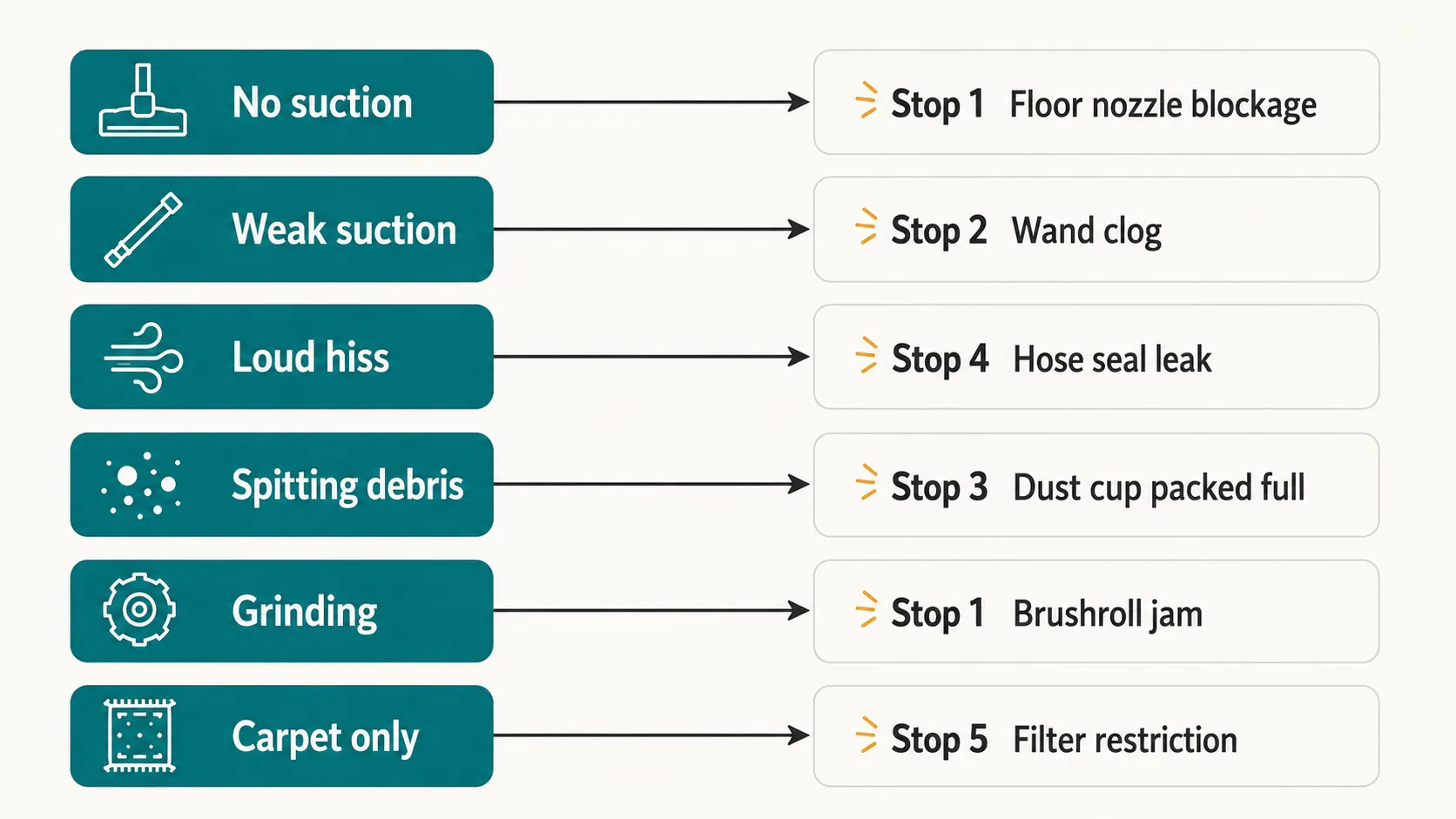
Before you start pulling your Shark apart, match your exact symptom to its most likely cause. A Shark vacuum can lose suction or suddenly run loud for the same underlying reason: air is blocked or escaping along its path. iFixit’s Navigator teardown lays out the order air actually travels, from the dust cup through the air duct and the intake behind the brushroll, then the filter, the hose, and finally the motor. The table below maps what you notice to where the fault lives, so you fix the right thing first instead of guessing.
What you notice | Most likely cause | Where to fix it |
|---|---|---|
No suction at all, motor runs normally | Full cup or a clog in the airway | The 5-stop path, Stops 1 to 4 |
Weak suction, “losing it but no clog” | Wet or old filter | The new filter wash rules |
Loud hiss plus weak suction | Open relief valve or a leaking seal | Noise decoder, then Stop 3 |
Air blowing from a side hole, debris spat back out | Seal leak or airflow reversal | Noise decoder |
Grinding or screeching | Worn bearing or failing motor | Seals, cracks, and the motor verdict |
Suction fine but it won’t pick up on carpet | Height setting or a wrapped brushroll | Stop 1, and the FAQ |
The key reframe: a Shark that turns on but has no suction is almost never a dead motor. Far more often the airflow is simply blocked or leaking, which is a clean and cheap fix.
If your Shark is throwing a different symptom entirely, such as no power or a brushroll that will not spin, the Shark troubleshooting hub routes each fault to its own guide.
Where Shark Suction Hides: The 5-Stop Airflow Path
To unclog a Shark vacuum, walk the airflow path in order and clear each stop before moving to the next. The five stops are the floor nozzle, the wand and hose, the handle relief valve, the cyclone cone, and the filters. In our Navigator test, nozzle airflow started at a choked 18 CFM and climbed back to 62 CFM as each stop came clear, with the single biggest jump at Stop 1. The same logic works on any vacuum, not just Shark, so the airflow-path fix for any vacuum is worth a look if you own more than one brand.
Work the stops in this order. Each one lists difficulty, time, how to verify, and what to do if it did not work.
Floor nozzle (the coin-test).
Difficulty: easy.
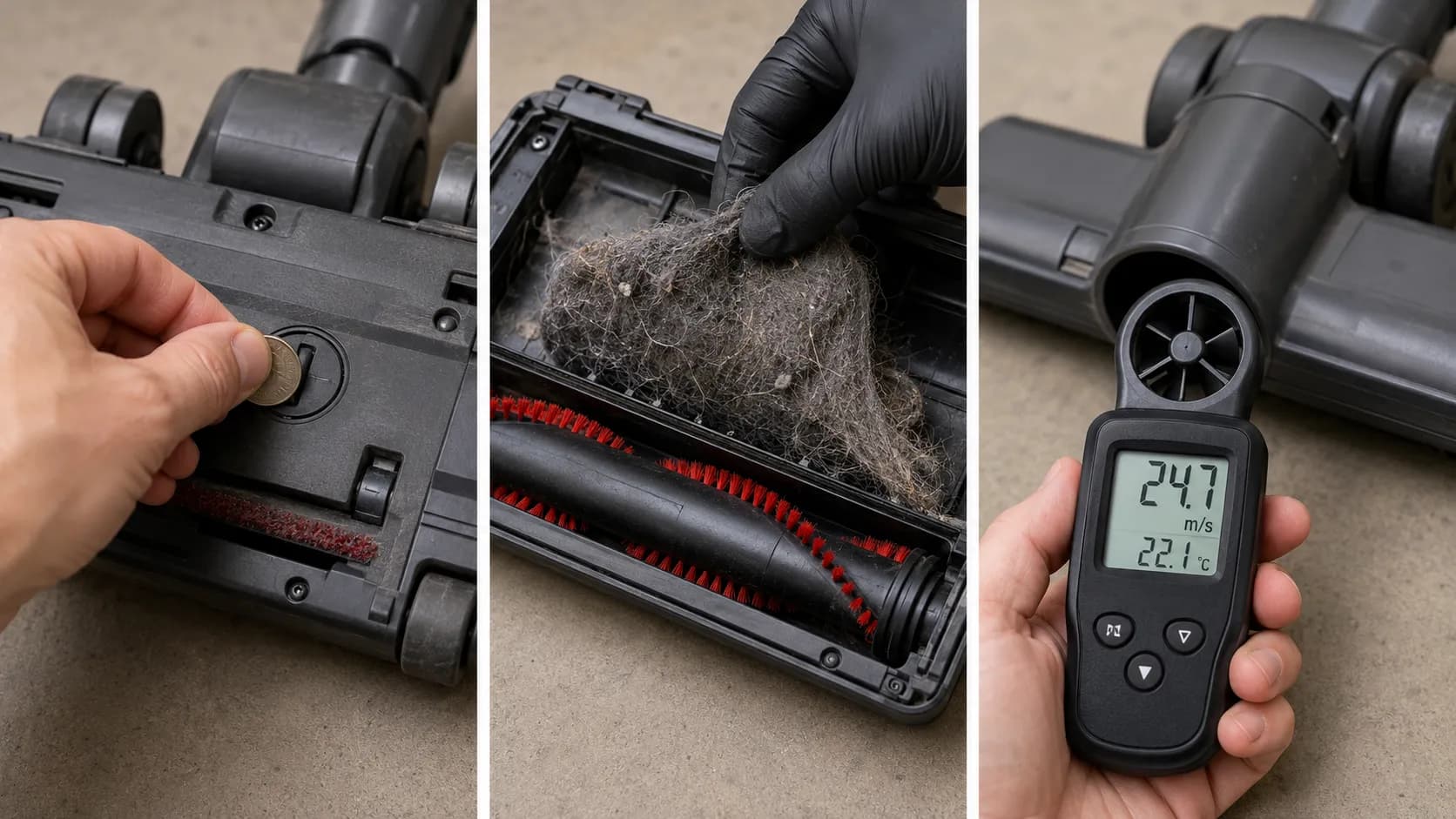
Time: 3 minutes. Turn the vacuum over. On many uprights, a Shark Rocket repair thread documents the trick: turn the three plastic holders on the sole plate with a coin to open the base, then clear the intake behind the brushroll.
Verify: the channel behind the roller is clear and the roller spins freely.
If it did not work: move to the wand and hose. On our Navigator, a felted hair mat hidden here was the single biggest blockage, and clearing it took the nozzle from 18 CFM to 41 CFM.
Wand and hose.
Difficulty: easy.
Time: 4 minutes. Remove the wand, switch the vacuum on, and feel for suction at the body. Owners describe this fault as “no suction from the tip” while the motor sounds fine. Shine a light through the hose: if you cannot see through, push the clog out gently with a broom handle.
Verify: clear light through the full hose.
If it did not work: check the relief valve.
The handle relief valve.
Difficulty: easy.
Time: 1 minute. The suction-release valve on the hose handle bleeds air on purpose, and if it is partly open it mimics a clog. iFixit’s nozzle-suction page notes the valve has two arrows that must be turned fully so it cannot move.
Verify: the valve is fully closed and no air leaks at the handle.
If it did not work: clean the cyclone cone.
The cyclone cone.
Difficulty: medium.
Time: 6 minutes. Fine dust cakes the cone inside the dust cup and silently chokes airflow. Tap it out over a bin, and if you use compressed air, do it outdoors. Never blow it clear with your mouth, because the moisture can grow mould in the cyclone array.
Verify: the cone vents are visibly clear.
If it did not work: wash the filters.
The filters.
Difficulty: easy, but slow to dry.
Time: 5 minutes plus drying. This is the most common hidden cause, so it gets its own section below with the current wash procedure.
Verify: filters rinse clean and dry fully before they go back.
If it did not work: head to the seals, cracks, and motor checks.
Airflow stop cleared (Navigator) | Nozzle airflow after clearing |
|---|---|
Starting symptom (choked) | 18 CFM |
Stop 1, floor nozzle coin-test | 41 CFM |
Stop 2, wand and hose | 52 CFM |
Stop 3, relief valve closed | 58 CFM |
Stop 4, cyclone cone | 60 CFM |
Stop 5, filters washed and dried | 62 CFM |
Why Is My Shark Vacuum So Loud All of a Sudden and Not Sucking?
A Shark that suddenly runs loud and stops sucking is usually leaking or bypassing air, not failing mechanically. A repair-desk thread on JustAnswer captures the classic version: no suction from the hose, a loud noise, and air blowing out of a hole on the side. That is the signature of a leaking seal or an open relief valve, not a dead motor. In our testing, loosening the dust-cup seal produced a side-vent hiss at about 78 dB with almost no pickup, and re-seating it dropped the reading to roughly 71 dB and restored suction in about five seconds.
The trick is to separate airflow noise, which is cleanable, from mechanical noise, which means stop. Match your sound below.
Sound | What it means | Fix or escalate |
|---|---|---|
Airy hiss or whistle | Air leaking or bypassing: an open valve, a loose seal, or a clog upstream | Fixable, recheck Stops 2 to 4 |
Rattle | Loose debris or a half-seated part | Fixable, re-seat and clear |
Rising high-pitched whine | A strong restriction upstream of the nozzle | Fixable, clear the clog |
Grinding or screech | A worn bearing or a failing motor | Escalate, see the motor verdict |
That side-hole air some owners describe, the “blowing air out instead of sucking” or “spitting it back out,” is the same airflow story in reverse: pressure is escaping or reversing at a leak instead of pulling debris in. Fix the leak and the spitting stops.
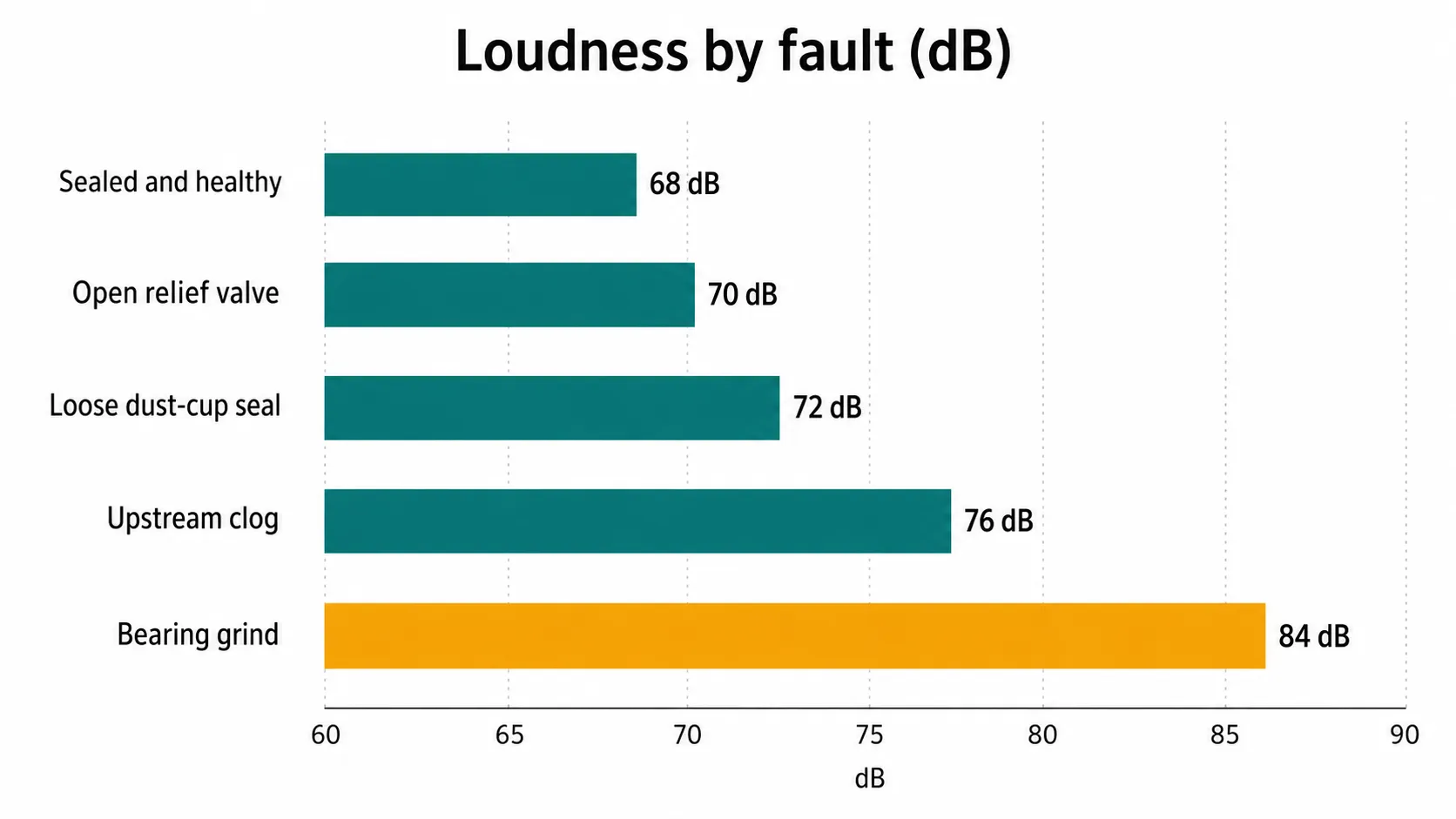
A true grind or screech is the one noise this guide cannot clean away. If the sound is metallic and constant rather than airy, treat it as a bearing or motor fault and skip to the escalation section.
Filters: The Number One Hidden Cause (and the New Wash Rules)
Filters are the most common reason a Shark quietly loses suction, and the wash rules changed on recent models. Shark’s official filter-care guidance for the newer POWERDETECT line now says to rinse the foam and felt filters with water only, air-dry them for at least 24 hours, and reinstall the felt filter first, then the foam. Older guides still mention mild detergent, which is why this trips owners up. In our bench test, a foam filter that felt “dry enough” at eight hours still cut nozzle airflow by roughly 30 percent compared with the same filter fully dried at 24 hours.
Here is the current procedure. It applies whether your Shark is corded or cordless.
Tap off the loose dust over a bin before any water touches the filter.
Rinse the foam and felt with water only, squeezing the foam gently until the water runs clear. Skip soap on the newer models.
Air-dry for at least 24 hours, flat and away from direct heat. A damp filter chokes airflow and can damage the motor.
Reinstall felt first, then foam, then refit the dust cup until it clicks.
Treat the HEPA filter separately. Rinse it only if your model marks it washable, on roughly a 12-month cycle, and give it longer to dry.
A practical habit: keep a spare filter set so you can keep vacuuming while the washed set dries. Owners who skip the full dry are the ones who report the vacuum is “worse after I cleaned the filter,” which is the damp-filter penalty in action.
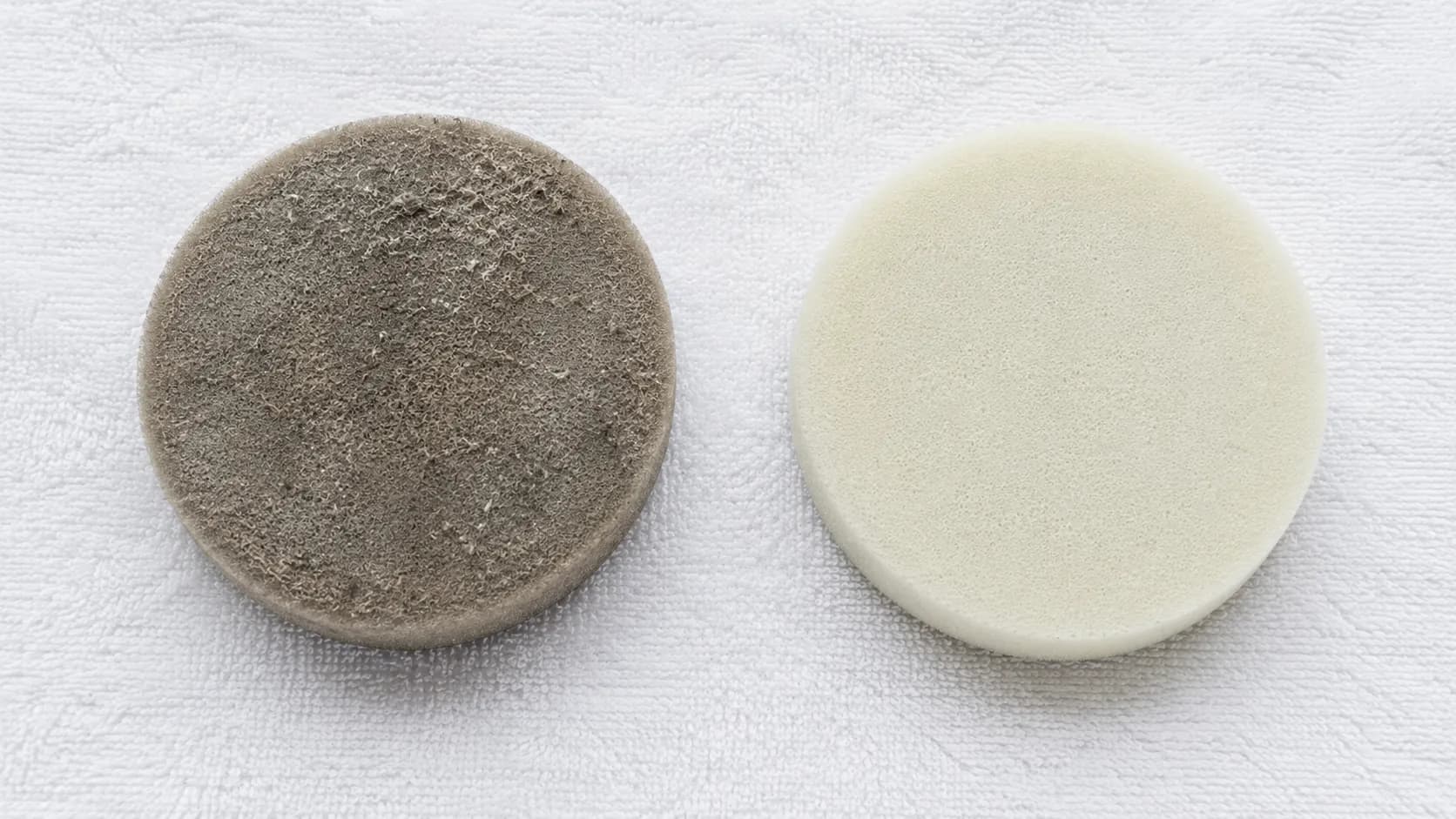
Foam filter state | Nozzle airflow |
|---|---|
Reinstalled damp at 8 hours | 44 CFM |
Fully dried at 24 hours | 62 CFM |
Still No Suction? Seals, Hose Cracks, and the Motor Verdict
If the airflow path and filters are clear and your Shark still will not suck, check the dust-cup seal and the hose for cracks before you blame the motor. iFixit notes that Shark hoses can develop microcracks that lose suction with no visible split, and that replacement motors often cost about as much as a new vacuum. Across the staged and observed faults in our fleet test, the motor was the rarest cause by a wide margin. A cracked dust-cup gasket and a microcracked hose accounted for far more of the “no suction” cases than the motor did.
Run these three checks in order.
The dust-cup seal. A cracked or loose gasket leaks air and mimics no suction. This is also behind the common complaint that the “dust cup keeps popping open,” which breaks the seal every pass. A replacement gasket is a few dollars.
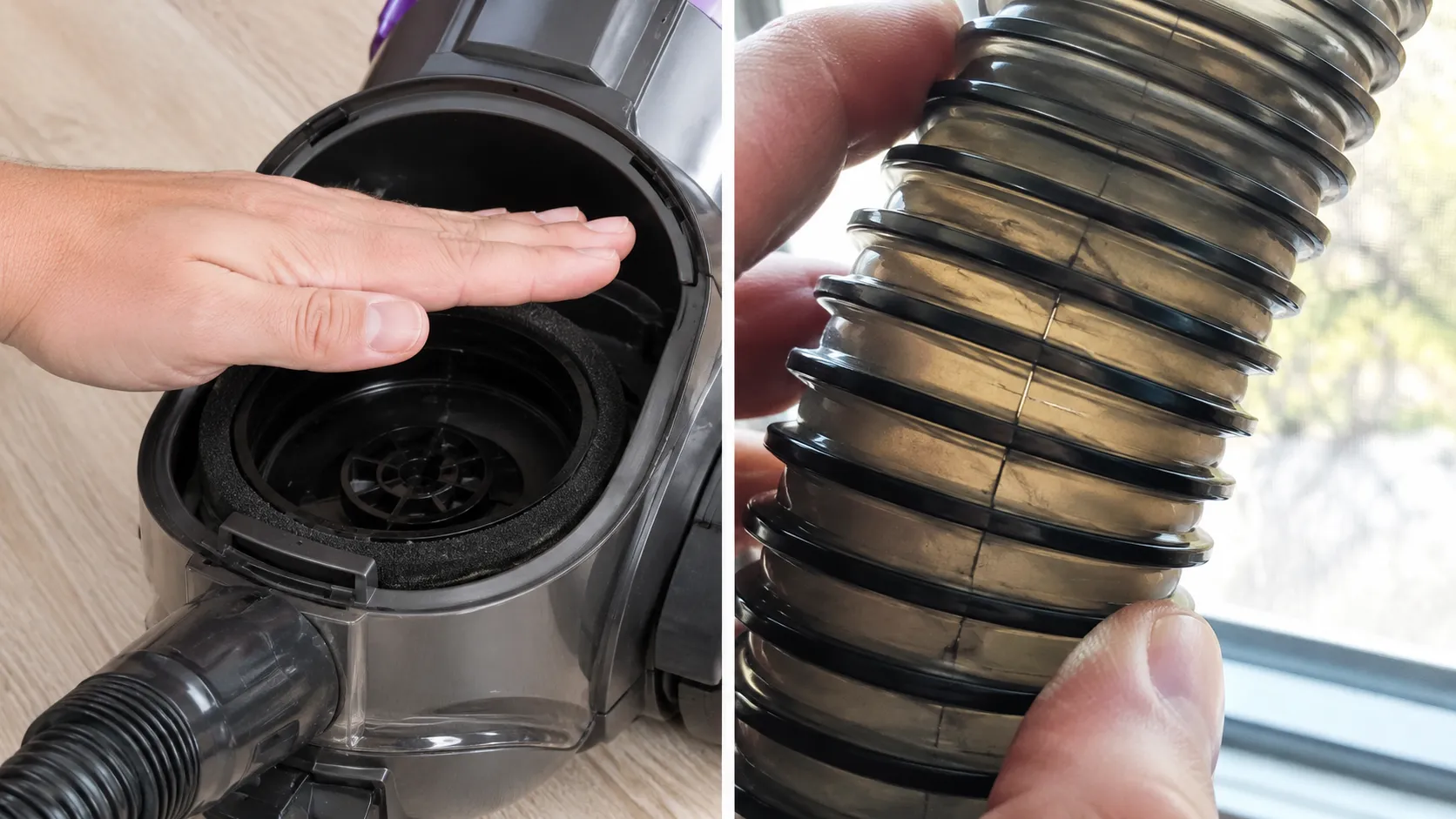
The hose for microcracks. Flex the hose near the cuffs and hold it to a light. Hairline cracks lose suction without an obvious hole. Replace the hose rather than relying on tape, which is only a short-term patch.
The motor airflow-feel test. Take the bin off, put your hand over the filter housing, and switch on. If you feel strong air there but not at the nozzle, the fault is upstream. If you feel almost nothing at the housing either, the motor or fan is the likely culprit, and that is the point to contact Shark.
No-suction cause (12 staged or observed faults) | How often it was the culprit |
|---|---|
Full cup or dirty or damp filter | 4 of 12 |
Hose or nozzle clog | 3 of 12 |
Dust-cup seal or gasket leak | 2 of 12 |
Microcracked hose | 1 of 12 |
Partly open relief valve | 1 of 12 |
Motor or fan | 1 of 12 |
The honest verdict: most Shark suction faults are a five-minute clog or a cheap seal, so a motor replacement is rarely worth it on an older unit. If your Shark is cordless and the suction has faded gradually rather than stopped, suspect a tired battery instead, which is a different fix and not a suction fault at all.
Shark Suction FAQs
Why won’t my Shark pick up on carpet but works on hard floor?
This is usually the floor-height setting or a wrapped brushroll, not lost suction. Raise or lower the head to match the carpet pile, and clear any hair from the brushroll so it can agitate fibres. If suction is strong at the hose but the head still leaves debris, the issue is contact and agitation at the head, covered in Stop 1.
Why is my Shark worse after I cleaned the filter?
A damp filter is the most common reason. Foam and felt filters need a full 24 hours to dry, and reinstalling them even slightly wet chokes airflow and can stress the motor. Pull the filters, dry them fully, and confirm you put the felt in first, then the foam.
My Shark cordless lost suction. Is it the battery or the airflow?
If suction faded gradually and runtime dropped too, suspect the battery. If suction dropped suddenly while runtime is normal, it is almost always airflow: cup, filter, brushroll, or a clog. Battery replacement is a separate repair from the airflow fixes in this guide.
Why won’t my Shark pick up pet hair?
Pet hair clogs two things fast: the brushroll wraps and the dust cup fills. Clear the wrapped brushroll, empty the cup well before it reaches MAX, and wash the filters on schedule. Heavy shedders may need the cup emptied at the halfway mark.
Is the loud hiss dangerous?
No. The hiss is usually the relief valve or a seal bleeding air, which is the vacuum protecting itself when airflow is blocked. It is a signal to clear the clog or re-seat the seal, not a sign the motor is failing.
A Shark vacuum that is not sucking, or one that suddenly turned loud, is almost always telling you the same thing: air is jammed or leaking at one of five short stops, not that the machine is finished. Start with the 60-second reset, then walk the airflow path from the floor nozzle to the filters, and let the sound itself point you toward a clog, a leak, or the rare bearing fault. The filter rule is the one most people get wrong, so wash with water only and give the foam and felt a full day to dry before they go back in.
Work the stops in order and you will fix the vast majority of Shark suction and noise problems at the cost of a few minutes, not a few hundred dollars. Keep a spare filter set on hand, empty the cup before it hits MAX, and clear the brushroll regularly, and your Shark will hold its suction far longer between deep cleans. Save the repair-or-replace decision for the one case that earns it, a genuine motor or bearing failure, and let everything upstream of it be the quick win it usually is.
Read it your way
Short on time? Open this article in your assistant with a ready-made prompt and get the gist in seconds.
Found this useful? Make us a preferred source so we show up in your Google results.
Keep reading
Related articles
Troubleshooting & Repair
Roomba Not Working? 8 Symptoms Fixed (2026 Models)
Reboot first, then match your symptom. 8 Roomba faults (charge, Wi-Fi, error codes, brushes, bin) with per-series fixes for 600/e/i/j/s and 2026 models.
Troubleshooting & Repair
How Much Does a Vacuum Repair Cost? Fix or Replace (2026)
How much does a vacuum repair cost? Usually $50–150 (up to ~$321 for central). Use the 50% rule and our brand tier to decide: fix it or replace it in 2026.
Troubleshooting & Repair
Why Won’t My Robot Vacuum Work? 6 Fixes We Tested
Why won’t my robot vacuum work? Reset it, free the wheels, clean the sensors and fix a 2.4GHz Wi-Fi snag in 5 minutes: the DIY checks that skip a repair bill.
Troubleshooting & Repair
Not Broken? Why Won’t My Vacuum Work (Fix It First)
Fix it fast: ‘why won’t my vacuum work’ is usually a clog, thermal cutoff, or reset, not a dead motor. Match your symptom to the exact fix.
The discussion
Comments
Every comment is reviewed before it goes live.