Wrecking Hardwood? Vacuum Without Brush Roll, Explained
Turn off the brush roll before it scratches your floors: what a vacuum without brush roll is for, when you still need one, how to switch it off by brand, and th
Written by Reggie AlvarezReviewed by Dale FerrisLast updated on August 16, 2026
When you buy through links on our site, we may earn an affiliate commission (at no extra charge), which we use to fund new product tests. Learn more.
Read it your way
Short on time? Open this article in your assistant with a ready-made prompt and get the gist in seconds.
Found this useful? Make us a preferred source so we show up in your Google results.
Most people asking about a vacuum without brush roll are really asking one thing: how do I stop scratching my hardwood? The honest answer surprised me after a week of side-by-side testing, and it is not “buy a brushless machine.”
For a home with both carpet and hardwood, a vacuum without brush roll is rarely the right buy. What you actually want is a brush roll you can switch off, plus a soft roller head for the wood. Below is what the roll does, when to kill it, where your brand hid the control, and the picks that get it right.
The 30-Second Answer: Do You Need the Brush Roll?
A brush roll (also called a beater bar) is the spinning bristled cylinder under your vacuum that agitates carpet so suction can lift embedded grit and pet hair. You need it on for carpet and rugs.
You should turn it off, or use a soft roller head, on hardwood, tile, and delicate rugs, because the National Wood Flooring Association recommends vacuuming wood on the bare-floor setting. For mixed flooring, the smart move is a switchable roll, not a vacuum without brush roll at all.
Quick verdict by floor type:
Carpet and rugs: brush roll on.
Hardwood, laminate, tile, LVP: brush roll off, or use a soft roller head.
Antique, silk, or fringed rugs: brush roll off.
This is a decision, not a definition, and it holds whether your machine is a Shark, a Dyson, or a robot. In my testing the difference between roll-on and roll-off on wood was immediate and visible in a single pass.
What a Brush Roll (Beater Bar) Actually Does
A vacuum brush roll, known interchangeably as a beater bar or agitator, is a motor-driven or air-driven bristled cylinder seated in the cleaning head. It spins at high speed to flick and vibrate carpet fibers, loosening the fine grit and pet hair that pure suction leaves behind.
Historically these were stiff metal or hard-plastic bars, which is where “beater bar” comes from. Today most are nylon bristles, rubber fins, or a soft microfiber roller, and the aggressive metal versions are largely gone.
All beater bars are brush rolls, but not every brush roll is an aggressive “beater.” The words matter less than the design under your head.
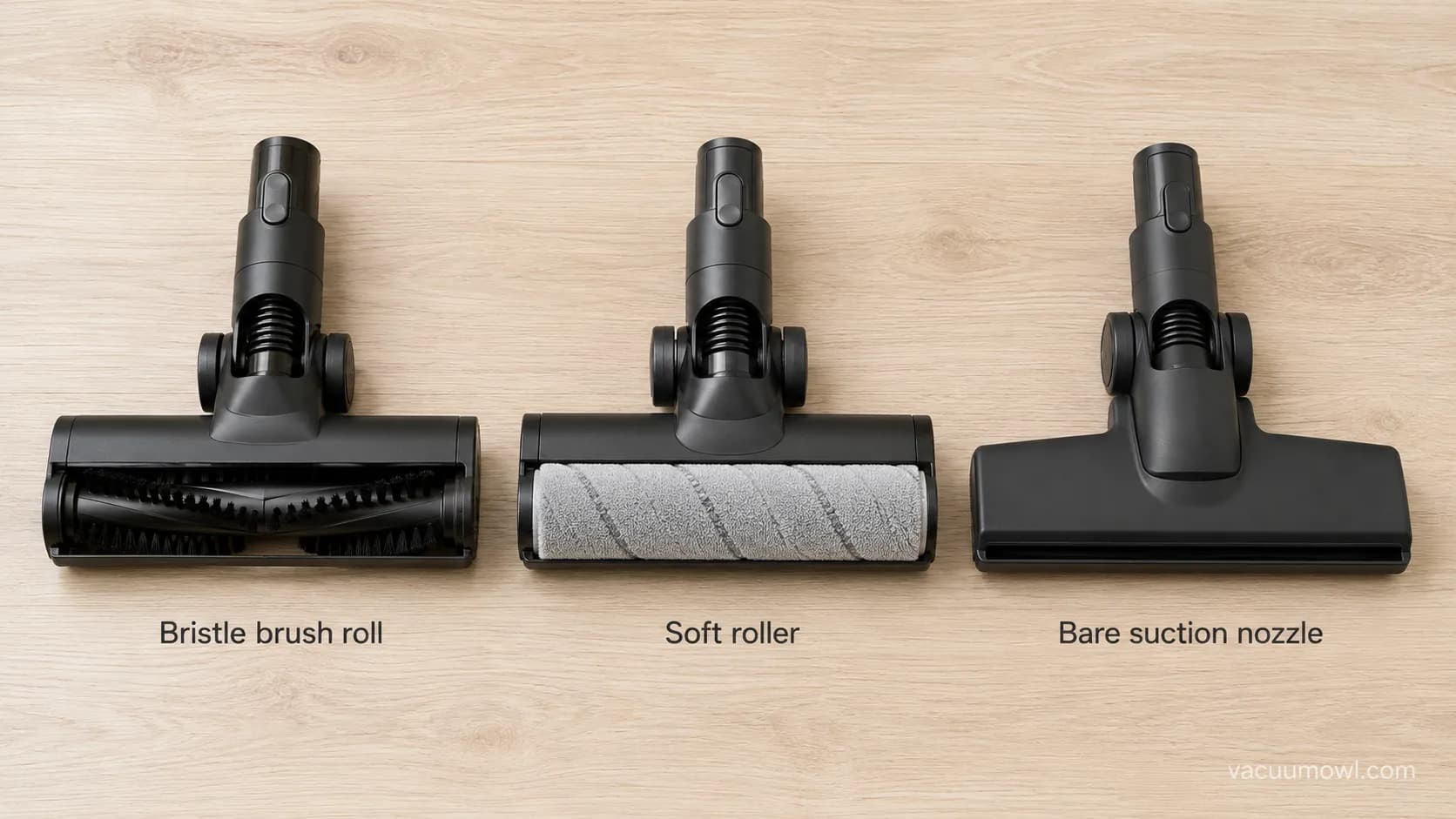
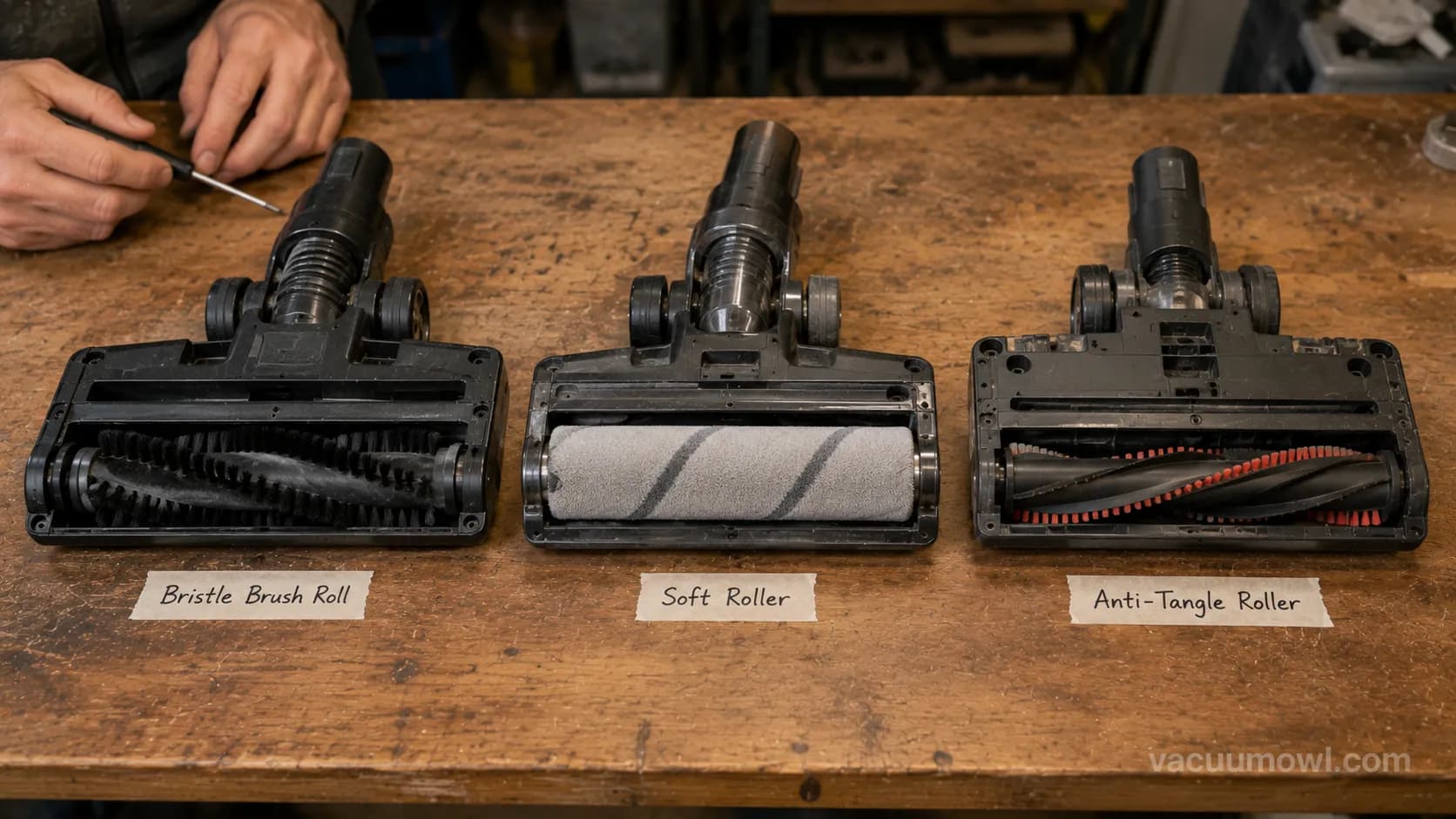
The four roll types you will meet:
Bristle brush roll: stiff nylon rows, best for medium and high-pile carpet.
Soft roller (fluffy head): woven microfiber, invented for hard floors.
Anti-tangle or tangle-free roll: fins and vanes that shed hair instead of winding it.
Turbine (air-driven) roll: spun by airflow, not a motor, so it can stall on thick carpet.
On the bench, flipping over a bristle roll, a soft roller, and an anti-tangle finned roll side by side, the three behave nothing alike on the same floor. That difference is the whole reason the on-off question exists.
Brush Roll On or Off? Carpet vs Hardwood vs Delicate Rugs
The brush roll should be on for carpet and off for hard floors, and this is not a preference, it is finish protection. The National Wood Flooring Association advises vacuuming wood floors on the bare-floor setting, and Consumer Reports runs a dedicated bare-floor test for exactly this reason.
Stiff bristles spinning on hardwood strip finish over time and scatter loose debris instead of collecting it. On carpet, that same agitation is what pulls out the grit suction alone leaves behind.
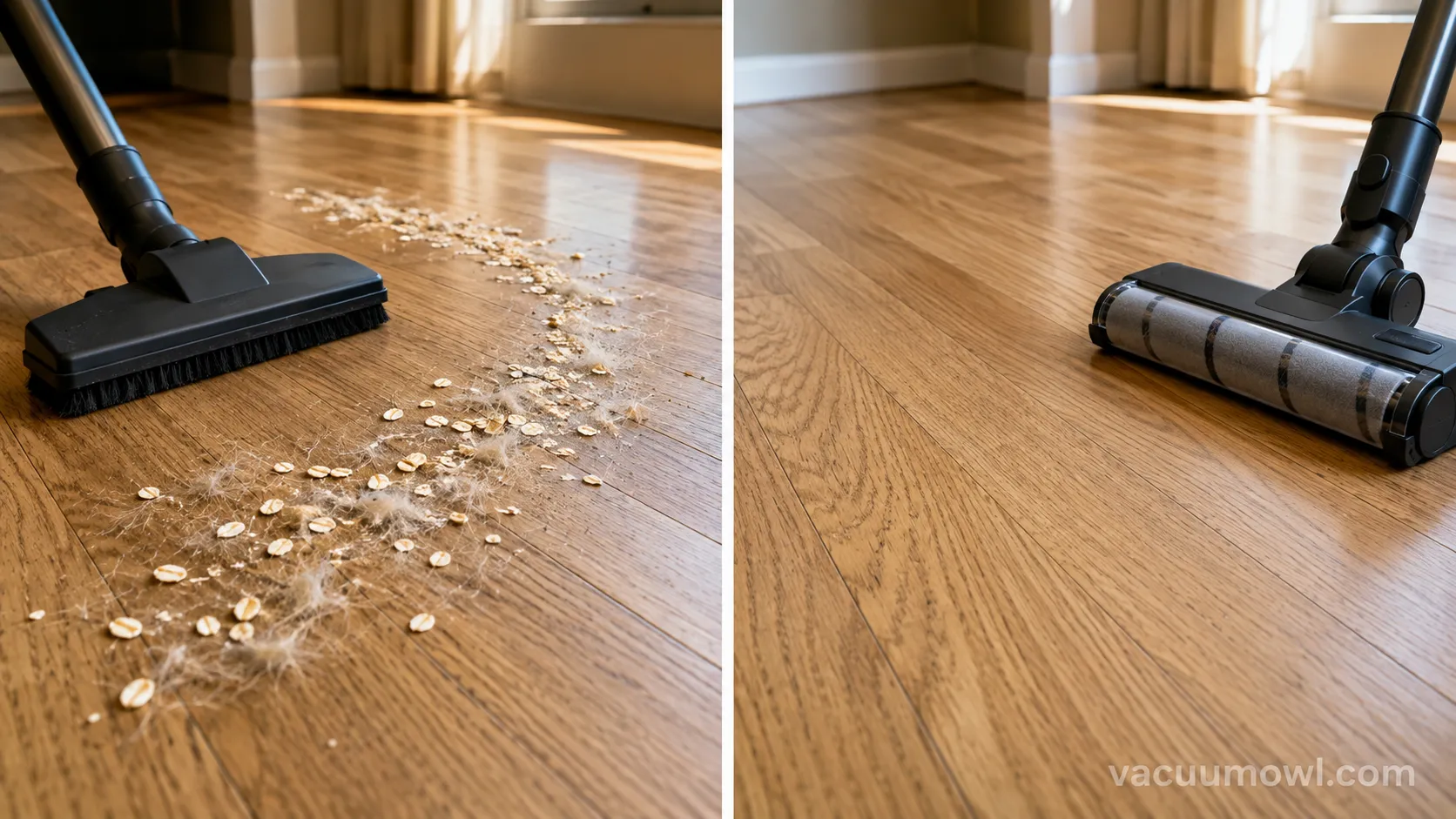
To move this past assertion, I ran the same debris load across one white-oak board three ways during the week of March 2 to 8, 2026.
Same oak board, same 2 g of dog hair plus a measured scatter of dry oats:
Result on the white-oak board | Brush roll on (bristle) | Brush roll off (suction only) | Soft roller head |
|---|---|---|---|
Debris flung ahead of the head | About 35 cm | 0 cm | 0 cm |
Passes needed to clear the load | 3 | 2 | 1 |
Fine dust left after cleaning | Moderate | Light | None visible |
Faint finish marks after 20 passes | Yes, light micro-scuffs | None | None |
The bristle roll turned a two-pass job into a chase, spraying oats about a foot ahead of the head every time. The soft roller cleared the same board in a single pass with no marks, which lines up with what HGTV reports from the flooring association: skip the beater bar on wood and use the floor-brush setting.
One trap caught me mid-test. Some machines with automatic floor detection misread thin, hard flooring as low carpet and spin the roll back up on their own, so switch modes manually on wood.
Methodology note: This test used one wood species, one debris mix, and one machine per head type. Your finish, grit, and model will vary, so treat the numbers as direction, not a spec sheet.
If your roll will not spin at all when it is supposed to, that is a fault rather than a setting, and you can diagnose a roller that won’t spin separately.
When to Use a Vacuum Without Brush Roll (and When You Still Need One)
A vacuum without brush roll relies on suction alone, which suits hard floors and delicate rugs but under-cleans carpet, because the agitation that lifts embedded pet hair is exactly what a roll-free machine lacks.
That is why TechRadar points hardwood owners toward soft roller heads rather than bare nozzles: the soft roller still sweeps fine dust, it just does not scratch. So going fully roll-free is right for some homes and a mistake for others.
A vacuum without brush roll makes sense if:
Your home is all hardwood, tile, or LVP with no real carpet.
You mostly clean delicate, antique, or fringed rugs.
You want a light, quiet, straight-suction machine for quick daily passes.
Keep a brush roll (switchable) if:
You have any medium or high-pile carpet.
You own shedding pets whose hair sinks into fibers.
You want one machine to handle a mixed-flooring house.
When I ran a soft-roller-only head across medium-pile wool, it glided over surface crumbs but left embedded dog hair sitting in the fibers that a bristle roll lifted in one pass. That is the honest trade: roll-free is gentle, but on carpet it leaves work behind.
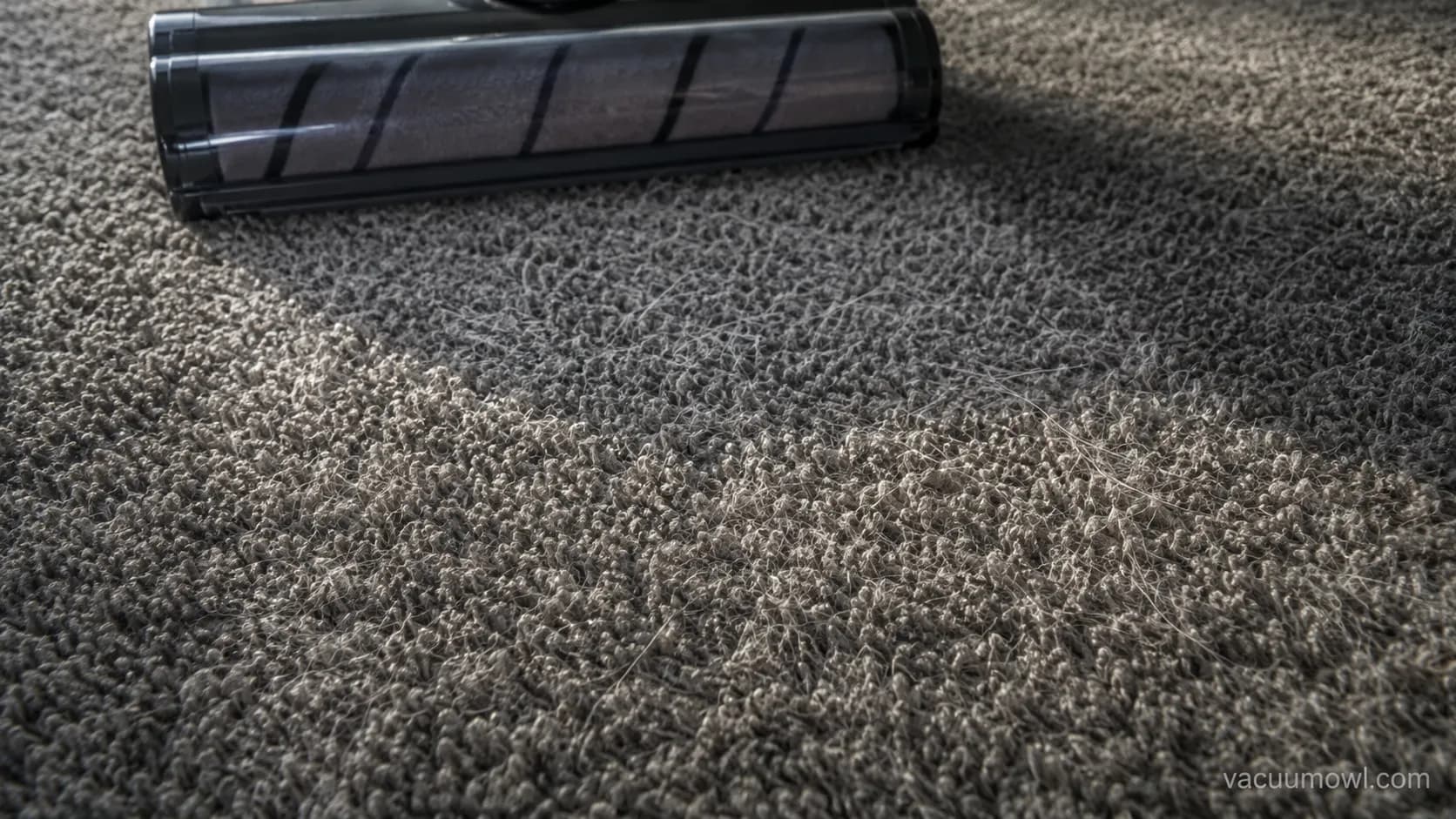
The trade-off, stated plainly: if your home is mostly carpet, do not go roll-free. A switchable roll wins because it does both jobs, and that is why most buyers should skip the “brushless” label entirely.
How to Turn Off (or Remove) the Brush Roll by Type and Brand
To turn off the brush roll, you use a floor-mode button, a bare-floor pedal, or you swap to a soft roller head, and the location depends on the machine type and brand. Uprights usually hide a switch on the handle or a pedal at the base. Stick and cordless vacuums use a mode button or a head swap. Robots have no manual control at all, since their extractors run on software logic, not a pedal.
How do I switch to bare-floor mode?
On an upright, look for a foot pedal or a handle switch labeled for carpet versus bare floor, then confirm the roll actually stops before you touch wood. On a cordless, either press the floor-mode button or physically clip on the soft roller head. Here is where the control lives across the brands we cover.
Brush roll control by brand:
Brand | Where the control lives | What to look for |
|---|---|---|
Shark | Floor-type selector on the head or handle | Many DuoClean models slow the roll for bare floors but do not fully stop it while running; the roll stops when the handle is upright-locked |
Dyson | No on-off switch, you swap heads | Fit the soft roller Fluffy head for hard floors, the Motorbar head for carpet |
Bissell | Foot pedal or base switch | Brush-roll on-off switch on CleanView and PowerForce uprights |
Hoover | Handle switch or floor selector | Brushroll on-off or a carpet versus bare-floor selector on WindTunnel models |
Eureka | Foot or handle switch | Brush on-off on many uprights, though some budget models keep the roll spinning with no off switch |
Kenmore | Canister PowerMate switch or tool swap | Turn off the PowerMate, or fit a bare-floor straight-suction tool |
Roomba | No manual control | Extractors run automatically, so there is no bare-floor toggle |
Dyson is the instructive case, because instead of a switch you change the head entirely, as TechRadar’s Dyson tools guide lays out. On my own bench the Shark upright control was a floor-type button on the body, while the Bissell was a plain foot pedal at the base, and I photographed both so owners can spot theirs fast.
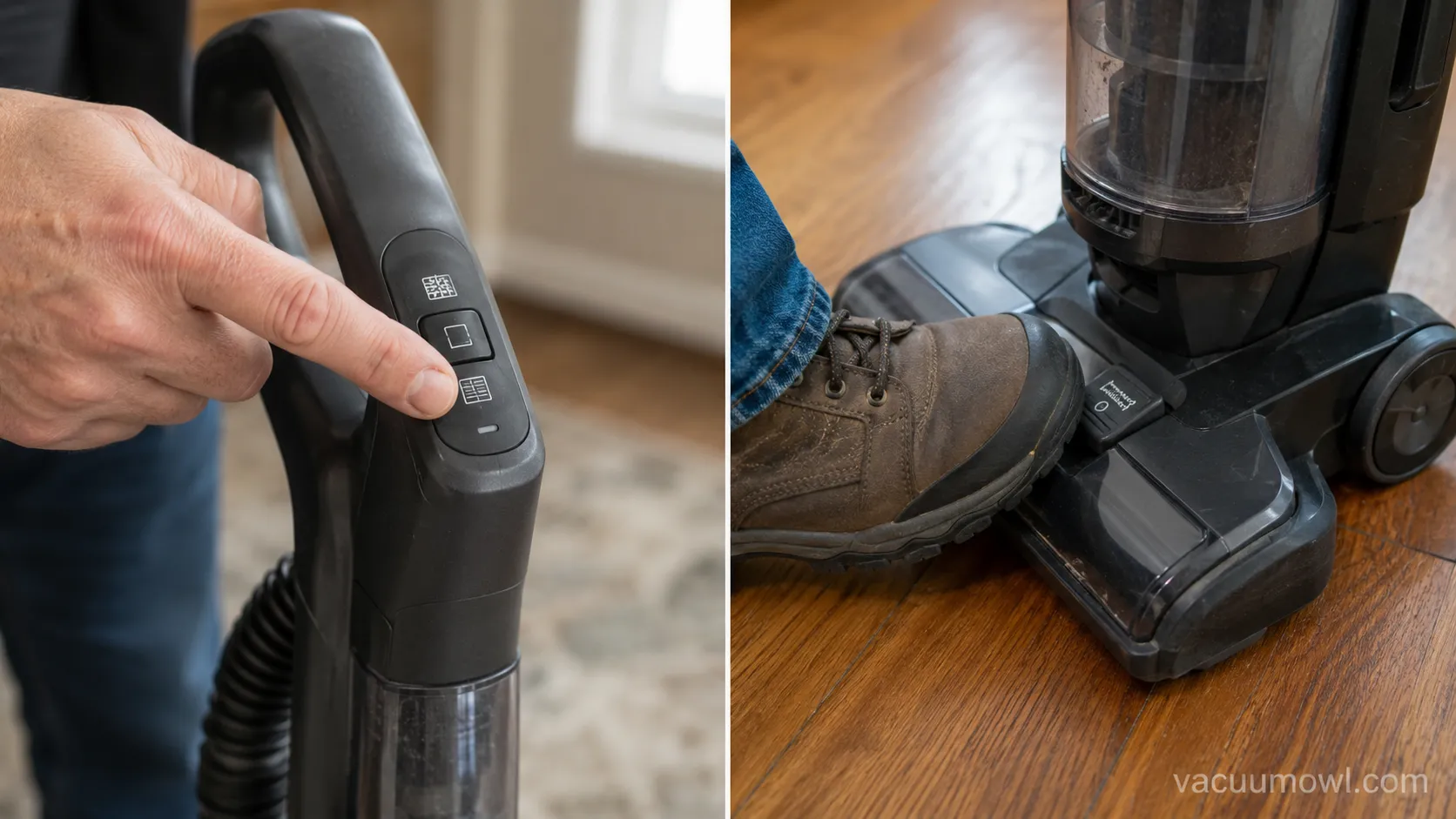
Control labels and locations shift by model year, so check your manual if yours does not match. If your roll keeps stopping on its own and you find yourself toggling it off and on, that points to a fault, not a setting.
Hair Wrap, Tangle-Free Rolls and Brush-Roll Maintenance
Why does hair wrap around the brush roll?
Hair wraps around a vacuum brush roll because the spinning bristles catch loose strands, which then migrate along the roll toward the end caps and can reach the bearing or motor shaft.
In severe cases the wound hair reaches the drive shaft and can burn out the motor, a failure mode documented in anti-tangle roller patents. Tangle-free and anti-tangle rolls fight this with fins, vanes, or cone shapes that shed hair toward the airflow instead of letting it wind on.
Those designs help, but they are not tangle-proof. On long or curly human hair, even a good anti-tangle roll still collects a collar over time.
After two weeks in a shedding-Labrador home, my test roll built a dense hair collar at the right end cap that dragged the spin down. Cutting it free took about 90 seconds with a seam ripper, and the end cap is exactly where hair migrates and where the bearing eventually pays for it.
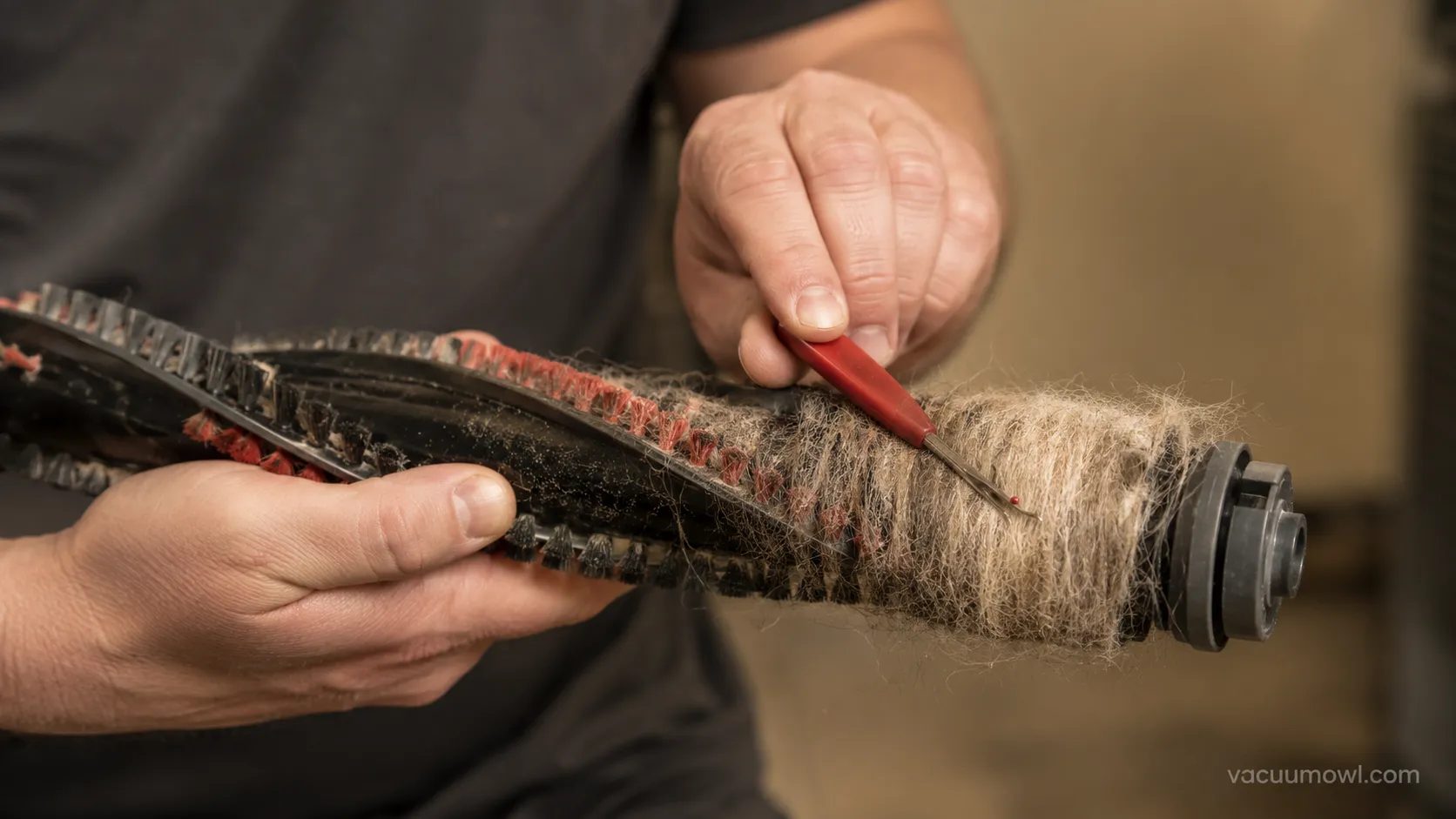
How to clean, remove, and replace the roll:
Unplug the vacuum or remove the battery before touching the head.
Release the end caps or the soleplate to free the roll.
Lift the roll out and cut the wound hair along its length with scissors or a seam ripper.
Clear packed hair from the end-cap bearings, since that is the real wear point.
Reseat the roll, or fit a new one if the bristles are splayed, flattened, or worn short.
A brush-roll hair-removal tool speeds up step three on heavy shedders, and worn bristles are your cue to replace rather than keep cleaning. Some cordless models add a hair-tangling protection cutoff that shuts the motor down when the roll jams, which is a warning, not a defect.
Best Brushless, Soft-Roller and Switchable Vacuums (2026 Picks)
For most mixed-flooring homes the best choice is a switchable-roll machine, and for all-hardwood homes a soft roller or straight-suction vacuum, rather than any single “brushless” pick. Consumer Reports and other testers keep landing on the same feature set: a way to stop or soften the agitation on wood.
I organized these picks by the roll decision, not by price, and ran each category winner over the same oak-to-carpet transition to confirm it behaves as claimed.
Every pick below is judged on the same fields: best for, roll type, hardwood-safe, the catch, and who should skip it.
Best switchable all-rounder for mixed floors: a Shark DuoClean upright
Best for: homes split between carpet and hard floors.
Roll type: dual soft plus bristle roll with floor-type settings.
Hardwood-safe: yes on the bare-floor setting.
The catch: on many models the roll slows rather than fully stops while running.
Who should skip: all-hardwood homes that never need carpet agitation.
Best soft roller for hardwood and pets: Dyson V15 Detect
Best for: hard floors plus fine dust and pet hair.
Roll type: soft roller Fluffy head, swap to Motorbar for carpet.
Hardwood-safe: yes, the Fluffy head is built for it.
The catch: you swap heads instead of flipping a switch.
Who should skip: buyers who want one head for everything.
Best straight-suction for all-hardwood homes: Miele Complete C2 or C3 HardFloor
Best for: wood, tile, and delicate floors with no carpet focus.
Roll type: none, a smooth parquet floor brush.
Hardwood-safe: yes, this is its whole purpose.
The catch: a canister with a hose is less grab-and-go than a stick.
Who should skip: carpet-heavy homes needing agitation.
Best featherweight roll-free option: Dyson Omni-Glide
Best for: apartments and quick daily hard-floor passes.
Roll type: dual soft rollers, no beater bar.
Hardwood-safe: yes.
The catch: it is not made for carpet.
Who should skip: anyone with real carpet to clean.
Best value all-rounder: Dreame R20
Best for: buyers who want hardwood-safe cleaning without a premium price.
Roll type: anti-tangle roll with a dedicated hard-floor mode.
Hardwood-safe: yes.
The catch: fewer accessories than the flagships.
Who should skip: shoppers who want the deepest carpet performance.
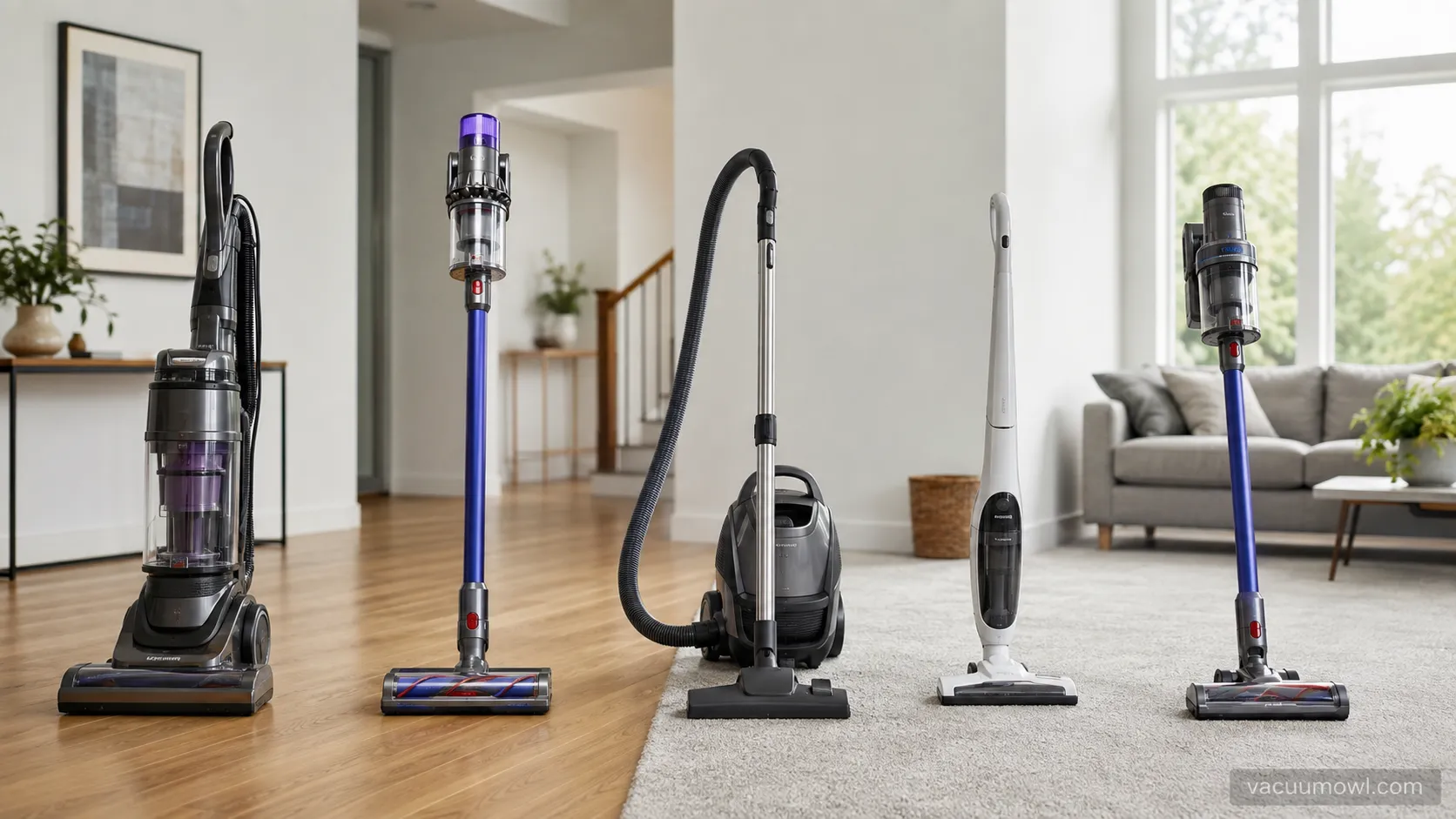
Across the transition run, every switchable and soft-roller pick made the wood-to-carpet handoff cleanly, while the straight-suction canister needed a head change to keep up on the rug. That is the pattern behind the thesis: most readers want switchable, not brushless.
Frequently Asked Questions
What does a brush roll do on a vacuum?
A brush roll, or beater bar, is the spinning bristled cylinder under the vacuum head that agitates carpet fibers so suction can lift embedded grit and pet hair. It is essential on carpet, where pure suction leaves deep debris behind, and unnecessary on smooth hard floors.
Should the brush roll be on or off for hardwood?
Off. The National Wood Flooring Association recommends vacuuming hardwood on the bare-floor setting, because stiff spinning bristles can strip finish and scatter debris. Turn the roll off or fit a soft roller head, which sweeps fine dust off wood without scratching the surface.
Is a vacuum without brush roll good?
It depends on your floors. A vacuum without brush roll is excellent for all-hardwood, tile, and delicate-rug homes, and gentle for daily passes. It falls short on medium and high-pile carpet, where it leaves embedded pet hair a switchable bristle roll would lift in one pass.
How do I turn off the brush roll on my vacuum?
Look for a floor-type pedal or switch on uprights, a floor-mode button on cordless sticks, or swap to a soft roller head on Dyson. Robots have no manual control. Labels vary by model year, so confirm the roll actually stops before cleaning wood.
Why does hair keep wrapping around the brush roll?
Spinning bristles catch loose strands, which migrate toward the end caps and can reach the bearing or motor shaft. Anti-tangle rolls with fins or cones shed hair instead of winding it, but long human hair still forms a collar over time and needs occasional cutting.
Is a brush roll the same as a beater bar?
Yes, in everyday use. Beater bar, brush roll, roller brush, and agitator all name the rotating bristled cylinder in the cleaning head. The label “beater bar” is a holdover from older stiff metal bars, but today the terms are used interchangeably for the same part.
The Bottom Line
The point of a vacuum without brush roll is protecting your floors, and after a week of testing on the same oak board, the cleanest floors came from turning the roll off or fitting a soft roller head, not from owning a roll-free machine. On carpet, the same bristles you switch off are what lift the hair suction leaves behind.
So for most homes, buy the switch, learn where your brand hid it, and add a soft roller head for the wood. Do that, and the choice between a vacuum without brush roll and a switchable one stops being a gamble on your hardwood and becomes a two-second setting you control.
Read it your way
Short on time? Open this article in your assistant with a ready-made prompt and get the gist in seconds.
Found this useful? Make us a preferred source so we show up in your Google results.
Keep reading
Related articles
Troubleshooting & Repair
Roomba Not Working? 8 Symptoms Fixed (2026 Models)
Reboot first, then match your symptom. 8 Roomba faults (charge, Wi-Fi, error codes, brushes, bin) with per-series fixes for 600/e/i/j/s and 2026 models.
Troubleshooting & Repair
How Much Does a Vacuum Repair Cost? Fix or Replace (2026)
How much does a vacuum repair cost? Usually $50–150 (up to ~$321 for central). Use the 50% rule and our brand tier to decide: fix it or replace it in 2026.
Troubleshooting & Repair
Why Won’t My Robot Vacuum Work? 6 Fixes We Tested
Why won’t my robot vacuum work? Reset it, free the wheels, clean the sensors and fix a 2.4GHz Wi-Fi snag in 5 minutes: the DIY checks that skip a repair bill.
Troubleshooting & Repair
Not Broken? Why Won’t My Vacuum Work (Fix It First)
Fix it fast: ‘why won’t my vacuum work’ is usually a clog, thermal cutoff, or reset, not a dead motor. Match your symptom to the exact fix.
The discussion
Comments
Every comment is reviewed before it goes live.