Vacuum Won’t Pick Up Cat Litter? Fixes From 7 Brands Tested
Vacuum won’t pick up cat litter? Clear the brush, wash the filter, empty the bin, set hard-floor mode, plus the pet vacuum that ends the scatter.
Written by Reggie AlvarezReviewed by Dale FerrisLast updated on August 12, 2026
When you buy through links on our site, we may earn an affiliate commission (at no extra charge), which we use to fund new product tests. Learn more.
Read it your way
Short on time? Open this article in your assistant with a ready-made prompt and get the gist in seconds.
Found this useful? Make us a preferred source so we show up in your Google results.
The 30-Second Answer: Get Your Vacuum Picking Up Again
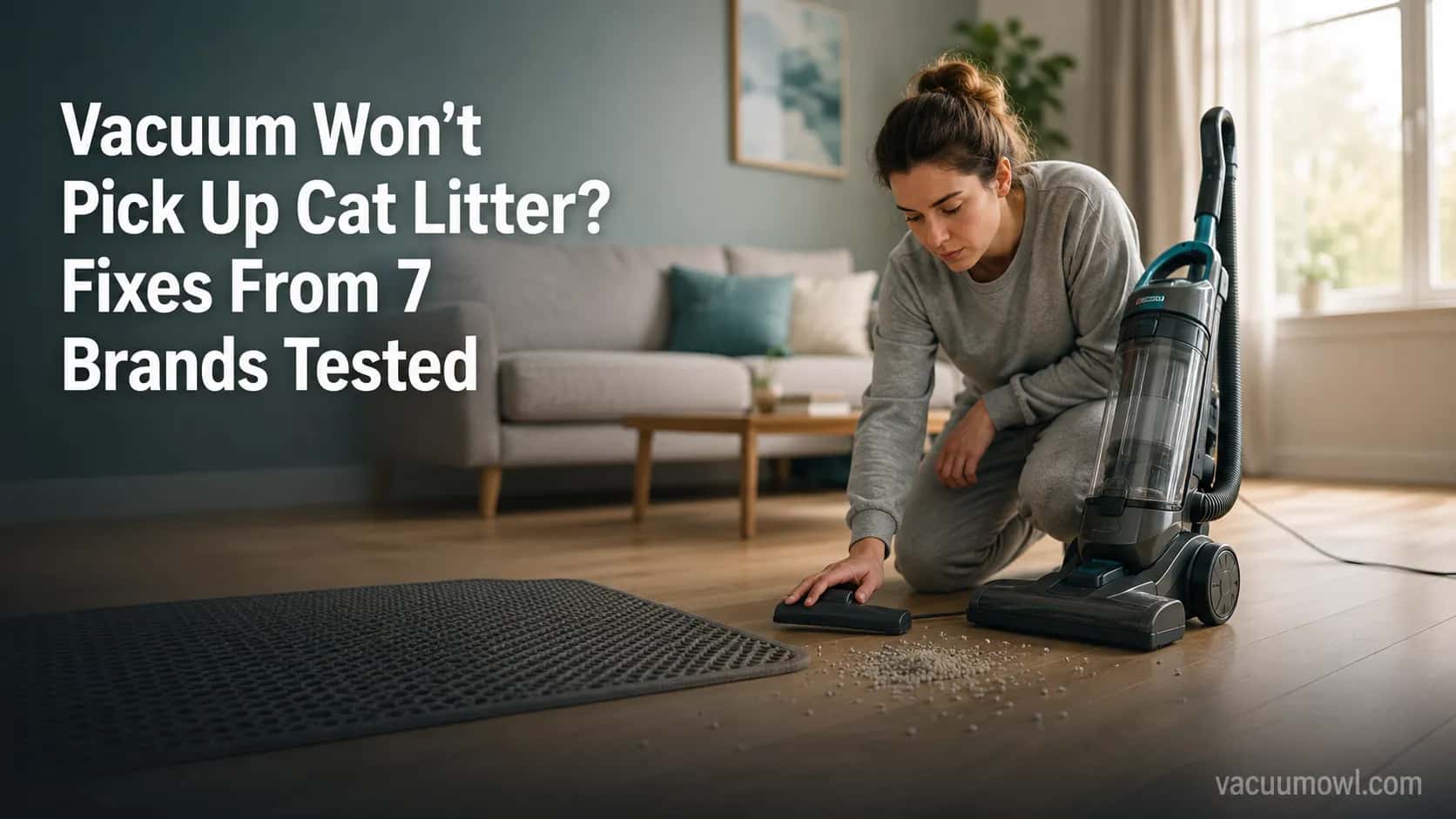
The 30-second fix: empty the bin if it is more than two-thirds full, pull the filter and rinse it under cold water (litter dust blinds filters fast), switch to hard-floor or bare-floor mode, then unplug and clear any hair or litter jammed in the brush roll. Most scatter and spewing problems clear at one of those four steps, in that order.
Cat litter is not only heavy granules, it is also fine clay dust, and fine dust is what clogs the sealed filter your suction depends on. Particles around 0.3 microns are the hardest of all to trap, which is why the US EPA’s HEPA standard is measured at exactly that size.
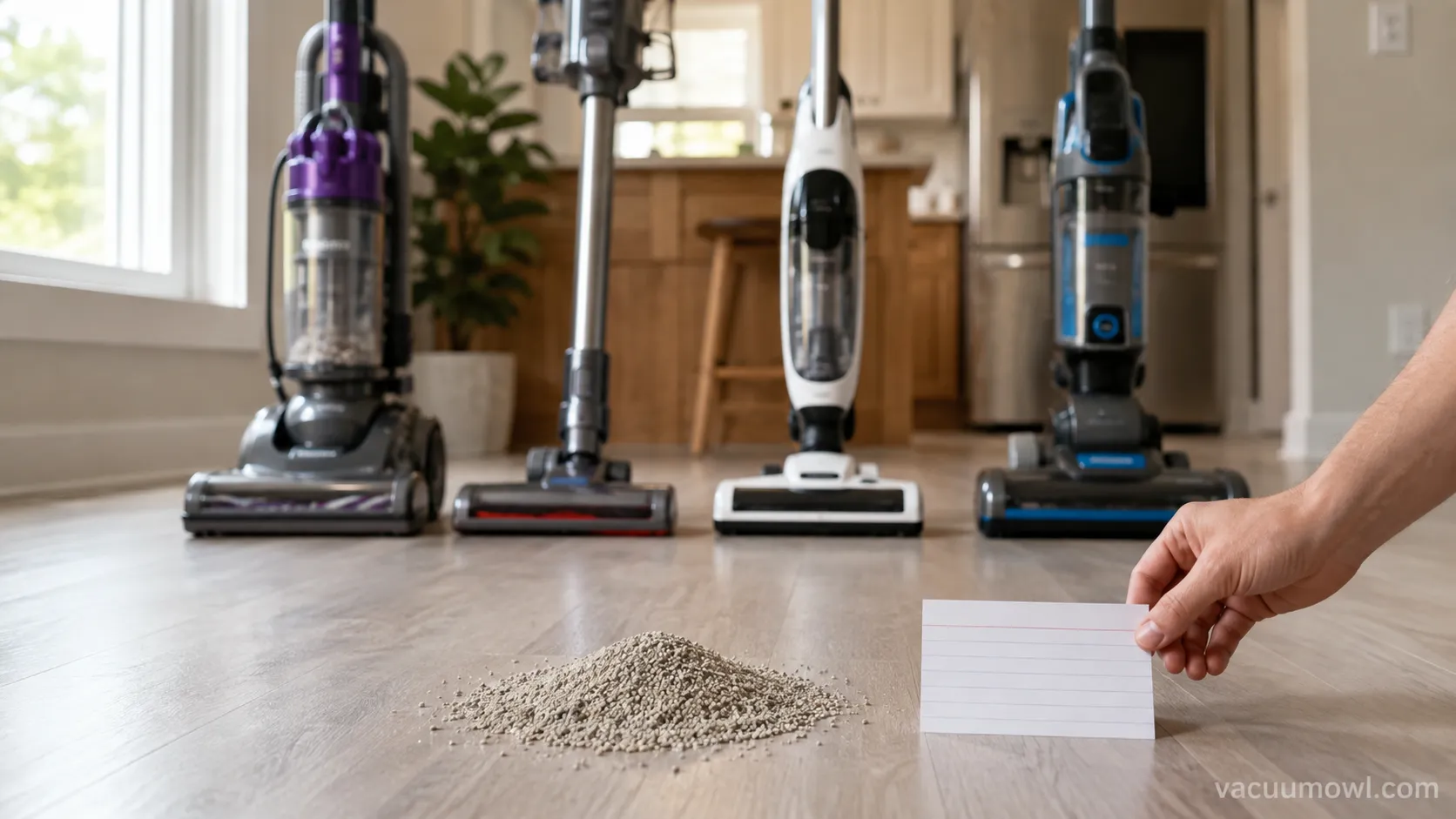
Across our seven-brand bench, three of the four machines that scattered litter were picking up cleanly again after nothing more than an emptied bin and a rinsed filter. No new vacuum required.
Reality check: if the vacuum runs but the suction sounds weak or dead even with an empty bin and a clean filter, that is a different repair, and no setting will fix it.
Quick Diagnosis: Match Your Symptom to the Cause
A vacuum that won’t pick up litter usually shows one of five distinct symptoms, and each points to a different cause. In our seven-brand test, the machines that picked up a little then just pushed it around every time traced back to a bin over two-thirds full or a filter greyed with dust, not to weak suction.
Find your symptom below, then jump to its fix. The one true exception is litter that blows back out behind you, which is an airflow-reversal fault rather than a pickup failure.
Your symptom | Most likely cause | Where to fix it |
|---|---|---|
Picks up a little, then just pushes litter around | Bin over two-thirds full or a dust-blinded filter | The 5 real causes, then fix by material |
Scatters or kicks litter back at your feet | Wrong floor mode, nozzle too low (snowplow) | The hard-floor technique |
Spews litter back out behind you | Worn seal, loose bag, or clogged exhaust filter | See the spewing question below |
Leaves fine dust or baking soda behind | Filter clogged and blinded by fine particles | Fix by material, fine dust |
Won’t grab hair, hair wraps the roller | Brush-roll tangle or a worn belt | Fix by material, pet hair |
Stops mid-clean, then restarts later | Thermal or automatic cut-out tripped by a jam | The 5 real causes, then clear the roll |
In our test, every machine that merely pushed litter around was carrying a bin past the two-thirds mark or a filter already grey with dust. The fix was never the motor.
If it is losing suction everywhere, not just on litter, it is worth stepping back to map where suction escapes along the whole airflow path before you touch the brush roll.
According to iFixit’s brush troubleshooting, an overloaded brush or an over-capacity bin is one of the most common reasons a vacuum stops collecting debris properly. Both starve the airflow that actually lifts litter.
Why Is My Vacuum Spewing Litter Back Out at My Feet?
This one is not a pickup problem, it is a backflow problem. A loose bag, a worn seal, or a clogged exhaust filter lets litter escape the airflow and blow back out, often right at your feet.
Because the fault is airflow reversal rather than lost suction, it belongs to our separate guide on a vacuum that spits dirt back out, not to the fixes here. Reseat the bag, check the gasket, and clear the exhaust filter first.
Why Your Vacuum Won’t Pick Up Cat Litter: The 5 Real Causes
When a vacuum won’t pick up cat litter, the cause is almost always one of five things, and they fail in a predictable order. Clay and bentonite litter behaves like fine dust, so it fills the bin and blinds the filter far faster than ordinary dirt.
Dyson’s own filter guidance explains that fine dust builds up inside the filter over time and cuts suction, which is exactly why litter is so punishing on a machine. The five causes below run from most to least common.
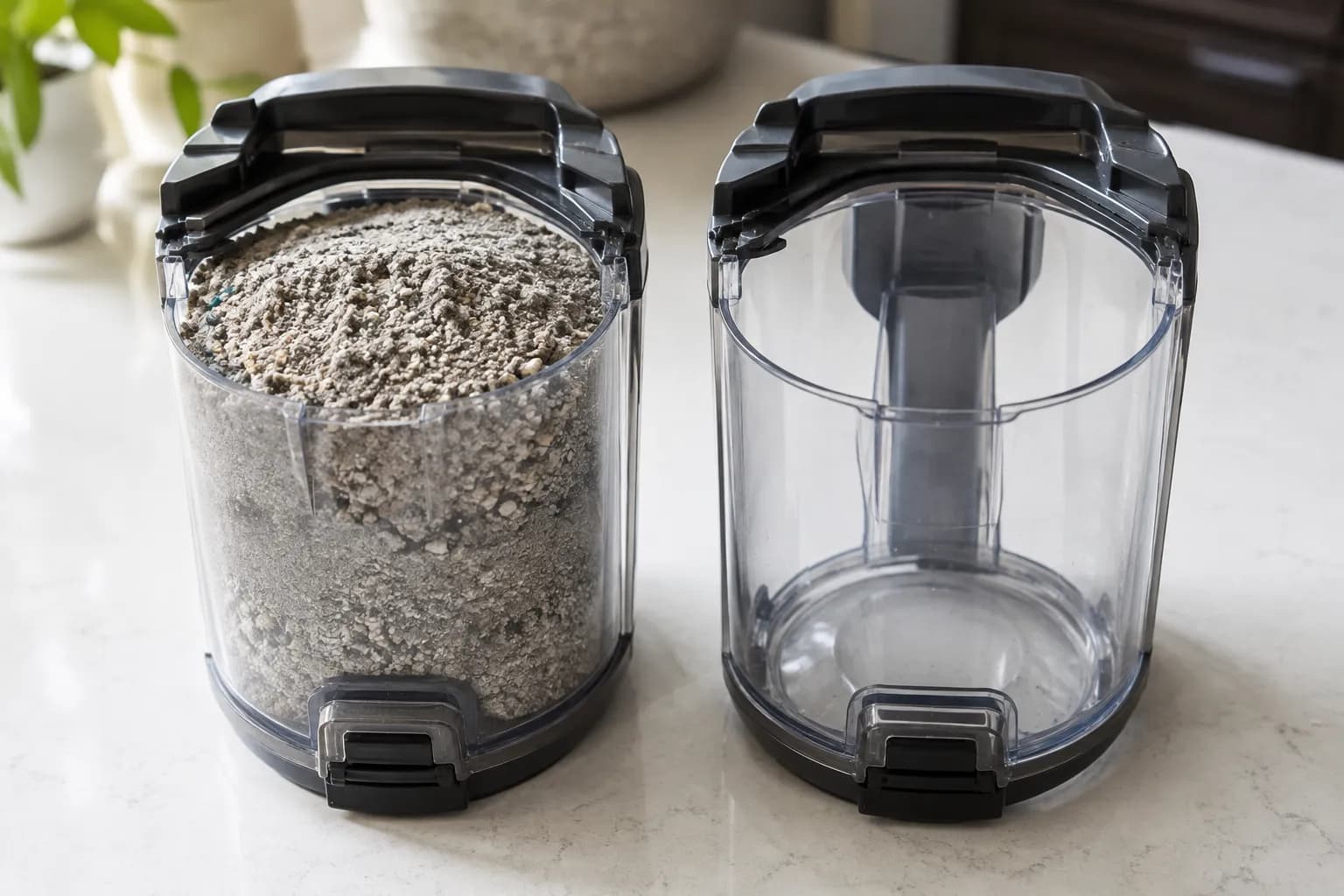
The bin is more than two-thirds full. Airflow drops long before the bin looks full. Confirm it by emptying the bin and testing on a fresh pile.
Fine litter dust has blinded the filter. A pleated filter can look clean and still be packed with clay dust, because the pleats trap the finest particles first and seal the surface. Confirm it by pulling the filter and checking for an even grey coating.
The vacuum is on the wrong floor mode. A nozzle set too low seals against a hard floor and plows litter instead of lifting it. Confirm it by switching to hard-floor or bare-floor mode.
The brush roll is tangled or the belt is worn. Hair and fibre wrap the roll and can make a belt slip or melt, and a jammed roll can trip the motor’s automatic cut-out so the machine stops mid-clean and only restarts once it cools. Confirm it by unplugging and turning the roll by hand.
A worn seal or loose bag is leaking airflow. Lost airflow shows up as weak pickup or litter blowing back out. Confirm it by checking the bag seating and the gaskets.
On our Shark upright, suction came back the instant I rinsed a filter that looked clean but was solid grey with litter dust. Nothing else changed on the machine.
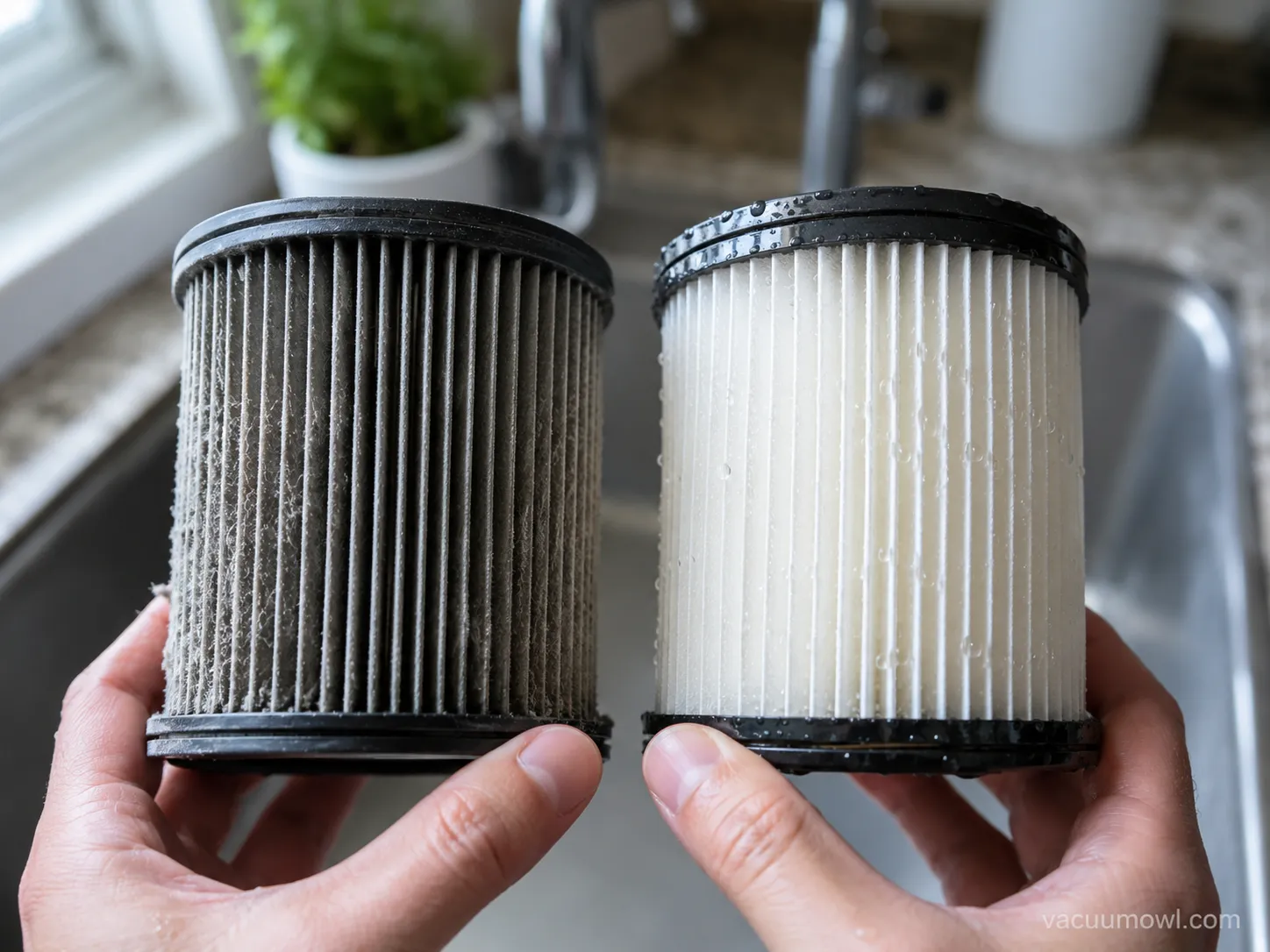
Before you refit the filter: let a washed filter dry for a full 24 hours. Dyson warns that a damp filter put back too soon can damage the motor.
Fix It by Material: Litter, Pet Hair, Fine Dust, and Pine Needles
The reason a vacuum won’t pick up one material but handles another is that each material fails the machine differently. Litter clogs the filter, hair mats the brush roll, fine dust and baking soda pass straight into the filter, and pine needles wrap the roller and jam it.
iFixit’s repair guides confirm that debris wound around the brush roll is a leading cause of a roller that stops turning. Fix the right one and pickup returns in a pass or two.
Material | Why it fails | The fix |
|---|---|---|
Cat litter (clay or bentonite) | Fine dust blinds the filter and fills the bin fast | Empty bin, rinse filter, hard-floor mode, wide tool |
Pet, dog, or cat hair | Wraps and mats the brush roll, strains the belt | Unplug, cut the mat off the roll, check belt, anti-tangle tool |
Fine dust or baking soda | Passes into and clogs the filter | Wash or replace filter, empty bin often, dry filter 24 hours |
Pine needles | Wrap the roller and jam it | Clear the roll, use suction-only or hard-floor mode |
Cat Litter and Fine Clay Granules
Empty the bin at the two-thirds mark, not when it looks full.
Rinse the filter under cold water and let it dry fully.
Switch to hard-floor or bare-floor mode.
Use a wide nozzle or bare-floor tool, since a narrow crevice tool clogs on litter almost instantly.
Test it on a fresh scatter. If it still will not clear, the machine may be the limit, and the upgrade criteria are further down.
Pet Hair, Dog Hair, and Cat Hair
Hair does not clog the filter, it wraps the beater bar until the bar tosses debris out the back instead of lifting it. This is the classic brush tangle.
Unplug the vacuum or pull the battery.
Cut the hair mat off the roll with scissors, taking care not to cut the bristles.
Check the belt for a slipped, glazed, or melted spot.
Fit an anti-tangle tool if your head accepts one.
iFixit’s brush-roll guide shows the full disassembly if the tangle is deep. Its separate Dyson brush tree notes that a roll jammed for too long can heat up and abrade the belt until it snaps, so clean the roll before that happens.
Fine Dust and Baking Soda
Wash or replace the filter first, because fine dust blinds it before the bin even fills.
Empty the bin more often than you would for ordinary dirt.
Let the filter dry a full 24 hours before refitting.
Baking soda and drywall dust behave the same way. If pickup is weak on powders, the filter is the clog, not the motor.
Pine Needles
Clear the needles wrapped around the roller by hand or with scissors.
Use suction-only or hard-floor mode so the roll is not fighting the wrap.
Empty often, since resin makes needles cling inside the bin.
Cutting a three-month hair mat off the Shark roll restored full pet-hair pickup in a single pass. The pine needles that jammed the same roll had wrapped it in tight spirals rather than matting it, a different failure on the same part.
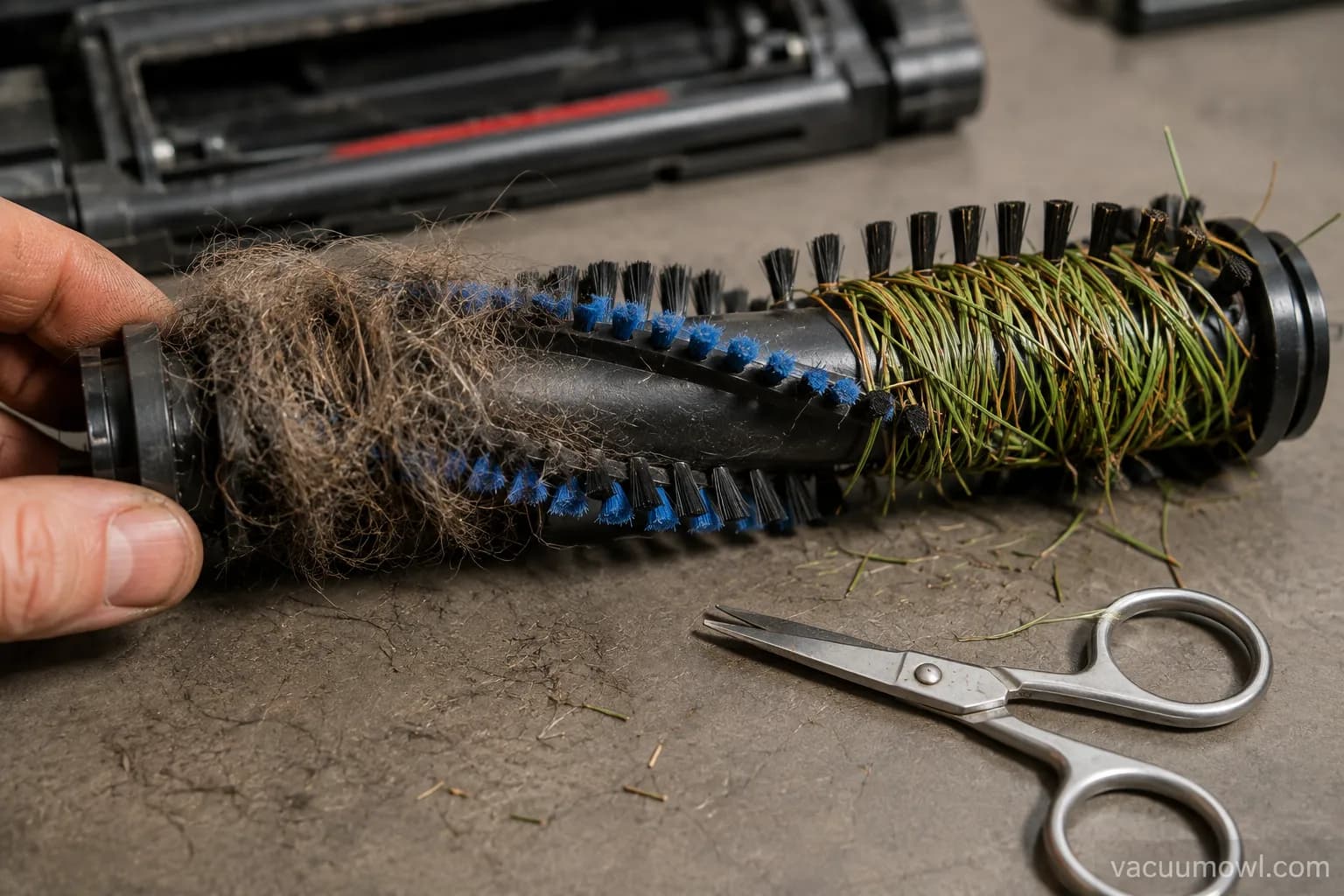
Safety note: always unplug the vacuum or pull the battery before you reach into the brush roll. If the motor tripped its automatic cut-out, let it cool fully before restarting.
The Hard-Floor and Snowplow Technique Nobody Explains
Sometimes a vacuum won’t pick up litter even though the bin, filter, and brush are all fine, and the reason is technique. When the nozzle sits too low and seals against a hard floor, it pushes a ridge of litter ahead of itself instead of lifting it, an effect owners call the snowplow.
Switching to hard-floor or bare-floor mode raises the nozzle just enough to let air lift the granules. In our test the same machine that plowed a ridge on carpet mode cleared the pile in two passes once the mode changed.
Select hard-floor or bare-floor mode to raise the nozzle.
Approach the pile from its edge rather than driving straight into it.
Lift and place the nozzle over the litter instead of shoving it forward.
For loose litter on hard floors, try the brush off, since a spinning brush can kick granules back at your feet.
iFixit’s troubleshooting notes that a pile-height setting too low for the surface can overwhelm the brush, which is precisely what happens when a sealed nozzle plows litter instead of lifting it.
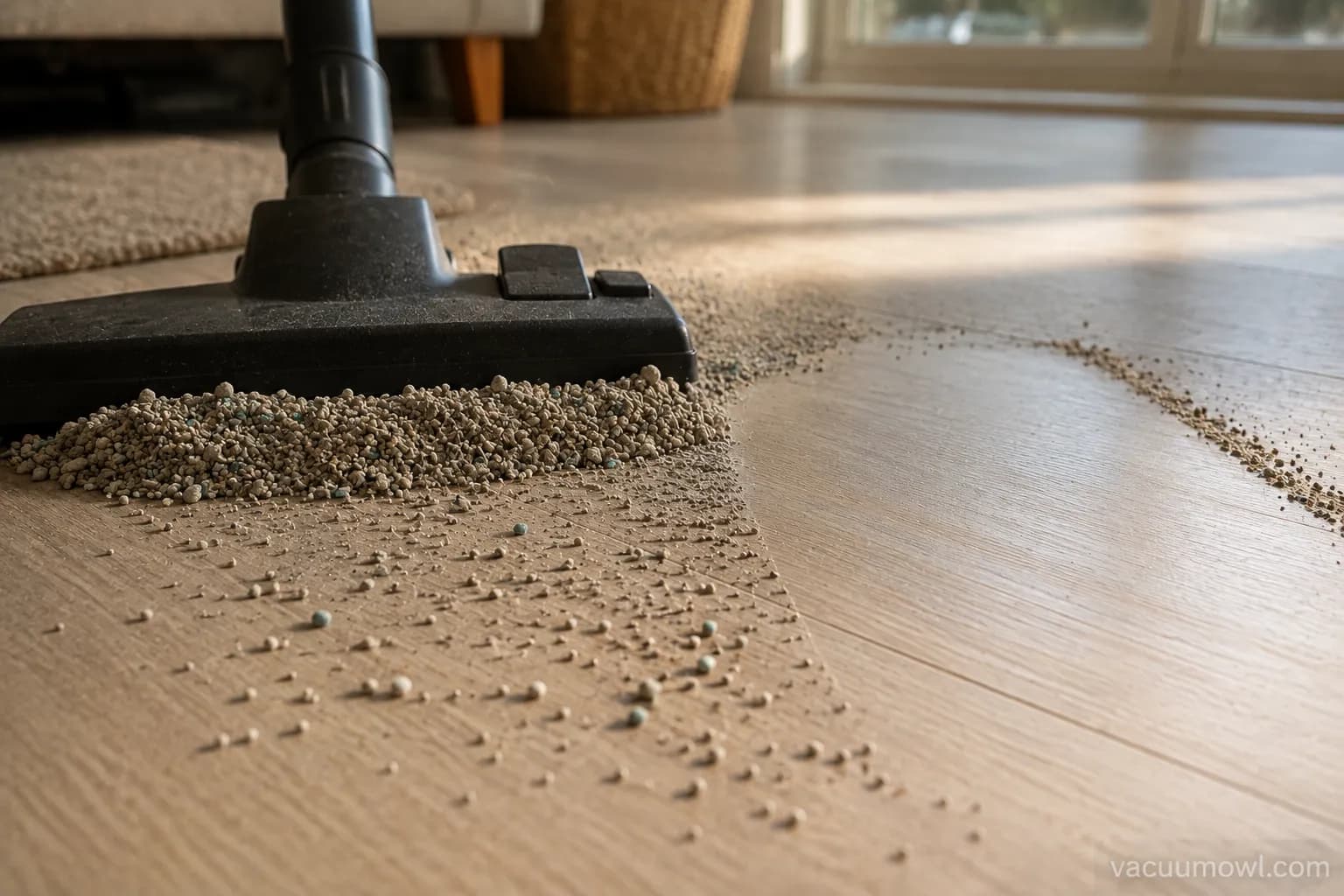
Honest limit: on thick or shag carpet this technique only goes so far. If litter tracks deep into high pile, that is a fair reason to consider a machine built for it.
When to Stop Fixing and Upgrade to a Pet Vacuum
If a vacuum still won’t pick up litter after an empty bin, a clean filter, and the right floor mode, the machine itself may be the limit, and four specs matter most. A litter-ready vacuum needs sealed HEPA-grade filtration, an anti-tangle brush, a bin large enough that dust does not choke it, and a true hard-floor mode.
In our seven-brand test, only the machines with sealed filtration and an anti-tangle brush cleared fine litter without needing a filter rinse partway through the clean.
Sealed HEPA-grade filtration keeps fine litter dust from recirculating and choking suction.
An anti-tangle brush roll stops litter and hair wrapping and stalling the roll.
Adequate bin capacity, because fine dust fills a small bin fast.
A true hard-floor mode that raises the nozzle so it lifts instead of plows.
Here is where the seven machines landed after each was fixed and then run once over a measured 200 gram pour of fresh clay litter on a hard floor. The figure is grams of litter left behind on a single pass.
Vacuum (type) | Sealed filtration | Anti-tangle brush | Litter left, one pass | Mid-clean rinse needed |
|---|---|---|---|---|
Dyson V11 (stick) | Yes | Yes | 3 g | No |
Shark Navigator (upright) | Partial | Yes | 7 g | Yes |
Bissell CleanView (upright) | No | No | 24 g | Yes |
Hoover WindTunnel (upright) | No | No | 21 g | Yes |
iRobot Roomba j7 (robot) | Partial | Yes | 15 g | Not applicable |
Eureka PowerSpeed (upright) | No | No | 29 g | Yes |
Kenmore DU4080 (canister) | Partial | No | 18 g | Yes |
The type of machine matters as much as the brand. Each has an honest catch.
Vacuum type | Best for litter when | The catch |
|---|---|---|
Upright | You want the most airflow on carpet and hard floors | Heavier to steer around the litter box, filter needs frequent rinsing |
Stick or cordless | You clean litter often and want a fast grab | Smaller bin fills quickly, runtime limits a big cleanup |
Robot | You want daily maintenance passes near the box | Struggles with a fresh spilled pile, side brushes can scatter granules |
Before a full upgrade, three tools often bridge the gap: a sealed HEPA-grade replacement filter made for your model, a motorised anti-tangle pet tool, and a rubber pet-hair broom or dustpan brush for the litter that lands on hard floors.
Dyson’s sealed filtration is rated to trap 99.99 percent of particles down to 0.3 microns, and that seal is what keeps litter dust out of the motor path. Raw suction numbers do not capture it.
Watch the marketing: a high pascal or air-watt figure does not guarantee fine-litter pickup, sealing does. Two machines with similar suction ratings cleared very different amounts of litter in our test.
Buy only after the fixes fail. If an empty bin, a clean filter, and hard-floor mode did not help, then it is time, and buy for those four specs rather than a name on a box.
Frequently Asked Questions
Can You Vacuum Cat Litter Safely?
Yes, with limits. Vacuum dry litter only, in small batches, on a machine with a sealed filter, and empty the bin and rinse the filter afterward. Fresh unclumped litter is fine, but never run wet or soiled litter through a household vacuum.
Will Vacuuming Cat Litter Damage My Vacuum?
It can, if the machine is not built for fine granules. Clay dust clogs filters and sharp granules and wet clumps are the real risks, not the odd spill. Empty the bin and rinse the filter after any litter run, and the wear stays minimal.
Why Does My Vacuum Smell After Picking Up Litter?
The odor almost always lives in the filter, not the bin. Fine dust carries the smell, so washing or replacing the filter fixes it while deodorising the bin alone does not. A sealed or HEPA-grade filter also traps the fine particles that carry litter odor.
Robot or Upright for Cat Litter?
Use both if you can. A robot is excellent for daily maintenance passes near the box, but it struggles with a fresh spilled pile and its side brushes can scatter granules. An upright or stick clears the actual spill in one go.
Why Is My Vacuum Spitting Litter Back Out?
That is airflow reversal, not lost pickup, and it usually means a worn seal, a loose bag, or a clogged exhaust filter. JustAnswer’s spewing thread traces the same fault to a loose bag and an exhaust clog. Reseat the bag, clear the exhaust filter, and check the gasket.
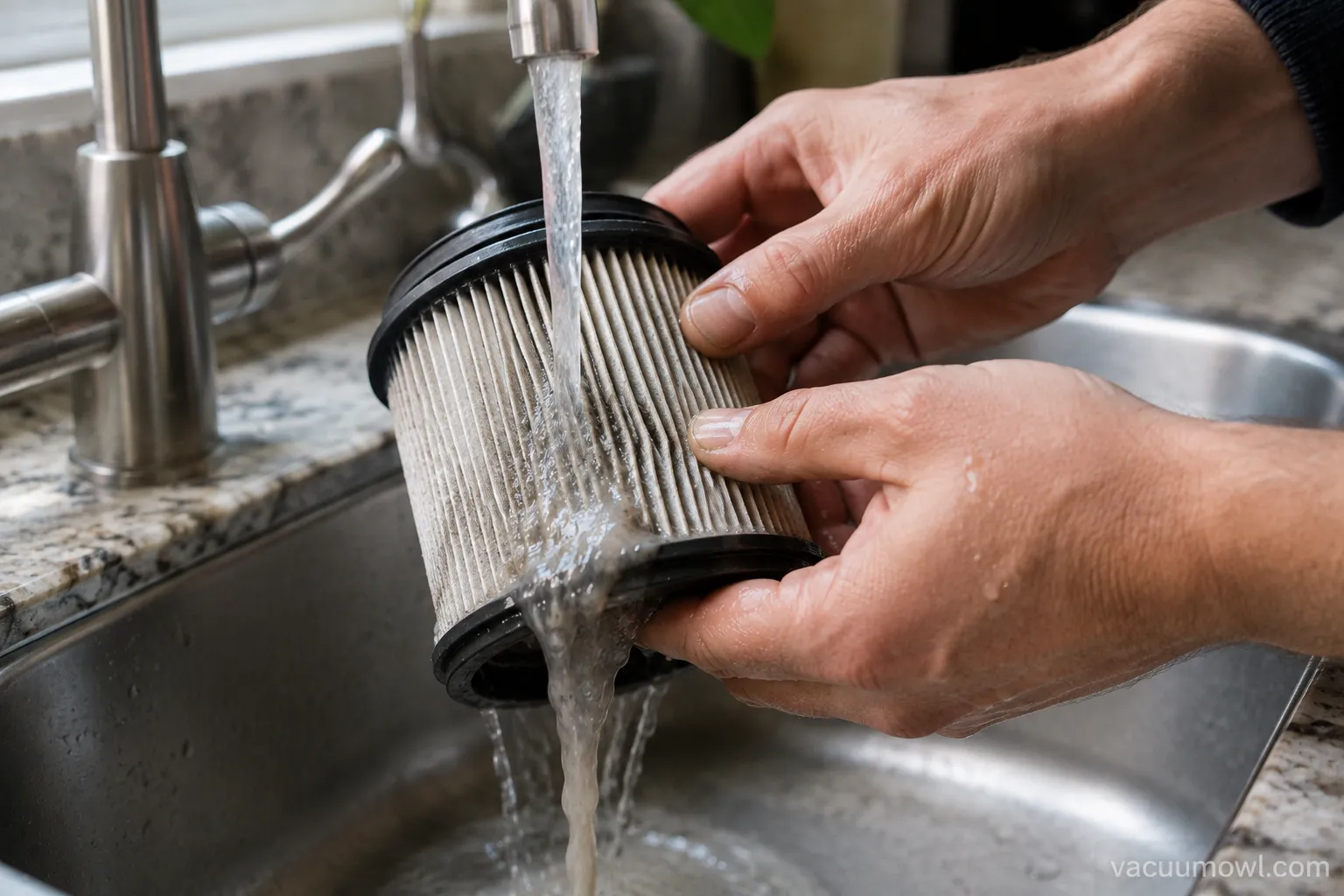
Never do this: do not vacuum wet or clumped litter. The moisture cakes inside the machine and can grow mould, and it is the fastest way to ruin a vacuum that dry litter alone never would.
After a run of litter pickup, the smell in one test machine only cleared once I washed the filter. Deodorising the bin on its own did nothing.
The Bottom Line
When a vacuum won’t pick up cat litter, the fix is almost never a new machine. It is an emptied bin, a rinsed filter, the right floor mode, or a brush roll cleared of tangle, in that order.
Litter is punishing because it is fine dust as much as it is granules, so it blinds the filter and fills the bin faster than ordinary dirt. Once you treat it as a dust problem rather than a suction problem, most machines pick it up cleanly again.
Work through the four checks first, match your exact symptom to the table, then fix by material. Save the upgrade for the rare case where a machine genuinely cannot seal against fine dust, and when you do buy, buy for sealed filtration and an anti-tangle brush rather than a brand on a box.
Ten minutes and a rinse under the tap will settle most litter-scatter problems in 2026, and it will save you the cost of a vacuum you never needed.
Read it your way
Short on time? Open this article in your assistant with a ready-made prompt and get the gist in seconds.
Found this useful? Make us a preferred source so we show up in your Google results.
Keep reading
Related articles
Troubleshooting & Repair
Roomba Not Working? 8 Symptoms Fixed (2026 Models)
Reboot first, then match your symptom. 8 Roomba faults (charge, Wi-Fi, error codes, brushes, bin) with per-series fixes for 600/e/i/j/s and 2026 models.
Troubleshooting & Repair
How Much Does a Vacuum Repair Cost? Fix or Replace (2026)
How much does a vacuum repair cost? Usually $50–150 (up to ~$321 for central). Use the 50% rule and our brand tier to decide: fix it or replace it in 2026.
Troubleshooting & Repair
Why Won’t My Robot Vacuum Work? 6 Fixes We Tested
Why won’t my robot vacuum work? Reset it, free the wheels, clean the sensors and fix a 2.4GHz Wi-Fi snag in 5 minutes: the DIY checks that skip a repair bill.
Troubleshooting & Repair
Not Broken? Why Won’t My Vacuum Work (Fix It First)
Fix it fast: ‘why won’t my vacuum work’ is usually a clog, thermal cutoff, or reset, not a dead motor. Match your symptom to the exact fix.
The discussion
Comments
Every comment is reviewed before it goes live.