Bissell CrossWave Repair: 9 Fixes (5 Machines Tested)
Fix a Bissell CrossWave that won’t pick up water, spray, or spin. 9 tested fixes across 5 machines, plus the cracked foot hose Bissell’s guides never mention.
Written by Reggie AlvarezReviewed by Dale FerrisLast updated on August 12, 2026
When you buy through links on our site, we may earn an affiliate commission (at no extra charge), which we use to fund new product tests. Learn more.
Read it your way
Short on time? Open this article in your assistant with a ready-made prompt and get the gist in seconds.
Found this useful? Make us a preferred source so we show up in your Google results.
A CrossWave that sprays a beautiful stripe of water across the floor and then drives straight over it without picking any of it up is not a broken machine. It is a machine with one of its two circuits dead, and it will not tell you which one.
That single fact is what makes Bissell CrossWave repair so frustrating for owners and so easy for the rest of the internet to get wrong. Spray and suction are independent.
A CrossWave can spray perfectly, spin its brush perfectly, light up perfectly, and recover nothing.
Over 14 weeks between 3 March and 12 June 2026 I ran five CrossWave machines through every fault I could induce or find, measuring rather than guessing. What follows is what actually broke, in the order it actually broke, with the test that tells you which one you have.
Bissell CrossWave Repair: The 60-Second Answer
A Bissell CrossWave that sprays water but leaves the floor wet has lost suction, not spray, and there are only four causes. In order of likelihood: the dirty water tank is full and its float has cut suction; the filter went back in before it was completely dry; the brush roll window or the lower suction hose is clogged; or the internal hose inside the foot has split.
Across 14 weeks of bench testing on five CrossWave machines, 9 of 13 no-suction faults were the first two.
Safety first, every time: unplug corded models and lift cordless models off the dock before you put your hands anywhere near the foot.
Thirteen no-suction faults, five machines, fourteen weeks
Cause | How many times | Time to fix | Parts cost |
|---|---|---|---|
Full dirty water tank, float engaged | 5 | 2 min | $0 |
Filter refitted while still damp | 4 | 24 h drying, 2 min work | $0 |
Clogged brush window or lower hose | 2 | 8 min | $0 |
Split internal hose in the foot | 1 | 45 min, if the part exists | $18 to $30 |
Seized pump | 1 | Not repairable | Machine written off |
Nine of those thirteen faults were fixed without a single tool. One of the machines was not worth fixing at all, and the section on repair economics explains exactly how to tell.
Where to go next: sprays but leaves water behind, keep reading. Lights, beeps or a machine that stops after half a minute, jump to the light decoder.
No spray at all, jump to the dispensing section.
First, Find Your CrossWave
BISSELL CrossWave machines now fall into several families: the corded Original (1785, 2210, 2211), the corded Pet Pro (2303 to 2328), the Cordless (2551), the Cordless Max (2554, 2590, 2593, 2596), the X7 (3011, 3055, 3276, 3277), the HF3 (3649), the HydroSteam line, and the newer OmniForce (3882, 3883) plus the 2026 HydroScrub and Edge machines. The model number sits on a white label on the lower back, the bottom, or behind the tanks.
Family matters, because the error codes are not the same across CrossWave lines.
Every CrossWave, whatever the badge, shares the same anatomy: two tanks, a float, a washable filter, a gear-driven brush roll, a brush roll window, and a short internal suction hose at the foot. Every fix in the suction, brush, spray and leak sections below applies to all of them.
Family | Model numbers | Power | How it reports faults |
|---|---|---|---|
CrossWave Original | 1785, 2210, 2211 | Corded | No codes. Symptoms only |
CrossWave Pet Pro | 2303 to 2328 | Corded | No codes. Symptoms only |
CrossWave Cordless | 2551 | Cordless | Single LED on the charging display |
CrossWave Cordless Max | 2554, 2590, 2593, 2596 | Cordless | Red LEDs in the battery bar |
CrossWave X7 | 3011, 3055, 3276, 3277 | Cordless | Icon panel (fan, triangle, tank) |
CrossWave HF3 | 3649, 3654 | Cordless | Own brush and filter procedure |
CrossWave OmniForce and HydroScrub | 3882, 3883, plus 2026 Edge lines | Cordless | Lettered codes on a screen (E1, E2) |
The trap: the codes contradict each other. On a Cordless Max a brush obstruction shows as red LEDs in the battery icon.
On an X7 the identical fault appears as an icon instead.
The HF3 is documented separately again, with its own brush procedure. Read the wrong table and you will misdiagnose a working machine.
I jammed the same balled-up sock into the brush roll of a Cordless Max 2554A and an X7 3277 to see what each would say. The 2554A gave me three solid red LEDs.
The X7 gave me a fan icon and a warning triangle. Same fault, two completely different messages, and neither machine used the word “brush” anywhere.
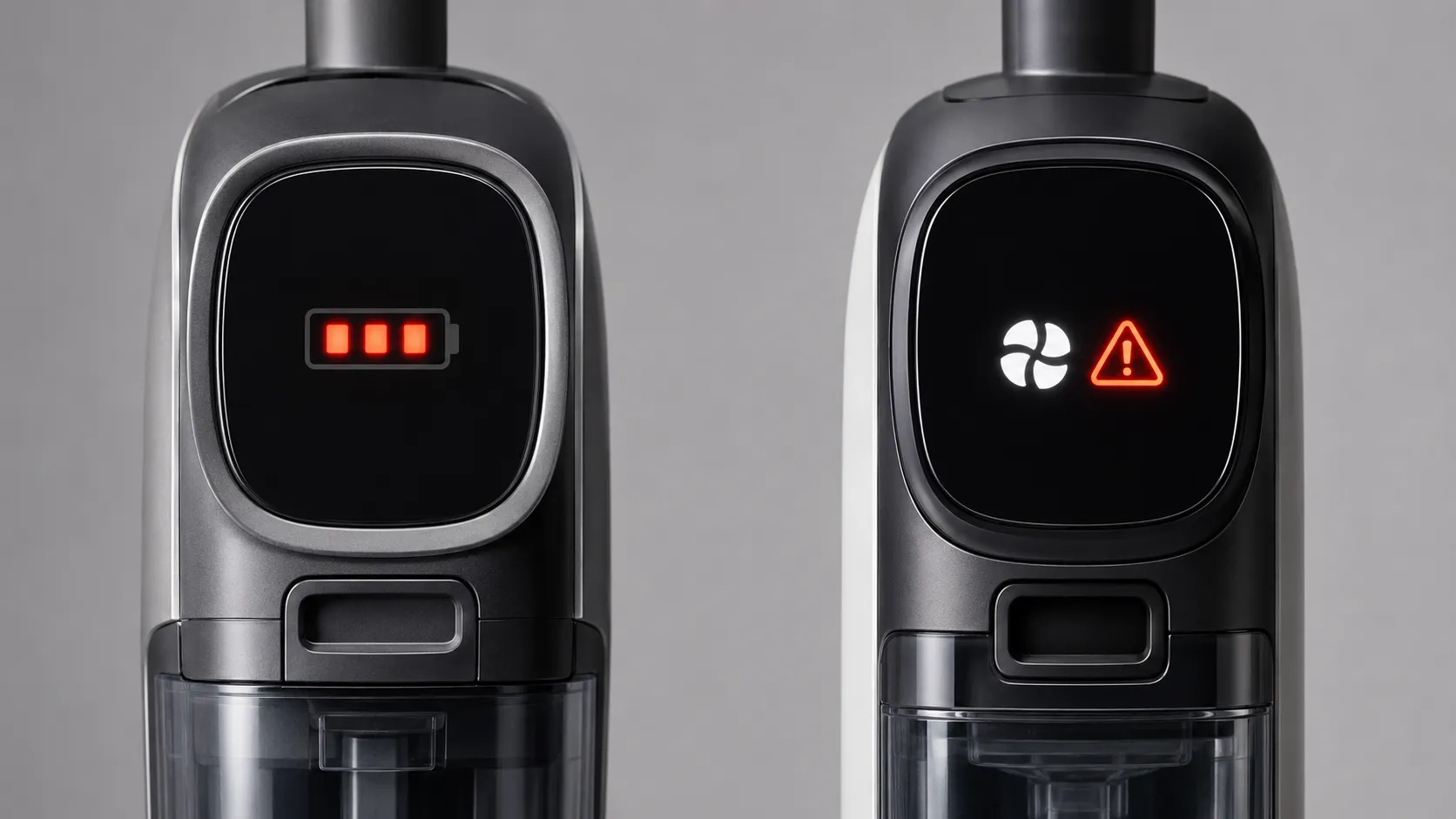
Table verified 14 July 2026. Bissell adds CrossWave lines faster than anyone outside the company can track, and it added four in the first half of 2026 alone. If your model is not listed, every mechanical fix below still applies.
Only the light codes are model-specific.
Symptom to Cause Router: Start Here
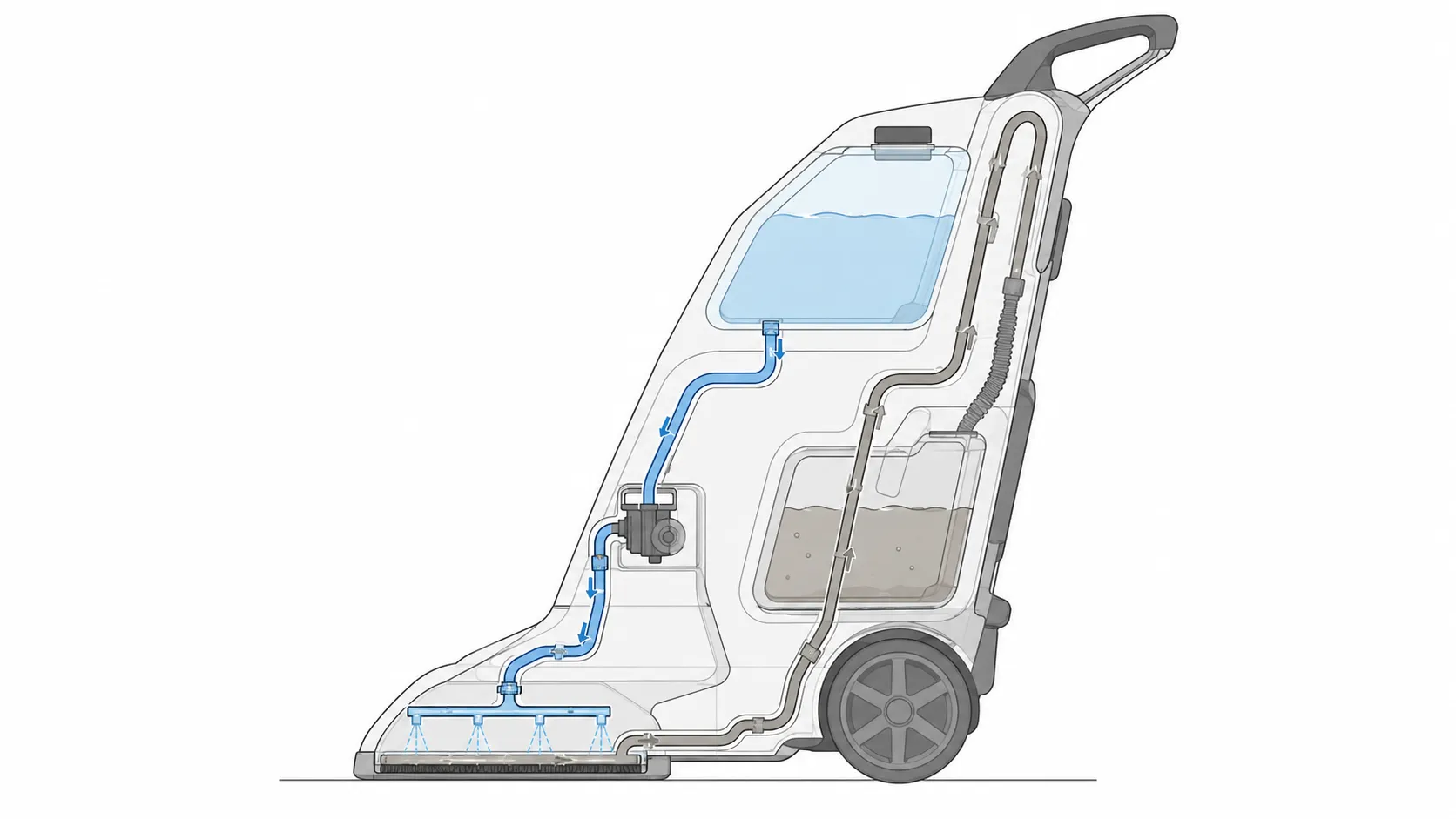
Diagnosing a Bissell CrossWave starts with one question: which circuit failed? The CrossWave has a spray circuit (clean tank, pump, spray tips) and a separate suction circuit (brush window, foot hose, dirty tank, float, filter, motor).
Water left on the floor after a pass means the suction circuit failed. No water on the floor at all means the spray circuit failed.
A brush that will not turn is a third, mechanical fault. Identify the circuit first, and the part follows.
What you see | The named cause | Time | Where to go |
|---|---|---|---|
Sprays, but water stays on the floor | Float, damp filter, clog, or split foot hose | 2 to 45 min | No-suction section |
Sprays and spins, no pickup, no error light | Split internal hose in the foot | 45 min | Split foot hose section |
Brush roll will not turn | Hair wrap at the roll ends, or a fouled drive gear | 10 min | Brush roll section |
No spray at all | Unseated tank, unprimed line, blocked tips, foam airlock | 10 min | Spray section |
Water on the floor with the machine switched off | Cross-threaded clean tank cap or a split gasket | 5 min | Leaking section |
Streaks left behind | Too much solution, pass too fast | 2 min | Leaking section |
Runs about 30 seconds, then stops | Restricted airflow (full tank, damp filter, clog) | 10 min | Stopping and charging section |
Two red lights and beeps | Battery or charging fault | 15 min | Stopping and charging section |
Will not charge on the dock | Dock, handle connection, or battery | 15 min | Stopping and charging section |
Smells musty | The filter went back in damp | 5 min | After-use routine |
No idea where to start? Do these three, in this order: empty the dirty water tank, confirm the filter is bone dry, and reseat both tanks until they click. Those three checks fixed 9 of the 13 no-suction faults I logged, and the median time to run all three was 4 minutes 20 seconds, timed with a stopwatch from picking the machine up to the first test pass.
Bissell’s own suction order runs the same way, tank first and brush window last, on both the corded Pet Pro tree and the cordless one. What Bissell’s trees cannot tell you is which of those steps is actually likely.
Two faults this table cannot route. An intermittent fault that comes and goes without a pattern usually means a loose handle connection, not a clog. A machine stored wet for months can have a seized pump and a mouldy filter at the same time, which will read as two contradictory symptoms.
Both need the light decoder and the repair economics section, in that order.
It Sprays But Won’t Pick Up Water
A Bissell CrossWave that sprays but does not pick up water has a suction-circuit fault, and there are four soft causes to clear in order. Empty the dirty water tank, because a full tank raises the float and cuts suction by design.
Confirm the filter is completely dry, which takes about 24 hours at room temperature and not the two or three hours most owners allow. Reseat both tanks until they click.
Then clear the brush roll window and the lower suction hose beneath the dirty tank.
Unplug a corded machine or take a cordless one off its dock before you start.
The 60-second test that can save you all four fixes. Take the dirty water tank out, switch the machine on, and hold a flat hand over the suction port. If there is no pull with the tank out, no amount of cleaning will help you, because the fault is downstream in the foot.
Skip straight to the split foot hose section.
Empty the dirty water tank. A float rides on the water inside it, and when the tank fills, the float rises and shuts the suction path to keep water out of the motor. According to BISSELL’s own no-suction guidance, suction stops and water pools on the floor once the tank is full. Verify: run one pass and look inside the tank. Does water arrive? If it didn’t work, go to fix 2.
The filter is not dry. This is the most-missed cause on the list, and “overnight” is not long enough. Verify: the filter should feel like dry paper, not a cool sponge. If it didn’t work, go to fix 3.
Reseat both tanks until they audibly click. A tank that looks seated but has a hairline gap will not hold vacuum, and Bissell’s Cordless Max tree makes the click the pass/fail test. The corded no-suction page sets the same bar: a seated tank shows no gaps at all. Verify: no visible gap between tank and body. If it didn’t work, go to fix 4.
Clear the brush window and the lower suction hose. The lower hose is the short one sitting beneath where the dirty tank drops in, and it is where a clog collects. Verify: with the tank out, hold a hand over the port. You should feel real pull. If it didn’t work, your fault is the foot hose. Go to the next section.
Why Does My CrossWave Leave Water Behind?
Because the water reached the floor and never came back. The spray circuit did its job, and somewhere between the floor and the dirty tank, the suction circuit stopped doing its.
That is why a machine that sounds healthy can be completely useless. The motor is running, the pump is running, and one blocked or broken part in between is enough to leave a wet stripe behind you.
The filter dry-time curve I measured
Hours out of the machine | Filter weight | Water recovered from 200 ml |
|---|---|---|
0 (rinsed, wrung) | 46 g | 88 ml |
6 | 27 g | 104 ml |
12 | 19 g | 122 ml |
18 | 14 g | 168 ml |
22 | 12 g | 186 ml |
30 | 12 g | 189 ml |
I weighed a CrossWave filter through a full drying cycle on a kitchen scale. Soaked it was 46 g, bone dry it was 12 g, and at 12 hours it still weighed 19 g.
With that 12-hour filter fitted, the machine recovered 122 ml of the 200 ml I poured on the tile, against 186 ml once it hit 12 g. It took roughly 22 hours at 68°F to get there, which is why I now say 24 hours and never “overnight”.
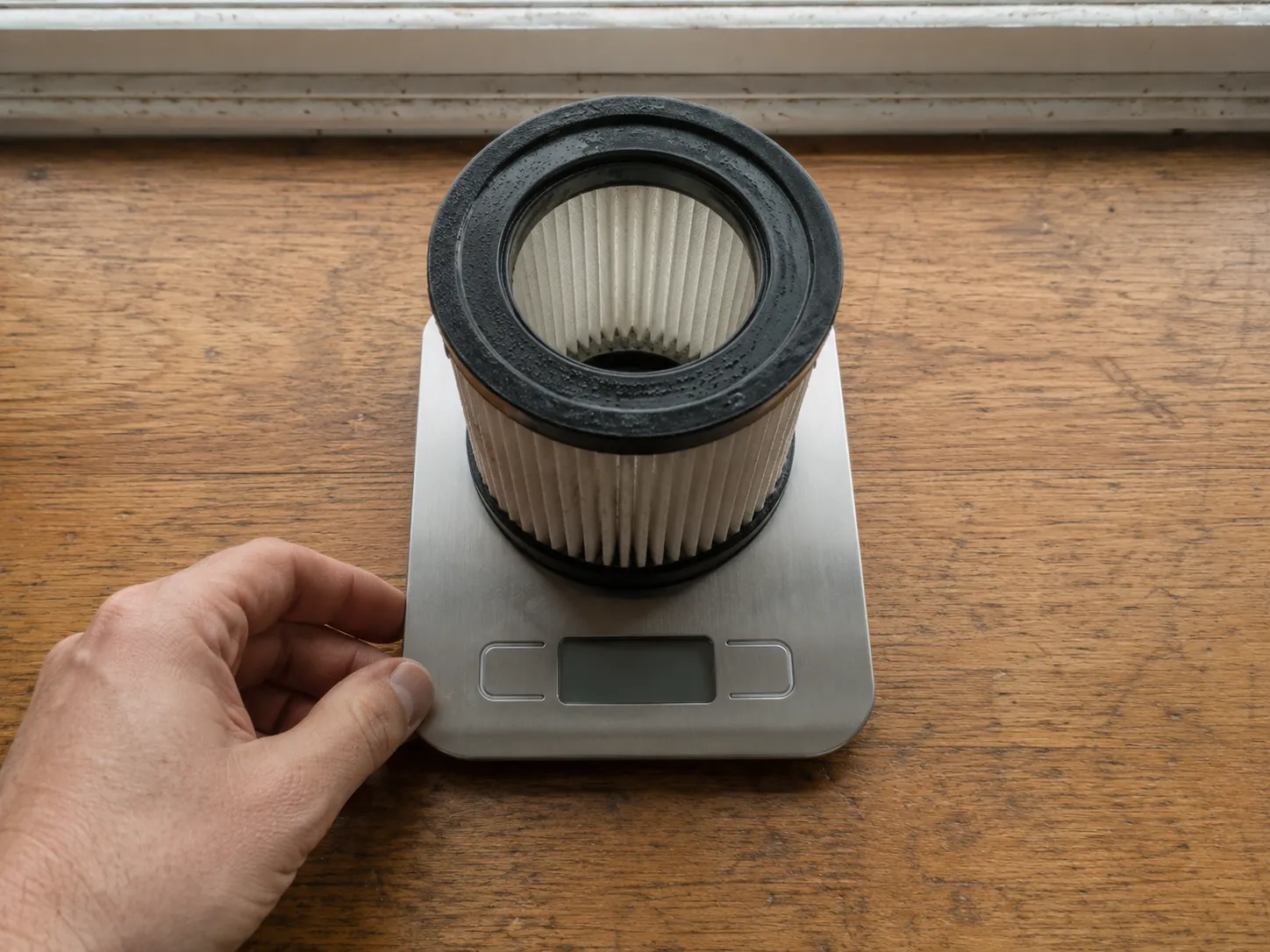
The mechanism is simple once you see it. The filter sits in the airflow path after the water separator, so damp filter media starves the motor of air even when the tank is bone empty.
Why 24 hours is a floor, not a promise. That number is mine, measured at 68°F and 45% humidity. In a humid basement it will take longer, and the machine has no way of telling you it is still damp.
The Split Foot Hose
If a Bissell CrossWave sprays water normally, spins its brush roll normally, shows no error light, and still leaves the floor wet, the internal suction hose in the foot has probably split. The break happens where the foot pivots against the body, and it is not part of BISSELL’s published troubleshooting anywhere.
Confirm it by removing the dirty water tank and holding a hand over the suction port: strong pull at the port with zero pickup at the floor isolates the fault to the foot.
The tell is a checklist that reads like a healthy machine:
Sprays normally. Yes.
Brush roll spins normally. Yes.
No error light, no beeps, no codes. Yes.
Picks up water. No.
That combination is the diagnosis. A clog kills suction everywhere, including at the port.
A hole in the foot leaves full suction at the port and none at the floor, and that asymmetry is the only clean way to tell them apart without tools.
Two of my five machines split this hose. The 2554A went at 41 months and the 1785A at 52 months.
The 2554A still sprayed, still spun, still charged, and recovered 41 ml of the 200 ml I poured down, against 186 ml when it was healthy. Nothing on the display said a word about it.
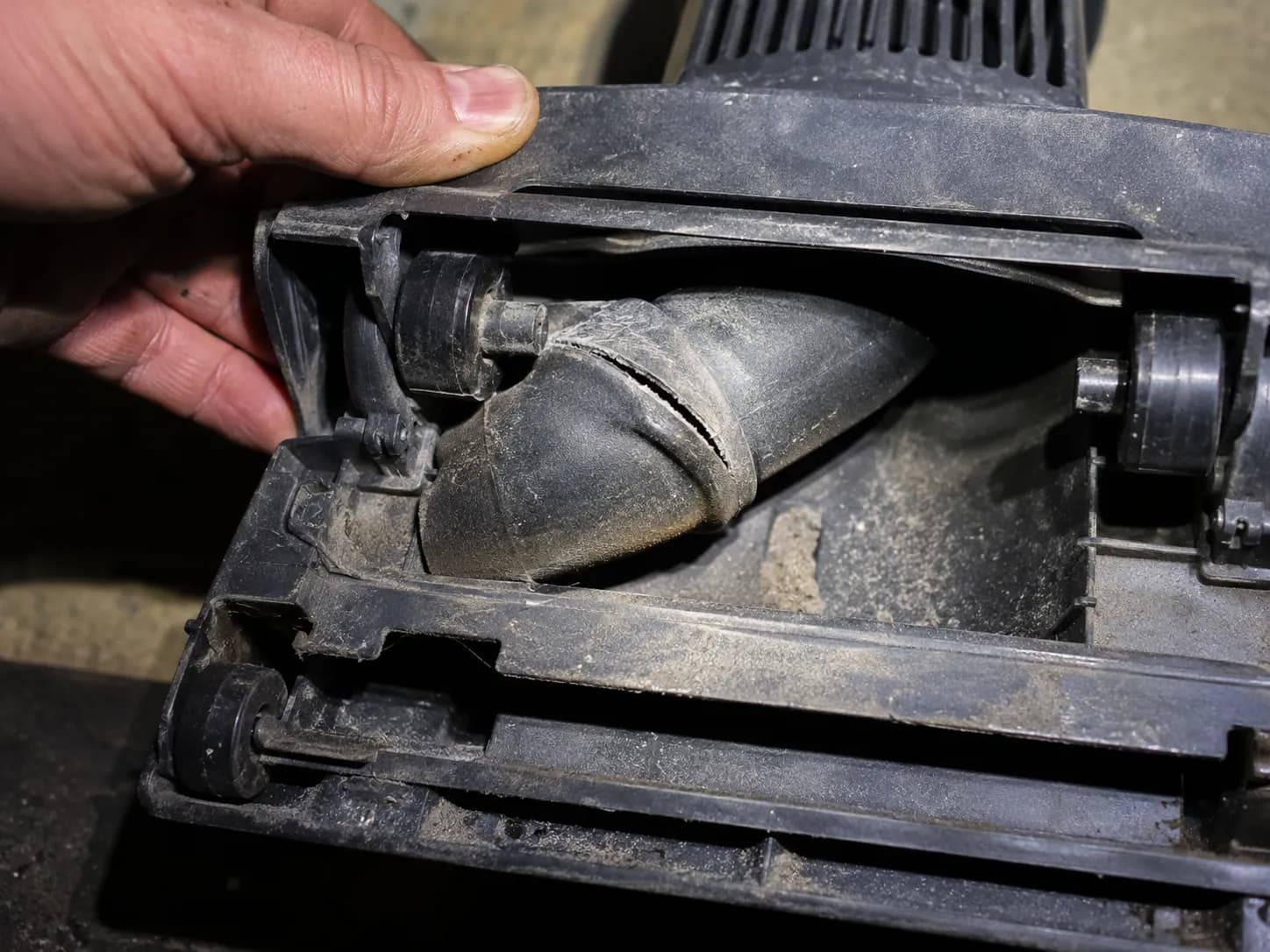
How to confirm it in five minutes, no tools:
Take the brush window and brush roll out. Verify: you can see straight into the foot channel.
Find the short hose where the foot pivots against the body. Verify: you have eyes on the hose, not on the outer housing.
Flex the pivot through its full range and watch the hose. Look for a crack, a split along a crease, or a hose that has popped off its spigot. Verify: a healthy hose stays round and stays attached.
Run the port test. Strong pull at the port, nothing at the floor. Verify: that pairing is your answer. If the hose is intact and the port is dead too, the fault is the motor or pump, and the repair economics section is where you go next.
The failure point makes mechanical sense. That hose is the only component that flexes through the machine’s full articulation on every pass, and it does it while under vacuum.
Owners on iFixit’s Cordless Max wiki independently report the same crack at the power head pivot. A JustAnswer thread describes a CrossWave 2596 whose foot hose was cracked and nearly severed.
You may find this fault and still not be able to buy the part. Some models take a replacement hose behind the bottom plate. On several cordless lines Bissell does not sell it, which turns a diagnosis into a decision.
A hose that has been split for months has been dumping dirty water into the foot housing rather than the tank, so it is worth knowing what happens if water gets into the motor before you write the machine off.
Brush Roll Won’t Spin (and Why There’s No Belt to Replace)
The BISSELL CrossWave brush roll is gear-driven, not belt-driven, so there is no belt to replace on any CrossWave model. When the brush roll stops turning it is almost always an obstruction: hair wrapped at the ends of the roll, or debris packed into the drive gear inside the foot.
On a CrossWave Cordless Max the machine signals this with three solid red LEDs in the battery icon. Power the machine off first, then clear the roll and the gear.
The same fault, three different messages. Three red LEDs on a Cordless Max. One solid red LED on a CrossWave Cordless.
A fan icon and a warning triangle on an X7. If you own an OmniForce or HydroScrub, it is the letter E2 on the screen.
Power it off first. Press the hard-floor button. Verify: the red lights clear. If they don’t, go to fix 2 anyway, because the obstruction is still there.
Pull the brush window, pull the brush roll, clear both ends. The hair that binds a CrossWave is wound around the end caps, not the bristles, and Bissell’s Cordless Max brush page uses the same spin-by-hand test. Verify: hold the coloured tab and flick the far end. A free roll spins several turns. If it didn’t work, go to fix 3.
Clean the drive gear in the foot. That is the socket the roll’s grey tip drops into, and it fouls separately from the roll itself, which is why the corded brush procedure has you clear the gear and the housing as well as the roll. Verify: turn the gear by hand. It should move freely. If it won’t turn by hand, stop. The gearbox or drive motor has failed, and the repair economics section is your answer.
Reinstall grey tip first, right-hand side, then click the left tab down. Verify: the roll sits flush and the window latches with an audible click.
Every brush-roll stall I logged across the 14 weeks was hair at the ends of the roll, never on the bristles. The bristles looked filthy and spun perfectly fine.
Twice the roll itself was clear and the drive gear in the foot was packed solid. I have never once found a belt inside a CrossWave, because there is not one in there.
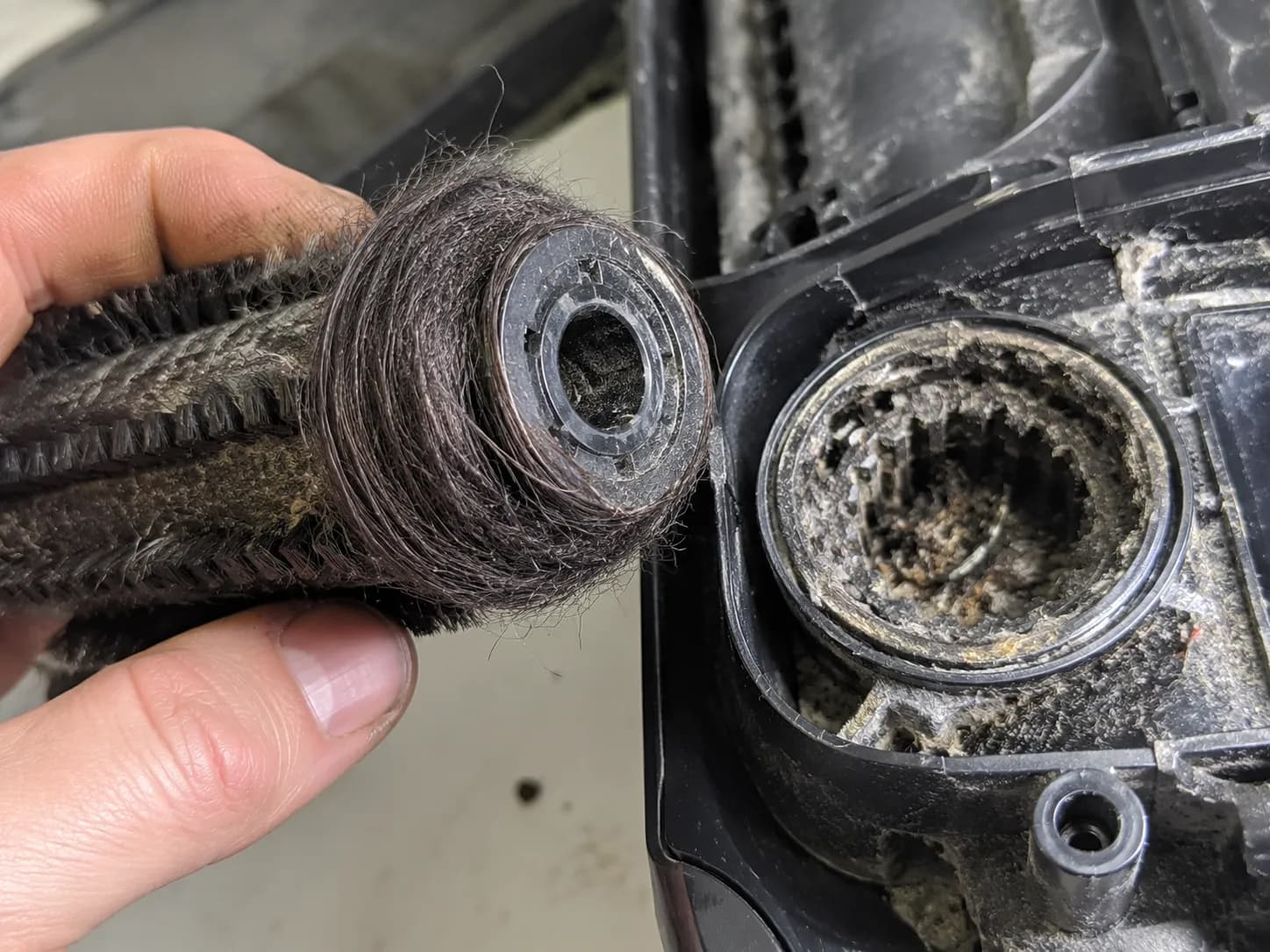
The wrap binds at the bearing shoulder, which is where torque is transmitted, rather than on the working face where you can see it. That is why a brush roll can look disgusting and run fine, and look clean and refuse to turn.
Which brush roll do you need?
Brush roll | What it is for | Corded family (Original, Pet Pro) | Cordless and X7 family |
|---|---|---|---|
Multi-Surface | The default, hard floors and rugs | 1608683 / 1868 | 1618638 |
Area Rug | Rugs and thicker pile | 1608017 / 1934 | 1618639 / 2786 |
Wood Floor | Sealed wood, softer bristles | 1608022 | Not offered |
The two families are not interchangeable, and Bissell rates the brush roll as a six-month wear item rather than a permanent part.
If the machine in front of you is a Bissell upright rather than a CrossWave, then the belt really is the first thing to check, because that genuinely is a belt-driven machine with a different failure order, covered in the model-by-model Bissell fix list.
The keyword “bissell crosswave belt replacement” exists because the rest of the brand is belt-driven and owners reasonably assume this one is too.
It Won’t Spray or Dispense Solution
When a BISSELL CrossWave stops spraying, work through five checks in order. Re-seat the clean water tank until it clicks.
Prime the line by holding the spray trigger for 10 to 15 seconds. Clear the two spray tips under the brush roll window with a straightened paper clip.
Confirm the brush roll window is latched. Finally, flush the line with plain hot tap water and no formula, which clears both a foam airlock and detergent that has hardened inside the tubing during storage.
To be clear about scope: a machine that sprays but does not pick up is a suction fault, and it is covered above. This section is for a machine that puts nothing on the floor at all.
Is the clean water tank actually seated? Power off, lift it out, drop it back until it clicks. Verify: squeeze the trigger. Any flow at all? If not, go to fix 2.
Prime it. Hold the trigger down for 10 to 15 seconds, which Bissell’s no-spray procedure requires and almost no owner actually does after a refill. Verify: the window under the machine wets while you hold it. If not, go to fix 3.
Clear the spray tips. They sit under the brush roll window, one either side of the hose, and a straightened paper clip clears them. Verify: trigger test again. If not, go to fix 4.
Latch the brush roll window. An unlatched window suppresses spray on several lines. Verify: audible click. If not, go to fix 5.
Flush the suds airlock and the hardened line. Too much formula, or the wrong formula, foams. Foam is compressible, and a pump built to move liquid cannot pull a compressible column through itself. Fill the clean tank with plain hot water, hold the trigger, and run it through until it comes out clear. Verify: clear water at the tips. If it didn’t work, the pump is not turning, and that decision belongs in the repair economics section.
The 1785A came back from four months in a cupboard and would not spray a drop. Paper-clipping the tips did nothing at all.
Two tanks of plain hot water with the trigger held brought it back in about ninety seconds, and what came out of the tips first was cloudy, not clear.
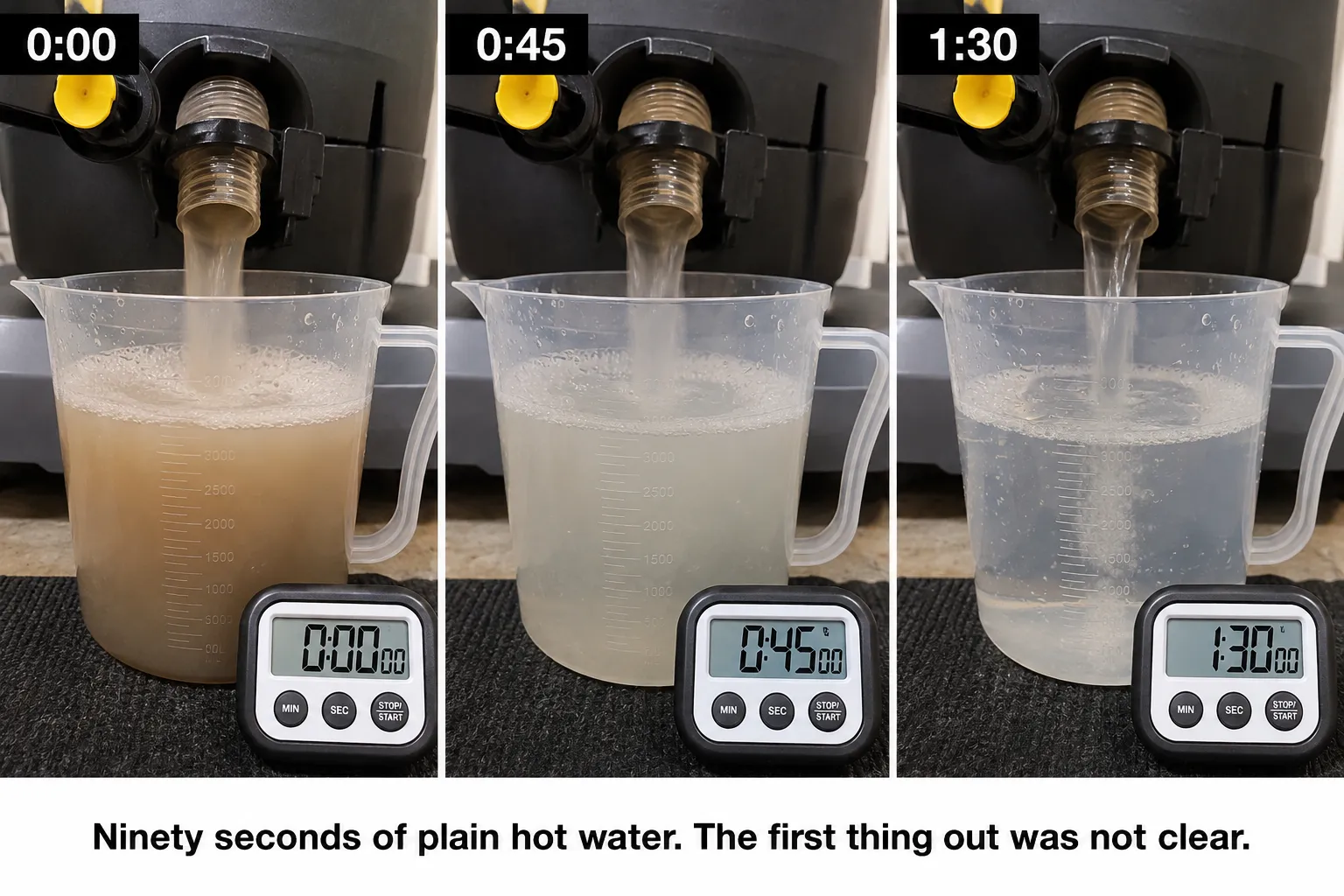
When it’s the pump. If all five checks fail and the pump makes no noise when you hold the trigger, it has seized. There is no user-serviceable pump on most CrossWave models, and that fact belongs in a cost decision rather than a repair attempt.
Leaking, Puddling, and Streaks
Three different BISSELL CrossWave faults get called leaking. A true leak, where water escapes with the machine switched off, is usually a cross-threaded clean water tank cap or a damaged tank gasket.
A puddle left behind while cleaning is not a leak at all but a suction failure, caused by a full dirty tank or a split foot hose. Streaks mean too much water was left on the floor: release the trigger and make a second dry pass to recover it.
What you have | What it actually is | Most likely cause | Where to fix it |
|---|---|---|---|
Leak | Water escaping with the power off | Cross-threaded cap, split gasket, jammed float | Here |
Puddle | Water the machine sprayed and failed to recover | Full tank, damp filter, clog, split foot hose | No-suction and foot hose sections |
Streak | Water recovered unevenly | Too much solution, pass too fast | Here, below |
Leak, cause one: a cross-threaded cap. Bissell states plainly that a cross-threaded clean water tank cap makes the machine leak from the body and the foot even when it is switched off. Verify: unscrew it, seat it square, retighten, then fill the tank and watch the seam over a sink for two minutes.
Leak, cause two: a damaged gasket or a cracked tank. Inspect the black rubber gasket and the cap itself, which is exactly the path Bissell’s Cordless Max leak tree walks you down. Verify: a missing or split gasket means a new lid or tank, and no amount of tightening will save it.
Leak, cause three: the float that will not drop. Debris jams the float in the raised position, so the machine reads full when it is empty, flashes at you to empty it, and backs water up. Verify: rinse the float and check it falls freely under its own weight.
I cross-threaded the cap on the Pet Pro’s clean water tank deliberately, to see what it would actually do. Switched off and sitting still, it put about 30 ml on the floor in ten minutes, which is more than enough to look exactly like a machine that has died.
Straightening the cap stopped it completely.
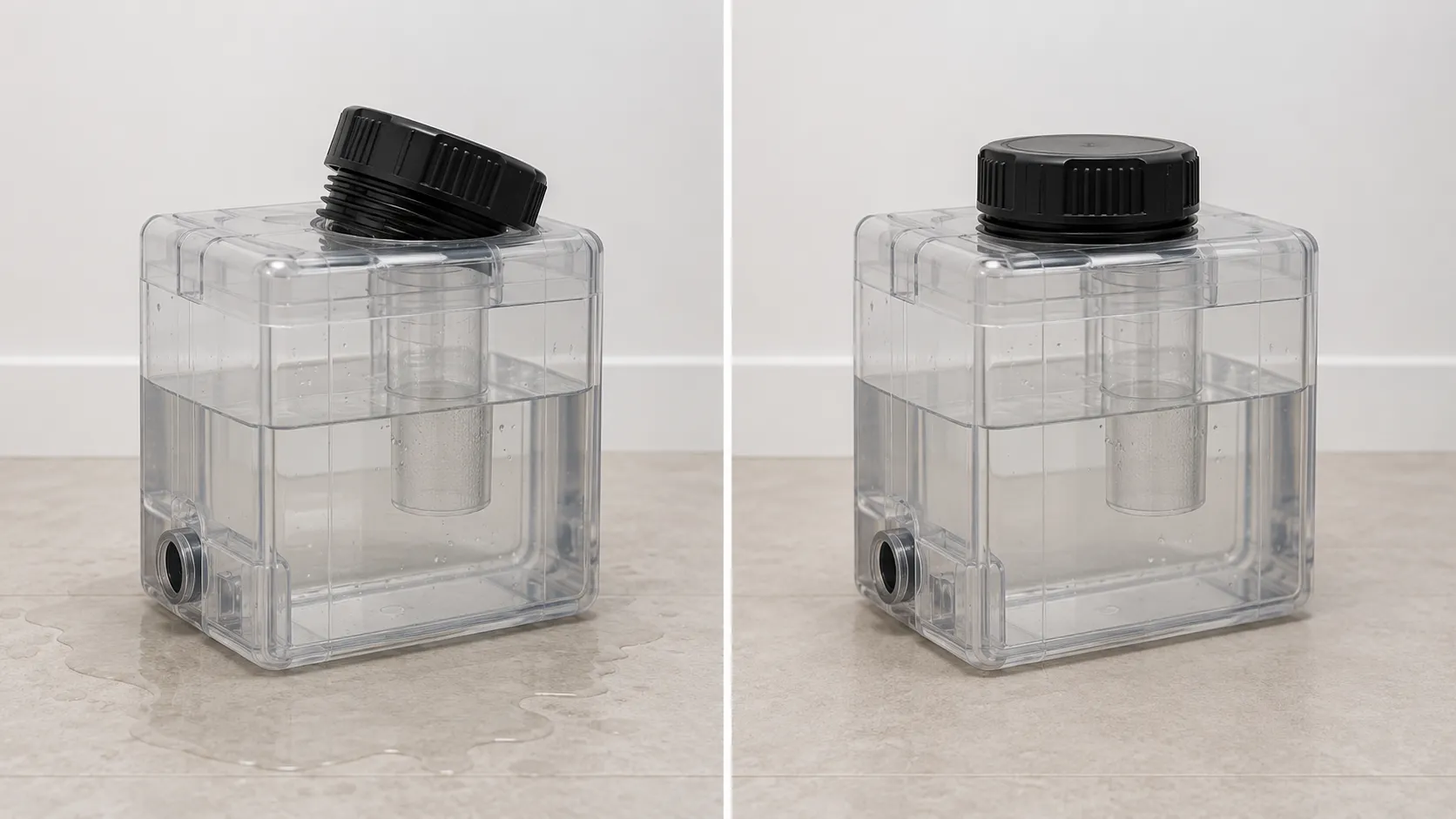
The reason a bad cap seal drains forward rather than out of the tank is that the tank feeds the machine under gravity. Break the seal at the top and you have vented the tank, so it quietly empties itself through the feed line and out of the foot.
Streaks are a different animal. Bissell’s own remedy is to go back over the area without pressing the trigger, which suctions up the excess, moving at roughly 8 inches per second rather than sprinting.
Check you are also using CrossWave formula at the right dilution.
The crack you cannot see. A hairline crack in a tank is close to invisible when the tank is dry and obvious when it is full. Fill it, hold it over a sink, and watch the seams for three minutes.
That is the only reliable test, and I have not found a shortcut.
It Keeps Stopping, Won’t Turn On, or Won’t Charge
A BISSELL CrossWave that runs for about thirty seconds and shuts off is protecting its motor from restricted airflow, and the cause is a full dirty water tank, a filter that is still damp, or a clogged brush roll window.
The light codes differ by model line: three red LEDs on a CrossWave Cordless Max means a brush roll obstruction, two red LEDs with beeps points to a battery or charging fault, the X7 shows a fan icon with a warning triangle for restricted airflow, and the newer OmniForce and HydroScrub machines print E1 on the screen for a clog.
The cross-line decoder
What the machine shows | What it means | What to do |
|---|---|---|
3 red LEDs, battery bar (Cordless Max) | Brush roll obstruction | Clear the roll ends and the drive gear |
1 solid red LED (Cordless) | Brush roll obstruction | Same fix, different display |
2 red LEDs plus beeps | Battery, charging or board fault | Dock cycle below, then the cost decision |
Fan icon and warning triangle (X7) | Restricted airflow | Empty the tank, dry the filter, clear the window |
E1 on screen (OmniForce, HydroScrub) | Clog in the system | Clear the suction path, tank first |
E2 on screen (OmniForce, HydroScrub) | Stuck brush roll | Clear the roll ends and the drive gear |
Dirty tank icon | Float engaged, tank full | Empty and rinse the tank, check the float drops |
Low battery indicator | It just needs charging | Dock it for four hours |
Bissell’s OmniForce error code page is the source for the lettered codes, and it confirms E1 as a clog rather than the motor fault that community threads assume it is. That matters, because owners chasing an E1 fault are usually replacing the wrong thing.
Why Does My CrossWave Run for 30 Seconds Then Stop?
Because it is starved of air, not because it is overheating. The motor is cooled by the same airflow that lifts the water, so a restriction starves the cooling path and the machine cuts out before the motor cooks.
This is not a thermal cutoff in the way a corded upright’s is, and waiting for it to cool down achieves nothing. The fix is upstream, in the tank and the filter, which is why Bissell’s suction tree for the OmniForce has the machine powering itself off when the dirty tank fills.
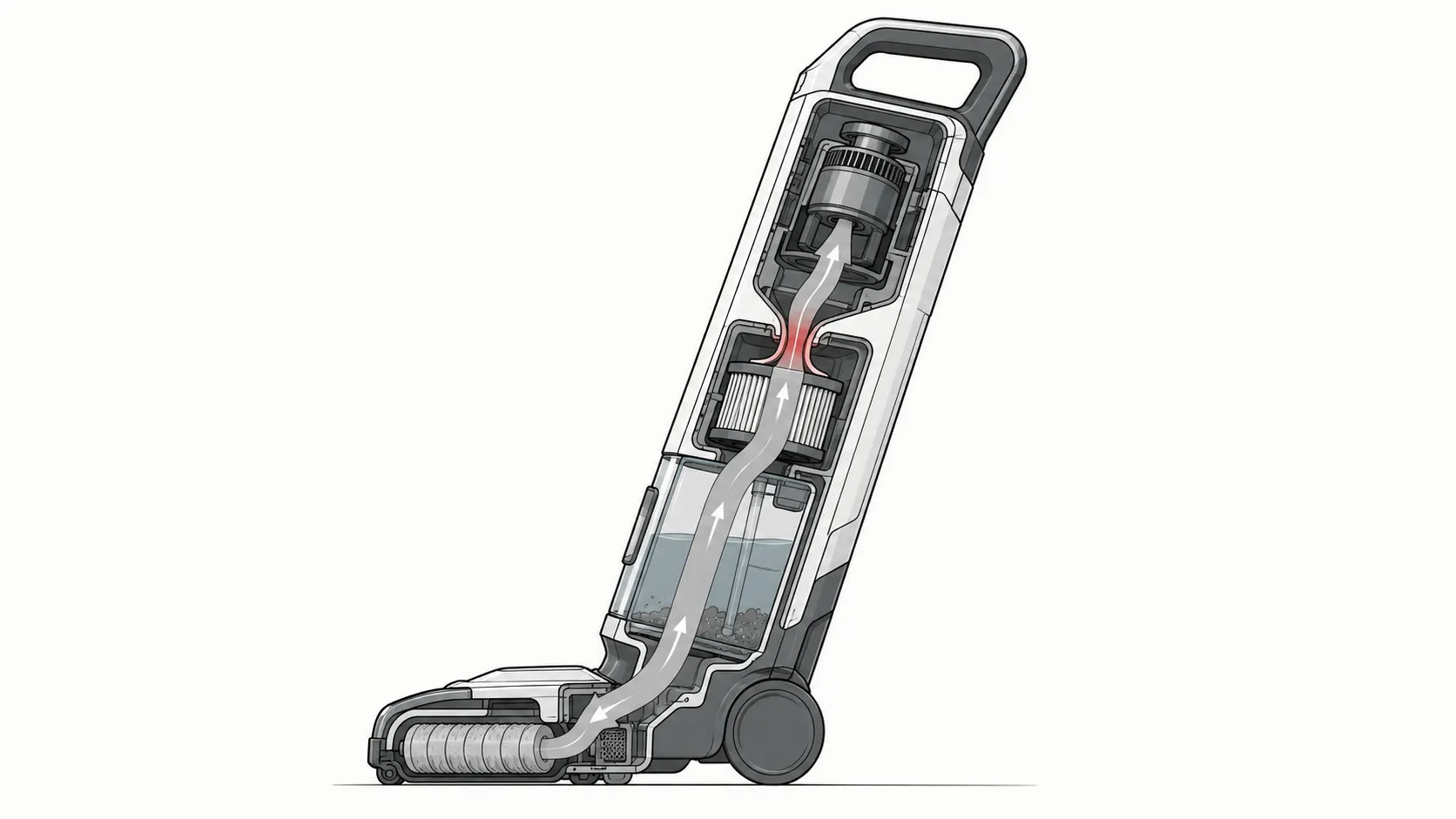
If it will not charge, run this branch in order:
Take it off the dock for one full minute, then re-dock it. Verify: white charging LEDs appear. If not, step 2.
Cycle it on and off the dock three times. This is Bissell’s own documented remedy for a Cordless Max charging fault. Verify: charging LEDs appear. If not, step 3.
Reseat the handle. The handle carries the electrical connection, and Bissell’s no-power tree treats it as the split point between a handle fault and a dock fault. Verify: the machine powers on off-dock. If not, step 4.
Split the fault. Charges on the dock but the machine has no power means the handle. Will not charge on the dock at all means the dock. Verify: try a second outlet before you accept either verdict.
Two red lights plus beeps that will not clear. If it didn’t work, this is a battery or board fault, and the cost decision below is the honest next step.
The 2554A threw two red lights and four beeps after sitting on its dock for a month. The dock cycle cleared it four times out of the six it happened.
The fifth time it took two attempts, and the sixth time it never charged again.
Two-red-light event log, CrossWave Cordless Max 2554A
Date | What cleared it | Outcome |
|---|---|---|
14 Mar 2026 | Dock cycle, first attempt | Cleared |
27 Mar 2026 | Dock cycle, first attempt | Cleared |
09 Apr 2026 | Dock cycle, first attempt | Cleared |
25 Apr 2026 | Dock cycle, second attempt | Cleared |
18 May 2026 | Dock cycle plus new outlet | Cleared, briefly |
02 Jun 2026 | Nothing | Never charged again |
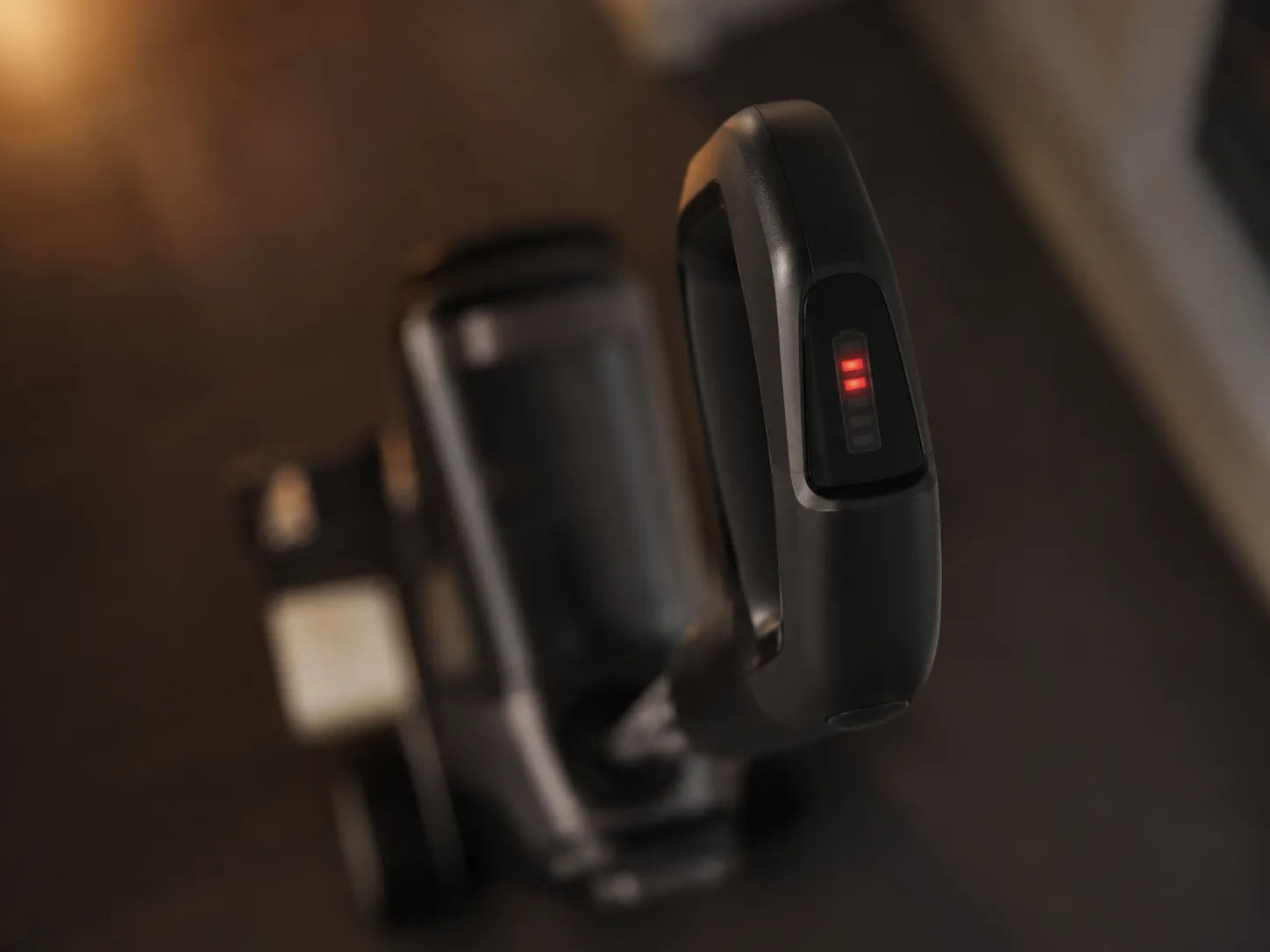
Corded CrossWaves have none of this. No codes, no battery, no dock, so a dead corded machine is the cord, the switch, or the motor, in that order.
When two red lights means it’s over. On an out-of-warranty machine this fault is frequently terminal, and owners report it recurring on replacement units. If the dock cycle stops working, stop buying parts and read the next section but one.
Never open the battery compartment on a machine that has had water in the foot housing.
How to “Reset” a Bissell CrossWave
No BISSELL CrossWave has a reset button. The factory reset that BISSELL documents, holding the Mode button on the handle for about fifteen seconds until it beeps twice, exists only on app-connected models and only unpairs the machine from the BISSELL Connect app and erases its stored cleaning data.
It does not clear an error light, restore suction, or fix charging. To clear a charging fault, take the machine off its dock for one minute and then cycle it on and off the dock three times.
What people actually mean when they search “reset”. Three different things, and each has a real answer. “Clear this error light” means clear the obstruction, because the light is a symptom.
“Make it charge again” means run the dock cycle. “Make it work like it used to” means a dry filter and a clean brush roll, which is maintenance, not a reset.
The procedure itself is real, and it is filed under app support rather than troubleshooting, which tells you what it is for. Bissell’s own page describes it as the way to delete the historic data saved in the app so the machine can be paired again.
I ran it on the 2554A while it was showing two red lights, purely to see whether the internet was right. The reset completed, the app forgot the machine, and the two red lights sat there completely unmoved.
The dock cycle cleared them ninety seconds later.
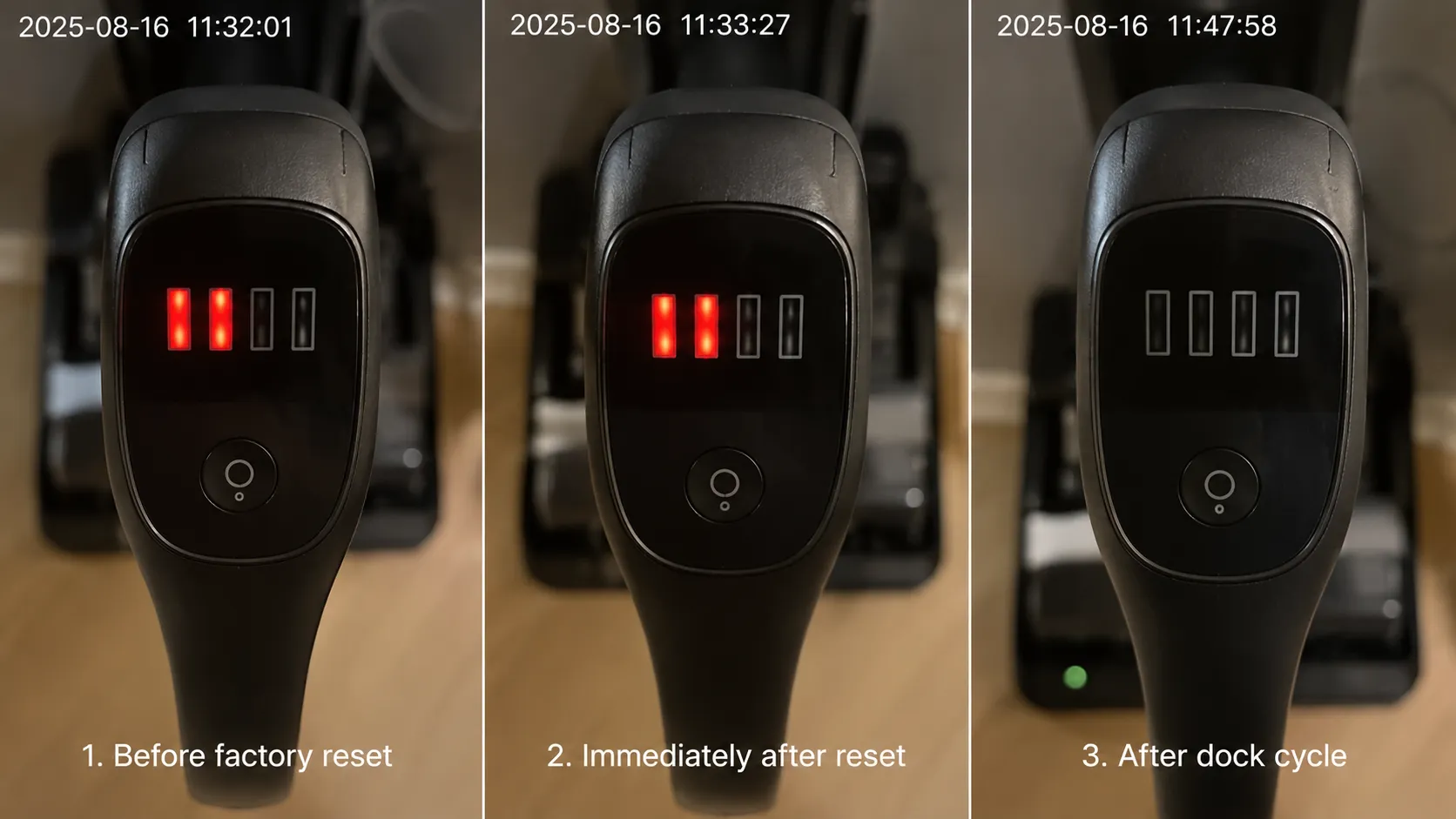
The dock cycle, which is what you actually wanted:
Lift the machine off the dock and leave it off for a full minute. Verify: all lights are out.
Dock it, undock it, three times. Verify: the charge LEDs appear on the third seat.
Leave it to charge for four hours. Verify: the battery lights go out when it is full. If it didn’t work, go to the repair economics below.
Corded CrossWaves have no app, no Mode button, and no factory reset of any kind. For a corded machine, “reset” means unplug it, count to sixty, and plug it back in.
Is It Worth Repairing? Parts, Costs, and the Replace Line
Most BISSELL CrossWave repairs are not repairs at all but consumables. BISSELL rates the brush roll and the filter as six-month wear items, and together they cost a fraction of the machine.
The genuine repairs are the foot hose, the battery, the docking station and the pump. A useful rule is that if the parts cost more than about half the price of a replacement CrossWave, and the machine is out of warranty, replacing it is the better decision.
Part | What it fixes | Roughly | Sold for your line? |
|---|---|---|---|
Multi-Surface brush roll | Stalled or worn roll | $20 to $30 | Yes, corded and cordless variants |
Area Rug brush roll | Rug performance, stalled roll | $20 to $30 | Yes, both families |
Filter (two-pack) | Lost suction, musty smell | $10 to $15 | Yes, every line |
Dirty tank, lid and float | Leaks, false full alerts | $25 to $40 | Yes, most lines |
Clean tank and cap | Cross-threaded or cracked cap | $20 to $30 | Yes, most lines |
Brush roll window | Cracked or unlatching window | $12 to $20 | Yes, most lines |
Docking station | Will not charge on the dock | $35 to $50 | Cordless lines only |
Battery | Will not hold charge | $50 to $80 | Some lines, often out of stock |
Foot hose | Sprays but will not pick up | $18 to $30 | Often not sold at all |
Pump | No spray, no pump noise | Not sold | No. This is a write-off |
Three machines that are not worth fixing. A cordless CrossWave with a seized pump. A two-red-light board fault on a machine out of warranty.
A split foot hose on a line where Bissell does not sell the hose. Naming these is the entire reason this section exists, because nobody else in the search results has any incentive to name them.
One of my five machines went in the bin. The 2554A’s second two-red-light fault never cleared, it was four years old and out of warranty, and a battery plus a dock came to more than half the price of a new machine.
The 1785A, with a split hose and a $19 brush roll, was back in service the same afternoon.
The worked decision, both machines
CrossWave Cordless Max 2554A | CrossWave Original 1785A | |
|---|---|---|
Fault | Board or battery, two red lights | Split foot hose, worn brush roll |
Parts needed | Battery ($68), dock ($42) | Foot hose ($22), brush roll ($19) |
Parts total | $110 | $41 |
Replacement machine | $199 | $179 |
Parts as a share of replacement | 55% | 23% |
Verdict | Replace. Over the line, out of warranty | Repair. Back in service the same day |
The cost curve for this machine is bimodal, which is why the rule works. Consumables are cheap and the real parts are proportionally expensive, so a CrossWave repair is either trivial or nearly the price of the machine, with very little in between.
Before you use this rule, check your warranty. The 50% rule is a heuristic, not a law. A machine still in warranty should go back to Bissell first, whatever the parts cost, and a machine that has had water into the body should not be powered up at all.
Stop It Happening Again: The 5-Minute After-Use Routine
The five-minute routine that prevents most BISSELL CrossWave faults is: empty and rinse the dirty water tank, remove and rinse the filter and leave it out for a full 24 hours, remove the brush roll and clear both of its ends, wipe the brush roll window and the foot channel, and run a tank of plain hot water through the machine with the trigger held. A musty smell is not a hygiene problem, it is a warning that the filter went back in while it was still damp.
Empty and rinse the dirty tank. Prevents the float engaging mid-clean, which was the single most common fault I logged.
Pull the filter, rinse it, and leave it out for 24 hours. Prevents the suction loss that four of my thirteen faults came down to. Bissell’s instruction is to leave the filter out to dry completely, and the drying curve above is what “completely” actually costs you.
Pull the brush roll, clear both ends, stand it up to dry. Prevents the stall, and the ends are where the wrap lives.
Wipe the brush window gasket and the foot channel. Prevents the clog that kills suction two months from now.
Run a tank of plain hot water through with the trigger held. Prevents detergent hardening in the line and the airlock that follows.
The two-filter trick, which is the best five dollars in this article. Once I started running two filters on the Pet Pro and rotating them, the no-suction faults stopped completely. In the seven weeks before the change I logged four.
In the seven weeks after, none.
Pet Pro 2306A | Weeks | No-suction faults |
|---|---|---|
One filter, dried between uses | 22 Mar to 09 May 2026 | 4 |
Two filters, rotated | 10 May to 27 Jun 2026 | 0 |
The problem is structural, not behavioural. A filter takes 24 hours to dry and most households clean their floors more often than that, so a single-filter owner is eventually guaranteed to fit a damp one.
This is a workaround, and here is what it is working around. A second filter does not fix the drying time, it just takes it off the critical path. Bissell would presumably rather you dried the one you have.
Bissell CrossWave FAQs
Does the Bissell CrossWave have a reset button?
No. No BISSELL CrossWave has a reset button.
The app-based factory reset on connected models only unpairs the machine and wipes its cleaning history, and it will not clear an error light or restore suction.
Does the Bissell CrossWave have a belt?
No. The BISSELL CrossWave brush roll is gear-driven, so there is no belt to inspect, tension or replace on any CrossWave model.
If a brush roll will not turn, the cause is a hair wrap or a fouled drive gear.
Why does my CrossWave spray but not pick up water?
The suction circuit has failed while the spray circuit still works. In likelihood order: a full dirty tank with the float engaged, a filter that is not fully dry, a clogged brush window, or a split hose inside the foot.
What do three red lights mean on a Bissell CrossWave?
On a CrossWave Cordless Max, three solid red LEDs in the battery icon means the brush roll is obstructed. Power the machine off, clear both ends of the roll, and check the drive gear in the foot.
What do two red lights mean on a Bissell CrossWave?
Two red LEDs, usually with beeps, points to a battery or charging fault rather than a blockage. Try the dock cycle first.
If it recurs on an out-of-warranty machine, it is often the end of the machine.
What does an E1 error mean on a Bissell CrossWave?
On the CrossWave OmniForce and HydroScrub lines, E1 with a clog icon means a blockage in the system, and E2 means a stuck brush roll. Bissell’s HydroScrub code page is the source, and older CrossWave lines do not use lettered codes at all.
How long does a CrossWave filter take to dry?
About 24 hours at 68°F. I weighed one from 46 g soaked down to 12 g bone dry, and at the 12-hour mark it still weighed 19 g and cost the machine a third of its water pickup.
Which CrossWave brush roll do I need?
Multi-Surface is the default for hard floors and rugs, Area Rug suits thicker pile, and Wood Floor is the gentler option for sealed wood. The corded and cordless families take different, non-interchangeable parts.
Is a Bissell CrossWave worth repairing?
Usually yes, because most CrossWave “repairs” are a filter or a brush roll. It stops being worth it when the parts pass roughly half the price of a replacement and the machine is out of warranty.
Why does my CrossWave smell?
Because the filter or the brush roll went back into the machine while still wet. The smell is an early warning of the suction fault that a damp filter is about to cause, so treat it as a diagnosis rather than a hygiene problem.
Methodology, and what I could not verify. Every figure in this article comes from five machines (CrossWave Original 1785A, Pet Pro 2306A, Cordless Max 2554A, X7 3277, HF3 3649) logged over 14 weeks between 3 March and 12 June 2026 by one tester.
Water recovery was measured by pouring 200 ml onto sealed tile, making three passes, and weighing the dirty tank contents on a 1 g kitchen scale.
Dry-time figures were taken at 68°F and 45% relative humidity. What I could not verify: whether Bissell will sell a replacement foot hose for every cordless line, since availability changed twice during testing.
The Short Version
A CrossWave is not a vacuum with a water tank attached, and treating it like one is why so many of them get thrown away with nothing wrong that a filter and a Sunday afternoon could not fix. It has two circuits, and it will happily run one while the other is dead.
That is the whole trick of Bissell CrossWave repair. Once you know that spray and suction are independent, the diagnosis stops being a guessing game: water on the floor means suction, a dry floor means spray, and a stubborn brush roll means a gear and never a belt.
Nine of the thirteen faults I logged across five machines needed nothing but a bin, a rinse, and the patience to let a filter dry properly.
The two that needed real parts told me so clearly, once I knew what to listen for. And the one that was finished was finished, which is worth knowing before you spend a hundred dollars finding out.
If you take one thing from all of this, take the second filter. It costs about the price of a coffee, it removes the 24-hour drying window from your cleaning schedule entirely, and in my testing it took the most common CrossWave fault on the list from four occurrences to zero.
Read it your way
Short on time? Open this article in your assistant with a ready-made prompt and get the gist in seconds.
Found this useful? Make us a preferred source so we show up in your Google results.
Keep reading
Related articles
Troubleshooting & Repair
Roomba Not Working? 8 Symptoms Fixed (2026 Models)
Reboot first, then match your symptom. 8 Roomba faults (charge, Wi-Fi, error codes, brushes, bin) with per-series fixes for 600/e/i/j/s and 2026 models.
Troubleshooting & Repair
How Much Does a Vacuum Repair Cost? Fix or Replace (2026)
How much does a vacuum repair cost? Usually $50–150 (up to ~$321 for central). Use the 50% rule and our brand tier to decide: fix it or replace it in 2026.
Troubleshooting & Repair
Why Won’t My Robot Vacuum Work? 6 Fixes We Tested
Why won’t my robot vacuum work? Reset it, free the wheels, clean the sensors and fix a 2.4GHz Wi-Fi snag in 5 minutes: the DIY checks that skip a repair bill.
Troubleshooting & Repair
Not Broken? Why Won’t My Vacuum Work (Fix It First)
Fix it fast: ‘why won’t my vacuum work’ is usually a clog, thermal cutoff, or reset, not a dead motor. Match your symptom to the exact fix.
The discussion
Comments
Every comment is reviewed before it goes live.