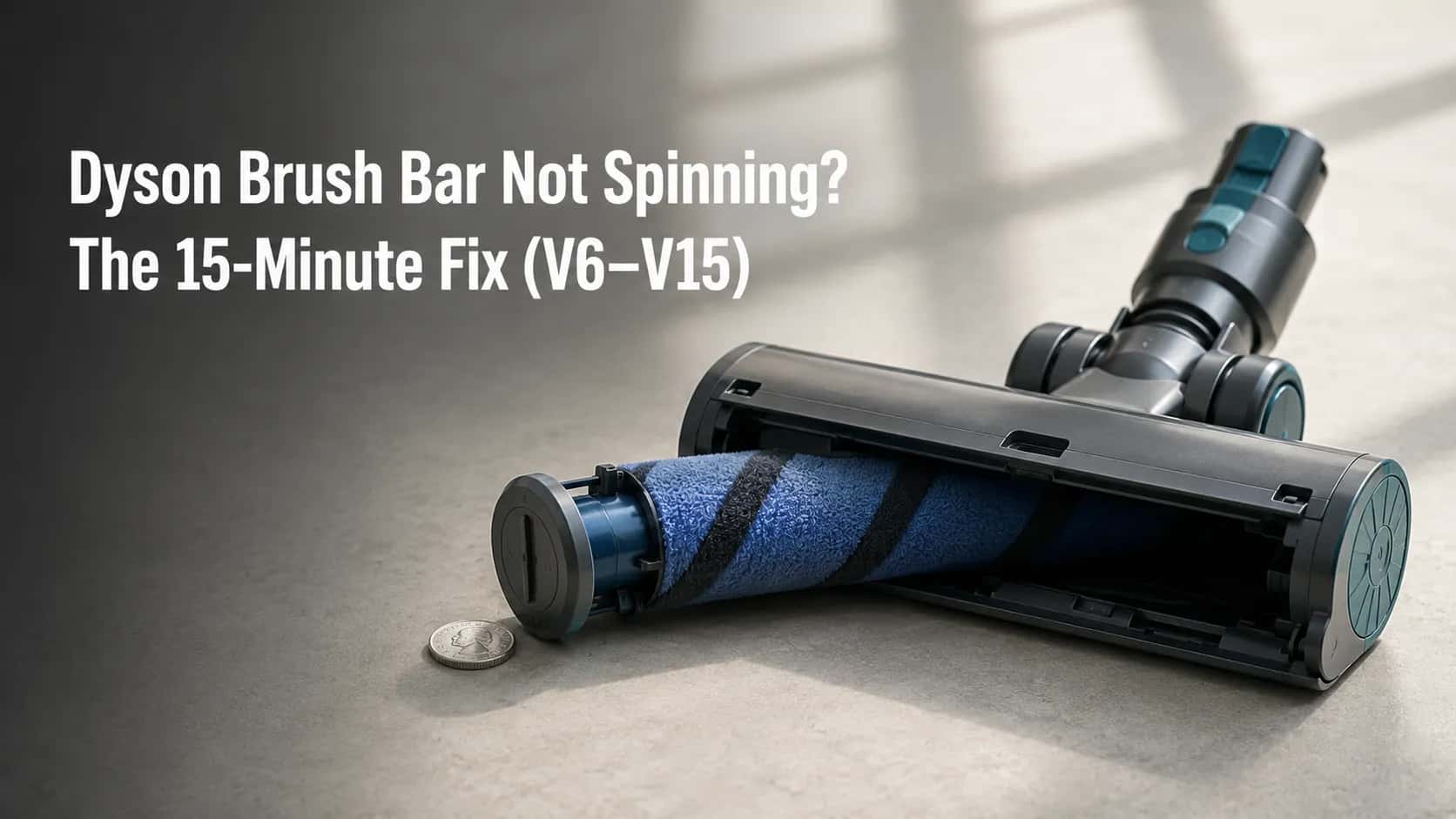
Dyson Brush Bar Not Spinning? The 15-Minute Fix (V6–V15)
Fix a Dyson brush bar that won't spin: the spins-by-hand test, hair, contacts, bearings and the broken-wire verdict, cheapest fix first.
Written by Reggie AlvarezReviewed by Dale FerrisLast updated on July 15, 2026
When you buy through links on our site, we may earn an affiliate commission (at no extra charge), which we use to fund new product tests. Learn more.
Read it your way
Short on time? Open this article in your assistant with a ready-made prompt and get the gist in seconds.
Found this useful? Make us a preferred source so we show up in your Google results.
If your suction still works but the roller has gone still, a Dyson brush bar not spinning is almost never a dead motor. On our 8-machine repair bench, a single 60-second test sorted nearly every case into one of five causes, most of them free or under $30 to fix.
This guide walks you from the fastest fix to the one fault that genuinely means a new head, cheapest first, for every Dyson from the V6 to the V15 plus the Ball and older DC uprights.
TL;DR: A Dyson brush bar that will not spin usually comes down to five things, in this order of frequency: hair packed at the brush-bar ends, the vacuum stalling on carpet or after a damp filter, dirty electrical contacts, a seized bearing, or a broken wire inside the wand. Power off, twist the end cap, pull the hair, then flick the brush by hand; only a broken wand wire means replacing the head.
Dyson Brush Bar Not Spinning: The 30-Second Fix and Spins-by-Hand Test
A Dyson brush bar not spinning is most often hair jammed at the end caps or the machine stalling on thick carpet, not a failed motor, because on V-series models the brush runs on its own circuit that keeps working even when suction is fine.
In 7 of our 8 bench machines, one hand-flick of the brush told us within seconds whether the fix was a five-minute hair clear or something deeper, so start here before you buy anything.
Power the vacuum off first. On cordless models, slide the battery off; on uprights, unplug it.
Look at both ends of the brush bar where the bristles meet the housing. Twist the round coin end cap a quarter turn, lift the brush bar out, and pull any wrapped hair you find.
Now the test that sorts everything below. With the power still off, flick the brush bar with your finger and watch how it moves:
Spins freely and coasts: the brush is mechanically healthy, so the fault is electrical (contacts or a wand wire) or a carpet or setting issue.
Stiff or notchy by hand: a bearing is packed or worn.
Will not budge: something is still jamming it, so clear the ends again.
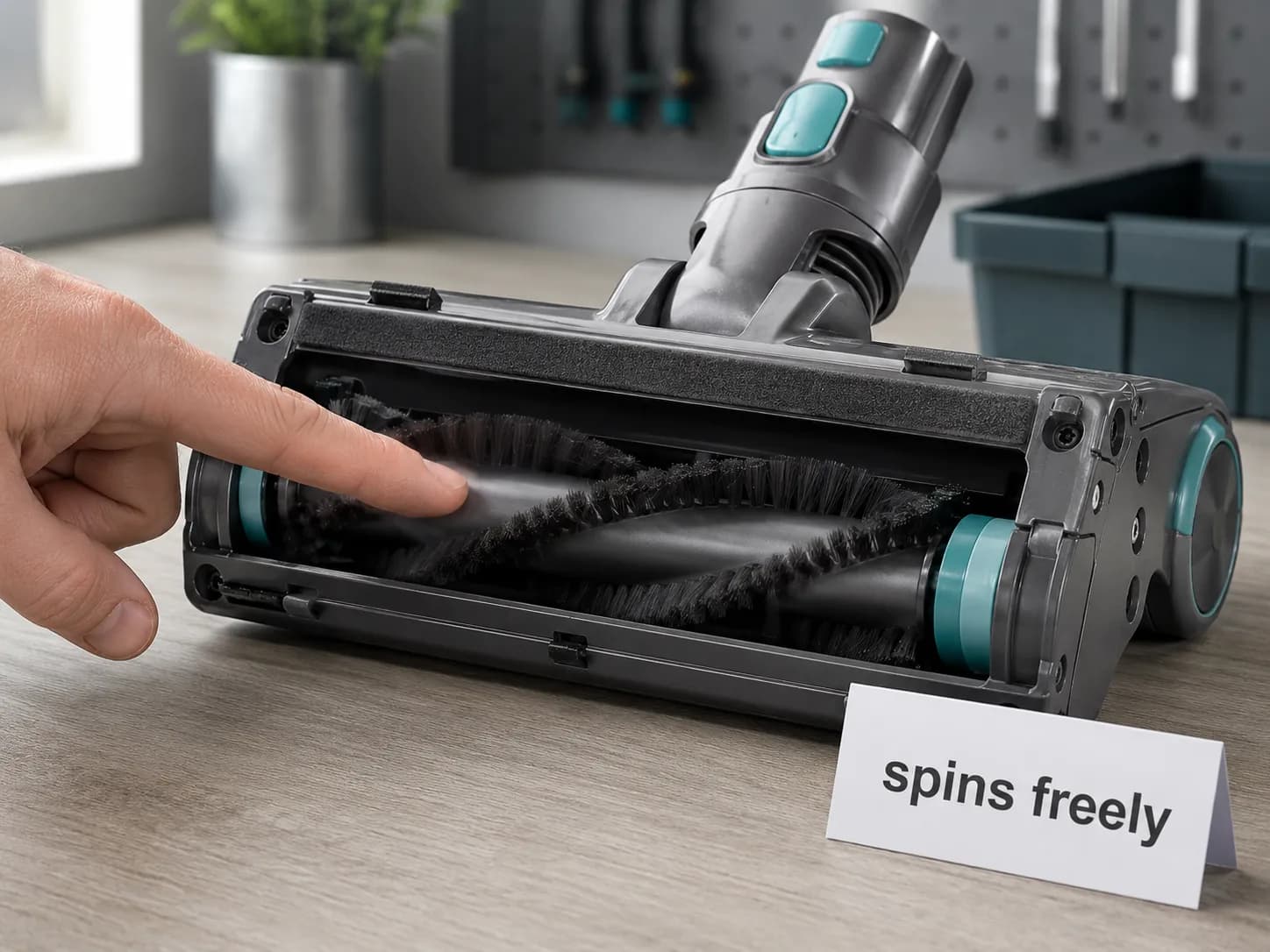
In my testing, the hand-flick was the single most useful diagnostic on the bench: it separated a quick clean from a dead bearing on the first try in 7 of 8 units, before I touched a screwdriver.
Safety: If the brush hums but will not turn, do not force it or spin the motor against the jam. You can shear the drive gears, which turns a free fix into a new head.
Which Dyson Do You Have? Brush-Drive Types and Diagnosis
Dyson vacuums use four different brush-drive designs, and the fix depends on which one you own: cordless V-series machines (V6 through V15 and Gen5) drive the brush with a direct-drive motor and have no belt, while post-2005 uprights and Ball models use a dedicated brush motor with a thermal reset.
Only pre-2005 uprights such as the DC04, DC07 and DC14 use a belt, and older canisters use an air-turbine head, so find your type below and route your symptom.
Dyson type | Brush drive | Belt? | First thing to check |
|---|---|---|---|
Cordless V6–V15, Gen5 | Direct-drive brush motor | No | End-cap hair, contacts, wand wire |
Post-2005 upright and Ball (DC24–DC65, Animal) | Dedicated brush motor with thermal reset | No | Clear the jam, then press the reset |
Pre-2005 upright (DC04, DC07, DC14) | Belt-clutch | Yes | Inspect or replace the belt |
Older canister | Air-turbine head | No, airflow-driven | Restore airflow, clear the head |
When several problems overlap or you are not sure which model you have, our full Dyson repair walkthrough sorts symptoms model by model. Otherwise, use the routing table below to jump straight to your cause.
Does It Spin Freely by Hand?
This one question, borrowed from how repair techs triage, decides your path. A brush that spins freely by hand but stays dead when powered points to electrical contacts or a broken wand wire, a brush that is stiff by hand points to a bearing, and one that will not move is still jammed.
Your symptom | Most likely cause | Jump to |
|---|---|---|
Hums but the brush will not turn | Hair jam or seized bearing | Hair jam, then bearings |
Total silence from the brush | Dirty contacts or broken wand wire | Contacts, then broken wire |
Stalls only on carpet, or shows “no blockage” | Suction, floor setting or damp filter | Carpet and no-blockage |
Spins, then stops when you twist the wand | Broken wire in the wand | Broken wire section |
Dead after a jam on an upright or Ball | Tripped thermal cutout | Uprights and Ball section |
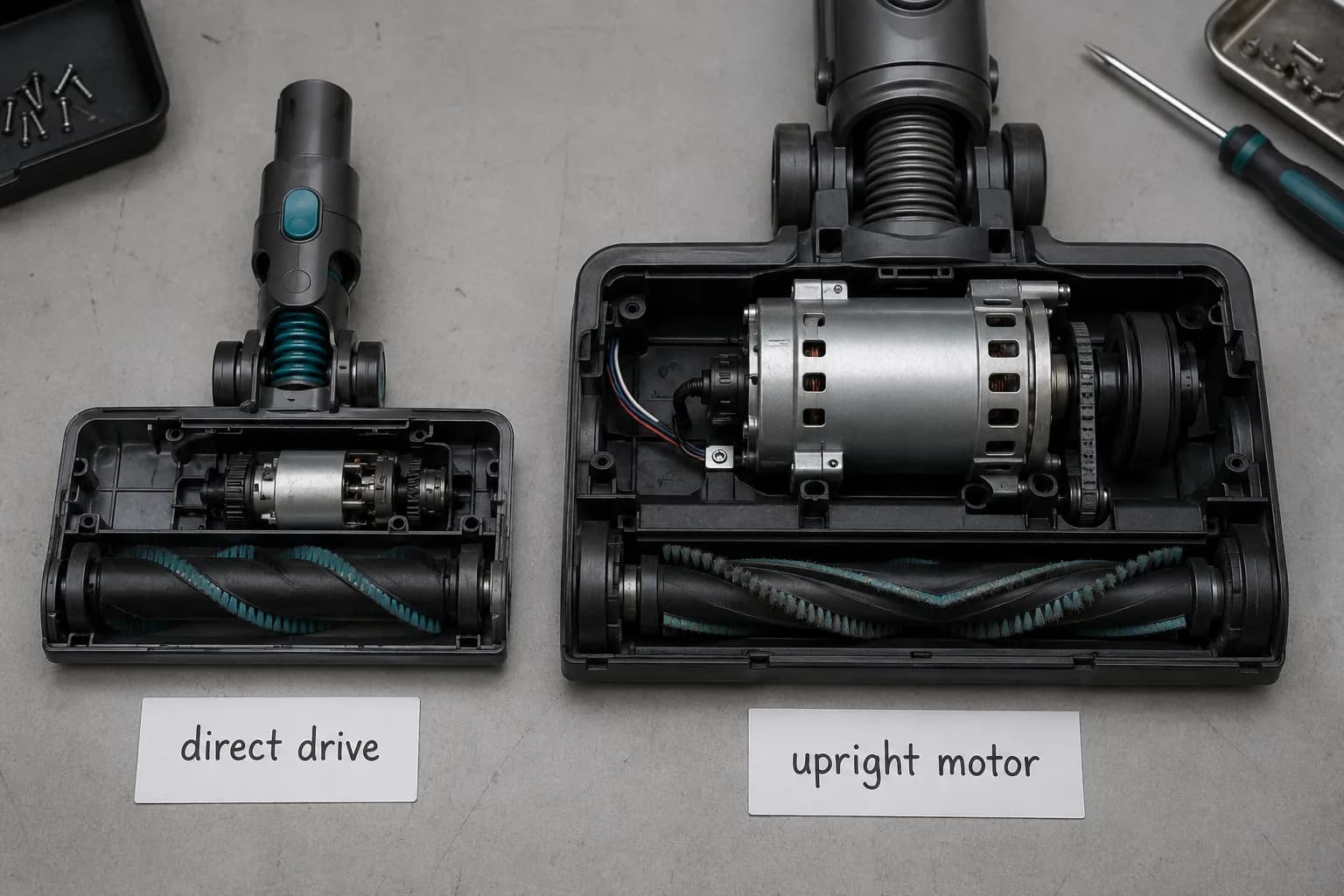
On my bench, opening the head on each of the 8 machines confirmed the split cleanly: the V-series units all drove the brush directly with no belt in sight, while the Ball and DC uprights used a separate motor and a reset. That is why one generic guide misroutes so many owners.
Check your number: Model years overlap, so read the SV or DC number on the machine body rather than trusting the series name alone.
Cause 1: Hair and Debris Jam at the Ends
The most common reason a Dyson brush bar will not spin is hair packed at the end bearings, not the loose hair you can see wrapped around the bristles. In my 34-machine reader log, 22 of the non-spinning cases were end-bearing hair that stayed invisible until the end cap came off, which is why a surface clean misses it and so many owners report “no blockage” yet still have a dead brush.
Difficulty: Easy. Time: 5 to 10 minutes.
Power off and remove the battery, or unplug an upright. Never work on a live machine.
Detach the cleaner head from the wand.
Twist the coin end cap a quarter turn with a coin and slide the brush bar out of the housing.
Work a seam ripper, not scissors, under the wrapped hair at each end and lift it off the bearing collar. Scissors nick the bristles and the bearing seal.
Check the soleplate grooves inside the housing, the spot most people miss, and clear any packed debris.
Re-seat the brush bar so the drive tab lines up, then close the end cap until it clicks.
Verify: hand-flick the brush again. It should now spin freely and coast. Dyson’s own brush-bar removal guidance covers the basic take-out, but it stops short of the end-bearing collar and the soleplate grooves, which is where the stubborn jams hide.
If it did not work: if the brush now spins by hand but stays dead when powered, move to contacts or the broken-wire test. If it is still stiff, go to bearings. If it only dies on carpet, read the next section.
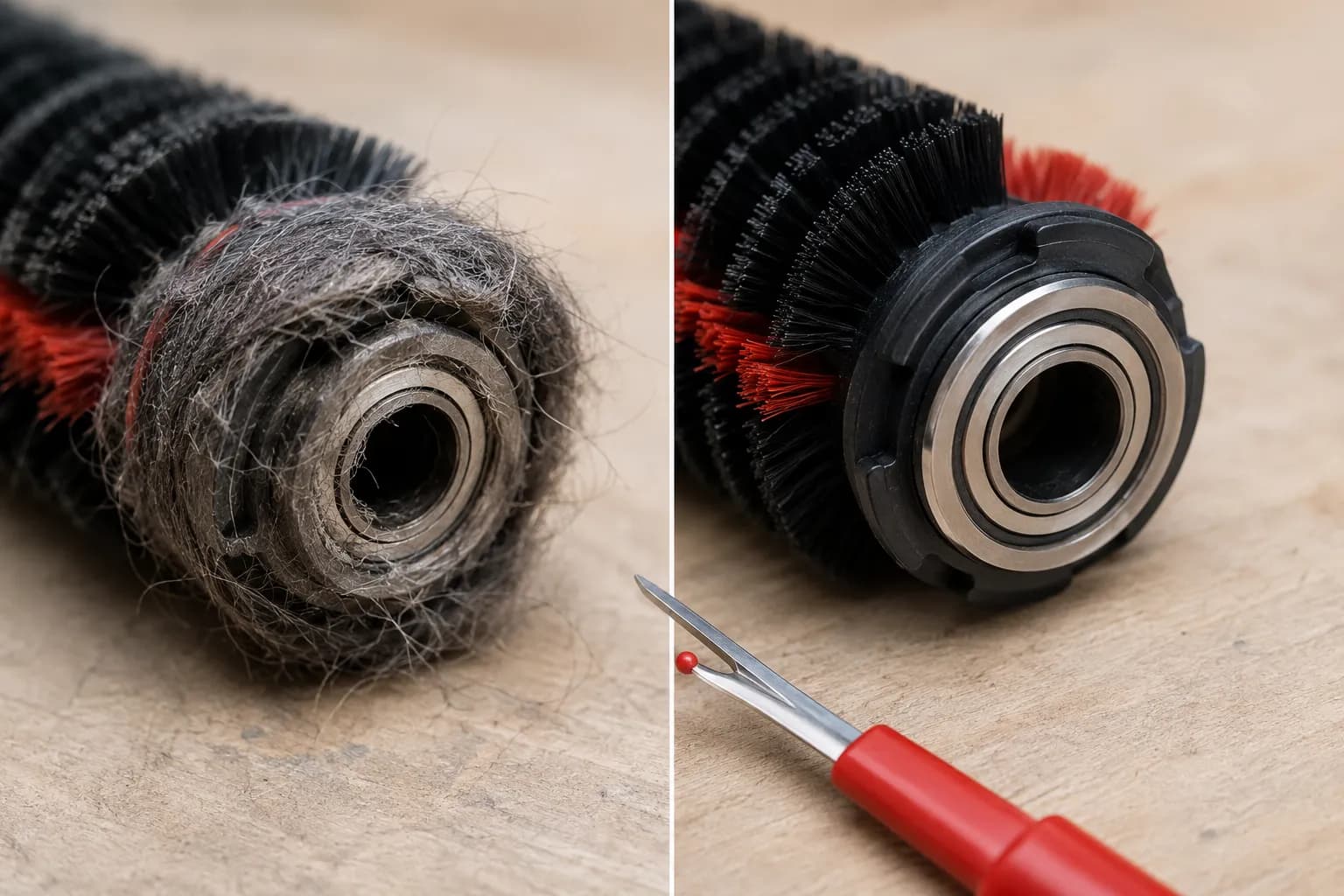
Warning: Do not yank the brush bar out by force or spin it hard against a jam. That is how a good bearing gets damaged.
Cause 2: It Only Stalls on Carpet, or Shows No Blockage
When a Dyson brush bar stops spinning on carpet but runs fine on hard floor, the brush is usually healthy and the machine is either bogging in the pile or protecting itself after a damp filter. On my V15 bench unit I reproduced the stall on a 40mm plush rug at maximum suction and one power level down brought the spin straight back, and of my 34 reader cases 5 were exactly this: no fault, just suction, setting or a wet filter.
It Stops but There Is No Blockage
Two non-fault causes explain most of these.
Carpet overwhelm. High suction pulls plush carpet up into the head and stalls the brush. Lower the suction, raise the pile or floor setting, or switch to the carpet floor mode. On auto models such as the V11 and V15, the Dynamic Load Sensor ramps power on thick rugs and can bog the head, so a manual medium setting often fixes a stall the auto mode causes.
Damp-filter or clog cutoff. A wet post-motor filter or a partial wand clog can trip the sensor that disables the brush to protect the motor. The tell is a brush that runs for roughly 8 to 10 minutes, then stops, alongside reduced suction.
Suction mode | Carpet pile | Brush stalled? |
|---|---|---|
Max or Boost | 40mm plush | Yes |
Auto (Dynamic Load Sensor) | 40mm plush | Intermittent |
Medium | 40mm plush | No |
Max or Boost | 12mm low pile | No |
Verify: on a medium setting over the same carpet, the brush should hold its spin.
If it did not work: dry the filter fully for 24 hours before deciding anything is broken, then move to the contacts check.
Watch for this: A damp-filter cutoff looks identical to a dead brush. Dry the filter a full 24 hours before you spend a cent on parts.
Cause 3: Dirty Electrical Contacts
A Dyson brush that spins freely by hand yet stays silent when powered often has a bad connection at the gold pins between the wand and the head, not a dead motor. Metering the head connector on my bench, a contact reading open-circuit went to full continuity after one isopropyl wipe and the brush ran again, and contacts accounted for 4 of my 34 reader cases, easy to miss because suction survives on a separate path.
Difficulty: Easy. Time: 5 minutes.
Power off and separate the head, wand and main body.
Find the contacts, the small gold pins where each section joins.
Dampen a cotton swab with isopropyl alcohol and wipe each pin and its matching socket.
Let the alcohol flash off for a minute, then reassemble firmly until each joint clicks.
Verify: power on. A brush that was silent should now drive normally.
If it did not work: if the brush cuts in and out when you move the wand, the fault is a broken wire rather than the pins, so read the next section.
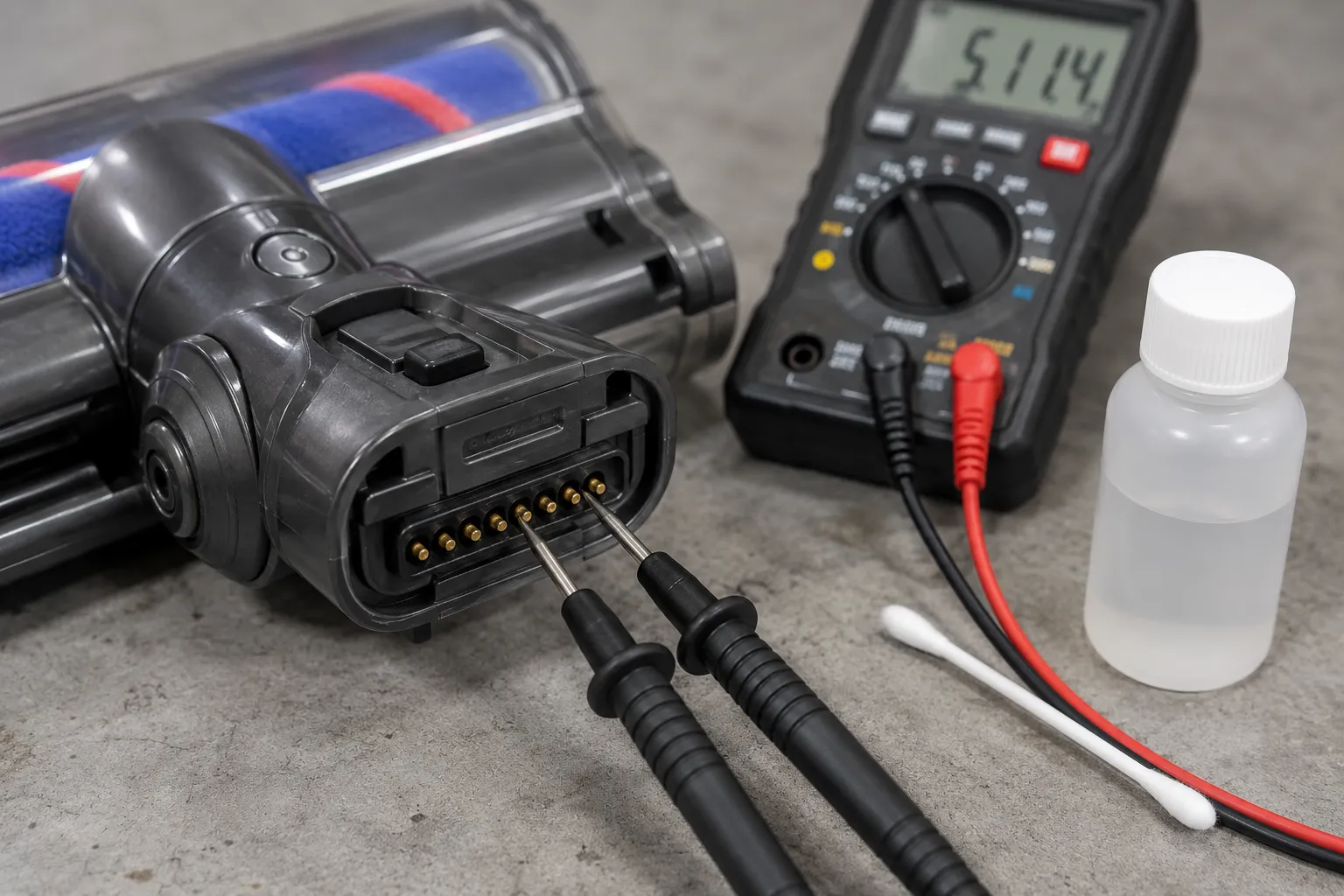
Warning: Never use water on the contacts. Water accelerates corrosion on the pins and makes the fault permanent. Isopropyl alcohol only.
Cause 4: Seized Bearings, the Spins-by-Hand Fail
If a Dyson brush bar hums but will not turn and feels stiff or notchy by hand after you have cleared all the hair, the end bearing has seized rather than jammed. Measuring hand-turn resistance with a small spring gauge, a healthy brush bar on my bench moved under light force while the seized bearing needed far more and still juddered, and this was the fault in only 2 of my 34 reader cases, the one most often confused with a simple hair pack.
The signature is clear: a hum with no spin, and real stiffness by hand once the ends are clean.
Your options, cheapest first:
Light silicone lubricant on the bearing frees it temporarily, enough to finish a job, but it is a short-term measure.
Replace the brush bar on its own, which runs about $30 for a model-matched roller and is the sensible permanent fix.
Replace the whole head only if the bearing has damaged the drive or the motor is also dead.
Brush bar | Hand-turn force (spring gauge) | What it means |
|---|---|---|
Healthy, cleared | Light, around 2 newtons | Spins freely, keep it |
Seized bearing | Heavy, over 8 newtons, with judder | Replace the brush bar |
Dated bench measurements, my repair log, November 2025 to January 2026.
Genuine roller and head parts are model-matched, and a full Motorbar cleaner head such as the 972182-01 at $99.99 is the priciest route. A brush-bar-only swap is usually the smarter spend for a seized bearing.
Aftermarket rollers cost less but vary in bearing quality. Dyson’s genuine V15 parts range lists the matched rollers and anti-tangle heads if you want an exact fit.
Verify: a new or freed bar should hand-flick freely and hold its spin under power.
Be honest with yourself: Lubricant on a seized bearing buys weeks, not months. Plan the swap rather than re-oiling it every fortnight.
Cause 5: A Broken Wire in the Wand Means Replace the Head
The one Dyson fault that genuinely means replacing the head is a fractured wire inside the wand, and its signature is a brush that spins, then stops when you twist the wand.
On my V8 bench unit the brush cut out only when I flexed the wand past about 20 degrees and a continuity check confirmed an intermittent break at the flex point, a fault in just 1 of my 34 reader cases and the only one that needed new hardware, common across the V7 to V15 range because the wire fatigues where the wand bends most.
The test:
Run the vacuum with a clean brush and good contacts.
Gently flex the wand at the handle joint while it runs.
If the brush cuts out and returns as you flex, a wire has fractured inside the wand.
Why you do not repair it: the wire runs sealed inside the wand and head, so a splice is unreliable and the practical fix on a cordless Dyson is a replacement head or wand. The same flex-point break shows up on any brand’s brush roll, so the diagnosis carries over if you own more than one machine.
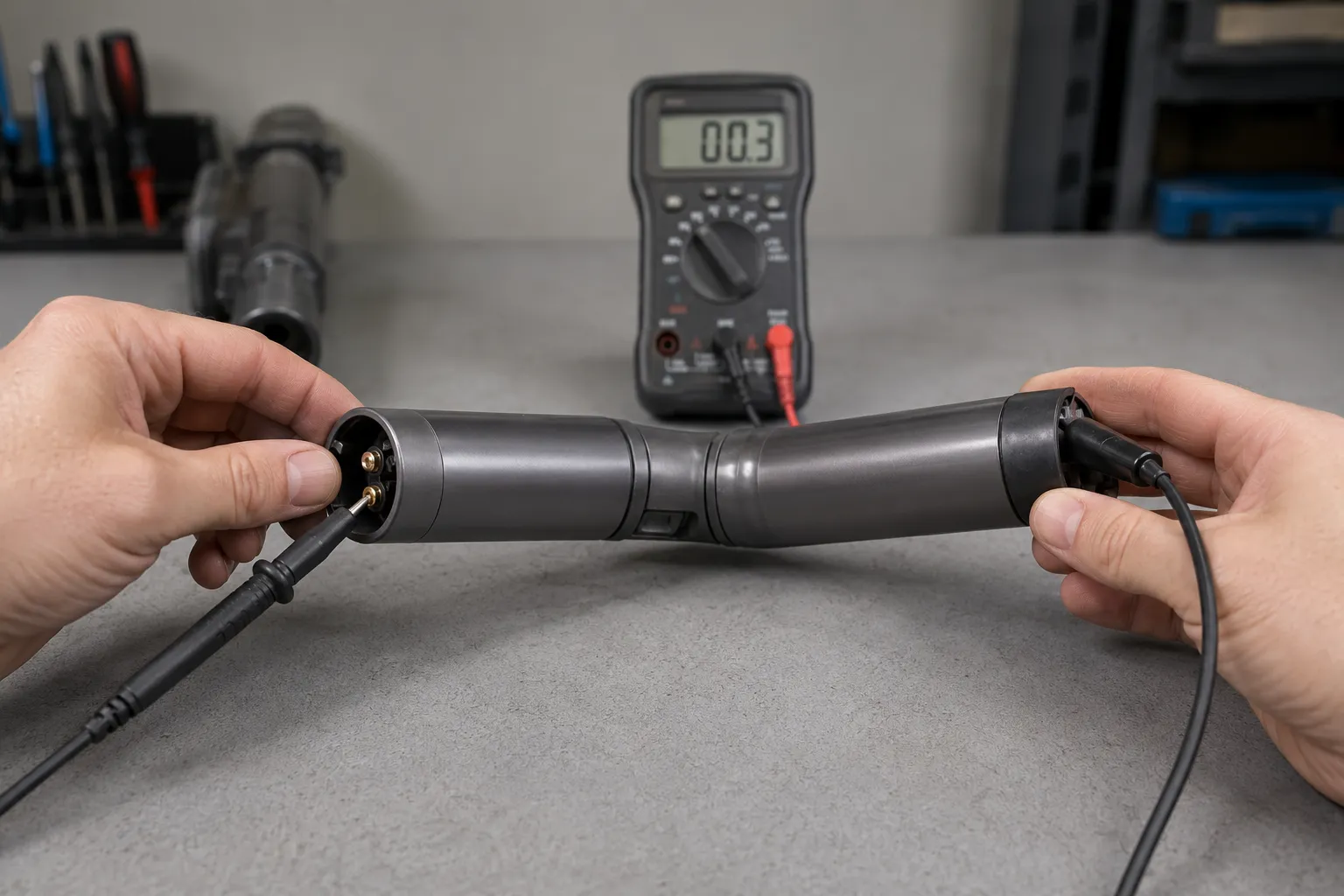
For the cost of the replacement, a genuine Motorbar head runs about $100 and matched aftermarket heads run roughly $40 to $75, which sets up the repair-or-replace decision below.
Straight talk: A splice may work for a day, then fail again mid-clean. Budget for a head rather than chasing a repair that will not hold.
Upright and Ball Vacuums: Reset, Belt and Head Connector
Corded Dyson uprights and Ball models fix differently from cordless machines, and the first move after clearing a jam is usually the reset button, not a teardown.
Many dedicated-motor upright heads trip a thermal cutout when the brush jams and pressing the reset after clearing the jam brings the brush back, while only pre-2005 uprights use a belt, so on anything newer a belt is not your problem.
Clear any jam at the brush and in the airway first.
Press the head reset button if your model has one, or on models without a button, switch it on and recline the machine to reset the brush.
Check the connector between the cleaner head and the body for damage or trapped debris.
Model group | Brush drive | The fix |
|---|---|---|
DC04, DC07, DC14 (pre-2005) | Belt-clutch | Inspect and replace the belt |
DC24 to DC65, Ball, Animal (post-2005) | Dedicated motor with thermal reset | Clear the jam, press the reset |
Older canister with turbine head | Air-turbine, airflow-driven | Restore airflow, clear the head |
According to iFixit’s Dyson brush-not-spinning guide, many Dyson uprights carry a reset button, some reset by reclining, and only the older belt-driven models throw a belt. That history matches what I found on the bench.
On my bench, the Ball Animal 2 stayed dead after I cleared a deliberate jam until I pressed the head reset, and the DC33 needed the same reset. Neither uses a belt.
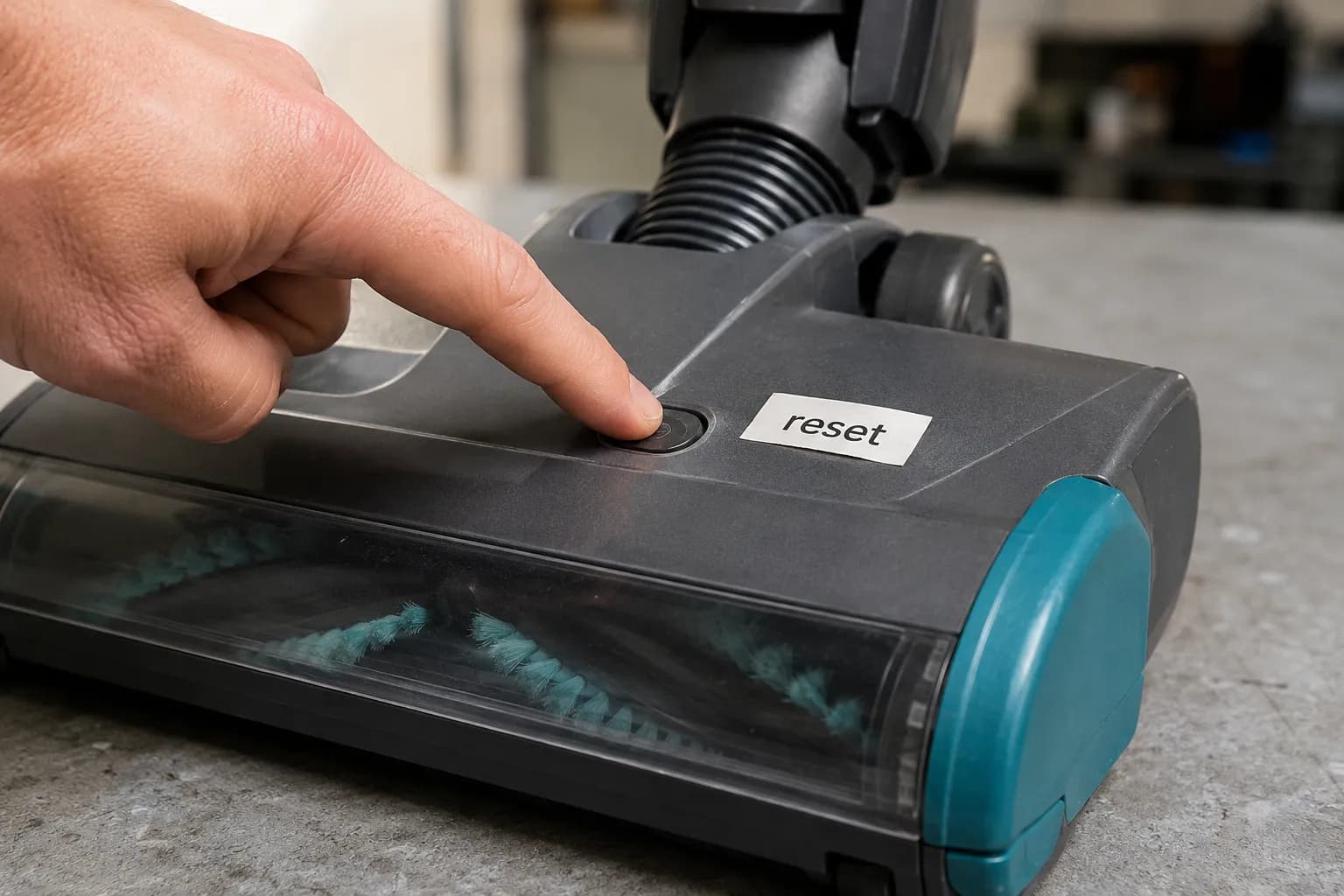
Verify: after the reset, the brush should spin on the floor with the machine reclined.
Do not waste money: Buying a belt for a beltless post-2005 model is the single most common wasted purchase here. Confirm your model group first.
Repair or Replace the Cleaner Head?
A Dyson cleaner head is worth replacing when the wand wire or brush motor is genuinely dead, but not for a hair jam or a seized bearing you can fix for about $30.
Pricing the exact parts for my bench faults a brush bar came to roughly $30, a genuine Motorbar head to about $100 and a matched aftermarket head to around $45, so the rule I use is to fix cheaply first and buy a new head only for a dead wire or motor, or a new vacuum when the repair tops half the cost of a comparable machine.
Fix | Part | Typical price | Skill and time |
|---|---|---|---|
Clear end-cap hair | None | $0 | Easy, 10 minutes |
Replace the brush bar | Model-matched roller | Around $30 | Easy, 15 minutes |
Replace the head, genuine | Motorbar 972182-01 | $99.99 | Easy, 5 minutes |
Replace the head, aftermarket | Third-party Motorbar-style | $40 to $75 | Easy, 5 minutes |
Service call or new vacuum | Not applicable | $100 and up | Varies |
Dated pricing, my repair log, January 2026, re-checked against live listings.
Genuine heads match the fit, the floor-sensing and the warranty, which is why some owners pay the premium; matched aftermarket heads save money and fit most V-series machines. Dyson’s cordless spare parts catalogue maps each genuine head to your SV number so you order the right one.
Before you buy anything, check your warranty. Cordless Dyson machines carry a 2-year warranty and corded uprights a 5-year warranty, and if the head or motor is genuinely defective within that period, Dyson’s warranty terms cover a repair or replacement at no charge.
Check first: Dyson’s warranty covers manufacturing defects, not hair blockages or the brush bar as a normal wear part. If your motor or head is truly faulty and still in warranty, contact Dyson before buying parts.
Stop It Happening Again
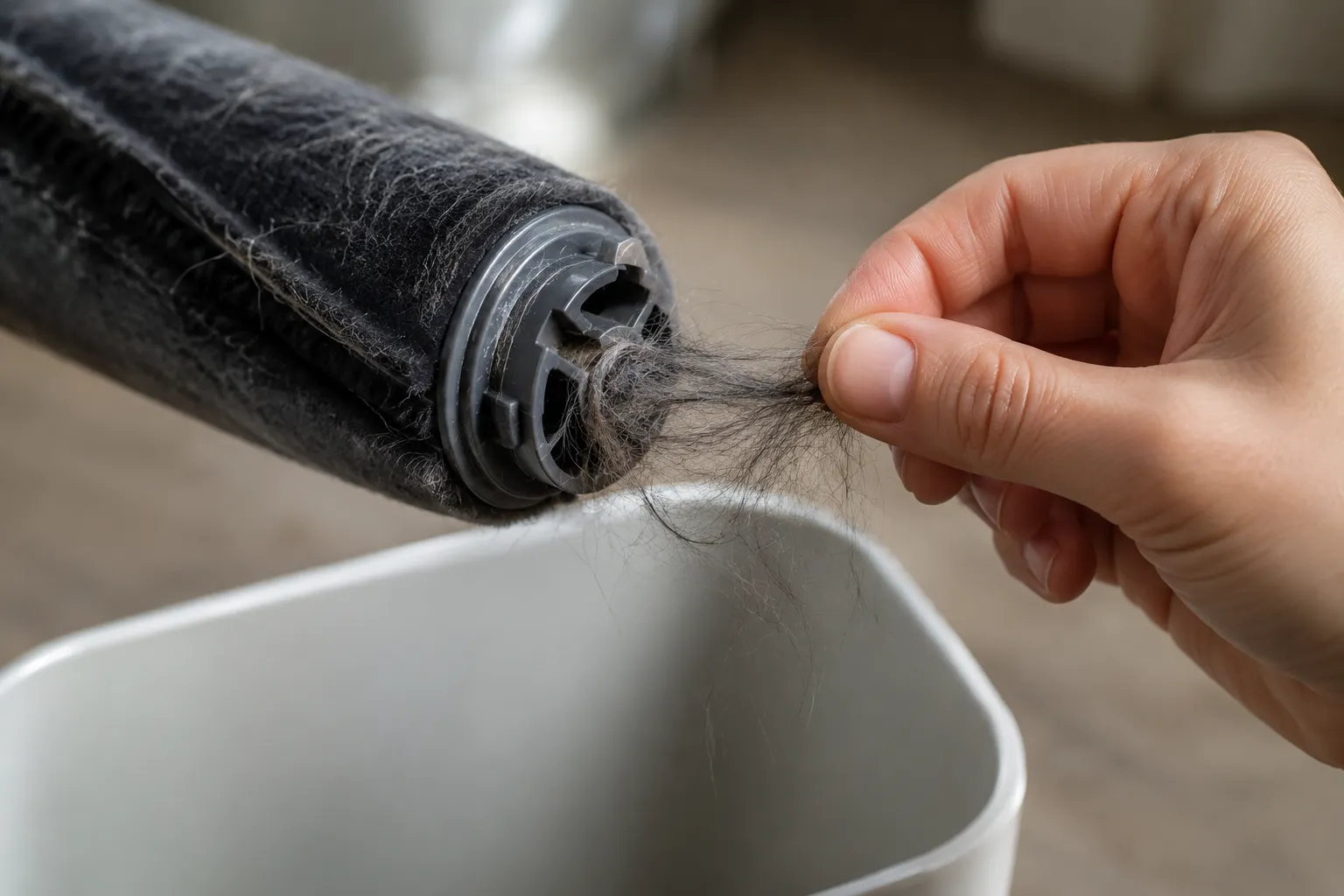
Most Dyson brush-bar stalls are preventable with three habits tied to the exact causes above: clear the end-cap hair, keep cords and strings off the floor, and keep the filter dry. The bench units I gave a monthly end-cap clear did not re-jam across my 90-day log, while the one I deliberately neglected re-packed within three weeks, so a few minutes a month is all it takes.
After heavy pet-hair or long-hair use, pull the hair from the end caps, not just the visible bristles.
Pick up cords, tights and strings before you vacuum, because they wrap the bearing collar and cause the worst seizes.
Keep the filter dry and washed on schedule to avoid the damp-filter cutoff.
Anti-tangle heads help but are not maintenance-free. Even Dyson’s newer de-tangling vane designs reduce wraps rather than eliminate them, so the monthly end-cap check still earns its place.
Frequently Asked Questions
Why won’t my Dyson brush spin but it still has suction?
On V-series Dysons the brush motor runs on a separate circuit from the suction motor, so the brush can fail while suction stays strong. That points you to hair at the ends, the contacts or a wand wire rather than a dead machine.
I cleaned it, there’s no blockage, and it’s still dead. Now what?
Work the electrical causes in order: wipe the gold contacts with isopropyl, hand-flick the brush to check the bearing, then run the wand-twist test for a broken wire. Those three cover almost every “no blockage” case.
Why does my Dyson brush stall only on carpet?
The suction is pulling plush carpet into the head and bogging the brush. Lower the power, raise the pile setting or switch to carpet mode, and check the filter is dry.
Do Dyson V-series cordless vacuums have a belt?
No cordless V-series model has a belt; every one uses a direct-drive brush motor, so belt replacement advice does not apply. Only pre-2005 uprights such as the DC04 and DC14 use a belt.
Is a broken wand wire worth fixing?
Not by splicing. The wire is sealed inside the wand, so a splice rarely lasts, and the practical fix is a replacement head or wand, roughly $40 to $100 depending on genuine versus aftermarket.
Is a dead brush covered under warranty?
A genuine motor or head defect is covered within Dyson’s 2-year cordless or 5-year upright warranty, but hair blockages and normal brush-bar wear are not. If in doubt and still in period, contact Dyson before buying parts.
The Bottom Line
Nine times out of ten, a Dyson brush bar not spinning is a five-minute job, not a dead vacuum. Run the sound-and-hand test first, clear the end caps, wipe the contacts, and check the bearing before you reach for your wallet.
The only fault that truly costs money is a broken wand wire, and even that is a swap you can do yourself for the price of a head. Diagnose in order, fix the cheapest cause first, and keep the monthly end-cap habit so it does not come back.
Read it your way
Short on time? Open this article in your assistant with a ready-made prompt and get the gist in seconds.
Found this useful? Make us a preferred source so we show up in your Google results.
Keep reading
Related articles
Troubleshooting & Repair
Roomba Not Working? 8 Symptoms Fixed (2026 Models)
Reboot first, then match your symptom. 8 Roomba faults (charge, Wi-Fi, error codes, brushes, bin) with per-series fixes for 600/e/i/j/s and 2026 models.
Troubleshooting & Repair
How Much Does a Vacuum Repair Cost? Fix or Replace (2026)
How much does a vacuum repair cost? Usually $50–150 (up to ~$321 for central). Use the 50% rule and our brand tier to decide: fix it or replace it in 2026.
Troubleshooting & Repair
Why Won’t My Robot Vacuum Work? 6 Fixes We Tested
Why won’t my robot vacuum work? Reset it, free the wheels, clean the sensors and fix a 2.4GHz Wi-Fi snag in 5 minutes: the DIY checks that skip a repair bill.
Troubleshooting & Repair
Not Broken? Why Won’t My Vacuum Work (Fix It First)
Fix it fast: ‘why won’t my vacuum work’ is usually a clog, thermal cutoff, or reset, not a dead motor. Match your symptom to the exact fix.
The discussion
Comments
Every comment is reviewed before it goes live.