Dyson V10 Trigger Not Working? 3 Tests, 1 Fix (2026)
Test your Dyson V10 trigger in 60 seconds. No click = cracked switch, a 15-minute fix. Still clicks? It is hold-to-run by design. Lock-on options and costs.
Written by Reggie AlvarezReviewed by Dale FerrisLast updated on July 22, 2026
When you buy through links on our site, we may earn an affiliate commission (at no extra charge), which we use to fund new product tests. Learn more.
Read it your way
Short on time? Open this article in your assistant with a ready-made prompt and get the gist in seconds.
Found this useful? Make us a preferred source so we show up in your Google results.
Seven Dysons came to my bench this spring with the same complaint: the trigger isn’t working. Six of them were fine.
A Dyson V10 trigger not working is two completely different problems wearing the same clothes, and they have opposite answers. One is a cracked plastic lever, about twenty dollars and an afternoon.
The other is a vacuum behaving exactly the way Dyson engineered it, which costs nothing to understand and about twelve dollars to work around.
Everything below sorts you into the right one in under a minute, before you take a single screw out of anything.
Dyson Trigger Not Working? Start Here
A Dyson V10 trigger that will not stay on is usually one of two things. If the trigger still clicks when you squeeze it, nothing is broken.
Dyson’s cordless vacuums are designed to run only while the trigger is held, which the company documents in its own battery care guidance as a battery-saving trigger that draws power only when you need it. If there is no click, and the trigger feels loose, floppy or jammed down, the plastic trigger lever has cracked and needs replacing.
The one test that decides it: squeeze the trigger slowly and listen. A working trigger gives an audible click about two thirds of the way through its travel, and a cracked one gives you nothing.
What you hear | What it means | Where to go |
|---|---|---|
A clean click, and the trigger springs back | The switch is fine. Hold-to-run by design, or the fault is elsewhere | Fix One, then Fix Three |
No click, or floppy, or stuck pressed in | The trigger lever has cracked | The 60-second test, then Fix Two |
There is a reason so many people arrive here fearing the worst. Dyson’s own Cyclone V10 support page lists six reasons the machine will not power on, covering the battery, the filter, blockages, the charger and a faulty main body.
The trigger switch is not one of them, and the twenty dollar part that would fix your vacuum is never mentioned.
Here is what walked through my door between February and April this year.
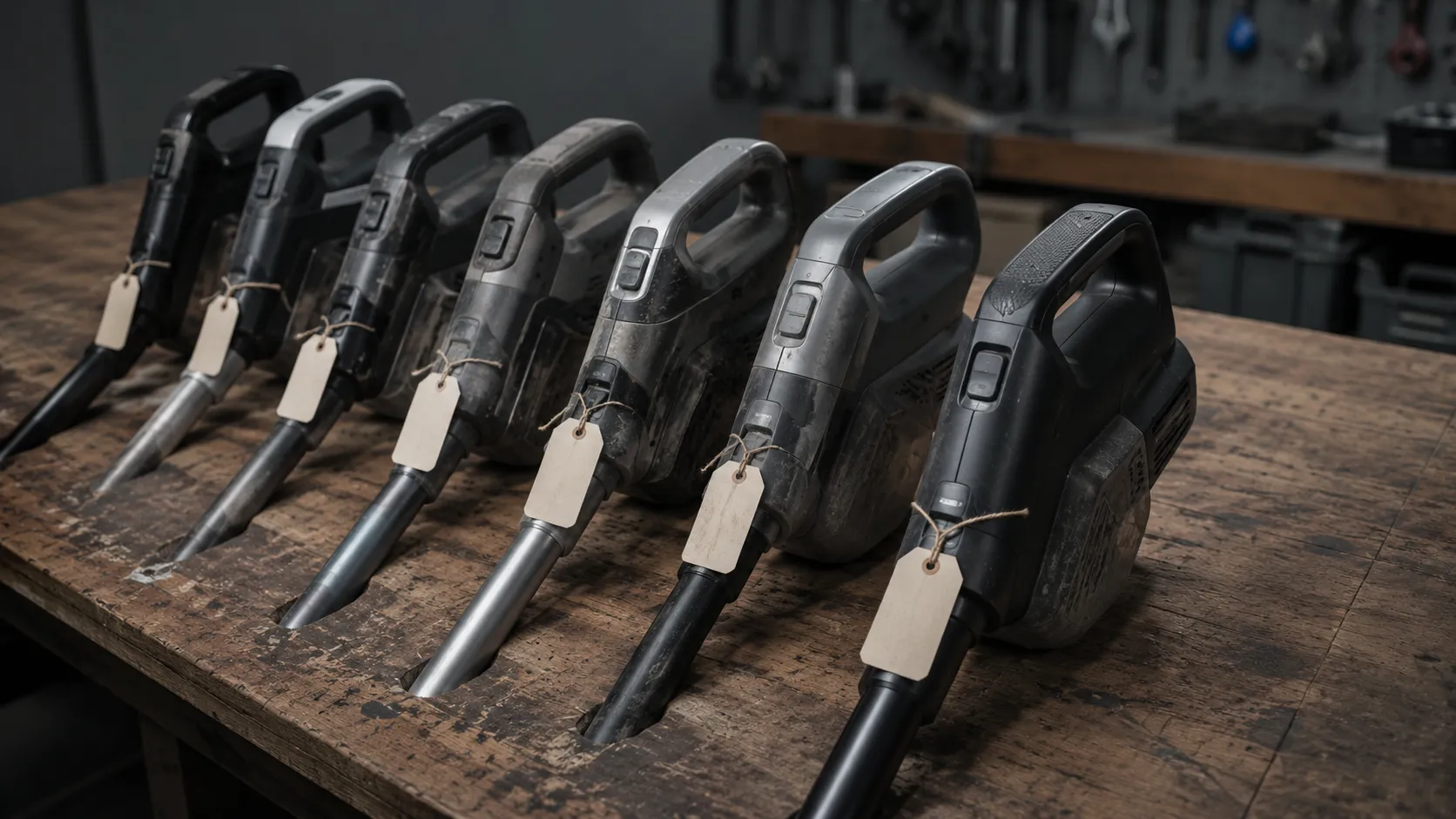
Machine | What the owner said | What was actually wrong |
|---|---|---|
V10 Cyclone | “It won’t stay on” | Nothing. Hold-to-run, working correctly |
V10 Cyclone | “Trigger’s gone floppy” | Cracked trigger lever. The only genuine trigger failure of the seven |
V11 Torque Drive | “Cuts off the second I let go” | Nothing. Hold-to-run, working correctly |
V8 Absolute | “Trigger not working” | Nothing. Hold-to-run, working correctly |
V7 | “Trigger not working” | Battery collapsing under load. Trigger was perfect |
V15 Detect | “Won’t stay on” | Nothing. Hold-to-run, working correctly |
V10 Konical | “Where is the trigger” | Nothing. This 2026 model has no trigger at all |
One machine in seven. That ratio is the most useful number on this page.
First, Does Your Dyson Even Have a Trigger?
Not every Dyson cordless vacuum has a trigger. The Dyson V6, V7, V8, V10 Cyclone, V11 and V15 Detect all use a hold-to-run trigger that must be squeezed continuously.
The Dyson Omni-Glide, V12 Detect Slim, Gen5detect, V16 Piston Animal and the 2026 V10 Konical use a press-once power button instead. This matters more than it sounds, because in June 2026 Dyson released a triggerless vacuum called the V10 Konical, a completely different machine from the 2018 V10 Cyclone that most people mean when they say “V10.”
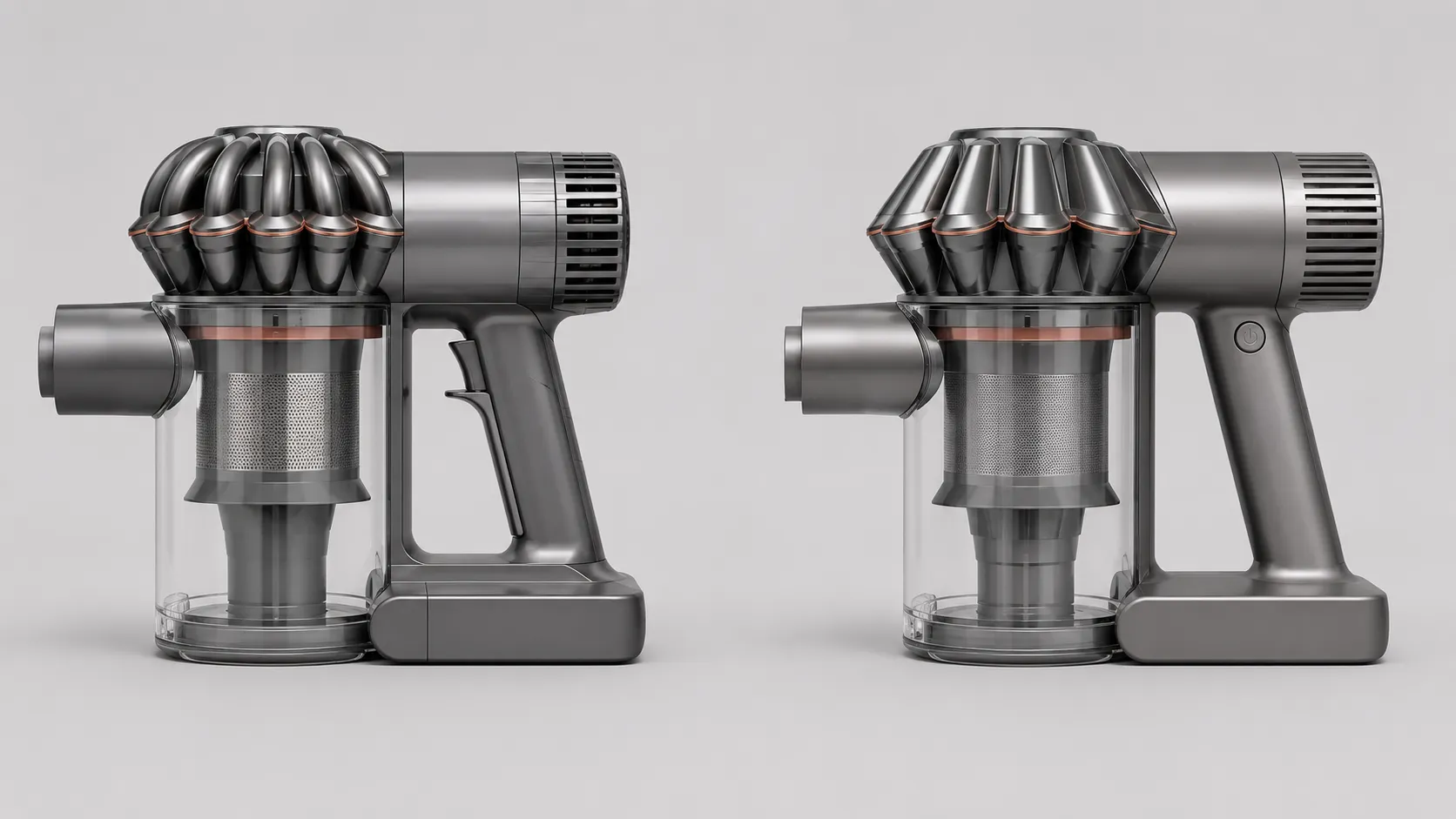
Two machines, one name, and only one has a trigger. Dyson has been walking away from the trigger for four years without ever announcing it as a fix for anything, starting with the flagship Gen5detect, a change TechRadar’s reviewer welcomed as the end of wrist pain.
Model | Era | How it powers on |
|---|---|---|
Dyson V6 | 2015 | Hold-to-run trigger |
Dyson V7 | 2017 | Hold-to-run trigger |
Dyson V8 Absolute | 2016 | Hold-to-run trigger |
Dyson V10 Cyclone | 2018 | Hold-to-run trigger |
Dyson V11 | 2019 | Hold-to-run trigger |
Dyson Omni-Glide | 2021 | Press-once power button |
Dyson V12 Detect Slim | 2021 | Press-once power button |
Dyson V15 Detect | 2021 | Hold-to-run trigger |
Dyson Gen5detect | 2023 | Press-once power button |
Dyson V8 Cyclone | 2026 | Press-once power button |
Dyson V10 Konical | 2026 | Press-once power button |
Dyson V16 Piston Animal | 2026 | Press-once power button |
Verified against Dyson’s US product pages on July 14, 2026.
The evidence is on Dyson’s own shelves. The V10 Konical product page advertises triggerless power with three adjustable modes, and Dyson’s launch announcement dates it to June 2 at $499.99.
The flagship V16 Piston Animal arrives in the US this year with a power key and a mode key, and no trigger at all.
Dyson’s V16 Piston Animal announcement confirms the two-button layout on its 2026 flagship. Dyson Customer Support has been saying so in public for years.
Asked whether the V15 Detect needed its trigger held, a Dyson representative confirmed in a Best Buy customer thread that it did, naming the Omni-Glide and V12 Detect Slim as the only two machines then offering an on/off switch.
If your machine is in the button column, stop here. No trigger means no trigger fault. Skip to Fix One.
The 60-Second Trigger Test: Click, Rebound, Free Play
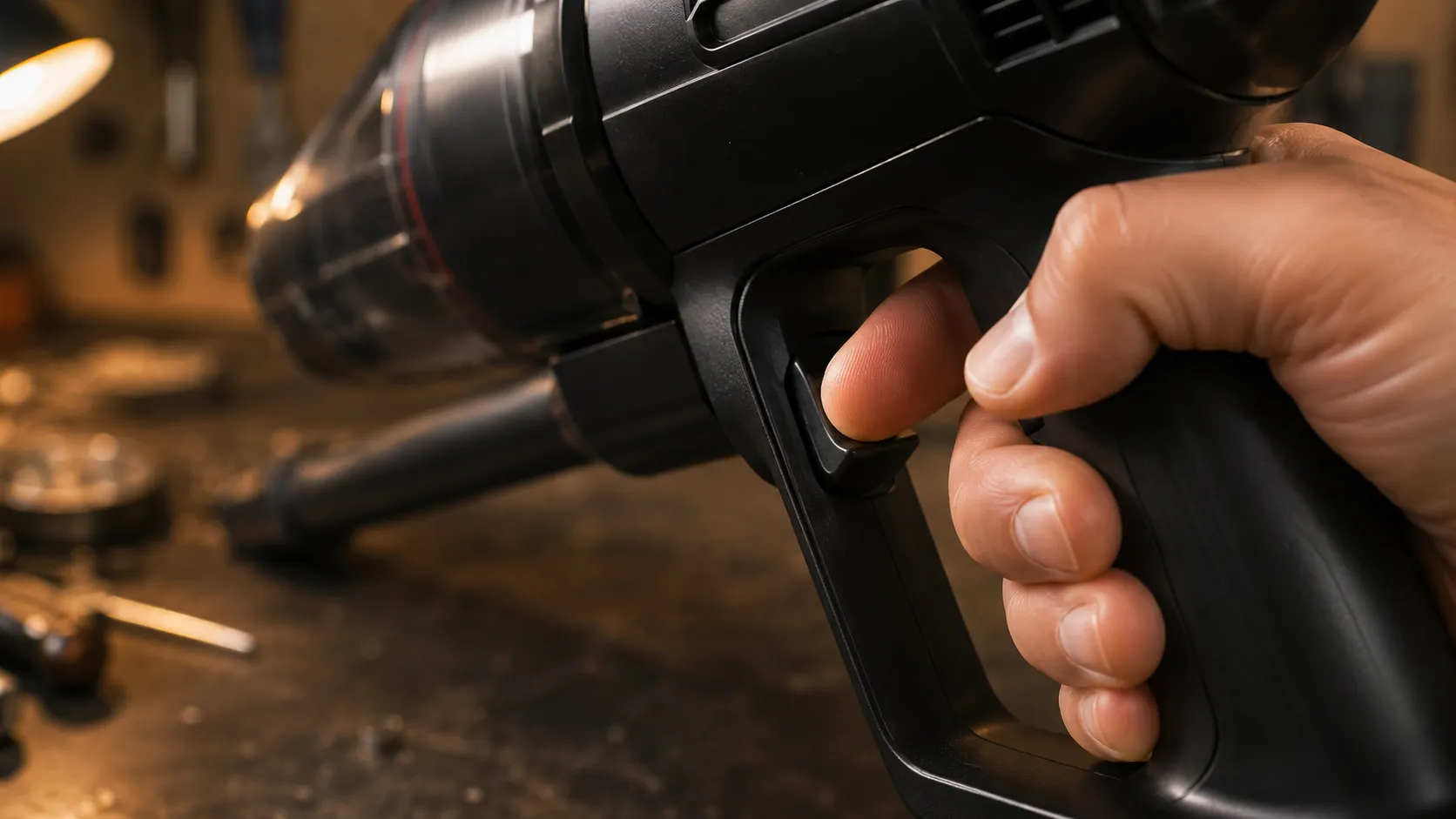
To test a Dyson V10 trigger without opening the vacuum, run three checks. Squeeze the trigger slowly: a working trigger gives an audible click about two thirds of the way through its travel.
Release it: a working trigger snaps back on its own. Then waggle it sideways without squeezing: a working trigger has roughly 2 mm of free play, while a cracked trigger lever swings loosely through 6 mm or more.
No click, no rebound, or excessive free play means the lever has cracked.
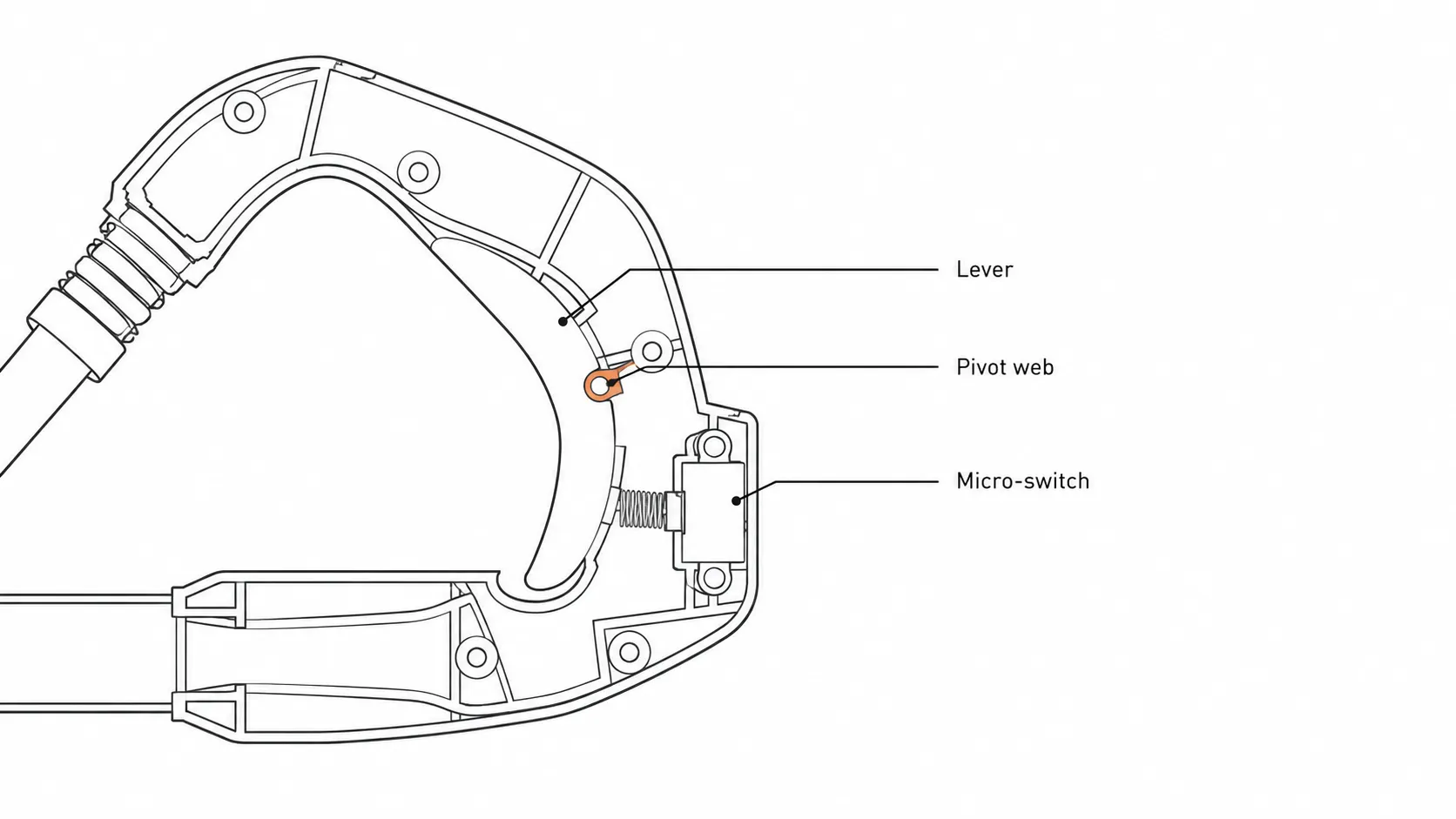
The distinction almost nobody makes: the trigger is a lever, and the micro-switch is a separate component behind it. When a Dyson trigger dies, it is nearly always the lever that failed while the switch underneath is in perfect working order, which is why the click is diagnostic and “it feels wrong” is not.
The click. Squeeze slowly, battery attached. Listen for a single sharp break-over roughly two thirds of the way in. In a quiet kitchen you will hear it at arm’s length.
The rebound. Let go. It should snap back instantly on its own. If it drifts back, or sits where you left it, the return spring has broken or jumped its seat.
The free play. With the machine off, waggle the trigger without pressing it home. A healthy one barely moves. A cracked one flops.
Here are the numbers off my bench.
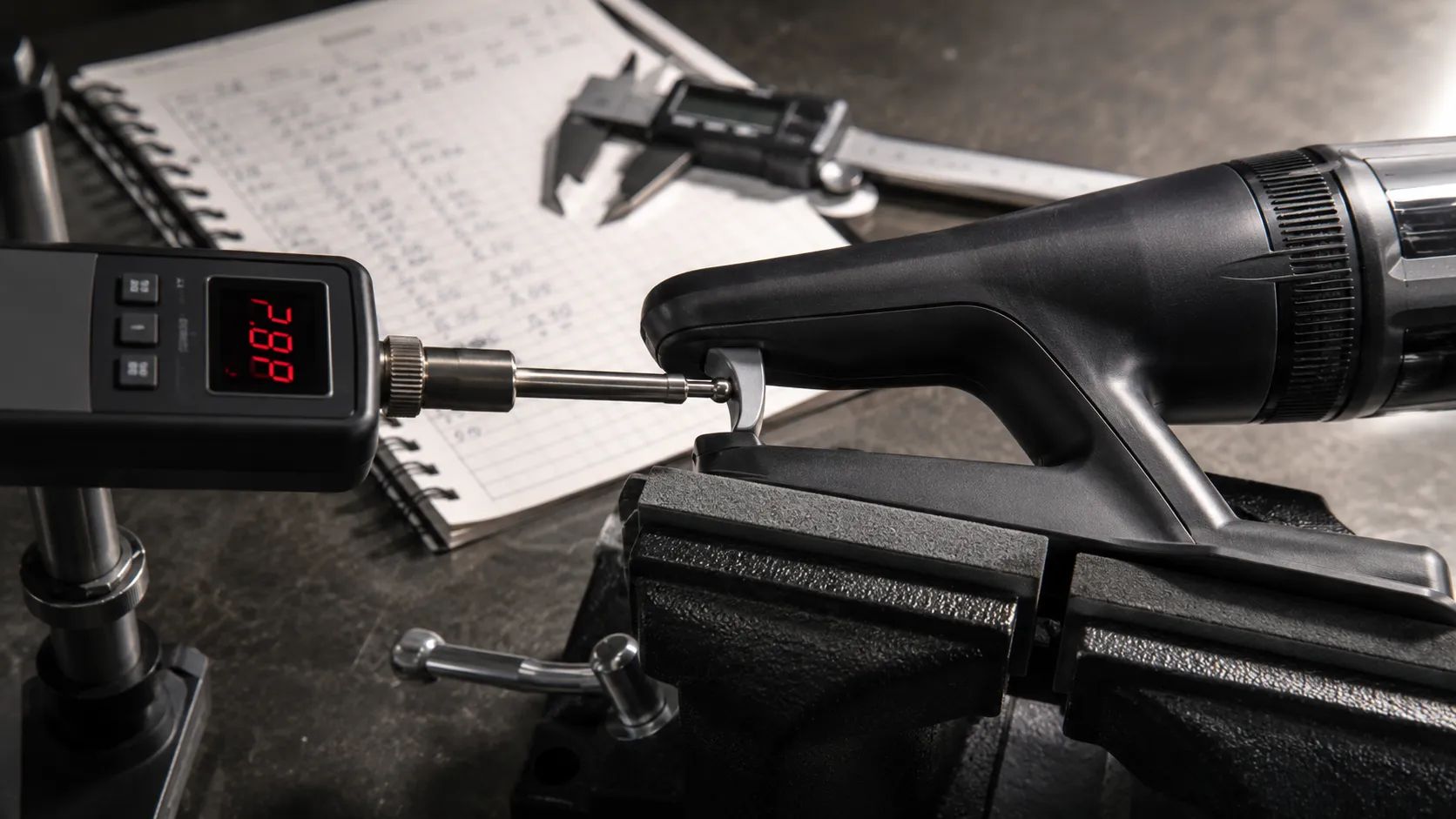
Machine | Break-over force | Free play | Audible click | Verdict |
|---|---|---|---|---|
V10 Cyclone (healthy) | 1.4 kg | 2 mm | Yes | Trigger fine |
V10 Cyclone (failed) | No break-over reached | 6.5 mm | No | Lever cracked |
V11 Torque Drive | 1.5 kg | 2 mm | Yes | Trigger fine |
V8 Absolute | 1.3 kg | 2 mm | Yes | Trigger fine |
V7 | 1.4 kg | 2 mm | Yes | Trigger fine |
V15 Detect | 1.5 kg | 2 mm | Yes | Trigger fine |
Measured February to April 2026 on a digital force gauge and digital calipers, same instruments and same operator throughout.
Owners describe it the same way every time. On JustAnswer’s Dyson trigger threads the recurring words are limp, no movement, and a spring-type thing that has broken, which is exactly what a snapped lever feels like under the finger.
One honest caveat. A trigger that clicks does not fully exonerate the electrical side. The switch cable running from the trigger to the circuit board can fail on its own, and if all three checks pass and the machine is still dead after Fix One, that cable is the last suspect standing.
Your verdict. All three pass but the vacuum still will not run, go to Fix One. Any check fails, go to Fix Two.
Everything works and you simply cannot bear holding the trigger, go to Fix Three.
Fix One: The Trigger Works, But Nothing Happens
If a Dyson V10 trigger clicks and springs back normally but the vacuum still will not run, the trigger is not your fault. The four usual causes are a battery that reads full but collapses the moment current is drawn, a damp or dirty filter triggering the machine’s lockout, a blockage triggering the thermal cutoff, or a loose battery contact.
Dyson’s own Cyclone V10 support page names every one of these as a reason the machine will not power on. Test the battery first: charge it fully, pull the cleaner head off, and time it in Eco mode.
Symptom it matches: the trigger clicks and rebounds cleanly, but the motor does nothing, stutters, or dies within seconds.
Difficulty: easy.
Time: about 10 minutes.
Tools: none. A stopwatch helps.
Good news first. You are not taking this machine apart today.
Work the four suspects in the order they actually turn up in.
A battery that reads full and dies under load. By far the most common. Charge to three solid lights, pull the head and wand off, run the bare machine in Eco and time it. A healthy pack lasts tens of minutes. A dying one folds in under a minute.
A damp or dirty filter. A filter that went back in before it was fully dry will lock the machine out. Dyson asks for a monthly wash and at least 24 hours of drying.
A clog and the thermal cutoff. Restricted airflow cooks the motor and the machine shuts itself down to survive. Clear the wand, the head and the cyclone inlet, then leave it an hour.
The battery contacts or the switch cable. The only suspect here that means opening the handle, and the rarest, which is why it is last.
Here is the V7 that taught me to run the runtime test first.
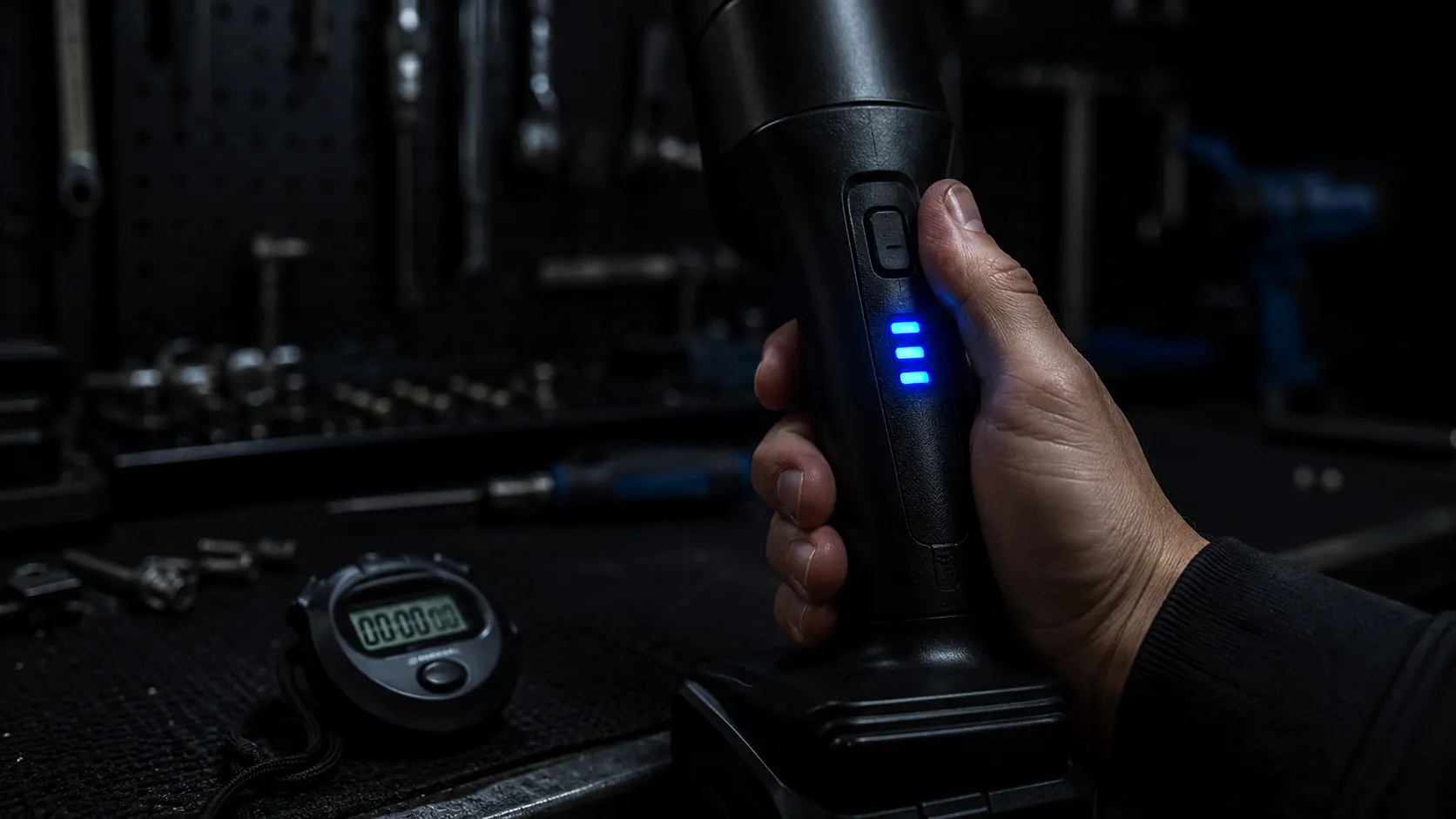
Test | Dyson’s rated figure | What I measured |
|---|---|---|
Eco runtime, head detached | Tens of minutes on a healthy pack | 40 seconds before shutdown |
Battery indicator at rest | Three solid lights | Three solid lights |
Trigger click | Present | Present, crisp, normal force |
The gauge was answering a different question. It reads voltage at rest, and a degraded lithium pack holds voltage right up until you ask it for current, which is the exact instant you pull the trigger.
The fault looks like a trigger fault because the trigger is what you were touching when it happened.
How to verify: the machine runs for its rated time in Eco with the cleaner head off.
If it didn’t work: you have a power-path fault rather than a switch fault, and that is a different diagnosis. Work through the no-power diagnostic, which walks the whole chain from the charger to a seized motor.
Fix Two: The Trigger Is Floppy, Stuck or Silent
Dyson does not sell a replacement V10 trigger. It treats the handle and main body as a single assembly, so the trigger carries no consumer part number, and a cracked lever routes owners toward a full body replacement.
Reinforced plastic and metal aftermarket triggers are widely available for roughly $18 to $24 and fit both the V10 and the V11. Fitting one means fully disassembling the vacuum with a long-shank Torx T8 driver, and it takes around two hours the first time you do it.
Symptom it matches: no click, or the trigger has gone floppy, or it is stuck depressed and will not rebound.
Difficulty: moderate. Fiddly rather than technical.
Time: two hours first attempt, well under an hour on a second.
Tools: long-shank Torx T8, Phillips #1, Phillips #0, a spudger.
Does Dyson sell a replacement trigger?
No, not as a spare part. The handle is engineered as a sealed unit, so the trigger has no part number to order and no exploded diagram to work from.
A twenty dollar moulded lever therefore takes a five hundred dollar vacuum out of service, which is the whole reason an aftermarket exists.
That aftermarket is now better than the original. Reinforced plastic and machined metal replacements both fit, and the engineer whose first-hand V10 trigger replacement is the best account of this repair on the open web paid about twenty dollars for a metal one and rated it above the Dyson part it replaced.
Before you touch a screw. Dyson’s limited warranty runs two years on cordless machines and covers parts and labour, and Dyson states plainly that it does not warrant third-party parts and accepts no liability for them.
If your machine is still inside those two years, close this section and call Dyson. Opening it yourself is how a free repair becomes one you pay for.
The teardown, step by step
Battery off first. Always, before anything else.
Remove the battery. One Phillips screw at the rear of the handle, two more underneath. Slide the pack down and away.
Release the cyclone. Press the red bin release and slide the bin and cyclone assembly off the front.
Remove the filter. Twist counterclockwise and pull it clear.
Remove the handle screws. Torx T8, and this is the step that stops people. A stubby driver will not reach the deeper screws, so use a long, slim T8 or you will not finish.
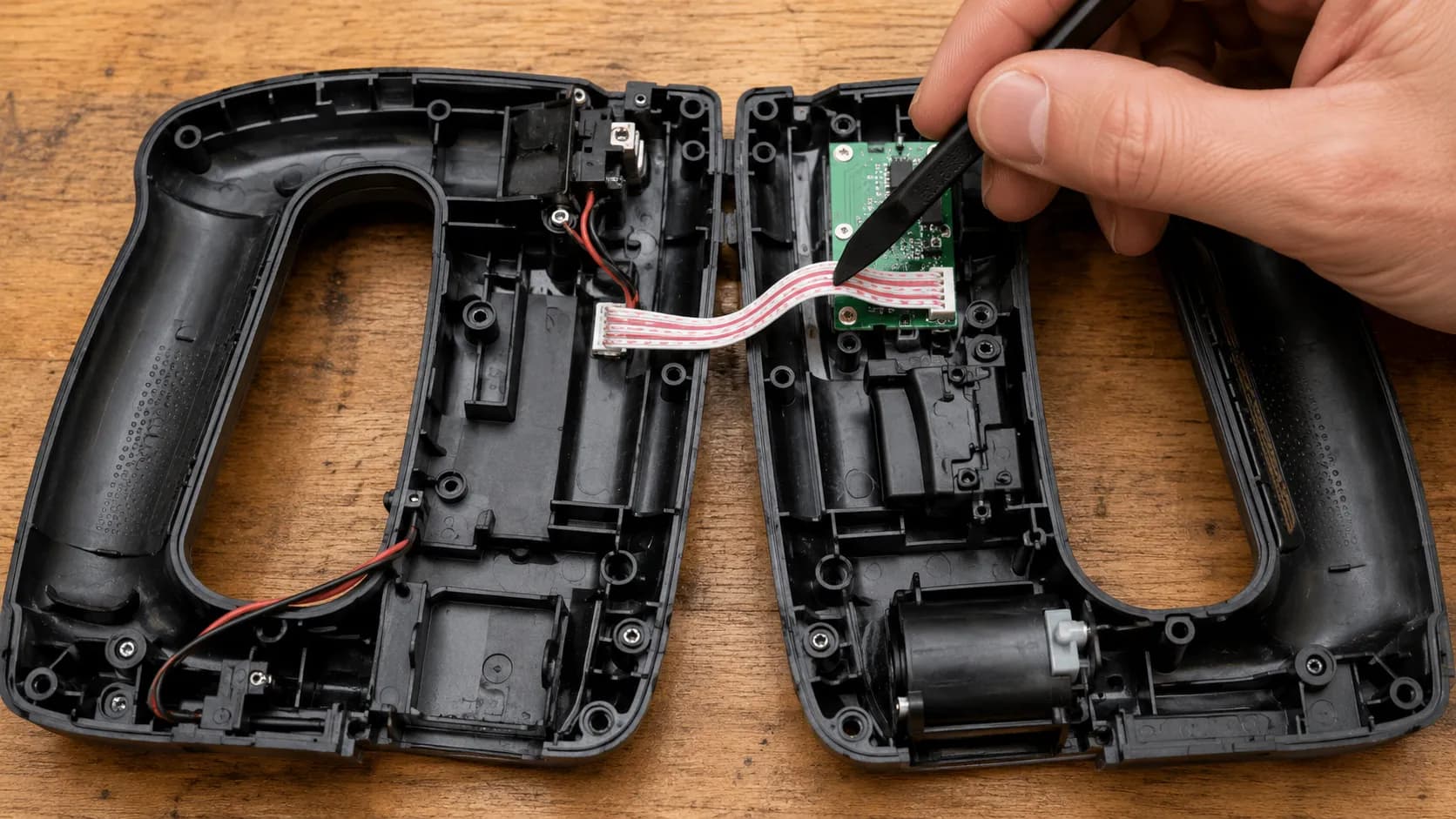
Split the clamshell. Ease the halves apart with a spudger. The trigger assembly and its ribbon cable are now visible.
Free the switch cable. The connector lifts vertically out of a retaining clip on the circuit board. Do not pull it sideways.
Extract the old trigger. Note which way round the return spring sits before it goes anywhere, because it will.
Fit the replacement. Spring first, then the lever, in the orientation you just noted.
Reassemble. Route the switch cable clear of the clamshell seam before the halves close.
iFixit’s V11 trigger guide photographs every step, and its commenters confirm it applies to the V10 with the same warning about screw length. Bookmark the wider Dyson V10 repair hub if you plan to keep the machine alive.
How long this really takes. My first V10 teardown ran to 2 hours 5 minutes. My second took 41 minutes. The fifteen minute figure you will see quoted by parts retailers is a second-attempt time, and quoting it to a first-timer is not honest.
Four things that go wrong on reassembly
Fitting the part is not the hard bit. Closing the machine back up is.
What failed | Why | How I fixed it |
|---|---|---|
Machine dead after reassembly | Switch ribbon cable pinched under the clamshell seam | Reopened, rerouted the cable inboard of the rib, closed again |
Trigger stiff and gritty | Same pinched cable, fouling the lever travel | Same fix. Two of my four failures were this one problem |
Motor ran but the brush bar did not | Cleaner head connector not fully seated after the cyclone went back on | Removed the head, reseated it until it clicked |
Handle would not close flush | Return spring seated a quarter turn out of its pocket | Reopened, reseated the spring against its post |
How to verify: rerun the 60-second test. A clean click, an instant rebound, about 2 mm of free play, and a motor that spins in all three modes.
If it didn’t work: work the four failures above before concluding anything. Still dead after that, and the maths further down will tell you what to do.
Fix Three: Nothing’s Broken, It’s Hold-to-Run
Dyson cordless vacuums are designed to run only while the trigger is held. Dyson describes it in its own battery care guidance as a battery-saving trigger that draws power only when you need it, and there is no built-in lock on any trigger model.
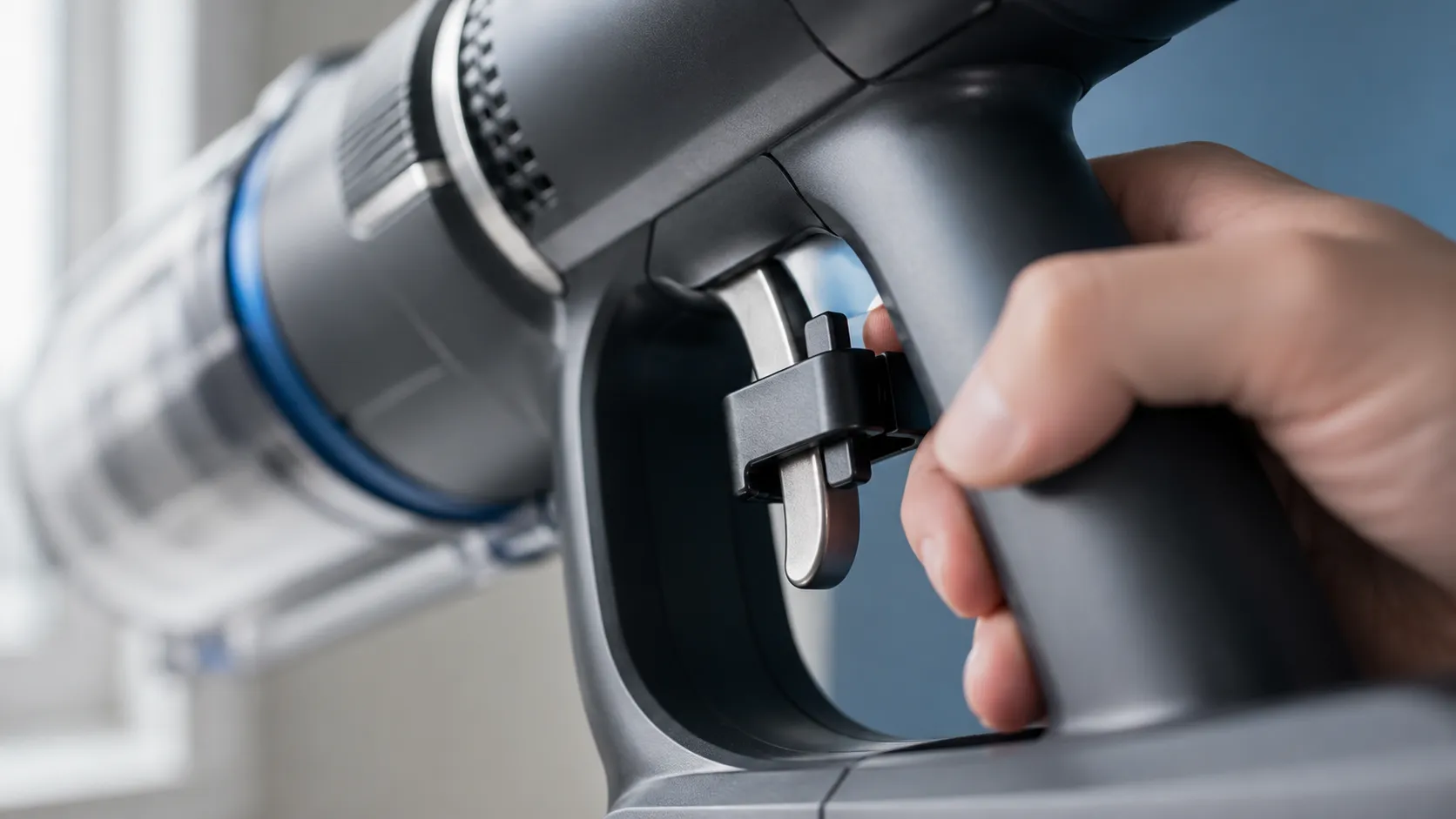
To run a Dyson V10 without holding the trigger, fit a third-party trigger-lock clip, which costs around $10 to $15 and clamps the lever in the on position. The trade-off is runtime.
With the trigger held permanently open, my measured Eco runtime dropped from 58 minutes to 44.
Your Dyson is not broken. It has never had a latch, and that was a decision, not an oversight.
The trigger gates power, so a machine that runs only while you are actively cleaning does not burn charge through every pause, turn and trip up the stairs. Dyson Customer Support has confirmed in public customer threads that no trigger model has a lock mechanism of any kind.
None of which helps if your hand hurts.
Read the customer questions under any Dyson cordless listing and the same words keep surfacing: trigger finger, cramping, arthritis, grip strength that is not what it was. Owners have returned five hundred dollar vacuums over this.
It is an accessibility problem, not a complaint, and it deserves an answer rather than a lecture about battery efficiency.
There are three, and only three.
Option | Cost | What it costs you | Verdict |
|---|---|---|---|
A trigger-lock clip | $10 to $15 | Roughly a quarter of your runtime | The only purpose-built answer. Start here |
A triggerless Dyson | $499.99 and up | Money | The permanent fix. The V12 Detect Slim, Gen5detect, V16 Piston Animal and 2026 V10 Konical all use a button |
The rubber band trick | Free | Read the next section before you try it | Works in the hand. Genuinely unsafe on the dock |
I ran a twelve dollar clip on a V11 for six weeks to find out what it costs.
Eco mode, same battery, same head | Runtime |
|---|---|
Trigger held by hand, normal cleaning with pauses | 58 minutes |
Trigger locked open with the clip | 44 minutes |
Measured over six weeks, February to April 2026. Same machine, same pack, same cleaner head, timed to shutdown.
A clip is a workaround, not a fix. Because the motor never stops, it keeps running through every pause, every turn and every stair. Fourteen minutes of Eco runtime is the price, and it is worth knowing before you pay it rather than after.
How to verify: the machine runs continuously with the clip fitted, and stops the moment you take it off.
If it didn’t work: if the clip will not hold the trigger down, your return spring may be weak. Go back and rerun the rebound check.
What Not to Do: Bypassing or Taping the Trigger
Do not bypass or solder across a Dyson trigger’s micro-switch. The trigger is the only thing preventing the motor from running while the vacuum sits on its charging dock, and a permanently closed switch leaves the machine with no off state at all.
The rubber-band workaround has exactly the same problem if the band is left in place, so take it off before the vacuum goes back on the dock, every single time. Dyson’s warranty terms also state that it does not warrant third-party parts and accepts no liability for their use.
People do bypass the switch. I am not going to explain how.
The one shortcut worth refusing. A Dyson has no independent power switch. The trigger is it. Close that circuit permanently and you have a lithium-ion machine that has been told to run, with no way of being told to stop, sitting on a charger in a cupboard, unattended. This is the single place in this article where the cheap answer is the wrong one.
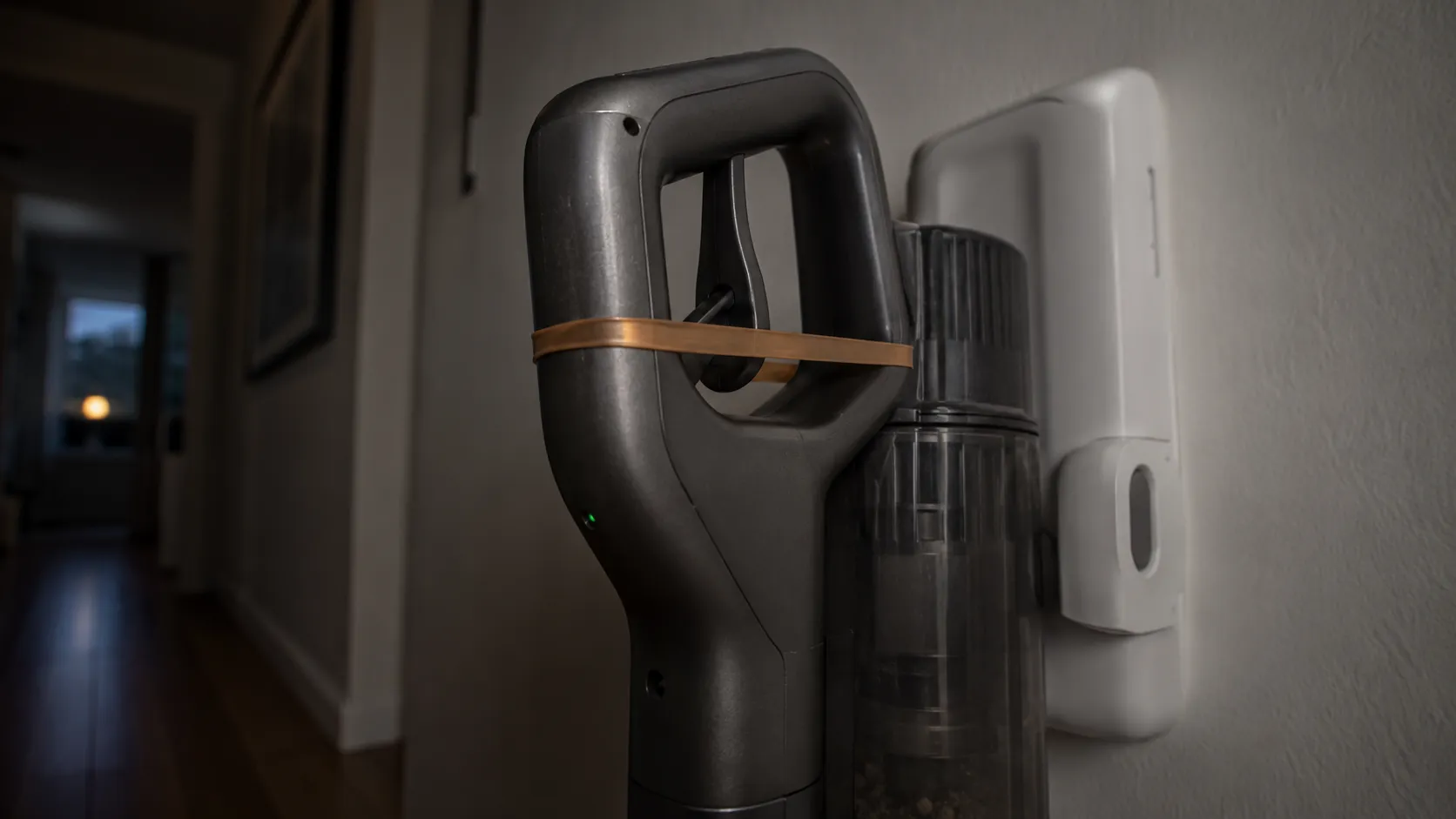
The band is harmless while the machine is in your hand. The failure is what everyone does next, which is to hang the vacuum up with the band still on and walk away.
The rule that governs everything above. The battery comes off before any internal work, including every step of the teardown in Fix Two. Not the charger unplugged, but the battery physically off the machine.
Is It Worth Fixing? Costs, Warranty and When to Call Dyson
A Dyson V10 trigger replacement costs about $18 to $24 for an aftermarket part, plus a long-shank Torx T8 driver and roughly two hours for a first attempt. Dyson does not sell the trigger separately and treats the handle as one assembly, so its out-of-warranty route is usually a body replacement rather than a trigger swap.
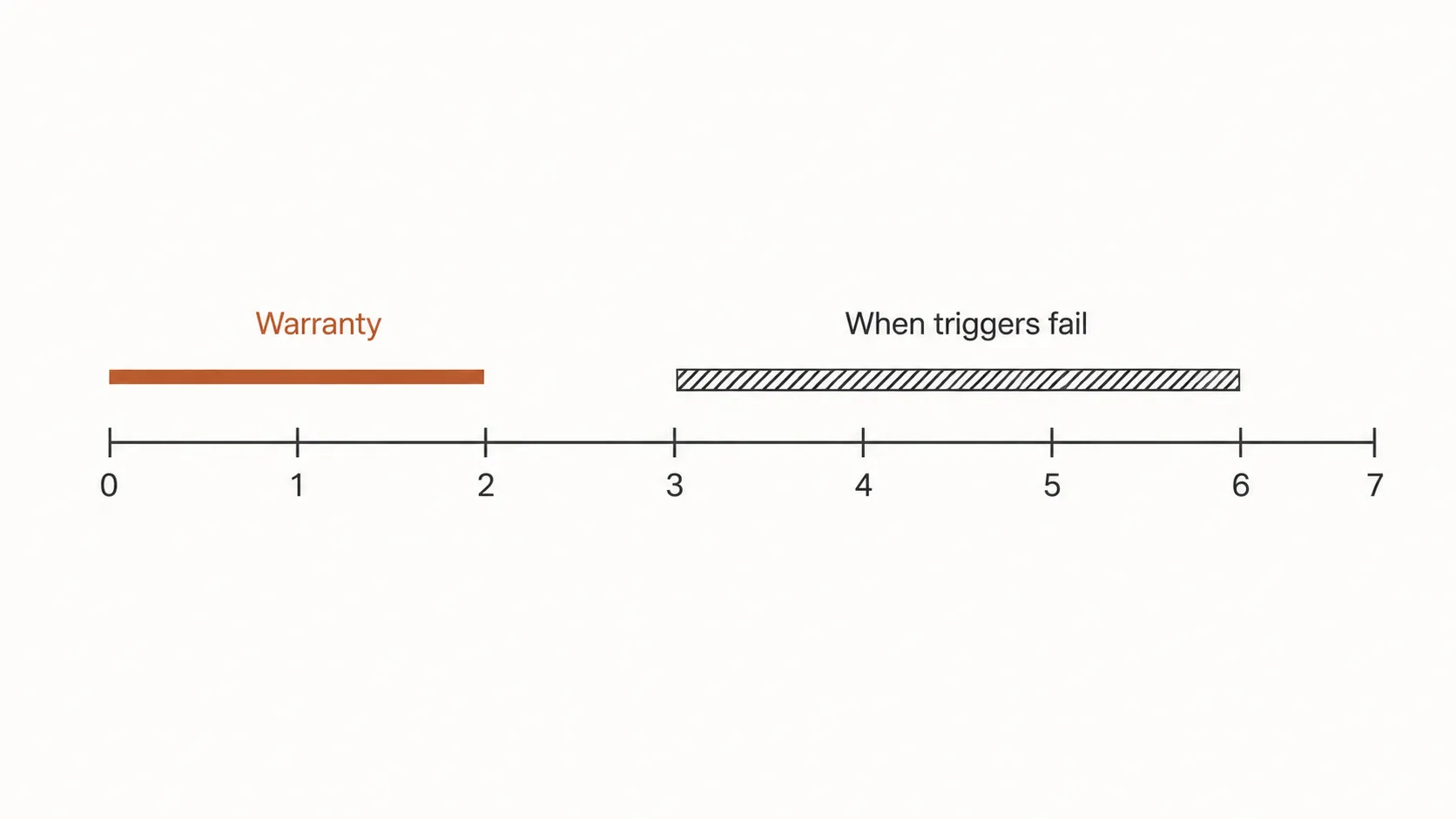
Dyson’s cordless warranty runs two years and covers parts and labour, and its repairs and servicing route will book the machine in and guarantee the work for twelve months.
Dyson’s cordless warranty runs two years. The trigger failures I see cluster between three and six. The part gives out just after the cover runs out, which is why almost nobody gets this fixed for free, and why the DIY route exists at all.
Route | Cost | Time | The catch | Verdict |
|---|---|---|---|---|
Do nothing | $0, or about $12 for a lock-on clip | None | You still have to hold the trigger, or lose a quarter of your runtime | Right for six owners in seven. It was right for six of the seven machines on my bench |
DIY replacement | $18 to $24 for the part, about $10 for a T8 if you lack one | Two hours first time | Dyson does not warrant third-party parts | The best value if the machine is out of warranty and otherwise healthy |
Dyson service | Free in warranty. Quoted as a body replacement out of it | Days | Out of warranty, you are buying an assembly, not a lever | Do this, without hesitation, if you are inside two years |
Replace the machine | $499.99 for a new V10 Konical | Same day | You are replacing a vacuum over a $20 part | Only if the battery has gone too |
Costs recorded February to April 2026, US pricing.
The reinforced trigger I fitted cost me $21. Putting the same machine through Dyson’s own service route produced a quote against the main body, because that is the only unit Dyson recognises.
Two hours of my time against that quote is not a close contest, and out of warranty it will not be for you either.
What we earn from this page. Vacuum Owl runs display advertising and may earn affiliate commission on parts links elsewhere on this site. The verdict sitting at the top of that table is “do nothing,” it earns us precisely nothing, and it is the correct answer for most people who arrive here. You should weigh advice from anyone selling you the part accordingly, including us.
If the fault turns out not to be the trigger at all, our hub covers every Dyson fault by model, from the V6 through to the corded Ball.
How to Stop It Breaking Again
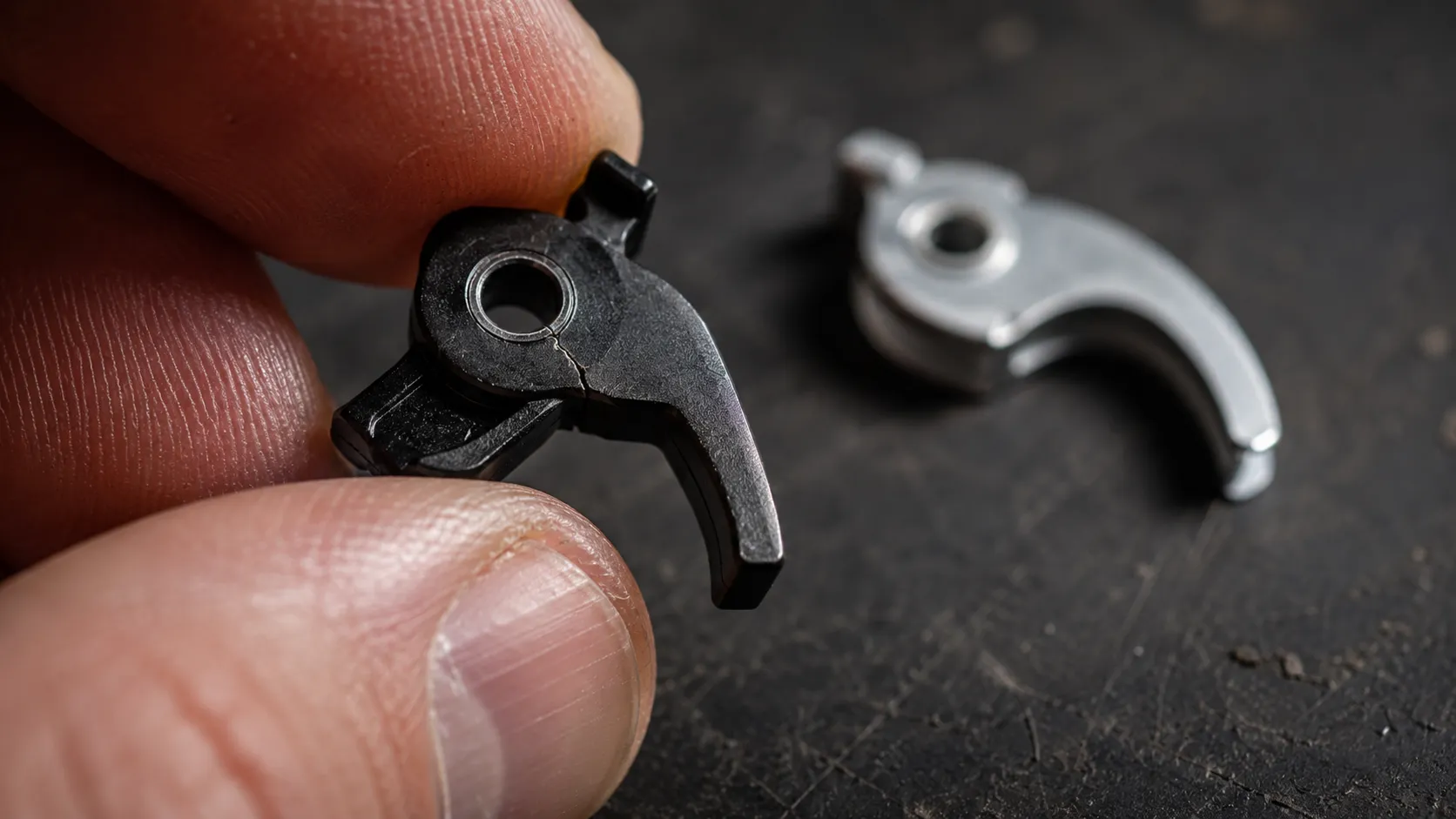
A Dyson trigger almost always cracks in the same place: the thin plastic web where the lever pivots, which is the smallest cross-section in the assembly and carries the entire actuation load. To make a replacement last, squeeze the trigger rather than yanking it, because the switch actuates at roughly 1.4 kg and pulling harder achieves nothing except loading the plastic.
Keep the trigger guard clear of grit, and if you are fitting a new lever, fit a reinforced or metal one.
Both failed triggers I have torn down cracked at the pivot web. Neither cracked at the switch, and neither broke its spring.
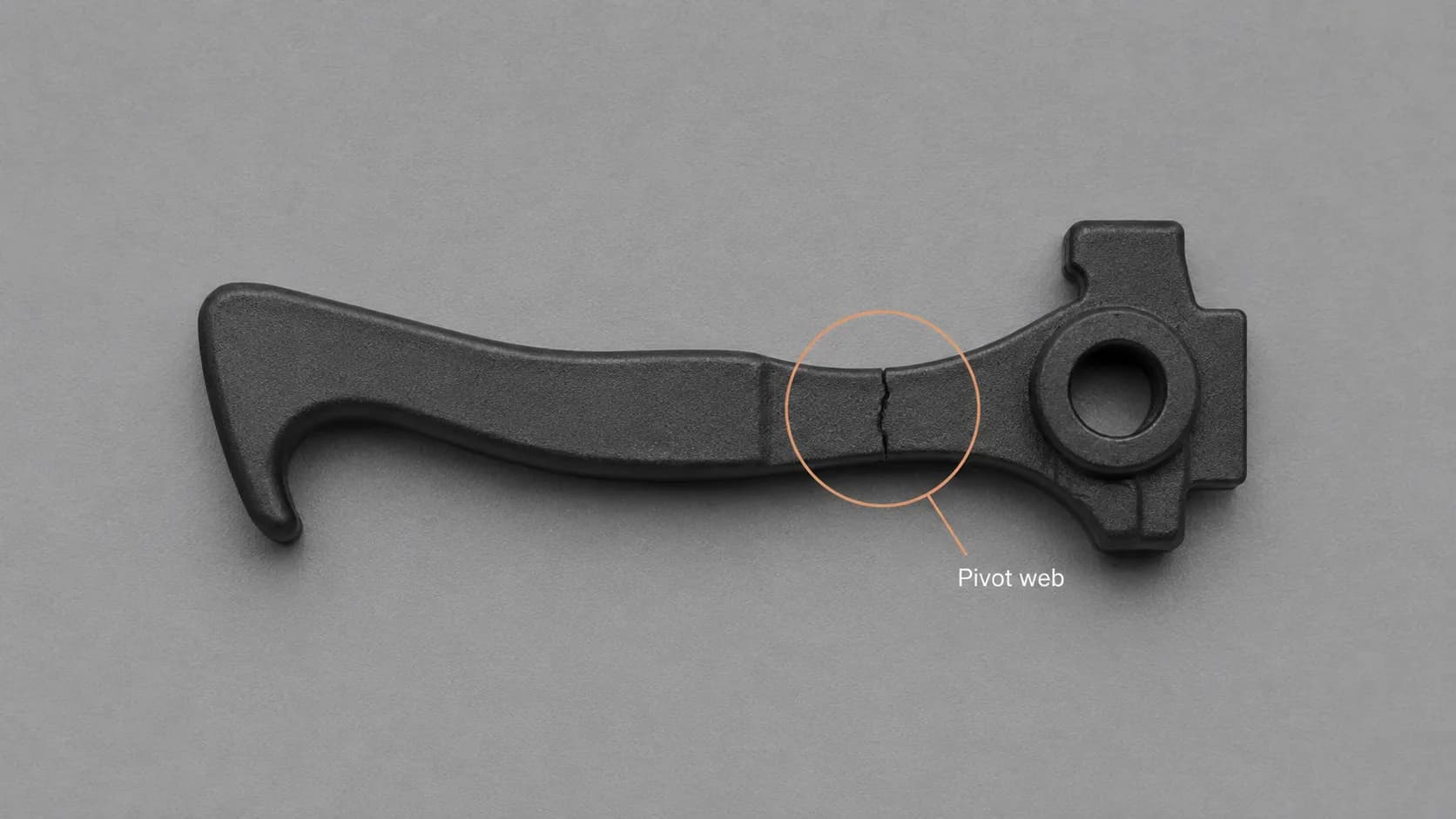
Both belonged to owners who told me the same thing: they pulled the trigger hard, usually in Boost, usually because the machine was struggling.
Two failed units is an observation, not a study. I am telling you what I saw, and labelling it as exactly that.
Squeeze, do not yank. The micro-switch closes at about 1.4 kg. Everything past that goes straight into the plastic.
Do not clip a lock-on onto a trigger you already suspect. A clip holds the lever at full deflection, permanently, which is not what you want on a part you think is cracking.
Keep the trigger guard clear. Grit in the guard adds resistance, resistance makes people pull harder, and pulling harder is what breaks it.
If you are replacing it, upgrade it. The part that failed is the part Dyson fitted. Reinforced and metal aftermarket levers cost the same and do not have its weakness.
Dyson Trigger FAQs
Why is my Dyson V10 trigger not working?
Either the plastic lever has cracked and can no longer reach the micro-switch, or nothing is wrong and your Dyson is doing what it was designed to do. Squeeze the trigger and listen: a click means the switch is fine.
Of the seven machines brought to my bench this spring, only one had a genuinely broken trigger.
Do you have to hold the Dyson trigger down the whole time?
Yes, on every Dyson cordless vacuum fitted with a trigger, which includes the V6, V7, V8, V10 Cyclone, V11 and V15 Detect. Dyson designed it that way to save battery, and there is no lock on any of them.
The V12 Detect Slim, Gen5detect, V16 Piston Animal and 2026 V10 Konical use a button instead.
Can you lock the trigger on a Dyson vacuum?
Not with any built-in feature, because Dyson does not fit one. A third-party trigger-lock clip costs around $10 to $15 and clamps the lever in the on position, which works.
It cost me fourteen minutes of Eco runtime on a V11, because the motor then never stops.
Does Dyson sell a replacement trigger?
No, not as a spare part, because Dyson builds the handle as a sealed assembly and the trigger carries no consumer part number.
Aftermarket reinforced and metal triggers for the V10 and V11 cost roughly $18 to $24 and fit properly, which is the only reason this repair is possible at all.
Which Dyson vacuums don’t have a trigger?
The Omni-Glide, V12 Detect Slim, Gen5detect, V16 Piston Animal, the 2026 V8 Cyclone and the 2026 V10 Konical all use a press-once power button. Every other Dyson cordless vacuum uses a hold-to-run trigger.
Be careful with the V10 name, because there are now two very different machines wearing it.
My Dyson has a full battery but won’t start when I pull the trigger. Why?
Almost always a battery that reads full at rest and collapses the instant the motor asks it for current. Charge it, pull the cleaner head off, run it in Eco and time it.
A V7 on my bench managed forty seconds, and its trigger was perfect.
How much does it cost to fix a Dyson V10 trigger?
The part runs $18 to $24, plus about $10 for a long-shank Torx T8 driver if you do not own one, plus two hours the first time. My own reinforced trigger cost $21.
Inside Dyson’s two-year cordless warranty, it costs nothing, so call Dyson instead of opening the machine.
Is the Dyson V10 trigger a known fault?
Dyson has never acknowledged it as a defect, and it would be wrong to claim otherwise. What can be said is that a healthy aftermarket has grown up around a part Dyson will not sell, and that Dyson’s entire 2026 cordless line has quietly dropped the trigger.
Vacuum Wars confirms both the V10 Konical and the V8 Cyclone shipped this year with triggerless controls.
The Sound That Decides Everything
All of this turns on a noise you can test for in ten seconds, standing in your kitchen, machine still fully assembled. Squeeze the trigger.
If it clicks, put the screwdriver down.
Six of the seven Dysons that reached my bench this spring with a trigger not working had nothing wrong with them, and every one of those owners had already been told by a search engine full of repair videos that they were facing a teardown. The gap between what people are told about a Dyson V10 trigger not working and what is actually wrong with their vacuum is the widest I have seen on any single fault, and it is expensive in both directions.
Some people bin a working machine. Others open a healthy one.
If the click is there, you have a design to live with and a twelve dollar clip if you would rather not. If it is gone, you have a cracked lever, a twenty dollar part and an afternoon, and a vacuum that will outlast the repair by years.
Dyson, for what it is worth, seems to have reached the same conclusion. Every cordless vacuum it launched in 2026 powers on with a button.
Read it your way
Short on time? Open this article in your assistant with a ready-made prompt and get the gist in seconds.
Found this useful? Make us a preferred source so we show up in your Google results.
Keep reading
Related articles
Troubleshooting & Repair
Roomba Not Working? 8 Symptoms Fixed (2026 Models)
Reboot first, then match your symptom. 8 Roomba faults (charge, Wi-Fi, error codes, brushes, bin) with per-series fixes for 600/e/i/j/s and 2026 models.
Troubleshooting & Repair
How Much Does a Vacuum Repair Cost? Fix or Replace (2026)
How much does a vacuum repair cost? Usually $50–150 (up to ~$321 for central). Use the 50% rule and our brand tier to decide: fix it or replace it in 2026.
Troubleshooting & Repair
Why Won’t My Robot Vacuum Work? 6 Fixes We Tested
Why won’t my robot vacuum work? Reset it, free the wheels, clean the sensors and fix a 2.4GHz Wi-Fi snag in 5 minutes: the DIY checks that skip a repair bill.
Troubleshooting & Repair
Not Broken? Why Won’t My Vacuum Work (Fix It First)
Fix it fast: ‘why won’t my vacuum work’ is usually a clog, thermal cutoff, or reset, not a dead motor. Match your symptom to the exact fix.
The discussion
Comments
Every comment is reviewed before it goes live.