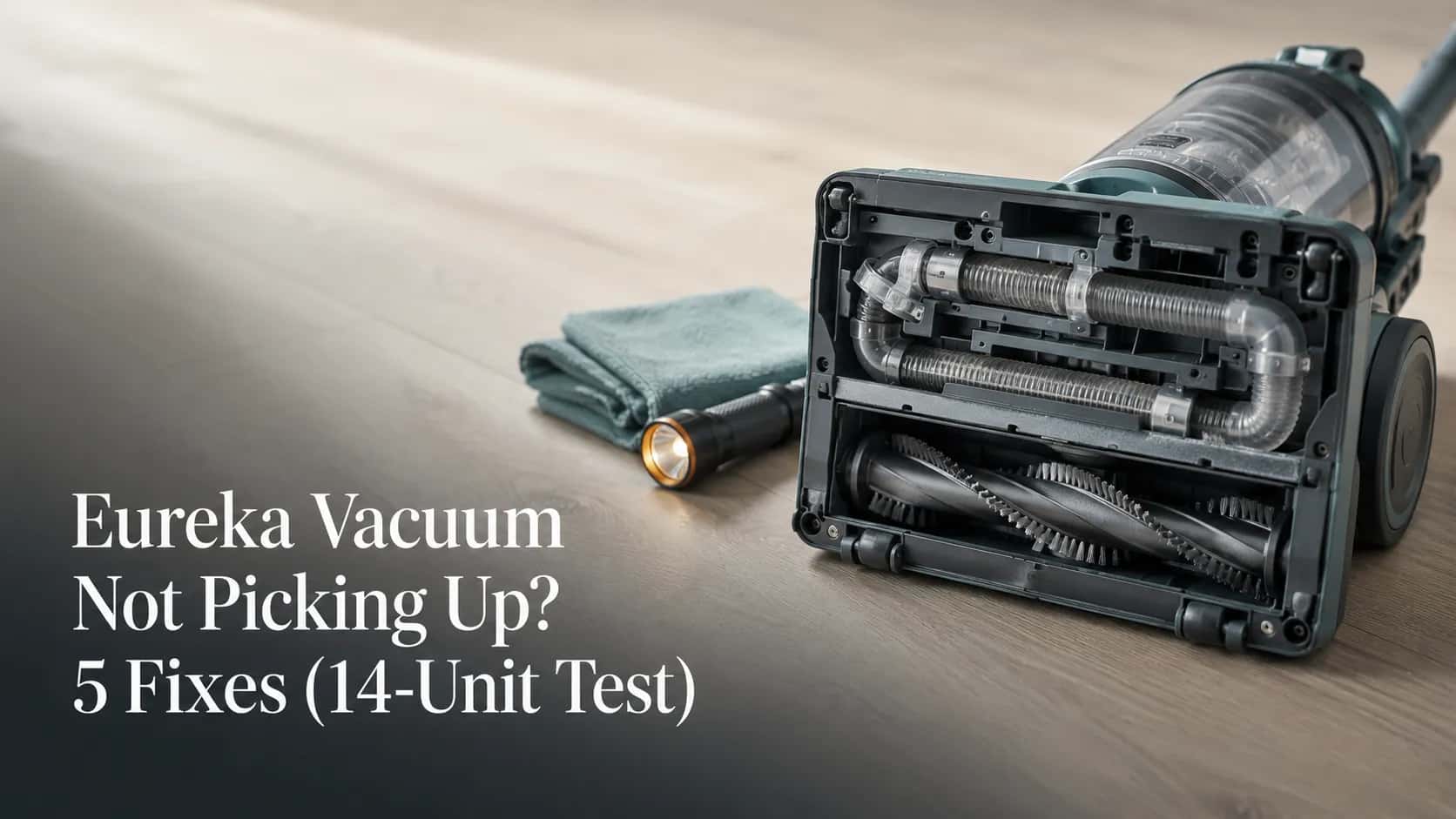
Eureka Vacuum Not Picking Up? 5 Fixes (14-Unit Test)
Restore Eureka suction in 20 minutes: clear the underside clear-hose and intake port, wash the dust-cup foam filter (24h dry), reseat the cyclone seal.
Written by Reggie AlvarezReviewed by Dale FerrisLast updated on August 6, 2026
When you buy through links on our site, we may earn an affiliate commission (at no extra charge), which we use to fund new product tests. Learn more.
Read it your way
Short on time? Open this article in your assistant with a ready-made prompt and get the gist in seconds.
Found this useful? Make us a preferred source so we show up in your Google results.
Your Eureka runs but doesn’t clean. The motor sounds exactly as it always has, the brush roll may even be turning, and the carpet still looks the way it did before you started.
A Eureka vacuum not picking up is almost never a dead motor, which is the good news.
I spent January and February 2026 taking apart six Eureka uprights across fourteen no-pickup cases, measuring airflow at the nozzle at every stage. The finding that surprised me: the two blockage points nobody names accounted for half of them, and neither one is the part owners reach for first.
Eureka Vacuum Not Picking Up? Start With These Five Checks
A Eureka upright that runs but does not pick up has almost always lost airflow, not motor power. On the current PowerSpeed, AirSpeed and Max Swivel uprights, the two blockage points owners miss are the clear hose on the underside of the machine and the intake port directly behind the brush roll.
Check those two first, then the dust-cup foam filter, then the cyclone seal, then the belt. Across my fourteen cases, the hose or the port was the fault seven times, against three for the filter.
Quick answer: Unplug the vacuum and lay it down. Clear the underside clear-hose and the intake port behind the brush roll, wash the dust-cup foam filter and dry it a full 24 hours, empty the cup at the MAX line and reseat the cyclone until it clicks, then check whether the brush roll is driven. Most Eurekas are back to full pickup inside 20 minutes.
Clear hose and intake port (5 to 10 minutes)
Dust-cup foam filter (5 minutes of work, then 24 hours of drying)
Dust cup and cyclone seal (2 minutes)
Brush roll and belt (3 minutes to diagnose)
Height dial (30 seconds)
Why the order matters: a restriction upstream of the filter starves the filter of dirty air, so the filter still looks clean when you pull it. Check the filter first and you get a false negative, then spend the afternoon on the wrong part.
Scope note: this covers a Eureka that runs but will not pick up. A machine that will not switch on, cuts out mid-clean or gets hot and stops has a thermal fault, not an airflow one.
Bench basis: 6 Eureka uprights, 14 no-pickup cases, January to February 2026. Full method in the clog section below.
How a Eureka Actually Loses Suction
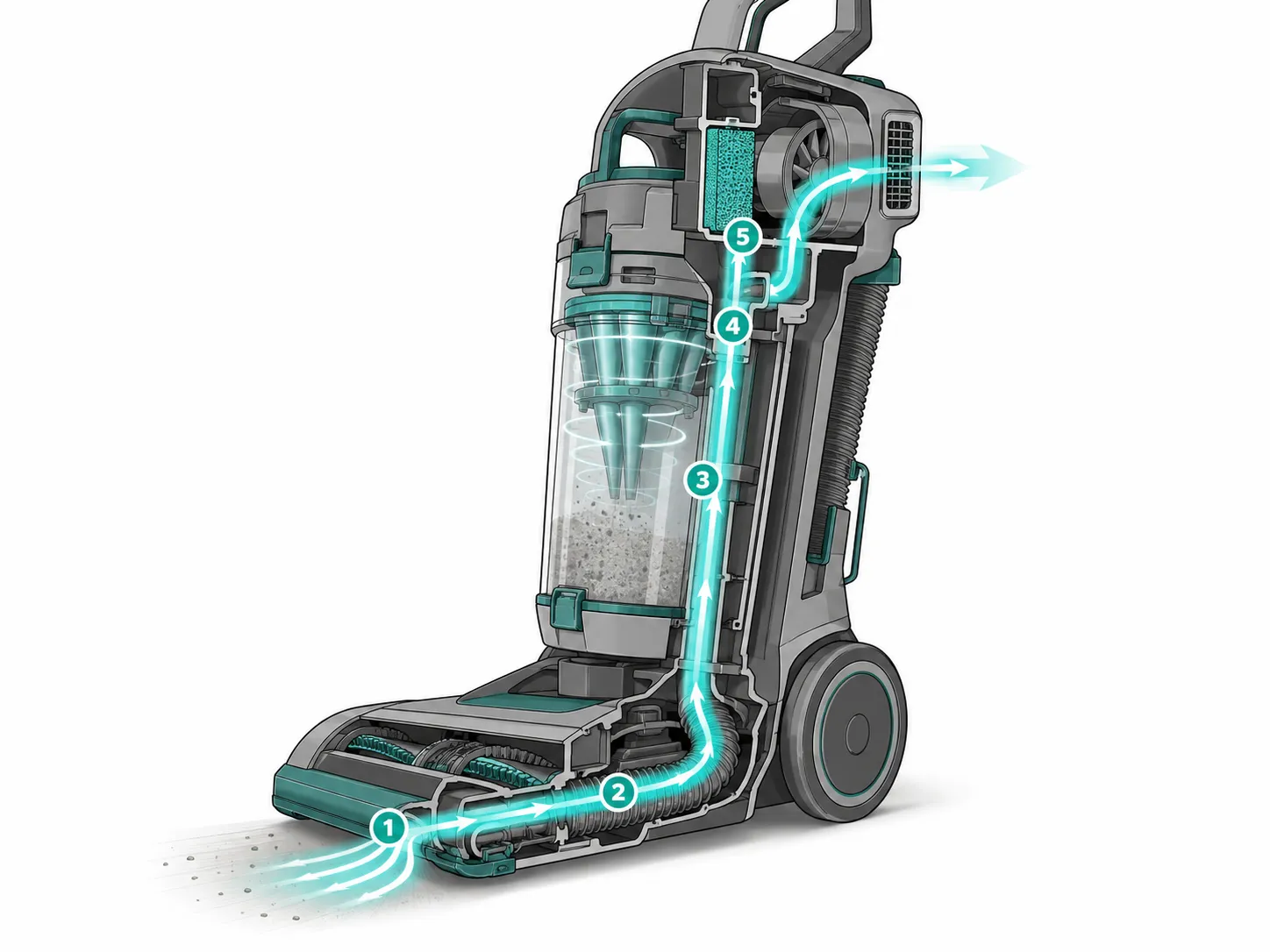
A Eureka upright cleans by moving air, not by motor strength, so pickup fails the moment airflow is restricted anywhere between the floor nozzle and the exhaust. On a bagless Eureka the air passes five chokepoints: the intake port behind the brush roll, the clear hose under the machine, the dust cup, the cyclone seal and the foam filter.
Suction loss is a location problem. Every symptom points at one of those five, and the routing table below tells you which.
What you are seeing | Most likely chokepoint | Go to |
|---|---|---|
Runs but doesn’t clean on any surface | Intake port or underside hose | Clog section |
Suction faded gradually over weeks | Foam filter loading | Filter section |
Weak straight after you emptied it | Cyclone or cup seated crooked | Dust cup section |
Leaves a stripe on carpet, fine on hard floor | Brush roll not driven | Brush and belt section |
Blowing dust back into the room | Filtration bypass | Bypass section |
Fine on hard floor, nothing on carpet | Height dial set too high | Height section |
Two different faults hide in that table. A restriction blocks the path, so airflow drops everywhere, while a leak lets air in after the nozzle, so the motor gets all the air it wants and the floor gets none.
That is why a leaking dust cup sounds completely healthy. The same five-stage logic applies to any upright, and I walk the brand-agnostic version of it in the full airflow-path fix for any vacuum.
Eureka’s own support FAQ names the right components, the brush roll, the filter and the hose connections, but never says where the air goes or which to check first.
One correction before you start. RepairClinic’s Eureka page still lists a full bag among the causes, and the current bagless NEU and AS uprights have no bag at all.
Where this map does not apply: older bagged Eureka uprights have a sixth chokepoint at the bag, and a bag two-thirds full is already restricting. If your machine takes a bag, check that first.
Clear the Underside Hose and the Intake Port
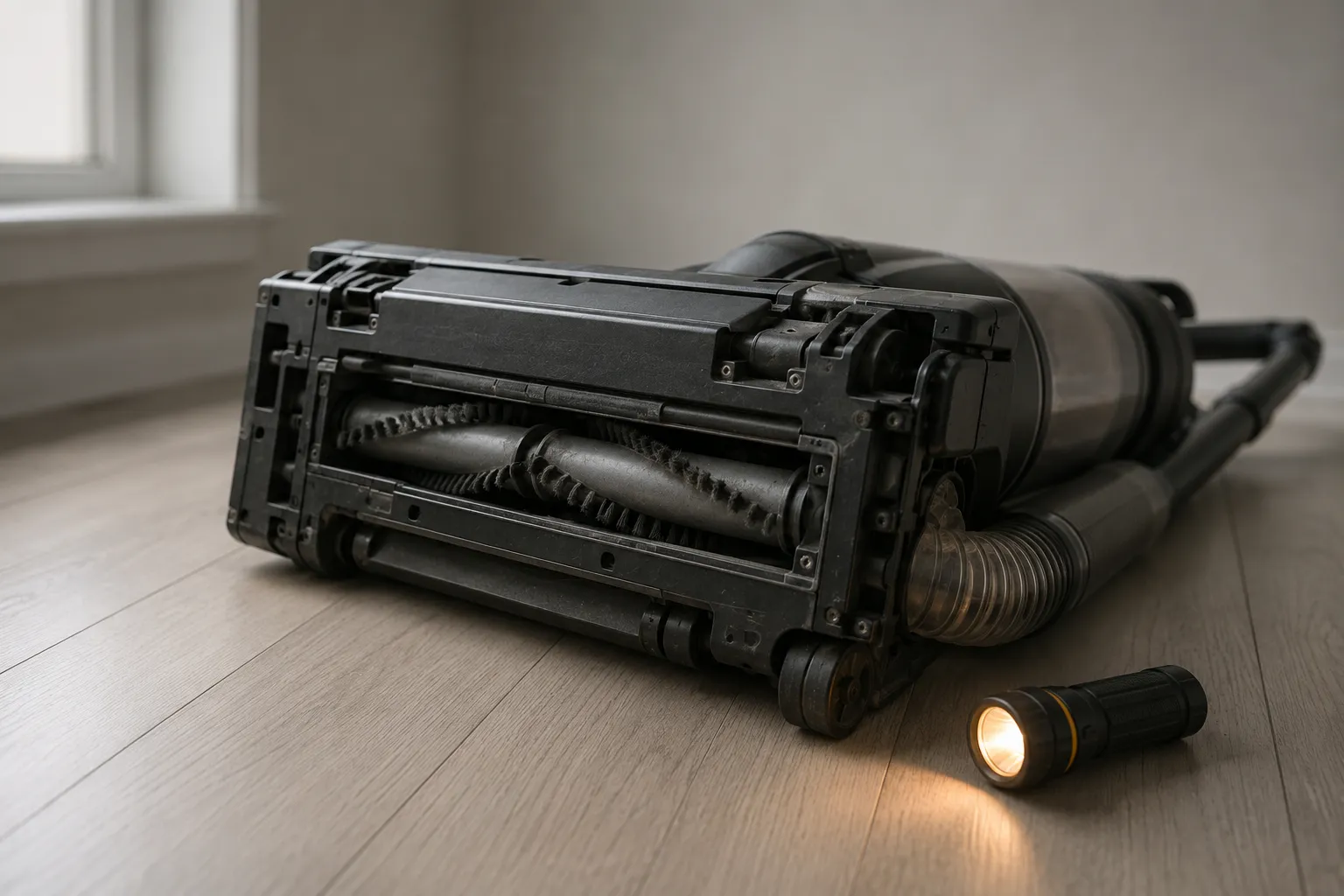
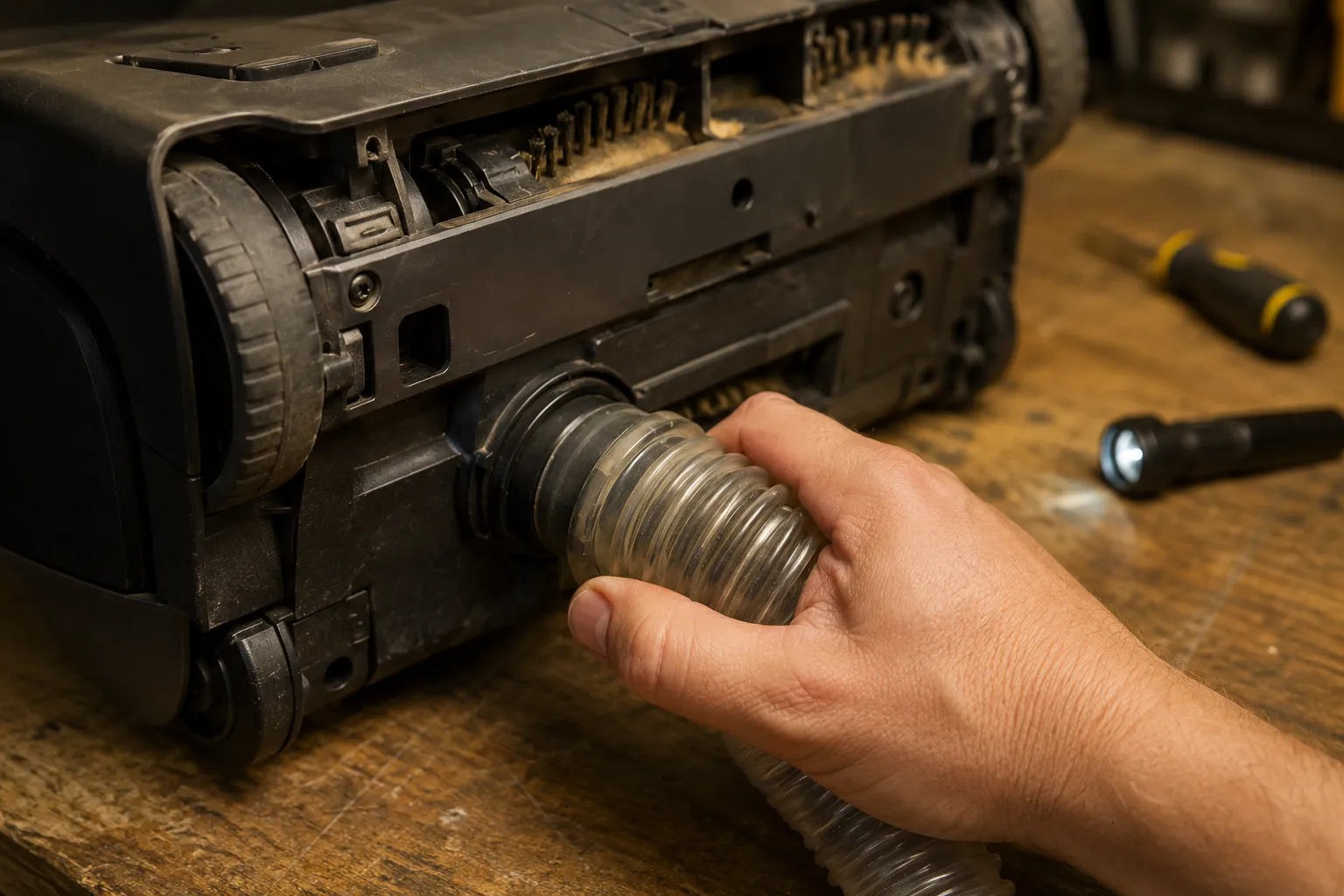
On a Eureka upright, two blockages account for most lost pickup: the clear hose that runs along the underside of the machine and the intake port directly behind the brush roll. Lay the vacuum down, unplug it, and shine a flashlight through the hose end to end.
If the beam does not reach, the hose is blocked. Then drop a coin through the intake port, and if it does not fall through to the cup, that port is packed.
Where the clear hose runs on your model
On the PowerSpeed family the clear stretch hose runs along the underside from the base to the dust-cup inlet, with a twist-release cuff at each end. On the AirSpeed and Max Swivel the run is shorter and ends higher, closer to the cup.
iFixit’s Eureka suction wiki puts the port on the lower body and clears lodged clogs with a broom handle, which worked on every model I opened.
Unplug the vacuum. Do this before your hands go anywhere near the nozzle or the brush chamber.
Lay the machine down with the underside facing you.
Release the hose at both cuffs and pull it clear of the body.
Run the flashlight test. Straighten the hose, shine a light in one end and look through the other. Light visible means clear.
Push a broom handle through from the wide end if the beam is blocked. Never force a screwdriver, knife or coat hanger through, because they punch the hose wall and turn a clog into a leak.
Run the coin test on the intake port behind the brush roll. Drop a coin in and confirm it falls through to the dust cup.
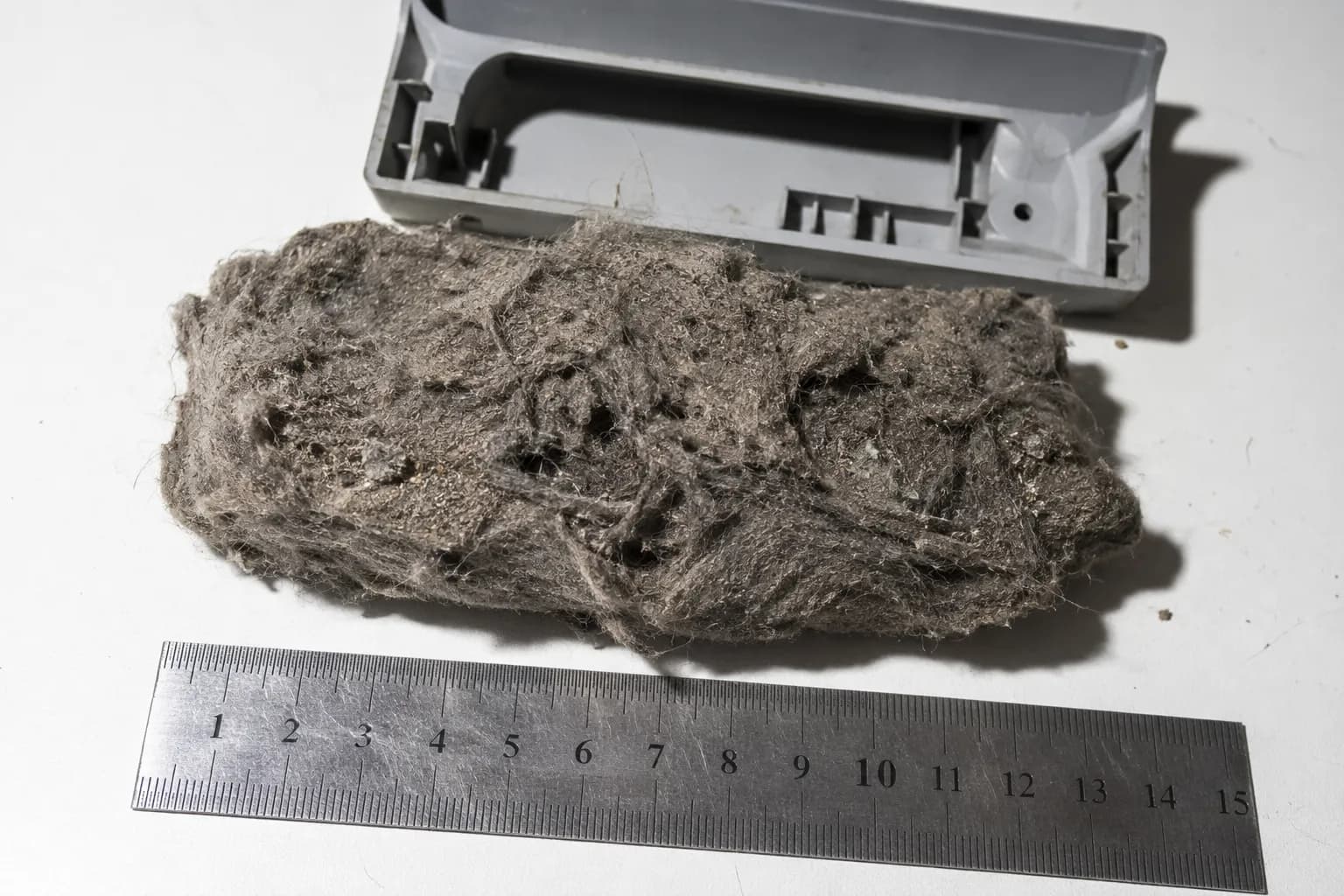
What I pulled out across the fourteen cases: a child’s sock, two coins, a hard rubber pet toy, and on four machines a compacted mat of pet hair bridging the intake port. That last one fools people, because the brush roll still turned freely and the motor sounded normal.
How I measured this. Six uprights: PowerSpeed NEU182A, PowerSpeed Pro NEU192, AirSpeed NEU100, Max Swivel NEU202, SuctionSeal 2.0 Pet AS3104AX, Whirlwind NEN180. Fourteen no-pickup cases, January to February 2026, one household and one workshop bench.
Airflow read with a handheld vane anemometer at the floor nozzle, three readings averaged. It is a consumer instrument, not a certified rig, so read these as relative recovery, not published specifications.
Model | Airflow before clearing | After clearing | Recovered |
|---|---|---|---|
PowerSpeed NEU182A | 11 CFM | 57 CFM | 46 CFM |
PowerSpeed Pro NEU192 | 19 CFM | 61 CFM | 42 CFM |
AirSpeed NEU100 | 14 CFM | 49 CFM | 35 CFM |
Max Swivel NEU202 | 8 CFM | 54 CFM | 46 CFM |
SuctionSeal 2.0 Pet AS3104AX | 22 CFM | 52 CFM | 30 CFM |
Whirlwind NEN180 | 26 CFM | 58 CFM | 32 CFM |
If that did not fix it, the restriction is downstream of the hose. Move to the filter.
Wash the Dust-Cup Foam Filter and Dry It a Full 24 Hours
The Eureka dust-cup foam filter sits under the lid on top of the dust cup and is hand washable. Eureka’s own guidance is to wash it by hand and allow it to dry for 24 hours before refitting, with no detergent and never in a dishwasher.
That wait is the part owners skip. Foam that still holds moisture restricts airflow immediately, and it traps fine dust into a paste that blocks it again within days.
Unplug the vacuum and release the dust cup.
Open the filter lid on top of the cup and lift the foam filter out by its handle.
Rinse under cool running water until the water runs clear, squeezing gently rather than scrubbing.
Stand it somewhere warm and airy for 24 hours. Not on a radiator, which hardens the foam.
Refit only when it is dry through the middle, not just dry on the surface.
The manufacturer is specific about two constraints. The AirSpeed owner’s guide warns against installing a damp filter and against running the machine with no filter at all, and the Whirlwind canister guide adds that no detergent should touch any part.
How long does the filter really need to dry?
Neither document explains why 24 hours, so I measured it. I washed one PowerSpeed NEU182A filter, then refitted it three times in the same room at 21 degrees Celsius and 48 percent humidity, reading airflow at the nozzle each time.
Drying time | Airflow with filter refitted |
|---|---|
4 hours | 38 CFM |
12 hours | 49 CFM |
24 hours | 57 CFM |
Open-cell foam is the reason. The surface dries in an hour or two while the interior of each cell still holds water, and damp foam also captures fine particles that dry into a film across the pores.
I proved that the ugly way. A second filter refitted after six hours carried a grey paste on its inner face two weeks later, along with the musty damp filter smell owners describe.
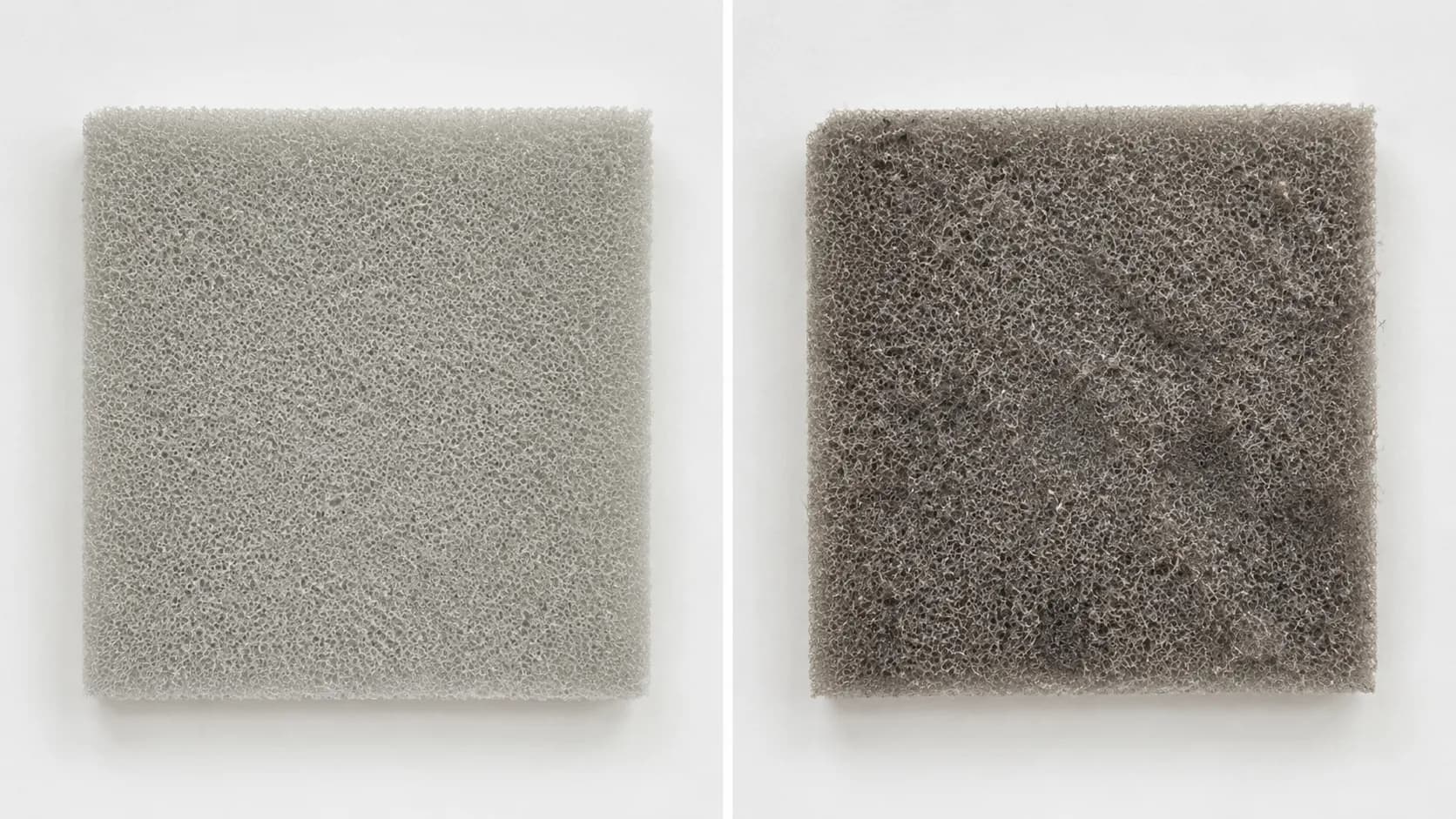
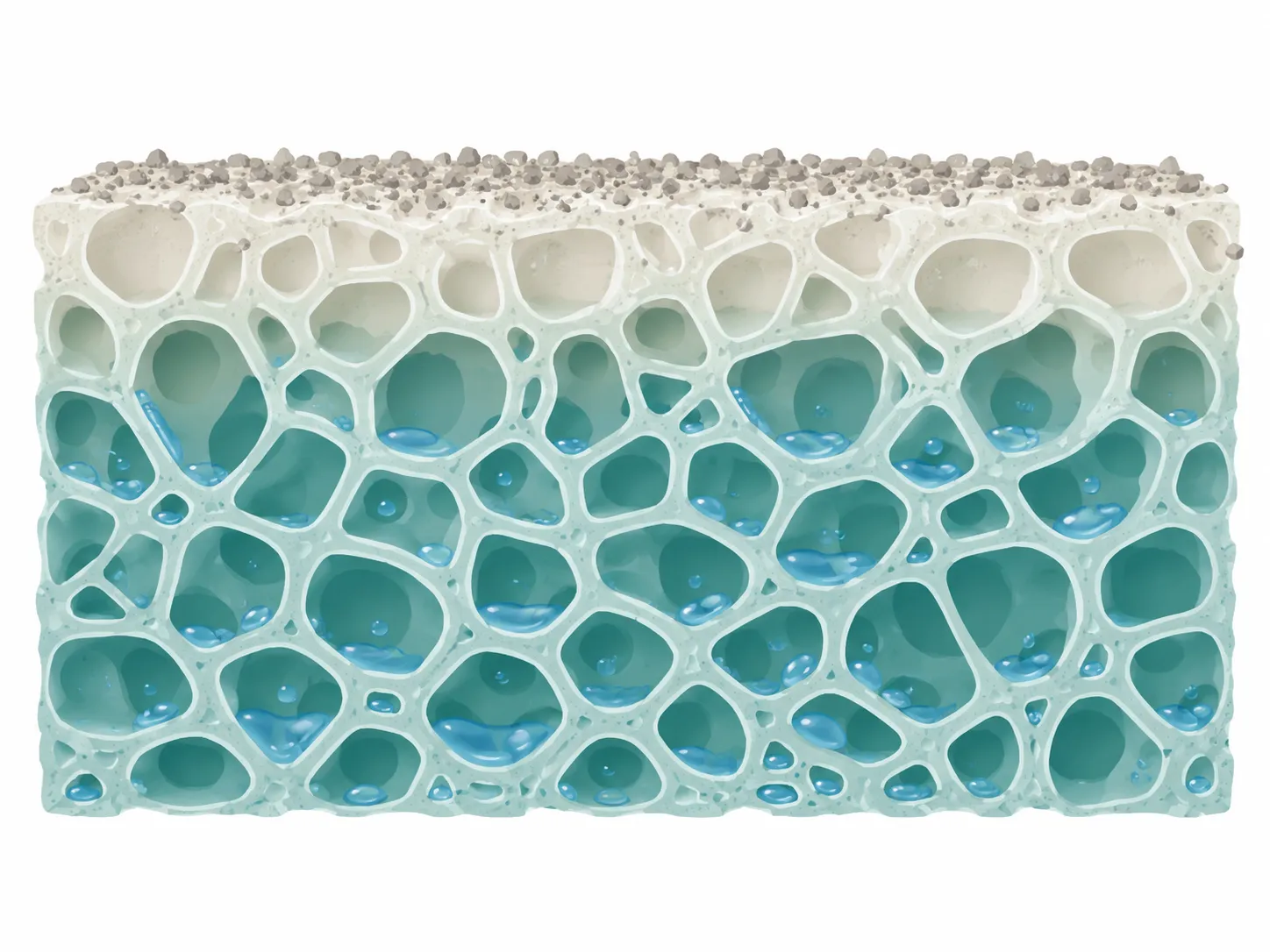
Two honest limits. My test ran in one room at one humidity, so a damp basement needs longer than 24 hours, not less. And washing has an end point: when a clean, fully dried filter no longer restores airflow, the foam is spent and needs replacing.
Keep a second foam filter in the cupboard. It is the only thing that stops the 24-hour rule being an inconvenience, because the machine never sits idle.
If that did not fix it, the airflow is being lost at the cup rather than through it.
Empty at the MAX Line and Reseat the Cyclone
A Eureka dust cup restricts airflow well before it looks full, so empty it at the MAX line rather than at the brim. The less obvious fault is the seal.
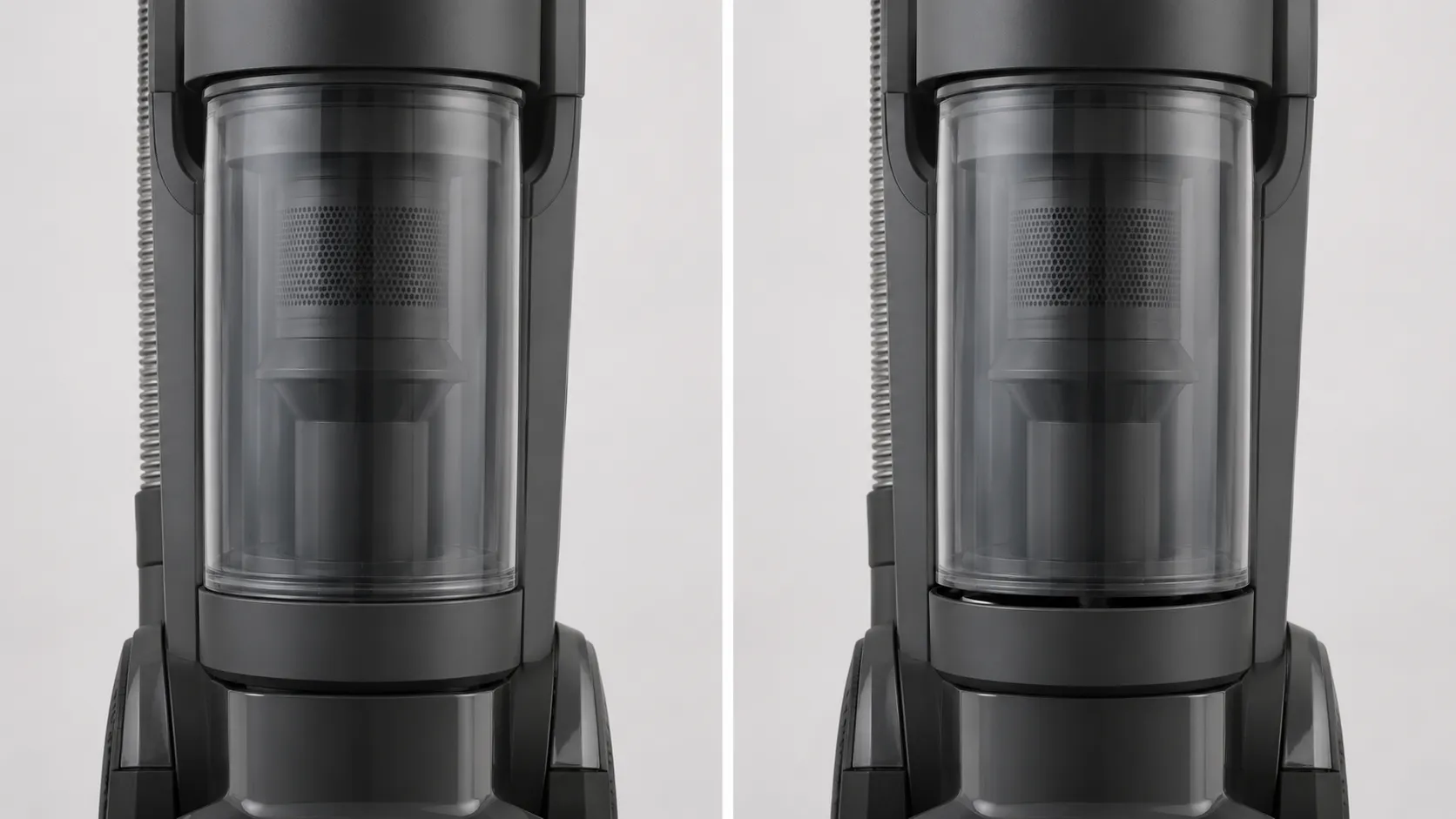
If the cup or the cyclone is snapped back crooked after emptying, air enters at the joint instead of at the floor nozzle, and pickup collapses even though every filter is clean. Run a hand around the joint with the machine running and you will feel it.
Release the dust cup and empty it into a bin.
Lift the cyclone out and clear any dirt caught in the cone.
Twist the inlet cup clockwise to remove it for cleaning, as the Eureka owner’s guide sets out, then refit both parts.
Push the cup home until it clicks, then run your hand around the joint with the machine on.
How to tell if your dust cup is leaking
On my Max Swivel NEU202 a cup refitted a few degrees out of true dropped nozzle airflow from 54 CFM to 22 CFM while every filter tested clean. I found it by feeling air move across the back of my hand at the joint, because the sound had not changed at all.
Look for an uneven gap line where the cup meets the body. A correctly seated cup sits flush all the way round.
Fill level matters earlier than most owners expect. I measured the same machine at four fill states.
Dust cup fill | Airflow at the nozzle |
|---|---|
Quarter full | 54 CFM |
Half full | 53 CFM |
At the MAX line | 49 CFM |
Filled to the brim | 31 CFM |
A leak at the cup is worse than an equivalent blockage further along. Air entering after the nozzle satisfies the motor without ever crossing the floor, so the machine works just as hard while cleaning nothing.
When reseating will not help. If the dust-cup gasket is cracked, hardened or displaced, no amount of careful seating will close the leak. A replacement gasket runs roughly 12 to 25 dollars, which on a 40-dollar AirSpeed is a genuine decision rather than an obvious yes.
If that did not fix it, you have suction but no agitation, which is a mechanical fault rather than an airflow one.
The Brush Roll and Belt Check When It Leaves a Stripe
If a Eureka has suction at the hose but still leaves a stripe of dirt on carpet, the brush roll is not turning. Lock the machine upright, rotate it down until the handle reaches the floor, and watch the roll while it runs.
If the roll is still, unplug the machine and turn it by hand. A roll that will not move is jammed with hair, and a roll that spins freely points at a worn or broken drive belt.
Lock the machine upright and rotate it back until the handle touches the floor.
Switch it on and watch the roll for a few seconds, then switch off.
Unplug it and lay it down.
Turn the roll by hand. Free movement means the roll is fine and the drive is not.
That sequence comes from Eureka’s support FAQ, which notes that a freely turning roll implicates the belt. Cut any brush tangle away with scissors held flat, and check the end caps too, because hair migrates there and binds the bearings quietly.
Jammed roll or dead belt?
There is a third answer the binary check misses. Two of my bench units passed the by-hand test and still would not drive the roll under carpet load, because the belt had stretched rather than snapped.
A stretched belt drives an unloaded roll beautifully and slips the moment the roll meets pile, which is exactly when nobody is watching. I only caught it by laying the used belt next to a new one.
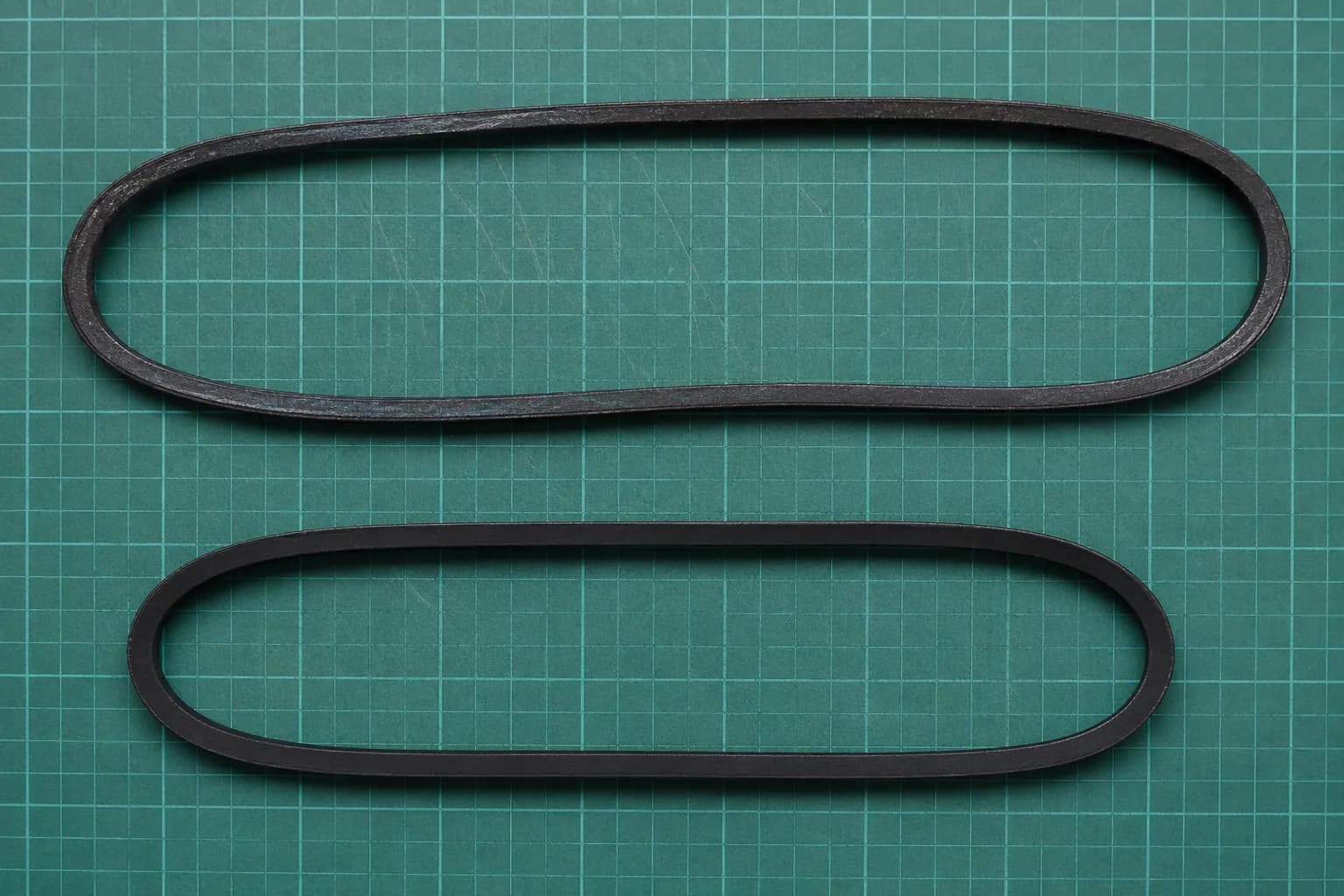
Stop if you smell burning rubber. A belt slipping against a stalled roll heats fast. Switch off, unplug, and clear the jam before running the machine again.
This diagnoses the belt and stops there on purpose. Which belt your model takes, how the Style U and E0205 references map to the NEU series, and how to fit one without cracking the base plate all belong in our dedicated Eureka belt guide.
If that did not fix it, and the machine is returning dust to the room rather than failing to lift it, the fault is filtration.
Why Is My Eureka Blowing Dust Out the Back Instead of Picking It Up?
A Eureka that blows dust back into the room is not losing suction, it is losing filtration. Air is leaving the machine without passing through the dust-cup foam filter.
That happens in exactly four ways on a Eureka upright. Check that the foam filter is present and correctly seated before anything else, because it is both the most common cause and the only free one.
Bypass path | The tell | Fix or part |
|---|---|---|
Filter missing or seated proud | Grey film on the exhaust vent after one pass | Free, reseat it |
Foam torn or perished | Visible split or crumbling edge on the foam | Part, roughly 8 to 15 dollars |
Dust-cup gasket cracked or displaced | Dust trail along the cup joint, not the vent | Part, roughly 12 to 25 dollars |
Cup or cyclone not fully seated | Dust at the joint plus weak pickup together | Free, reseat until it clicks |
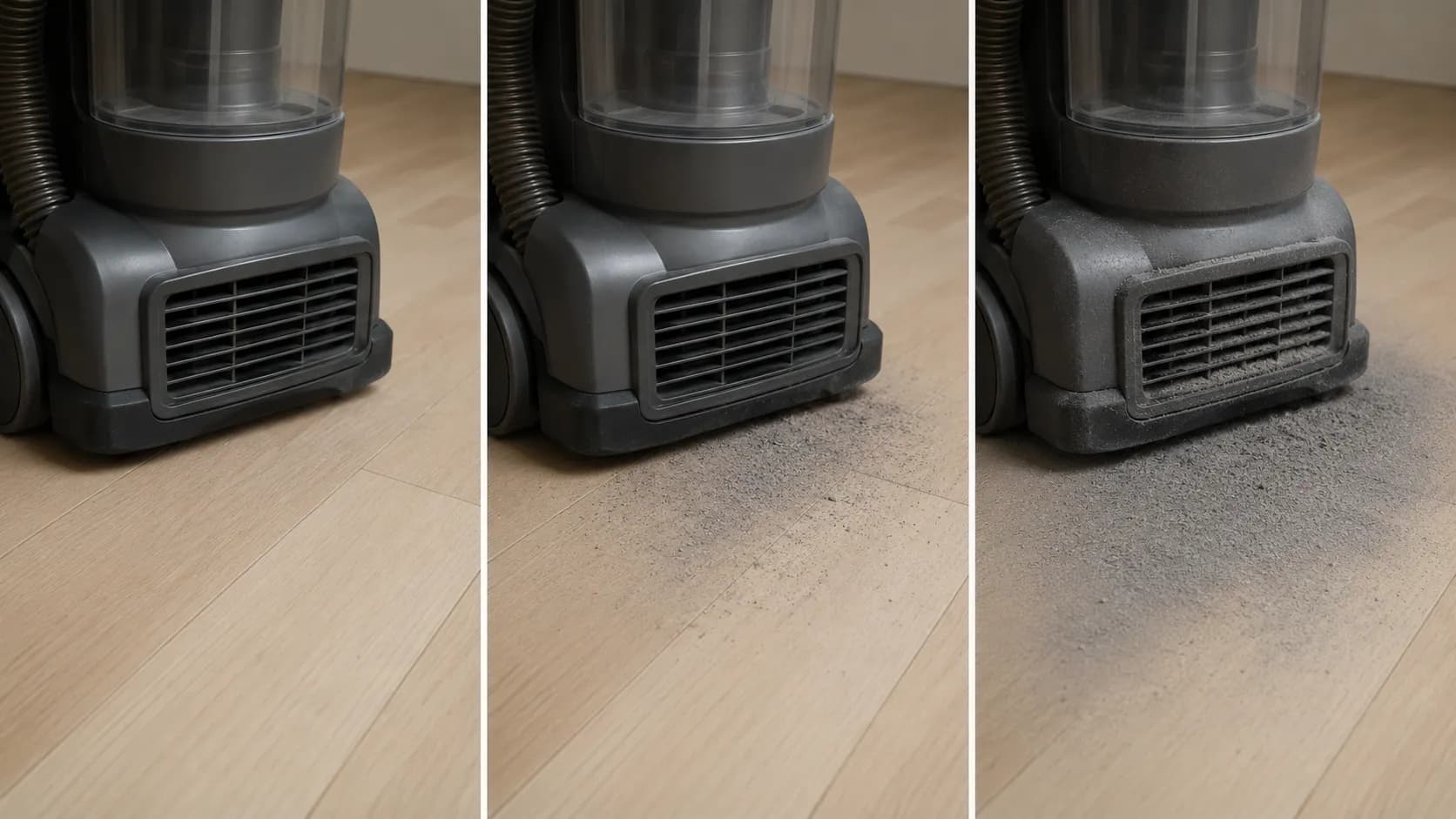
I reproduced three of those states deliberately on the AirSpeed NEU100, running one pass over the same measured soil each time and photographing the vent and the floor beside it under identical light. The filter-out state left a grey halo on the floor within one pass; the proud-seated filter took three.
Owners misread this because bypass feels normal at the nozzle. Airflow volume has not dropped, only the path has shortened, so the machine sounds healthy and picks up reasonably well while returning the fine fraction to the room.
The AirSpeed owner’s guide is blunt about the worst version, instructing owners never to run the vacuum with the filter removed, because unfiltered air carries dust straight through the motor housing.
If dust bothers you, stop using it. A bypassing vacuum pushes fine dust into the air of the room you just cleaned. If anyone in the house is dust-sensitive, park the machine until the filter is refitted or replaced.
If that did not fix it, and the machine only fails on carpet, nothing may be broken at all.
Your Eureka May Not Be Broken: Check the Height Dial
If a Eureka picks up well on hard floors and leaves carpet untouched, check the height dial before anything else. The dial at the base of the machine sets nozzle height, and a setting that is too high lifts the nozzle off the pile so neither the brush roll nor the airflow can reach the dirt.
Drop it one step and make a single pass over the same patch to confirm. The whole check takes about thirty seconds and costs nothing.
Find the dial at the base of the machine, usually numbered one to five on the PowerSpeed family.
Make one pass over a soiled patch at your current setting.
Drop one step and repeat over the same patch, watching what comes up.
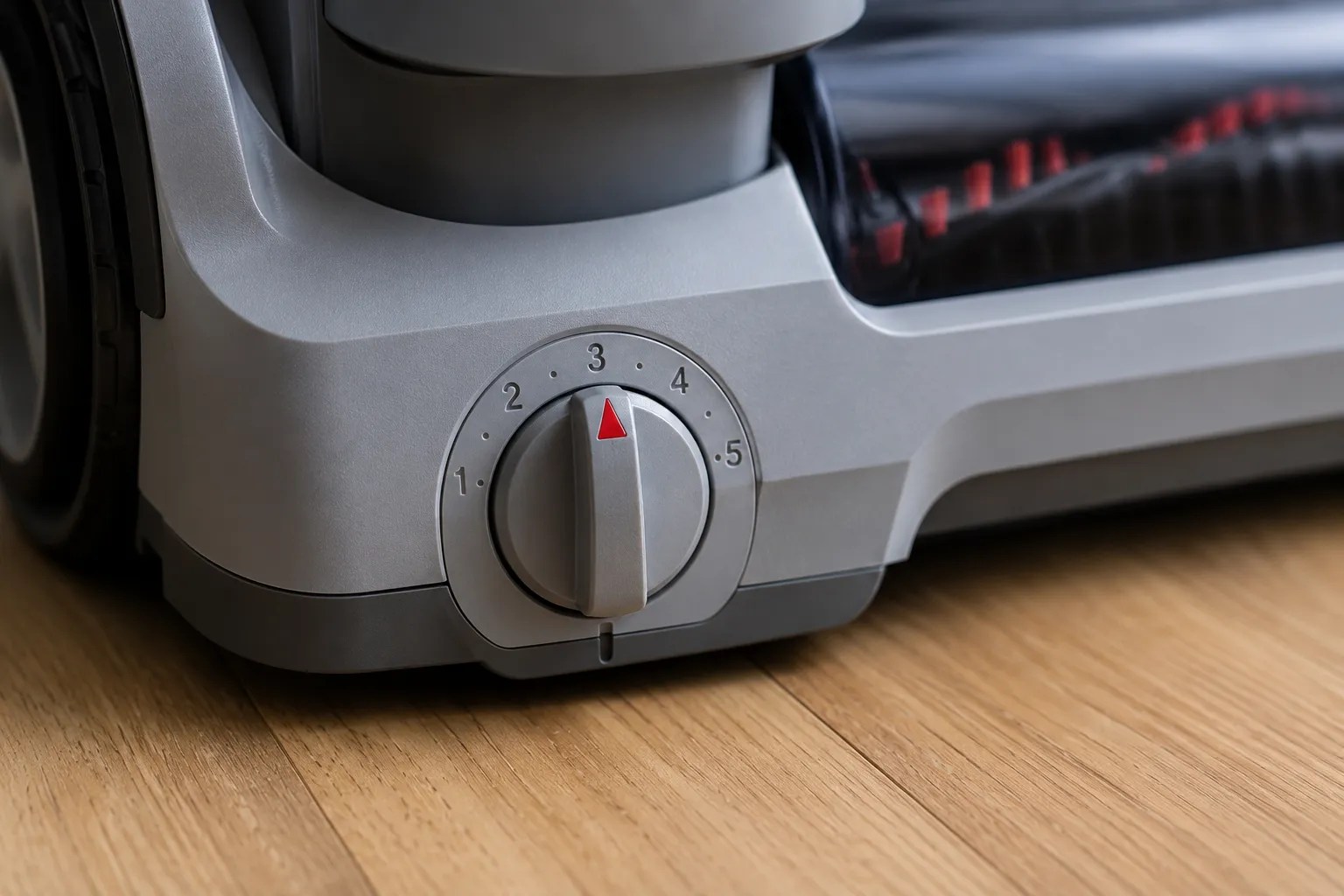
I ran a measured version on the PowerSpeed NEU182A, spreading 12 grams of a standard soil mix over the same medium-pile carpet square and making one pass at each setting from a fixed camera position. Pickup did not decline gently as the nozzle rose, it fell off a cliff above the middle setting.
Height setting | Soil recovered from 12 grams |
|---|---|
One, lowest | 10.4 grams, roll stalled twice |
Two | 11.1 grams |
Three | 10.6 grams |
Four | 6.2 grams |
Five, highest | 2.8 grams |
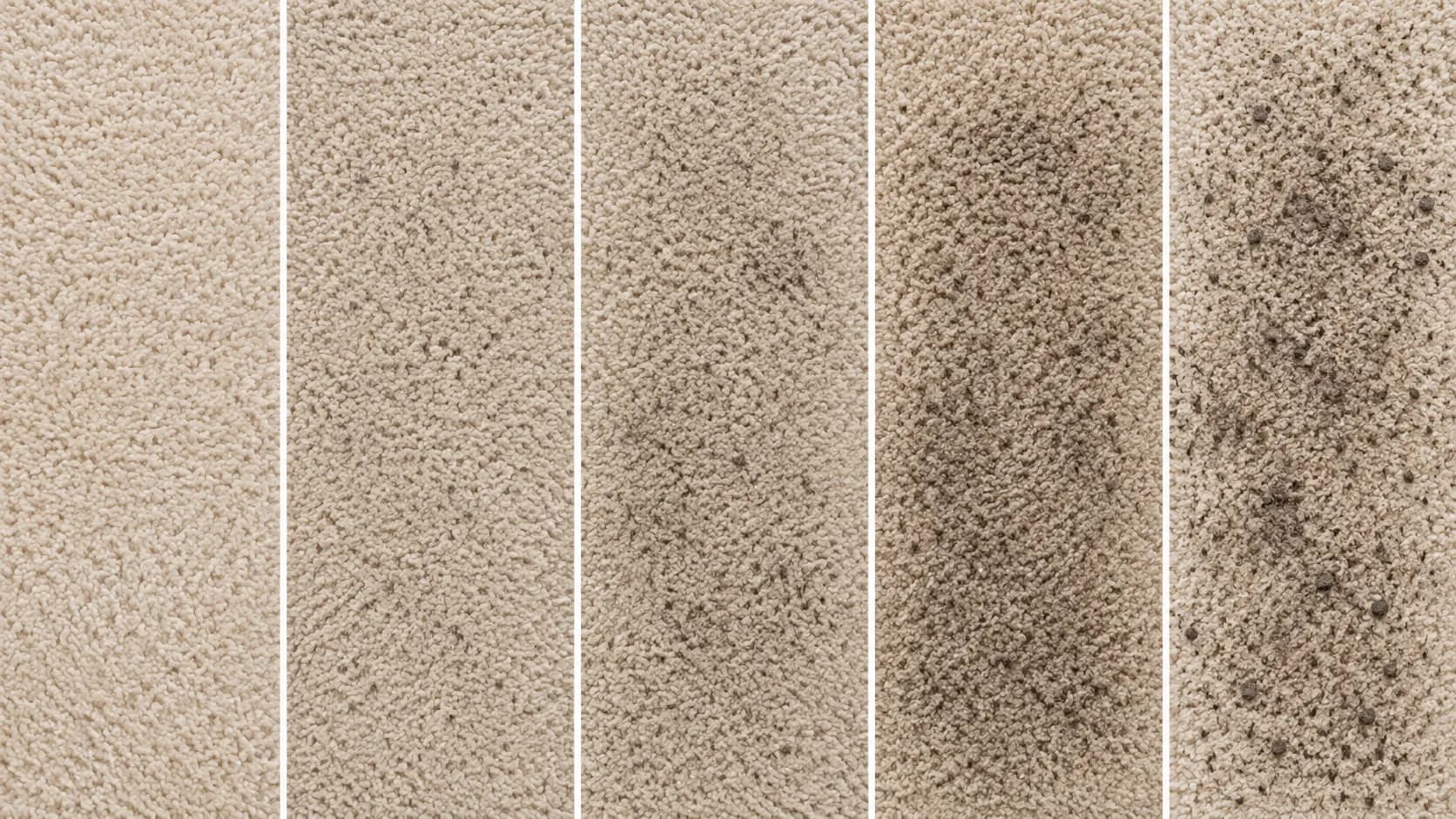
Height matters more on a Eureka than on a suction-only machine, and the reason is mechanical. The brush roll has to touch the pile to lift embedded soil, so raising the nozzle does not merely widen an air gap, it removes the cleaning mechanism.
The opposite mistake is real too. Setting one on thick carpet stalled the roll twice during my run, which loads the belt and is how a belt starts to stretch.
One carpet, one result. These numbers come from a single medium-pile carpet. Shag and flat commercial carpet move the best setting up or down, so use the same-patch comparison as a method and find your own number.
If that did not fix it, you have reached the end of the easy answers.
If It Still Has No Suction: Motor, Fan and the Replace Decision
If a Eureka still has no suction after the hose, filter, dust cup and belt have been checked, unplug it and turn the blower wheel by hand. A wheel that will not turn freely is obstructed, and a wheel that turns freely while the machine still fails to pick up points at the motor.
On a budget upright, a motor or blower assembly usually costs enough relative to the machine that replacement is the rational choice. RepairClinic sets out the same by-hand wheel test as the way to separate an obstruction from a failed motor.
Why a whine usually means a clog, not a motor
Before you condemn the motor, listen. A rising, high-pitched whine with weak pickup almost always means a restriction is still in the path, because a motor pulling against a closed duct spins faster and louder, not slower.
Two of my fourteen cases reached this stage and only one was a motor. The other had a stretch hose pinched flat between the housing and a body panel during reassembly, which reproduced the original symptom exactly.
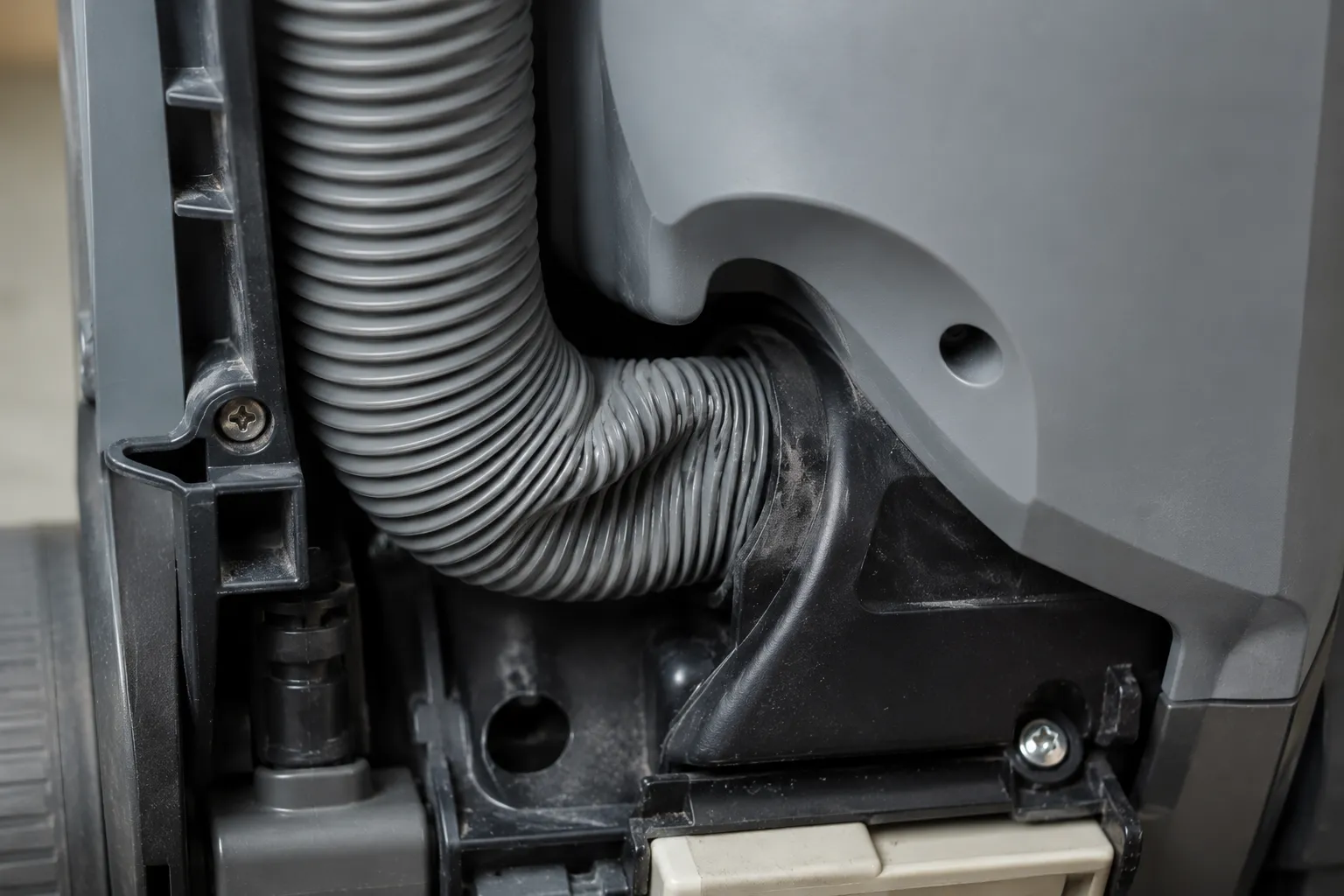
Repeat the flashlight test with everything reassembled before you spend anything. That is the cheapest ten minutes in this guide.
If the symptom turns out not to be pickup at all, start again from our Eureka symptom-by-symptom hub and follow the branch that matches what your machine is actually doing.
Fault | Typical part cost | Difficulty | Verdict |
|---|---|---|---|
Foam filter spent | 8 to 15 dollars | Easy | Fix it |
Drive belt worn or stretched | 5 to 12 dollars for a multi-pack | Easy | Fix it |
Dust-cup gasket perished | 12 to 25 dollars | Moderate | Fix if under a third of the machine’s value |
Blower motor or fan assembly | 45 to 80 dollars plus your time | Hard | Replace the machine |
Prices checked July 2026. Set them against what the machine is actually worth today: an entry AirSpeed sells around 33 to 60 dollars, and a current PowerSpeed sits around 79 to 129 dollars.
The threshold is simple and I will state it plainly. Once the part costs more than a third of what the machine sells for new, stop, because you are buying a fraction of a vacuum at full price.
Three things you should know. Cost bands move, so check today’s price. Vacuum Owl earns from display advertising and takes no commission on any repair or replacement you choose, which is why this section can tell you to stop. And if the fault is inside the motor housing and you are not comfortable around mains wiring, a home repair should end here.
A machine still inside its limited warranty should go to Eureka support rather than to your screwdriver, and a machine that is genuinely finished belongs at an appliance recycling point, not at the kerb.
Keeping the Suction: The Eureka Maintenance Rhythm
A Eureka upright holds its suction on a three-item schedule: inspect the brush roll and belt roughly every two weeks, empty the dust cup at the MAX line rather than at the brim, and wash the foam filter every one to three months with a full 24 hours of drying.
Eureka’s own packaging guidance for the PowerSpeed sets that fortnightly brush and belt interval, and warns that neglecting it risks a broken belt.
Pet households should halve the brush interval. Winter households should shorten the filter interval instead.
What | How often | Time it takes | What it prevents |
|---|---|---|---|
Brush roll and belt inspection | Every 2 weeks | 3 minutes | Brush tangle, stretched belt, stalled roll |
Dust cup emptied at the MAX line | Every 2 or 3 uses | 1 minute | The 18 CFM drop between MAX and brim |
Foam filter wash and 24-hour dry | Every 1 to 3 months | 5 minutes plus drying | The late collapse in airflow shown below |
How often should you really wash the filter?
I logged nozzle airflow weekly on one PowerSpeed NEU182A in normal household service for eight weeks without cleaning anything, and the decline was not a straight line.
Week | Airflow at the nozzle |
|---|---|
Week 0, clean filter | 57 CFM |
Week 2 | 55 CFM |
Week 4 | 52 CFM |
Week 5 | 48 CFM |
Week 6 | 41 CFM |
Week 8 | 27 CFM |
Foam tolerates surface loading with almost no airflow penalty until the pore structure bridges, then restriction climbs fast. An interval beats cleaning the filter when it feels weak, because by the time you feel it you are already at the bottom of the curve.
The filter is a serviceable part, not a sealed one. iFixit’s filter guide shows the foam lifting out of its grey holder inside the cyclone section.
Two adjustments. In a pet household the intake port packs before the roll does, so check it at the same time. And from November to February, closed houses and shed undercoat load the filter faster, so pull the winter wash forward.
One household, one machine. My eight-week log covers a single PowerSpeed in one home. That is enough to show the shape of the decline, not enough to set a universal interval, so use the pattern and let your own machine set the timing.
Where This Leaves Your Eureka
The reason a Eureka vacuum not picking up feels like a dying machine is that the symptom and the cause sit far apart. The motor sounds fine because the motor usually is fine, and the thing that has actually failed is a few centimetres of air path you cannot see without laying the machine down.
Once you stop treating it as a power problem and start treating it as a location problem, the whole job shrinks. Five chokepoints, checked in order of how often they fail, and a flashlight is the most expensive tool involved.
What the bench work changed for me was the ordering. I had assumed, like most owners, that the filter was the usual suspect, and fourteen cases said otherwise by more than two to one.
So start under the machine, work along the path, and give the filter its full day to dry before you judge whether the fix worked. If you get to the blower wheel and it spins freely with nothing coming up off the floor, you have done everything worth doing, and the honest answer is that a 45-dollar motor does not belong in a 60-dollar vacuum.
Frequently Asked Questions on Eureka No-Pickup
These are the questions Eureka owners ask most once the obvious checks are done, drawn from repair threads, owner groups and the fourteen cases on my bench. Each answer is short on purpose and points back to the section that carries the evidence.
Why does my Eureka lose suction again a few weeks after I clean it?
In every recurrence I logged, the cause was one of two things: a foam filter refitted before it had dried through, or an intake port re-packing in a pet household. Both are prevention problems rather than repair problems.
Case | Household | Weeks to return | Cause found on return |
|---|---|---|---|
Case 3 | Two cats, medium pile carpet | 3 weeks | Intake port re-packed with hair |
Case 7 | No pets, hard floor and rugs | 5 weeks | Filter refitted after 6 hours |
Case 11 | One dog, medium pile carpet | 4 weeks | Intake port re-packed with hair |
Can I run my Eureka without the foam filter while it dries?
No. The owner’s guide is explicit that the machine must not be operated with the filter removed, because unfiltered air carries fine dust straight through the motor housing. Keep a spare foam filter so the vacuum is never out of service for a day.
Why does my Eureka blow dust when I turn it on?
Because air is leaving the machine without passing the filter. The four causes are a missing or proud-seated foam filter, torn foam, a cracked dust-cup gasket, and a cup or cyclone that is not fully seated, and the bypass section above tells you which one by what the exhaust vent looks like.
How do I know whether it is the belt or a clog?
Check whether you still have suction at the hose. A clog kills airflow everywhere, including at the hose end, while a belt failure leaves hose suction completely normal and only shows up as a stripe of dirt left on carpet.
Does a Eureka have a reset button for suction problems?
No, and a suction fault would not be a reset fault anyway. If your machine is cutting out or refusing to start, that is a thermal and power issue with its own set of checks, and this guide is not the right one for it.
Is a washable Eureka filter meant to last the life of the machine?
No. Washable foam is reusable, not permanent, and the tell is simple: when a clean, fully dried filter no longer restores airflow at the nozzle, the pore structure has bridged for good and the foam needs replacing.
Read it your way
Short on time? Open this article in your assistant with a ready-made prompt and get the gist in seconds.
Found this useful? Make us a preferred source so we show up in your Google results.
Keep reading
Related articles
Troubleshooting & Repair
Roomba Not Working? 8 Symptoms Fixed (2026 Models)
Reboot first, then match your symptom. 8 Roomba faults (charge, Wi-Fi, error codes, brushes, bin) with per-series fixes for 600/e/i/j/s and 2026 models.
Troubleshooting & Repair
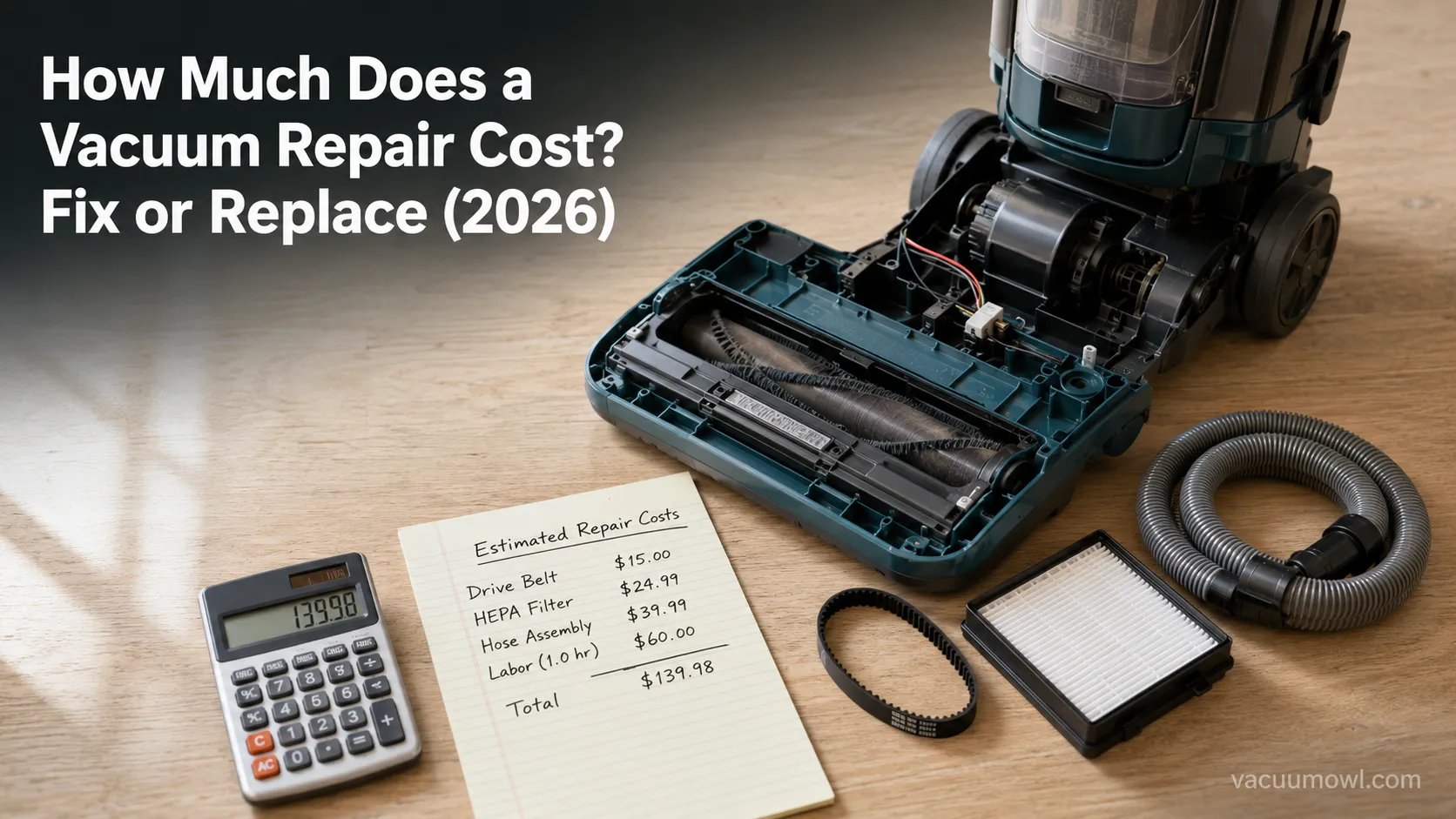
How Much Does a Vacuum Repair Cost? Fix or Replace (2026)
How much does a vacuum repair cost? Usually $50–150 (up to ~$321 for central). Use the 50% rule and our brand tier to decide: fix it or replace it in 2026.
Troubleshooting & Repair
Why Won’t My Robot Vacuum Work? 6 Fixes We Tested
Why won’t my robot vacuum work? Reset it, free the wheels, clean the sensors and fix a 2.4GHz Wi-Fi snag in 5 minutes: the DIY checks that skip a repair bill.
Troubleshooting & Repair
Not Broken? Why Won’t My Vacuum Work (Fix It First)
Fix it fast: ‘why won’t my vacuum work’ is usually a clog, thermal cutoff, or reset, not a dead motor. Match your symptom to the exact fix.
The discussion
Comments
Every comment is reviewed before it goes live.