Hoover Vacuum Belt Replacement: Check the Pedal (2026)
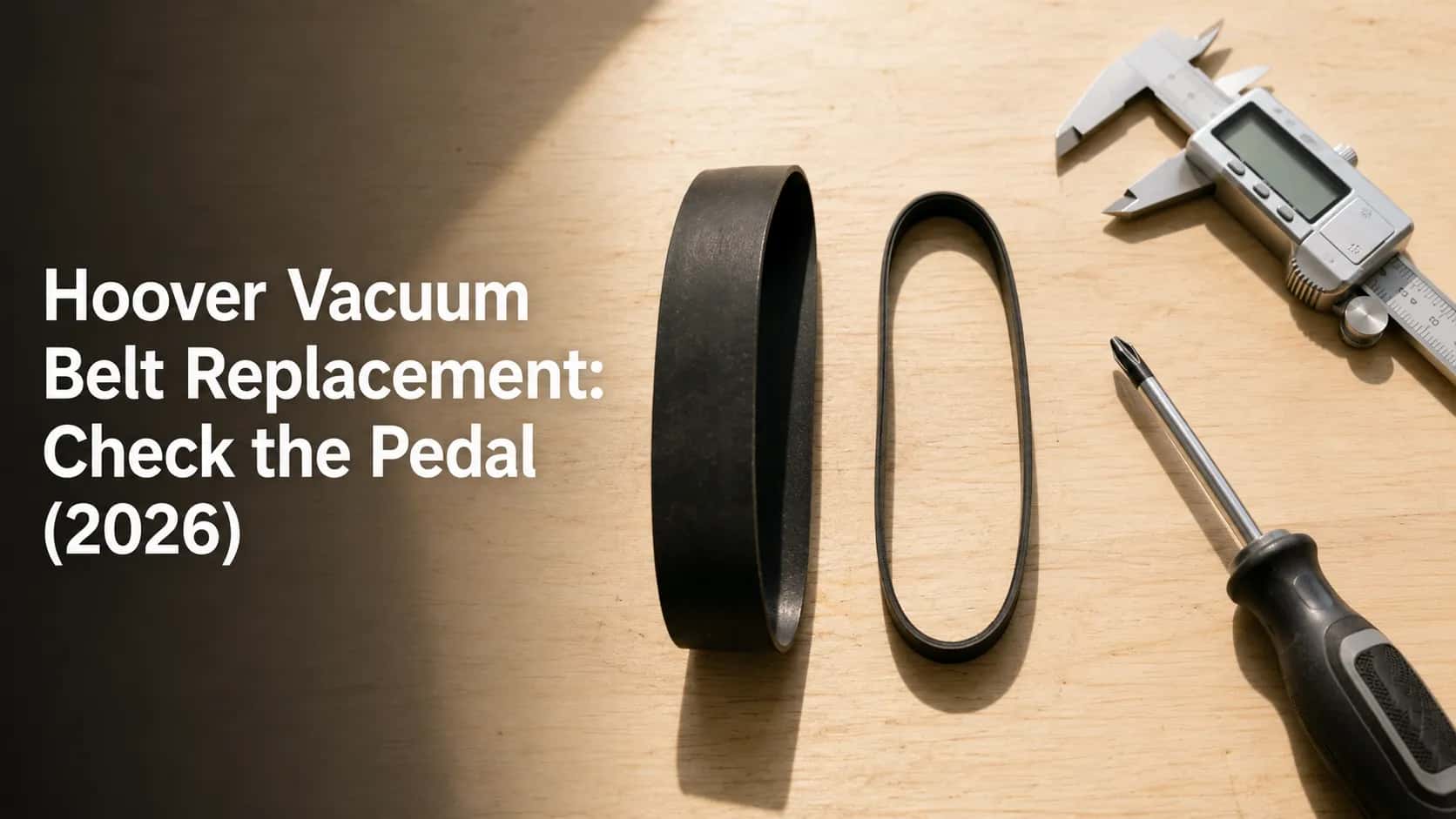
Check the brushroll on/off pedal: pedal = flat AH20065, no pedal = stretch AH20080. Hoover belt decoder, 15-minute swap steps, and why belts keep breaking.
Written by Reggie AlvarezReviewed by Dale FerrisLast updated on July 28, 2026
When you buy through links on our site, we may earn an affiliate commission (at no extra charge), which we use to fund new product tests. Learn more.
Read it your way
Short on time? Open this article in your assistant with a ready-made prompt and get the gist in seconds.
Found this useful? Make us a preferred source so we show up in your Google results.
Which Hoover Belt Do You Need? Start Here
The 20-second answer. Hoover vacuum belt replacement starts with a pedal, not a model number. Hoover upright vacuums take one of two brushroll belts.
If the nozzle has a Brushroll On/Off pedal, which Hoover labels Suction Only Mode, Hoover specifies the flat non-stretch belt, part AH20065 (also numbered 562289001).
If there is no such pedal, Hoover specifies the stretch belt, part AH20080 (also 38528058 and 562932001). Self-propelled, geared and cordless machines are separate branches.
That rule is not my invention. It is printed in the Hoover owner’s manual, in a single sentence most owners never read, because the booklet went into the recycling a decade ago.
What it is not printed on is Hoover’s own store. The product page for the stretch belt describes it, in full, as a replacement belt for select Hoover bagless uprights.
The flat belt page carries no model list either. The top result on this search sells the part without telling you whether it fits.
Scope, up front. The pedal rule covers corded Hoover uprights.
Cordless ONEPWR and MPWR machines, and the geared PowerDrive uprights, use toothed belts sold by model and sit outside the Style-number system. The decoder below covers them.
You are in the right place if the brushroll has stopped turning, suction still feels normal, and there is a faint smell of hot rubber. Budget fifteen minutes and one Phillips number two screwdriver.
The 10-Second Pedal Test: Look at Your Vacuum, Not Your Model Number
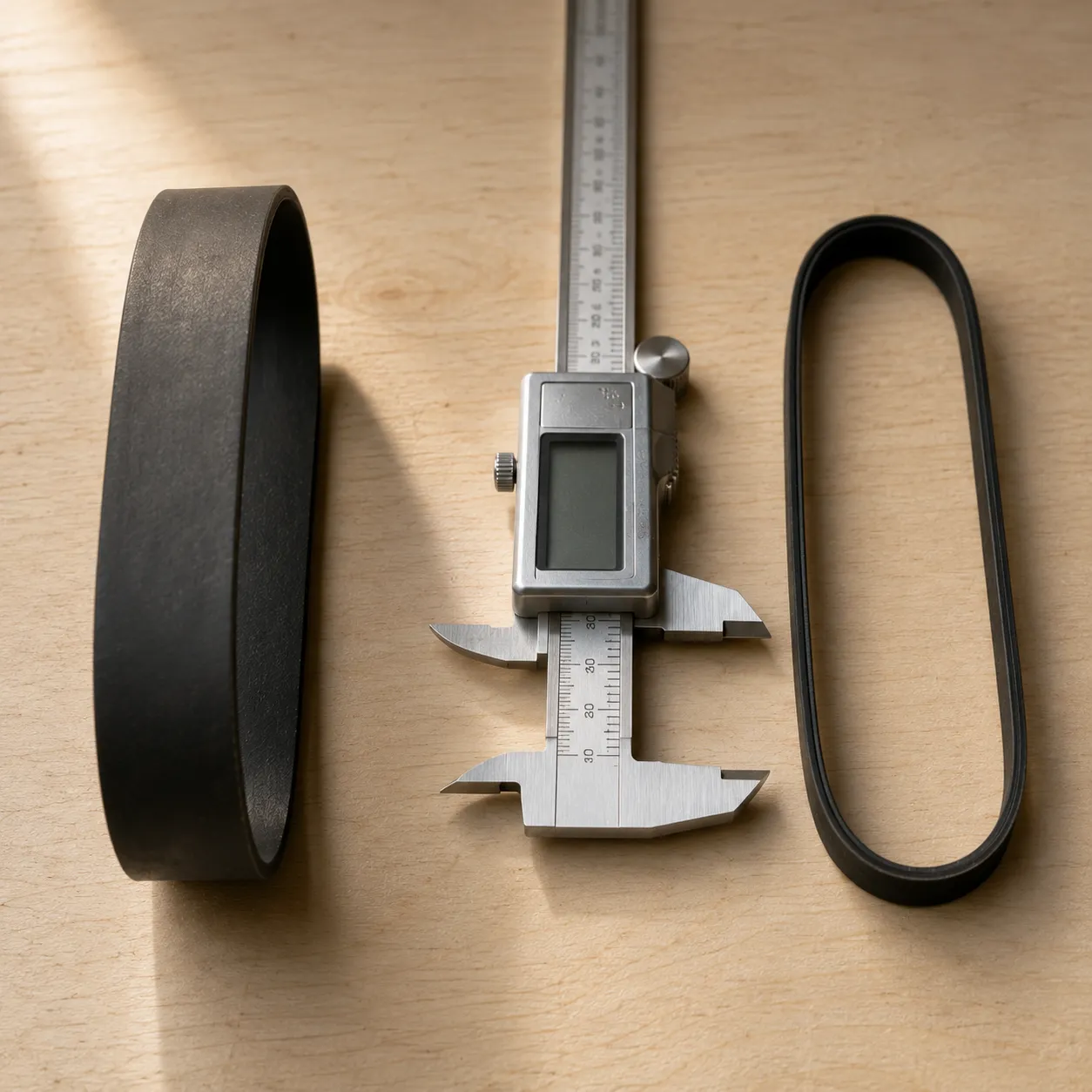
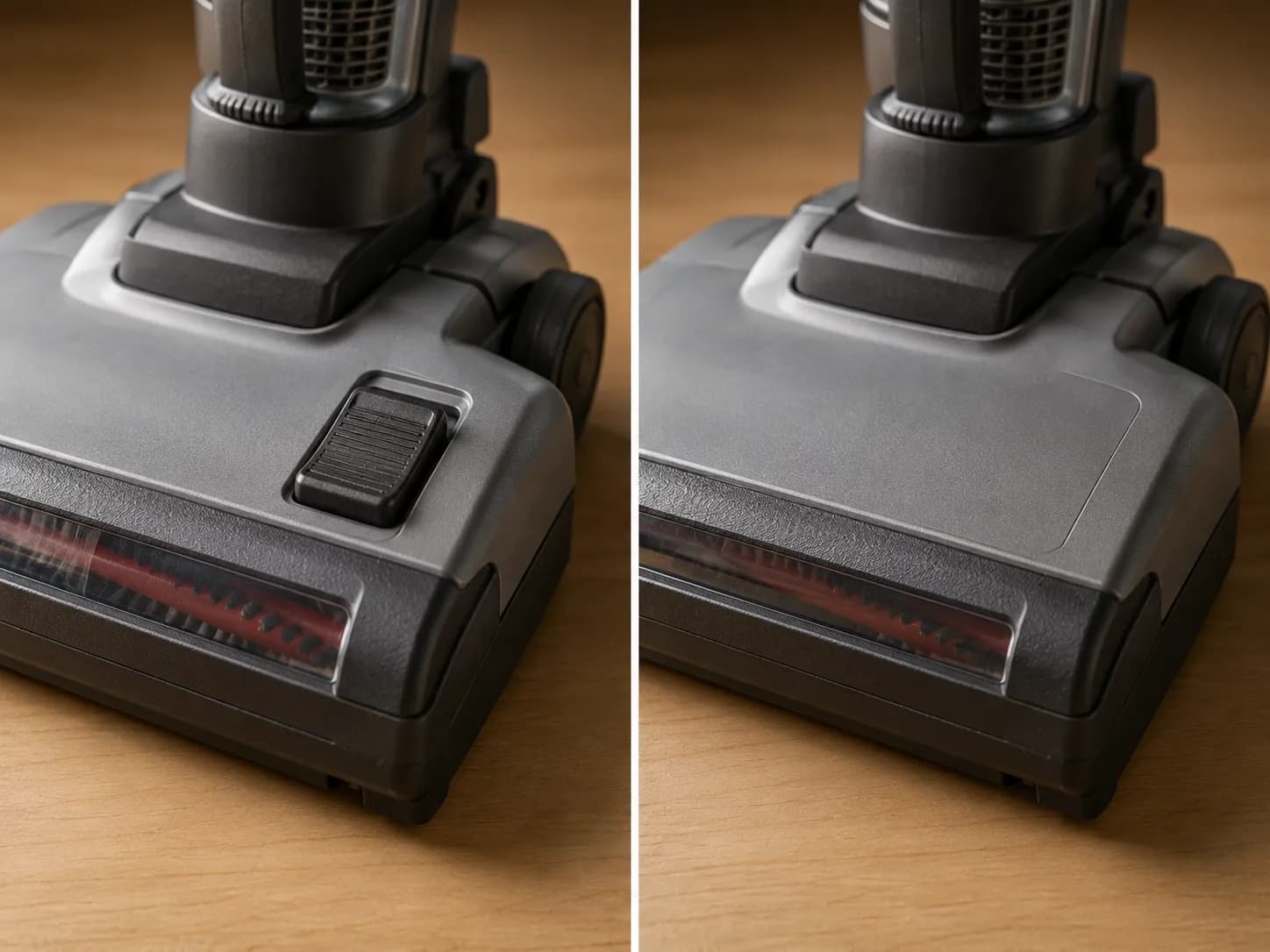
To identify the correct Hoover vacuum belt, ignore the model number and look at the top of the nozzle. If your Hoover upright has a Brushroll On/Off pedal, the one Hoover labels Suction Only Mode, the manual specifies the flat non-stretch belt AH20065 (562289001, printed MS 12.8x457 on the belt itself).
If there is no pedal, the manual specifies the stretch belt AH20080 (38528058). The pedal is not a convenience feature: it is the fitment key.
Run it now.
Look at the top face of the nozzle, the part that rides on the carpet. You want a small foot pedal, separate from the height dial and the handle-release pedal.
Pedal there? Flat non-stretch belt: AH20065 / 562289001.
No pedal? Stretch belt: AH20080 / 38528058 / 562932001.
I ran that test on all six machines on my bench before opening a single one, and it called the belt type correctly six times out of six. That includes the UH71250, where two of the three retail listings I had bought from disagreed with it.
Why does Hoover ship two different belts at all?
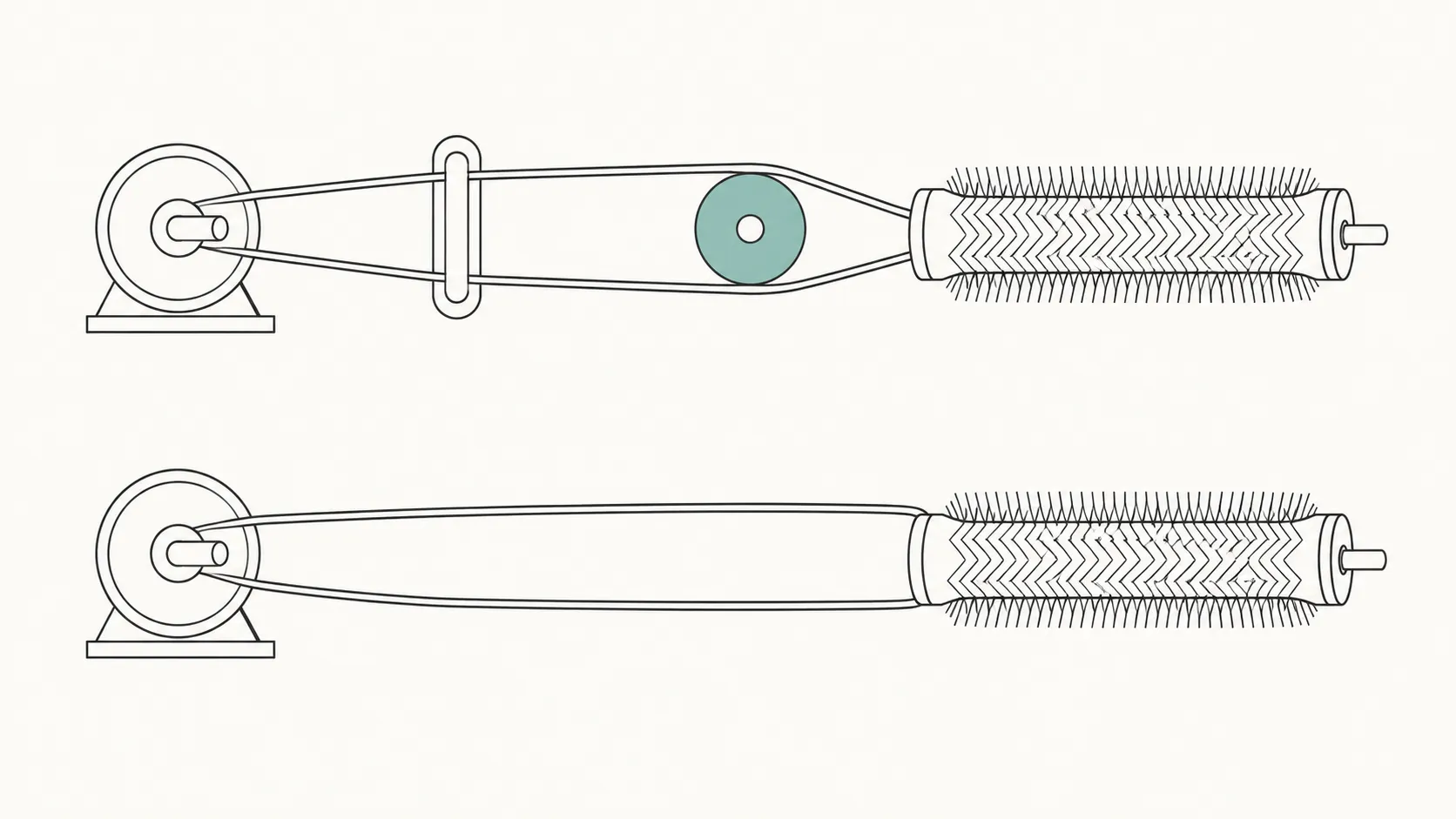
Because they run on two different mechanisms, and the manual gives it away in one parenthetical. On machines with Suction Only Mode, the belt threads through a belt guide and over a metal pulley before it reaches the brushroll.
On machines without the pedal, that pulley does not exist. The belt runs straight from motor shaft to roller and holds itself on by stretching.
So one belt is a pulley belt, which is why it does not need to stretch and is nylon-reinforced so that it cannot. The other is a tension belt, and stretching is its job.
What the pedal test does not tell you. It resolves belt type, stretch versus non-stretch.
It will not tell a legacy WindTunnel apart from a current one, and it does not apply to self-propelled, geared or cordless machines. For those, use the decoder.
The Hoover Belt Decoder: Every Style, Every Part Number, What It Fits
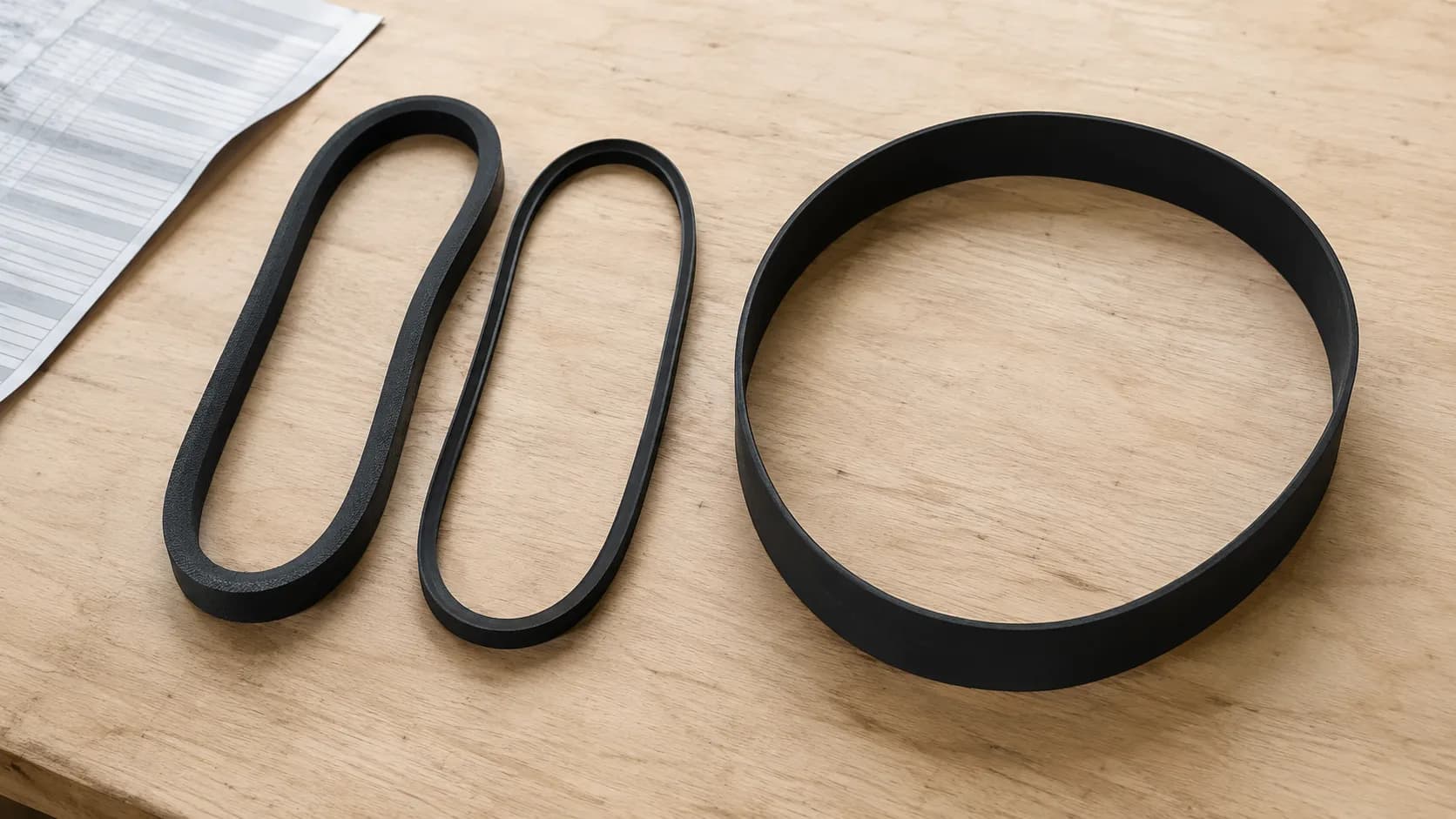
Hoover uses four belt systems across its upright range. Current bagless uprights take either the flat non-stretch AH20065 or the stretch AH20080, decided by the pedal.
Legacy WindTunnel and Tempo uprights take the Style 160 belt, 38528033, packaged as 40201160, and self-propelled WindTunnels take a two-belt set. Geared PowerDrive uprights and cordless ONEPWR machines use model-specific toothed belts that sit outside the Style-number system entirely.
Belt | Hoover part numbers | Type | Fits | The tell-tale on your machine |
|---|---|---|---|---|
Style 65 flat |
| Flat, nylon-reinforced, will not stretch. Printed | WindTunnel T-Series, 2, 3 and Max; Whole House Rewind and Rewind Pet (UH71250, UH71255, UH71215, UH71230); Complete Performance | Pedal present, metal pulley in the belt path |
Style 80 stretch |
| Flat, elastic, holds on by tension | Elite Rewind Plus (UH71200, UH71012, UH71009); WindTunnel XL Pet (UH71100, UH71105, UH71107); PowerDrive Swivel XL, Elite Swivel XL Pet, High-Performance Swivel (UH75110, UH75120, UH75200) | No pedal, no pulley |
Style 160 legacy flat |
| Flat, about 5.9 in outside diameter | Older WindTunnel and Tempo uprights, non self-propelled only (U5453-900, UH40020, UH30015) | Pre T-Series body, no self-propel trigger |
Self-propelled set |
| Two belts: a brushroll belt and a transmission drive belt | Self-propelled WindTunnel, Anniversary WindTunnel, Mach Cyclonic | The vacuum pulls itself when you squeeze the handle |
Geared PowerDrive |
| Toothed, will not stretch | UH74200, UH74205, UH74210, UH74215 | Visible cogs on the belt’s inner face |
Cordless ONEPWR and MPWR | No Style number, sold per model | Geared, model-specific | BH55500, CH95519, BH53310 powered nozzle | Battery powered, so the Style system does not apply |
Every row was checked against Hoover’s own SKU pages or Hoover’s support library, never against a retail listing. The two-belt self-propelled set is confirmed on Hoover’s PowerDrive belt page.
The geared UH742xx belt has its own Hoover page. The Style 160 diameter comes from the OEM belt specification printed on the pack.
How to read a Hoover part number
The same belt legitimately carries three or four different numbers, which is not a counterfeit signal. It is the single biggest reason buyers panic when the pack does not match the listing.
AH2xxxxis the current consumer retail SKU, the number on the hanging pack.562xxxxxxis the current engineering part number.38528-0xxis the legacy engineering number, still printed on plenty of live stock.4020xxxxis the multi-pack package number, not the belt.
One code catches Americans out completely. If your search surfaced a hoover vacuum belt YMH29694, you have landed on a European part, Hoover reference V29, used on UK Smart, Whirlwind and Hurricane machines and on Tesco-branded vacuums.
US Hoover is a different company from the European one, and none of the codes above cross over. A YMH29694 belt will not fit a WindTunnel.
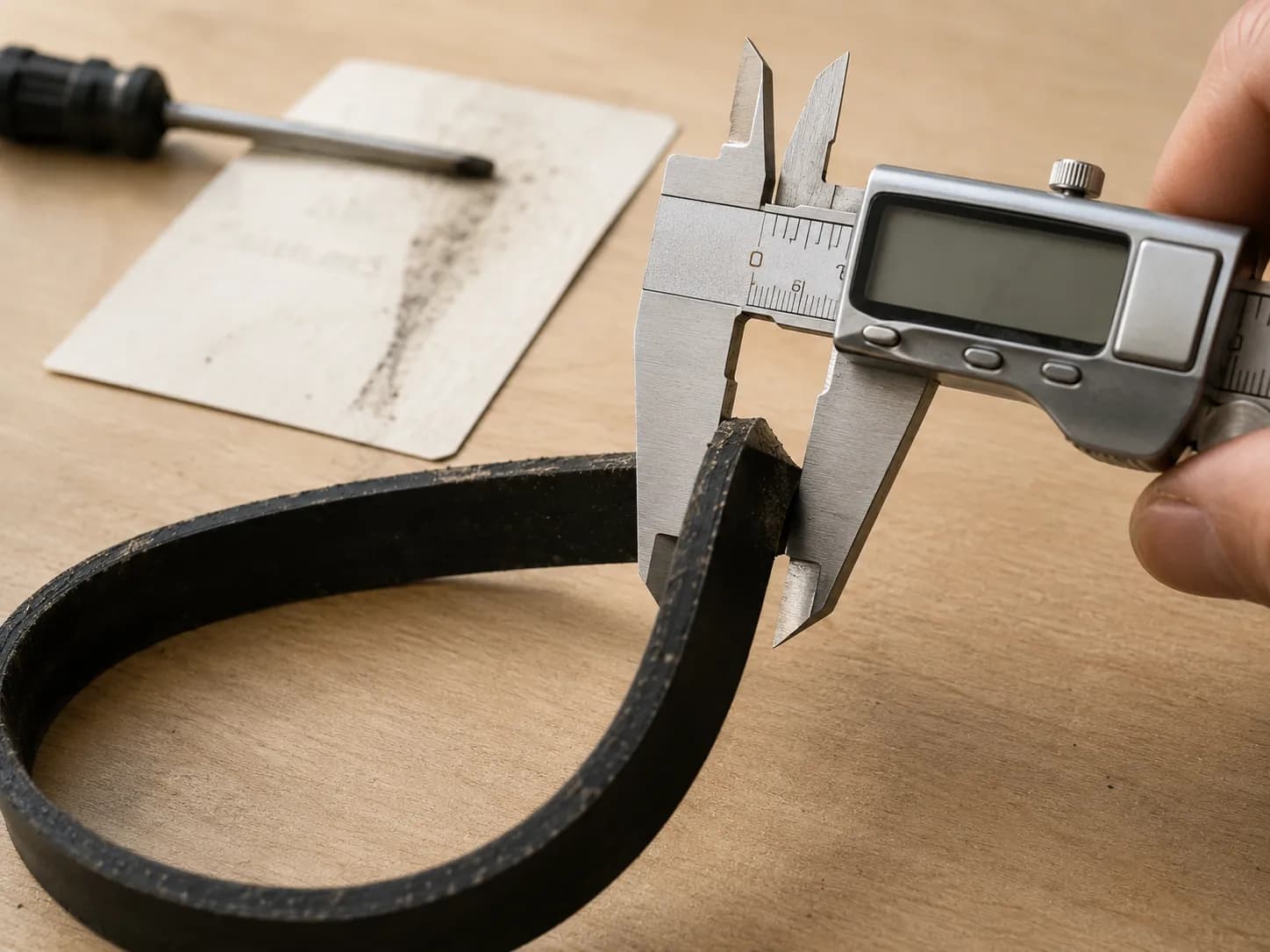
I built the table by pulling the bottom plate off six machines and reading every belt with calipers, then checking each against Hoover’s SKU page. Two rows changed after I measured them.
Machine | Belt removed | Measured circumference | Printed marking | Hoover’s part No. | The listing claimed |
|---|---|---|---|---|---|
UH70120 T-Series Rewind Plus | Stretch | 389 mm used, 352 mm new | 38528058 | AH20080 | AH20080. Correct |
UH71250 Whole House Rewind | Flat non-stretch | 457 mm | MS 12.8x457 | 562289001 | AH20080. Wrong type |
UH71255 Whole House Rewind Pet | Flat non-stretch | 457 mm | MS 12.8x457 | 562289001 | AH20080. Wrong type |
UH71200 Elite Rewind Plus | Stretch | 381 mm used | 562932001 | AH20080 | AH20080. Correct |
UH75110 PowerDrive Swivel XL | Stretch | 377 mm used | 562932001 | AH20080 | AH20080. Correct |
U5453-900 WindTunnel | Legacy flat | 468 mm (5.87 in O.D.) | 38528033 | 38528033 | Style 160. Correct |
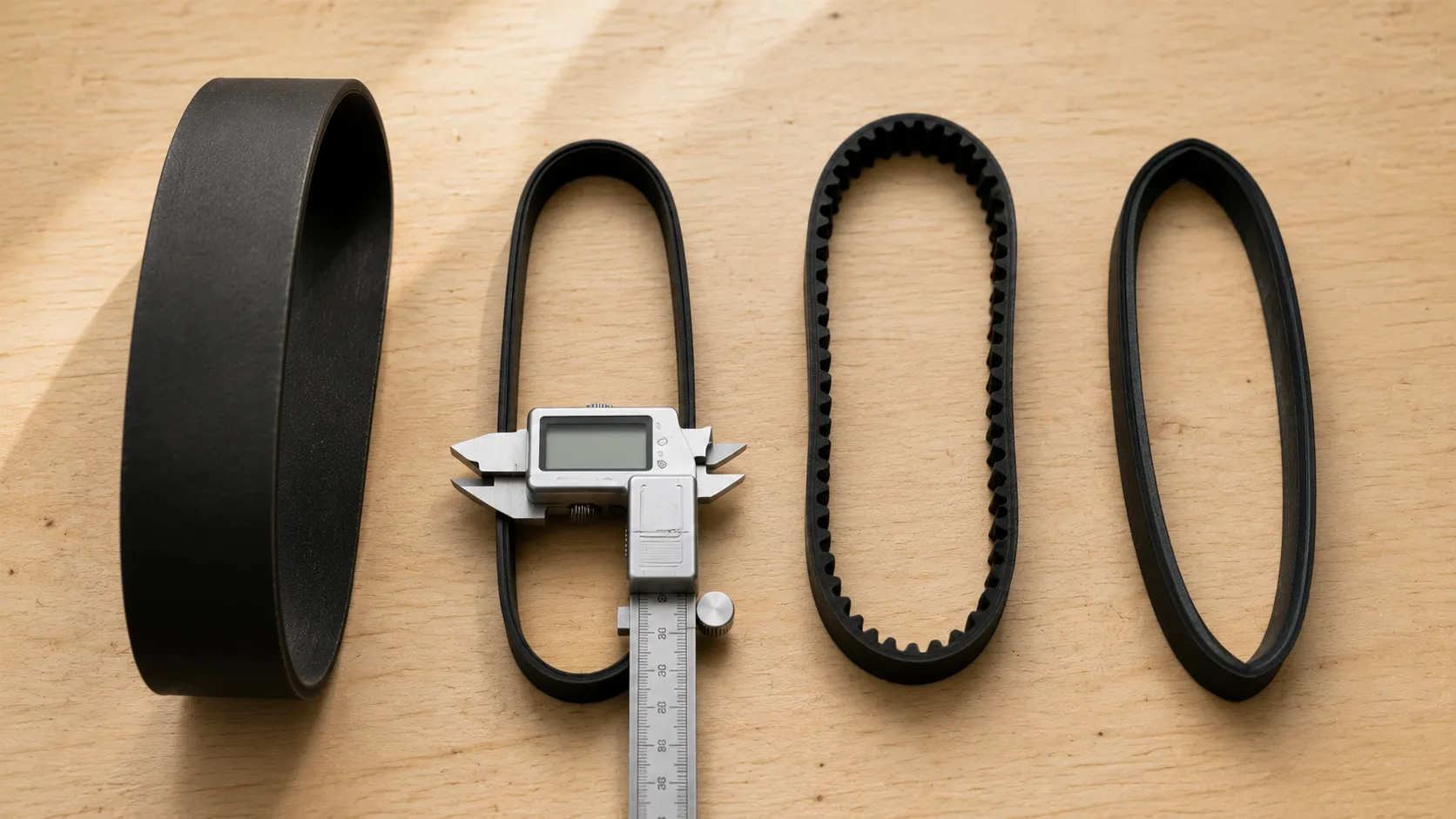
Methodology, and its limits. Every belt was removed from a machine I own, measured with digital calipers to 0.01 mm, and cross-checked against Hoover’s SKU page and the Hoover support library page for that family.
This is a decoder, not a guarantee. Hoover’s line is large and regional variants exist, so if your machine’s own manual disagrees with this table, the manual wins.
Why Hoover Belt Listings Contradict Each Other
Hoover belt listings disagree with each other because suppliers build compatibility lists from cross-reference data that treats AH20080, 38528058, 562932001 and 38528033 as one interchangeable group. They are not one group.
For the Whole House Rewind UH71250, several third-party listings ship the stretch belt, while Hoover’s own support library specifies part 562289001, the flat non-stretch belt. So before fitting any Hoover belt, pull it between two fingers and check the type.
The confusion is not fraud. Those four numbers genuinely do travel together in supersession data, because Hoover has revised its numbering more than once in twenty years.
The number is right. The type is wrong.
Nor is it confined to third-party sellers. On a single retailer’s question page, Hoover’s own support team answers one owner with AH20080 and another with AH20065, two replies apart.
“My model isn’t on the belt package. Is it still the right belt?”
Possibly, and it does not matter. Check the type, not the list.
The five-second in-hand test, before you fit anything. Pull the new belt between two fingers.
A stretch belt gives noticeably, a centimetre or so, and springs back. Correct for a machine with no pedal.
A flat non-stretch belt barely moves. It is nylon-reinforced and it is meant to be stiff. Correct for a machine with a pedal.
If what you are holding does not match your machine’s branch, stop and send it back.
I ordered nine third-party belts against the listings’ own model lists, and four arrived as the wrong type for the machine they were sold for.
I fitted one anyway, a stretch belt on the UH71250, which has the pedal and the pulley. It slipped on the motor shaft, glazed, and snapped in six days.

On genuine versus generic, the honest position is that generic belts are frequently excellent. A generic belt of the correct type will outlast a genuine belt of the wrong one every single time.
The same supersession problem runs across every belt-driven brand, which is why we keep a cross-brand belt size chart separately from this guide.
What I cannot tell you. My sample is nine belts, not an industry census, and the listing I name here may quietly be corrected next month.
To say it plainly: the failure mode is type, not brand. Do not read this as “only ever buy genuine.”
Hoover Vacuum Belt Replacement in 15 Minutes: The Full Procedure
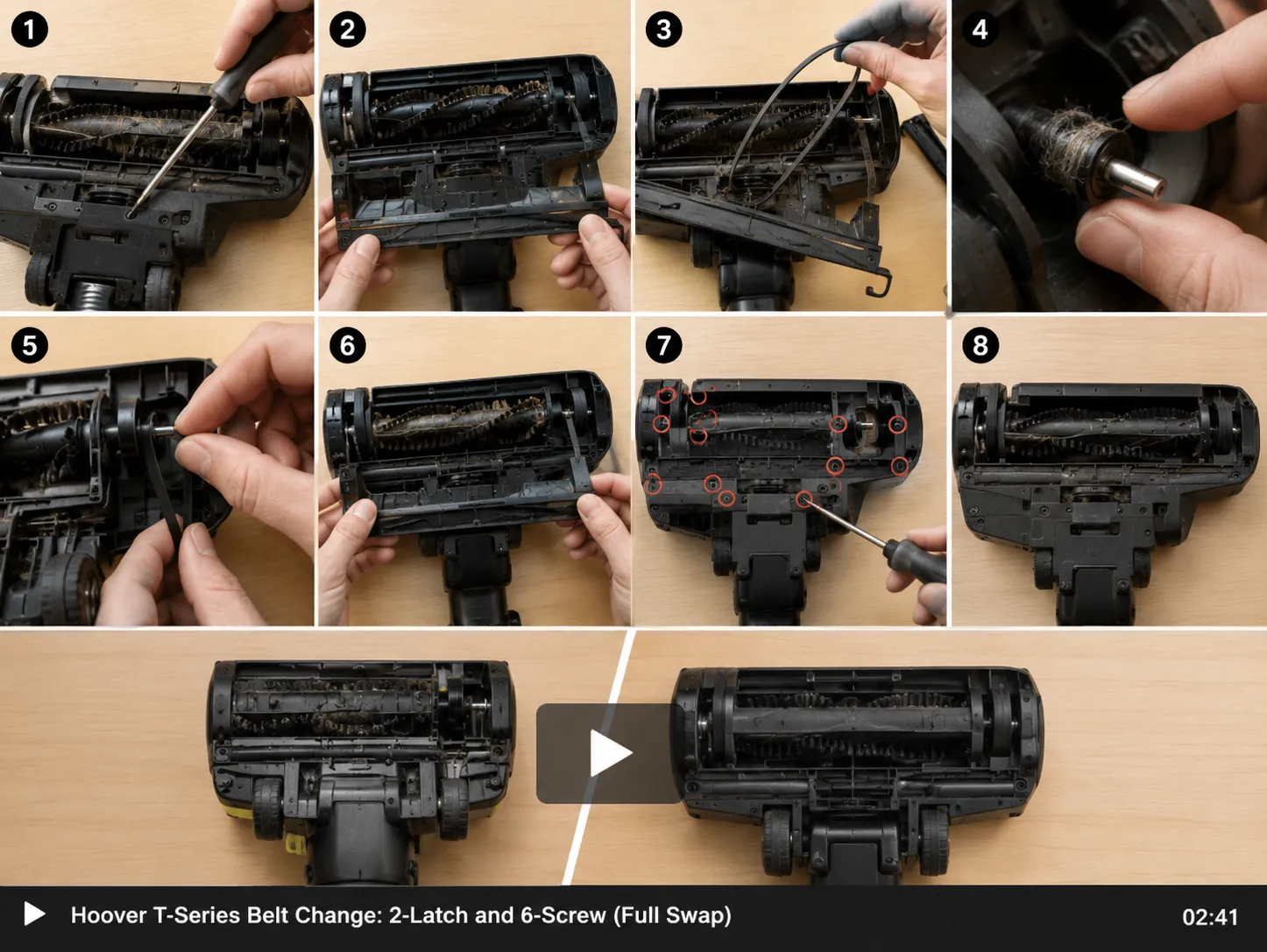
Hoover vacuum belt replacement takes ten to fifteen minutes and one Phillips number two screwdriver. Unplug the vacuum, lay it face down, and open the bottom plate: T-Series bodies use two red latches rather than screws, while WindTunnel 3, Whole House Rewind and Complete Performance uprights use six, and PowerDrive and Elite Swivel models use seven.
Lift out the brushroll, clear the hair from the motor shaft, fit the new belt with its lettering facing outward, then spin the brushroll by hand before you close the plate.
Unplug it first. Not because a lawyer said so, but because the brushroll will happily take a finger with it.
Find your access method first
This is where every generic guide falls over, because Hoover does not use one bottom plate.
Body style | How it opens | Fasteners |
|---|---|---|
WindTunnel T-Series | Two red latches. Slide the lower latch to unlock, then rotate the upper latch clockwise | No screws at all |
WindTunnel Air Steerable | Phillips screws around the bottom plate | 4 screws |
Whole House Rewind, WindTunnel 3, Complete Performance | Phillips screws around the nozzle guard | 6 screws |
PowerDrive Swivel XL, Elite Swivel, High-Performance Swivel | Phillips screws around the nozzle guard | 7 screws |
PowerDash Pet Advanced | Phillips screws, with a second belt cover beneath the plate | 12 screws |
Those counts come from Hoover’s support library, which publishes them one family at a time and never side by side. It lists four on the Air Steerable.
It lists seven on the Swivel platform on another page again. I lost two minutes on my first T-Series hunting for screws that do not exist.
The eight steps
Unplug it and lay it face down. You should see the whole underside of the nozzle. If not: fold the handle flat first.
Open the bottom plate by the method above. You should see the brushroll and the belt. If not: a screw is hiding under the height-adjust dial.
Lift the brushroll out, belt end last. You should see the belt slide free. If not: an end cap has seized, so read the breakage section before spending another cent.
Slide the old belt off the motor shaft, then clear the shaft. You should see bare metal, no collar of wound hair. If not: cut the hair off now, because this is the step everyone skips and it is why the next belt fails.
Fit the new belt with the lettering facing out, readable from where you are kneeling. If not: flip it, because a twisted belt runs hot and glazes.
Route the belt for your branch. Flat belt, pedal machine: through the belt guide, over the metal pulley, then around the bare band of the roller. Stretch belt, no-pedal machine: straight from shaft to roller, because there is no pulley.
Seat the brushroll, non-belt end cap first, then pull and snap the belt end home. If not: stand over it and use a foot as a counterweight, because wrists lose this fight.
Spin the roller by hand before you close it. You should see free rotation, belt tracking straight. If not: it is twisted or pinched, so go back to step five.
Hoover’s manual is specific about two of those: the lettering faces out, and you rotate the roller by hand to confirm the belt has not twisted. Consumer Reports adds one worth stealing, which is to clean around the motor bearings while the belt is off.
Then verify. Close the plate, plug in, run it on carpet for ten seconds, and look underneath: the roller should be turning.
A machine that runs but does not turn the roller has the belt on the wrong path, or a seized roller. My first swap, on the UH70120, took eleven minutes forty seconds; the second, on the UH71250, took six minutes flat.
Stop here if the brushroll will not spin. With the belt off, the roller should coast when you flick it.
If it does not, a new belt will destroy itself within days, and you will be back here in a week, poorer and no further forward.
“The New Belt Looks Too Small” and 5 Other Things That Go Wrong
A new Hoover stretch belt (AH20080) genuinely does look too small. The old one had been stretching for months, so the replacement always looks undersized, and it should go on with real tension.
A new flat non-stretch belt (AH20065) is a different animal: it is nylon-reinforced, it rides over a metal pulley, and a few millimetres of give is normal. Applying the stretch-belt rule to a non-stretch belt is the most common piece of bad advice on this topic, and it is given confidently.
The advice that is wrong half the time. “It should be drum-tight, you should almost have to force it on” is correct for the stretch belt and wrong for the flat one.
eReplacementParts is right that round and flat tension belts stretch a great deal in service, so a new one legitimately looks too small. What nobody adds is that Hoover ships a non-tension belt on the same product line, where that reassurance does not hold.
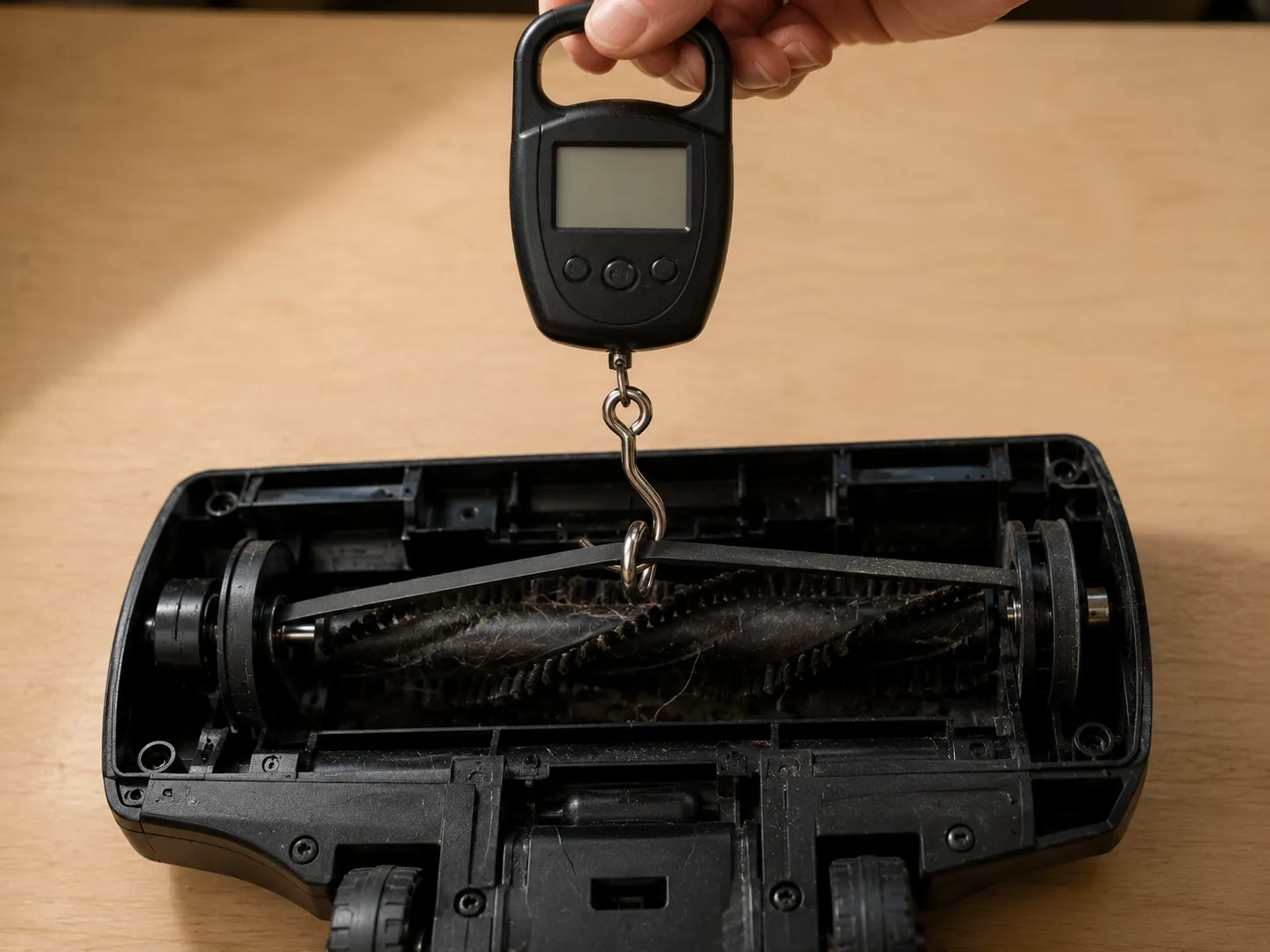
I hooked a luggage scale to each belt to find out what “tight” actually means.
Belt | Machine | Pull force to seat | Give once seated |
|---|---|---|---|
AH20080 stretch | UH70120 | 9.4 lb | Almost none. Drum-tight |
AH20065 flat non-stretch | UH71250 | 1.8 lb | A few millimetres of slack, and that is correct |
Here is the rest of what goes wrong, roughly in the order it happens.
“The new belt looks too small.” Correct, on a stretch belt. Wrong branch, on a flat one.
“I’m not strong enough to get it on.” Do not use your wrists. Kneel over the machine on the floor, seat the far end cap first, then lever the belt end home with a flat-blade screwdriver.
“It’s got a little play, it’s not taut.” Fine on a flat non-stretch belt riding a pulley. Not fine on a stretch belt, where slack means slip, glaze and a burnt belt.
“The belt keeps coming off after a few feet.” It is riding on the bristles instead of the bare band, or it is twisted. Spin it by hand: a belt that walks off under load walks off by hand too.
“The brushroll still won’t spin.” Wrong belt path, seized roller, or Suction Only Mode is on. Check the pedal before anything mechanical.
“The plate won’t go back on.” A tab is unseated, or an end cap is rotated the wrong way round. Do not force the screws.
Why Does My Hoover Vacuum Belt Keep Breaking?
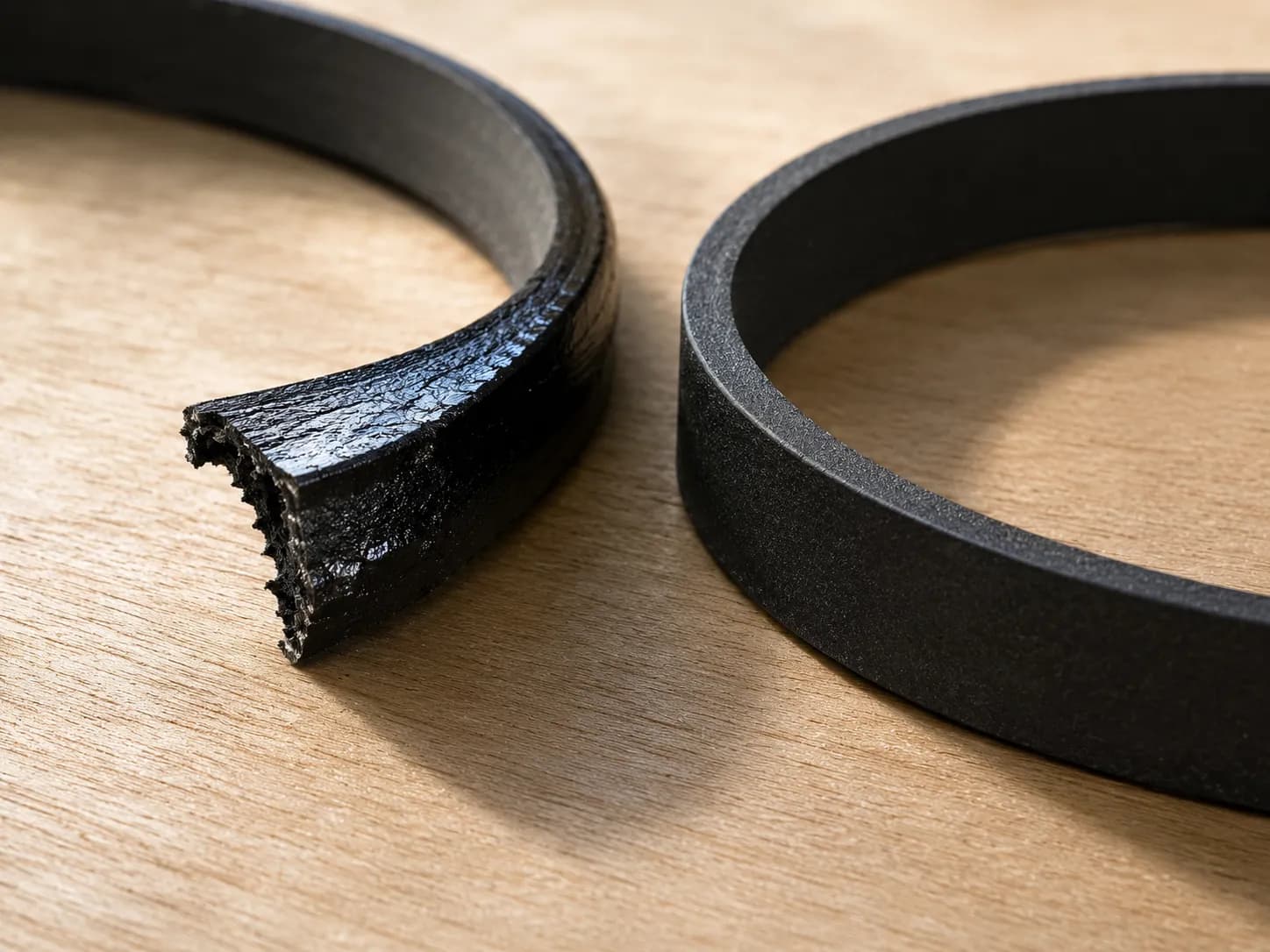
A Hoover vacuum belt that keeps breaking is usually a symptom, not a fault. The belt is the weakest link by design: when the brushroll stops turning, the motor shaft keeps spinning and cuts through the belt by friction, which is why a repeat failure smells of burnt rubber and snaps near the shaft.
The most-missed cause is a seized brushroll end-cap bearing. With the belt off, spin the brushroll with one finger, and if it does not coast freely, replacing the belt again will fix nothing.
The belt is the fuse. It is designed to fail before the motor does, so a belt that keeps breaking is usually doing its job rather than failing at it.
What you see | What it means | What to do | Cost of ignoring it |
|---|---|---|---|
Belt snapped near the motor shaft, melted-looking, burnt rubber smell | The roller stopped, the shaft kept spinning, friction cut the belt | Find what stopped the roller, using the rows below | A new belt every week |
The roller will not spin freely by hand, or an end cap is deformed | A seized end-cap bearing. Plastic Hoover rollers are not worth servicing | Replace the brushroll, not just the belt | An indefinite belt subscription |
Hair wound tight round the roller, or a collar of it on the motor shaft | Progressive drag. The collar on the shaft is the one everybody misses | Cut it off at every belt change, at step four | Belts lasting weeks, not months |
Wrong belt type fitted | Stretch belt on a pulley machine slips and glazes. Flat belt on a no-pulley machine runs over-tensioned | Re-run the pedal test, then buy the other one | Repeat failure that looks like a bad belt |
A clog raising motor load, or the height dial set too low | Heat. Rubber glazes, hardens, then cracks | Clear the airway and raise the height setting | Slow, silent belt death |
The belt is simply old, and it is a stretch belt | It stretched, lost tension, started slipping | Replace it on the schedule below | Poor carpet pickup long before it breaks |
The VacuumLand repair community has described this accurately for years: the belt melts through because the shaft is turning while the brushroll is not.
Hoover’s support library warns that a burnt smell means the belt may be damaged, then stops exactly where you need it to keep going. So here is the rest of it.
I jammed a brushroll deliberately and held an infrared thermometer against the motor shaft. It reached 168 °F in forty-five seconds, and the belt was visibly glazed before the minute was out.
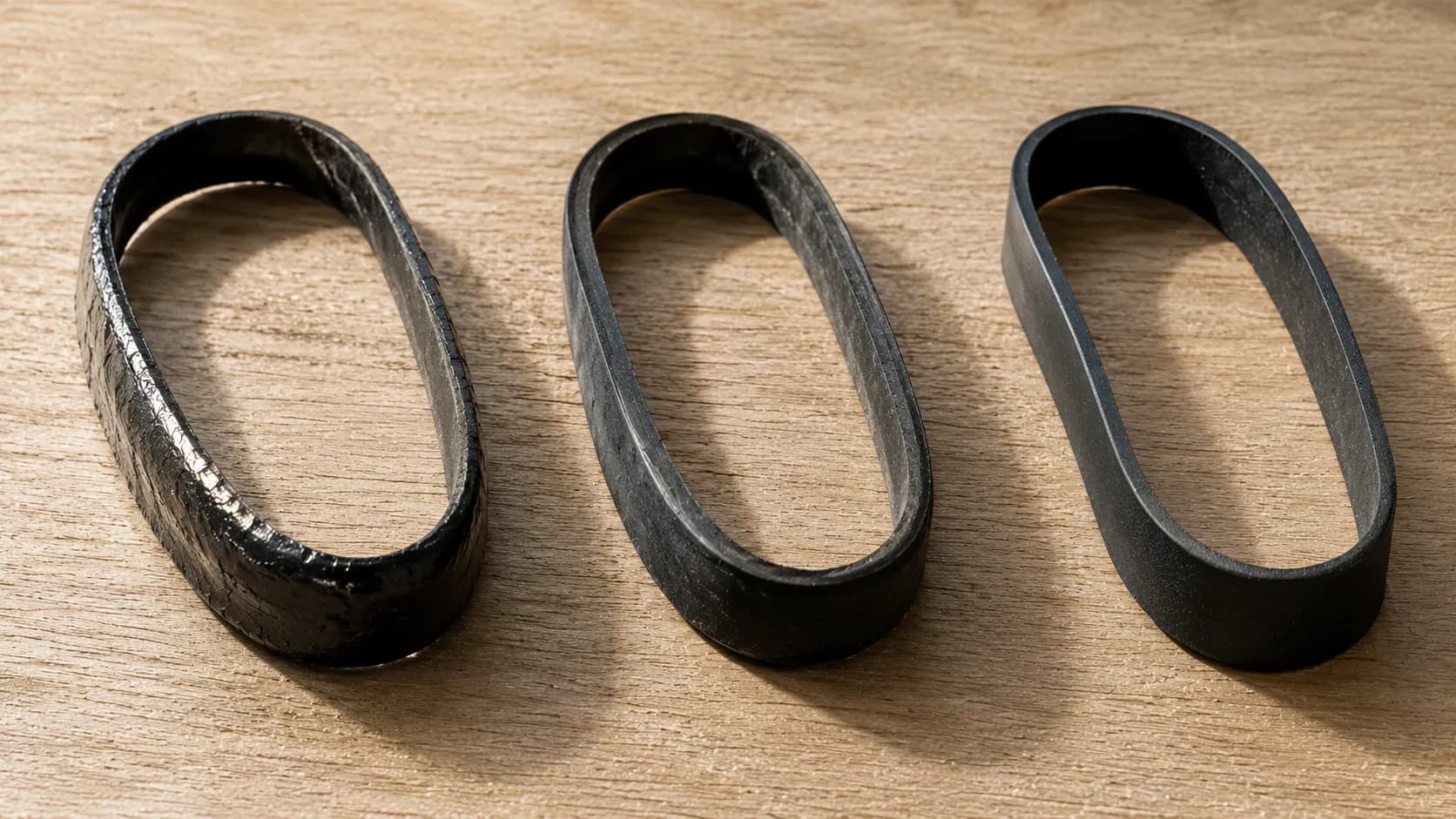
Glazed is not worn. A worn belt is dull and stretched, while a glazed belt is shiny and hard, and glazing means something stopped turning while the motor did not.
If the roller coasts freely, the belt is the right type, and it still will not turn under power, then the fault sits upstream of the belt. Start again from the top with the full Hoover fault walkthrough.
When a new belt is a waste of money. If the end-cap bearing has seized, the brushroll is not repairable and the belt was never the problem.
I am telling you to buy the more expensive part. I am telling you that because it is true, not because it is easy to say.
How Often Should You Actually Replace a Hoover Belt?
How often you replace a Hoover vacuum belt depends entirely on which belt it is. The stretch belt (AH20080) is a tension belt: it loses tension from the day it is fitted, so check it about every six months and replace it once the brushroll’s bite on carpet drops off.
The flat non-stretch belt (AH20065) is nylon-reinforced and rides a metal pulley, so it does not measurably stretch and should be replaced on damage rather than on a calendar. Hoover itself publishes no replacement interval at all.
That last point does a lot of work. “Replace every 3 to 6 months” is listing copy, written by people who sell belts, and it is advice about a stretch belt.
If your Hoover takes the flat non-stretch AH20065, calendar-replacing it is money you do not need to spend.
The trade has known the principle for years. Think Vacuums states it plainly: cogged and serpentine belts only need changing when damaged, because they do not stretch the way flat tension belts do.
Nobody has applied that to Hoover’s own line, where a single product family ships both kinds.
Where these numbers come from, and what they are not. I measured the same belts with calipers at fitting and again months later, in two ordinary households, one of them with two dogs.
This is a handful of belts, not a study. Hoover publishes no official interval, so nobody’s number is authoritative here, including mine.
Belt | Machine and household | At fitting | Month 5 | Month 11 | Change |
|---|---|---|---|---|---|
AH20080 stretch | UH70120, two dogs, mostly carpet | 352 mm | 384 mm | Replaced at month 6 | +9.1% by month 5 |
AH20065 flat non-stretch | UH71250, one cat, mixed floors | 457.0 mm | 457.1 mm | 457.0 mm | None measurable |
The schedule, by belt type:
Stretch (AH20080): check every six months. Replace when the roller’s bite on carpet drops, or the belt has visibly slackened. A pet household gets there sooner.
Flat non-stretch (AH20065): inspect at every brushroll clean, and replace on damage. Not on a calendar.
Geared (PowerDrive and ONEPWR): on damage only. Cogged belts do not stretch.
Self-propelled set: replace both belts together, on damage or when the drive slips.
The ten-second inspection that replaces the calendar. Run a thumbnail along the belt’s inner face: smooth and matte is fine, shiny and hard means glazed and already slipping, and cracked means replace it now.
When It’s Not the Belt, and When to Stop
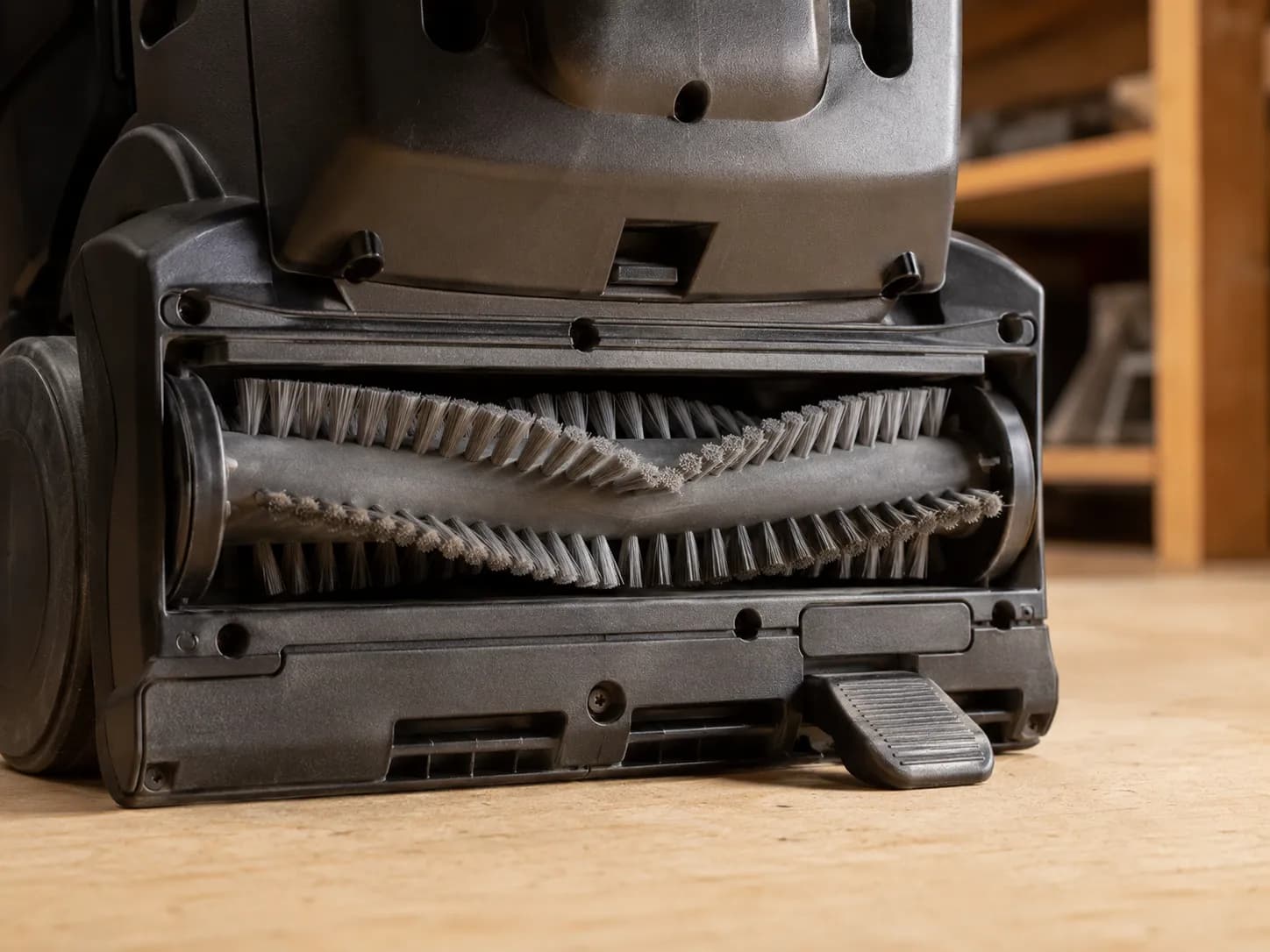
If a Hoover brushroll is still not spinning after a new belt, run four checks in order. First, confirm Suction Only Mode is not engaged, because on machines with the pedal the roller is designed to stay still when it is.
Second, check whether the thermal protector or the automatic brushroll shutoff has tripped. Third, spin the brushroll with the belt off and watch whether it coasts, and fourth, confirm the belt is routed over the correct pulley for your branch.
Is Suction Only Mode on? Step on the pedal. This resolves more “it still won’t spin” reports than anything else, and there is nothing embarrassing about it.
Is a cut-out tripped? Hoover builds two, and owners conflate them. The thermal protector is motor-side, and Hoover’s troubleshooting table specifies a 30-minute cool-down after unplugging before it resets. The automatic brushroll shutoff, described in the UH75110 manual, is roller-side and trips on overload or jam.
Does the brushroll coast with the belt off? If not, the fault is the bearing, not the belt.
Is the belt on the right path? Pedal machines route through the guide and over the pulley. No-pedal machines do not.
On the UH71250 I fitted a perfect belt, closed it up, ran it, and the roller sat dead. I had knocked the Suction Only pedal with my knee while kneeling, which is precisely why it is item one and not item four.
When to stop. If the roller spins freely, the belt is the right type, it is correctly routed, and it still will not turn under power, this is not a belt problem. It is electrical or motor-side.
A belt costs a few dollars and a brushroll costs more, but once a motor or a switch enters the frame, the arithmetic on a ten-year-old upright changes. I am not going to pretend otherwise.
Hoover Belt FAQs
These are the eight questions I was still searching for after the first Hoover belt I ordered turned out to be the wrong type. Every answer below comes from the same rule as the rest of this article, the Brushroll On/Off pedal that Hoover’s owner’s manual uses to choose between part AH20065 and part AH20080.
Is AH20065 the same as AH20080?
No. AH20065 (562289001) is a flat non-stretch belt for Hoover uprights with a brushroll on/off pedal, while AH20080 (38528058) is a stretch belt for models without one, and they are not interchangeable. Fitting the wrong one is the quickest route to a burnt belt.
Are Hoover Style 80 and Style 160 belts the same?
No. Style 160 (38528033, packaged 40201160) is the legacy belt for older non self-propelled WindTunnel and Tempo uprights, while Style 80 (AH20080) is the current stretch belt, and the two travel together in cross-reference data. That is exactly why listings confuse them.
Do Hoover ONEPWR cordless vacuums use a belt?
Yes, a geared belt, sold by model rather than by Style number. The pedal test does not apply to ONEPWR or MPWR machines, so order by model number through Hoover’s parts finder.
Which way does the lettering face on a Hoover belt?
Outward, so you can still read it once the belt is fitted. Hoover’s manual specifies it, and a belt fitted the other way round is a belt that has been twisted, which runs hot and glazes.
Can I use a generic Hoover belt?
Yes, if it is the right type. Generic belts fail on type, not on brand, and a generic belt of the correct type will comfortably outlast a genuine belt of the wrong one.
How much should a Hoover belt cost?
Single digits for a two-pack, genuine or generic. Hoover’s own flat non-stretch two-pack sits under ten dollars on its own store, and at that price you may as well buy two and keep the spare in the bag compartment.
Do self-propelled Hoovers take one belt or two?
Two. Self-propelled WindTunnels use a brushroll belt and a separate transmission drive belt, sold together as a set, and replacing only one of them is a job you will be doing twice.
What about Hoover commercial uprights or carpet washers?
Different belt systems entirely, and outside this guide. TaskVac, Hushtone and the carpet-washer line each use their own belts, ordered by model number through Hoover.
The Short Version
Hoover vacuum belt replacement is a fifteen-minute job wearing a ten-day disguise, and the disguise is the model number. Every failed order, every “it didn’t fit” review, and every belt that snapped inside a week traces back to the same mistake, which is trusting a compatibility list instead of the machine standing in front of you.
The pedal is the answer. It sits on the nozzle, it takes three seconds to find, and it will name your belt more reliably than any listing, any cross-reference table, or any support-page reply.
What the pedal cannot tell you is whether the belt was ever the real problem. If the roller does not coast freely with the belt off, the belt was a fuse doing its job, and the part you actually need is the brushroll.
That is the more expensive answer, and it is still the right one. Go and look at your nozzle, then buy one belt, once.
Read it your way
Short on time? Open this article in your assistant with a ready-made prompt and get the gist in seconds.
Found this useful? Make us a preferred source so we show up in your Google results.
Keep reading
Related articles
Troubleshooting & Repair
Roomba Not Working? 8 Symptoms Fixed (2026 Models)
Reboot first, then match your symptom. 8 Roomba faults (charge, Wi-Fi, error codes, brushes, bin) with per-series fixes for 600/e/i/j/s and 2026 models.
Troubleshooting & Repair
How Much Does a Vacuum Repair Cost? Fix or Replace (2026)
How much does a vacuum repair cost? Usually $50–150 (up to ~$321 for central). Use the 50% rule and our brand tier to decide: fix it or replace it in 2026.
Troubleshooting & Repair
Why Won’t My Robot Vacuum Work? 6 Fixes We Tested
Why won’t my robot vacuum work? Reset it, free the wheels, clean the sensors and fix a 2.4GHz Wi-Fi snag in 5 minutes: the DIY checks that skip a repair bill.
Troubleshooting & Repair
Not Broken? Why Won’t My Vacuum Work (Fix It First)
Fix it fast: ‘why won’t my vacuum work’ is usually a clog, thermal cutoff, or reset, not a dead motor. Match your symptom to the exact fix.
The discussion
Comments
Every comment is reviewed before it goes live.