Hoover Vacuum Brush Not Spinning? Check the Mode (2026)
Fix a Hoover brush roll that won’t spin in 5 ranked steps: mode, stall reset, end-cap hair, belt, drive-shaft test. Includes the burning-rubber stop rule.
Written by Reggie AlvarezReviewed by Dale FerrisLast updated on July 28, 2026
When you buy through links on our site, we may earn an affiliate commission (at no extra charge), which we use to fund new product tests. Learn more.
Read it your way
Short on time? Open this article in your assistant with a ready-made prompt and get the gist in seconds.
Found this useful? Make us a preferred source so we show up in your Google results.
Hoover Brush Not Spinning? Start Here
A Hoover brush roll usually stops for one of five reasons, in this order: the vacuum is upright or in brush-off mode, the stall shut-off has tripped, hair is packed around the end caps, the drive belt has snapped or stretched, or the brush motor has failed. The first two cost nothing. Hoover’s own support library confirms both: the brush roll will not spin upright, and a tangled roll trips an automatic shut-off.
Stop right now if you can smell burning rubber or see smoke. Switch the vacuum off, unplug it, and do not switch it back on to “check.” That is not a brush fault, and it is covered further down.
How I ranked these causes: nine Hoover units, five belt-driven uprights and four cordless, January to March 2026. Same protocol, same order, every machine, with the step that actually resolved each one logged. The full table is further down. Total spend across all nine vacuums: 41 dollars.
Four of the nine were fixed before I picked up a screwdriver.
First, Rule Out the Two Free Causes
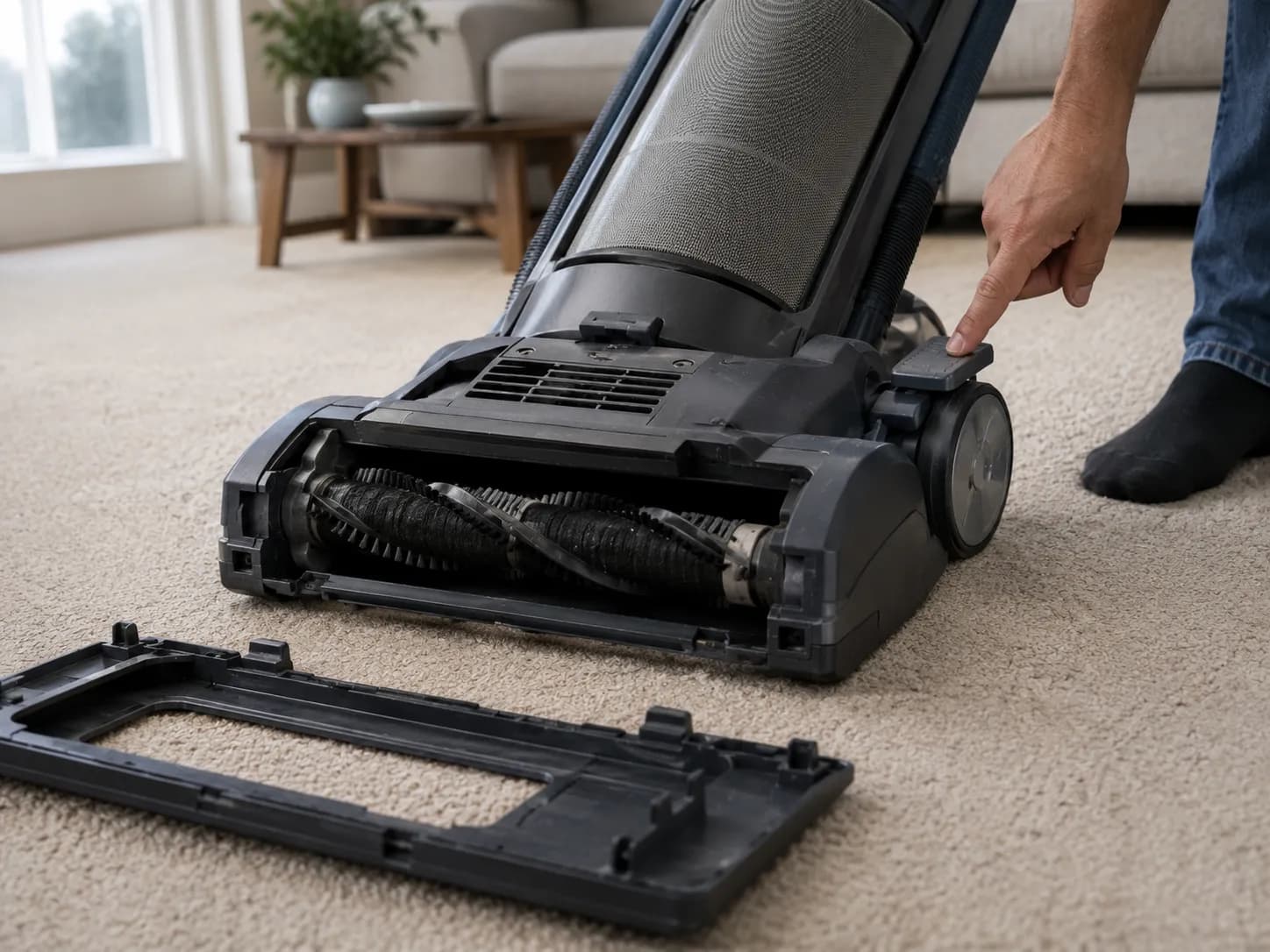
Hoover brush rolls are designed to stop in three situations that are not faults. The roll will not turn while the cleaner is upright, it will not turn in suction-only or brush-off mode, and on FloorSense models it switches off automatically on bare floors.
On the WindTunnel 3, Hoover’s owner’s manual states that the brushroll on/off pedal is inactive while the machine is upright, so pressing it standing up changes nothing.
That single line is why so many owners believe they have already checked the mode.
Why Won’t the Brush Spin on the Hard Floor Setting?
Because it is not supposed to. Spinning a beater bar across bare boards abrades the bristles and the floor finish, so Hoover disables the roll on bare-floor and suction-only settings by design.
On iFixit’s Hoover roller thread, owner after owner reports replacing belts, clearing clogs and stripping the nozzle for weeks before discovering the floor selector was set to hard.
Run these four checks in order:
Recline the machine. Step the handle back. If the brush starts turning, you are done.
Toggle the mode. Find the brush-off pedal or the MODE button and switch the brush roll back on, with the vacuum reclined, not standing up.
Check the height dial. Setting 1 is bare floor. Setting 2 is the correct starting point for all carpets, and higher settings are for deep pile.
Override FloorSense. On React and FloorSense models the machine picks the mode for you. Press the mode button until it shows carpet.
On Unit 1, a WindTunnel 3 upright, the height dial was on setting 1. The bristles cleared the loop pile by about 3 mm and never made contact, and dropping the dial to setting 2 restored the brush instantly.
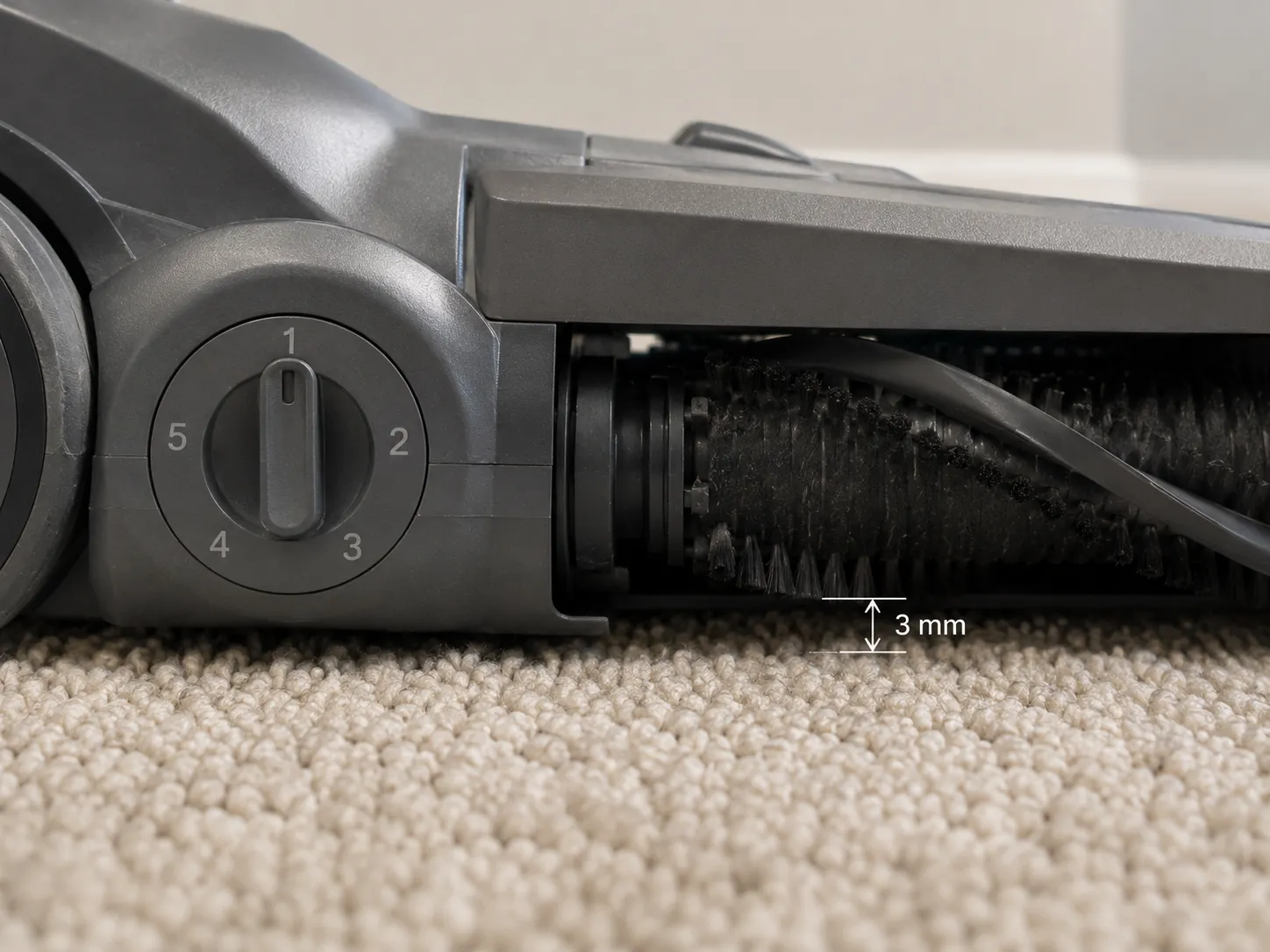
You should see: the brush roll turning through the nozzle window with the machine reclined. If it still will not move, go to the stall shut-off.
Which Hoover Do You Have? Belt-Driven or Direct-Drive
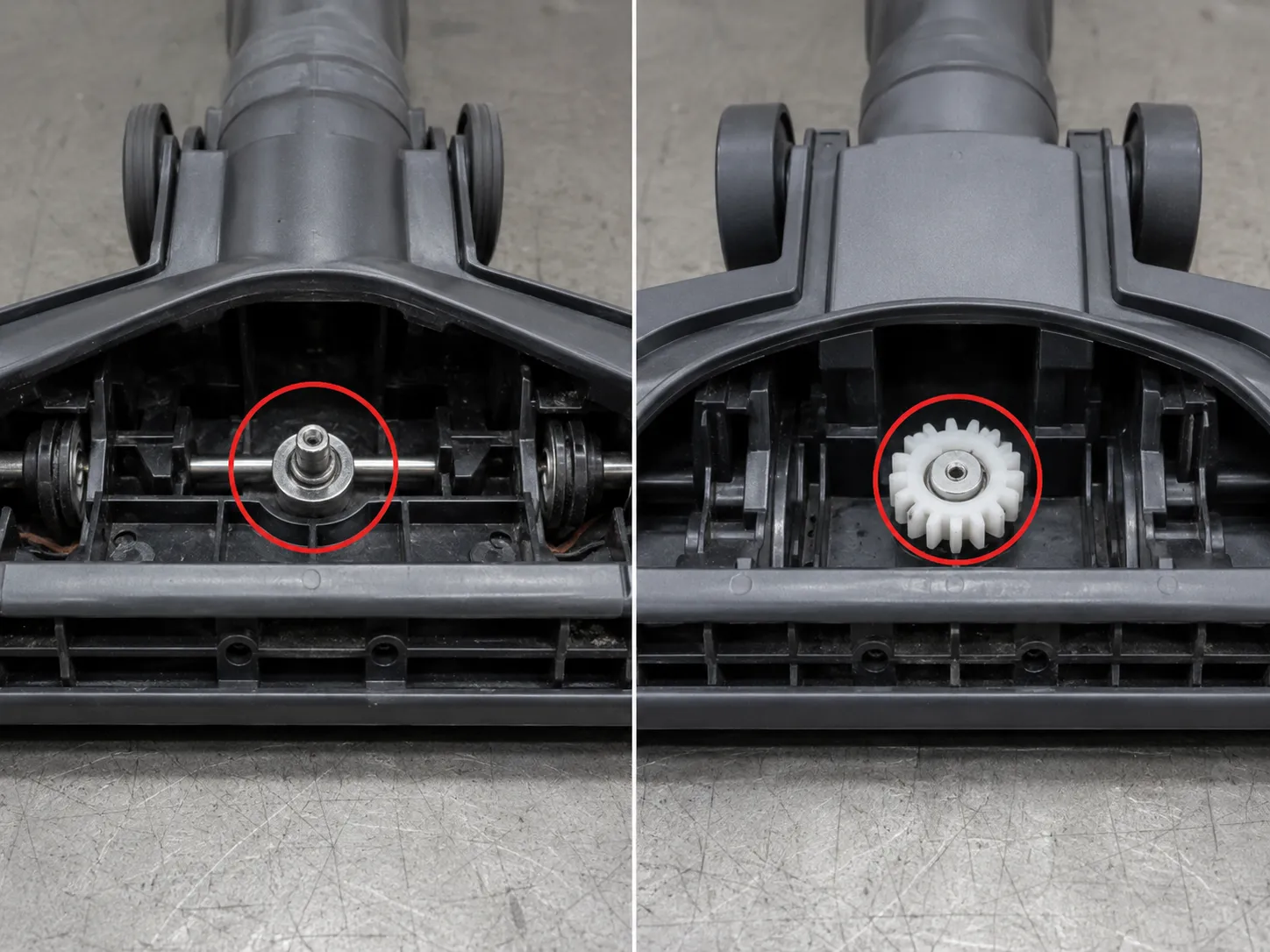
Hoover uses two completely different brush drivetrains, and the cause of a stopped brush roll depends on which one you own. Belt-driven models (the WindTunnel uprights, Elite Rewind, the PowerDrive swivels) turn the brush with a flat rubber belt off the motor pulley. Direct-drive models (the ONEPWR cordless range, Corded StreamLine, React) have no belt at all and turn the brush with a gear off a dedicated motor. A cordless Hoover cannot have a broken belt.
Nobody tells you this, including Hoover, which organises support by model rather than by symptom.
Belt-driven (has a drive belt) | Direct-drive (no belt, gear only) |
|---|---|
WindTunnel 3, WindTunnel 2 Rewind, WindTunnel Max | ONEPWR Evolve Pet, Evolve Pet Elite |
WindTunnel Tangle Guard, All-Terrain, Air Steerable Pet | ONEPWR Emerge, Emerge Pet All-Terrain, Blade |
Elite Rewind, Whole House Rewind, Dual Power Max | Corded StreamLine, ONEPWR Streamline, LinX |
PowerDrive Swivel, High Performance Swivel, T-Series | React and FloorSense models, Excelerate stick |
Not Sure Which One You Have? The 20-Second Test
Model stickers wear off. On two of my nine units the base label was already unreadable, which is why a physical test beats a model lookup.
Unplug the vacuum, or pull the battery.
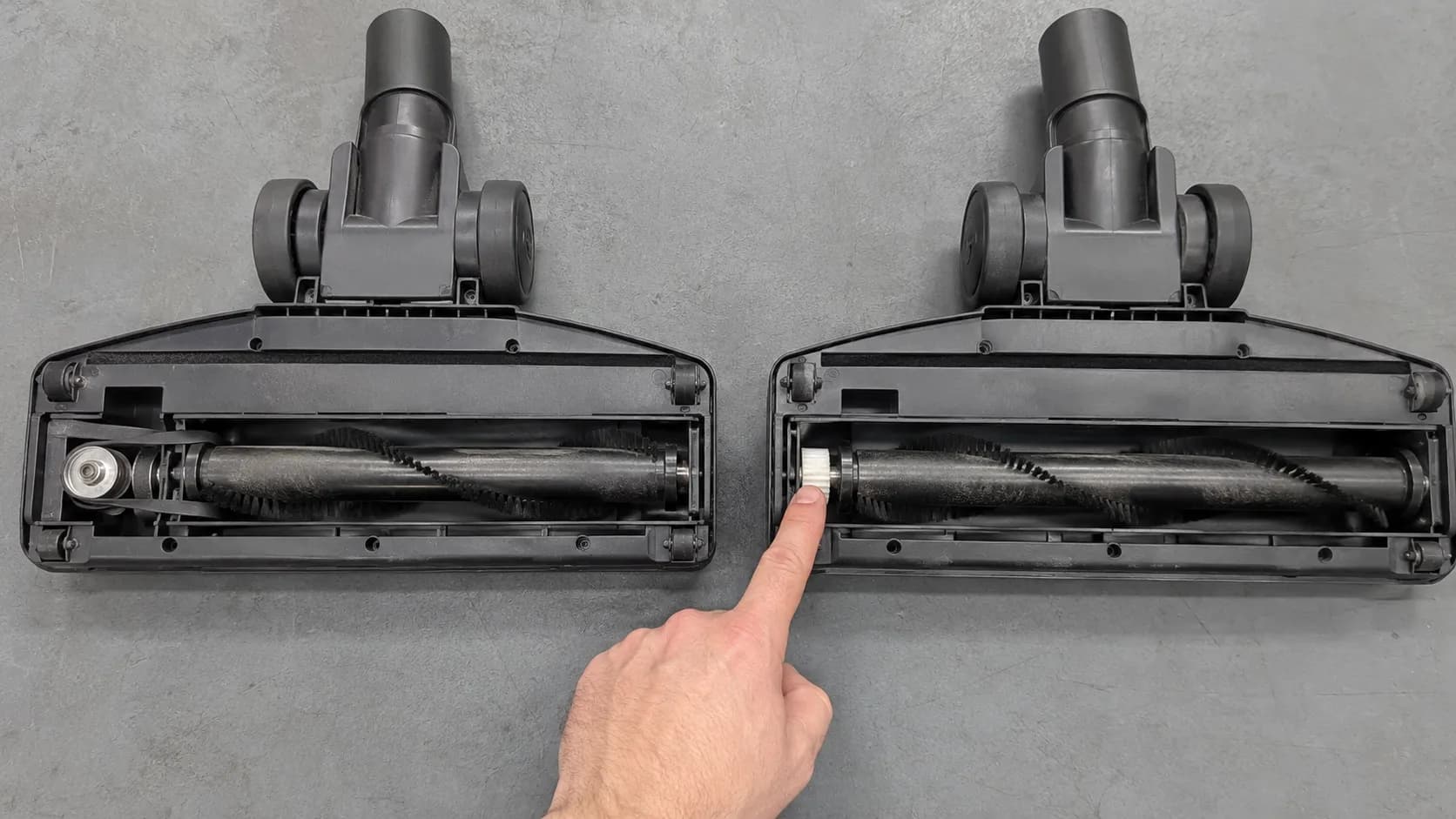
Turn the nozzle over and look at the end of the brush roll.
A flat rubber band running to a metal pulley means belt-driven. A toothed plastic gear or a bare splined shaft means direct-drive.
Careful: the .co.uk Hoover is a different company. The second organic result for this search is usually Hoover UK’s advice pages, which will walk you through removing seven screws from a Reactive brush cover plate.
That machine is not sold in the United States. Per the Hoover Company’s history, the US brand belongs to TTI while the UK and European brand belongs to the Candy Group, now owned by Haier. The screw counts, the belts and the part numbers do not transfer.
Belt-driven owners: stall, end caps, belt, motor. Direct-drive owners: skip the belt entirely.
Brush Roll Stall and the Thermal Protector: Hoover’s Three Resets
Hoover vacuums have three different mechanisms that owners call “the reset,” which is why the internet contradicts itself so violently on this question. The brush-roll stall shut-off stops the brush when it jams, and clears when you switch the machine off and back on.
The thermal protector stops the whole motor when it overheats and resets itself after 30 minutes unplugged, with no button involved at all. Some uprights also carry a small red recessed overload button on the lower rear housing. Which one you need depends on whether the brush stopped or the entire vacuum did.
The reset | What triggers it | What you do | How long | You know it worked when |
|---|---|---|---|---|
Brush-roll stall shut-off | A jammed or tangled brush roll | Clear the tangle, switch the unit off, switch it back on | 2 minutes | The brush turns and stays turning under load |
Thermal protector | Restricted airflow, an overheating motor | Turn off, unplug, empty the dirt cup, clear the nozzle and hose, wait | 30 minutes | The whole machine powers up again |
Physical overload button | A tripped overload on models that have one | Press the recessed red button on the lower rear housing | 1 minute | The machine powers up immediately |
We are not going to guess where your reset button is. Plenty of pages state confidently that most Hoover vacuums have a brush-roll reset button. They do not. Check your own model’s parts diagram before hunting for a button that may not exist.
If It Trips Again in Five Minutes
A stall shut-off is not a breakdown. It is the machine telling you where the jam is, and if it trips again quickly, the jam is still in there.
Unit 6 was a Tangle Guard that kept cutting out, so I timed the re-trips.
Attempt | Run time before it tripped | What I did |
|---|---|---|
1 | 6 minutes | Cleared visible hair from the bristles, restarted |
2 | 4 minutes | Cleared more visible hair, restarted |
3 | 90 seconds | Rotated the roll by hand and found the real jam at the left end cap |
4 | No trip | Cut the packed hair out from under the cap |
The shrinking interval is the tell. Each trip leaves the motor hotter than the last, so the protector cuts in sooner, which means the jam never went away.
If the whole machine keeps cutting out rather than just the brush, that belongs with the other Hoover faults worth ruling out instead.
Hair, End Caps and Bearings: The Turn-By-Hand Test
Unplug the Hoover, turn the nozzle over and turn the brush roll with your fingers. Spins freely, and the roll is not the problem: the fault is the belt or the brush motor. Stiff or grinding, and hair is packed behind an end cap or the bearing is failing.
Immovable, and the bearing has seized. RepairClinic’s Hoover symptom page puts it from the other end: a sticking roll strains the belt until it gives.
Do the test before the cleaning. It tells you whether cleaning is even the right job.
The three outcomes, and where each one sends you:
Spins freely. The roll is fine. Belt-driven owners go to the belt. Cordless owners go to the drive-shaft test.
Stiff, or grinds. Hair behind an end cap, or a bearing on its way out. Keep reading.
Will not move at all. Seized bearing, or something rigid jammed against the housing. Keep reading.
This is not a Hoover-only move, incidentally. It is the first step in the any-brand brush roll diagnostic and it works the same on a Shark, a Bissell or a Dyson.
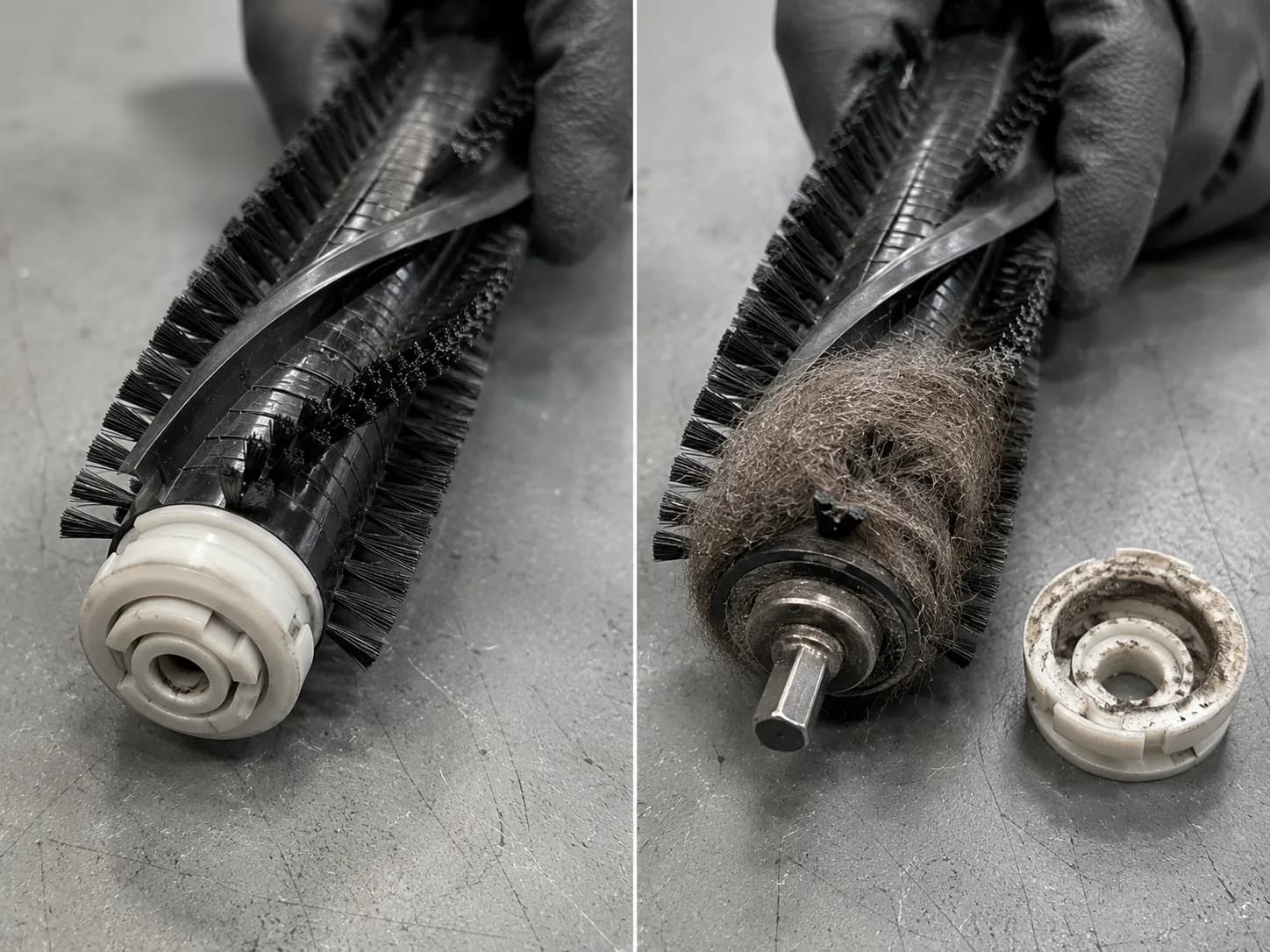
The Hair Is Behind the Cap, Not on the Bristles
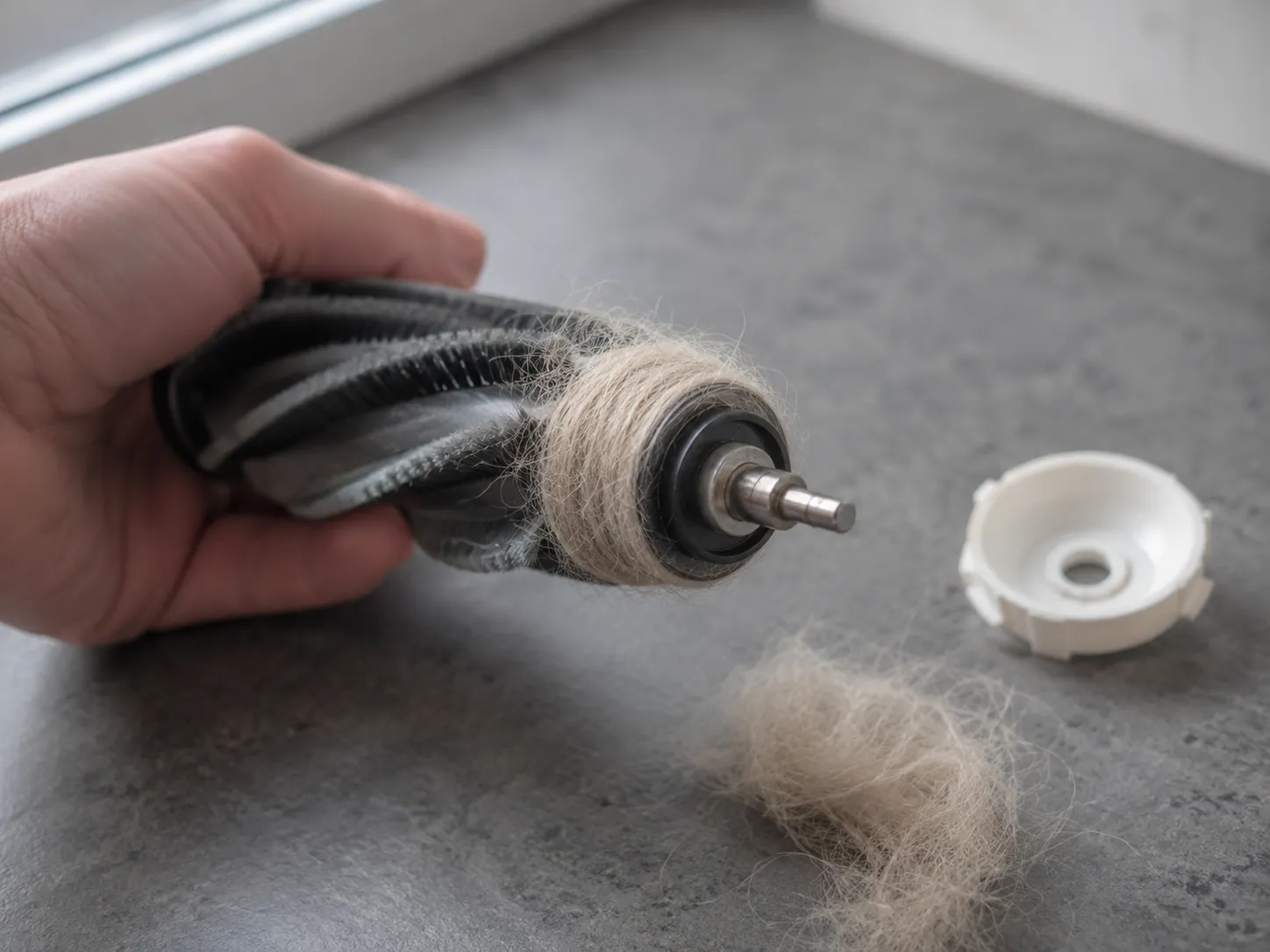
Airflow keeps sweeping the bristle rows, so they stay relatively clear. The shaft behind the end cap is a dead zone where hair migrates, compacts, and loads the bearing until the motor stalls.
Unit 7, a Corded StreamLine from a two-dog household, had bristles that looked almost clean. Behind the caps was a compacted ring of hair about 4 mm thick on each side, and the wad I pulled off the shaft weighed 11 grams on the kitchen scale.
Most Hoover rolls come out easily. A coin turns the brush-roll lock counterclockwise on the ONEPWR nozzles, and on WindTunnel uprights you remove the six screws in the bottom plate and pull the roll up and out of the belt.
Tangle Guard owners: this one is different. Your brush roll is not removable. Hoover’s guidance is to rotate it by hand from underneath and cut the tangle out in place, which is what I did on Unit 6.
Why Does the Brush Spin When Lifted but Stop on Carpet?
Because the roll has just enough torque unloaded and not enough under pile. Bearing drag, a stretched belt, or a height setting burying the bristles all produce this exact symptom, and the turn-by-hand test tells you which.
You should see: the roll spin a full rotation under its own momentum when flicked by hand.
The Belt: Snapped, Stretched or Glazed
A Hoover drive belt fails in three ways, and only one of them is visible. A snapped belt leaves the brush dead while the motor runs on. A stretched belt stays on the pulley but slips under load, so the brush spins in the air and stalls the moment it touches carpet. A glazed belt looks perfectly good, because the rubber has hardened with heat and has no grip left. Belt-driven Hoover uprights need a fresh belt roughly once a year.
Failure mode | What you see | The test | Verdict |
|---|---|---|---|
Snapped | Belt hanging loose or gone, motor running normally | Look at the pulley | Replace the belt |
Stretched | Belt in place, brush turns in the air, stalls on carpet | Push the belt sideways off the pulley track: a healthy belt fights back, a stretched one moves 10 mm with no resistance | Replace the belt |
Glazed | Belt looks fine, brush slips under any load | Run a fingernail across the inner face: matte and slightly tacky is alive, shiny and hard is glazed | Replace the belt |
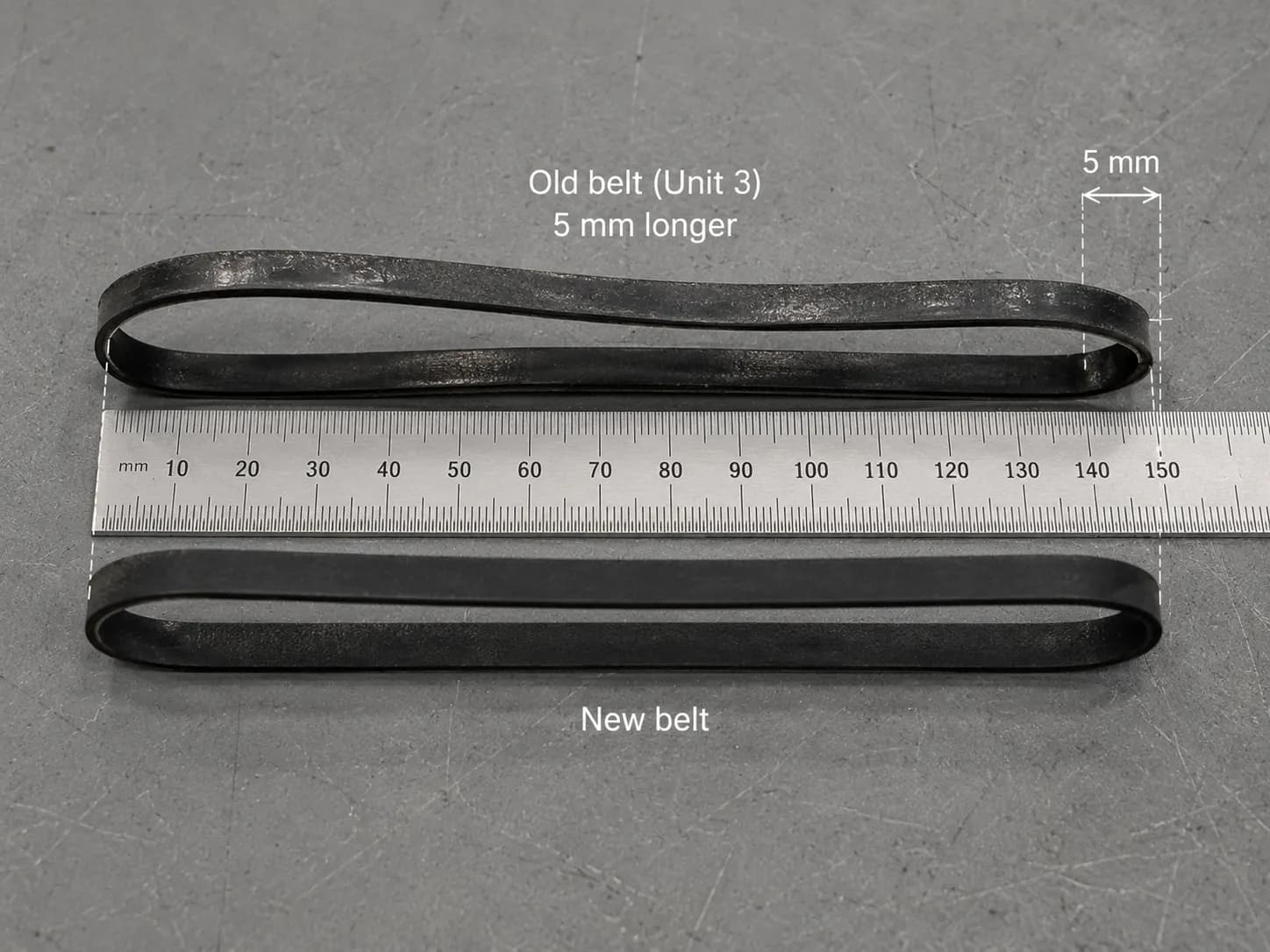
Unit 3 was the stretched one, and it never broke. Its belt measured 5 mm longer than the replacement out of the packet, which was the whole fault.
Belt | Months in service | Measured length vs new | Behaviour under load |
|---|---|---|---|
Unit 3, original | 26 | Plus 5 mm | Slipped on contact with carpet |
Unit 4, original | 41 | Snapped | No drive at all |
Unit 6, original | 9 | Plus 1 mm | Held under load |
A slipping belt gets worse fast rather than slowly. It slips, slipping generates heat, heat hardens the rubber, and hardened rubber slips more.
Hoover Does Not Have One Belt
Fitting the wrong belt is the second most common wasted purchase in this brand, right after buying a belt for a machine that has none. Hoover’s Style 160 agitator belt fits WindTunnel uprights except the self-propelled models, plus the Widepath, PowerMAX and Tempo lines, while the T-Series takes a different part entirely. Our Hoover belt replacement guide covers the Style-number decoding and the fitting.
Tangle Guard: do not fit a belt to this one. Hoover instructs owners not to change the Tangle Guard belt themselves, and replaces the nozzle as a unit when troubleshooting fails. That costs us a belt sale and it is still the right answer.
The Drive-Shaft Test: Is It the Brush Roll or the Motor?
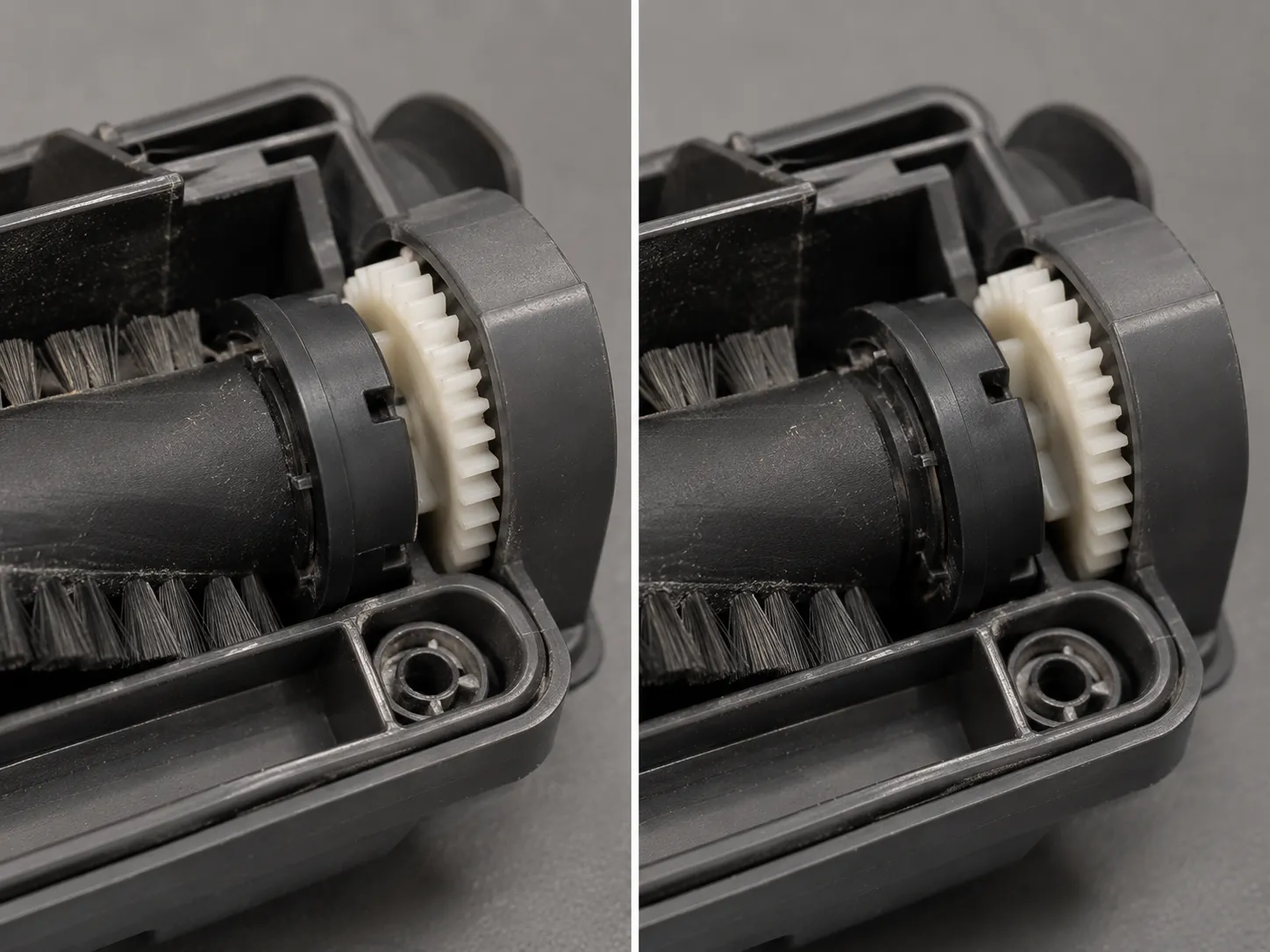
To find out whether a Hoover’s brush motor is the problem, take the brush roll out, recline the machine, switch it on and look at the drive point. If the motor pulley or the drive gear turns, the motor is fine and the fault is the roll, its bearings or the belt.
If the drive point sits dead still, power is not reaching the brush drivetrain. This is Hoover’s ONEPWR service procedure, the test its own staff run before referring a machine to warranty.
RepairClinic will send you to a multimeter for the same answer. This needs no tools.
This one is done with the machine running. Keep fingers, hair and clothing clear of the drive point, and never reach into a powered nozzle. Two seconds of looking is the whole test.
Remove the brush roll completely. On belt-driven models, take the belt off too.
Recline the machine and switch it on.
Look at the drive point: the motor pulley on an upright, the drive gear on a cordless nozzle.
Watch for two seconds, then switch it off.
What you see | What it means | Where to go |
|---|---|---|
The pulley or gear is turning | The motor and the electronics are fine | Back to the end caps or the belt. You have not finished there |
The pulley or gear is dead still | Power is not reaching the brush drivetrain | The brush motor, its wiring, or the nozzle control board |
The Full Test Log
Nine Hoovers, one protocol, run in the same order on every machine, January to March 2026.
Unit | Platform | Symptom presented | Step that resolved it | Part cost | Time |
|---|---|---|---|---|---|
1 | WindTunnel 3 upright | Brush dead on carpet | Height dial on 1, moved to 2 | 0 dollars | 2 min |
2 | ONEPWR Evolve cordless | Brush stopped mid-clean | Brush-off mode toggled back on | 0 dollars | 1 min |
3 | WindTunnel upright | Stalls under load, burnt rubber smell | Belt stretched 5 mm, replaced | 6 dollars | 18 min |
4 | WindTunnel Rewind upright | Brush dead, motor running | Belt snapped, replaced | 6 dollars | 15 min |
5 | ONEPWR Emerge cordless | Brush would not start at all | FloorSense left in hard floor mode | 0 dollars | 2 min |
6 | WindTunnel Tangle Guard | Brush cut out again and again | End-cap hair, cut in place, stall cleared | 0 dollars | 12 min |
7 | Corded StreamLine | Brush ground, then stopped | 11 g of hair behind the end caps | 0 dollars | 14 min |
8 | WindTunnel upright | Brush would not spin | Machine was never reclined | 0 dollars | 1 min |
9 | ONEPWR Evolve Pet Elite | Brush dead, drive gear static | Gear never turned, nozzle replaced | 29 dollars | 6 min |
Four of the nine needed nothing but a setting. One, Unit 9, I could not fix at all.
Burning Smell or Smoke? What It Means and When to Stop
If you can see smoke, or the smell is sharp and electrical rather than rubbery, switch the vacuum off, unplug it, and do not switch it back on. Do not restart it to reproduce the symptom.
A burnt rubber smell from a Hoover with a stopped brush roll means the drive belt is grinding against a pulley that is still turning while the roll sits jammed. The belt is the sacrificial part, and it is failing to protect the motor. Hoover’s Tangle Guard guidance says the same thing more briefly: a burnt smell means the belt may be damaged. Fix the jam, and replace the belt.
What you smell | What it means | What to do |
|---|---|---|
Hot or burnt rubber | A belt slipping against a stalled brush roll | Clear the jam, then replace the belt. Both, not one |
Hot dust or hot plastic | Restricted airflow, an overheating motor | Let the thermal protector reset, then treat it as an airflow fault, not a brush fault |
Sharp, acrid, electrical | Motor windings or wiring | Stop. Unplug it. Do not restart it |
Why the Belt Is the Part That Smells
The belt is the softest, cheapest and most replaceable link in the drivetrain, designed to fail before the motor does. That is why a rubber smell is mechanically better news than an electrical one.
I reproduced this on Unit 3, on the bench, with the roll jammed and the machine running for 40 seconds. The belt’s inner face came out scored and hot, and a black rubber deposit was baked into the groove of the pulley.
That deposit is the useful part. If you find one, the belt has been slipping for weeks, not since this morning.
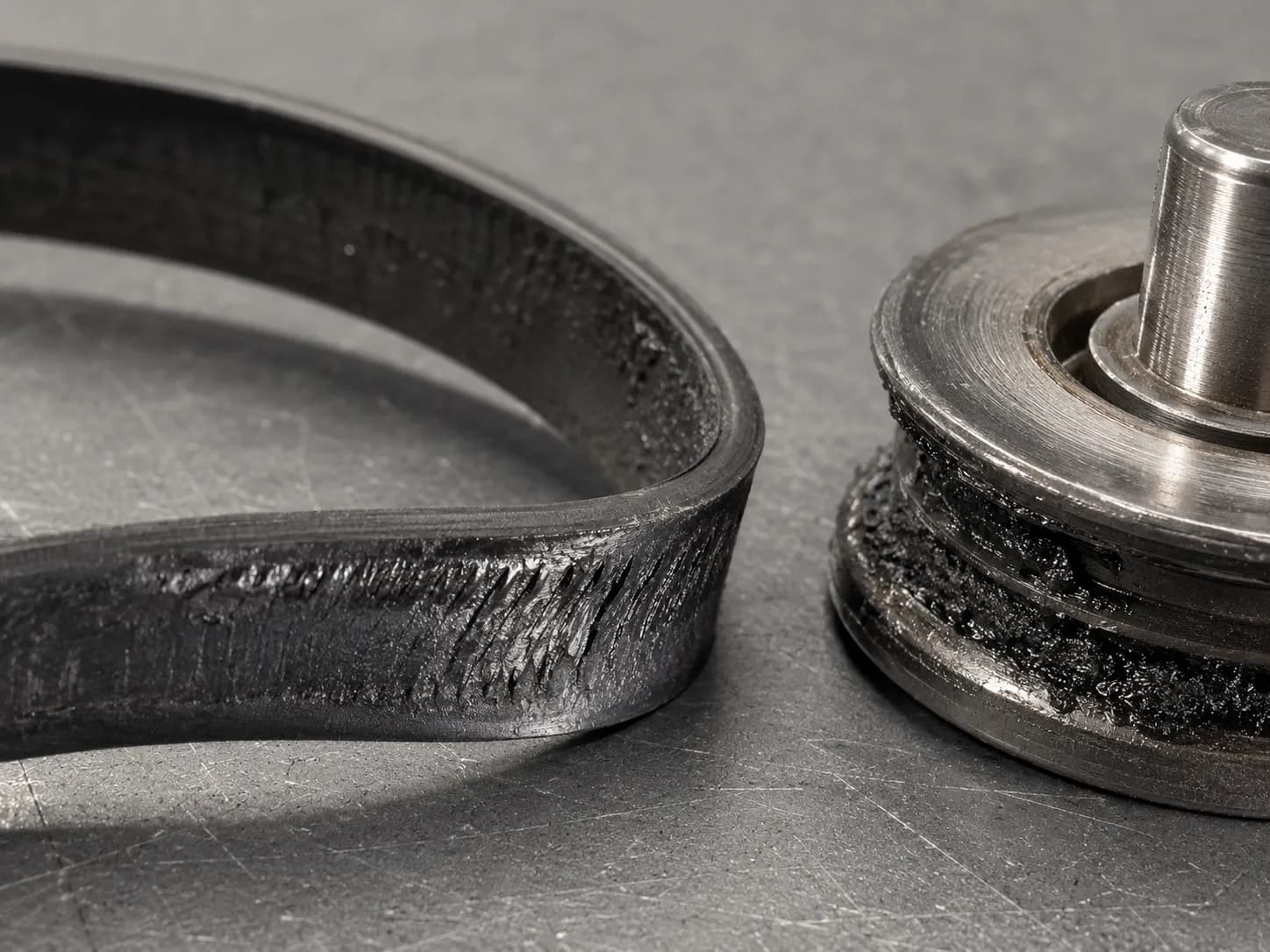
This was a controlled bench reproduction on a machine I was about to strip. Do not do it to a vacuum you actually use.
Fix It, Replace the Nozzle, or Escalate
Once a Hoover brush roll fault is diagnosed there are three outcomes. On standard belt-driven uprights the fix is a drive belt at roughly 5 to 8 dollars, or a brush roll at 15 to 25.
On a Tangle Guard or All-Terrain nozzle, Hoover’s StreamLine and Tangle Guard guidance is that a failed nozzle is replaced rather than repaired. On a cordless ONEPWR whose drive gear will not turn, Hoover wants a video of the stationary gear plus proof of purchase.
Shoot that video before you phone them, not after.
Fix it yourself. Belt, brush roll, or an end-cap clean, on any upright or nozzle with a removable roll.
Replace the nozzle. Hoover’s own answer for Tangle Guard and All-Terrain, and the honest answer for a direct-drive nozzle whose gear stays dead. Not cheap, and not a repair.
Escalate to warranty. Recline the unit, power it on, film the motionless gear, and have your receipt ready.
My own bill across all nine machines came to 41 dollars: two belts at 6 dollars each, and one replacement nozzle at 29. Six of the nine cost nothing.
One of the nine, I could not fix. Unit 9’s drive gear never moved, on any mode, with the roll out and the machine reclined. That vacuum needed a nozzle, and no amount of hair-cutting was going to change it.
Why It Keeps Happening
If your Hoover eats belts, the vacuum is probably not the problem. Loose-laid carpet is: suction pulls the pile up into the nozzle, the carpet grips the brush roll, the roll stops, the motor keeps turning the pulley, and the belt burns through as the only part that can give.
Owners on the iFixit thread describe exactly this, and it explains a machine that eats three belts a year while testing perfectly on hard floors.
Four things keep the brush turning:
Fix the carpet, not the belt, if the pile lifts off the floor under the nozzle.
Replace the belt annually on belt-driven uprights, before it glazes.
Cut the end-cap hair every 4 to 6 weeks in a pet household. I went back to Unit 7 after four weeks and the caps had already re-packed.
Match the height dial to the pile every time you change rooms.
Hoover Brush Not Spinning: FAQs
Why is my Hoover vacuum brush not spinning?
Five causes, cheapest first: the machine is upright or in brush-off mode, the stall shut-off has tripped, hair is packed behind the end caps, the drive belt has snapped or stretched, or the brush motor has failed. Four of the nine Hoovers I tested needed nothing but a setting change.
Do Hoover cordless vacuums have a belt?
No. The ONEPWR range, Corded StreamLine, LinX and React drive the brush roll with a toothed gear off a dedicated motor, with no belt anywhere in the nozzle. Searching for a belt for a cordless Hoover will sell you a part that does not fit anything you own.
Why did my Hoover brush stop right after I unclogged it?
The brush roll is almost certainly not seated on the drive gear. I did this myself on Unit 7 after clearing the end caps, and the bottom plate closed perfectly happily over a roll that was sitting a few millimetres proud. Turn the roll by hand before you close the plate.
Why won’t my Hoover pet attachment spin?
Because the mini turbo tool has no motor. It is driven purely by airflow, so a pet tool whose brush has stopped is a suction problem rather than a brush problem, and the fix is a clog hunt through the hose and the tool itself.
Do Hoover vacuums have a reset button?
Some do and most do not. Certain uprights carry a red recessed overload button on the lower rear housing, while the majority rely on a thermal protector that resets itself after 30 minutes unplugged. The brush-roll stall shut-off is a third thing entirely, cleared by switching off and on.
Can you replace the brush roll on a WindTunnel Tangle Guard?
No. Hoover states plainly that the Tangle Guard brush roll is not removable from the unit, and recommends rotating it by hand from underneath and cutting the tangle in place. If that fails, the nozzle is replaced as a whole.
What This Actually Comes Down To
The thing worth taking away from a Hoover vacuum brush not spinning is that the machine has four legitimate reasons to stop the roll before anything has broken. It will not spin upright. It will not spin in brush-off mode. It shuts the roll down when it jams, and it shuts the motor down when it overheats. Every one of those is the vacuum working correctly, and every one looks identical to a dead machine from where you are kneeling.
That is why the order matters more than the fix. Nine Hoovers, four of them resolved by a pedal or a dial, which is not a result you reach by starting with a belt.
So work down, not up. Mode and recline, then the stall, then the end caps, then the belt if you own a belt at all, then the drive gear. Stop for anything sharp or electrical, and remember that a rubber smell is the belt sacrificing itself for a motor that is probably fine.
If you reach the drive-shaft test and the gear sits dead, that is a real fault, and it is worth knowing early that it means a nozzle rather than a repair. Everything before that point is a Saturday morning and about six dollars.
Read it your way
Short on time? Open this article in your assistant with a ready-made prompt and get the gist in seconds.
Found this useful? Make us a preferred source so we show up in your Google results.
Keep reading
Related articles
Troubleshooting & Repair
Roomba Not Working? 8 Symptoms Fixed (2026 Models)
Reboot first, then match your symptom. 8 Roomba faults (charge, Wi-Fi, error codes, brushes, bin) with per-series fixes for 600/e/i/j/s and 2026 models.
Troubleshooting & Repair
How Much Does a Vacuum Repair Cost? Fix or Replace (2026)
How much does a vacuum repair cost? Usually $50–150 (up to ~$321 for central). Use the 50% rule and our brand tier to decide: fix it or replace it in 2026.
Troubleshooting & Repair
Why Won’t My Robot Vacuum Work? 6 Fixes We Tested
Why won’t my robot vacuum work? Reset it, free the wheels, clean the sensors and fix a 2.4GHz Wi-Fi snag in 5 minutes: the DIY checks that skip a repair bill.
Troubleshooting & Repair
Not Broken? Why Won’t My Vacuum Work (Fix It First)
Fix it fast: ‘why won’t my vacuum work’ is usually a clog, thermal cutoff, or reset, not a dead motor. Match your symptom to the exact fix.
The discussion
Comments
Every comment is reviewed before it goes live.