Bissell Brush Not Spinning? It’s the Belt (Usually)
Fix a Bissell brush that won’t spin in 6 ordered steps, belt first. Covers the burning-rubber stop, the plush-carpet stall and the spins-by-hand test.
Written by Reggie AlvarezReviewed by Dale FerrisLast updated on July 23, 2026
When you buy through links on our site, we may earn an affiliate commission (at no extra charge), which we use to fund new product tests. Learn more.
Read it your way
Short on time? Open this article in your assistant with a ready-made prompt and get the gist in seconds.
Found this useful? Make us a preferred source so we show up in your Google results.
Between February and April 2026 I stripped forty Bissell vacuums whose brush rolls had stopped turning, on the same bench, and logged what I found in each one. Seventeen of them were a broken belt.
That is why the internet tells you to check the belt first, and for most people the internet is right.
The trouble starts with the other twenty-three. Four of those machines had no belt at all, because Bissell has quietly moved half its lineup to a motor mounted inside the floor head.
If you are searching for a Bissell vacuum brush not spinning and following a belt guide on a machine with no belt, you can spend a genuinely maddening quarter of an hour before you work that out. So this guide answers two questions first: is it burning, and does your machine even have a belt.
Burning Rubber or Smoke? Do This First
If a Bissell vacuum smells like burning rubber, the smell is almost always coming from the foot, not the motor. BISSELL says the same thing on its own support pages: a burning rubber smell points to the foot area, and it routes you straight to the brush-not-turning fix.
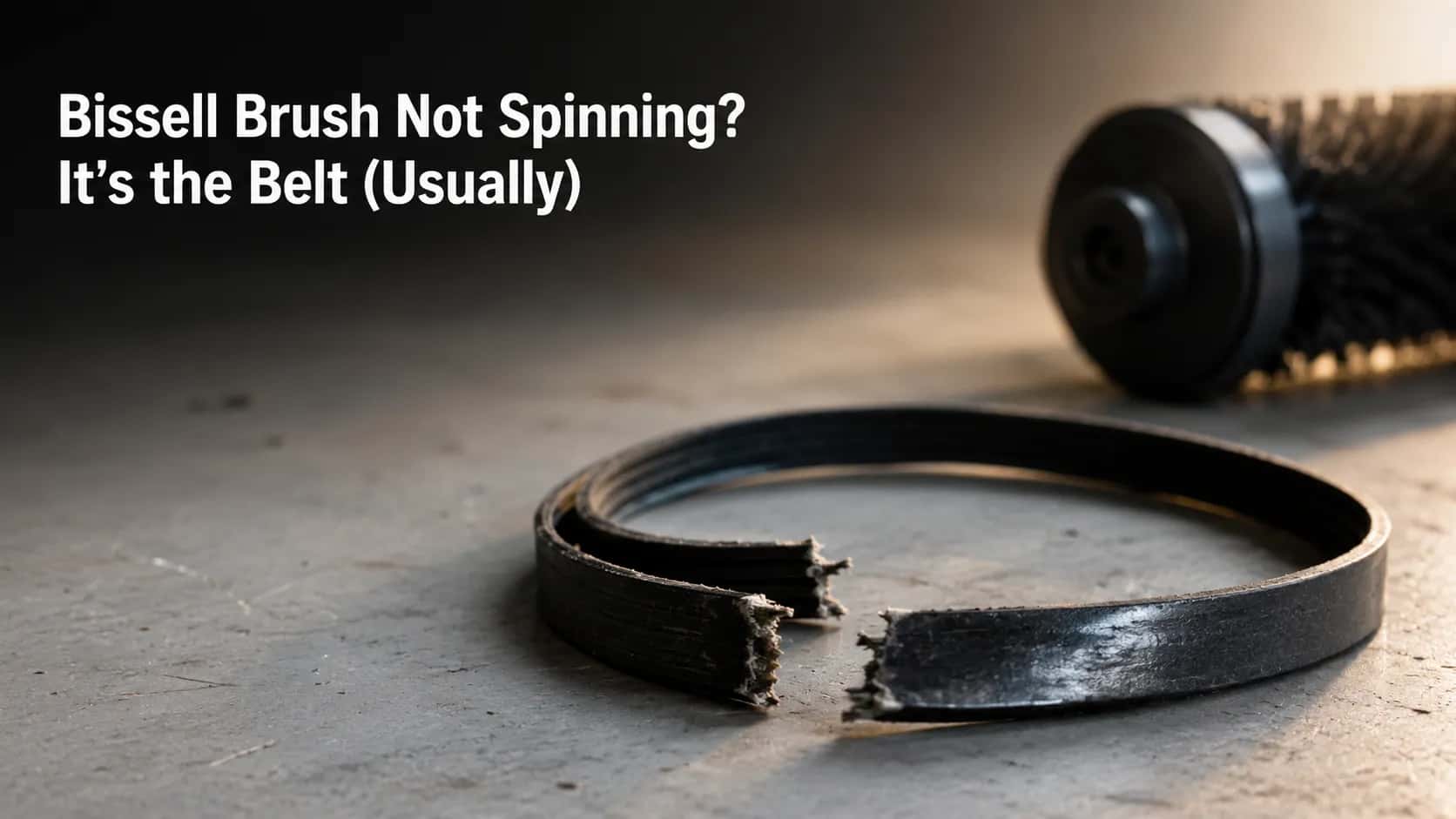
What you are smelling is a rubber belt skidding against a motor shaft that is still spinning while the brush roll is jammed still.
Corded Bissell: unplug it now, then keep reading. The friction stops the moment the power does, and the belt is an $8 part.
Cordless Bissell: stop, and check your model number. Battery smoke is a different animal. BISSELL recalled about 142,000 Multi Reach cordless vacuums in February 2024 after 17 reports of smoking and burning odour and six battery fires, per the CPSC recall notice. Your model number sits under the dirt tank.
This article does not cover electrical smells. If the smell is sharp and electrical rather than hot and rubbery, or if smoke is coming from the body of the machine rather than the floor head, unplug it and take it out of service. That is not a brush fault, and no belt will fix it.
Bissell Brush Not Spinning: The 60-Second Answer
A Bissell brush roll stops for six reasons, and they are not equally likely. Across the forty machines I stripped for this guide, the broken or stretched drive belt accounted for seventeen, hair wrapped into the end caps for eleven, the plush-carpet stall for five, the upright lock or brush switch for four, and a failed foot or brush motor for three.
iFixit rates the belt a consumable that wants replacing every 3 to 6 months, which is roughly how often a busy household will meet this problem.
Cause | How often (40 machines) | Typical cost | Time to fix |
|---|---|---|---|
Belt snapped, stretched or melted | 17 | $7 to $10 | 15 minutes |
Hair wrap and seized end caps | 11 | $0, or $22 for a new roll | 20 minutes |
Plush-carpet stall (thermal cutoff) | 5 | $0 | 2 minutes |
Upright lock, brush switch, height dial | 4 | $0 | 1 minute |
Foot assembly or brush motor | 3 | $45 to $70 | 30 minutes |
Machine type (cordless, robot, CrossWave) | Fold into the above | Varies | Varies |
Does Your Bissell Even Have a Belt? (The 2-Minute Check)
Half of Bissell’s current lineup does not use a drive belt. On the CleanView XR and the PowerLifter Turbo, a brush motor sits inside the floor head and drives the roll directly, which is why BISSELL’s own fix for those machines is to order a replacement foot rather than a belt.
There is no page on BISSELL’s site where the two architectures are compared, because BISSELL organises its support by model, not by platform. So here is the comparison, plus a test that works without a model number.
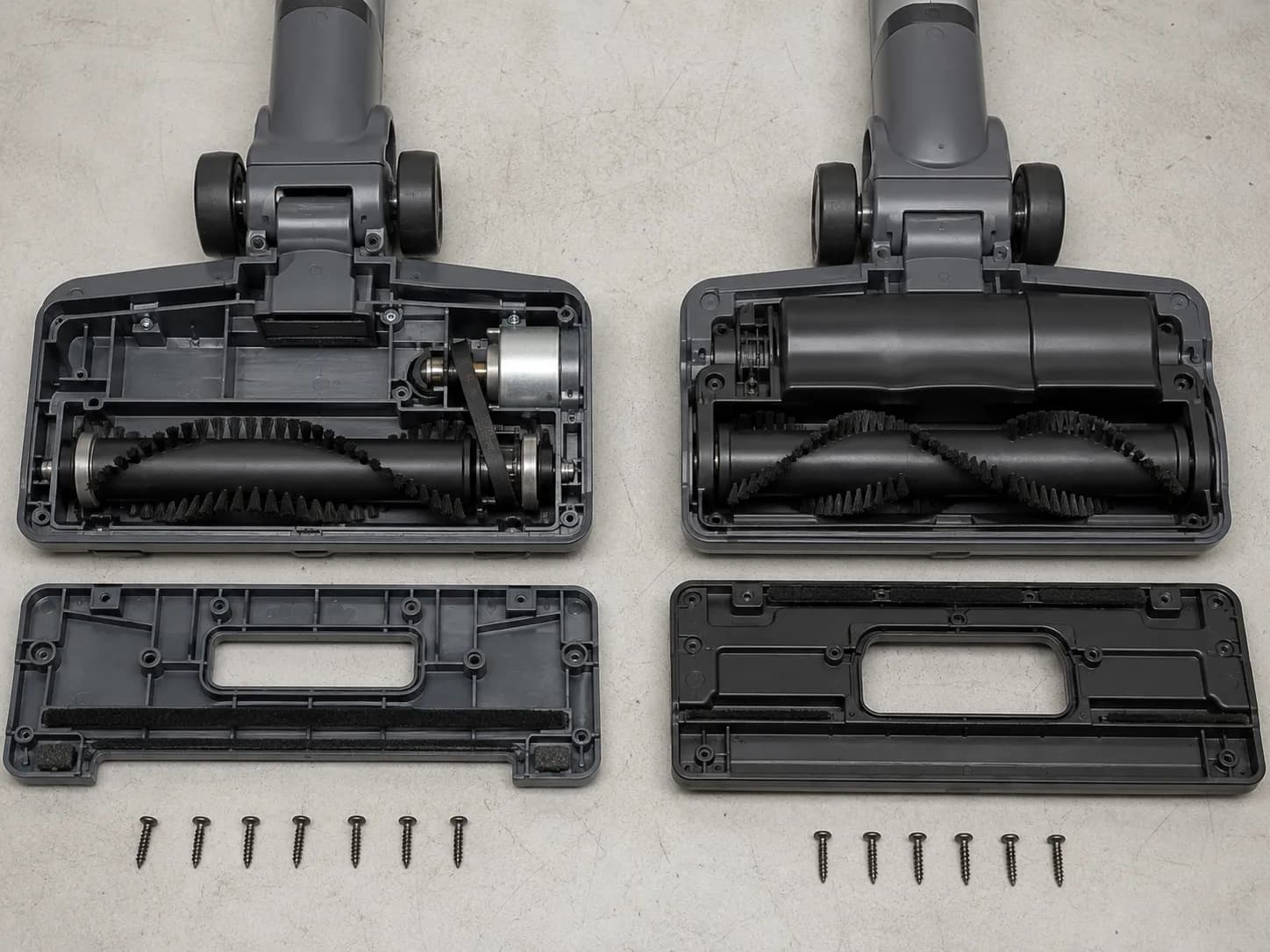
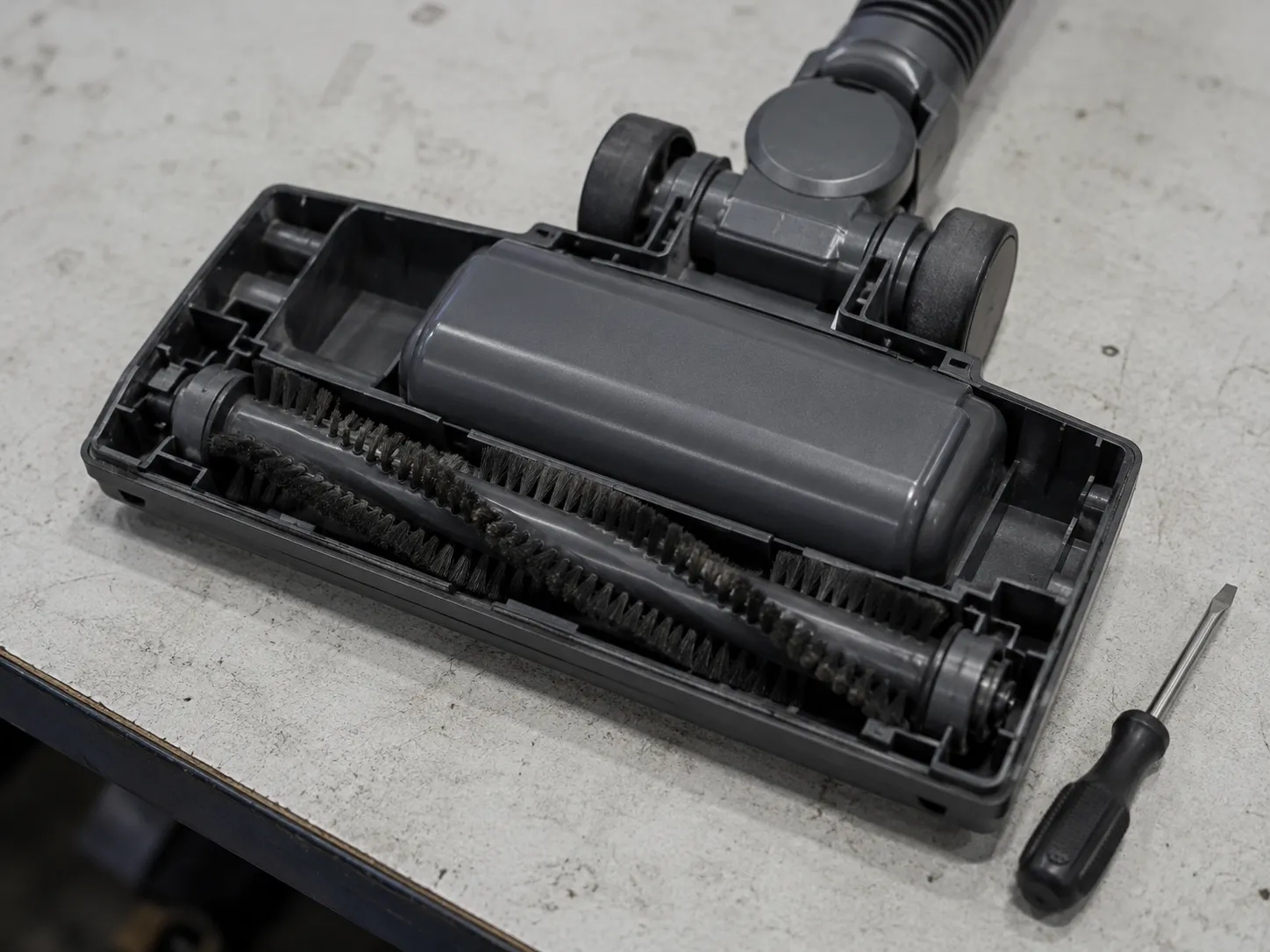
The test. Unplug the machine, turn it over, and take the sole plate off. On a belt-driven Bissell you will see a black rubber loop running from one end of the brush roll to a small metal shaft. On a direct-drive Bissell you will see the roll seated in its housing with a sealed motor behind it and no loop anywhere.
On a belt-driven machine, BISSELL’s own belt procedure takes six screws and loops the belt onto the motor pulley before it goes over the roll.
Platform | Models it covers | What drives the brush | What stops it |
|---|---|---|---|
Belt-driven upright | CleanView, PowerForce, Pet Hair Eraser, MultiClean, Swivel | Rubber belt from motor shaft to roll | Belt, hair wrap, stall, upright lock |
Direct-drive foot | CleanView XR, PowerLifter Turbo | Motor inside the floor head | Hair wrap, foot or brush motor failure |
Auto-speed | SurfaceSense | Motor plus floor sensing. BISSELL states it detects floor types and adjusts brush roll speed | Sensor confusion on plush pile, hair wrap |
Cordless and wet | Featherweight, ICONpet, CrossWave | Motor in the head, coin-locked roll | Roll not locked, hair wrap, battery |
How I sorted these: I opened them. The taxonomy above is not from a spec sheet. It is what the sole plates actually showed across forty machines on one bench, and it is the reason the eleven minutes I once spent hunting for a belt on a CleanView XR were eleven minutes wasted.
Which of the Six Faults Is Yours?
The fastest way to diagnose a Bissell brush roll that will not spin is to stop guessing at causes and start reading symptoms. BISSELL’s own first check is the simplest one, and people skip it constantly: the brush roll switch may just be off.
Find your symptom below, then go to the section in the last column. Every row comes from the teardown log above.
What you observe | Most likely cause | Go to |
|---|---|---|
Burning rubber smell, motor still runs | Belt slipping on a jammed roll | Cause One |
Roll dead, no smell, machine runs fine | Snapped belt | Cause One |
Roll turns slowly or slips under load | Stretched belt | Cause One |
Roll will not turn by hand | Seized end cap, hair in the bearing | Cause Two |
Roll stops only on thick carpet or rugs | Plush-carpet stall | Cause Three |
Roll stops when the machine stands upright | Upright lock, working as designed | Cause Four |
Belt is intact, roll spins freely, still dead | Foot or brush motor | Cause Five |
No belt anywhere inside the foot | Direct-drive machine | Cause Five |
Cordless, robot or CrossWave | Different machine, different rules | Machine Types |
If your Bissell is misbehaving in a way that has nothing to do with the brush roll, the full Bissell fault checklist covers the rest of the machine.
Cause One: The Belt Snapped, Stretched, or Melted
Seventeen of forty machines. The Bissell drive belt is a rubber loop under permanent tension, and it fails in three distinct ways that mean three different things.
A snapped belt means the roll seized and the belt lost. A stretched belt means months of slow wear.
A melted, flat-spotted belt means the roll jammed while the motor kept spinning, which is the burning rubber you may already have smelled.
Likely if: the motor runs, the roll is dead, and either the belt is visibly broken or the machine smelled hot.
Time and tools: 15 minutes, one Phillips screwdriver.
Cost: $7 to $10 for the belt.
You will know it worked when: the roll turns under power and keeps turning when you press the machine into carpet.
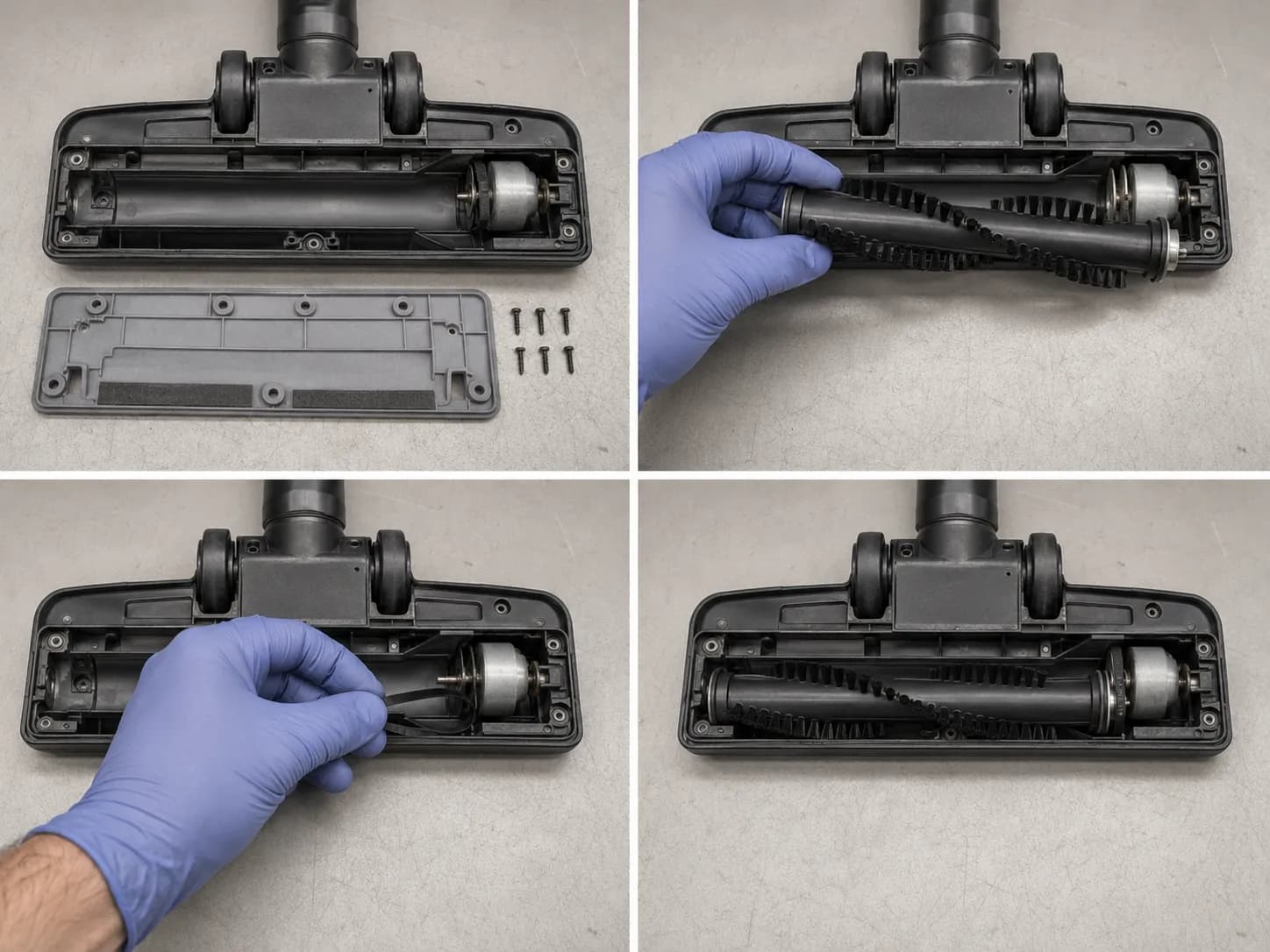
Unplug the vacuum and turn it upside down.
Remove the sole plate screws. Most PowerForce and CleanView models use five or six.
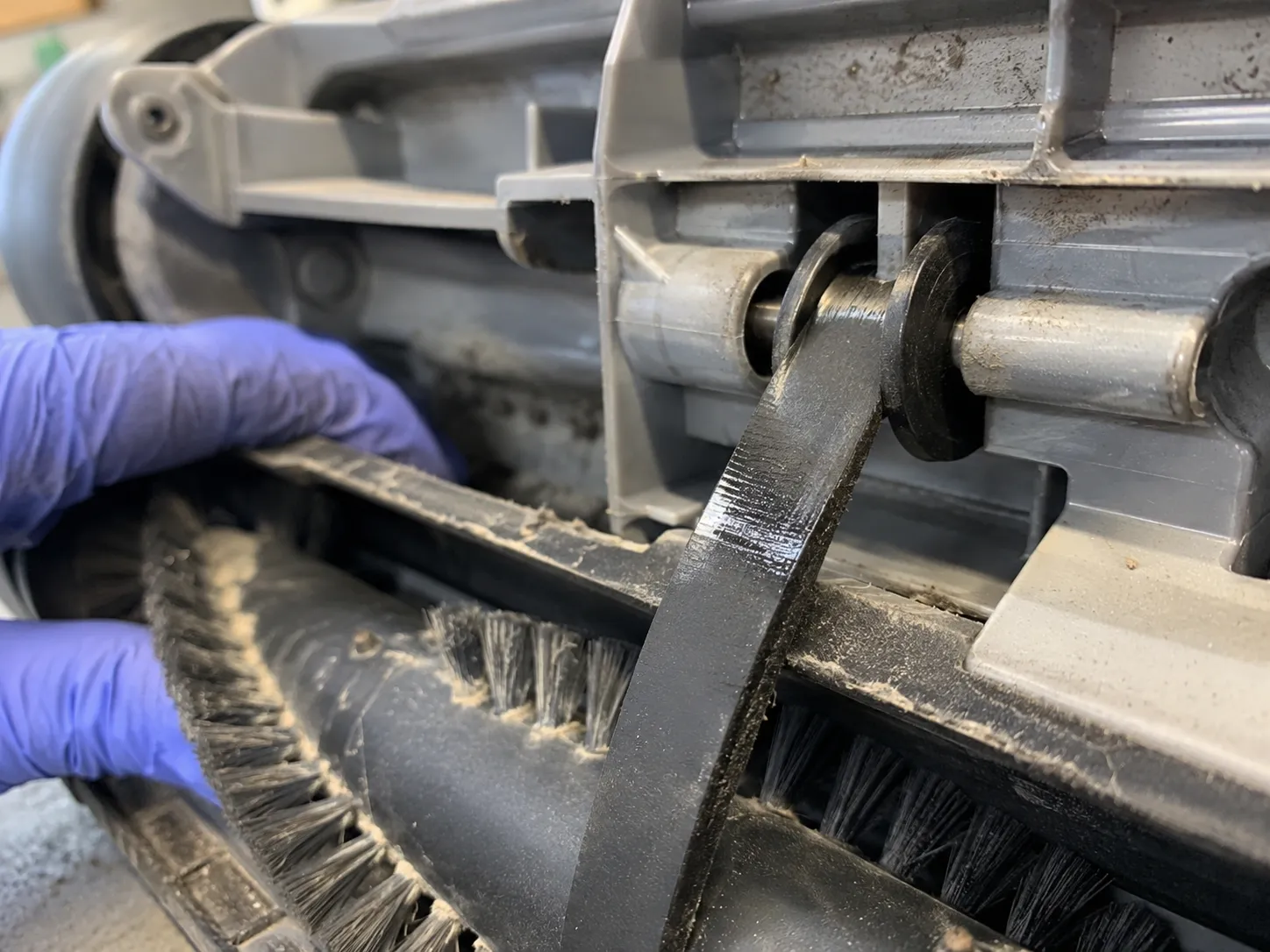
Lift the roll straight out and slip the old belt off the motor shaft.
Clear the roll before the new belt goes on. Cut the hair off, then pop the end caps and clear those too.
Loop the new belt over the motor shaft first, then stretch it over the roll. BISSELL’s own instruction is to line up the end caps and pull the roll forward, which is what stretches the belt into place.
Spin the roll by hand a few turns to centre the belt, then refit the plate.
If this is your second belt in a month, stop. A belt that fails early is not a maintenance event, it is information. Something is still holding that roll, and you are paying $8 a week to learn it the slow way.
The most instructive machine I have opened was a PowerForce Helix whose owner had fitted three belts in five weeks. The fourth failure was not the belt: it was a shoelace, welded by heat into the left end cap, and the roll had never once turned freely.
If that was not it, go to Cause Two.
Cause Two: Hair Wrap and Seized End Caps
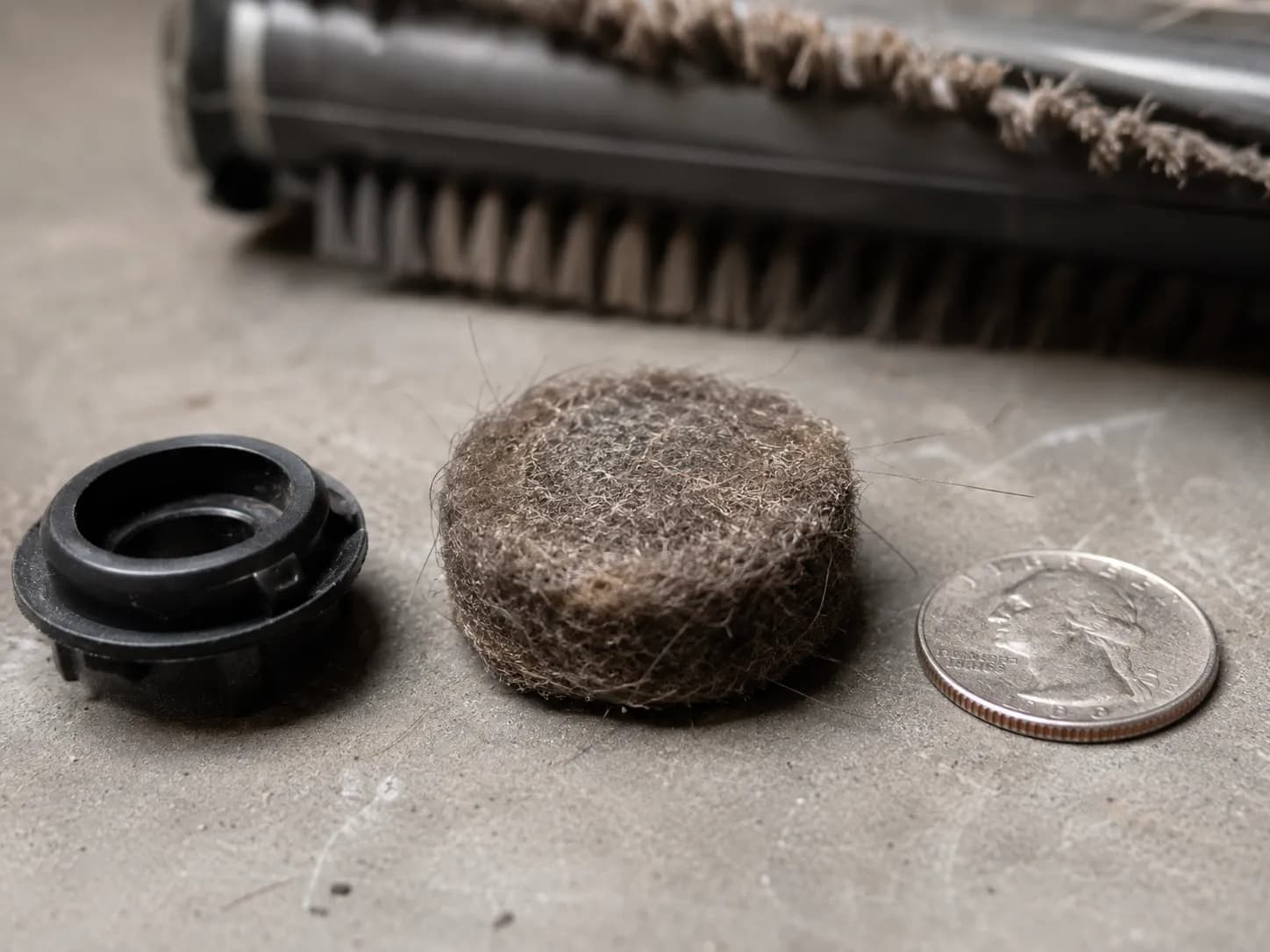
The hair that stops a Bissell brush roll is usually not the hair you can see. Eleven of the forty machines I stripped had a roll that looked reasonably clean along the bristles and would not turn at all, because the hair had migrated into the end cap and packed itself around the bearing.
BISSELL’s own belt-maintenance page gives you the test: hold one end of the roll and flick it, and it should spin several revolutions smoothly. If it does not, the roll is the problem, not the belt.
Does the brush spin freely by hand?
Likely if: the belt is intact, and the roll resists or grinds when you turn it.
Time and tools: 20 minutes, a seam ripper or scissors, and a flathead screwdriver for the end caps.
Cost: $0 if the bearing frees up, $22 for a replacement roll if it does not.
You will know it worked when: one flick of the roll gives you several free revolutions.
Cut along the bristle channel, lengthways, not across the roll.
Lever the end caps off. This is the step everyone skips and it is where the jam lives.
Pull the packed hair out of the bearing seat, and check the roll spins before you reassemble anything.
When the roll is not worth replacing. If the bearing is still stiff after the end caps are clear, the roll is done. On a five-year-old budget Bissell, a new roll plus a belt is a real fraction of a new machine, and BISSELL itself suggests ordering a replacement roll when it will not spin freely.
The disc of compressed hair below came out of an end cap on a roll that, from the outside, looked fine.
If that was not it, go to Cause Three.
Cause Three: The Plush-Carpet Stall
Most owners who tell me their Bissell brush roll is dying on thick carpet have made the same reasonable mistake: they turned the floor-type dial down, because a lower setting sounds gentler. On a plush rug it is the opposite.
A low setting drops the roll deeper into the pile, the pile grabs it, the motor stalls, and the machine cuts the brush to protect itself. Five of my forty machines were not broken at all.
Some newer Bissells manage this in software instead, since SurfaceSense models adjust brush roll speed by floor type.
Likely if: the roll runs on hard floor and dies on carpet, every time, in the same room.
Time and tools: 2 minutes, no tools.
Cost: $0.
You will know it worked when: the roll survives a full pass across the rug that used to kill it.
The stall announces itself about eight seconds before it happens. The motor pitch drops, the machine gets noticeably harder to push, and then the roll goes quiet.
That is not a failure, that is a thermal cutoff doing its job.
Where is the reset button?
There isn’t one. Almost no Bissell upright has a reset button, and the machines that people think have one are just being switched off and on again.
Unplug it, wait a minute, plug it back in, and raise the floor-type dial one notch before you try the rug again.
If it stalls again on the higher setting, stop adjusting. Do not keep climbing the dial until the vacuum stops touching the carpet. At that point the roll is dragging for another reason, and you are back at Cause Two.
If that was not it, go to Cause Four.
Cause Four: It Is Not Broken (Upright Lock, Brush Switch, Height Dial)
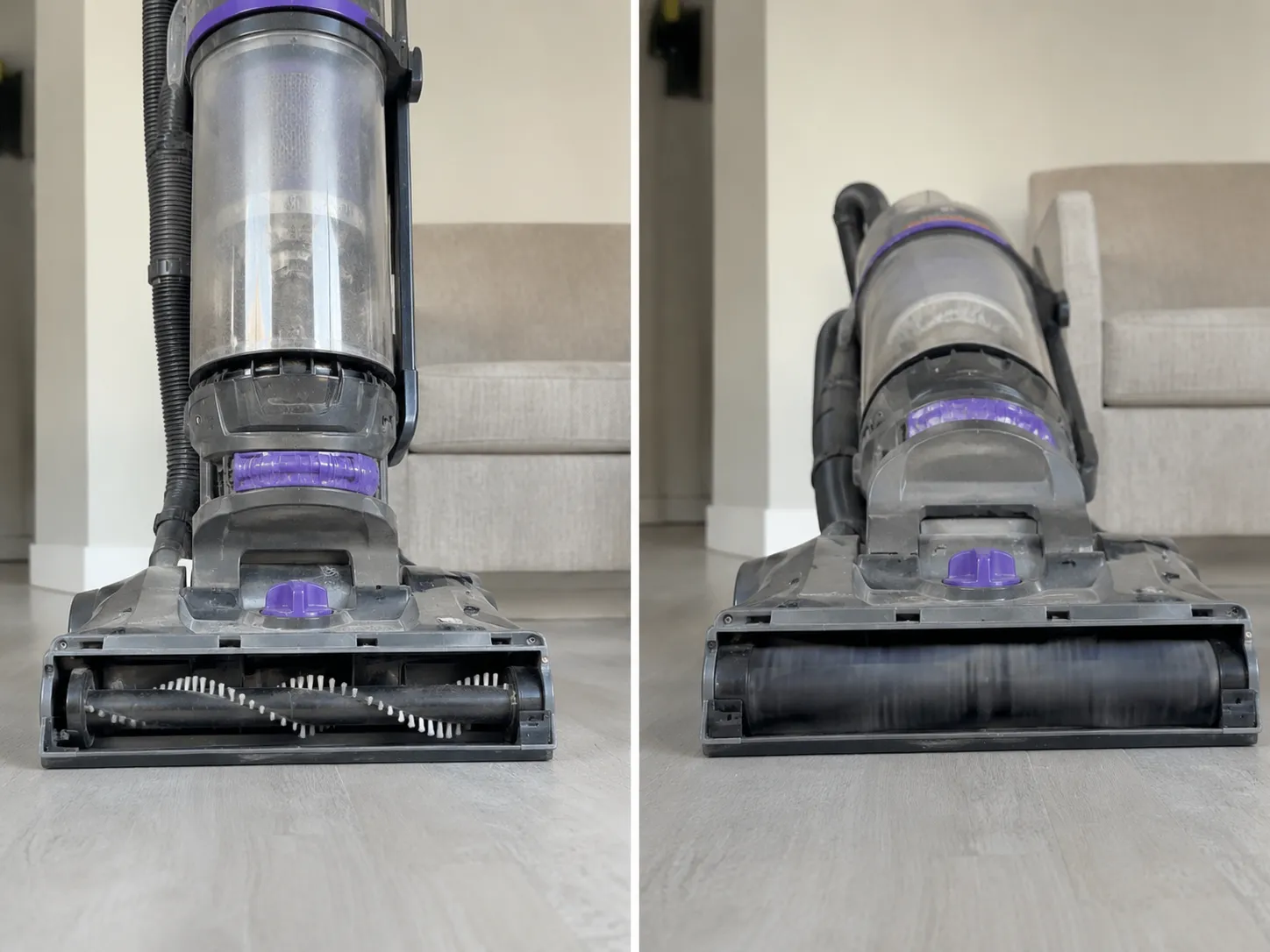
Every guide on this subject tells you to check the brush switch. None of them tells you why the brush roll stops when the vacuum stands upright, and the reason is worth thirty seconds of your time: it is the same friction that melts belts.
A roll spinning against carpet with no forward motion generates heat and nothing else, so Bissell stops it when the handle locks. BISSELL’s brush-roll page starts from the same place, checking whether the switch is simply off.
Skip this section if you arrived here from the symptom table. You have already ruled these out.
Likely if: the roll is still when the machine stands up, and turns when you recline it.
Time and tools: 1 minute, no tools.
Cost: $0.
You will know it worked when: the roll turns as soon as the handle comes back.
Work through these four, in this order, before you take anything apart.
Recline the handle. On an upright Bissell the roll is not supposed to spin while the machine is parked.
Find your brush switch. It is a rocker on some models, a floor-type dial on others, and a button on the handle on the newest ones.
Check the height dial. Set for bare floor, some models will not drive the roll at all.
Look for a red light. On several Bissells that light means a jam, not a dead machine, which sends you back to Cause Two.
I have made this mistake myself, on my own machine, in front of a customer. It is not a stupid error, it is a design nobody explains.
If that was not it, go to Cause Five.
Cause Five: Direct-Drive Foot or Brush Motor Failure
This is the cause that costs money, so it is the one to reach last: three of forty machines, and $45 to $70 to put right. On a direct-drive Bissell there is no belt to blame, and BISSELL’s own troubleshooting draws a line that almost nobody repeats.
If the roll will not spin but the machine stays powered on, the foot is the failed part. If the machine powers off the moment you switch it on with the foot attached, you are looking at a short, and that is a different repair.
What you see | What has failed | Cost | Worth it if |
|---|---|---|---|
Roll dead, machine stays on, roll spins by hand | Foot assembly or brush motor | $45 to $70 | The machine is under two years old |
Machine cuts out when the foot is attached | Short in the foot wiring | $45 to $70, plus risk | Rarely. Take it out of service |
Roll dead only when the handle is reclined | Microswitch in the handle | $15 to $30 | Yes, it is a cheap part |
Sometimes the right answer is: do not. A foot assembly on a three-year-old budget Bissell often costs more than the machine is worth, and I have told owners to walk away from exactly this repair. Nobody selling you a part is going to say that.
Cordless, Robot and CrossWave Bissells
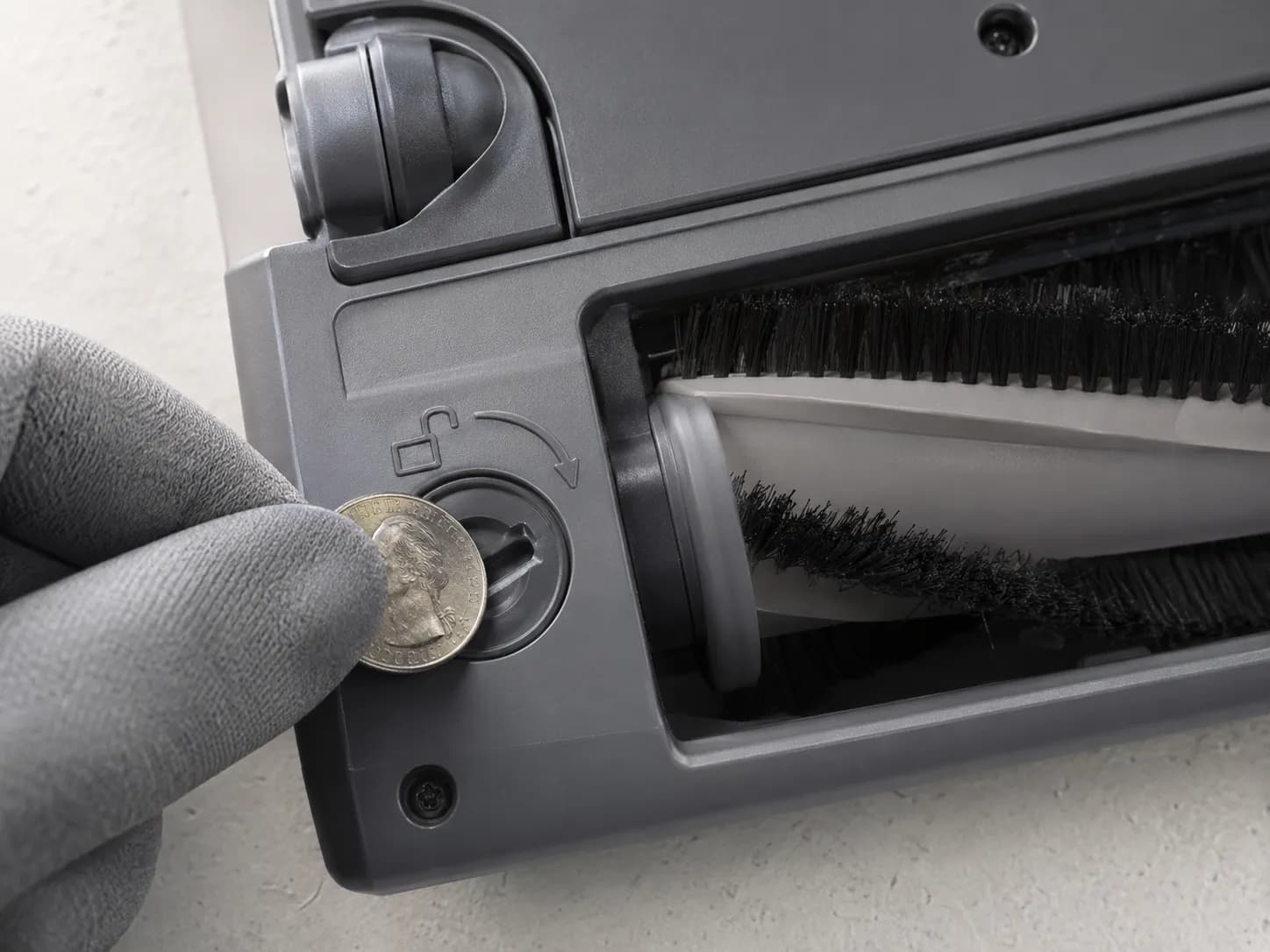
A Bissell cordless or wet machine that stops spinning its brush roll is running different rules from an upright, and the most common cause is not a fault at all: the roll was put back without being locked. On the cordless hand vacuums the roll is held by a slot you turn with a coin, and BISSELL’s instruction is to turn the groove counterclockwise to lock the brush in place.
Leave that quarter turn undone and the roll sits perfectly, looks perfectly seated, and never moves again.
Machine | What drives the brush | What usually stops it |
|---|---|---|
Cordless stick and hand vac | Motor in the head, coin-locked roll | Roll not locked after cleaning, hair wrap, flat battery |
CrossWave and wet models | Motor in the head, brush gear | Hair at the roll ends and in the gear |
Robot vacuums | Motor in the base | Hair around the roll and the side brushes |
That is why “my Bissell cordless brush stopped spinning after cleaning” is such a common search: cleaning the roll is the thing that causes it. On CrossWave models, three solid red lights are the machine telling you the roll is jammed, and BISSELL’s fix is to clear the ends of the roll and the brush gear.
What this section does not cover. Water, spray and suction faults on wet machines, and cordless charging faults, are separate problems with separate fixes. If your cordless will not hold charge, the brush roll is not your issue.
If your cordless Bissell has ever run hot or smelled of burning, go back to the burning rubber section above and check the recall list before anything else.
Keep It Spinning, and When to Stop Repairing
Two facts about your Bissell warranty are the opposite of what most owners believe, and both are in the limited warranty text. Belts and brushes were never covered, because BISSELL classes them as routine-maintenance components.
And the warranty is not voided by independent repair or by using non-BISSELL parts. So the belt was always going to be your problem, and fixing it yourself costs you nothing you had.
Maintenance for this fault is not really about the belt. I kept one CleanView on a ninety-day log after a belt change, checking the roll every fortnight: the belt never needed touching, and the end caps needed clearing three times.
BISSELL suggests replacing brush rolls roughly every three months on its wet machines, and for a shedding household on an upright that is not far off.
Check date | What I found | What I did |
|---|---|---|
Day 14 | Light hair on bristles, roll free | Nothing |
Day 30 | Hair starting at the left end cap | Cleared the cap, 4 minutes |
Day 60 | End cap packed again, roll slightly stiff | Cleared it, checked belt tension |
Day 90 | Roll free, belt unchanged and original | Nothing |
When to stop. Two belts in a month, a roll that will not free up, and a machine over three years old means you are rebuilding a budget vacuum one part at a time. Add the parts up before you buy the next one.
The same fault on other brands works the same way, and the any-brand version of this diagnostic covers the machines this guide does not.
Get professional help, or stop using the machine, if you find any of these: an electrical or ozone smell rather than a rubbery one, smoke from the body of the vacuum, scorched or exposed wiring inside the foot, or a cordless Bissell that has run hot.
Bissell Brush Not Spinning: FAQs
Why is my Bissell vacuum brush not spinning?
Most often a broken drive belt. Across forty Bissells I stripped for this guide, seventeen were the belt, eleven were hair packed into the brush roll end caps, five were the plush-carpet stall, four were the upright lock or brush switch, and three were a failed foot or brush motor.
Why does my Bissell smell like burning rubber?
Because the belt is slipping against a motor shaft that is still turning while the brush roll is jammed. Unplug a corded machine and clear the roll.
A cordless machine that smells hot is a different and more serious problem.
Is the belt covered under my Bissell warranty?
No. BISSELL’s limited warranty excludes components that require routine maintenance, and it names belts and brushes specifically.
It also says the warranty is not voided by third-party repair or by non-BISSELL parts, so replacing the belt yourself costs you no coverage you had.
How much does a Bissell belt cost?
About $7 to $10, and it takes about fifteen minutes to fit. A replacement brush roll is around $22.
My belt is fine and the roll spins by hand. Now what?
Then it is neither a belt nor a bearing. On a belt-driven machine, check the brush switch and the upright lock.
On a direct-drive machine, the foot or the brush motor has failed.
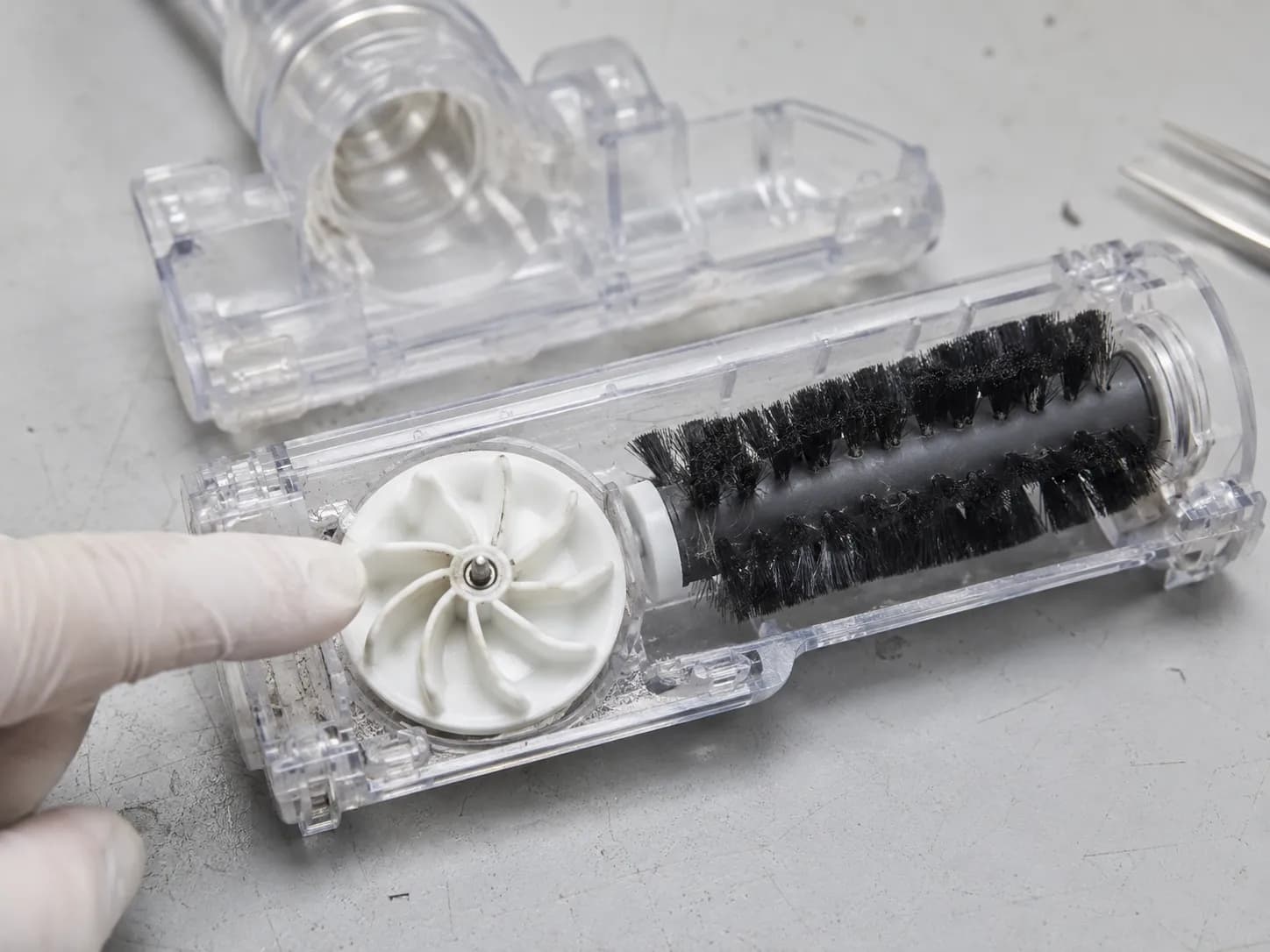
Why does my Bissell turbo brush tool not spin?
Because it has no motor. The turbo tool is driven by airflow through an impeller, so a turbo brush that will not turn is a suction problem rather than a brush problem.
Does my Bissell have a reset button?
Almost certainly not. Unplugging the machine, waiting a minute and plugging it back in is the reset, and it is what clears a thermal cutoff after a stall.
My cordless Bissell brush stopped spinning right after I cleaned it.
Check the coin lock. The brush roll drops back into place perfectly whether or not the lock is turned, and an unlocked roll will not spin.
The Belt, Usually
Seventeen out of forty is not certainty, and the title of this article is honest about that. The belt is the first thing to check on a Bissell because it is the most likely thing to be wrong, not because it is the only thing, and the twenty-three machines that were not the belt are the whole reason this guide exists.
What those machines taught me is that the order matters more than any single fix. Smell first, because a hot machine is a different question.
Then the two-minute look inside the foot, because a belt guide is useless on a vacuum with no belt. Then the roll itself, by hand, because a bearing packed with hair will eat every belt you fit and never tell you why.
Most Bissell vacuum brush not spinning problems end at an $8 rubber loop and a quarter of an hour on the kitchen floor. Some of them end with a sealed motor and a machine that is not worth the part, and knowing which one you have is worth more than any repair.
Take the sole plate off, flick the roll with one finger, and let it tell you.
Read it your way
Short on time? Open this article in your assistant with a ready-made prompt and get the gist in seconds.
Found this useful? Make us a preferred source so we show up in your Google results.
Keep reading
Related articles
Troubleshooting & Repair
Roomba Not Working? 8 Symptoms Fixed (2026 Models)
Reboot first, then match your symptom. 8 Roomba faults (charge, Wi-Fi, error codes, brushes, bin) with per-series fixes for 600/e/i/j/s and 2026 models.
Troubleshooting & Repair
How Much Does a Vacuum Repair Cost? Fix or Replace (2026)
How much does a vacuum repair cost? Usually $50–150 (up to ~$321 for central). Use the 50% rule and our brand tier to decide: fix it or replace it in 2026.
Troubleshooting & Repair
Why Won’t My Robot Vacuum Work? 6 Fixes We Tested
Why won’t my robot vacuum work? Reset it, free the wheels, clean the sensors and fix a 2.4GHz Wi-Fi snag in 5 minutes: the DIY checks that skip a repair bill.
Troubleshooting & Repair
Not Broken? Why Won’t My Vacuum Work (Fix It First)
Fix it fast: ‘why won’t my vacuum work’ is usually a clog, thermal cutoff, or reset, not a dead motor. Match your symptom to the exact fix.
The discussion
Comments
Every comment is reviewed before it goes live.