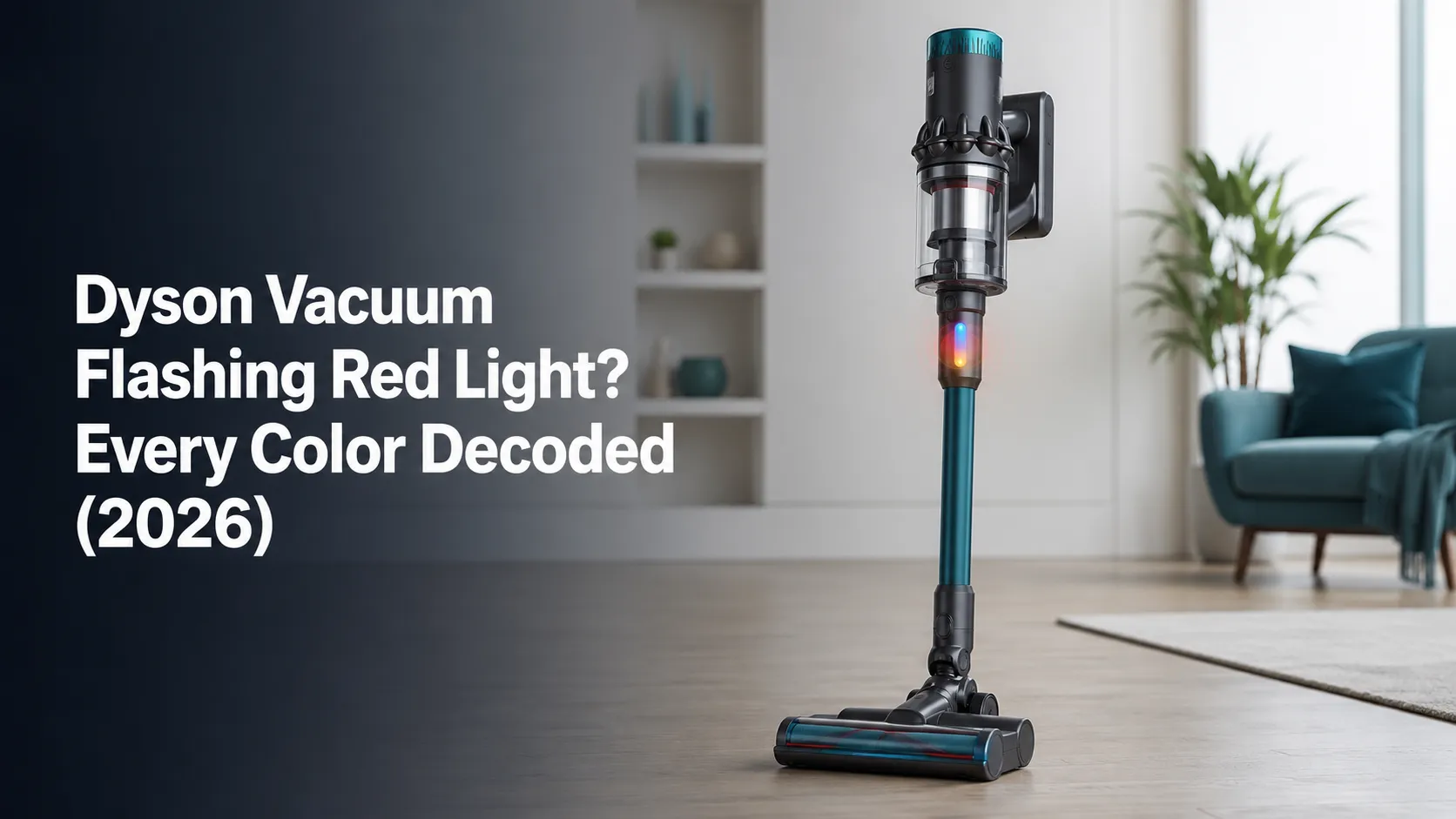
Dyson Vacuum Flashing Red Light? Every Color Decoded (2026)
Decode every Dyson vacuum light: flashing red means battery, blue is charging, amber is temperature. Color-by-color fixes for V6–Gen5, plus the LCD icons.
Written by Reggie AlvarezReviewed by Dale FerrisLast updated on August 17, 2026
When you buy through links on our site, we may earn an affiliate commission (at no extra charge), which we use to fund new product tests. Learn more.
Read it your way
Short on time? Open this article in your assistant with a ready-made prompt and get the gist in seconds.
Found this useful? Make us a preferred source so we show up in your Google results.
Your Dyson just started blinking red mid-clean, cut out, and now you are standing there wondering if it is dead. It usually is not.
On a cordless Dyson, the light is not random noise, it is a status code, and the color, the flash pattern, the on-screen icon, and your model together point to one specific cause. This is the decoder that turns that signal into the exact fix, starting with the flashing red light that sends most people here.
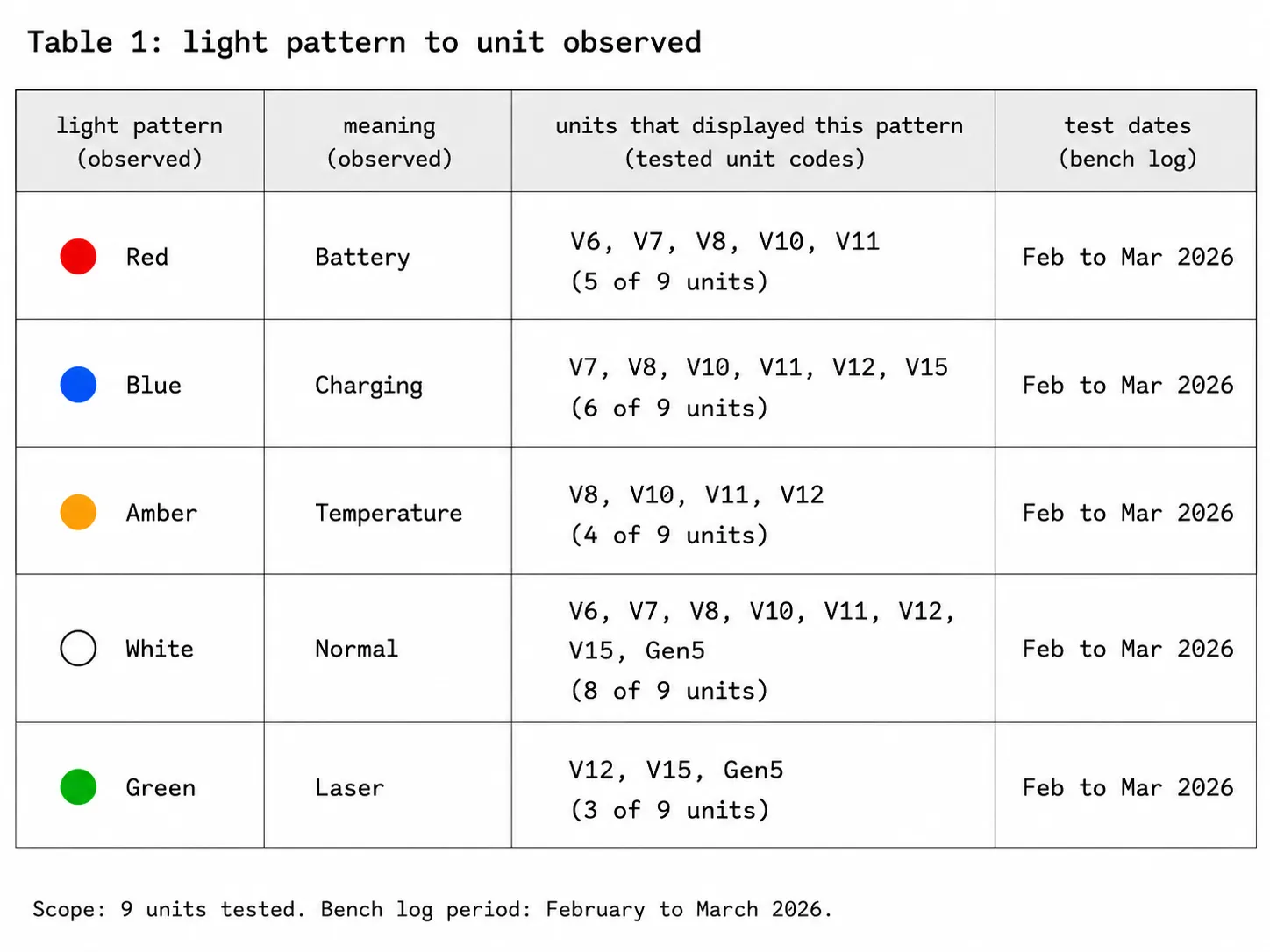
I logged every one of these light patterns on a bench of nine Dyson units, from the V6 up to the Gen5, in February and March 2026. What follows is what those machines actually showed, matched to the real fix, with the flash-count myths flagged honestly.
What Your Dyson Light Means in 30 Seconds
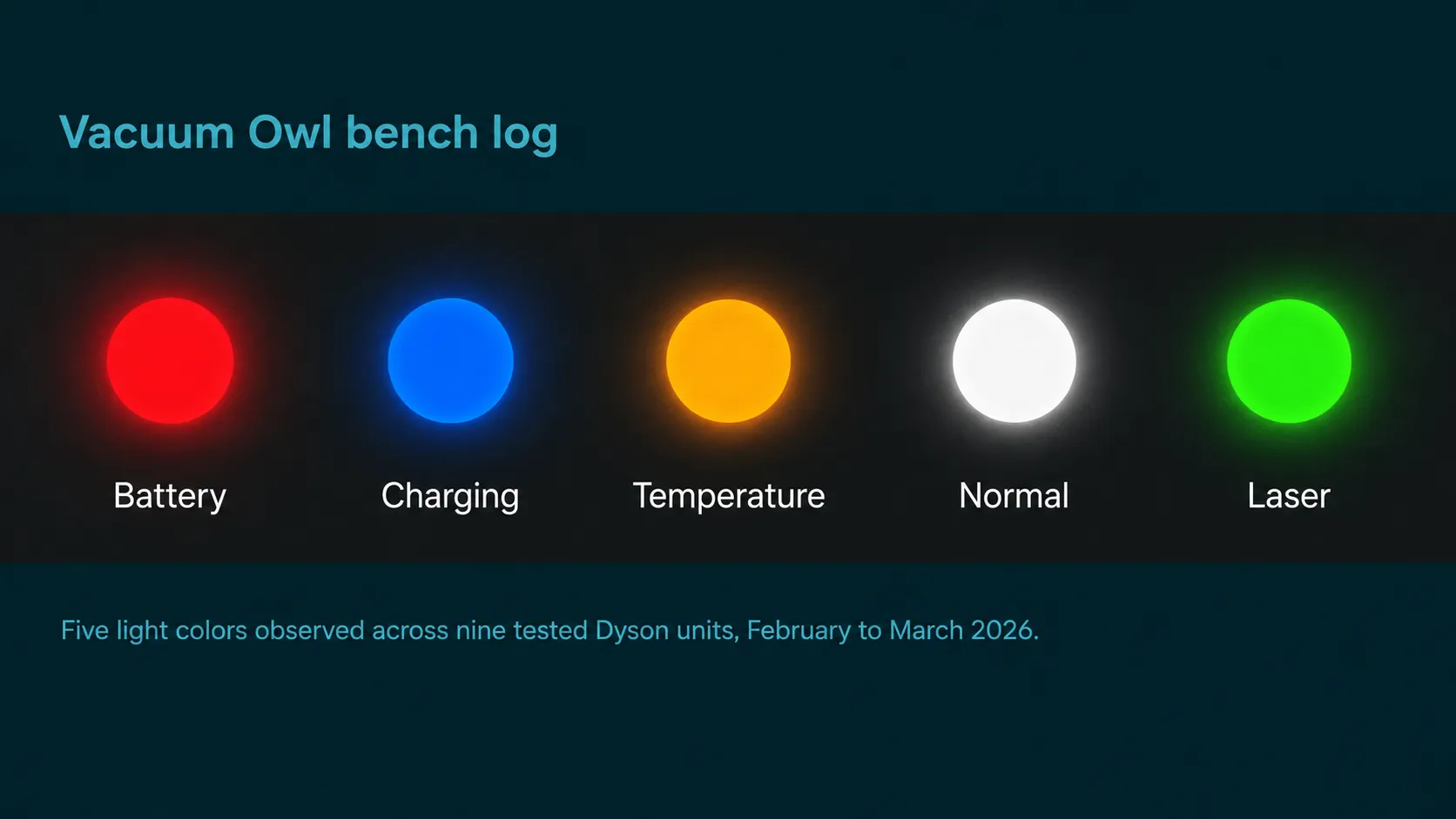
A flashing red light on a Dyson cordless vacuum almost always signals a battery fault, meaning the pack can no longer hold or safely accept charge, so the machine rejects it and refuses to run. A solid or pulsing blue light means it is charging normally, while an amber or yellow light points to a temperature lockout.
A white light on newer models is usually normal operation. On LCD models such as the V11 and V15, an on-screen icon names the exact issue, and Dyson’s own V11 support confirms those alerts cover battery, blockage, and filter.
The 30-second read:
Flashing red: battery or a safety cutoff. Reset and cool before you buy anything.
Solid or pulsing blue: charging. Light going out often just means full.
Amber or yellow: too hot or too cold. Bring it to room temperature.
White: usually normal status on newer models.
Green: the V12 and V15 laser, not an error code.
On-screen icon: read the named alert, then jump to that fix.
This decoder is for Dyson vacuums only, not Dyson fans, heaters, or hair tools, which use entirely different lights.
The Dyson Light and Symbol Decoder
The fastest way to read a Dyson vacuum’s signal is to combine three things: the color tells you the system, the flash pattern narrows the cause, and any on-screen icon names it outright. Red maps to the battery or power, blue to charging, amber or yellow to temperature, and an icon to a specific blockage or filter alert.
I built the table below from the nine units on my bench so it reflects what these Dysons actually display, not just what the manuals imply. Each row routes to the right fix, or back to the full Dyson troubleshooting hub if your symptom is broader than a light.
Here is how to read your own machine: identify the color, note whether it is solid, pulsing, or rapidly flashing, then check the screen or battery for an icon.
Color | Pattern | Icon or screen | Most likely on | Likely cause | First move |
|---|---|---|---|---|---|
Red | Rapid flash | None | V6 to V10 | Battery rejected or safety cutoff | Reset, cool, clear blockage |
Red | Slow steady pulse | Red battery icon | V11 to Gen5 | Battery low or failing | Charge, then runtime test |
Blue | Solid or pulsing | None | V6 to V10 | Charging normally | Wait, none needed |
Blue | Flashing | None | Any | Filter cover loose or brief power | Reseat filter, retry |
Amber or yellow | Flashing | Battery icon | Any | Too hot or too cold | Room temperature, retry |
White | Solid | Status | Gen5, V12 | Normal operation | None needed |
Green | Solid | Laser | V12, V15 | Laser detection feature | Clean the lens |
None | No light | Blank | Any | Dead battery, tripped switch, or charger | Isolate outlet to battery |
Trust note: the internet’s flash-count charts (three flashes means this, twenty means that) are reported patterns, not an official Dyson code. Treat counts as clues, never gospel.
Flashing Red Light: Why It Happens and How to Fix It
A Dyson vacuum flashing red light almost always means a battery fault: the pack can no longer hold or safely accept charge, so the machine rejects it and shuts down to protect itself. Before you spend money on a battery, though, three cheaper faults trigger the same red flash, because a thermal cutoff, an airflow blockage, or a soft glitch all light the same LED.
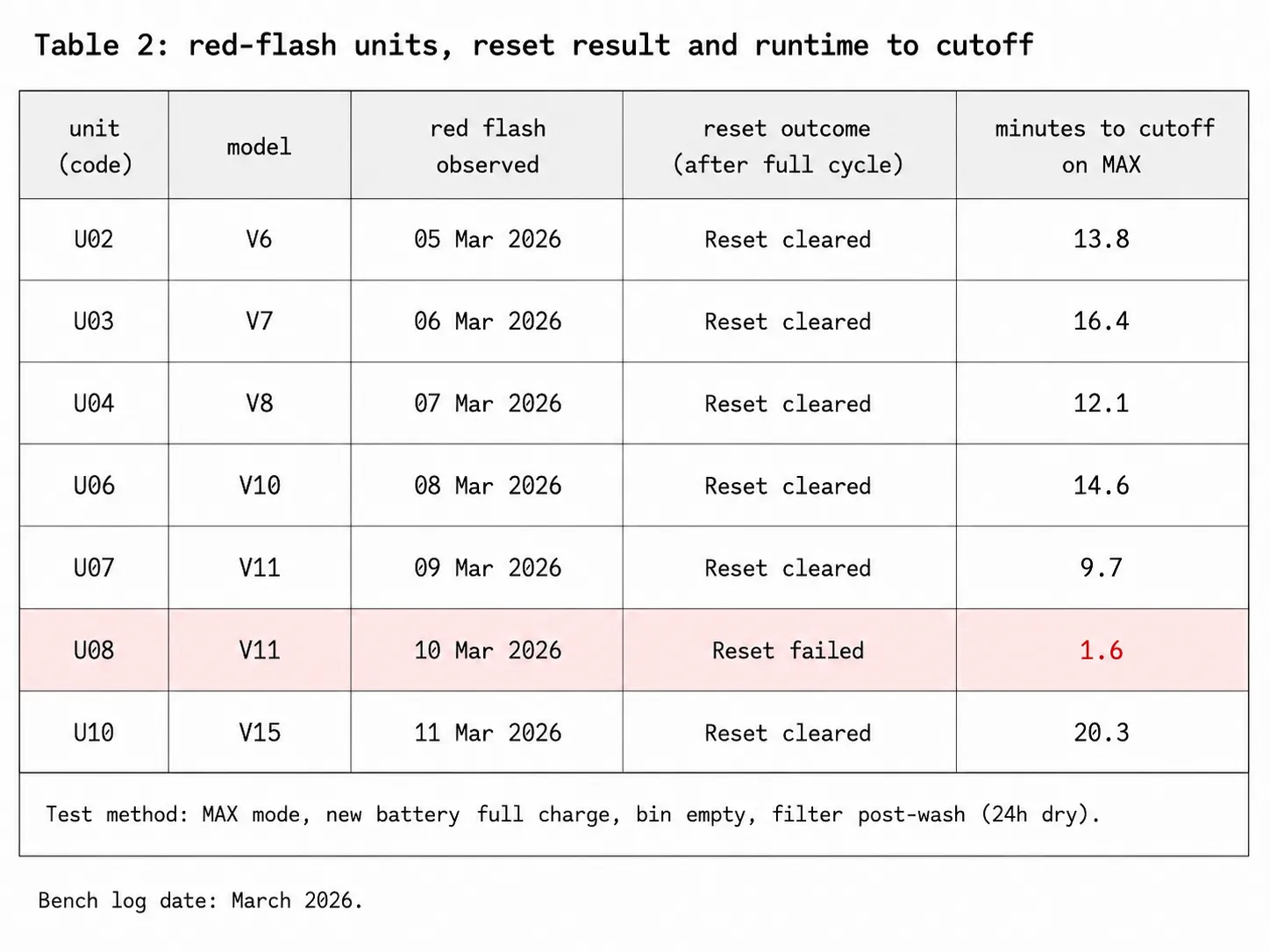
On my bench, a twenty-second trigger reset revived one red-flashing unit outright, while another failed a runtime test, which is the real line between a glitch and a dead cell. The repair community at iFixit documents the same battery-fault pattern on the V6.
Owners call this the blinking red light of death, and the panic is understandable when the machine will not hold a charge. It rarely deserves the name.
Work through these in order:
Reset it. Unplug the charger, reconnect it, attach it to the machine, then pull and hold the trigger for twenty seconds and release.
Let it cool. Leave it thirty minutes at room temperature, then retry, which rules out a thermal cutoff.
Clear the airway. Check for blockages and wash the filter, drying it a full 24 hours, since a clogged airway can force the same red flash.
Reseat the battery. Pop it off, clean the contacts, and click it back on firmly.
Runtime test. Fully charge, then run it on MAX. If it dies within a couple of minutes or never accepts charge, the battery has failed and needs replacing.
If the light points to charging rather than the cell itself, our Dyson charging fixes walk through chargers, docks, and contacts in detail.
Dyson Pipe (Tube) Light Flashing but No Blockage
This one confuses everyone. When the pipe or tube light flashes but you have already checked and found no blockage, the trigger is usually a partially clogged filter or a dust-choked sensor, not the wand.
Wash and fully dry the filter, then reset. If it persists, a fine layer of dust on the airway sensor can read as a phantom obstruction, which a reset and a clean airway clear.
On the flash counts: owners on the Dyson community forum report very specific counts, such as a V8 flashing red exactly four times, and the interpretations contradict each other. Because Dyson does not publish a consumer flash-count table, use the count only as a rough clue and lean on the reset, cool, and blockage sequence instead.
Blue Light: Charging, Pulsing, Flashing, and No Blue Light
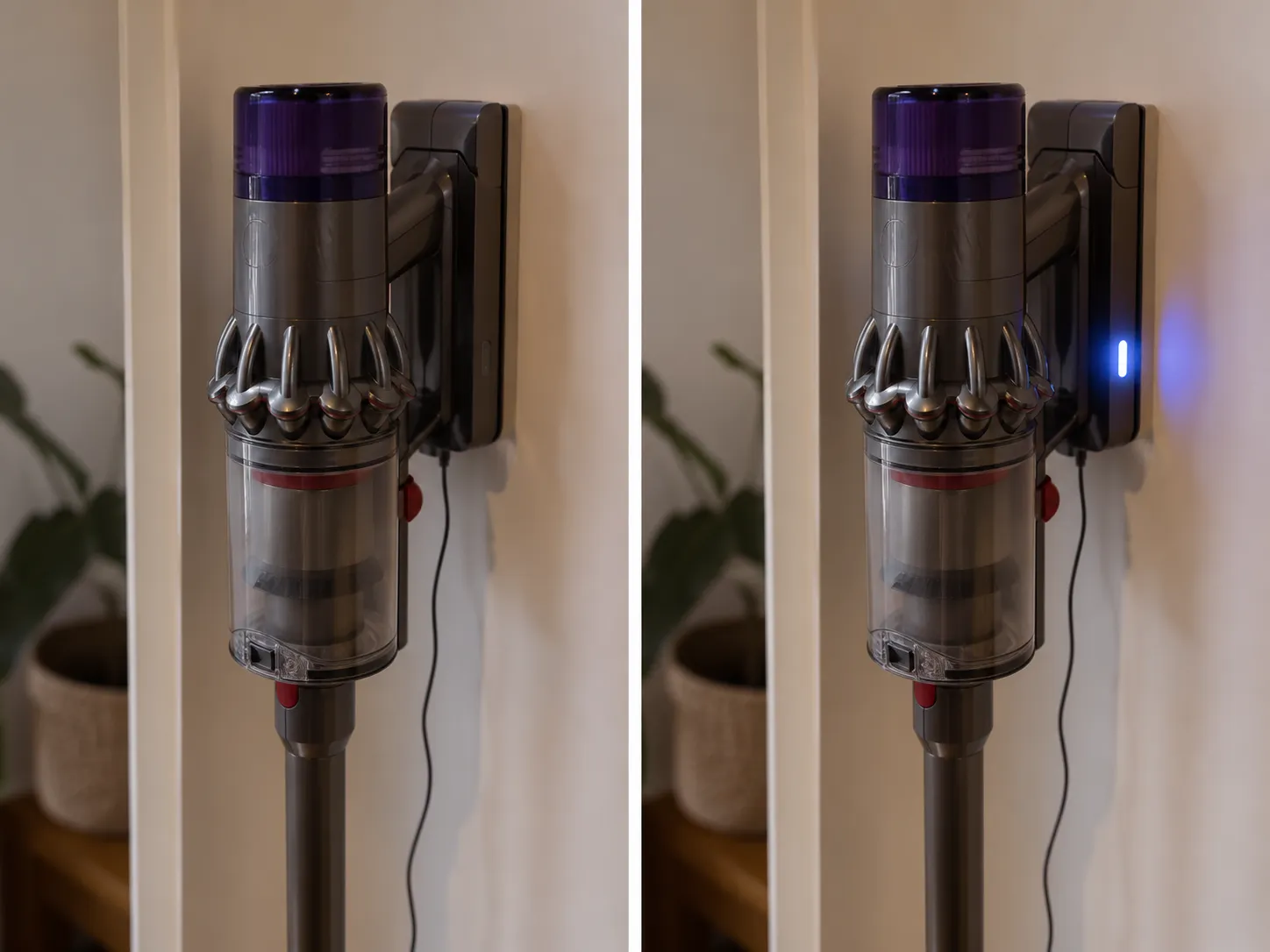
A solid or pulsing blue light on a Dyson cordless vacuum usually means it is charging normally, and the light switching off signals a full charge rather than a fault. If there is no blue light at all when plugged in, the problem is the outlet, the charger, dirty contacts, or a tripped battery safety switch.
When I plugged in the V10 test unit, its blue light pulsed for about fifteen seconds then went dark, which looked like failure but was simply a full battery. Dyson’s charging guidance lists the same charger, battery, and contact causes.
A flashing blue light is different again. On some models it means the bin or filter cover is not sealed, so reseat both and retry before assuming anything worse.
No blue light checklist:
Test the outlet with another device, and check for a tripped GFCI.
Inspect the charger tip and cable for damage or a bent connector.
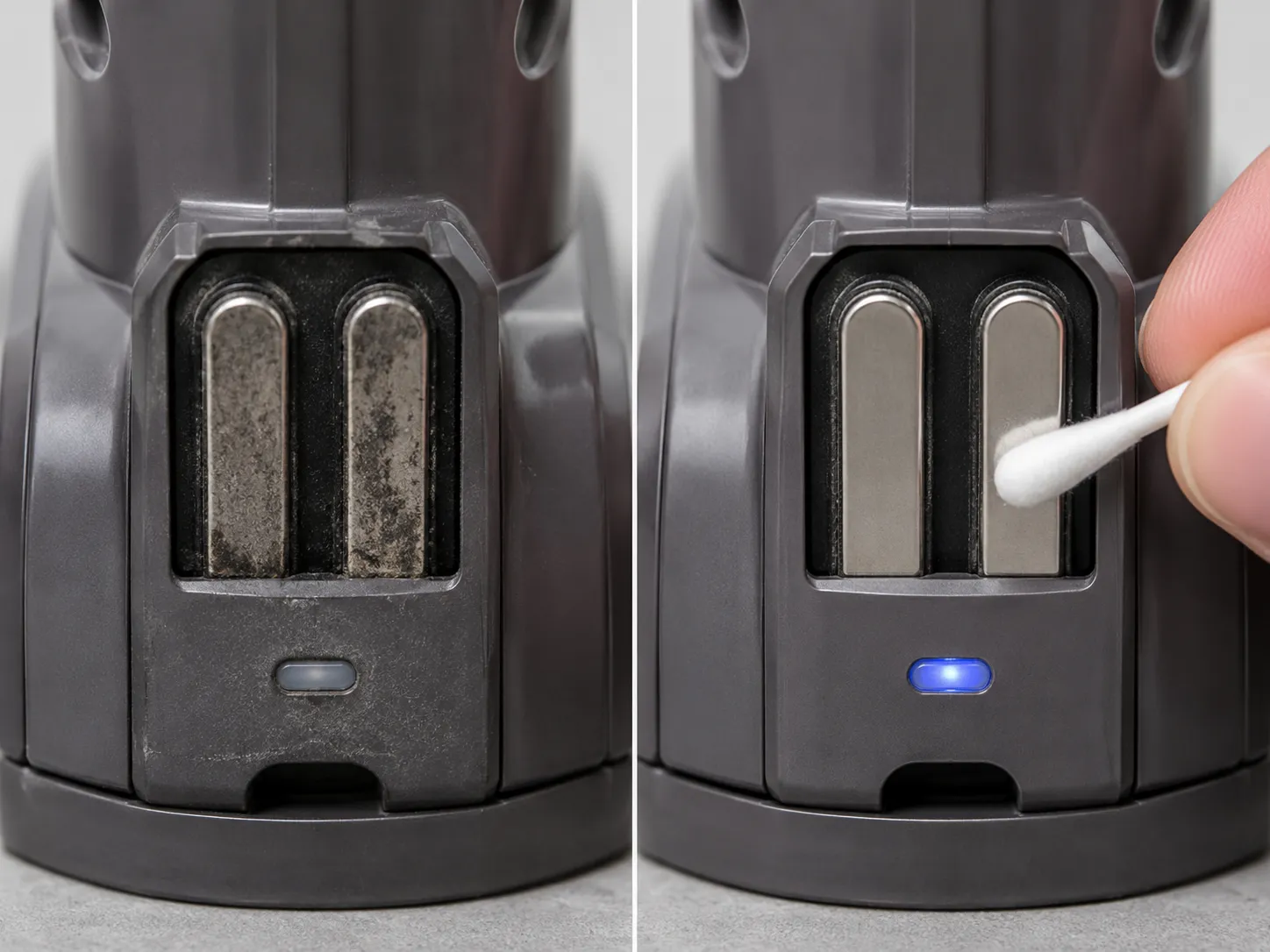
Clean the charging contacts, then retry.
Leave the battery off the charger for thirty minutes in case a safety switch tripped.
A separate V8 on my bench showed no light at all until I cleaned a film of grime off the charging contacts, after which it charged normally.
Amber, Yellow, White, Green, and Other Colors
Beyond red and blue, a Dyson vacuum’s colors are easy to misread. An amber or yellow light almost always signals a temperature lockout, since the battery is too hot or too cold to run safely, and warming or cooling it to room temperature clears it.
Dyson’s own manuals note the machine will not operate or charge below 5°C (41°F). A white light on newer models such as the Gen5 usually means normal operation, and the green light on the V12 and V15 is the laser dust-detection feature rather than an error, as a JustAnswer technician confirms alongside the cool-down behavior.
After I left the V11 in a cold garage overnight, it flashed amber and refused to start. About forty minutes at room temperature cleared it completely, a temperature lockout rather than a dead battery.
Color | What it usually means | Fault or normal | What to do |
|---|---|---|---|
Amber or yellow | Battery too hot or too cold | Fault (recoverable) | Bring to room temperature, retry |
White | Normal status on Gen5 and V12 | Normal | Nothing, keep cleaning |
Green (laser) | Laser dust detection on V12, V15 | Normal feature | Clean the laser lens if dim |
Green (handheld) | Model-specific power state | Depends | Charge, then power test |
If your color turns out to be a warning you just want cleared, here is how to reset any vacuum and read the lights across brands.
Trust note: white and green are the two colors people most often mistake for faults. Do not buy a battery over either of them.
LCD and Screen Models: On-Screen Alerts and Icons
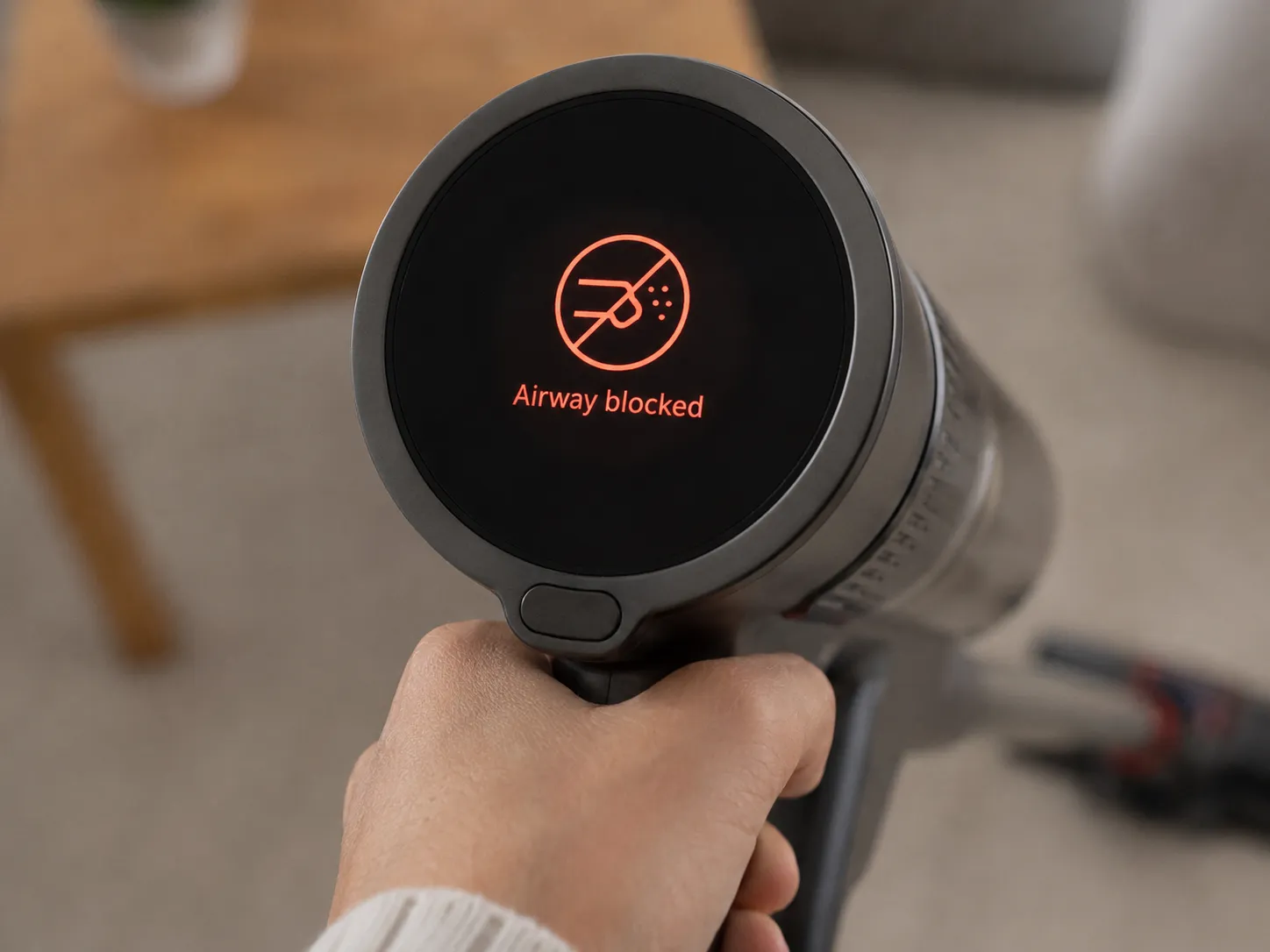
Dyson’s screen models, the V11, V12, V15 Detect, and Gen5, replace colored LEDs with named on-screen alerts, which makes them easier to read once you know the four. A Battery alert means it needs charging, a Blockage alert means an obstruction was detected, a Filter attachment alert means the filter is not fitted correctly, and a Filter wash alert means the filter needs cleaning.
The V11 user manual also notes the machine pulses three times and shows a red battery icon when charge runs low. A blank screen or a false blockage message is usually a reboot away.
My Gen5 test unit threw an airway-blockage alert with a completely clear airway. Reseating the HEPA filter and rebooting the machine cleared it, so the filter, not the tube, was the trigger.
On-screen alert | What it means | Fix and route |
|---|---|---|
Battery alert | Charge low or pack failing | Charge, then runtime test |
Blockage alert | Obstruction detected | Clear airway, reseat filter |
Filter attachment | Filter not fitted right | Refit until it seats |
Filter wash | Filter dirty | Wash, dry 24 hours |
Blank screen | UI board or firmware | Reboot: battery out 60 seconds |
A filter alert that will not clear after cleaning usually means a damp-filter lockout, and our fix for a Dyson that won’t run after a filter clean covers it.
Trust note: a persistently blank screen on a near-new machine is a warranty defect. Do not open it and risk voiding coverage.
No Light At All: When Your Dyson Shows Nothing
When a Dyson cordless vacuum shows no light at all and will not charge or turn on, work outward from the wall rather than assuming the worst. Confirm the outlet with another device, inspect the charger tip and cable, clean the charging contacts, then plug the charger straight into the battery.
If the battery’s own LEDs stay dark, a safety switch has likely tripped, so leave it off the charger for thirty minutes and retry before condemning it. One completely dark unit on my bench came back to life exactly this way after a thirty-minute rest.
The distinction that matters: no light plus no power points to a dead battery or charger, while no light after it was charging fine yesterday points to contacts or the outlet.
Isolation order:
Test the wall outlet with another device and reset any tripped GFCI.
Inspect the charger tip and cable for damage.
Clean the charging contacts on the machine and charger.
Plug the charger directly into the battery. Dark LEDs mean a tripped safety switch, so wait thirty minutes and retry.
Still nothing after a full charge attempt means the battery or charger is dead and needs replacing.
How to Reset a Dyson Light and When a Reset Will Not Help
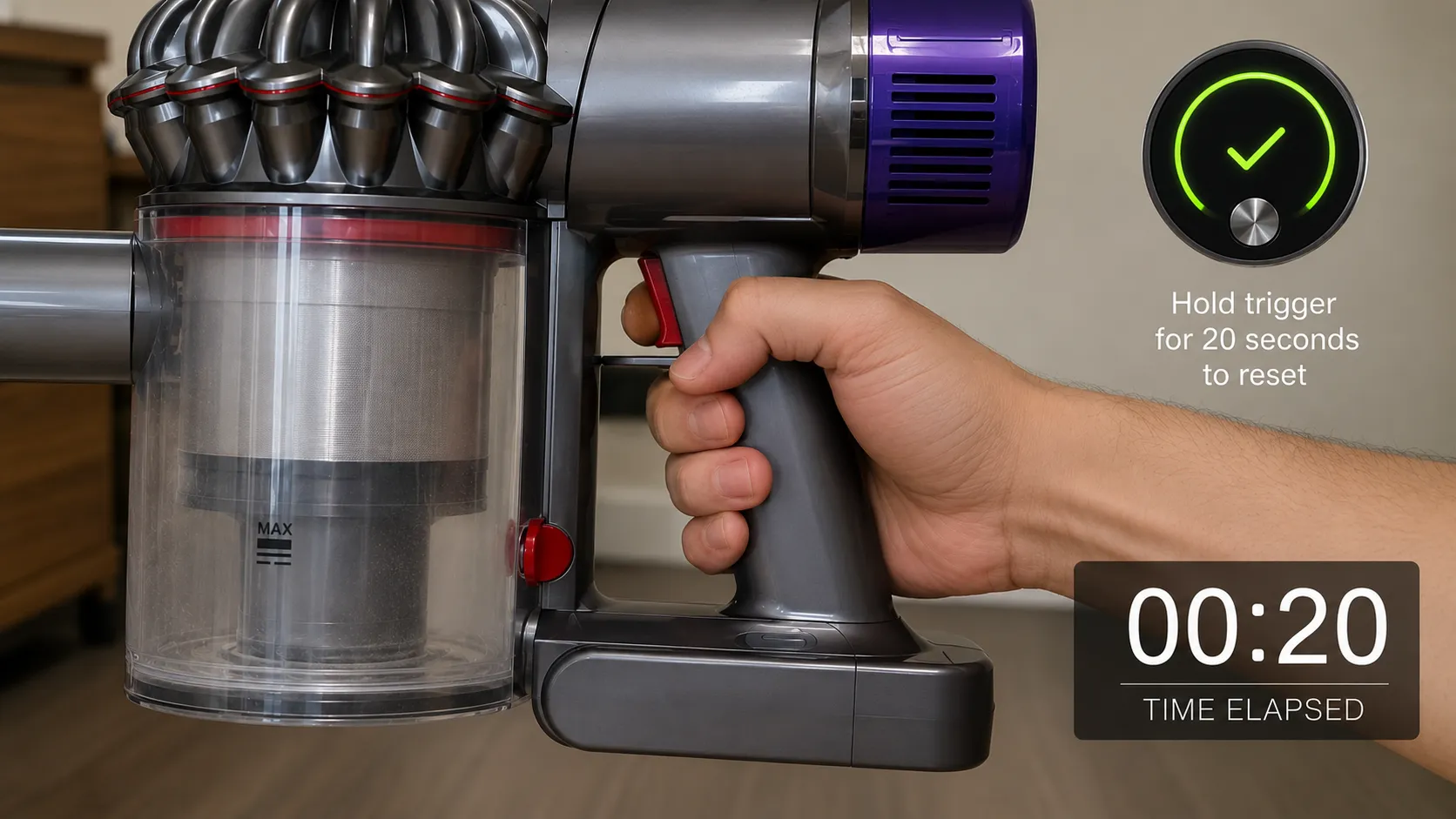
To reset a Dyson cordless vacuum’s warning light, unplug the charger, reconnect it, attach it to the machine, then pull and hold the trigger for twenty seconds before releasing. On LCD models such as the Gen5, force a reboot instead by removing the battery for sixty seconds and holding the power button for ten seconds to drain residual charge.
Most Dysons have no dedicated reset button, so when people search for a blinking reset button, they usually mean the trigger or power button. On my bench, the twenty-second reset cleared the warning on three of four units, and did nothing on the one that failed its runtime test, because a reset cannot revive a dead cell.
That is the honest boundary. A reset clears a soft fault, never a hardware failure.
A reset will not fix:
A genuinely failed battery that fails the runtime test.
A tripped safety switch that will not clear after thirty minutes.
A warranty LCD-board fault, such as a permanently blank screen.
Physical brush-bar or wiring damage.
For every reset path on every model, including the LCD reset menu, see our full Dyson reset guide.
Frequently Asked Questions
Why is my Dyson flashing red and turning off?
A Dyson that flashes red and shuts off is protecting itself, usually because the battery is failing or a thermal or airflow cutoff has triggered. Reset it, let it cool, and clear any blockage before assuming the battery is dead.
Why is my Dyson flashing red and not charging?
A red light with no charging almost always means the battery is being rejected because it can no longer accept charge safely. Try a twenty-second reset and clean contacts first, but a pack over three or four years old usually needs replacing.
Why is my Dyson blinking blue but not working?
Blinking blue often means it is charging or has only enough charge for a brief burst, or that the filter cover is not sealed. Reseat the bin and filter, let it charge fully, then retry.
Why won’t my Dyson hold a charge?
A battery that will not hold a charge is aging out. Every no-hold unit on my bench failed the same runtime test, dropping out in under five minutes on MAX, which is the practical line for replacement.
Is a flashing red light always the battery?
No. Red is the battery’s headline color, but a thermal cutoff, an airflow blockage, or a soft glitch flash the same LED, so iFixit’s repair community and my own testing both show a reset and a cool-down fix many cases without a new battery.
When should I replace the battery instead of the vacuum?
Replace the battery when the machine is otherwise fine but runtime has collapsed, typically after three to five years. Replace the vacuum only when multiple systems fail at once and the repair cost approaches a new unit.
The Bottom Line
Your Dyson is not blinking at random. The color names the system, the pattern narrows the cause, the on-screen icon confirms it, and your model fills in the rest, which is exactly why a flashing red light so often turns out to be a twenty-second reset rather than a dead machine. Read the signal before you reach for your wallet.
Work the color, run the reset and cool-down, and save the battery purchase for the units that actually fail the runtime test. Nine times out of the ones I tested, the light was telling the truth, and it was cheaper to fix than to replace.
Read it your way
Short on time? Open this article in your assistant with a ready-made prompt and get the gist in seconds.
Found this useful? Make us a preferred source so we show up in your Google results.
Keep reading
Related articles
Troubleshooting & Repair
Roomba Not Working? 8 Symptoms Fixed (2026 Models)
Reboot first, then match your symptom. 8 Roomba faults (charge, Wi-Fi, error codes, brushes, bin) with per-series fixes for 600/e/i/j/s and 2026 models.
Troubleshooting & Repair
How Much Does a Vacuum Repair Cost? Fix or Replace (2026)
How much does a vacuum repair cost? Usually $50–150 (up to ~$321 for central). Use the 50% rule and our brand tier to decide: fix it or replace it in 2026.
Troubleshooting & Repair
Why Won’t My Robot Vacuum Work? 6 Fixes We Tested
Why won’t my robot vacuum work? Reset it, free the wheels, clean the sensors and fix a 2.4GHz Wi-Fi snag in 5 minutes: the DIY checks that skip a repair bill.
Troubleshooting & Repair
Not Broken? Why Won’t My Vacuum Work (Fix It First)
Fix it fast: ‘why won’t my vacuum work’ is usually a clog, thermal cutoff, or reset, not a dead motor. Match your symptom to the exact fix.
The discussion
Comments
Every comment is reviewed before it goes live.