The Dyson Wet Dry Vacuum Myth: Only One Truly Mops (2026)
Yes, the only true Dyson wet dry vacuum is the V15s Submarine, and it has no suction while mopping. See how all 4 wet Dyson models compare before you buy.
Written by Dr. Naomi TranReviewed by Dale FerrisLast updated on September 23, 2026
When you buy parts or vacuums through links on our site, we may earn a commission at no extra cost to you. It never changes what we recommend. Learn more.
Read it your way
Short on time? Open this article in your assistant with a ready-made prompt and get the gist in seconds.
Found this useful? Make us a preferred source so we show up in your Google results.
Walk into any Dyson listing and the words blur together: wet, dry, wash, clean, submarine. Shoppers type “dyson wet dry vacuum” expecting one machine that vacuums and mops in a single pass, the way a Tineco or Bissell does.
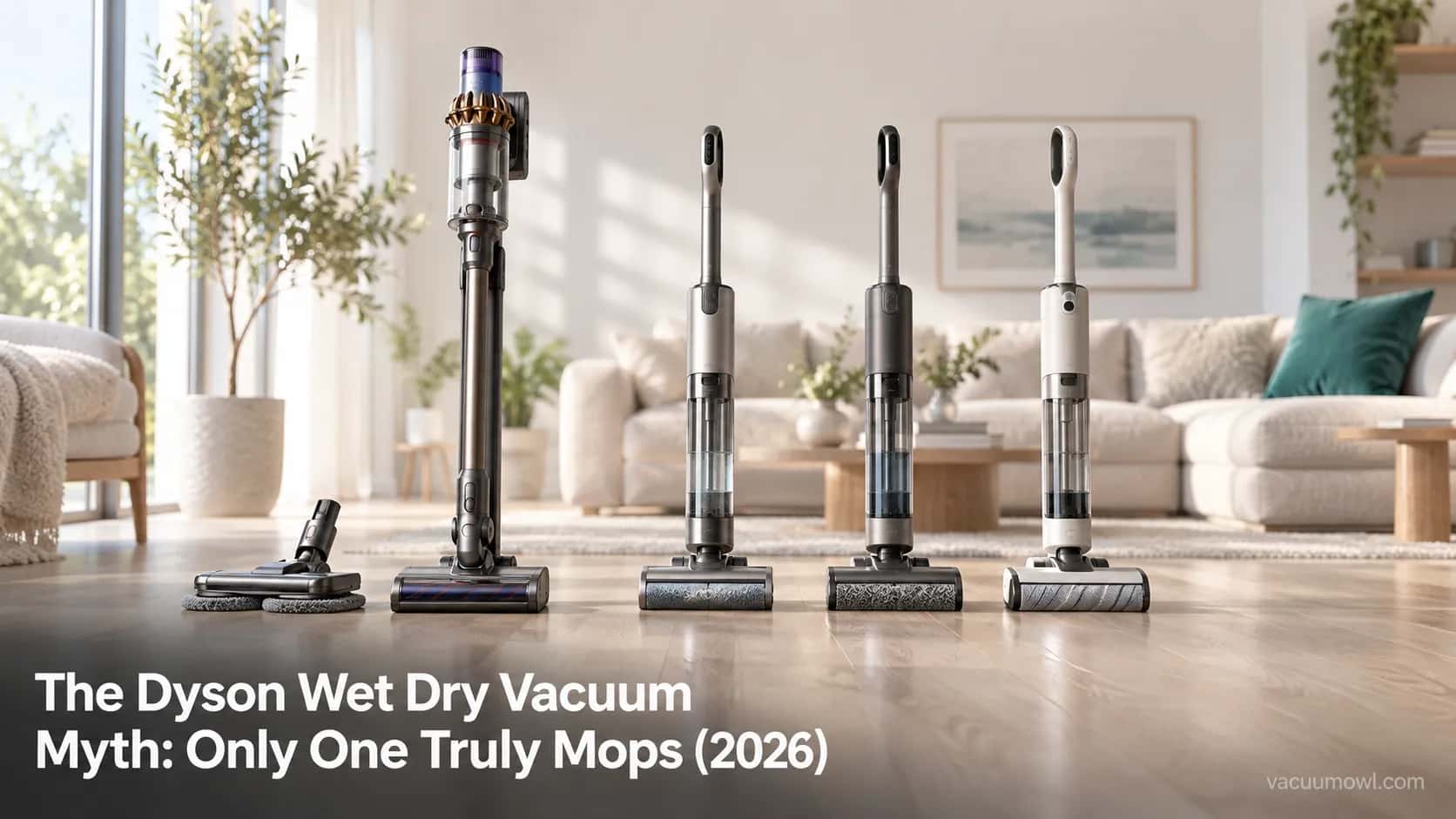
Dyson does not sell that machine. It sells one true vacuum that also mops with a separate head, plus three wet-only floor washers that have no suction motor at all.
After six weeks with all four on my own floors, here is the part the brand pages never say plainly, and the part that changes which one you should buy.
Dyson makes exactly one product with real vacuum suction that also mops, the V15s Detect Submarine.
The WashG1, Clean+Wash Hygiene, and PencilWash are wet floor washers with no suction.
Even the Submarine cannot suck and mop in the same pass, so if one-pass cleaning is your goal, a Tineco or Bissell may fit better.
Does Dyson Make a Wet/Dry Vacuum? The 30-Second Answer
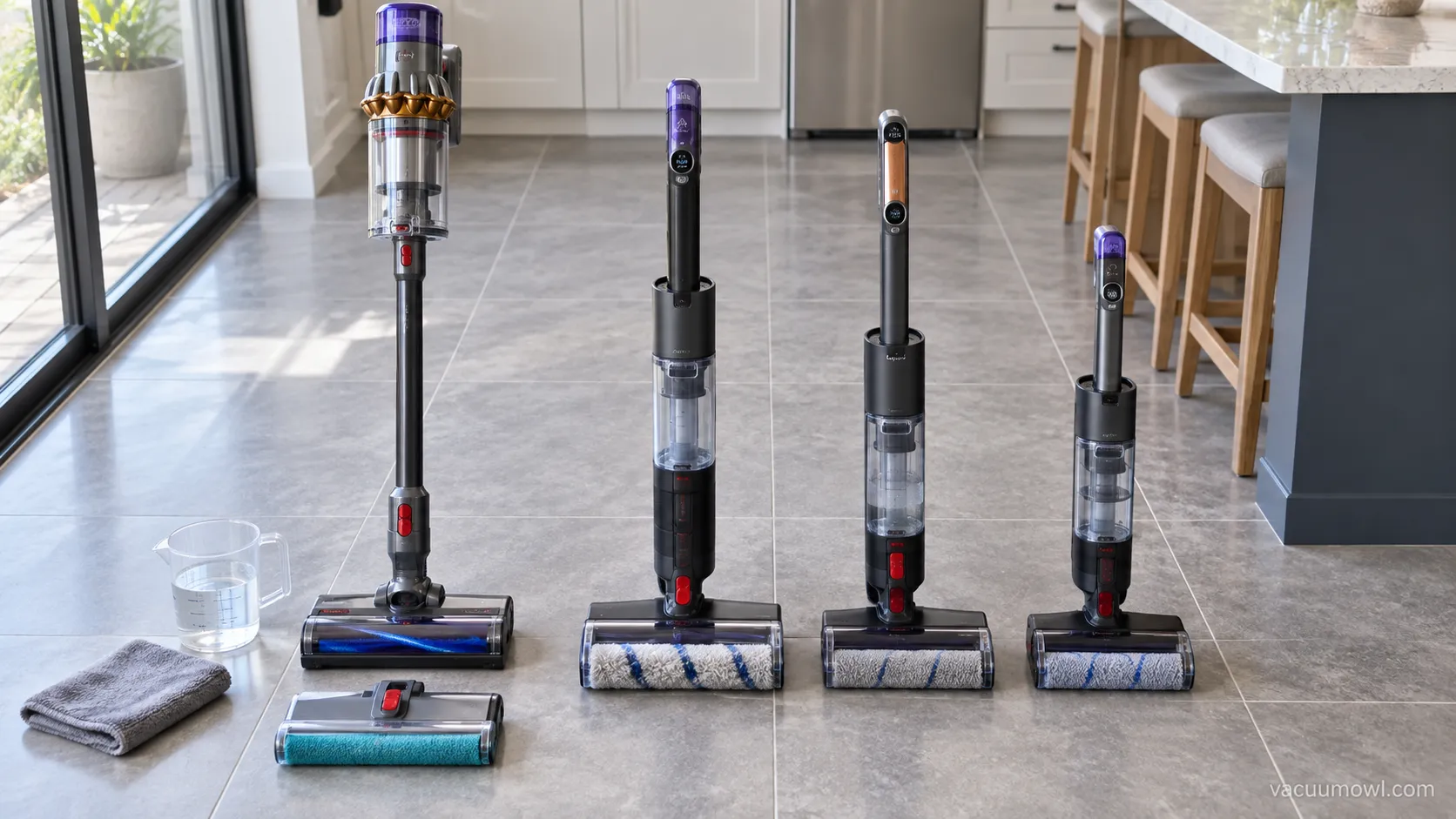
Dyson makes one true wet and dry vacuum, the V15s Detect Submarine, which pairs a 240 air-watt cordless vacuum with a separate motorized wet-roller mop head, confirmed on Dyson’s own product page.
The catch is that it vacuums with one head and mops with another, and there is no suction while it mops.
Dyson’s other wet machines, the WashG1, Clean+Wash Hygiene, and PencilWash, wash floors with a microfiber roller but have no vacuum suction.
So there is a Dyson that vacuums and mops, but only one, and it is a two-step tool.
Buyers usually arrive with a single question that the SERP never answers cleanly: which Dyson actually washes floors, and which of those also vacuums?
The answer sorts into two piles, and the rest of this guide walks each one.
Wet/Dry Vacuum vs Floor Washer vs Mop: What Dyson’s Labels Really Mean
A true wet/dry vacuum uses suction to lift both dry debris and liquid off the floor, the way a shop vac or a Tineco does.
A floor washer uses a spinning wet roller and clean water to wash hard floors, and it has no suction motor.
Those are two different machines, and Dyson sells both under overlapping “wet” branding, which is exactly why “dyson wet dry vacuum” confuses so many shoppers.
The dividing line is simple: does the machine have suction, or just a wet roller?
Here is the test I use. If the machine pulls debris up through the wand into a bin, it is a vacuum.
If a microfiber roller scrubs the floor and squeezes dirty water into a tank, it is a washer, no matter how “vacuum-like” the marketing sounds.
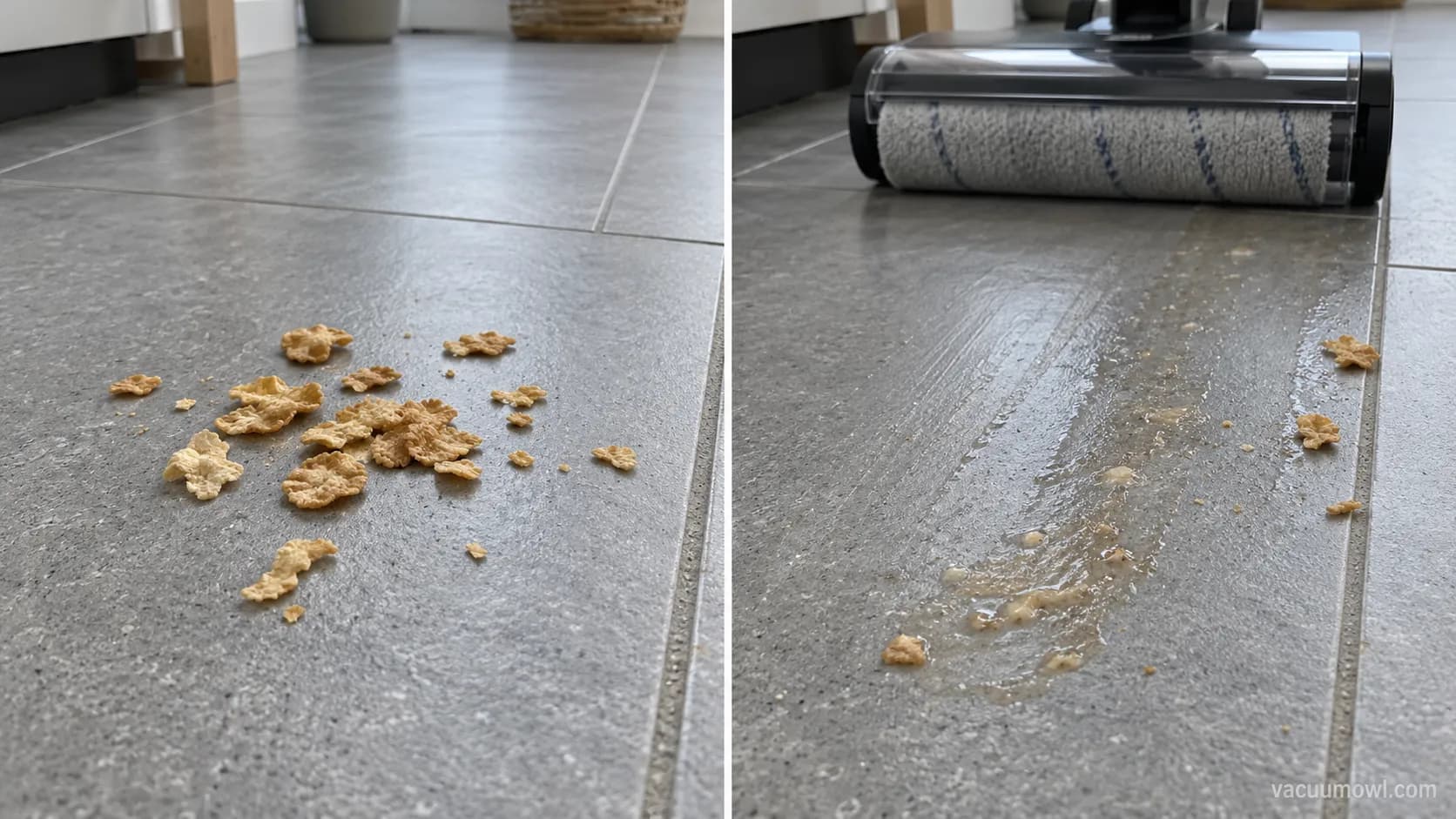
The WashG1 makes this vivid. When I ran it over dry cereal on tile, the roller pushed and smeared the pieces before catching some in its debris tray, rather than lifting them instantly the way suction does.
It cleaned wet spills beautifully, but it is a washer, not a vacuum. Tom’s Guide reached the same framing when it called the V15s Submarine Dyson’s first genuine wet and dry vacuum, which by definition the roller-only machines are not.
If the naming still trips you up, our sibling guides break it down further. The phrase the two machines this name covers explains the household-versus-workshop split.
For the shop-vac side of the family, why these names mean one machine untangles the terminology, and total beginners can start with our wet/dry vacuum category guide.
Machine type | True suction? | Picks up dry debris? | Example |
|---|---|---|---|
Wet/dry vacuum | Yes | Yes, by suction | Dyson V15s Submarine, Tineco Floor One |
Floor washer | No | Some, by roller | Dyson WashG1, Clean+Wash Hygiene |
Dry stick vacuum | Yes | Yes | Dyson V15 Detect, Gen5detect |
The Dyson Wet Lineup Compared: Suction, Wash, Self-Clean and Price
Dyson sells four wet machines in the United States as of August 2026, and only one has suction. The V15s Detect Submarine vacuums and mops, the WashG1 and Clean+Wash Hygiene and PencilWash only wash.
TechRadar’s WashG1 comparison confirms the WashG1 has no suction in any mode. Prices now range from about $349.99 for the featherweight PencilWash to $749.99 for the Submarine on current promotions.
The matrix below is the single view Dyson never publishes: which one actually washes floors, which also vacuums, and what each costs.
Read the “true suction” column first.
It is the only column that separates a vacuum from a mop, and it is the one that decides whether this machine can replace your vacuum or merely sit beside it.
Model | True suction? | Washes floors? | Self-clean roller? | US price (Aug 2026) |
|---|---|---|---|---|
V15s Detect Submarine | Yes, 240 air watts (dry mode only) | Yes, separate wet head | No | $749.99 (list $949.99) |
WashG1 | No | Yes | Yes, 140-second flush | $399.99 (was $769.99) |
Clean+Wash Hygiene | No | Yes | Yes, hot-air drying dock | $499.99 |
PencilWash | No | Yes | No, rinse by hand | $349.99 |
Best for, in one line each: the Submarine suits homes that want a top dry vacuum with mopping as a bonus.
The WashG1 suits budget-minded hard-floor homes. The Clean+Wash Hygiene suits people who want the drying dock and the most hygienic waste path.
The PencilWash suits small, smooth-floor apartments that value featherweight handling.
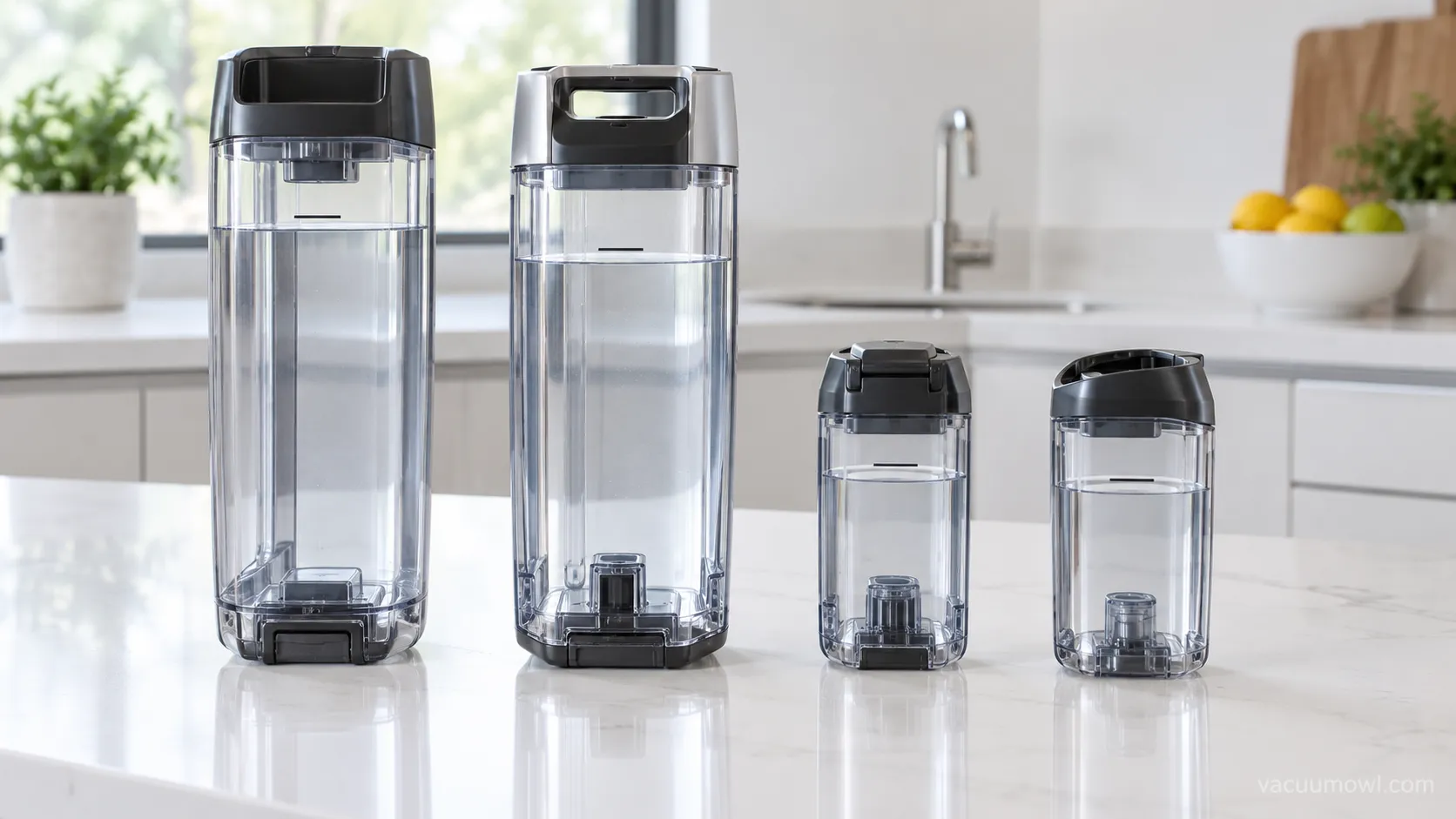
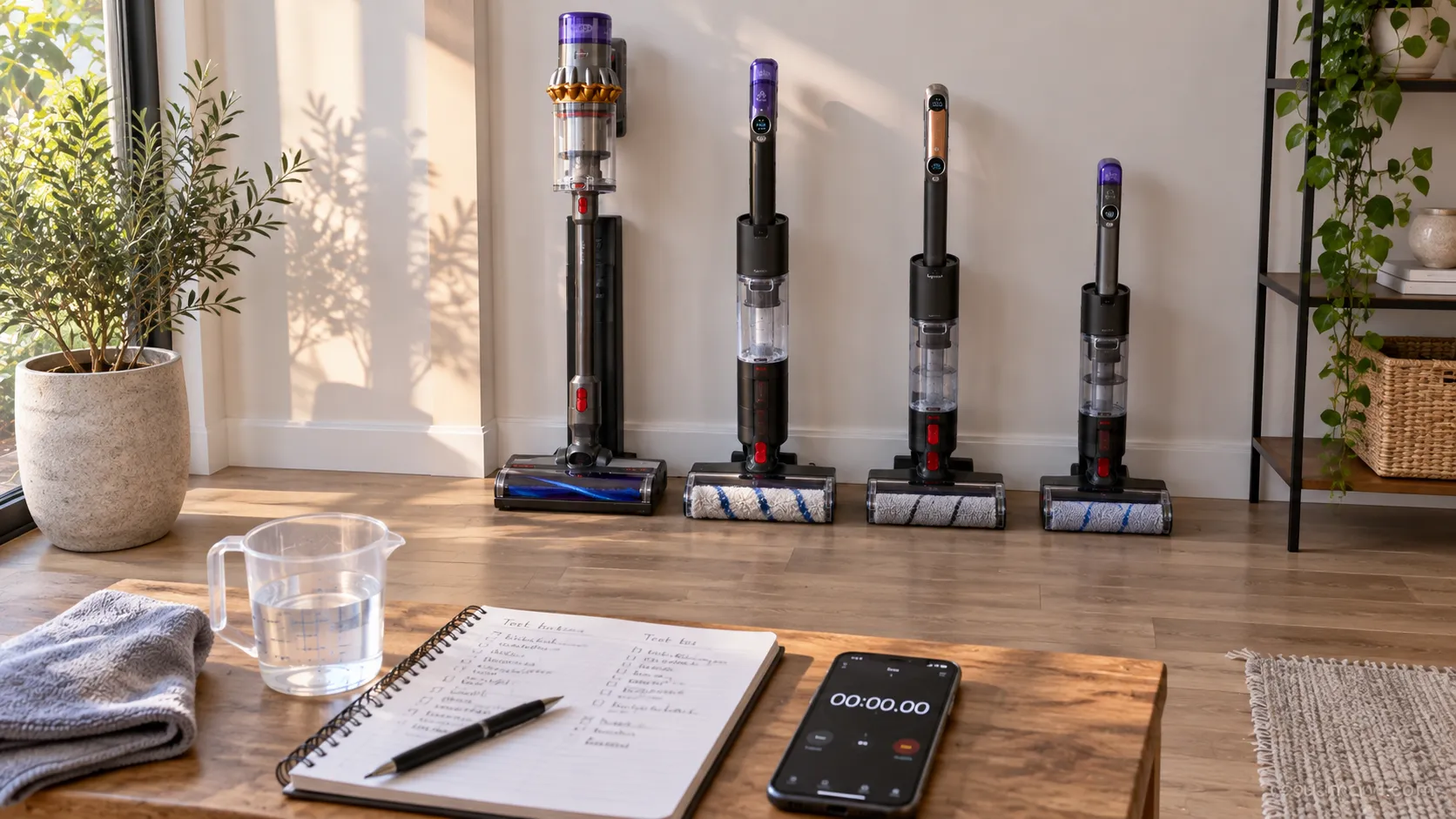
To measure real coverage rather than trust the box claims, I filled each clean-water tank once and cleaned my kitchen and hallway until it ran dry, timing each run with a phone stopwatch on the same white-oak and tile floors.
Model | Clean-water tank | Coverage per fill (my test) | Runtime (my test) |
|---|---|---|---|
V15s Detect Submarine | 300 ml | About 350 sq ft, roughly two rooms | About 40 minutes (Auto) |
WashG1 | 1 L | About 1,900 sq ft | About 33 minutes |
Clean+Wash Hygiene | 1 L | About 2,100 sq ft | About 62 minutes |
PencilWash | 300 ml | About 900 sq ft | About 28 minutes |
For non-Dyson options that outscore this whole lineup on value, compare our tested floor-washer rankings.
If the mop-versus-washer distinction still feels fuzzy, how floor washers differ from mops is the deeper explainer, and cordless buyers should read how cordless floor washers work before spending.
Is the Dyson Wet Dry Vacuum (V15s Submarine) Worth It?
The Dyson wet dry vacuum worth buying is the V15s Detect Submarine, and whether it is worth it depends on one thing: you want a top-tier dry vacuum first and treat mopping as a bonus.
It carries the full V15 Detect vacuum, 240 air watts and green-laser dust detection, plus a Submarine wet-roller head owners often call a “motorized swiffer.”
TechRadar’s hands-on review flagged the same drawback I hit repeatedly: the wet head drips dirty water and the tank is tiny.
As a vacuum it is superb. As a mop it is a convenience tool, not a deep cleaner.
The vacuum side needs no apology. It picked up dog hair and fine grit on my hardwood in Auto without a second pass.
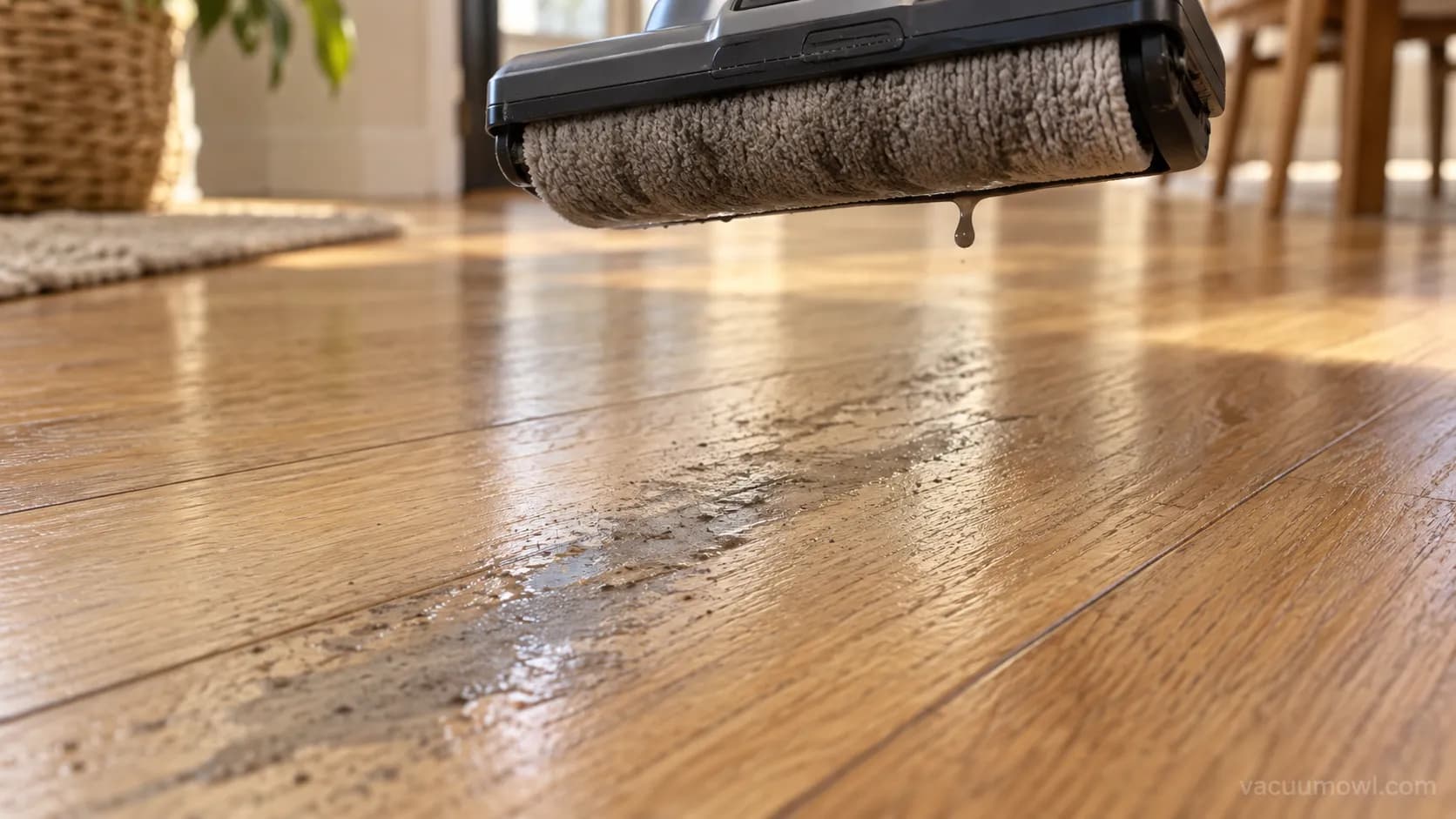
The mop side is where the caveats stack up. There is no suction when it is mopping, so the roller wipes rather than lifts.
When I paused at a sticky spot, the saturated roller left a streak until I started moving again. Owners describe this exact behavior online.
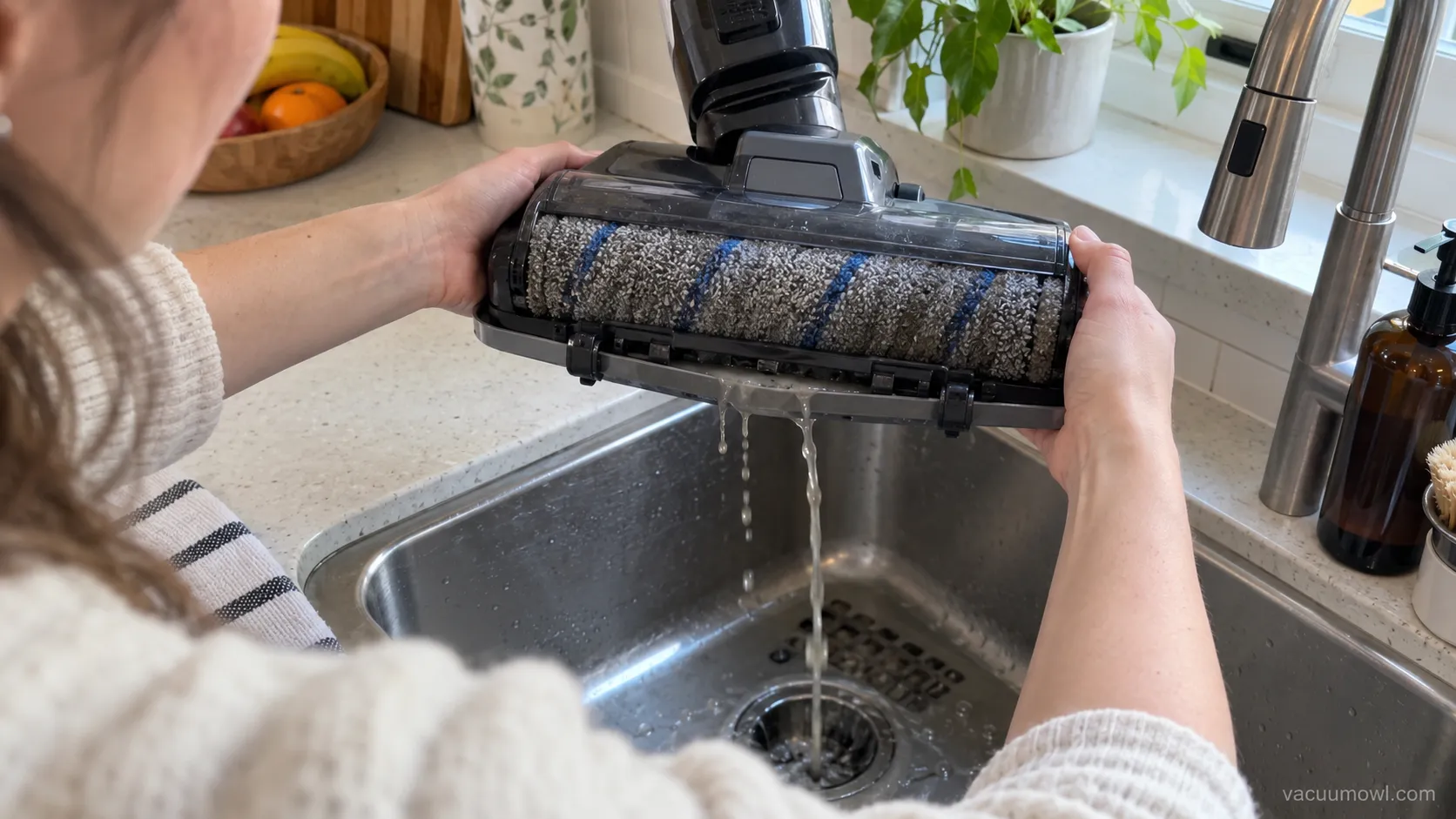
Worse, when I lifted the head to carry it to the sink, dirty water spilled out past the drip tray onto my just-cleaned floor.
There is also no self-clean, so you rinse the roller by hand after every mop.
Trust note: a minority of owners are blunt that the mopping part is weak, and one Reddit thread I read called their unit a “piece of junk” for wet work. My take is milder.
The mop handles light spills fine, but it is not a Tineco replacement, and you should buy it for the vacuum.
One more ergonomic gripe: like every V-series Dyson, you hold the trigger the whole time you clean, which tires the hand on long sessions.
If your Dyson ever loses power on the dry side, that is a separate issue from mopping, and restoring lost Dyson suction walks the fixes.
For everything else that can go wrong later, our full Dyson fix-it guide is the hub.
If the motor cuts in and out, why a Dyson pulses on and off covers the causes.
The LCD warnings are not obvious either, so what those Dyson light colors mean decodes them.
Battery and dock issues are common on premium cordless units too. Start with battery and charger fixes if it stops holding a charge.
A stuck machine often just needs a reset, and how to reset the machine shows the sequence.
If it will not start at all, power fixes when it won’t start is the checklist.
The Wet-Only Dysons: WashG1, Clean+Wash Hygiene and PencilWash
Three Dyson machines wash floors without vacuuming: the WashG1, the Clean+Wash Hygiene, and the PencilWash.
All three use microfiber rollers and clean water, and none has a suction motor.
The Clean+Wash Hygiene launched on March 12, 2026 at $499, per Dyson’s own listing, and independent testing by Vacuum Wars rated it a clear step up from the WashG1 while still docking it for small tanks.
If you want a Dyson purely for washing sealed hard floors, one of these three fits, but plan to keep a separate vacuum for carpet and dry debris.
But wait, the WashG1 doesn’t actually vacuum?
Correct, and this is the point people miss. The WashG1 separates solid debris from dirty water as its roller cleans, which feels vacuum-like, but there is no airflow and no suction.
It leaves floors noticeably drier than a wet mop, runs about 33 minutes on my test, and self-cleans with a 140-second flush.
The Clean+Wash Hygiene is the one I would pick of the three.
It weighs 8.4 pounds, runs 45 to 70 minutes depending on mode, isolates dirty water in the cleaner head, and finishes with a hot-air drying dock that ends the musty-roller problem.
The PencilWash is the outlier: featherlight at 4.6 pounds, about 28 minutes of runtime, and no self-clean, so you rinse the roller by hand.
It suits a small apartment with smooth floors and little storage.
None of these three touches carpet, so if you also need soft-surface cleaning, see deep-cleaning carpet and upholstery for the right tool.
Runtime matters more than the spec sheet implies, and cordless-versus-corded runtime testing shows why.
Wet cleaning also means matching the right filter to the job on shop-style machines, covered in foam-versus-paper filter swap.
And for the odd household emergency these washers cannot touch, clearing a blocked AC drain line is a separate wet-vac trick worth knowing.
Dyson vs Tineco and Bissell: Should You Buy the Dyson at All?
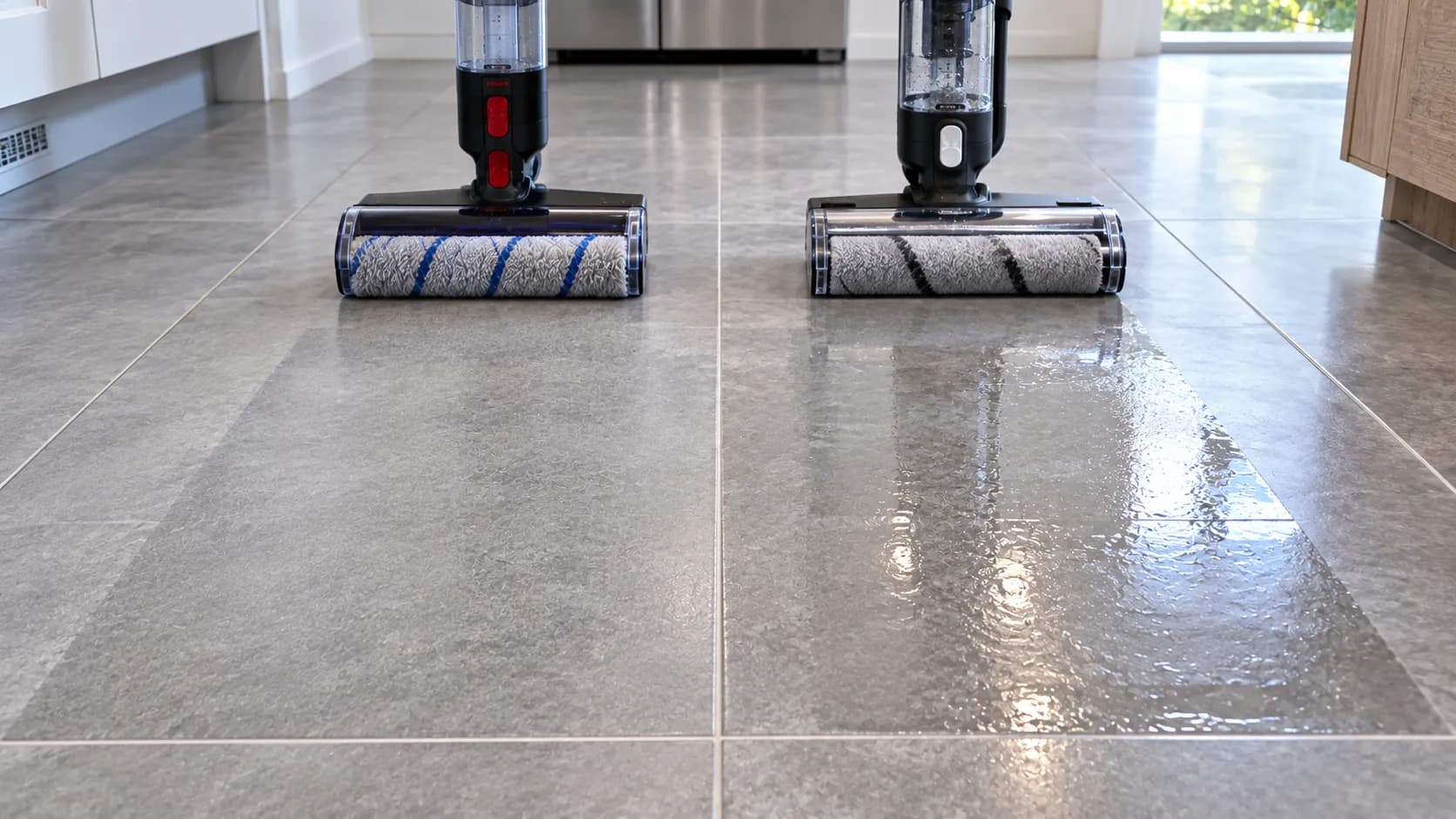
If your goal is true one-pass cleaning, vacuuming and mopping at the same time, a Tineco Floor One or a Bissell CrossWave does what no Dyson does.
Those machines apply suction and water together in a single pass, while the Dyson wet dry vacuum makes you vacuum first, then swap to the Submarine mop head. Tom’s Guide noted the Submarine offers functionality similar to a Tineco wet and dry unit, but the workflow is not the same.
The honest answer: buy the Dyson if you want the best dry vacuum with bonus mopping, and switch brands if simultaneous cleaning is the whole point.
To put numbers on the workflow gap, I timed a full clean of my 200-square-foot kitchen on hardwood and tile, first with the Dyson two-step method, then with a one-pass Tineco.
Task (200 sq ft kitchen) | Dyson V15s, two-step | Tineco, one pass |
|---|---|---|
Vacuum dry debris | About 4 minutes | Included in pass |
Mop the floor | About 5 minutes | About 7 minutes total |
Head swaps and setup | About 2 minutes | None |
Water refills | 2 | 1 |
Total time | About 11 minutes | About 7 minutes |
The Tineco finished a third faster because it never asked me to stop and change heads. The Dyson won on carpet, which the Tineco cannot clean at all, so the “better” machine depends on your floors.
Owners often say the Submarine is only worth it if you catch it on sale, and my pricing tracks that: at $749.99 it competes, at the $949.99 list it does not.
For the full cross-brand breakdown, read our full multi-brand wet mop comparison.
Car owners have their own priorities, so the best pick for car interiors and our detailing-tested pick list point to different winners.
Frequently Asked Questions
Does Dyson make a wet and dry vacuum?
Yes, but only one. The V15s Detect Submarine is Dyson’s single machine with real vacuum suction that also mops, using a separate wet-roller head. The WashG1, Clean+Wash Hygiene, and PencilWash wash floors but have no suction, so they are floor washers rather than wet/dry vacuums.
Does the Dyson Submarine have suction while mopping?
No. The V15s Detect Submarine vacuums with its dry heads and mops with the Submarine wet roller, but there is no suction in mop mode. The roller wipes and washes the floor with clean water, then squeezes dirty water into a tank. Suction and mopping never happen in the same pass.
Is the Dyson wet dry vacuum worth it?
It is worth it if you want a top dry vacuum and treat mopping as a bonus, especially on sale near $749.99. It is not worth it if you want one-pass vacuum-and-mop cleaning, since a Tineco or Bissell does that faster. The Submarine mop is a convenience tool, not a deep-clean mop.
Which Dyson washes floors without a vacuum?
The WashG1, Clean+Wash Hygiene, and PencilWash all wash hard floors without any vacuum suction. They use microfiber rollers and clean water. The Clean+Wash Hygiene adds a hot-air drying dock, the WashG1 is the budget pick near $399.99, and the PencilWash is the featherweight for small apartments.
The Bottom Line
Strip away the branding and the dyson wet dry vacuum question has a clean answer: one machine, the V15s Detect Submarine, actually vacuums and mops, and even it splits the two jobs across separate heads with no suction while mopping.
The WashG1, Clean+Wash Hygiene, and PencilWash are wet-only floor washers, priced from $349.99 to $499.99, that pair well with a vacuum but never replace one.
So match the machine to your real need.
Choose the Submarine if you want Dyson’s excellent dry vacuum with mopping on the side, pick a wet-only model if you only wash sealed hard floors, and look hard at Tineco or Bissell if one-pass cleaning is what you actually pictured when you started searching.
Read it your way
Short on time? Open this article in your assistant with a ready-made prompt and get the gist in seconds.
Found this useful? Make us a preferred source so we show up in your Google results.
Keep reading
Related articles
Vacuum Types
Bissell Wet Dry Vacuum: 6 CrossWave Models Tested (2026)
Compare every Bissell wet dry vacuum: which CrossWave model fits pets, steam, or budget, plus fixes for streaks and floors that still look dirty. Tested 2026.
Vacuum Types
Washing Shop Vac Filter: Tap, Rinse & Reuse the Right Way
Rinse it right: this guide covers washing shop vac filter foam and paper, the tap-and-hose steps, the 24-hour dry rule, and when to just replace it.
Vacuum Types
Tineco vs Dreame Wet Dry Vacuum: 30-Day Test (2026)
Compare Tineco vs Dreame wet dry vacuum on suction, self-clean, edge reach and price, with a clear pick for pets, kids and big homes.
Vacuum Types
Is the DEWALT Shop Vac Worth It? Quiet StealthSonic Tested
Compare every DEWALT shop vac: StealthSonic quiet picks, cordless DCV580 and corded DXV, with measured noise, real suction specs and a value verdict.
The discussion
Comments
Every comment is reviewed before it goes live.