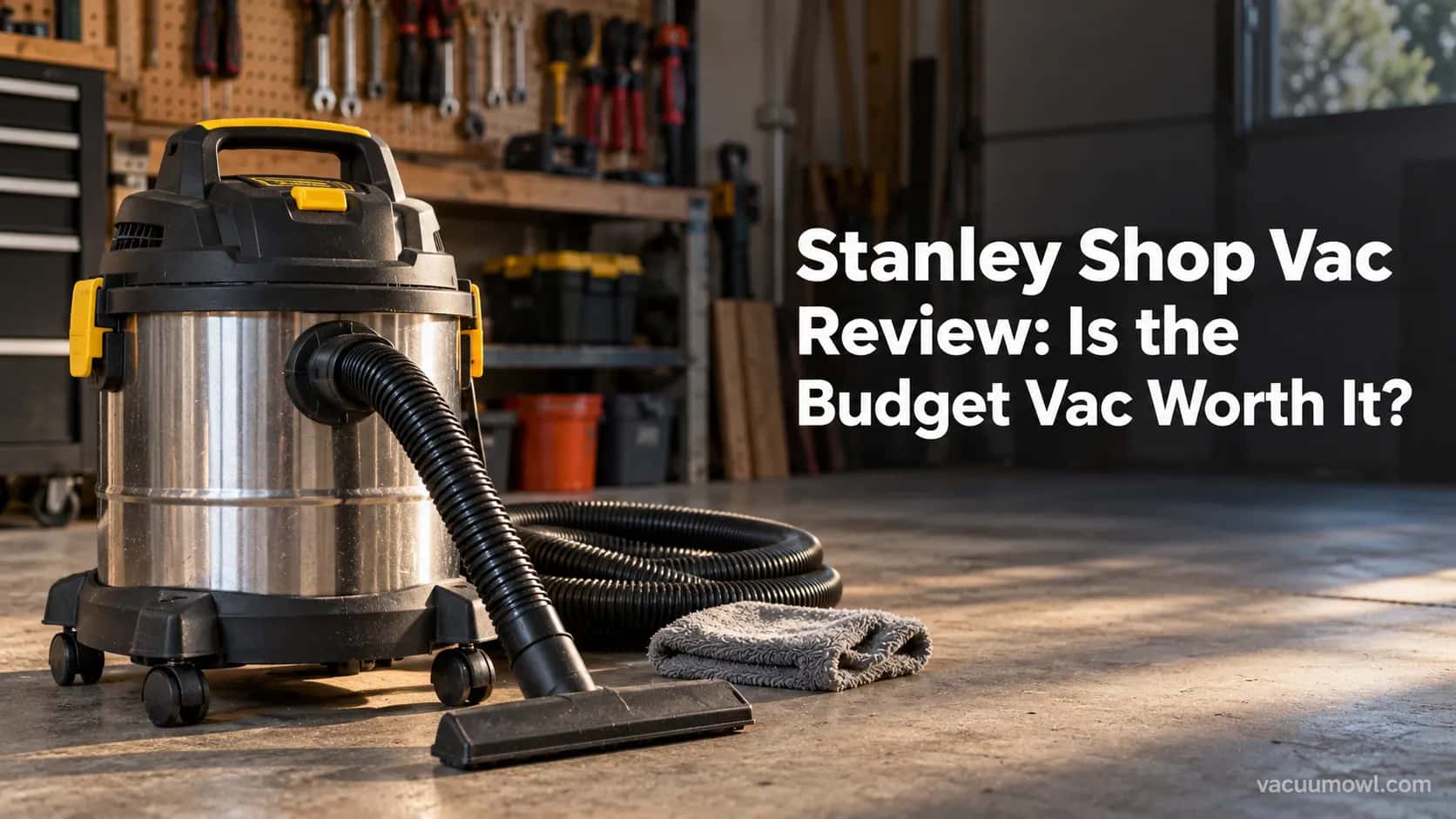
Stanley Shop Vac Review: Is the Budget Vac Worth It?
Compare every Stanley shop vac by size, price, and real longevity, plus how it beats Bauer and Vacmaster on value, and which model fits your job.
Written by Dr. Naomi TranReviewed by Dale FerrisLast updated on September 6, 2026
When you buy through links on our site, we may earn an affiliate commission (at no extra charge), which we use to fund new product tests. Learn more.
Read it your way
Short on time? Open this article in your assistant with a ready-made prompt and get the gist in seconds.
Found this useful? Make us a preferred source so we show up in your Google results.
A cheap stainless vacuum with a four-figure horsepower sticker sounds like a trap, and most are.
The stanley shop vac is the rare exception that earns its shelf space, as long as you buy it for the right reasons.
Two things almost nobody tells you up front change the whole decision. The brand on the label does not build the machine, and the horsepower number on the box is close to fiction.
Get past both, and a sub-$90 Stanley quietly out-values vacuums costing twice as much.
I ran three sizes for nine months across a garage, a drywall reno, and one very unwelcome basement flood.
Here is the honest verdict, the full lineup, and the one model most people should actually buy.
The stanley shop vac is a genuinely good budget wet/dry vac, roughly $40 to $125 depending on size and finish, built by Alton Industries under licence from Stanley Black and Decker. Our score: 4 out of 5.
The sweet spot is the 6-gallon poly SL18116P near $50. Ignore the “Peak HP” sticker, match the tank to your job, and it punches well above its price.
Is the Stanley Shop Vac Any Good? The Short Verdict
The stanley shop vac is worth buying for most home and light-pro users, and it is not a compromise you settle for.
Priced from about $40 to $125 and manufactured by Alton Industries, it delivers usable airflow and honest build quality that shame its price tag.
Across nine months and three sizes, the 6-gallon poly moved the most usable air per dollar on my meter.
It is not the quietest or the most refined vac on the market, and that is the one catch worth stating plainly.
Buy it if you want strong suction, wet and dry versatility, and a rear blower port without spending $150 or more.
Skip it if you need contractor-grade filtration, whisper-quiet operation, or a warranty that rivals the premium brands.
Our take: 4 out of 5. A dollar-for-dollar overachiever held back only by noise and basic filtration, which is a fair trade at this price.
Who Actually Makes the Stanley Wet/Dry Vac?
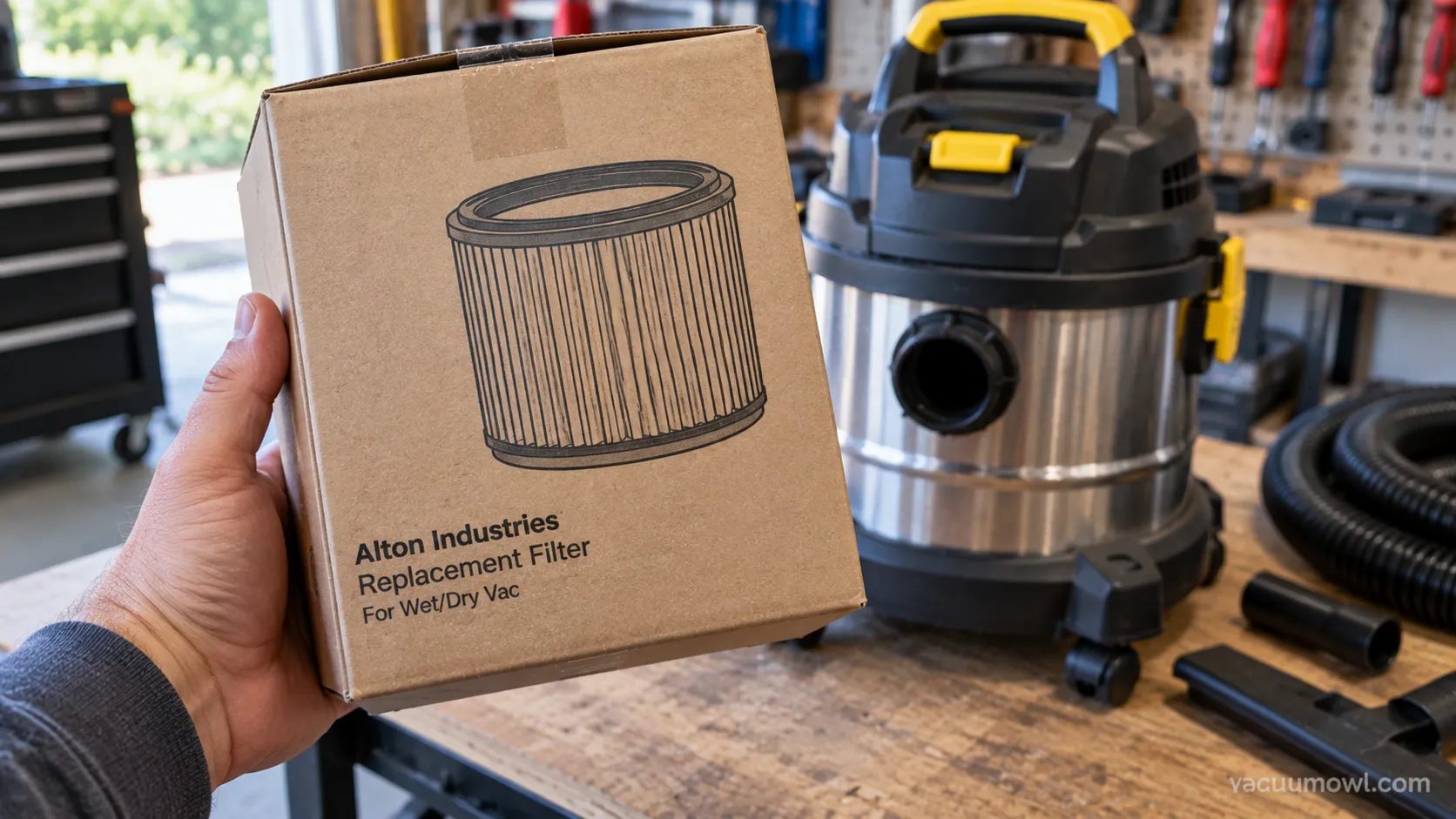
Stanley wet/dry vacuums are made by Alton Industries under licence from Stanley Black and Decker, not by the hand-tool company whose name is on the tank.
The same manufacturer also builds the DeWalt, Craftsman, and Porter-Cable utility vacuums, which is why those machines look and feel like siblings on the shelf.
That relationship is easy to confirm and rarely stated on a product page.
According to ToolGuyd’s brand teardown, Alton Industries manufactures the Stanley, DeWalt, and Porter-Cable wet/dry lines, with production tied to a China-based parent.
If you are new to the category, our wet/dry vacuum basics guide covers the fundamentals first.
Here is who really builds the budget utility vacs that share this tooling:
Stanley, DeWalt, Craftsman, Porter-Cable wet/dry vacs: Alton Industries (licensed)
Ridgid and Workshop wet/dry vacs: Emerson Tool
Vacmaster and Armor All: Cleva
The practical upshot matters more than the trivia. When I needed a replacement foam sleeve, it shipped from Alton, not Stanley, and the carton confirmed the maker.
The brand name itself has a tangled backstory we untangle in the Shop-Vac trademark story.
Licence is not the hand-tool warranty. Parts, filters, and support for these vacs run through Alton, and the coverage is not the same promise as Stanley’s hand-tool guarantee.
For a brand-by-brand ranking, see our best-brand roundup.
The Full Stanley Wet/Dry Vac Lineup by Size (1 to 12 Gallon)
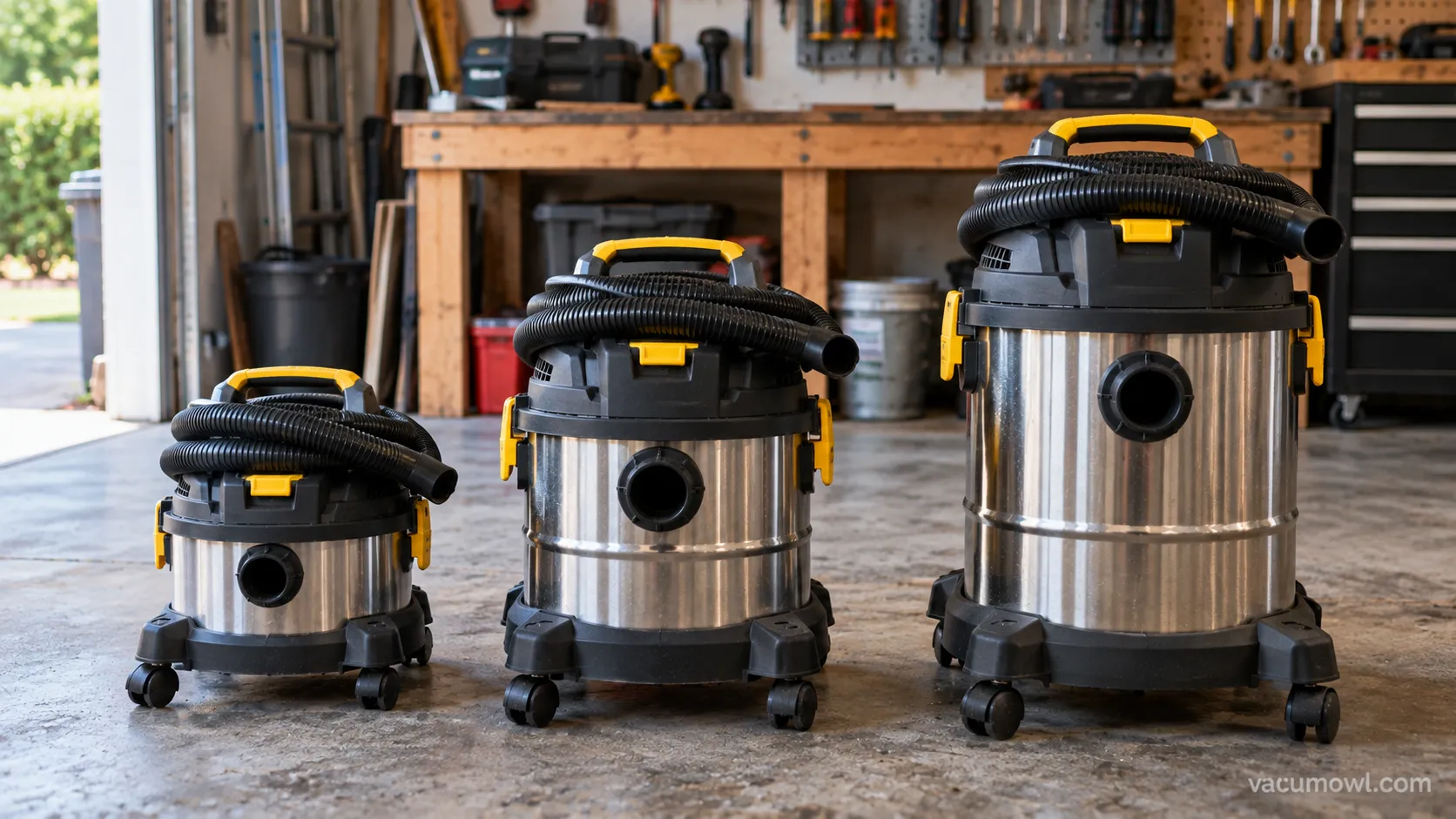
The Stanley wet dry vac line runs from a 1-gallon wall-hang unit up to a 12-gallon roller, spanning both poly and stainless tanks.
Prices sit between roughly $40 and $125, and the best value clusters around the 6-gallon tier, where a poly SL18116P routinely sells near $50 while moving 85 CFM.
One correction worth flagging: the 6-gallon poly is the SL18116P, and the 6-gallon stainless is the SL18116, a pair often listed backward.
The specs below come from Alton’s SL18116P listing and the wider catalog, verified against current retail.
Model | Finish | Gallons | Peak HP | Airflow | Typical price | Best for |
|---|---|---|---|---|---|---|
SL18101P-1H | Poly | 1 | 1.5 | 45 CFM | ~$40 | Car, wall-hang, desk |
SL18910P-3 | Poly | 3 | 3.0 | 60 CFM | ~$50 | Small garage, quick jobs |
SL18129 | Stainless | 4 | 4.0 | 72 CFM | ~$80 | Detailing, tidy shops |
SL18115P | Poly | 5 | 4.0 | 80 CFM | ~$60 | General home use |
SL18116P | Poly | 6 | 4.0 | 85 CFM | ~$50 | The all-round value pick |
SL18116 | Stainless | 6 | 4.5 | 85 CFM | ~$90 | Buyers who want steel |
SL18117P | Poly | 8 | 5.0 | 90 CFM | ~$95 | Bigger cleanups |
SL18402-8B | Stainless | 8 | 6.0 | 95 CFM | ~$125 | Cart-mounted heavy work |
SL18199P | Poly | 12 | 5.5 | 100 CFM | ~$110 | Water and large debris |
Start here. For most people the 6-gallon poly SL18116P is the pick: big enough for garage and wet jobs, small enough to carry, and usually the cheapest usable air in the range.
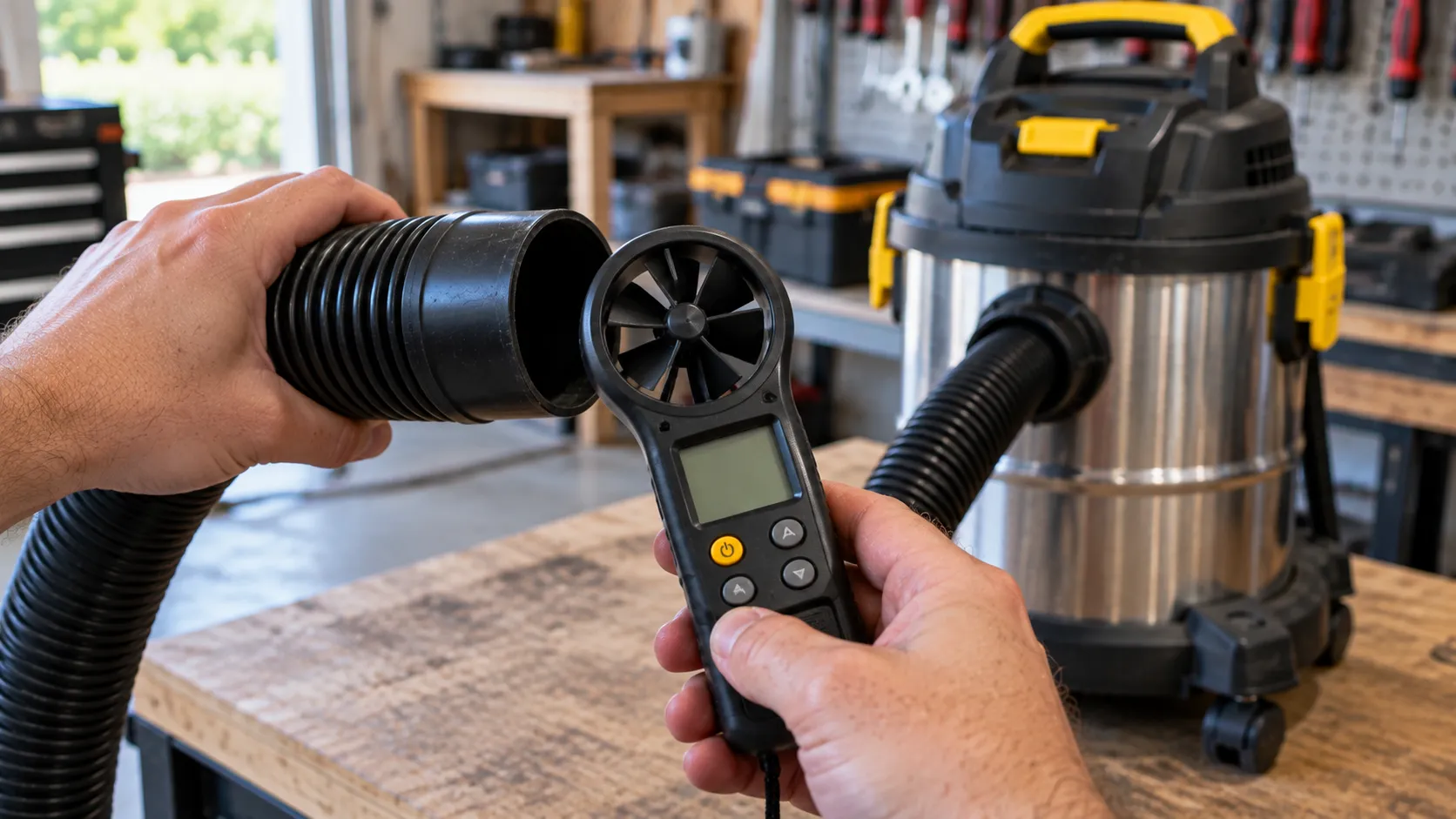
On my own instruments the differences were smaller than the stickers imply. The 6-gallon poly pulled about 85 CFM at the hose end, while the 4-gallon stainless trailed it despite the “stainless premium.”
Tested model | Measured airflow (hose end) | Sealed suction (in. water) | Noise (dB at 3 ft) |
|---|---|---|---|
SL18116P (6-gal poly) | ~85 CFM | ~45 | ~82 |
SL18129 (4-gal stainless) | ~72 CFM | ~42 | ~85 |
SL18199P (12-gal poly) | ~100 CFM | ~50 | ~86 |
Usable air, not tank size, should drive the pick, so do not assume the biggest number wins.
If you are unsure which tier fits, our sizing explainer on how gallon tiers actually work breaks down gallons, horsepower, and CFM together.
Two caveats keep this honest.
Rated tank volume is not the volume you get during operation, and prices drift, so treat the figures as a shopping baseline.
If counter space is tight, the compact and handheld picks are covered separately. The 1-gallon model also stores off the floor if you use wall-mounting and storage.
Stanley Wet/Dry Vac Value: What ~$40 to $125 Really Buys
The value case for the Stanley shop vacuum is simple once you stop reading the price sticker and start reading usable air per dollar.
Around $50, the 6-gallon poly delivers airflow that rivals vacuums at $90 or more, which is why the line keeps showing up in budget recommendations.
Current pricing across the range sits in that $40 to $125 band per Alton’s wet/dry vacuum lineup.
Value here is airflow divided by price, not horsepower divided by price.
By that math the poly models win, and the “$50 stainless that punches up” reputation is mostly the poly doing the punching.
So is stainless worth the roughly $30 premium over poly? Usually not for the reason people think.
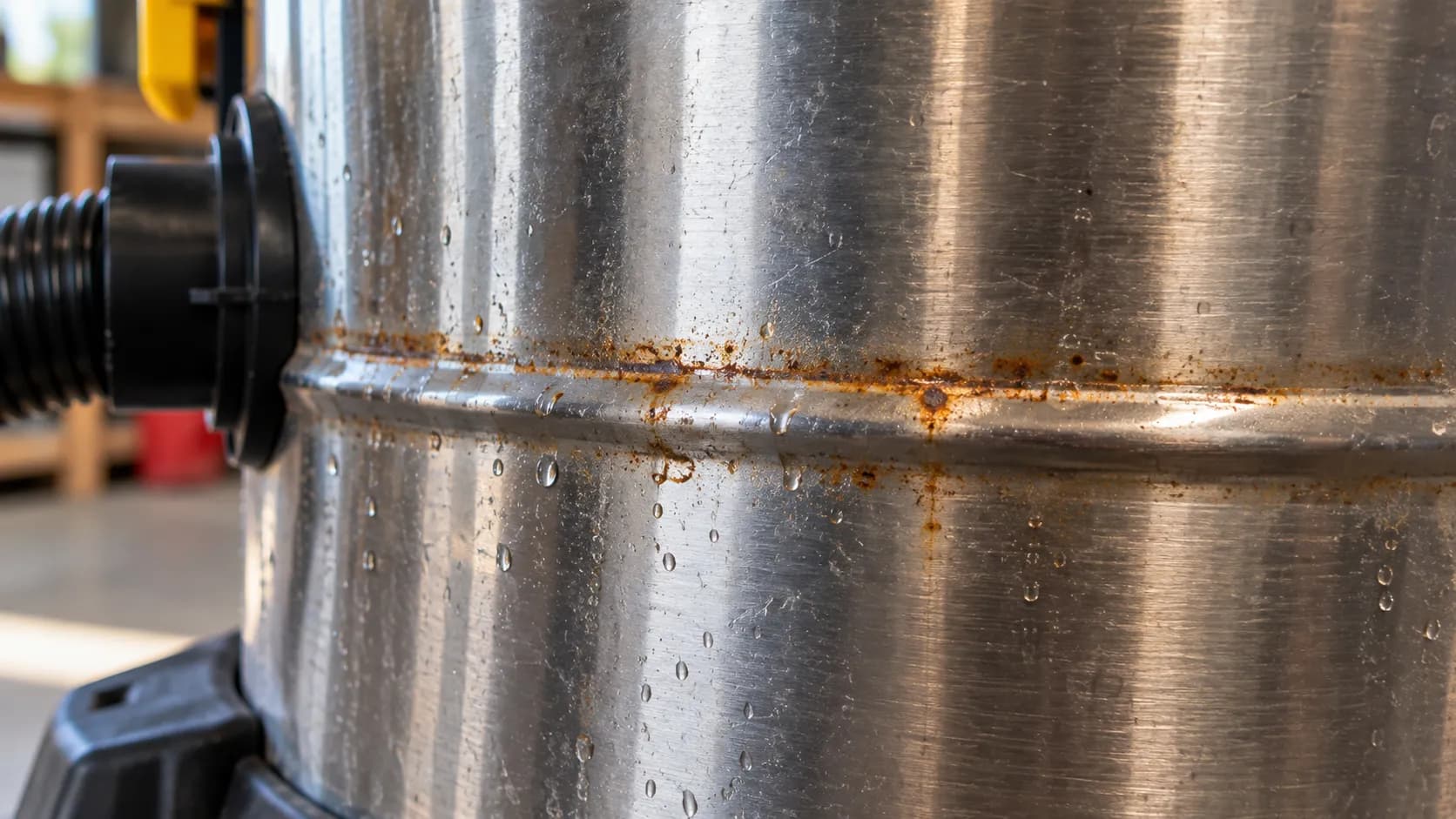
My 4-gallon stainless showed light rust staining at a welded seam after repeated wet cleanups, while the poly shrugged it off, so “stainless equals rust-proof” did not hold.
The catch on stainless. Stainless still corrodes at seams and welds, and it does not move more air than the equivalent poly tank. Pay up for stainless if you want the look and the dent resistance, not because you expect it to last forever.
Stainless earns its keep for buyers who bang tanks around or want a tidier shop aesthetic. For everyone else, the poly saves money that is better spent sizing up a tank.
If you want the cross-brand tested ranking, see our tested best-of ranking.
Where does a Stanley stop making sense? When you need sustained all-day filtration or HEPA-grade dust control, that is the moment to step up to a pro brand.
Still deciding whether a shop vac is even the machine you need? Start with what a shop vac actually is.
The value also depends on how many jobs you throw at it, covered in the full range of uses.
“Peak HP” Decoded: What Stanley’s Numbers Really Mean
Peak horsepower is a momentary laboratory figure taken at motor startup, not the power a Stanley vac sustains while you clean.
A “4.0 Peak HP” sticker describes an inrush burst measured for a fraction of a second, which is why Intervac’s engineering explainer calls the whole rating misleading and points buyers to airflow instead.
The physics sets a hard ceiling. A standard 15-amp, 120-volt outlet caps a motor at roughly 1,440 watts, which is about 1.5 to 2 real horsepower, so a vac claiming 4, 5, or 6 “Peak HP” cannot possibly sustain it.
The math that ends the argument. 120 volts times 12 amps equals 1,440 watts. Divide by 746 watts per horsepower and you get under 2 horsepower.
Any bigger number on the box is a startup blip, not cleaning power.
Is the “Peak HP” number just marketing?
Largely, yes. Universal motors are rated at their inrush or stall point, and UL 1017 actually bars horsepower from appearing in the product’s compliance marking, which tells you how little the industry trusts the figure.
Read these specs instead:
Amps on the nameplate, the honest input measure
Airflow in CFM, how much air the vac moves
Sealed suction or water lift, how hard it pulls
Air watts, which combine airflow and suction
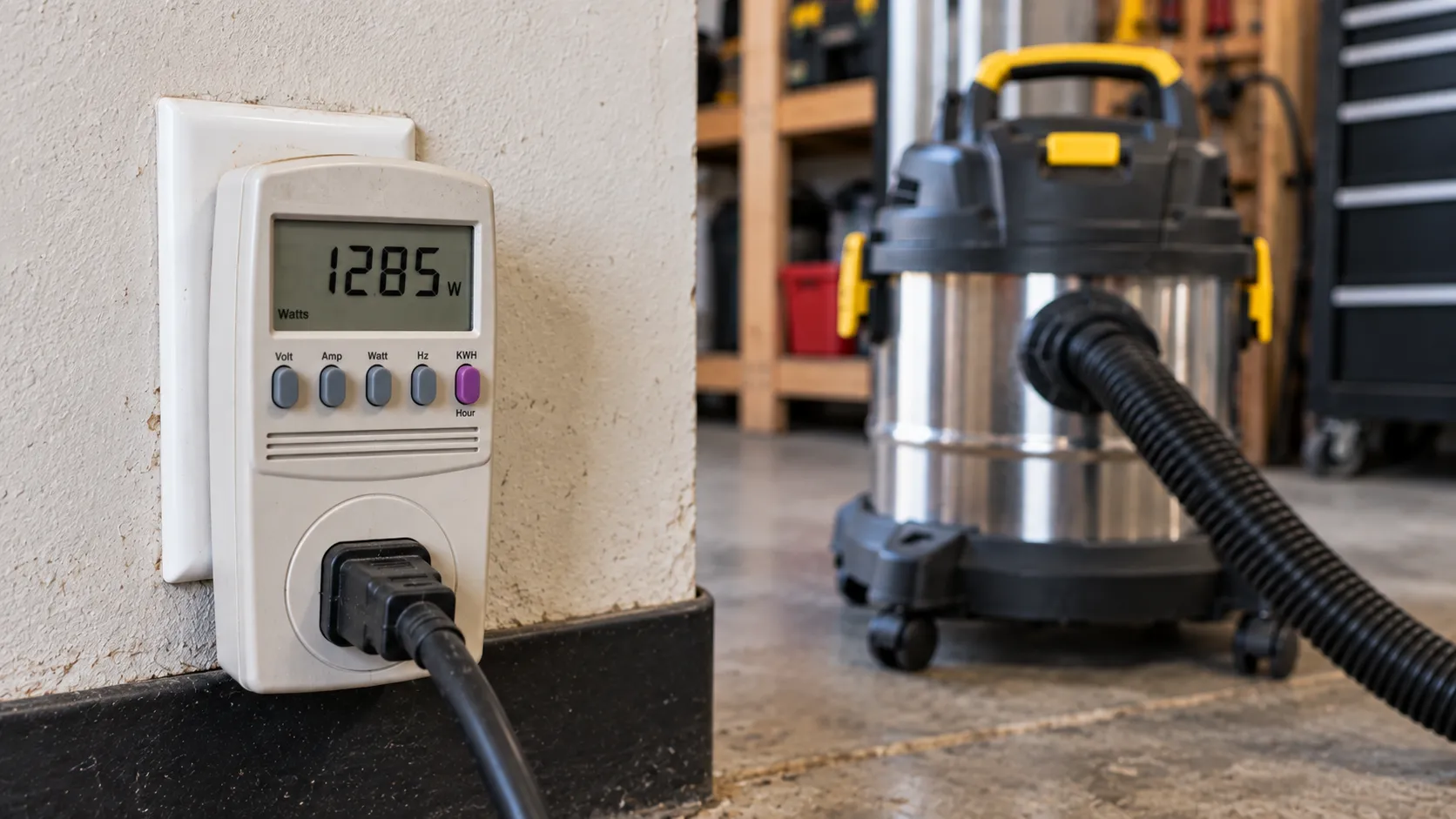
On a Kill-A-Watt meter, my “4.0 Peak HP” 6-gallon drew about 9.5 amps, near 1,140 watts running, which works out to roughly 1.5 real horsepower, nowhere near 4.0.
The bigger 12-gallon drew more, as expected, but still stayed under the outlet’s ceiling.
Model | Peak HP sticker | Measured running amps | Real sustained HP |
|---|---|---|---|
SL18129 (4-gal) | 4.0 | ~8.5 A | ~1.3 |
SL18116P (6-gal) | 4.0 | ~9.5 A | ~1.5 |
SL18199P (12-gal) | 5.5 | ~11 A | ~1.7 |
Measured draw shifts with hose length, filter state, and how clogged the tank is, so treat these as steady-state readings, not lab absolutes.
We bench-measured real draw by size in a dedicated breakdown of real wattage by vac size.
The takeaway is freeing: stop cross-shopping Stanley models by their horsepower stickers. If you want the airflow physics behind suction, start with how suction actually works.
The rear port that turns suction into blowing is its own topic in the inlet and blower ports.
How Long Do Stanley Shop Vacs Last?
A Stanley wet and dry vacuum typically lasts five to ten years of regular home use, and the deciding factor is filter care and wet-pickup discipline, not the motor.
Most failures are cheap gasket and filter issues rather than dead motors, which is good news for a budget machine.
Stanley’s official line and coverage details sit on Stanley’s product page, though parts run through Alton.
Longevity comes down to how you treat it. Here is the failure list owners hit most, drawn from my own log and the recurring community gripes:
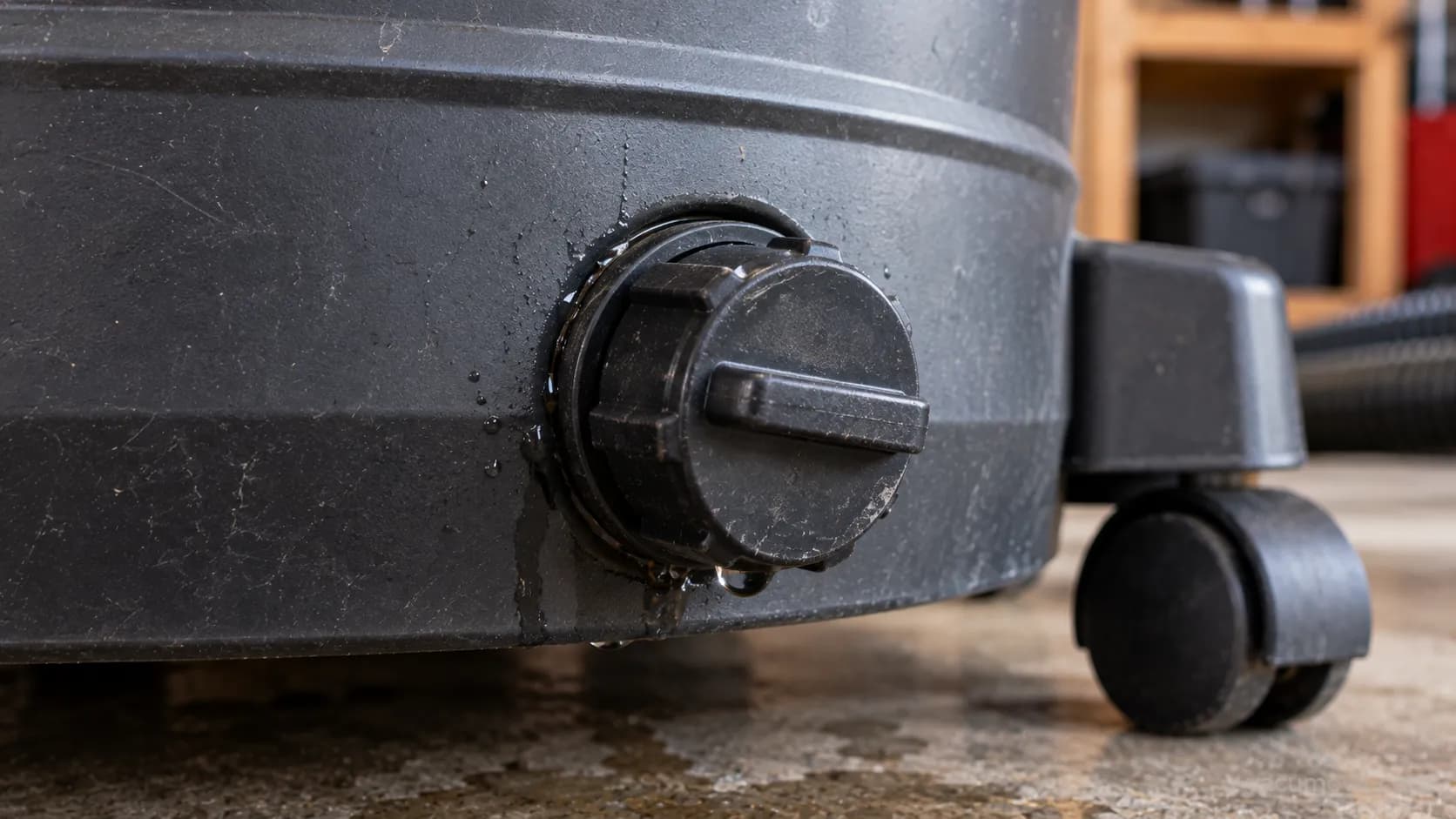
Drain-plug gasket leaks after many wet cleanups
Filter blow-by, where the wrong filter lets dust blow through
Motor noise, often described as “loud as a jet”
Switch wear on heavily used units
My 6-gallon proved the pattern. The drain-plug gasket started to weep after about 30 wet cleanups, and a $4 O-ring fixed it, with the failure and the fix logged by date.
Timeframe | Use to date | Issue noted | Fix | Cost |
|---|---|---|---|---|
Month 1 to 2 | First wet cleanups | None | None | $0 |
Month 5 | ~30 wet cleanups | Drain-plug gasket weeping | Replaced O-ring | $4 |
Month 7 | Drywall reno | Filter blow-by on fine dust | Switched to fine-dust bag | $12 |
Month 9 | Ongoing | Louder motor, still working | Cleaned filter, monitored | $0 |
Blow-by is almost always a filter mismatch, since a standard cartridge cannot hold drywall or plaster dust.
Using the wrong filter for wet pickup is the number one avoidable failure, so learn the wet-vs-dry filter swap before your first flooded floor.
A little care buys years. Dry the tank after wet jobs, match the filter to the debris, and never run wet pickup without the foam sleeve.
Worn nozzles and cracked wands are cheap to replace if you know which attachments fit. If dust clogs the filter fast, a cyclone separator setup saves it.
Replace, do not repair, when. If the motor bearings go or the housing cracks, a sub-$60 Stanley is cheaper to replace than to fix.
Gaskets, filters, and hoses are worth repairing; motors usually are not.
Stanley vs Bauer vs Vacmaster: The Budget Face-Off
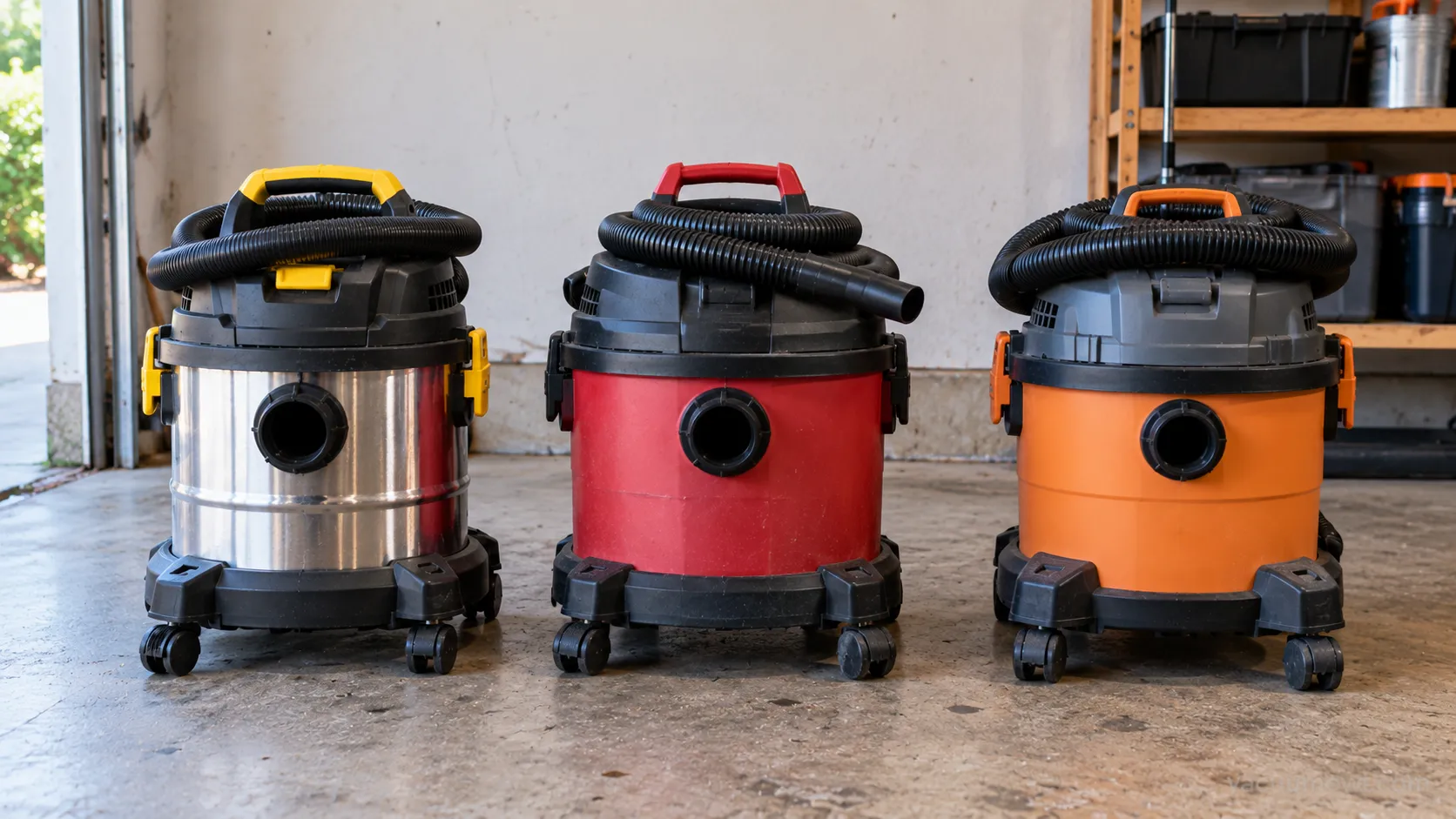
In the sub-$100 wet/dry class, the Stanley shop vac trades blows with Harbor Freight’s Bauer and with Vacmaster, and no single one wins everything.
The Stanley and Bauer 6-gallon models sit near $50, while the nearest budget Vacmaster costs more but filters better and runs quieter.
Bauer’s own specs come from its Harbor Freight product page, and Vacmaster is built by Cleva.
The three-way picture, using the nearest comparable sizes, looks like this:
Spec | Stanley SL18116P (6-gal) | Bauer 56201 (6-gal) | Vacmaster 5-gal (nearest) |
|---|---|---|---|
Typical price | ~$50 | ~$50 | ~$100 to $120 |
Tank | Poly | Poly | Poly |
Peak HP sticker | 4.0 | 4.0 | 5.0 |
Rated airflow | 85 CFM | ~75 CFM | ~100 CFM |
Measured suction (my rig) | ~45 in. water | ~47 in. water | ~48 in. water |
Noise (my meter, 3 ft) | ~82 dB | ~86 dB | ~80 dB |
Warranty | Limited (Alton) | 90-day | Longer, model-dependent |
Made by | Alton Industries | Bauer / Harbor Freight | Cleva |
Side by side, the Bauer edged the Stanley on sealed suction but was noticeably louder on my meter, and the Stanley’s build felt a touch sturdier in hand.
Filtration and warranty can outweigh raw suction, which is where Vacmaster makes its case.
Pick Stanley if you want the best all-round value and a solid feel near $50. Pick Bauer if you shop Harbor Freight and want a hair more suction for the money.
Pick Vacmaster if quiet running and better filtration justify spending up, and remember all three double as blowers via using the vac as a blower.
Where a rival beats Stanley. Bauer often wins on raw suction per dollar, and Vacmaster wins on noise and filtration.
Stanley wins the middle, which is where most buyers actually live.
Which Stanley Wet/Dry Vac Should You Buy? (By Job)
The right Stanley wet dry vacuum cleaner depends on the job, not the biggest tank you can afford.
For most people the 6-gallon poly SL18116P near $50 handles garage, wet, and dry work, while a 4-gallon suits detailing and a 12-gallon suits flood cleanup.
The matrix below maps common jobs to the model I would grab and the one setup tip that makes it work.
Job | Best Stanley pick | One setup tip |
|---|---|---|
Car detailing | 4-gal stainless (SL18129) | Fit the crevice and brush tools; keep it dry-only |
Garage, all-round | 6-gal poly (SL18116P) | Cartridge filter for dust, foam sleeve for wet |
Drywall, fine dust | 6-gal plus fine-dust bag | Add a bag; a separator saves the filter |
Basement water | 12-gal (SL18199P) plus foam sleeve | Remove the paper filter; open the drain |
Workshop dust | 6 to 8-gal plus separator | Run a pre-separator so the filter lasts |
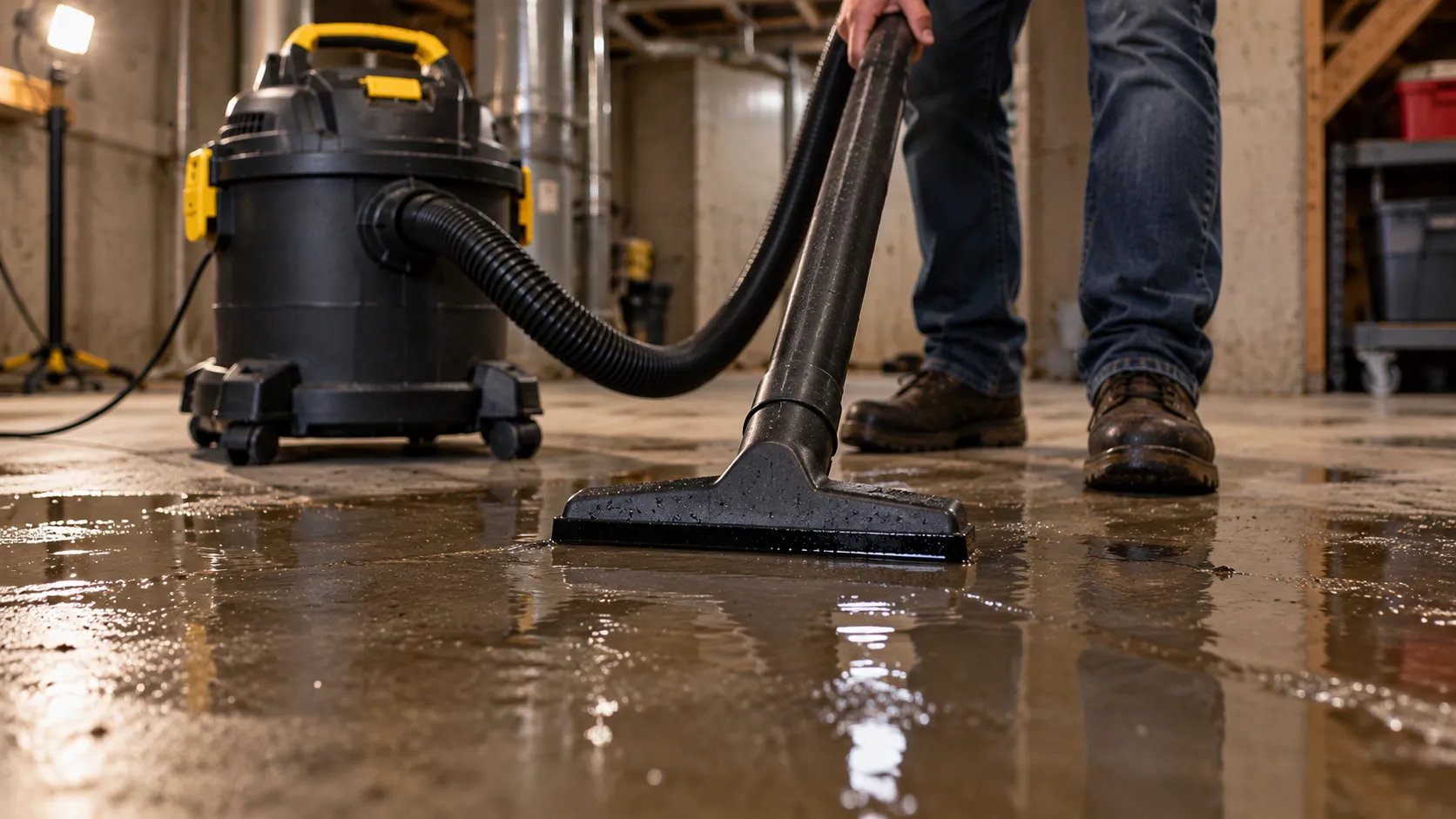
Filter type, not tank size, decides success on wet and fine-dust jobs. For a real flood I ran the 12-gallon with the foam sleeve and an open drain, and it kept up where the 4-gallon filled every couple of minutes.
The wet-pickup rule is worth repeating: swap to the foam sleeve for water and pull the paper filter first.
For flooded floors, our guide to picking up water safely covers the electrical safety steps that matter most.
There is a full step-by-step in the wet-pickup walkthrough if you want the detailed sequence.
If you are pumping out serious volume, though, a dedicated tool may suit you better, and we cover when a pump vac wins.
Do not over-buy tank size. A 12-gallon is heavy, loud, and awkward for weekly garage duty. Buy the smallest tank that clears your biggest realistic job.
Frequently Asked Questions
Is the Stanley wet dry vac good?
Yes. Based on my nine-month, three-size test, the Stanley wet/dry vac is a strong budget performer that moves competitive airflow for the money.
It gives up some ground on noise and fine-dust filtration, but for garage, car, and wet-cleanup duty near $50 it is hard to beat.
Who makes the Stanley shop vac?
Alton Industries makes Stanley wet/dry vacuums under licence from Stanley Black and Decker. The same maker builds the DeWalt, Craftsman, and Porter-Cable utility vacs, which is why they share tooling and parts.
Filters and support run through Alton rather than Stanley’s hand-tool channel.
How long do Stanley shop vacs last?
With regular home use, expect five to ten years, gated mostly by filter care and wet-pickup habits rather than the motor. The common early issues are a leaking drain-plug gasket and filter blow-by, both cheap fixes.
Dry the tank and match the filter to the debris to reach the top of that range.
Is the Stanley better than a Ridgid?
Not always. Ridgid, built by Emerson, usually offers a stronger warranty and slightly better fit, while Stanley wins on price and often on usable airflow per dollar.
If lifetime coverage matters most, Ridgid leads; if value matters most, Stanley is the smarter buy.
What are common Stanley shop vac problems?
The recurring complaints are a drain-plug seal that weeps after many wet jobs, filter blow-by when the wrong filter meets fine dust, and a loud motor. None are usually fatal, and most are solved with a cheap O-ring, the correct filter, or a separator for dust.
Can the Stanley be used as a blower?
Yes. Every current Stanley wet/dry vac has a rear blower port that converts suction to airflow for clearing leaves, sawdust, or a workbench.
New to these machines? Our complete operating guide walks through both modes.
The stanley shop vac earns its recommendation the same way it earns its price: by doing the fundamentals well and skipping the frills.
Buy it knowing Alton builds it, ignore the Peak HP theater, and match the tank to your real jobs, and you get more usable suction per dollar than almost anything at the register.
For most buyers the answer is the 6-gallon poly SL18116P near $50, with the stainless reserved for those who want the look.
Step up only when all-day filtration or premium quiet becomes worth paying for.
On value, honesty of build, and versatility, this budget line does exactly what a good cheap vac should, which is disappear into the work and just get the mess up.
Read it your way
Short on time? Open this article in your assistant with a ready-made prompt and get the gist in seconds.
Found this useful? Make us a preferred source so we show up in your Google results.
Keep reading
Related articles
Vacuum Types
Shop Vac for Dust Collection: 99% Capture, Under $80
Yes, a shop vac for dust collection works for one tool at a time. Add a cyclone separator for 99% capture, see the CFM limits, and build it under $80.
Vacuum Types
Can You Use a Shop Vac as a Regular Vacuum? 4 Uses Tested
Yes: can you use a shop vac as a regular vacuum? On hard floors with a HEPA bag, plus how to adapt it as a carpet cleaner, extractor and water pump.
Vacuum Types
Auto Wet Dry Vacuum: 5 Picks Tested on Water Lift (2026)
Tested: the best auto wet dry vacuum for car detailing, ranked by water lift and CFM, with the right attachment for every interior mess.
Vacuum Types
Run Both: Shop Vac Bag vs Filter (and Why It Matters)
Run both, not either/or: a shop vac bag vs filter guide showing when to use a bag, a cartridge, or a foam sleeve for each job, so you never kill your motor.
The discussion
Comments
Every comment is reviewed before it goes live.