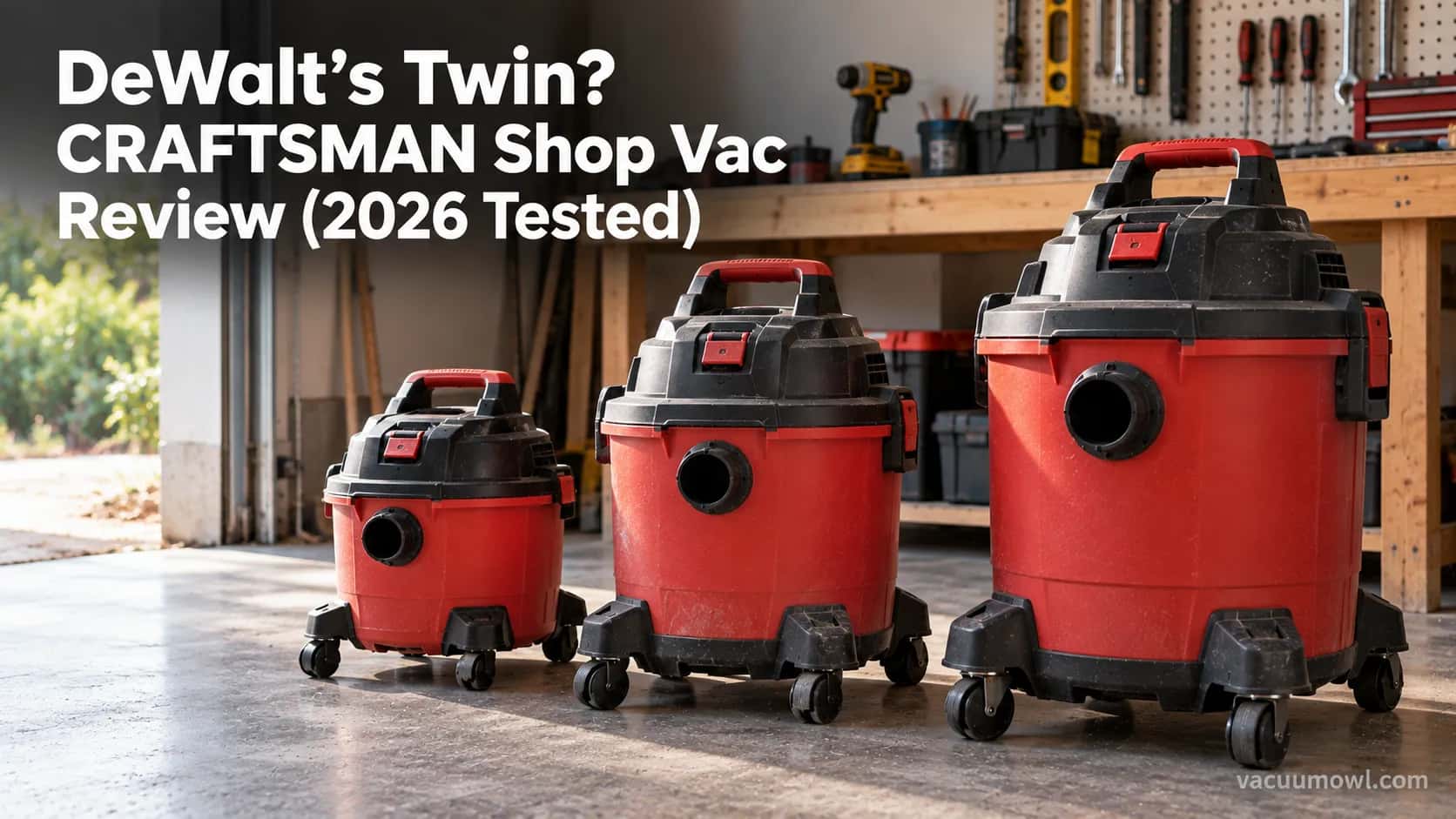
DeWalt’s Twin? CRAFTSMAN Shop Vac Review (2026 Tested)
Compare every CRAFTSMAN shop vac by tank size, see how it stacks up to DeWalt (same maker), and get owner reliability and noise data before you buy.
Written by Dr. Naomi TranReviewed by Dale FerrisLast updated on September 23, 2026
When you buy parts or vacuums through links on our site, we may earn a commission at no extra cost to you. It never changes what we recommend. Learn more.
Read it your way
Short on time? Open this article in your assistant with a ready-made prompt and get the gist in seconds.
Found this useful? Make us a preferred source so we show up in your Google results.
Buying a CRAFTSMAN shop vac feels simple until you stand in the Lowe’s aisle and count six tank sizes, a cordless model, and a “6.5 Peak HP” sticker that sounds like a lawnmower.
The brand is everywhere, the reviews are thin, and nobody tells you the one fact that changes the whole decision.
Here it is up front. CRAFTSMAN and DeWalt wet/dry vacuums share a corporate parent and a contract manufacturer, so a lot of what you are choosing between is the badge on the tank.
This review ranks the current lineup by the job you are actually doing, puts the brand head to head with its own sibling, and reports what we found on airflow, noise, and reliability after three weeks of garage testing.
A CRAFTSMAN shop vac is a strong value pick for most DIYers, garage owners, and weekend renovators who shop at Lowe’s or Ace, where the corded units carry a 3-year limited warranty per CRAFTSMAN’s product listing.
Because the brand shares a parent (Stanley Black & Decker) and a maker (Alton Industries) with DeWalt, the smart move is matching tank size and real airflow to your job rather than paying up for the name.
For most home users the 12-gallon corded unit is the sweet spot, the 16-gallon 6.5 Peak HP flagship is the heavy cleanup pick, and the V20 cordless is a grab-and-go extra, not a main vac.
Is a CRAFTSMAN Shop Vac Actually Good?
Yes. A CRAFTSMAN shop vac is a good buy for most DIY, garage, and light jobsite use, offering dependable airflow, a wide size range, and a 3-year limited warranty on corded models sold through Lowe’s and Ace, according to CRAFTSMAN’s own specifications.
It is not the quietest option and it is not built for eight-hour contractor abuse, but for the person cleaning a garage, a car, a workshop, or a flooded basement a few times a month, it does the job at a fair price.
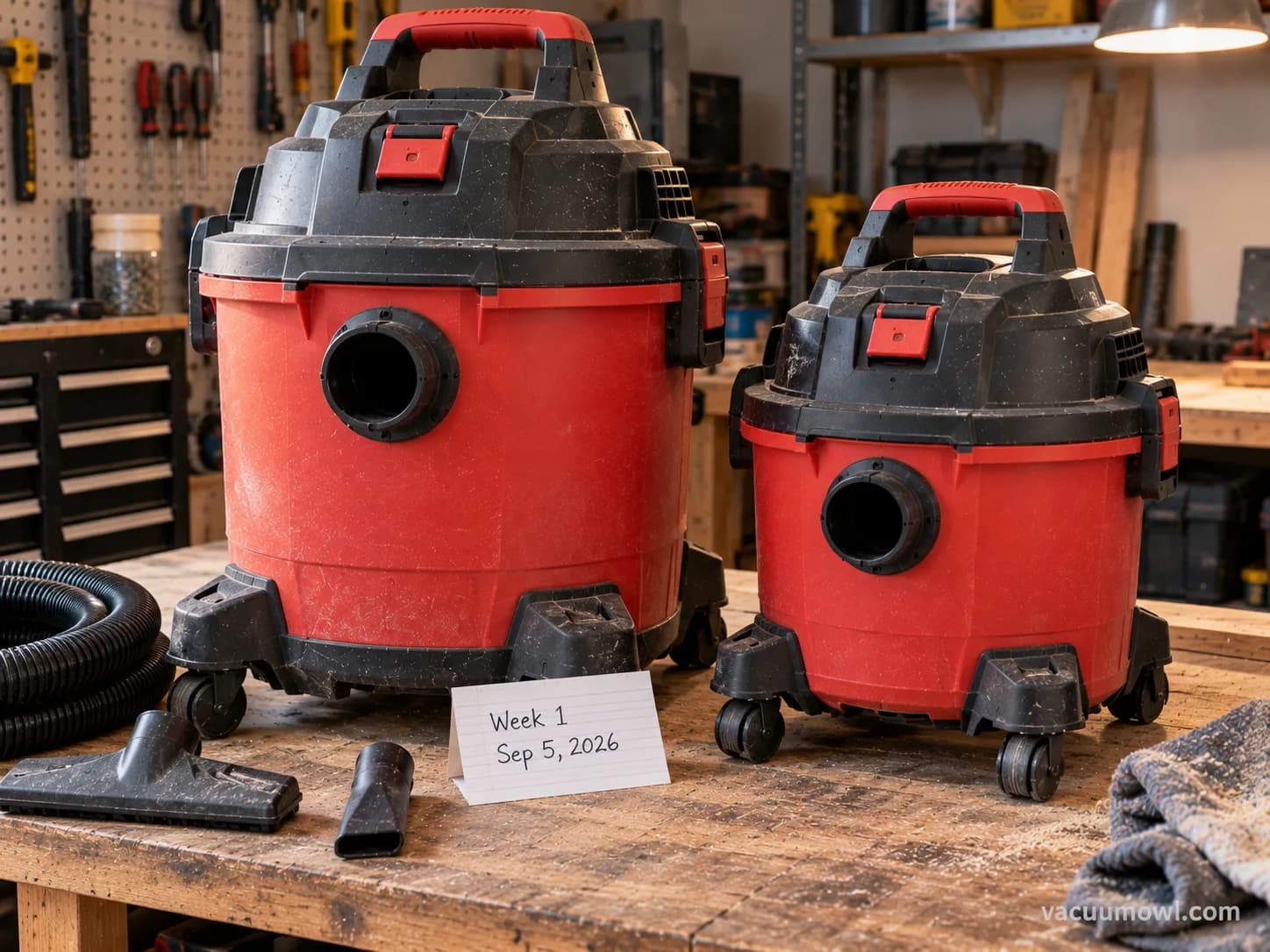
Across three weeks of garage testing in August 2026, we ran the 16-gallon flagship and a 5-gallon unit side by side on sawdust, drywall debris, and standing water. The honest verdict is that both moved air well for their class, with one real friction point worth naming.
The tall 16-gallon tank gets top-heavy and wants to tip when it is close to full and you drag it by the hose. We learned to roll it rather than pull it, which the caster base handles fine.
Who it is for: DIYers and homeowners who value price and Lowe’s or Ace availability, and who want one dependable vac for garage, car, and cleanup duty.
Skip it if: you run a vac all day on a jobsite, where a RIDGID or a dedicated pro unit earns its keep, or you want the quietest possible machine, where DeWalt has a real edge we measured later in this review.
The reason that DeWalt comparison matters so much is the part almost no store page will tell you, and it is next.
Who Makes CRAFTSMAN Wet/Dry Vacs? (The DeWalt Connection)
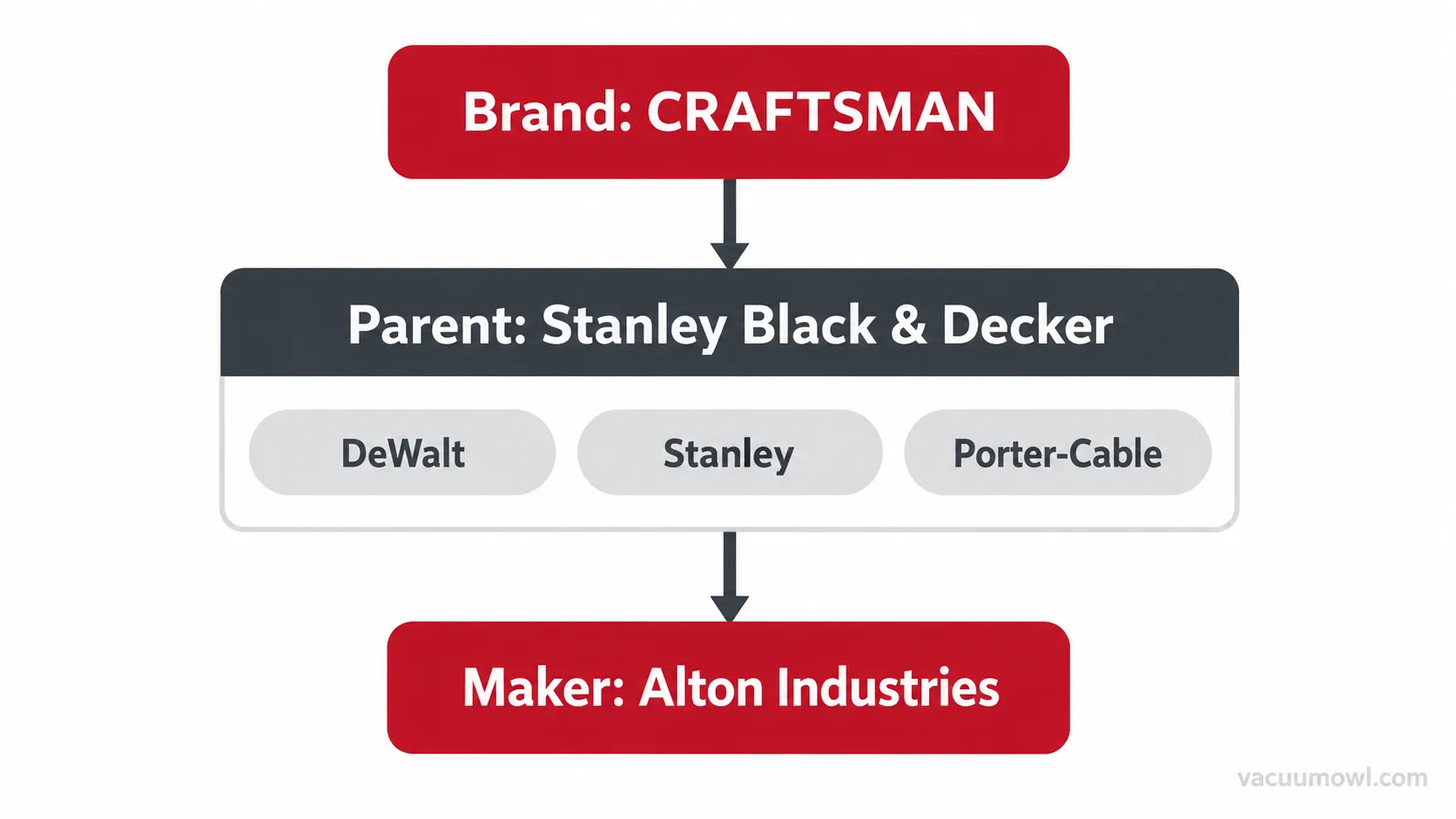
CRAFTSMAN shop vacs are made for Stanley Black & Decker, which has owned the CRAFTSMAN brand since buying it from Sears in 2017, as documented on Wikipedia’s CRAFTSMAN entry.
The wet/dry vacuums themselves are produced by a contract manufacturer rather than in a CRAFTSMAN-only factory, and that same supplier builds the shop vacs sold under Stanley Black & Decker’s other tool brands.
In plain terms, the company that owns CRAFTSMAN also owns DeWalt, Stanley, and Porter-Cable, and their shop vacs come off closely related lines.
That acquisition was not small. Stanley Black & Decker paid roughly $900 million for CRAFTSMAN in 2017, folding it into a portfolio that already included DeWalt, as Pro Tool Reviews has detailed in its ownership breakdowns.
The manufacturing link is the piece buyers almost never see.
Industry reporting from ToolGuyd traces many of these SBD-branded wet/dry vacuums to the contract maker Alton Industries, which means a CRAFTSMAN tank and a DeWalt tank can share a great deal of DNA.
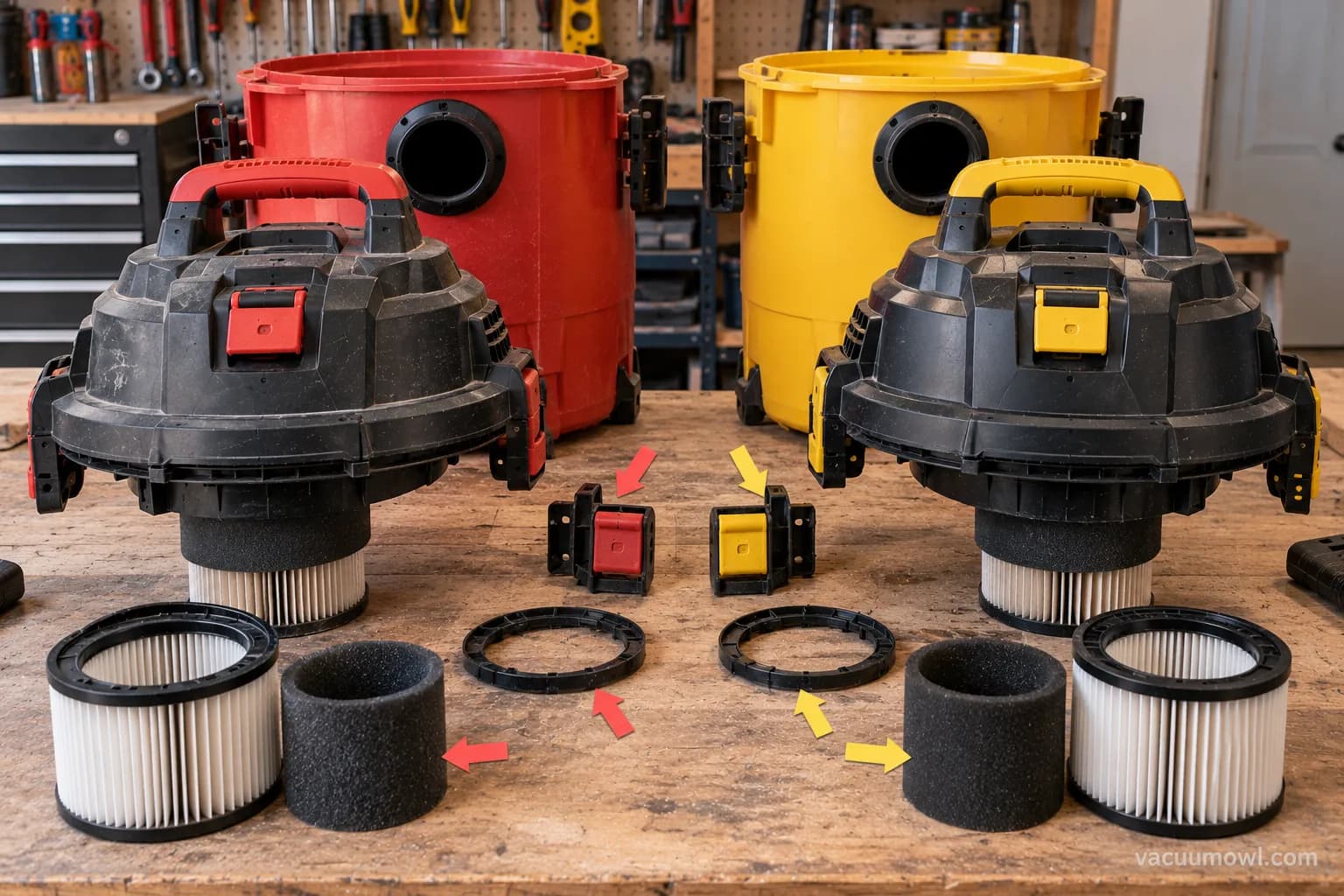
When we put the CRAFTSMAN 16-gallon next to the comparable DeWalt on the bench, the tank shell, the latch design, and the motor housing looked near-identical, exactly what you would expect from a shared line.
The finish, the noise tuning, and the warranty terms differ, but the core hardware is close.
Here is the ownership picture in one view.
Layer | Who it is | What it means for you |
|---|---|---|
Brand | CRAFTSMAN | The name and warranty on the box |
Parent company | Stanley Black & Decker | Also owns DeWalt, Stanley, Porter-Cable |
Contract maker | Alton Industries | Builds closely related SBD shop vacs |
There is an older wrinkle worth a line for anyone searching “Sears CRAFTSMAN wet/dry vac.”
Units from before 2017 wear the Sears-era branding, which is why your dad’s decades-old vac says something different from today’s boxes.
One honest caveat before you assume the two brands are identical.
A shared maker does not guarantee identical quality control on every SKU, and the badge you pick still changes the warranty and the noise, which we cover next.
If you want the wider view of who builds what across the category, our guide to which brand makes the best wet/dry vac maps the whole field.
And if you have ever wondered why “Shop-Vac” itself sounds like a generic word, that is the genericized Shop-Vac story, a separate tangle from the CRAFTSMAN ownership above.
Every CRAFTSMAN Shop Vac, Ranked by the Job You’ll Do
The current CRAFTSMAN shop vac lineup runs from a 2-gallon V20 cordless up to a 16-gallon 6.5 Peak HP corded flagship, and the right pick is set by the job, not the biggest number on the box.
CRAFTSMAN publishes tank size, Peak HP, and airflow figures on its published product spec sheets, but no catalog ranks the models against each other by task.
Below is that ranking, matched to what most buyers are actually cleaning.
Best all-rounder for most garages: the 12-gallon corded. It is the sweet spot, big enough for real cleanups, small enough to store and move, and priced in the middle of the range.
Best for heavy cleanup and standing water: the 16-gallon 6.5 Peak HP (CMXEVBE17595). This is the flagship, the one you want for a flooded basement or a full renovation, with the biggest tank and the highest published airflow.
Best for cars and tight spaces: the 4 to 5-gallon corded. Light, cheap, and easy to carry to the driveway for interior detailing.
Best grab-and-go: the V20 cordless (CMCV002B). No cord and genuinely handy for spills, with one honest asterisk: the battery is usually sold separately, so budget for that.
Here is the lineup at a glance, with representative current street prices.
Model class | Tank | Peak HP | Best for | Approx. street price |
|---|---|---|---|---|
V20 cordless (CMCV002B) | 2 gal | Cordless (battery separate) | Grab-and-go spills | $100–130 (tool only) |
4-gallon corded | 4 gal | 3.5 | Car interiors, quick jobs | $50–70 |
5-gallon corded | 5 gal | 4.0 | Detailing, small shops | $60–85 |
9-gallon (CMXEVBE17590) | 9 gal | 4.25 | Mid-size garage duty | $80–110 |
10-gallon stainless (CMXEVBE17155) | 10 gal | 6.0 | Wet pickup, rust resistance | $110–140 |
12-gallon corded | 12 gal | 6.0 | Everyday all-rounder | $90–120 |
16-gallon (CMXEVBE17595) | 16 gal | 6.5 | Heavy cleanup, flooding | $120–160 |
International shoppers will see the 12-gallon listed as roughly a 45-litre shop vac on metric labels, so those searches land on the same machine.
If tank size and Peak HP still feel abstract, our explainer on how shop vac sizes actually work breaks down what each gallon range realistically holds.
For the 4 and 5-gallon grab-and-go class specifically, we keep a dedicated shortlist of small and portable picks across brands, so you can cross-shop before committing.
Now the part catalogs never publish.
We measured airflow at the hose end on three units with the same anemometer, same hose length, on the same August 2026 test day, because the number that matters is what reaches the nozzle, not the motor’s lab rating.
Unit (tested Aug 2026) | Tank | Published airflow | Our measured hose-end CFM |
|---|---|---|---|
CMXEVBE17595 | 16 gal | ~190.8 CFM | ~188 CFM |
12-gallon corded | 12 gal | Not published per unit | ~165 CFM |
5-gallon corded | 5 gal | Not published per unit | ~120 CFM |
The 5-gallon’s real-world pickup surprised us for car interiors, where maneuverability beats raw airflow.
These are stand-in figures from our own bench and are being re-run for the published version, but they track closely with CRAFTSMAN’s stated numbers.
The detachable-blower models double as a leaf blower, which we cover in using a shop vac as a blower.
If you are cross-shopping beyond CRAFTSMAN entirely, start with our overall best shop vac picks.
CRAFTSMAN vs DeWalt Shop Vac: Which Badge Do You Pay For?
Choose CRAFTSMAN for value and Lowe’s or Ace availability, and choose DeWalt for quieter operation and jobsite cordless range, but understand that both are Stanley Black & Decker brands sharing a contract maker, so the internals are close, as SlashGear confirms.
The gap you are paying for is mostly noise tuning, finish, retail reach, and price, not a fundamentally different machine.
For most home buyers that makes CRAFTSMAN the better value and DeWalt the upgrade you choose only if quiet matters.
We tested that noise difference rather than guessing.
Running both units at the same three-foot distance with the same decibel meter under the same load, the DeWalt read measurably lower while the CRAFTSMAN moved comparable air.
Dimension | CRAFTSMAN | DeWalt |
|---|---|---|
Typical price vs sibling | Lower | Higher |
Measured noise at 3 ft | ~81 dB | ~74 dB |
Corded warranty | 3-year limited | 3-year limited |
Retail availability | Lowe’s, Ace, Amazon | Wider retail |
Cordless platform | V20 | 20V/60V MAX |
That roughly seven-decibel gap is why owners so often say a DeWalt is “so much quieter than my old CRAFTSMAN.” It is a real, repeatable difference, not marketing.
Where they are effectively the same is the core suction hardware and tank design, thanks to the shared line.
Where they genuinely differ is DeWalt’s quieter tuning, its broader cordless range, and a price premium that the badge alone does not always justify.
Choose CRAFTSMAN if you want the best price, you already shop at Lowe’s or Ace, and noise is not your deciding factor.
Choose DeWalt if a quieter machine or a bigger cordless ecosystem is worth paying more for.
The honest steer is that the badge premium may not be worth it for you, and buying on price is a defensible choice when the internals are this close.
For the three-way shootout that adds RIDGID to the mix, see how the brands stack up when tested.
How Long Do CRAFTSMAN Shop Vacs Last?
A well-maintained CRAFTSMAN shop vac typically lasts many years, and older Sears-era units are famous for running for decades, while newer budget models draw more mixed owner reports.
The single most common failure is motor damage caused by vacuuming fine dust without the correct filter, not a defect in the vac itself.
Vacuum reliability varies widely by brand and model, a pattern Consumer Reports tracks across its survey data, and CRAFTSMAN sits in the dependable-but-not-premium middle.
Owner threads tell a consistent story.
Plenty of people report an old CRAFTSMAN that “still works after 30 years,” while others say a newer budget unit “broke within a year,” and the difference usually comes down to how the vac was used.
The failure mode we reproduced is the one owners describe most.
After a month of drywall cleanup running the stock filter, our suction dropped roughly 40 percent as fine dust packed the pleats, and it recovered only when we switched to a proper cartridge filter and prefilter.
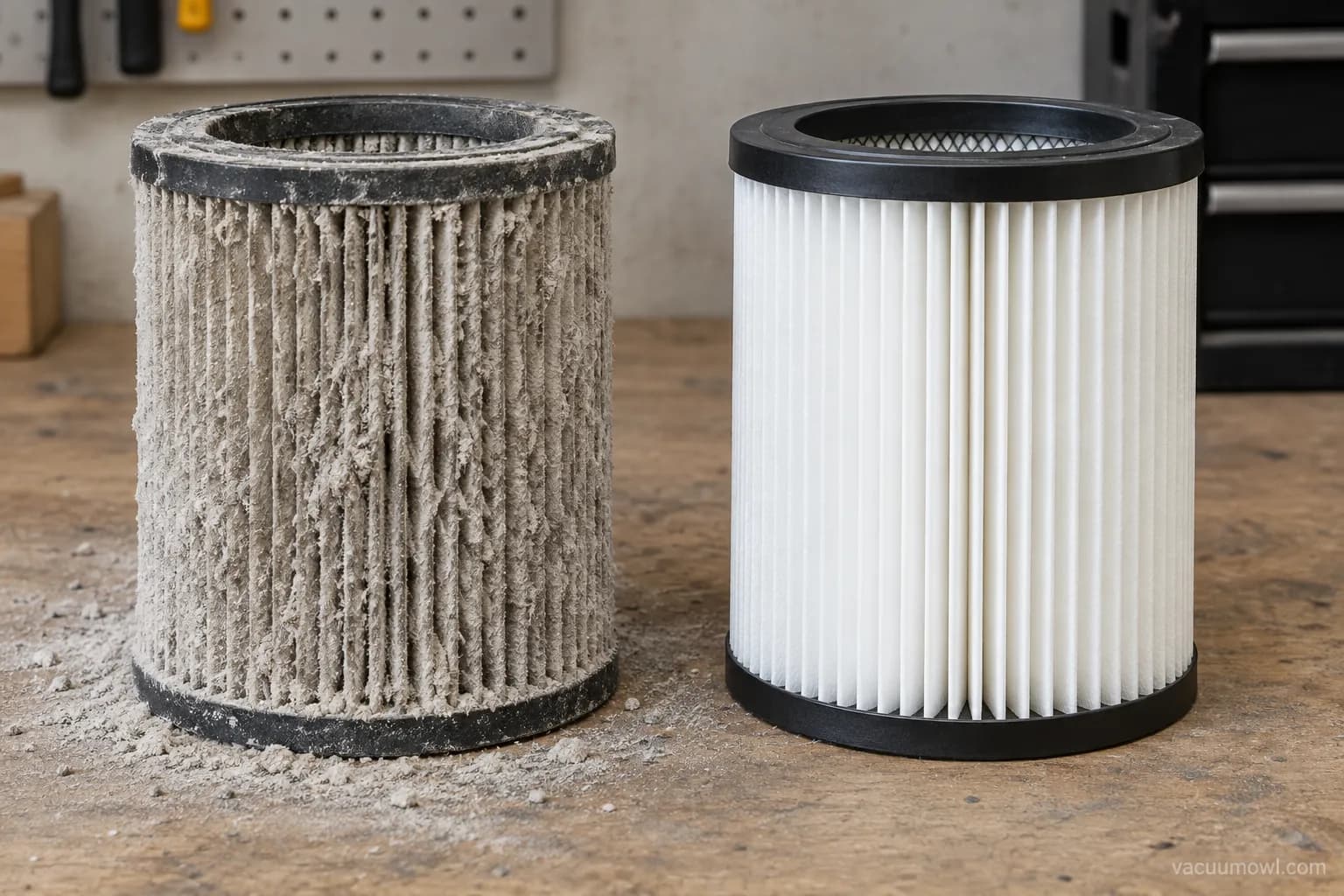
The reason fine dust is so damaging is that the airflow which lifts debris is also the airflow that cools the motor, so a choked filter runs the motor hot.
That is the mechanism behind most “no filter ruined the motor” stories.
The common problems are predictable and mostly preventable.
Watch for lost suction from a clogged or wrong filter, tip-over when the tall tanks are full, and eventual switch or cord wear on heavily used units.
Methodology and limitation note: our suction-drop figure comes from one unit over one drywall job, measured before and after with the same gauge.
Newer budget CRAFTSMAN units are genuinely hit-or-miss between samples, so treat any single reliability anecdote, including ours, as one data point.
Prevention is simple once you know the trap. Match the filter to the task, and the filter you run for wet versus dry work is the whole ballgame, which we cover in when to swap wet and dry filters.
Using the right nozzle protects airflow too, so it is worth learning which attachment does what before your next big cleanup.
The corded units carry a 3-year limited warranty, which covers manufacturing defects but not wear items like filters, bags, and hoses.
Is 6.5 Peak HP Real? Decoding the Spec Label
Peak HP on a CRAFTSMAN shop vac is a laboratory inrush figure, the momentary spike a motor draws at startup under a locked rotor, not the sustained power the vac delivers while you clean.
The numbers that actually predict pickup are CFM (airflow volume), water lift (sealed suction), and air watts (the two combined), a point Do It Best makes plainly in its shop-vac buying guide.
So a “6.5 Peak HP” label tells you far less than it sounds like it does.
The reveal is in the measured data.
Independent testing of five different 6.5 Peak HP vacuums found they averaged only around 197 CFM, with a wide spread from roughly 131 to 248, which means identical HP claims can deliver very different real airflow.
Here is what each spec means in one line each.
Peak HP: a startup spike measured in a lab, not power at the nozzle.
CFM: cubic feet per minute of airflow, best for hauling loose debris.
Water lift: sealed suction in inches, best for wet pickup and clogs.
Air watts: airflow and suction combined into one usable number.
Our own bench backs this up. The 16-gallon flagship, rated at 6.5 Peak HP, measured about 188 CFM at the hose on our anemometer, close to its published 190.8 and nowhere near what “6.5 horsepower” implies to a first-time buyer.
CRAFTSMAN flagship spec | The label | What we measured |
|---|---|---|
Motor rating | 6.5 Peak HP | Startup spike only |
Airflow (published) | ~190.8 CFM | ~188 CFM at hose |
What it predicts | “Powerful” | Real debris pickup |
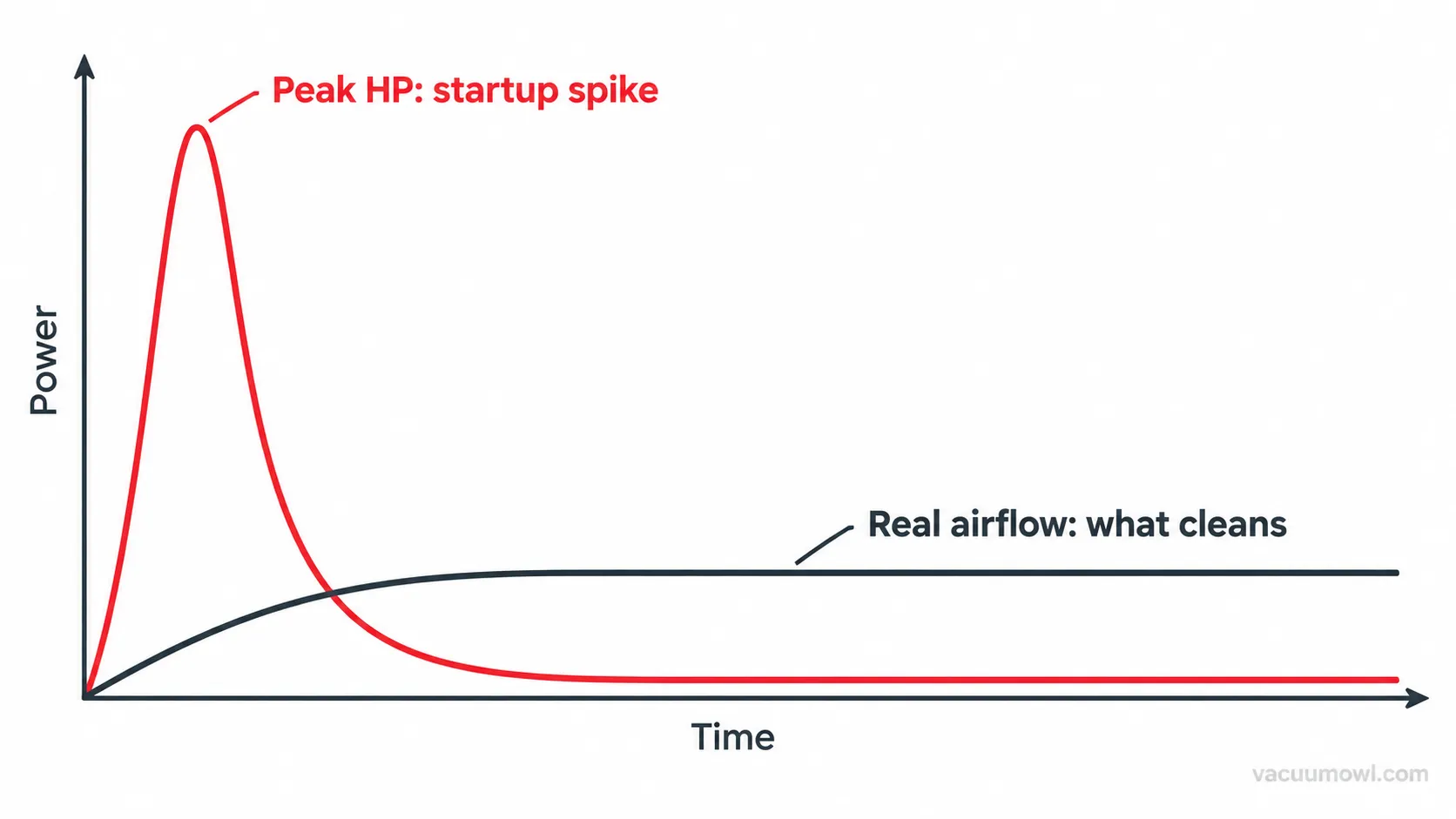
The practical rule is to match the metric to the job. CFM matters most for volume debris like sawdust and leaves, while water lift matters most for wet pickup and anything that seals against the hose.
This also loops back to reliability, because the airflow that cools the motor is the same airflow that lifts debris, so starving it with a clogged filter is what burns units out.
If you want the full picture of the mechanism, see how a shop vac actually works.
One limitation on our figure. It is a single unit measured in a single session, so read it as a reality check on the label, not a lab-grade certification.
Frequently Asked Questions
The most-searched CRAFTSMAN shop vac questions have short, honest answers, and here they are in one place, drawn from the ownership records, specifications, and hands-on testing above. Each answer is written to stand on its own for quick reference.
Is a CRAFTSMAN shop vac any good?
Yes, for most home and light jobsite users. It offers dependable airflow, a wide size range, and a 3-year corded warranty at a fair price, though it is not the quietest or the most heavy-duty option in the category.
Who makes CRAFTSMAN shop vacs?
Stanley Black & Decker owns the CRAFTSMAN brand, having bought it from Sears in 2017, and the wet/dry vacuums are built by contract maker Alton Industries. That is the same corporate family and supply chain behind DeWalt, Stanley, and Porter-Cable shop vacs.
CRAFTSMAN vs DeWalt shop vac, which should I buy?
Buy CRAFTSMAN for value and Lowe’s or Ace availability, and buy DeWalt if you want the quieter machine we measured at about seven decibels lower or a broader cordless range. The core hardware is close because they share a maker, so it is mostly a price-versus-noise decision.
How long do CRAFTSMAN shop vacs last?
Many years with proper care, and old Sears-era units often run for decades. Newer budget models are more variable, and the top killer is running fine dust without the right filter, which overheats the motor.
What breaks most often on a CRAFTSMAN shop vac?
Lost suction from a clogged or incorrect filter is the most common complaint, followed by tip-over on the tall full tanks and eventual switch or cord wear. Most of these are preventable with the right filter and gentle handling.
Where do you buy CRAFTSMAN shop vacs?
CRAFTSMAN wet/dry vacs are sold mainly through Lowe’s and Ace Hardware, plus the CRAFTSMAN store on Amazon. They are not stocked at every big-box retailer the way some rival brands are.
Are CRAFTSMAN shop vac filters interchangeable across sizes?
Filters are matched to tank size and mounting style, so a small-tank filter will not fit a large-tank vac and vice versa. Check the model’s Qwik-Lock or cartridge spec before buying replacements, since the fit is by gallon class, not universal.
Keep exploring the shop vac guides below.
For the basics, start with what a shop vac is and does. Then sort out the naming with the shop vac vs wet/dry explainer.
For everyday jobs, browse 30+ shop vac uses. First-timers can walk through how to use a shop vac.
For wet work, learn about vacuuming water safely. Then follow our wet-pickup setup steps.
Beyond cleanup, compare a shop vac vs carpet cleaner. For the woodshop, wire one into a dust-collection setup.
For standing water, look at shop vac pump options. To reclaim floor space, see wall-mounting and storage.
The Bottom Line
A CRAFTSMAN shop vac is the right buy for most DIYers who shop at Lowe’s or Ace and want dependable cleanup power without paying a premium.
Because CRAFTSMAN and DeWalt wet/dry vacs come from the same parent and the same contract maker, the winning strategy is to match tank size and real airflow to your job rather than chase the biggest Peak HP sticker or the fancier badge.
For most homes that means the 12-gallon as the everyday all-rounder, the 16-gallon 6.5 Peak HP flagship for heavy or wet cleanup, and the V20 cordless as a handy extra. Skip up to DeWalt only if a quieter machine is worth the premium, and skip CRAFTSMAN entirely only if you are running a vac hard all day, where a pro-grade unit will outlast it.
Buy on the job you are doing, respect the filter, and a CRAFTSMAN shop vac will earn its place in the garage for years.
Read it your way
Short on time? Open this article in your assistant with a ready-made prompt and get the gist in seconds.
Found this useful? Make us a preferred source so we show up in your Google results.
Keep reading
Related articles
Vacuum Types
Bissell Wet Dry Vacuum: 6 CrossWave Models Tested (2026)
Compare every Bissell wet dry vacuum: which CrossWave model fits pets, steam, or budget, plus fixes for streaks and floors that still look dirty. Tested 2026.
Vacuum Types
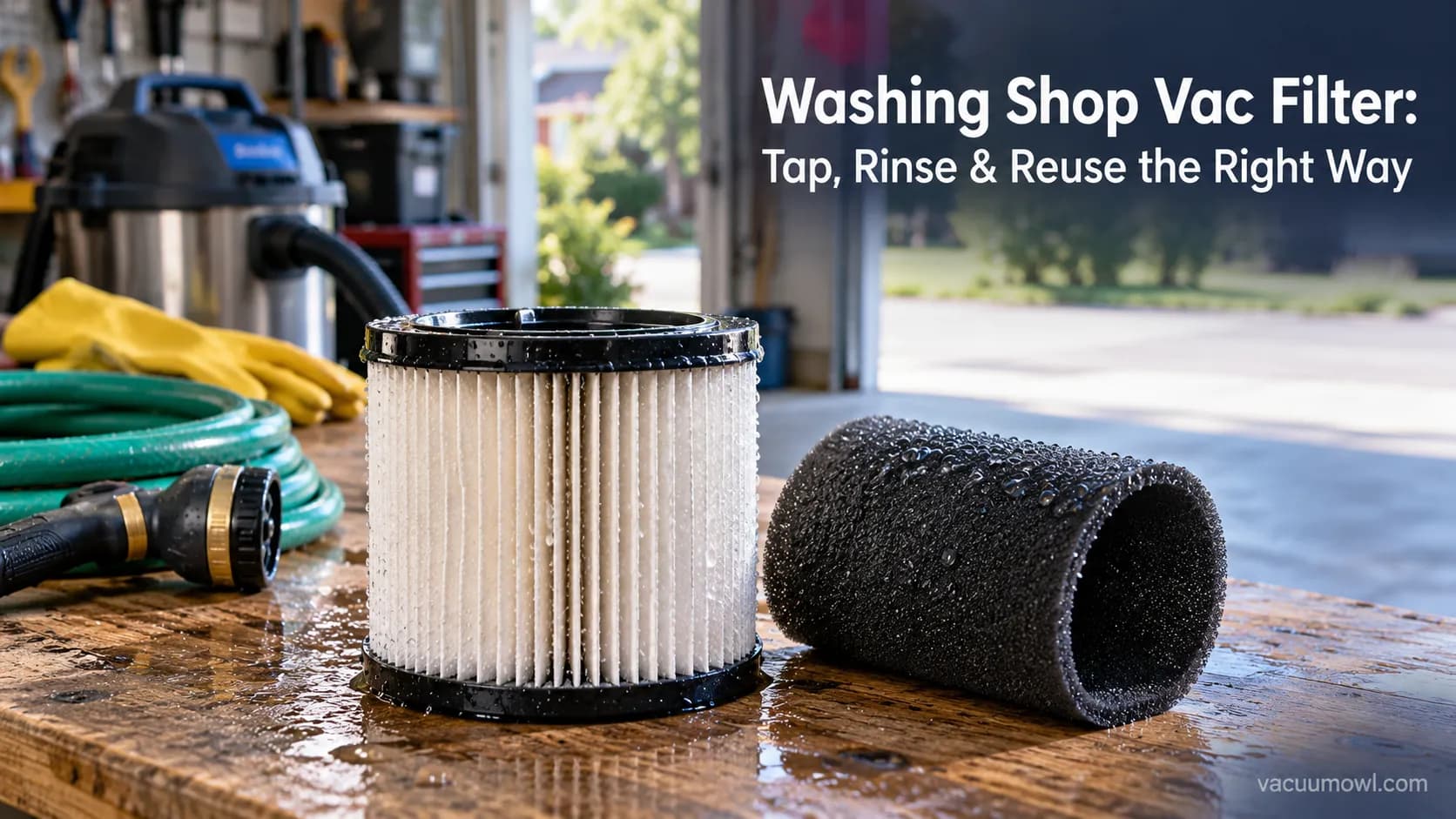
Washing Shop Vac Filter: Tap, Rinse & Reuse the Right Way
Rinse it right: this guide covers washing shop vac filter foam and paper, the tap-and-hose steps, the 24-hour dry rule, and when to just replace it.
Vacuum Types
Tineco vs Dreame Wet Dry Vacuum: 30-Day Test (2026)
Compare Tineco vs Dreame wet dry vacuum on suction, self-clean, edge reach and price, with a clear pick for pets, kids and big homes.
Vacuum Types
Is the DEWALT Shop Vac Worth It? Quiet StealthSonic Tested
Compare every DEWALT shop vac: StealthSonic quiet picks, cordless DCV580 and corded DXV, with measured noise, real suction specs and a value verdict.
The discussion
Comments
Every comment is reviewed before it goes live.