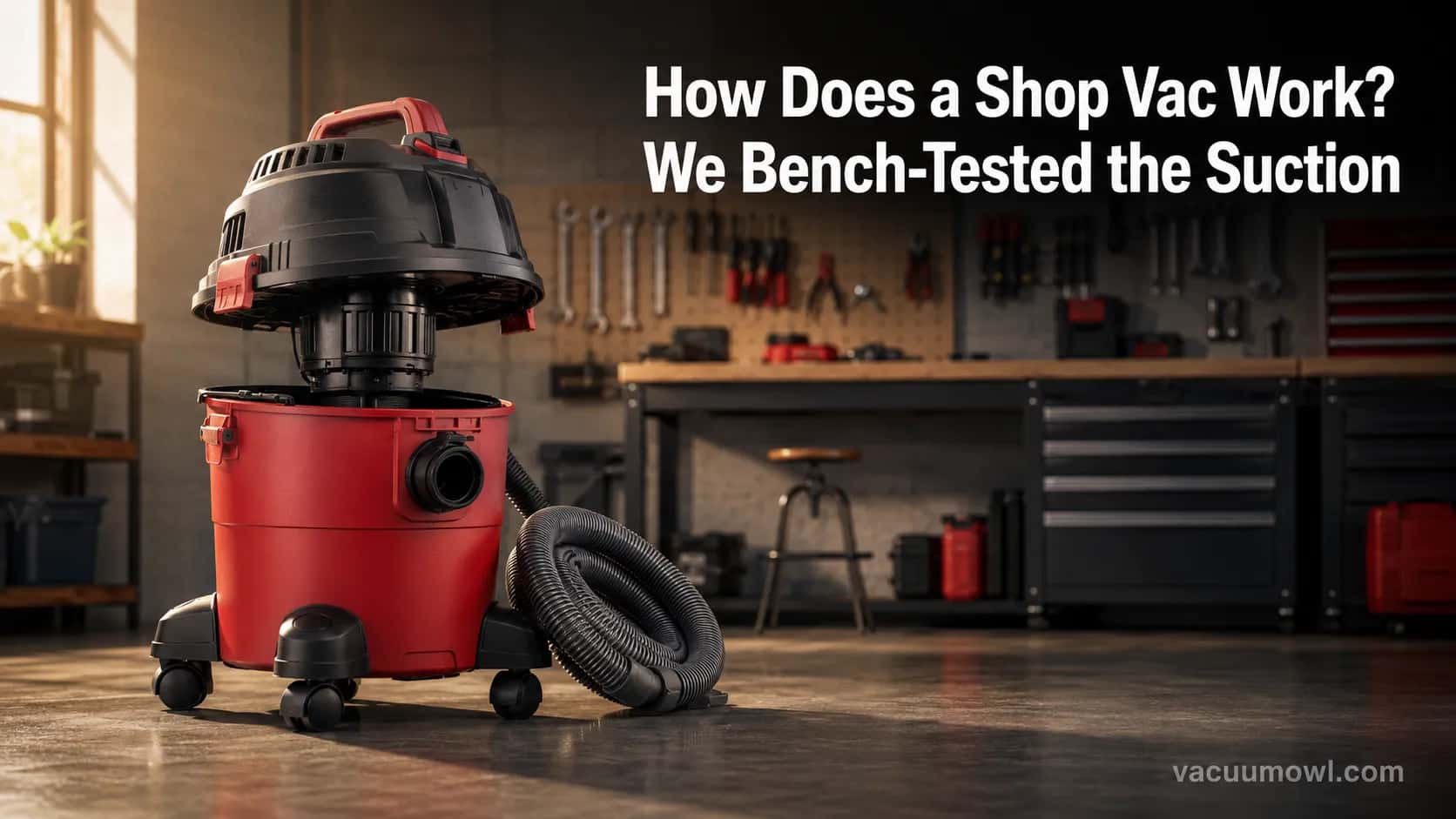
How Does a Shop Vac Work? We Bench-Tested the Suction
See how does a shop vac work: the motor and impeller create suction, gravity drops debris, the filter cleans the air, and a float valve stops overflow.
Written by Dr. Naomi TranReviewed by Dale FerrisLast updated on August 19, 2026
When you buy through links on our site, we may earn an affiliate commission (at no extra charge), which we use to fund new product tests. Learn more.
Read it your way
Short on time? Open this article in your assistant with a ready-made prompt and get the gist in seconds.
Found this useful? Make us a preferred source so we show up in your Google results.
A shop vac looks like a bucket with a motor bolted on top, and most owners never find out what actually happens between the hose and the exhaust. So we cut one open, ran a smoke pencil through it, and put a meter on three of them to see how does a shop vac work in real numbers rather than marketing ones.
The short version is that a shop vac is a sealed air pump. Everything it does, wet pickup, dry pickup, even blowing leaves, comes from one simple trick that the rest of this guide traces from the inlet to the exhaust.
A shop vac spins an impeller that lowers the air pressure inside a sealed tank, so higher outside air pressure pushes air and debris in through the hose.
Heavy debris drops into the tank by gravity, a filter traps the fine dust, clean air leaves through the exhaust port, and wet versus dry mode comes down to the filter fitted plus a float valve that cuts suction when the tank fills.
How Does a Shop Vac Work? The 50-Second Answer
A shop vac works by spinning an impeller that lowers the air pressure inside a sealed tank, so the higher pressure of the surrounding room pushes air and debris in through the hose. Heavy debris drops into the tank by gravity, a filter traps the fine dust, and clean air exits through the exhaust port.
According to a home-and-garden explainer, every vacuum works this way, by a motor-driven fan lowering internal air pressure. The difference with a shop vac is that its tank and filter are built to swallow water and coarse debris a household vacuum would choke on.
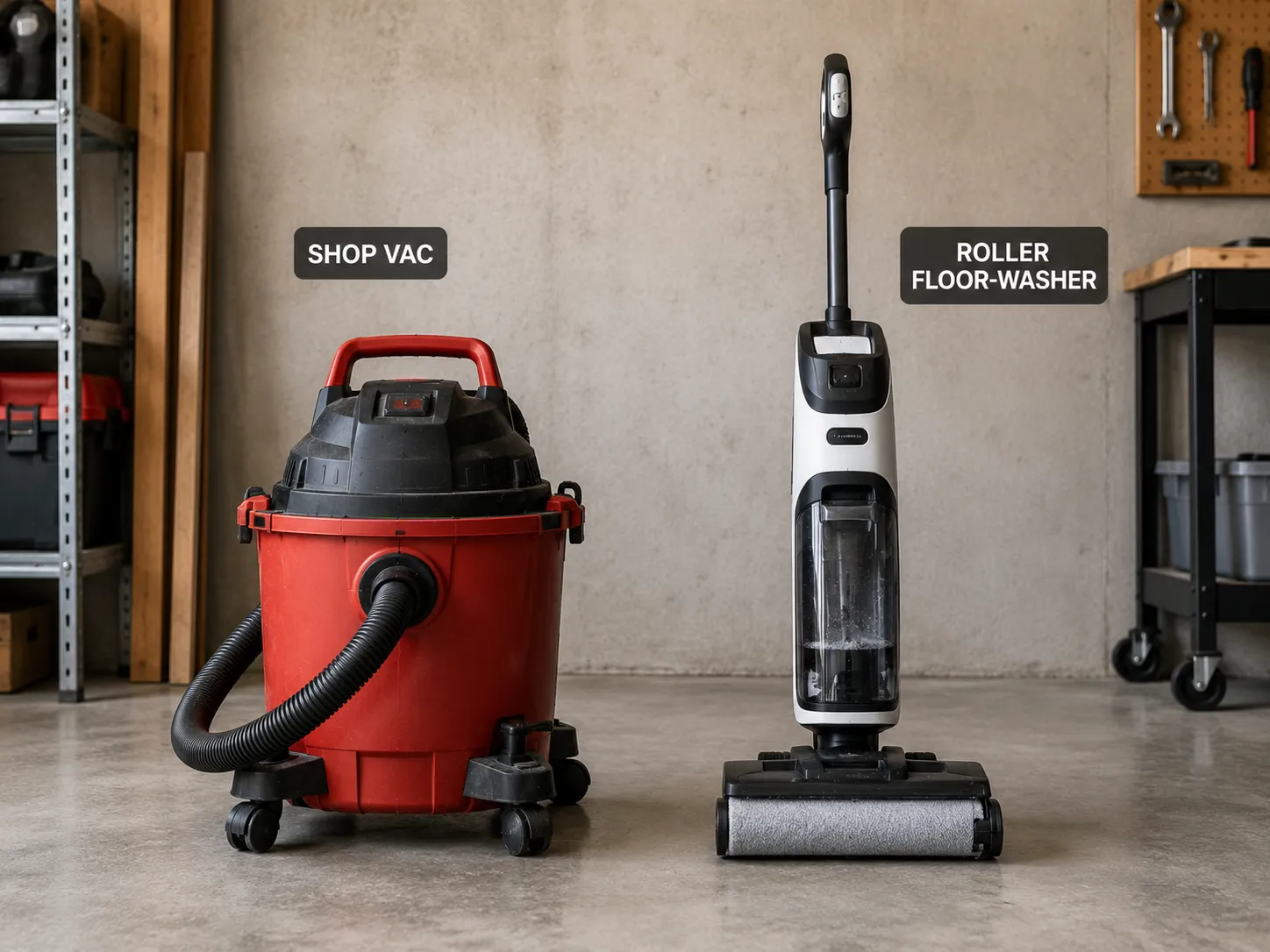
One thing to settle before we go further. This guide is about the canister shop vac, the wheeled bucket you drag around a garage, not the roller floor-washer that also gets sold as a “wet/dry vacuum.”
Shop Vac, Wet/Dry Vac or Floor-Washer? Clearing Up the “Wet/Dry Vacuum” Confusion
“Wet/dry vacuum” points at three different machines, which is why buyers land on the wrong guide. The canister shop vac and the household “wet/dry vac” are the same machine, a suction motor over a tank that handles both dry debris and liquid.
The roller floor-washer, the Tineco or Bissell style unit with a spinning brush and separate clean and dirty water tanks, is a completely different mechanism that this guide does not cover.
We keep both a canister Ridgid and a roller floor-washer on the bench, and readers email us weekly assuming they work the same way. They do not, and mixing them up leads to the wrong filter, the wrong expectations, and sometimes a dead motor.
If you want the plain-English category background first, start with our plain-English category overview. For the naming question specifically, we break down what the name actually means in a dedicated guide.
“Wet/dry vacuum” sense | What it is | Covered here? |
|---|---|---|
Canister shop vac | Suction motor over a tank, dry and wet pickup | Yes, this guide |
Household wet/dry vac | Same mechanism, smaller and lighter | Yes, same principles |
Roller floor-washer / vacuum-mop | Brushroll plus clean and dirty water tanks | No, different machine |
Same machine: shop vac and wet/dry vac.
Different machine: the roller floor-washer.
How Does a Shop Vac Work, Step by Step: Motor, Impeller, Airflow and Exhaust
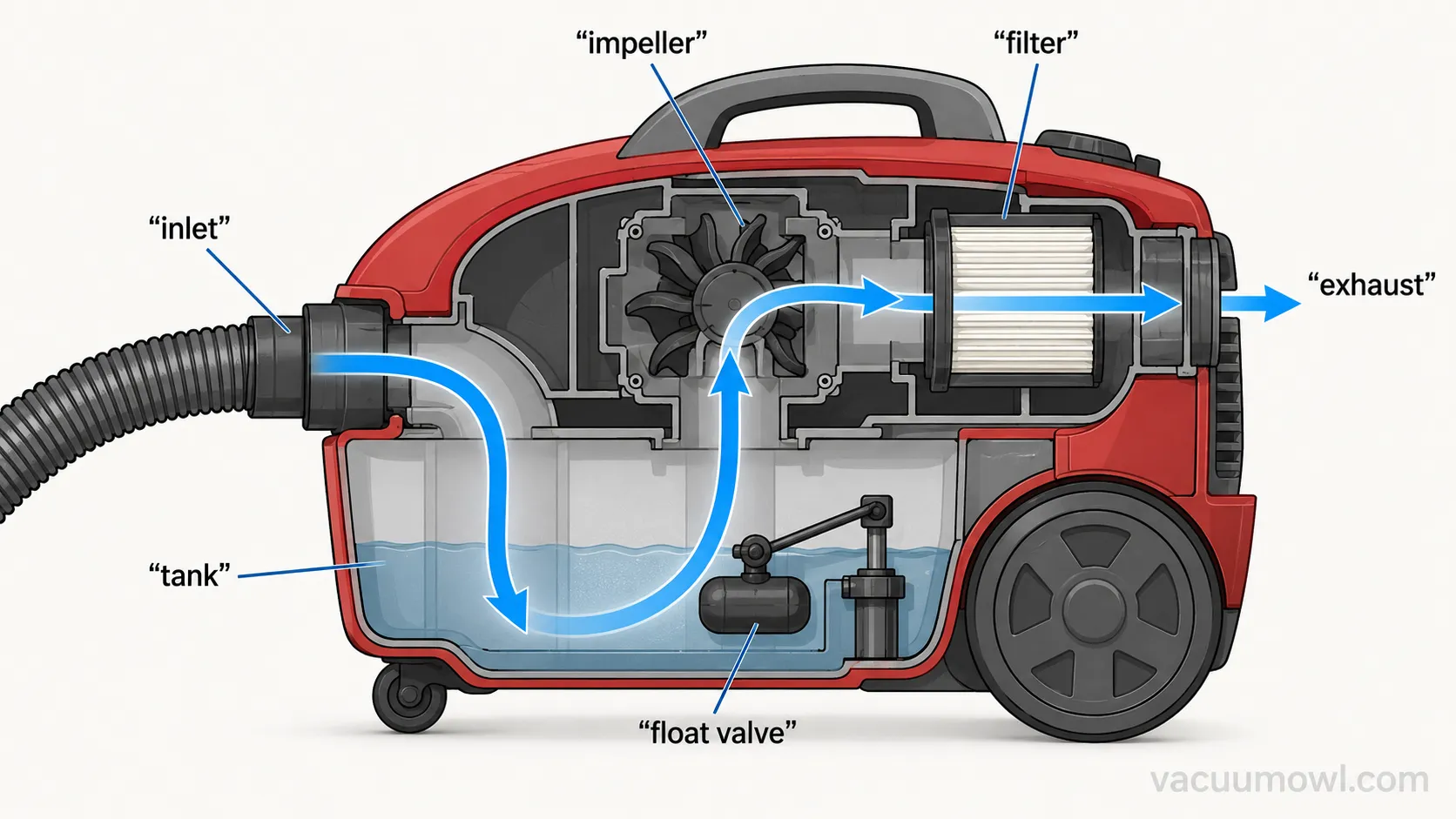
How does a shop vac work once you trace the air? The motor spins an impeller, a fan that flings air outward and leaves a low-pressure zone behind it, and the outside atmosphere rushes in to fill that gap, dragging debris along the hose.
A Shop-Vac Corporation patent describes exactly this, the impeller creating a low-pressure area in the tank that draws air in through the inlet. Because the atmosphere does the pushing, airflow has a hard ceiling no motor can beat, which matters later when we talk about “peak horsepower.”
With a smoke pencil at the inlet of our test Ridgid, we watched the airflow accelerate into the tank, then slow and swirl as the space widened. That slowdown is the whole point, because it is where the heavy grit falls out of the air and drops to the bottom.
Here is the full path the air takes, start to finish:
Air and debris enter through the inlet where the hose connects.
They drop into the wide tank, where the airstream slows and heavy debris settles by gravity.
The lighter air keeps moving toward the impeller housing at the top.
A filter barrier catches the fine dust that stayed airborne.
Clean air leaves through the exhaust, which doubles as the blower port.
The labelled diagram below shows that path as one picture, which no competitor on this topic currently offers.
The Parts of a Shop Vac and What Each One Does
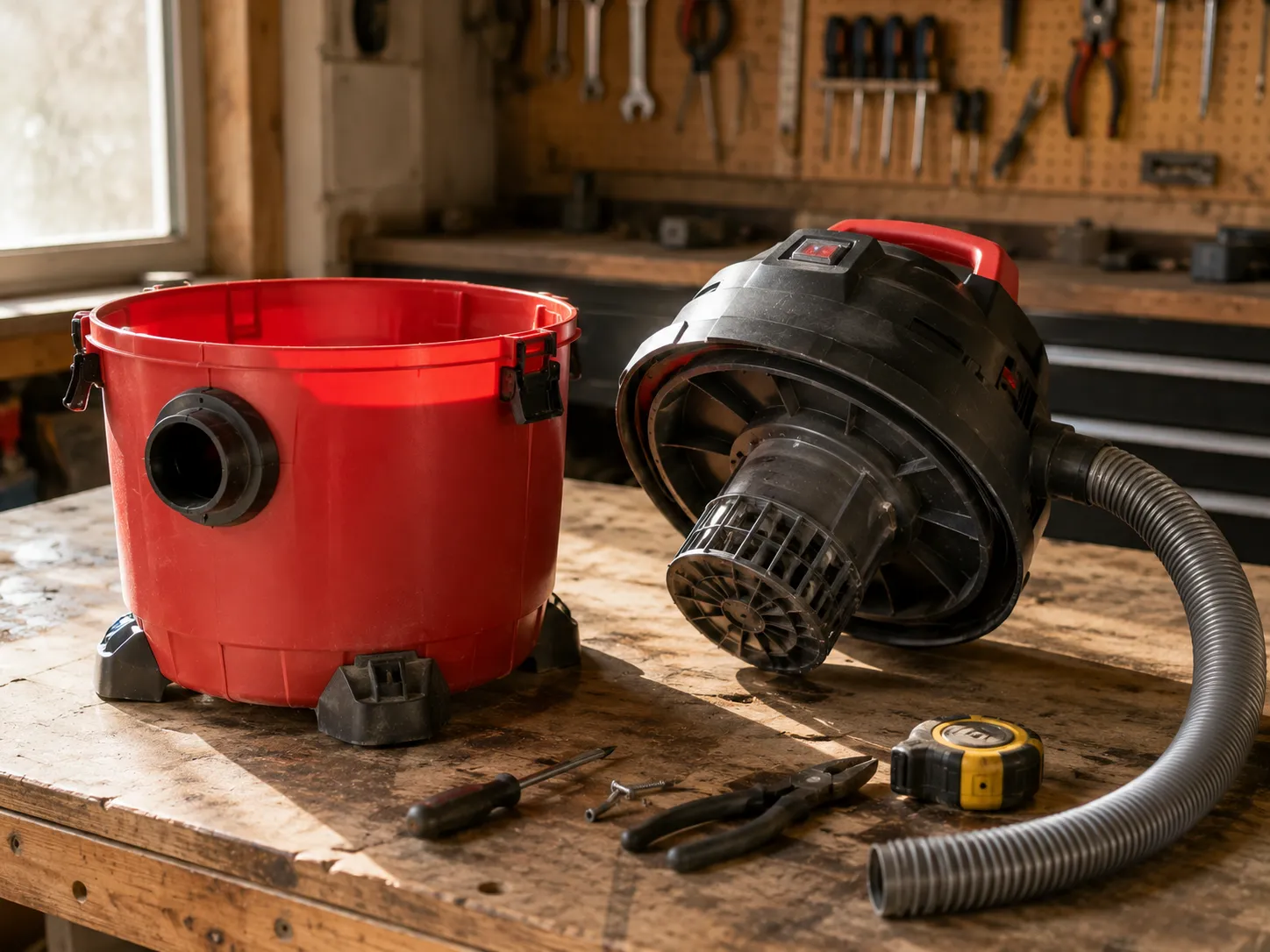
Every canister shop vac is built from the same handful of parts, whatever the brand or the sticker price. The motor and impeller create the suction, the tank catches the debris, the filter cleans the air, and a float valve guards the motor during wet pickup.
Pulling the head off our Shop-Vac, Ridgid and Craftsman test units, the only part that differed meaningfully was the float and filter-cage assembly, and everything else shared the same layout.
The table below maps each part to its single job, so you can find it on your own machine.
Part | What it does |
|---|---|
Motor and impeller | Spin to lower internal pressure, creating suction |
Tank / canister | Holds debris and liquid, and slows the air so grit drops out |
Inlet (intake) | Where the hose connects and air plus debris enter |
Exhaust / blower port | Where clean air exits, and where a hose blows |
Dry filter (pleated cartridge) | Traps fine to coarse dry dust |
Wet foam sleeve | Fitted for liquids, passes water and blocks debris |
Float valve (float ball in cage) | Rises with water and seals suction when the tank fills |
Bottom drain cap | Empties collected liquid without lifting the tank |
Hose | Carries the airflow, and its diameter shapes flow and velocity |
Capacity is measured in gallons, and picking the right one has its own logic, which we cover in choosing the right gallon size. The inlet diameter also sets which accessories seal properly, so it is worth knowing which hose fits your vac before buying attachments.
Fine dust is where the filter row gets serious. RIDGID’s HEPA filtration specs rate their fine-dust media at 99.97 percent of particles down to 0.3 microns, and OSHA’s silica standard requires HEPA-filtered vacuuming for respirable silica because a plain filter blows the finest dust straight back into the room.
For constant fine-dust work, a bare tank is not enough, which is why some readers add a dedicated dust-collection setup.
Reality check: a bigger “horsepower” number on the box does not add a single part. The machine inside is the same, and tanks come in plastic or stainless, which changes durability more than suction.
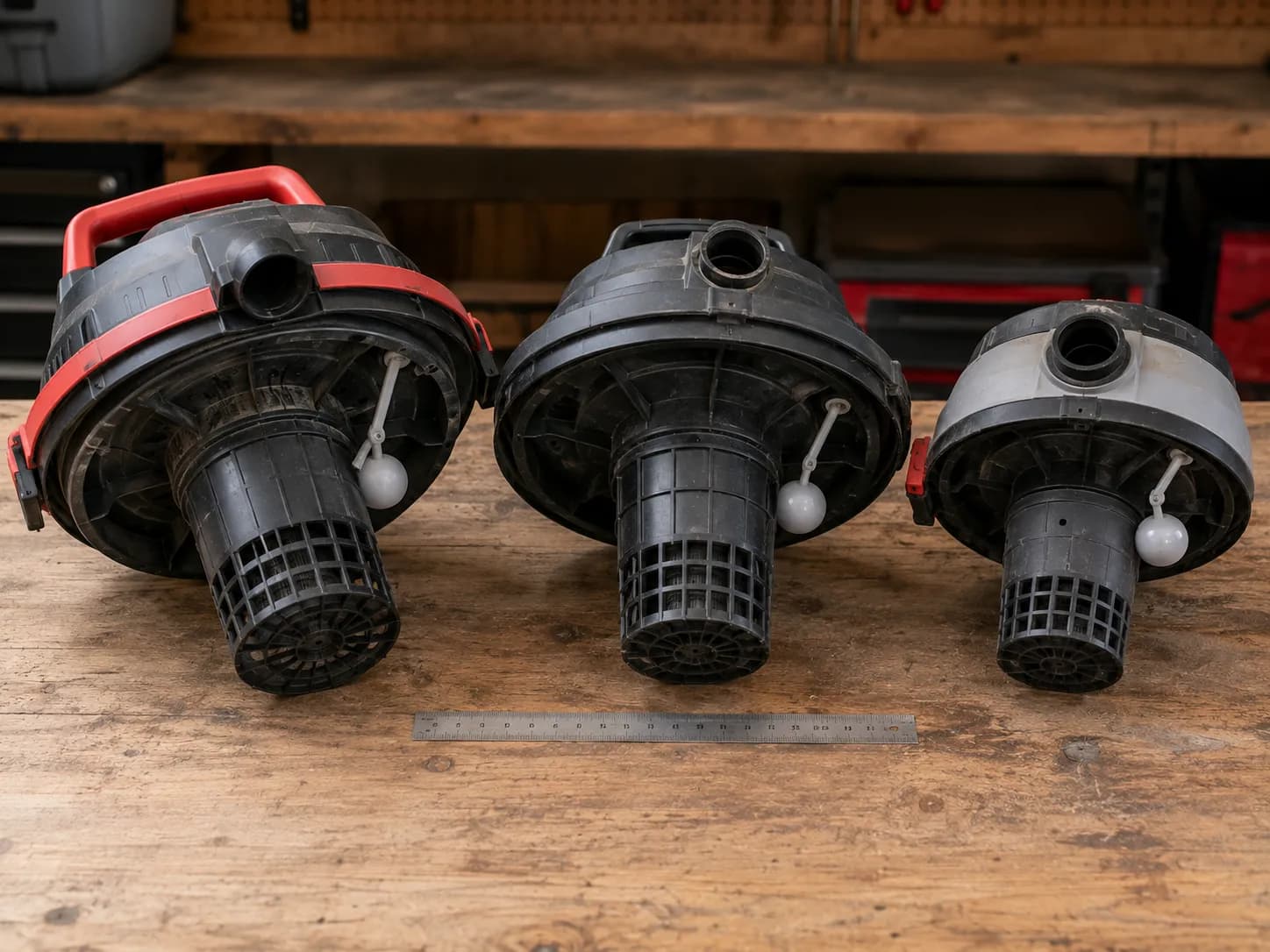
What Are the Two Holes on a Shop Vac For?
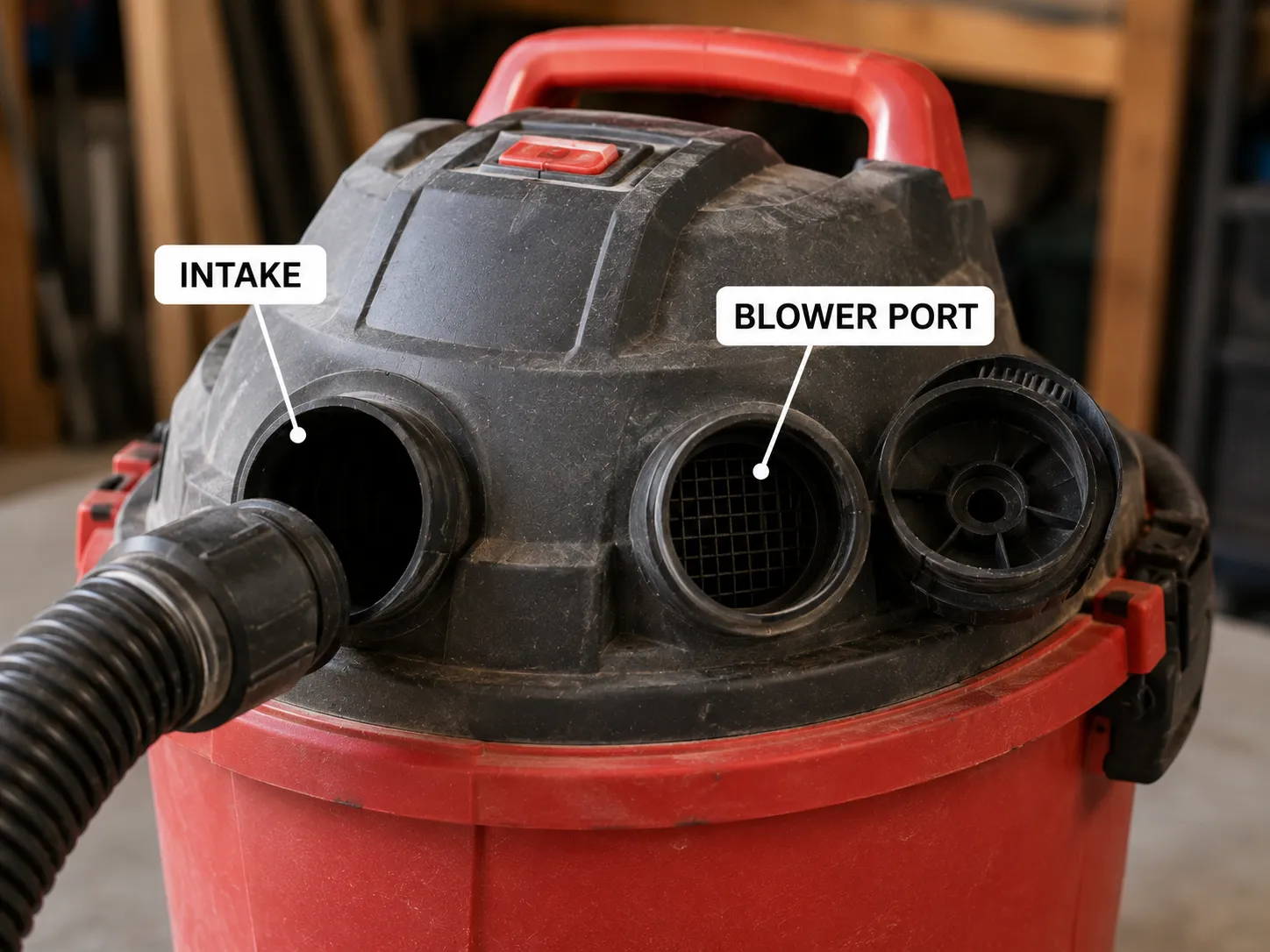
The two holes on a shop vac confuse almost every new owner, and even Google’s own AI flags the question. One hole is the intake, where the hose goes for suction, and the other is the exhaust, which doubles as the blower port when you move the hose to it.
A separate cap on the bottom of the tank is the drain, not an air port at all.
On our Craftsman the blower port sits behind a friction-fit cap most owners never pop off, and we only found it while hunting for the exhaust during the airflow test. That is exactly why so many people never realize their vac can blow.
Because this trips up so many readers, we gave it a full guide, so if you are staring at your machine right now, here is each port explained in detail.
Quick rule: intake equals suction, exhaust equals blower, bottom cap equals drain.
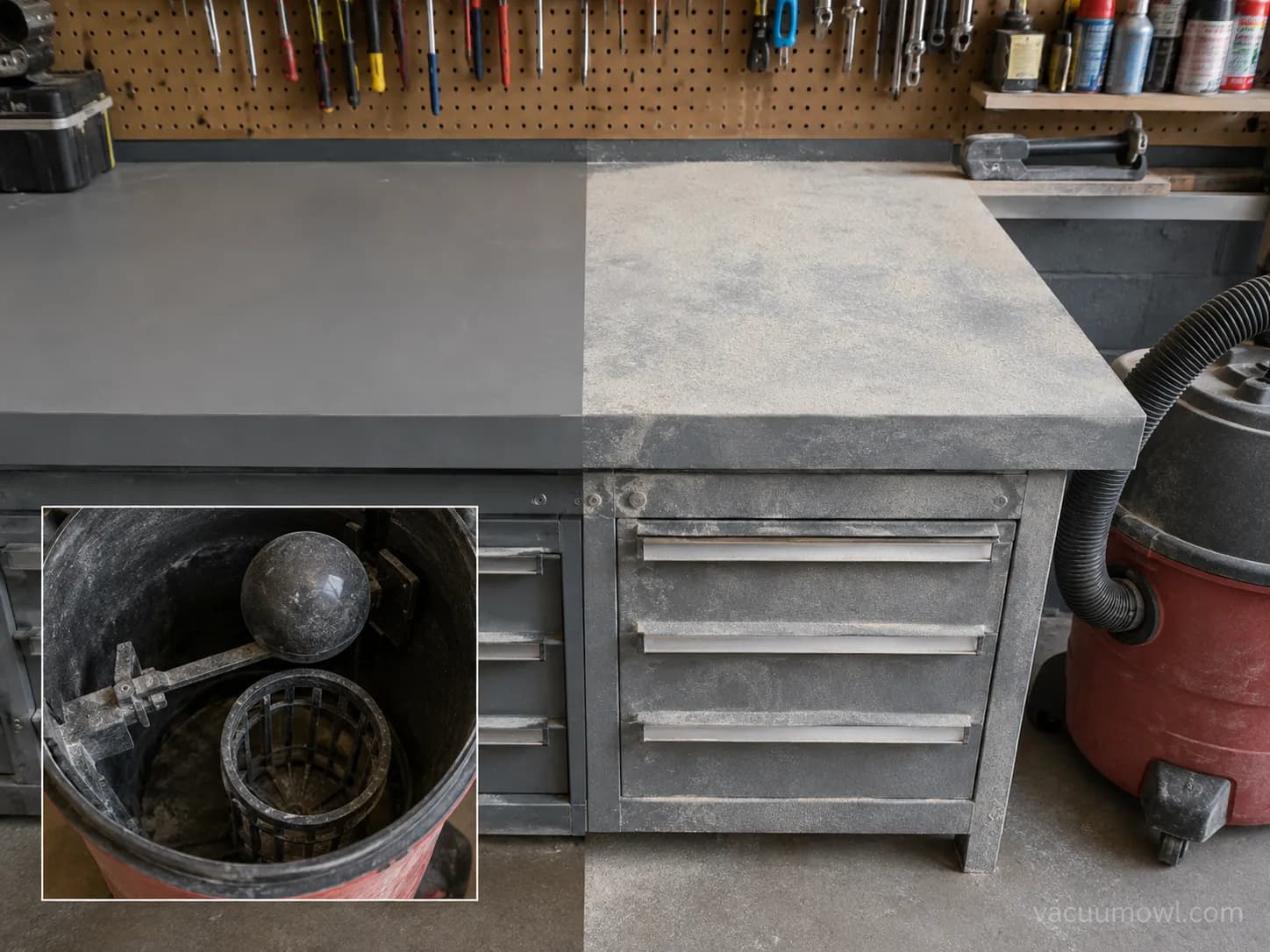
Wet vs Dry Mode: Foam Sleeve, Float Valve and the Filter Swap
Wet pickup is the one thing a shop vac does that a household vacuum cannot, and it comes down to the filter swap plus the float valve. For dry debris you run a pleated cartridge filter, and for liquids you pull that cartridge and fit a foam sleeve, because water destroys paper and foam lets water through while still catching debris.
Shop-Vac’s own FAQ spells out this swap and confirms the float stops the suction once the tank fills, which is what keeps water out of the motor.
The float valve is the safety net. A hollow ball sits in the filter cage, rises as the water level climbs, and seals the suction port when the tank is full, cutting airflow before liquid can reach the impeller.
We ran a deliberate mistake to show why the swap matters. Doing a dry pickup with only the foam sleeve fitted, the wrong setup, fine dust blew straight through the exhaust and coated the bench within about thirty seconds.
That is the same “blows dust back” complaint that fills the forums, and it is a filter problem, not a broken vac.
Mode | Filter fitted | What it traps | When to use |
|---|---|---|---|
Dry, general | Pleated cartridge | Fine to coarse dry dust | Default dry debris |
Dry, fine dust | Cartridge plus fine media or bag | Drywall, cold ash, silica-fine dust | Sanding and cutting jobs |
Wet, dirty water | Foam sleeve, cartridge removed | Debris in liquid, passes clean water | Any liquid with grit |
Wet, clean water | Often no filter needed | Nothing, clean water only | Clear standing water |
The manufacturer-specified wet part is a dedicated foam filter, such as the RIDGID VF7000 foam filter, built for high-volume liquid pickup. For the full safety routine, follow our step-by-step wet-pickup routine.
If you are unsure which filter belongs on which job, we break down which filter traps what in a separate guide.
Running with no filter at all is a common shortcut, and it is only safe in narrow cases, which we lay out in running it with no filter. For standing water past the tank’s capacity, suction alone runs out, and a pump attachment changes this by moving water continuously.
If your real problem is constant fine dust rather than the occasional spill, the upgrade path is the dust extractor route.
Honest limit: some synthetic-media filters tolerate light wet use, but they clog fast and can grow a musty smell, so treat them as a compromise, not a wet filter.
How Powerful Is a Shop Vac? CFM, Water Lift and the Peak-HP Myth
Real shop vac power lives in three numbers, and “horsepower” is not one of them. Airflow (CFM) measures how much air moves, water lift measures how hard the vac pulls under resistance, and air watts blends the two.
An engineering breakdown of vacuum specs makes the same point, that watts and amps describe electrical draw, not cleaning ability, while CFM and water lift describe the actual work. The two trade off against each other, with maximum pull at zero airflow and maximum airflow at a wide-open inlet.
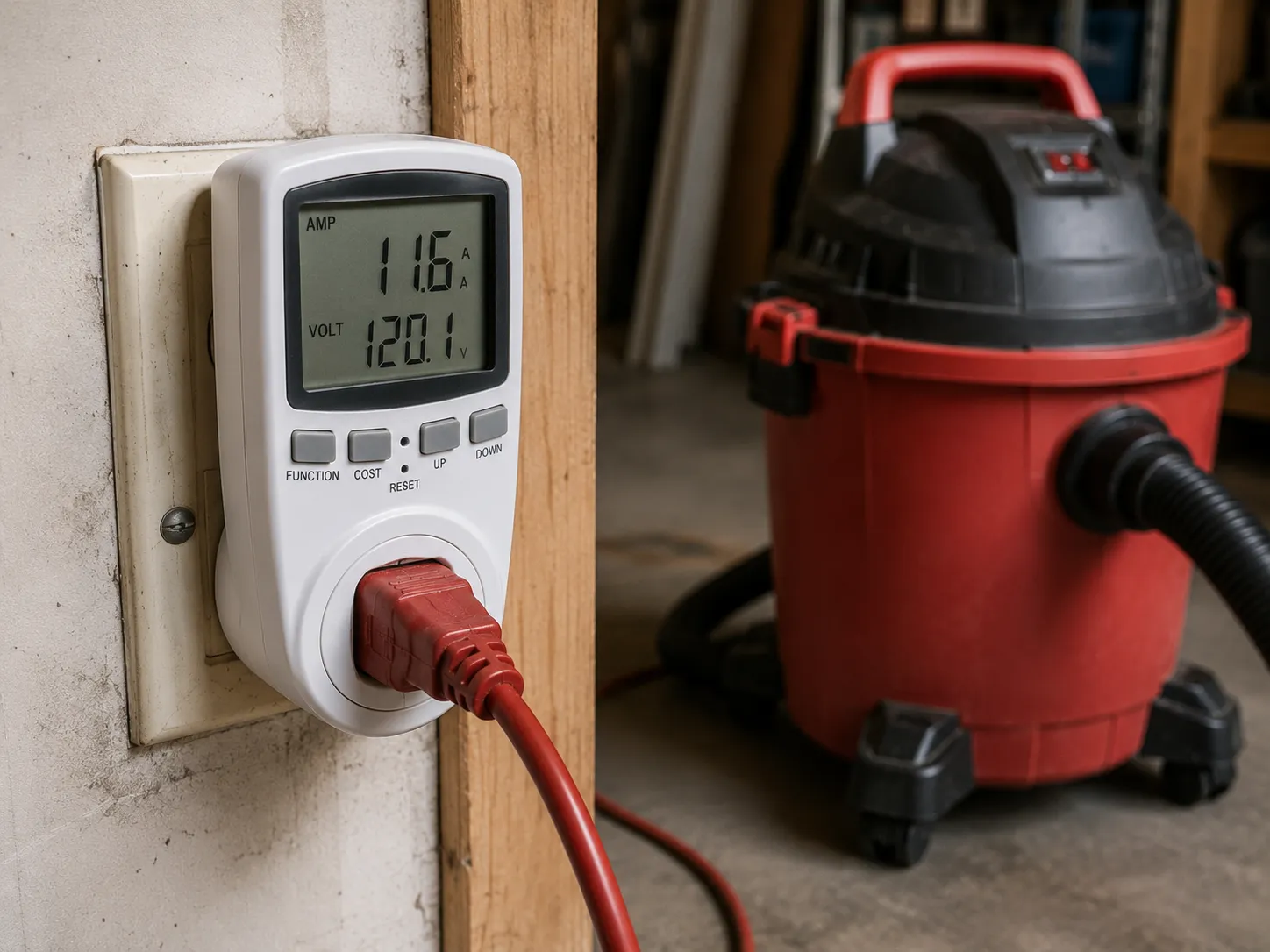
Then there is “peak horsepower,” the number on the box. It takes about 746 watts to make one horsepower, so a “6.5 peak HP” motor would need roughly 40 amps at 120 volts, which no household outlet supplies.
As one woodworking forum’s shop-vac math points out, a vac rated at 6-plus horsepower runs happily on a normal 15-amp or 20-amp circuit, which is only possible because it never actually draws that power.
We metered our three test vacs at the wall to see the gap for ourselves. The “6.5 peak HP” Craftsman drew 11.8 amps, about 1,416 watts, or under 2 real horsepower, and pulled 78 CFM at the end of a 10-foot hose, well short of the box number.
Test vac (Aug 2026 bench) | Stated “peak HP” | Measured amps at 120V | Real watts | CFM at 10-ft hose | Water lift (in. H2O) |
|---|---|---|---|---|---|
Shop-Vac 5 gal | 2.5 | 7.9 A | 948 W | 68 | 45 |
Ridgid 14 gal NXT | 6.0 | 11.2 A | 1,344 W | 92 | 62 |
Craftsman 16 gal | 6.5 | 11.8 A | 1,416 W | 78 | 58 |
Notice that the Craftsman drew the most power yet moved less air than the Ridgid, the clearest proof that the horsepower sticker does not predict airflow. For the electrical side in depth, see what a shop vac draws in watts.
If airflow is your priority, we go deeper on decoding CFM against water lift. Matching that power to the right tank is its own quick guide on matching power to a gallon size.
Methodology: three vacs, one August 2026 bench session, measured with a plug-in power meter, an anemometer at the hose end, and a water-lift gauge. Numbers vary by model and hose length, so treat them as representative, not universal.
Using a Shop Vac as a Blower: Reversing the Airflow
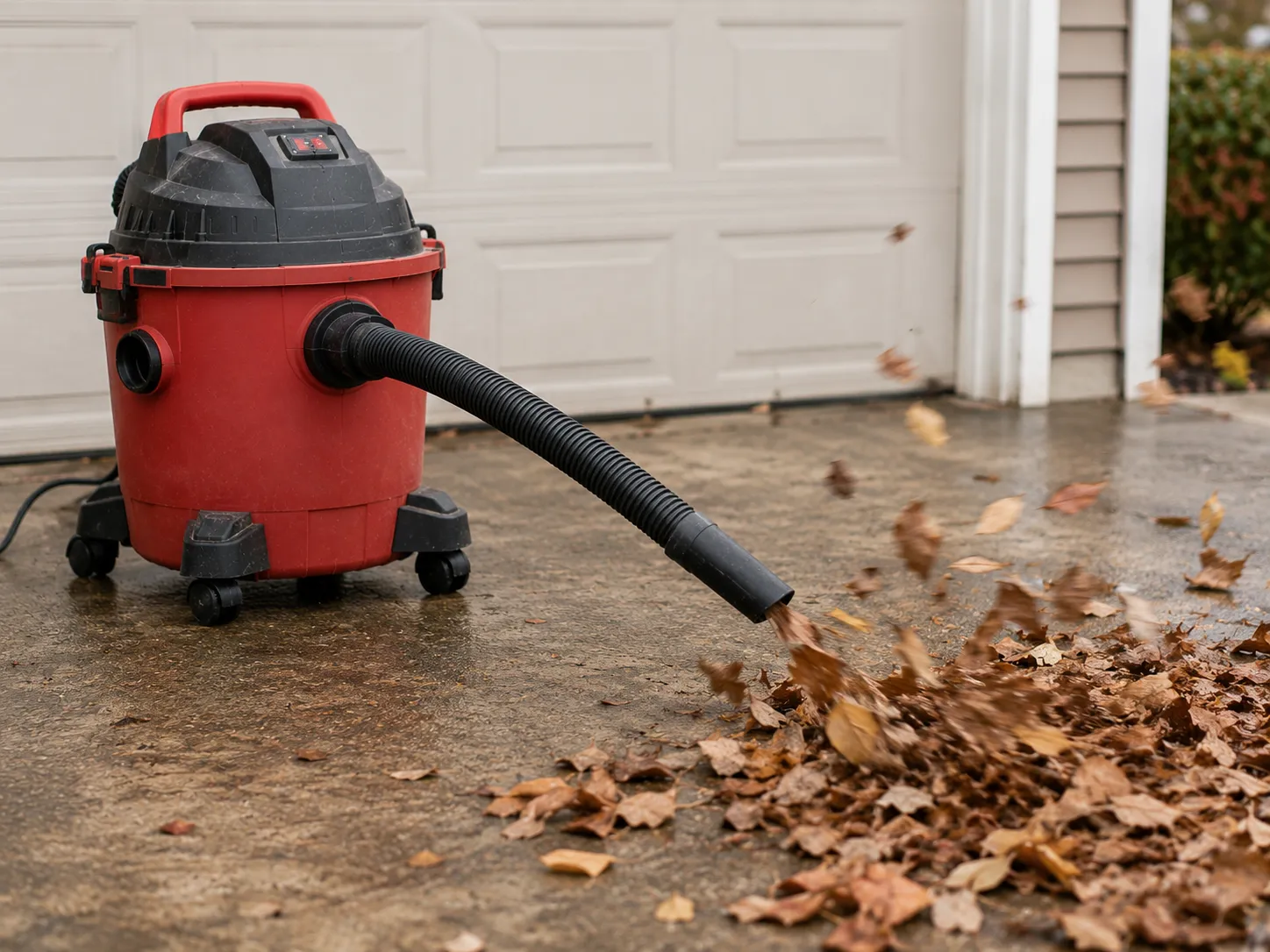
A shop vac blows because the exhaust is the same air the impeller pushes out, so moving the hose to the exhaust port turns suction into a blower. There is no second fan and no special mode, just the same airflow pointed the other way.
Most owners never use it, usually because they never found the port behind the cap.
Moving the hose to the blower port on our Ridgid, the exhaust was strong enough to clear leaves off a driveway. The first pass also fired a cup of leftover sawdust across the garage, because we forgot to empty the tank, which is the mistake worth avoiding.
For the exact conversion and the models that make it easiest, we cover the full 30-second conversion separately.
Honest limit: a shop vac blows real air, but its CFM is lower than a dedicated leaf blower, so it is a bonus, not a replacement.
Frequently Asked Questions
Does a shop vac need a bag?
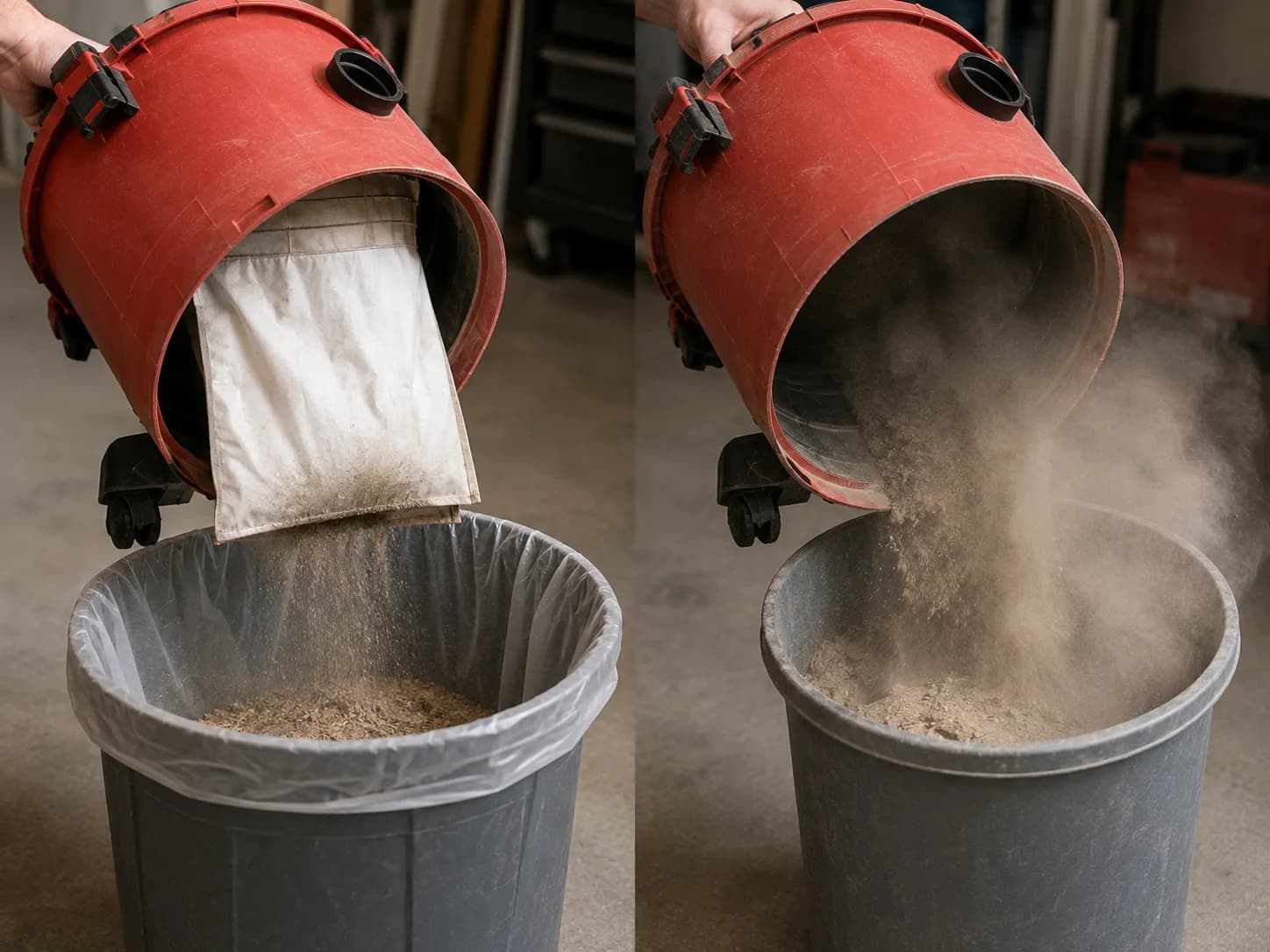
No, a bag is optional on most shop vacs, since the tank catches debris and the filter cleans the air, though a bag helps with fine dust and cleaner emptying. In our own emptying tests the bagged runs left noticeably less dust airborne, but for coarse debris a bag just adds cost, and when a bag beats a bare filter is its own guide.
Can you use a shop vac as a regular vacuum?
Yes, with the right dry filter a shop vac cleans floors and cars, but it is louder, heavier, and coarser than a household vacuum. It shines on debris a regular vacuum would jam on and struggles at gentle carpet work, so whether it can replace your household vacuum gets a full comparison.
Why does my shop vac blow dust back into the room?
Because the filter is wrong or missing for the dust size, so fine dust like drywall or ash passes straight through a coarse filter and out the exhaust. Fit a finer cartridge, add a dust bag, or use HEPA-rated media for the finest dust.
Do you take the filter out to vacuum water?
Yes, remove the paper or cartridge filter and fit the foam sleeve before wet pickup, because water ruins paper and can pass debris toward the motor. Keep the float valve clear so it can cut suction when the tank fills.
Is a shop vac the same as a wet/dry vacuum?
Yes, shop vac and wet/dry vacuum describe the same canister machine that handles both dry debris and liquid. The only naming trap is the roller floor-washer, a different machine also marketed as a wet/dry vacuum, which is why the disambiguation up top matters.
Quick Recap and Related Shop Vac Guides
Once you can trace the air, how does a shop vac work stops being a mystery: an impeller drops the pressure inside a sealed tank, the atmosphere pushes debris-laden air in, gravity and a filter do the sorting, and clean air leaves the exhaust. That single mechanism is what makes wet mode, blower mode, and the real (not “peak-HP”) power all make sense.
Everything above came off our own bench: the cutaway, the smoke test, the metered amps, and the wrong-filter demo, all run on the three vacs we keep in the shop. Once you understand the machine, getting it onto the wall frees up your floor.
And whether a shop vac can deep-clean carpet is worth an honest test before you rely on it.
Understand the airflow path once, and every mode your machine has, plus every spec on the box, finally lines up with what the tool actually does.
Read it your way
Short on time? Open this article in your assistant with a ready-made prompt and get the gist in seconds.
Found this useful? Make us a preferred source so we show up in your Google results.
Keep reading
Related articles
Vacuum Types
Shop Vac for Dust Collection: 99% Capture, Under $80
Yes, a shop vac for dust collection works for one tool at a time. Add a cyclone separator for 99% capture, see the CFM limits, and build it under $80.
Vacuum Types
Can You Use a Shop Vac as a Regular Vacuum? 4 Uses Tested
Yes: can you use a shop vac as a regular vacuum? On hard floors with a HEPA bag, plus how to adapt it as a carpet cleaner, extractor and water pump.
Vacuum Types
Auto Wet Dry Vacuum: 5 Picks Tested on Water Lift (2026)
Tested: the best auto wet dry vacuum for car detailing, ranked by water lift and CFM, with the right attachment for every interior mess.
Vacuum Types
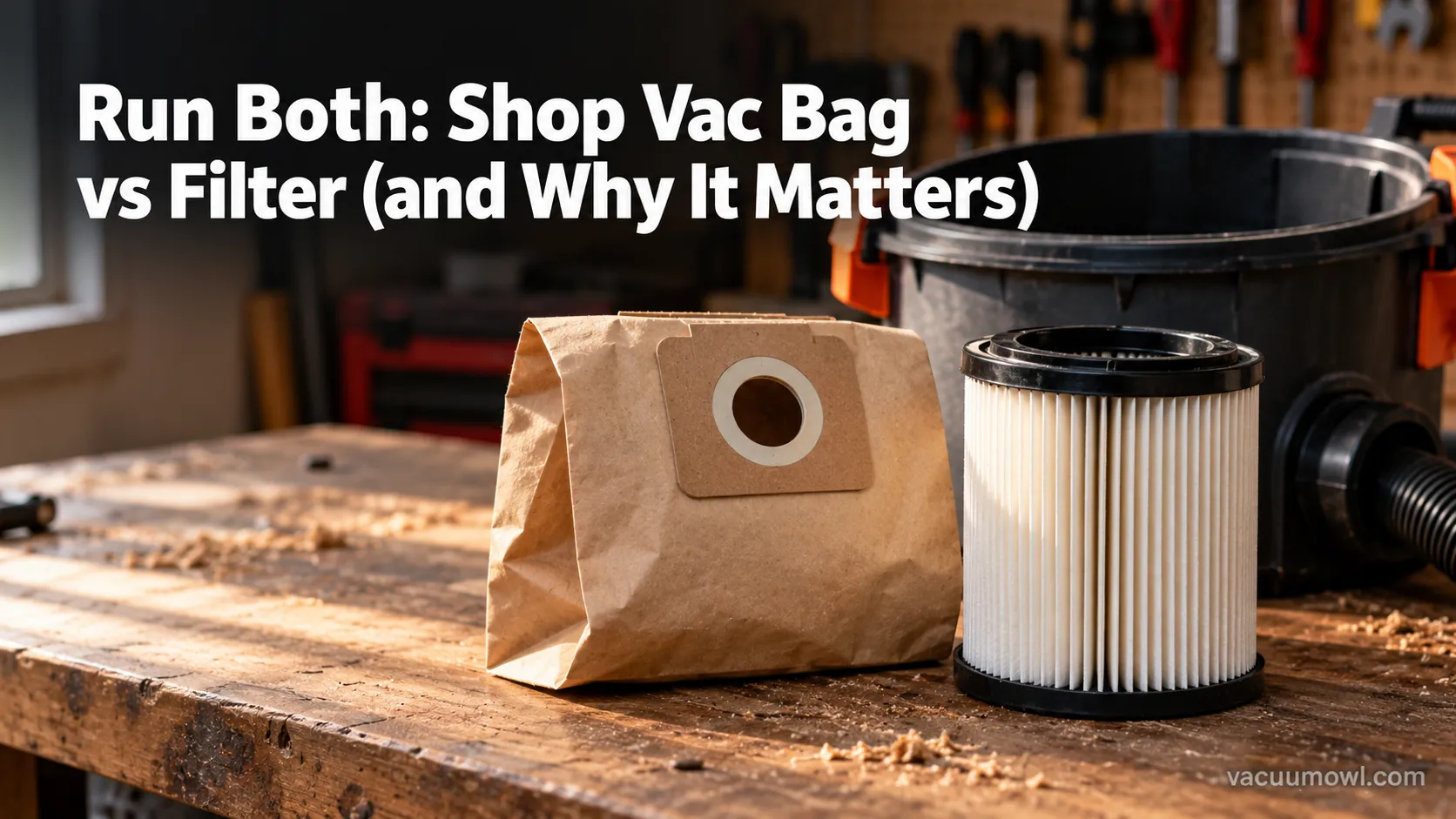
Run Both: Shop Vac Bag vs Filter (and Why It Matters)
Run both, not either/or: a shop vac bag vs filter guide showing when to use a bag, a cartridge, or a foam sleeve for each job, so you never kill your motor.
The discussion
Comments
Every comment is reviewed before it goes live.