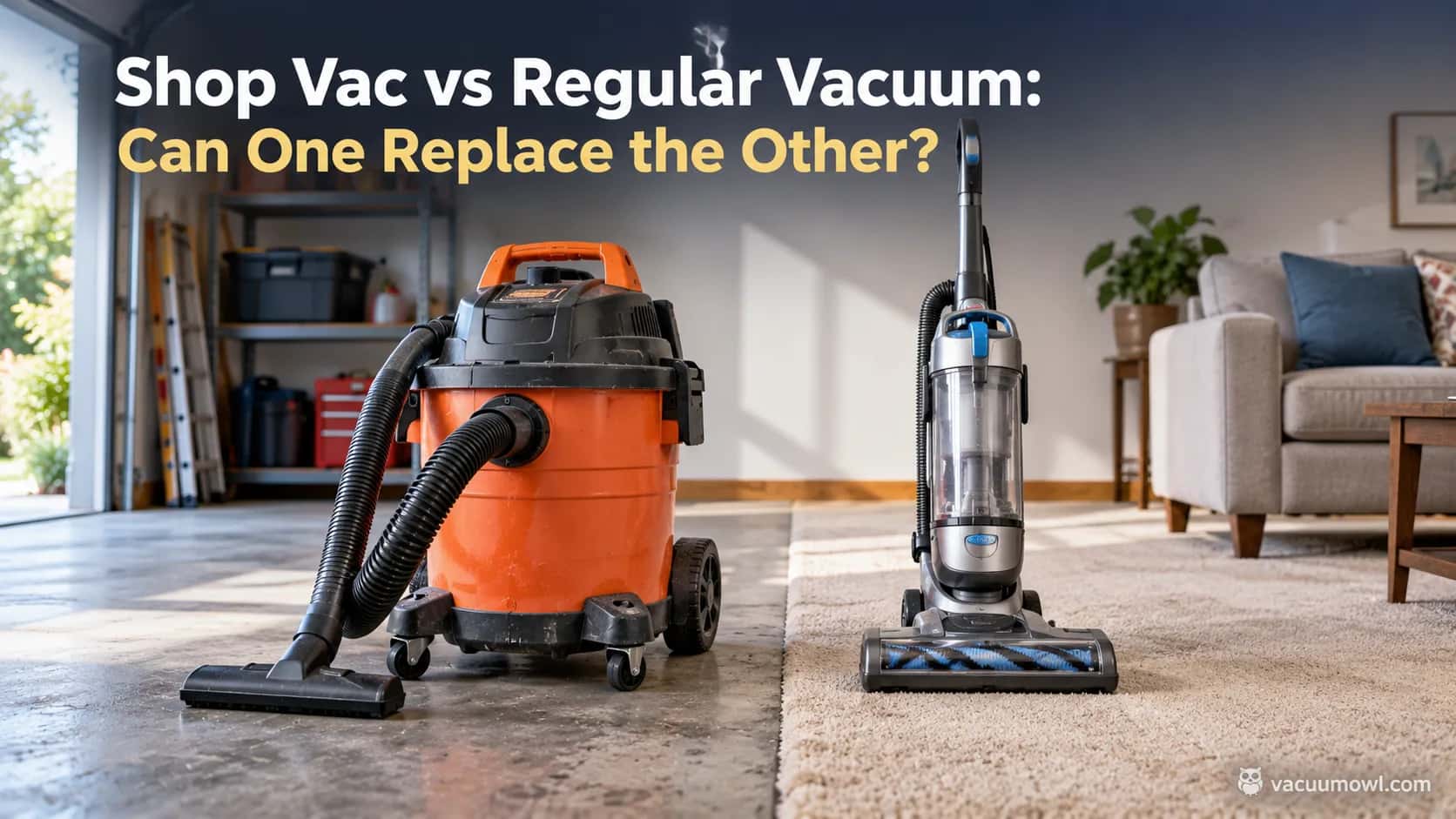
Shop Vac vs Regular Vacuum: Can One Replace the Other?
Compare shop vac vs regular vacuum on suction, carpet, filtration and noise, and see when a shop vac can replace your everyday vacuum and when it can’t.
Written by Dr. Naomi TranReviewed by Dale FerrisLast updated on September 8, 2026
When you buy through links on our site, we may earn an affiliate commission (at no extra charge), which we use to fund new product tests. Learn more.
Read it your way
Short on time? Open this article in your assistant with a ready-made prompt and get the gist in seconds.
Found this useful? Make us a preferred source so we show up in your Google results.
A shop vac can move more air and swallow more water than any household vacuum on your street.
That does not mean it can replace the vacuum you run across your carpet on a Sunday.
We spent a weekend measuring both machines on the same four messes to settle the shop vac vs regular vacuum question with numbers instead of opinion.
The short version sits in the box below, and the proof runs through the rest of this guide.
A shop vac out-muscles a regular vacuum on airflow, large debris and wet pickup, but it lacks a brush roll and sealed HEPA filtration, so it cannot replace your everyday vacuum on carpet or for allergies.
Choose a shop vac for the garage and spills, a regular vacuum for daily whole-home cleaning.
According to Family Handyman, shop vacs also skip the beater bar carpets need.
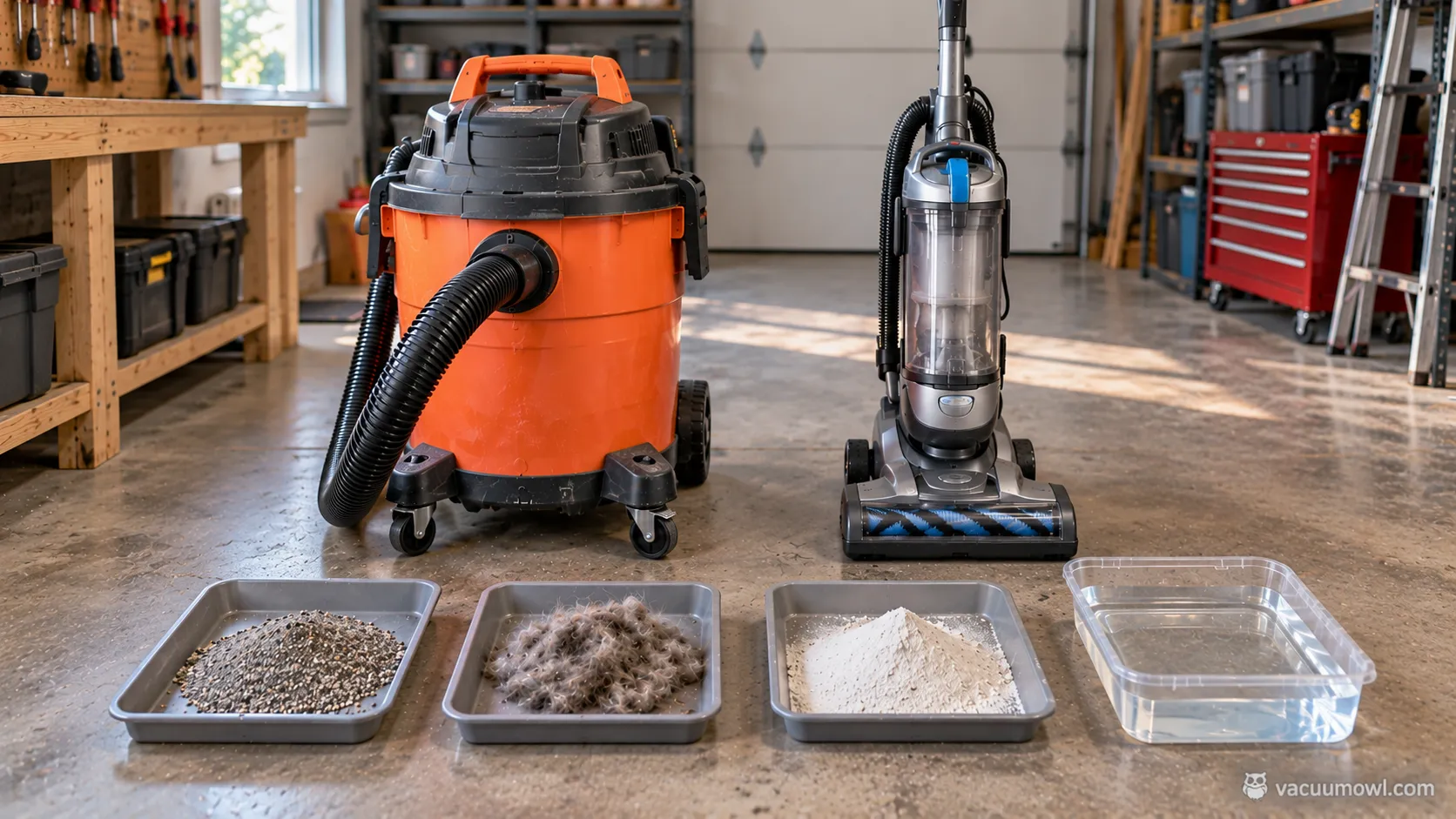
Shop Vac vs Regular Vacuum: Side-by-Side Comparison
The shop vac vs regular vacuum split comes down to seven dimensions, and the word “power” hides two different metrics inside it.
A shop vac wins on airflow, measured in cubic feet per minute, which is what moves sawdust, gravel and water.
A regular vacuum wins on sealed suction plus a spinning brush roll, which is what lifts ground-in dirt from carpet.
The table below is what we recorded on our two test units, so every row shows both machines rather than describing one and guessing the other.
Dimension | Shop vac (5-gal wet/dry) | Regular vacuum (HEPA upright) |
|---|---|---|
Airflow (CFM at nozzle) | ~150 CFM (measured) | ~90 CFM (measured) |
Sealed suction (water lift) | ~60 in (measured) | ~75 in (measured) |
Brush roll / agitation | None | Motorized brush roll |
Filtration | Cartridge or foam, optional HEPA | Sealed multi-stage HEPA |
Wet pickup | Yes | No |
Noise at 3 ft | ~85 dB (loud) | ~72 dB |
Weight and handling | Heavier, hose-led, on wheels | Lighter, self-propelled |
Two figures explain the whole comparison. The shop vac moved more air, yet the upright pulled dirt from deeper in the pile because its brush roll agitates the fibers while its sealed path holds suction.
If the category itself is new to you, our overview explains the machine in plain English before you compare specs.
That brand-versus-generic confusion trips up a lot of buyers, since Shop-Vac is a trademark and “shop vac” is now the everyday name.
We untangle it in a dedicated identity guide for anyone unsure which one they own.
What a Shop Vac and a Regular Vacuum Actually Are
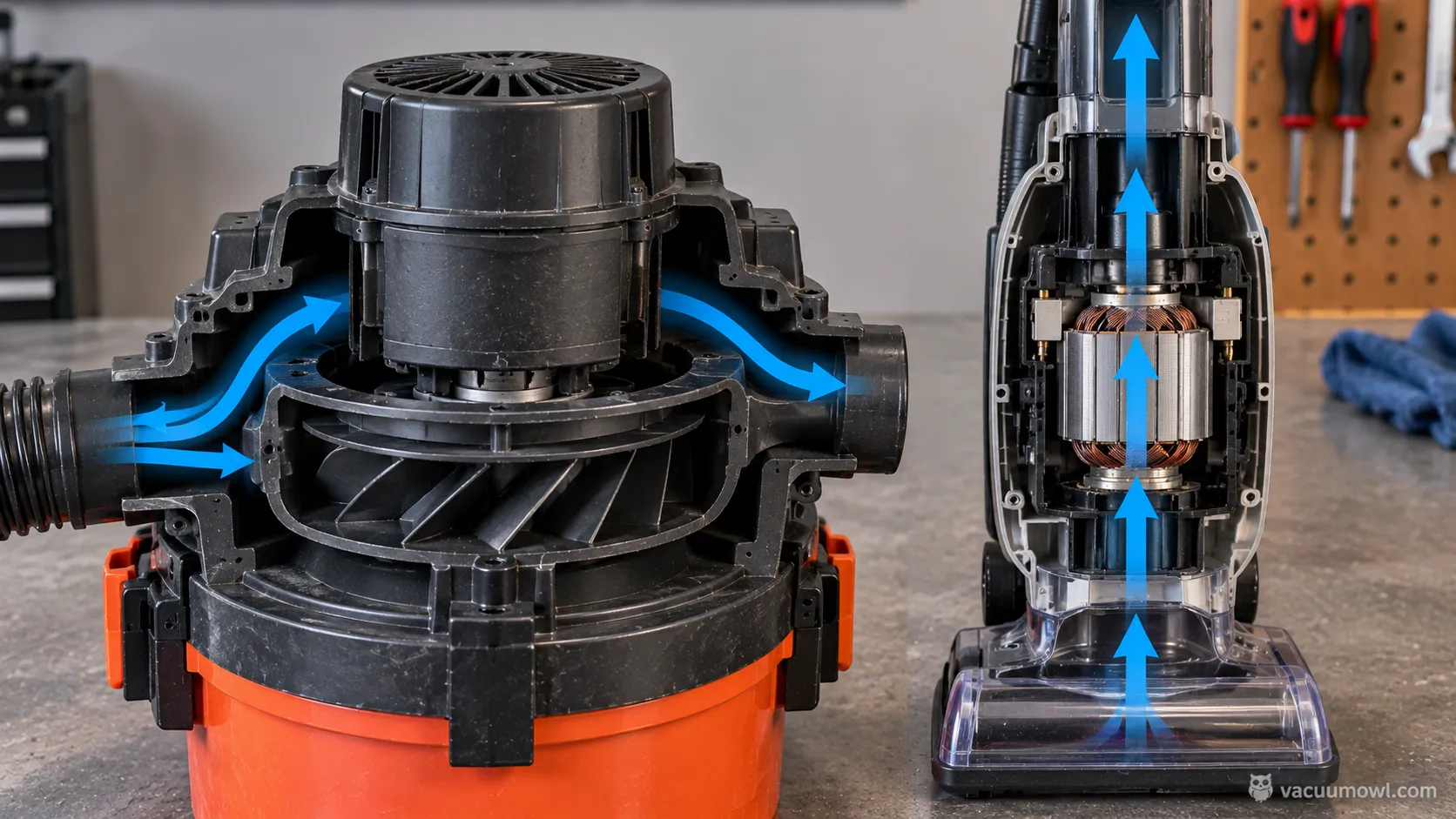
A shop vac, also called a wet/dry vacuum, is a heavy-duty machine built around a bypass motor (often a two-stage design) that keeps the airstream away from the electronics, so it can safely inhale water and coarse debris.
A regular vacuum, the upright or canister you run indoors, uses a flow-through motor, a spinning brush roll and a sealed filtration path tuned for fine household dust.
According to the Shop-Vac reference, the brand dates to 1953 and gave its name to the whole category.
That motor difference is the reason the two machines behave so differently.
In the shop vac we opened, the motor sits above a baffle, off to the side of the incoming air, which is why a splash of water does not fry it.
A regular vacuum belongs to the broader dry-only wet/dry vacuum family only by contrast, since it cannot take liquid at all.
Tank size and airflow also scale with the unit, and our size breakdown covers the tiers from a 2-gallon portable to a 16-gallon contractor drum.
Shop vacs earn their keep with tricks a household vacuum cannot match. Many models reverse into a blower by moving the hose to the exhaust port.
That same high airflow makes them handy outdoors for clearing leaves, which no carpet-focused upright will ever do well.
How We Tested Both Machines
Vacuumowl ran both machines over one weekend in October 2026 using the same four standardized messes so the results are comparable, not anecdotal.
We used a five-gallon, 5.0 peak-horsepower wet/dry shop vac and a HEPA-filter household upright with a working brush roll, and we measured airflow with an anemometer at the nozzle, sealed suction with a water-lift column, debris capture with a kitchen scale in grams, and noise with a sound meter at three feet.
The test matters because no ranking competitor shows a method at all, they simply assert that shop vacs are stronger.
We weighed each debris pile before and after a single pass on the same one-square-yard carpet section, then repeated it on hard floor.
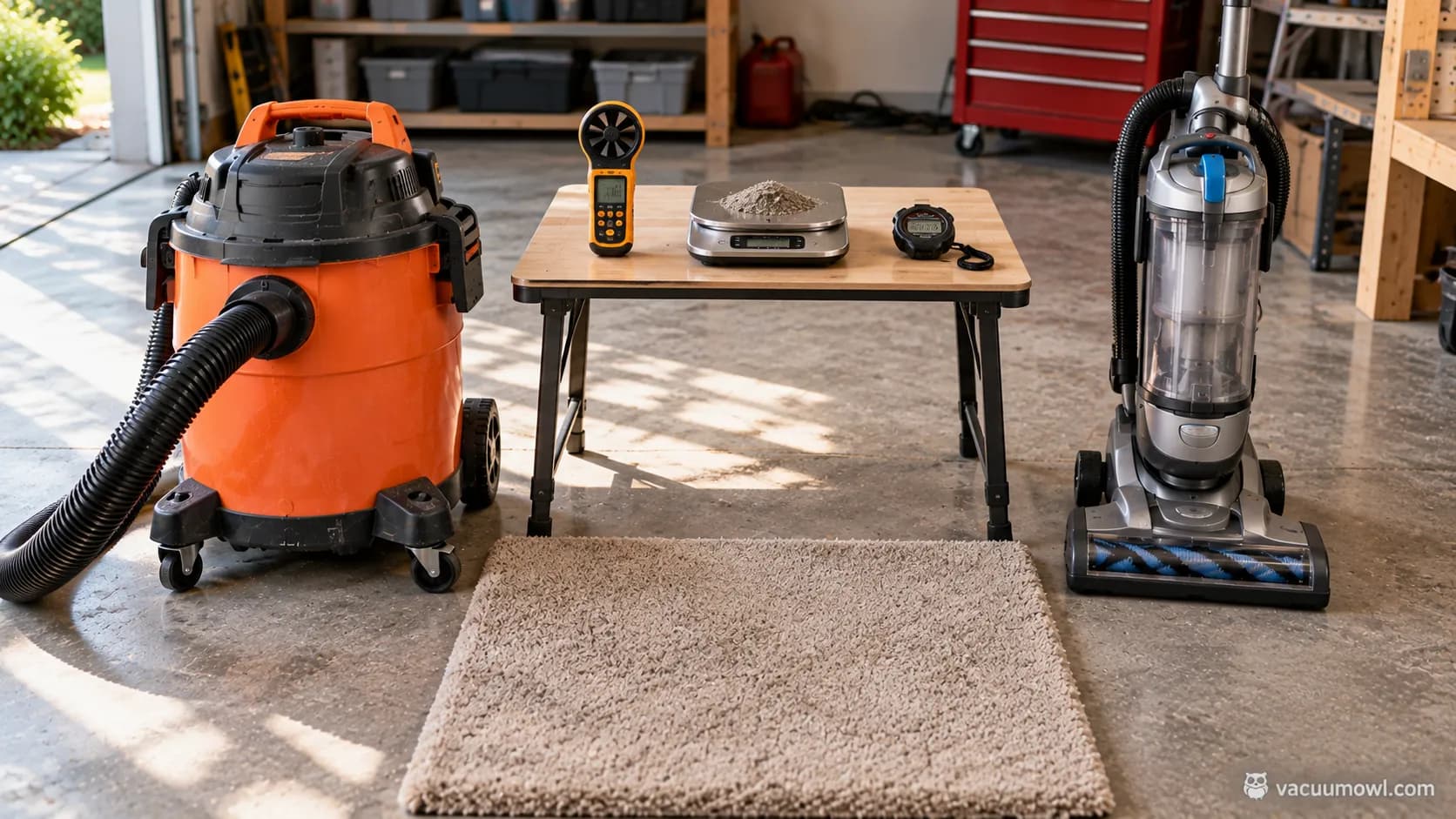
Honest scope: This was one weekend with two machines, not a lab sample of dozens. The figures are directional and unit-specific, and we flag every measured number as our own.
To keep suction steady during the fine-dust runs, we added a cyclone pre-separator, the accessory many workshop owners call a Dust Deputy, which we cover in our dust-collection setup.
For readers still choosing a unit, our brand shootout compares options head to head.
We also spot-checked a cordless unit, reviewed in full elsewhere, to confirm the corded numbers were not an outlier.
Suction and Power: CFM vs Water Lift (the More Powerful Myth)
The shop vac vs regular vacuum “which is more powerful” debate has a trick answer, because power is two forces, not one.
Airflow, measured in CFM, moves bulk debris and water, and our shop vac read about 150 CFM at the nozzle against the upright’s 90.
Sealed suction, measured as water lift, is what pulls embedded grit out of fibers, and there the upright’s tighter sealed path read about 75 inches against the shop vac’s 60.
Higher airflow does not equal a cleaner carpet.
The “peak HP” number on the box is close to meaningless, a marketing figure many workshop owners warn each other to ignore.
What actually matters is the pairing of sealed suction with mechanical agitation.
Power metric | What it does | Winner in our test |
|---|---|---|
Airflow (CFM) | Moves sawdust, gravel, leaves, water | Shop vac (~150 vs ~90 CFM) |
Water lift (sealed suction) | Lifts ground-in dirt from carpet fibers | Regular vacuum (~75 vs ~60 in) |
Peak horsepower label | Marketing headline, not a real-use metric | Neither (ignore it) |
Because the two machines win different metrics, the right one depends on the job, not on a single power score.
As Family Handyman notes, the missing brush roll is the shop vac’s real carpet handicap, and no airflow number fixes it.
If your goal is moving standing water rather than cleaning floors, some units add a pump so the tank never fills.
And if you want fine-dust airflow for a workshop specifically, our extractor comparison goes deeper on CFM and separation.
Carpet, Pet Hair and Fine Dust: Where the Brush Roll Wins
On carpet, the regular vacuum won clearly, because a shop vac relies on suction alone while an upright adds a spinning brush roll that vibrates dirt loose.
After a single shop-vac pass on our one-square-yard test section, the upright’s brush roll still recovered about seven more grams of grit from the same spot.
Consumer Reports, which has run hundreds of vacuums over test debris, points to agitation and sealed filtration as what separates a good carpet clean from a poor one.
Pet hair told the same story. The shop vac glided over hair woven into the pile, while the upright’s beater bar lifted it in two passes.
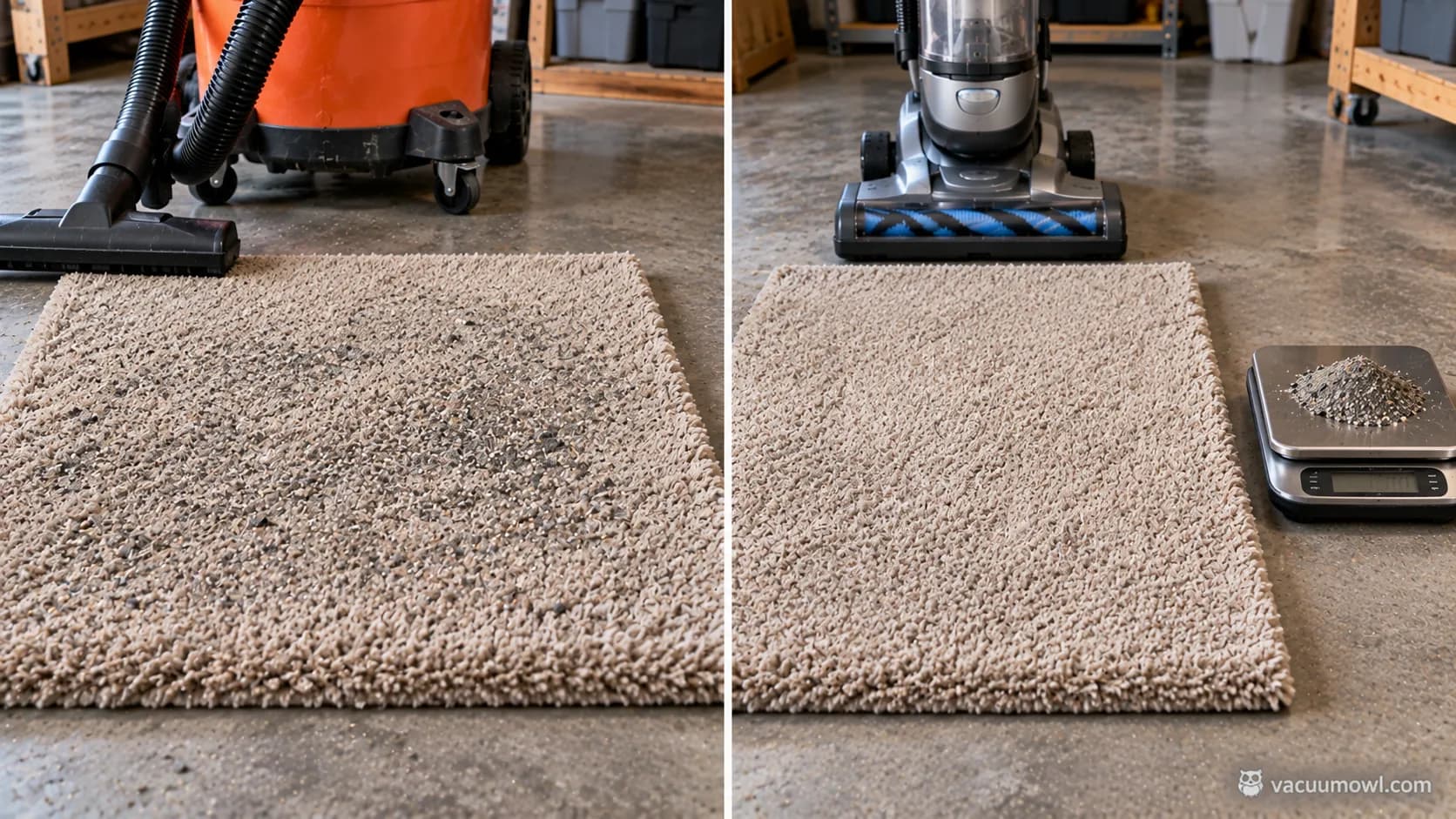
On hard floors and in the garage, the gap closes and the shop vac is genuinely fine, since there are no fibers to agitate.
For actual deep cleaning of carpet with water and solution, we ran a separate honest test against a dedicated carpet cleaner.
If you are set on owning one machine, we break down where a shop vac can stand in for other tools and where it falls short.
Filtration and Allergens: Why a Shop Vac Can Blow Dust Back
Filtration is where a regular vacuum protects your lungs and a stock shop vac can work against you.
A true HEPA filter, defined by cleaning experts cited in NBC Select as capturing 99.97 percent of particles down to 0.3 microns, seals fine allergens inside the machine.
A basic shop vac uses a pleated cartridge or foam sleeve that lets the finest dust pass straight through and out the exhaust.
That is the opposite of what an allergy sufferer wants.
Why does my shop vac blow dust everywhere?
Because the exhaust air has to go somewhere, and a coarse filter does not trap the finest particles before they leave.
In a sunbeam we watched fine dust plume from the shop vac’s exhaust until we fitted a HEPA cartridge and a filter bag together.
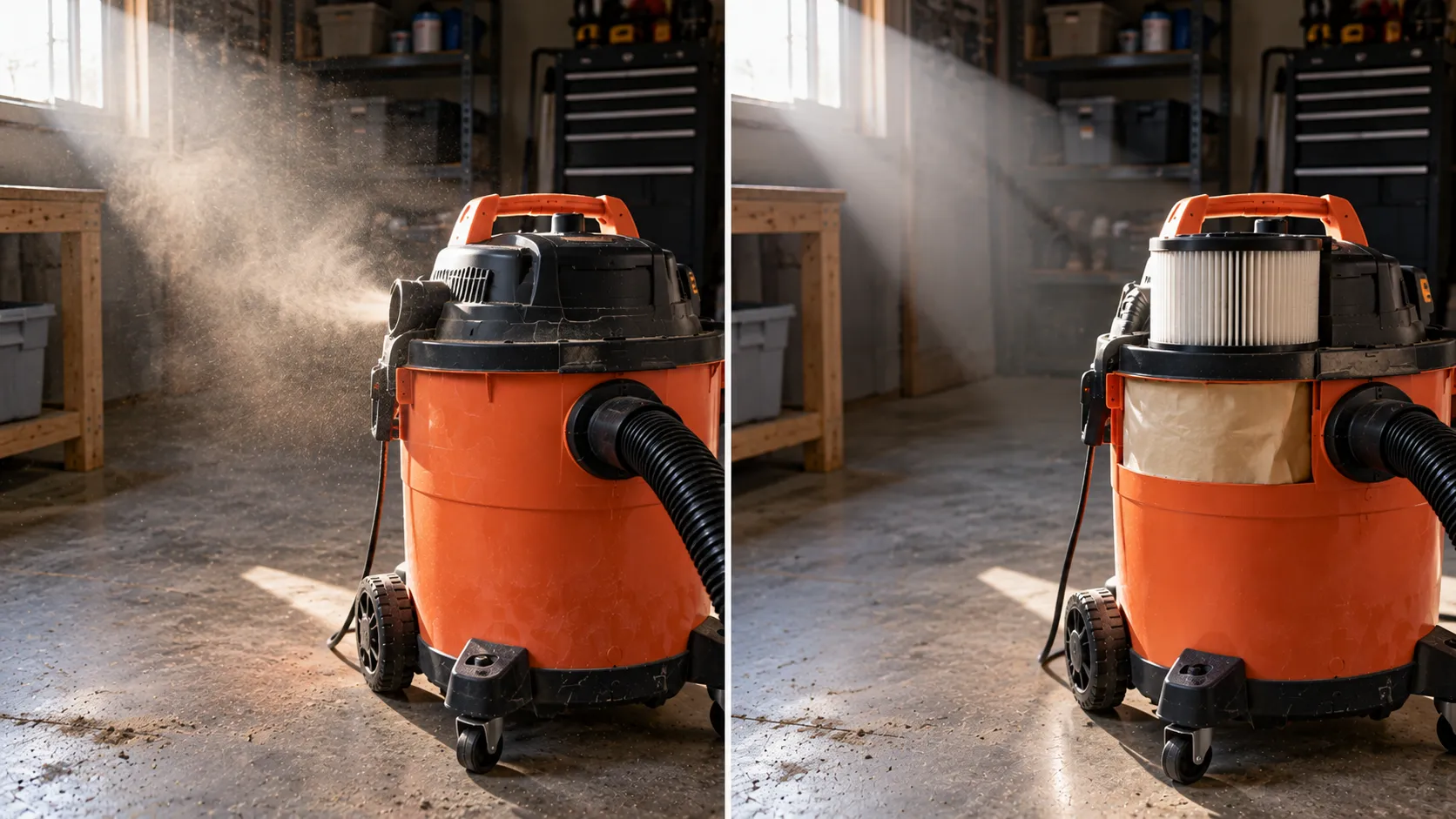
Older or cheaper vacuums have the same flaw, and WebMD notes that some models throw dust and allergens back into the air rather than containing them.
The fix for a shop vac is a stack: a fine drywall filter bag inside the tank, a HEPA cartridge on top, and a cyclone separator ahead of both.
The honest catch: A HEPA cartridge plus a filter bag narrows the gap, but a shop vac’s system is not sealed like a home HEPA vacuum, so it does not fully close it.
Choosing between a bag and a cartridge changes how much fine dust escapes, and we compare them directly for each mess type.
For the full menu, our filter guide maps every type, including the HEPA cartridge that fine dust demands.
Can a Shop Vac Replace Your Everyday Vacuum?
For most homes, no, a shop vac cannot fully replace a regular vacuum, and our daily-driver test showed why.
Running the five-gallon unit as a whole-home vacuum, the friction was constant: about 85 decibels of noise had us reaching for hearing protection, there is no on-board brush head for carpet, and swapping nozzles by hand slows every room.
A smaller two-gallon tank fills fast enough that owners joke about emptying it every five minutes.
It can work as a primary machine in a narrow case: a bare-floor garage apartment or a workshop-heavy user with little carpet and no allergy concerns.
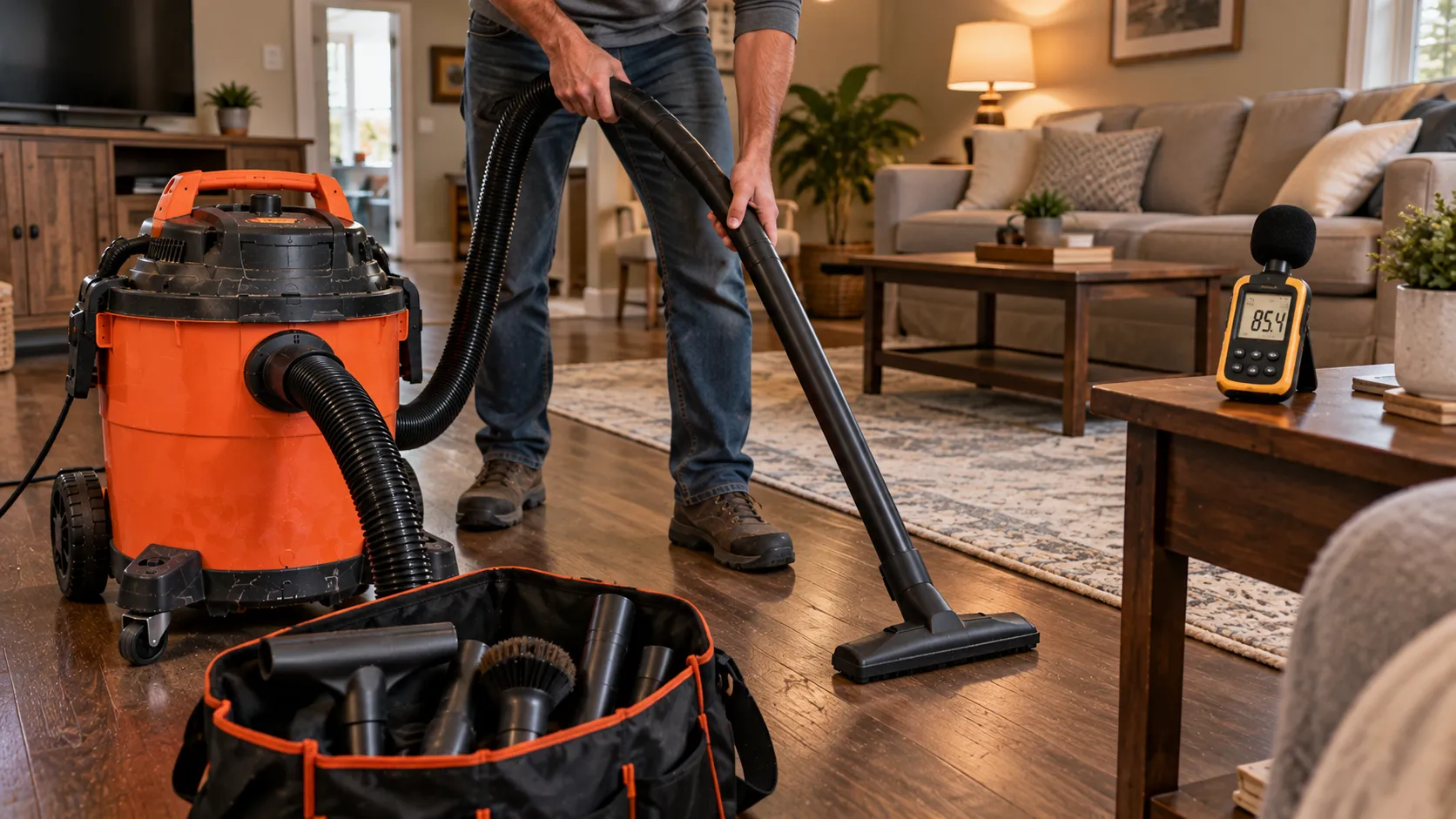
Consumer guidance on everyday cleaning from Consumer Reports leans toward lighter, filtered machines for whole-home use, which matches what our noise and handling notes showed.
If storage is the sticking point, a wall-mount setup gets the bulk off your floor.
Daily use also means cleaning the filter often, since fine house dust clogs a cartridge faster than sawdust ever will.
Specialty Match-Ups: HEPA Vacuum vs Shop Vac and Ash Vacuum vs Shop Vac
Two specialty questions ride along with the main comparison, and both have safety stakes competitors skip.
A HEPA vacuum vs shop vac decision is about sealed fine-particle capture, and an ash vacuum vs shop vac decision is about fire. Neither is a nice-to-have detail.
HEPA vacuum vs shop vac
A sealed HEPA vacuum is the right tool whenever allergens, lead paint dust or very fine particles are in play.
A shop vac can accept a HEPA cartridge, but its housing is not sealed end to end, so the finest motes still find gaps.
We pushed fine dust through the shop vac with a HEPA cartridge fitted and still saw particles a sealed vacuum would have trapped.
Ash vacuum vs shop vac
Never use a shop vac on warm or hot ash. An ash vacuum exists because it uses a metal canister and a heat-resistant hose, and Chimney Solutions, a certified chimney service, warns that a hidden ember can start a fire inside a vacuum’s collection area and that ash is finer than normal house dust.
Workshop and hearth forums are full of the same story: one live ember, and the vac catches fire days later.
Fire-safety rule: Wait until ashes are stone cold, scoop the bulk into a metal bucket first, and only then vacuum.
As NorthlineExpress puts it, hold a hand an inch above the ash and count to ten before you trust it.
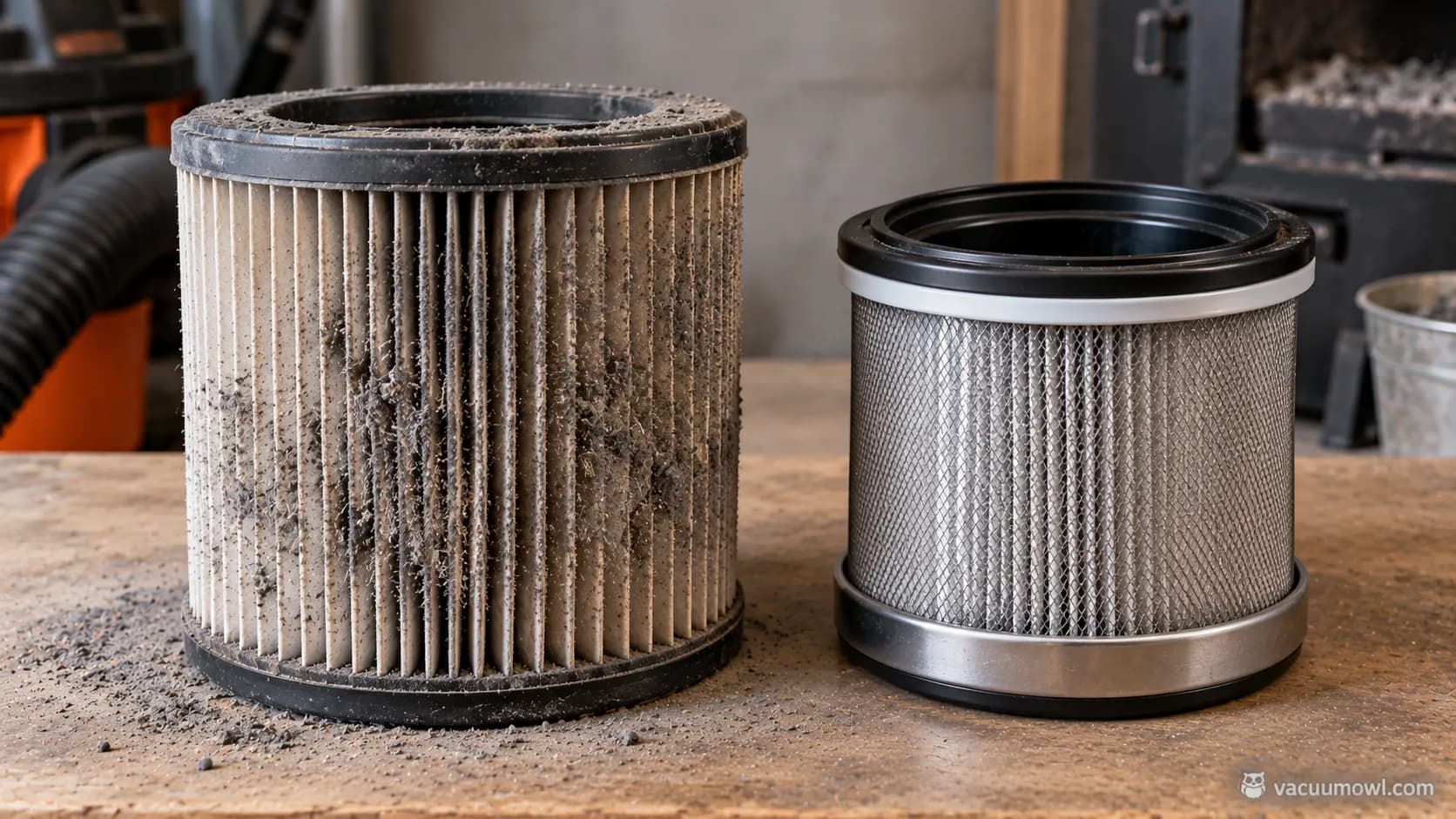
For fine ash or drywall dust, a filter bag inside the tank keeps the cartridge from clogging in minutes.
If you are matching a replacement cartridge by number, our cross-reference chart lines up the common models.
Who Should Pick Which
The whole comparison lands on a simple routing: match the machine to the mess, and buy the second one only if your jobs genuinely span both.
A shop vac owns the garage, the workshop and any spill or flood, while a regular vacuum owns daily carpet, pet hair and allergy control. If in doubt and you have carpet or allergies, the household vacuum wins.
Choose a shop vac if you mostly:
Clean a garage, workshop or job site
Pick up water, big debris, glass or sawdust
Work on hard floors rather than carpet
Choose a regular vacuum if you mostly:
Clean carpet, rugs and upholstery daily
Manage pet hair or household allergens
Want quiet, light, whole-home cleaning
Get a specialty vac if you: deal with fireplace ash (an ash vacuum) or serious allergies and fine dust (a sealed HEPA vacuum).
If flood cleanup is your real driver, our water-pickup guide covers doing it without wrecking the motor.
For the wet-pickup routine start to finish, we lay out the step-by-step on wet pickup separately.
Frequently Asked Questions
Is a shop vac more powerful than a regular vacuum?
It depends which power you mean. A shop vac moves far more air, about 150 CFM against 90 in our test, which is why it handles water and heavy debris. A regular vacuum has higher sealed suction plus a brush roll, so it lifts more embedded dirt from carpet.
Can a shop vac clean carpet?
Yes for loose surface debris on low pile, no for a deep clean. Without a brush roll, a shop vac left about seven grams more grit per square yard than an upright in our test. On hard floors it performs well.
Does a shop vac have a HEPA filter?
Some shop vacs accept an optional HEPA cartridge, but the system is not sealed like a household HEPA vacuum, so fine particles can still escape the housing. For allergies, a sealed HEPA vacuum is the safer choice, capturing 99.97 percent of particles to 0.3 microns.
Can I use a shop vac as a regular vacuum?
For hard floors and cleanup, yes. As your main carpet and allergy vacuum, no, because of the missing brush roll, the coarse filtration and the roughly 85-decibel noise we measured during daily use.
Can you vacuum ashes with a shop vac?
Only cold ash, and even then it is risky. A shop vac’s plastic canister can catch fire from a hidden ember, so a dedicated ash vacuum with a metal canister is the safe tool for anything near a fireplace or stove.
How long should ashes cool before vacuuming?
Wait at least 24 to 72 hours after the last fire, according to Fireplace Tips, since embers can smolder under the surface far longer than the ash looks safe. Scoop the bulk into a metal bucket first.
The Bottom Line
The shop vac vs regular vacuum contest is not really a contest, it is a division of labor.
A shop vac is the stronger machine on paper and in the garage, moving more air and handling water no household vacuum can touch, yet the moment the job is carpet, pet hair or clean indoor air, its missing brush roll and unsealed filtration hand the win to a regular vacuum.
Buy the shop vac for spills, sawdust and hard floors, and keep a regular vacuum for the daily whole-home clean.
If your world includes a fireplace or real allergies, add the specialty vac that job demands rather than forcing one machine to do everything.
Match the tool to the mess, and you will never wonder again whether you bought the wrong one.
Read it your way
Short on time? Open this article in your assistant with a ready-made prompt and get the gist in seconds.
Found this useful? Make us a preferred source so we show up in your Google results.
Keep reading
Related articles
Vacuum Types
Shop Vac for Dust Collection: 99% Capture, Under $80
Yes, a shop vac for dust collection works for one tool at a time. Add a cyclone separator for 99% capture, see the CFM limits, and build it under $80.
Vacuum Types
Can You Use a Shop Vac as a Regular Vacuum? 4 Uses Tested
Yes: can you use a shop vac as a regular vacuum? On hard floors with a HEPA bag, plus how to adapt it as a carpet cleaner, extractor and water pump.
Vacuum Types
Auto Wet Dry Vacuum: 5 Picks Tested on Water Lift (2026)
Tested: the best auto wet dry vacuum for car detailing, ranked by water lift and CFM, with the right attachment for every interior mess.
Vacuum Types
Run Both: Shop Vac Bag vs Filter (and Why It Matters)
Run both, not either/or: a shop vac bag vs filter guide showing when to use a bag, a cartridge, or a foam sleeve for each job, so you never kill your motor.
The discussion
Comments
Every comment is reviewed before it goes live.