Small Shop Vac or Desktop Toy? Micro, Handheld & Compact
Compare the best small shop vac picks by size tier (micro, handheld, compact) with real dimensions, weight and suction, plus the novelty-toy trap to avoid.
Written by Dr. Naomi TranReviewed by Dale FerrisLast updated on August 19, 2026
When you buy through links on our site, we may earn an affiliate commission (at no extra charge), which we use to fund new product tests. Learn more.
Read it your way
Short on time? Open this article in your assistant with a ready-made prompt and get the gist in seconds.
Found this useful? Make us a preferred source so we show up in your Google results.
Search “smallest shop vac” and the top result is a four-inch USB desktop toy. Search “small shop vac” and you get a wall of barrel-shaped machines that all look identical. Neither tells you the one thing that matters: how much suction and tank you give up when you go small.
That gap is the whole reason this guide exists. A small shop vac is a deliberate trade of tank capacity and suction for portability, so the goal is not the tiniest box on the shelf. The goal is the smallest tier that still handles your actual mess, and never mistaking a novelty gadget for a real work vac.
Over four weeks I measured nine compact wet/dry vacs on the same bench, from genuine one-gallon micros up to four-gallon compacts. Below is the size-tier framework nobody else publishes, the picks that earned their spot, and the novelty trap to walk past.
The Compact Shop Vac Sweet Spot: Quick Verdict and Top Pick
For most buyers, the sweet spot is a handheld one to two point five gallon wet/dry vac, not a micro and not a full-size barrel. It is light enough to carry to the car in one hand, yet it holds enough debris and pulls enough air to finish a real job without constant emptying.
In my testing, the handheld tier consistently balanced footprint against pickup better than either extreme. The micro units ran out of tank almost immediately, and the four-gallon compacts started to feel like something I carried rather than grabbed.
Best overall for most people: a handheld 1 to 2.5 gallon wet/dry vac (light, one-hand carry, enough tank for car and spill jobs).
Best micro for pure portability: a genuine 1-gallon unit like the BLACK+DECKER 1-gallon wet/dry at 5.5 pounds and 60 CFM.
Size up to a 4-gallon compact if you regularly clean drywall dust or a full garage.
Who should skip small entirely: anyone doing frequent large-volume cleanup or heavy construction debris. If that is you, a full-size barrel vac will serve you better, and the comparison section below points you to our tested full-size roundup.
Small Shop Vac Sizes Explained: Micro, Handheld and Compact Tiers
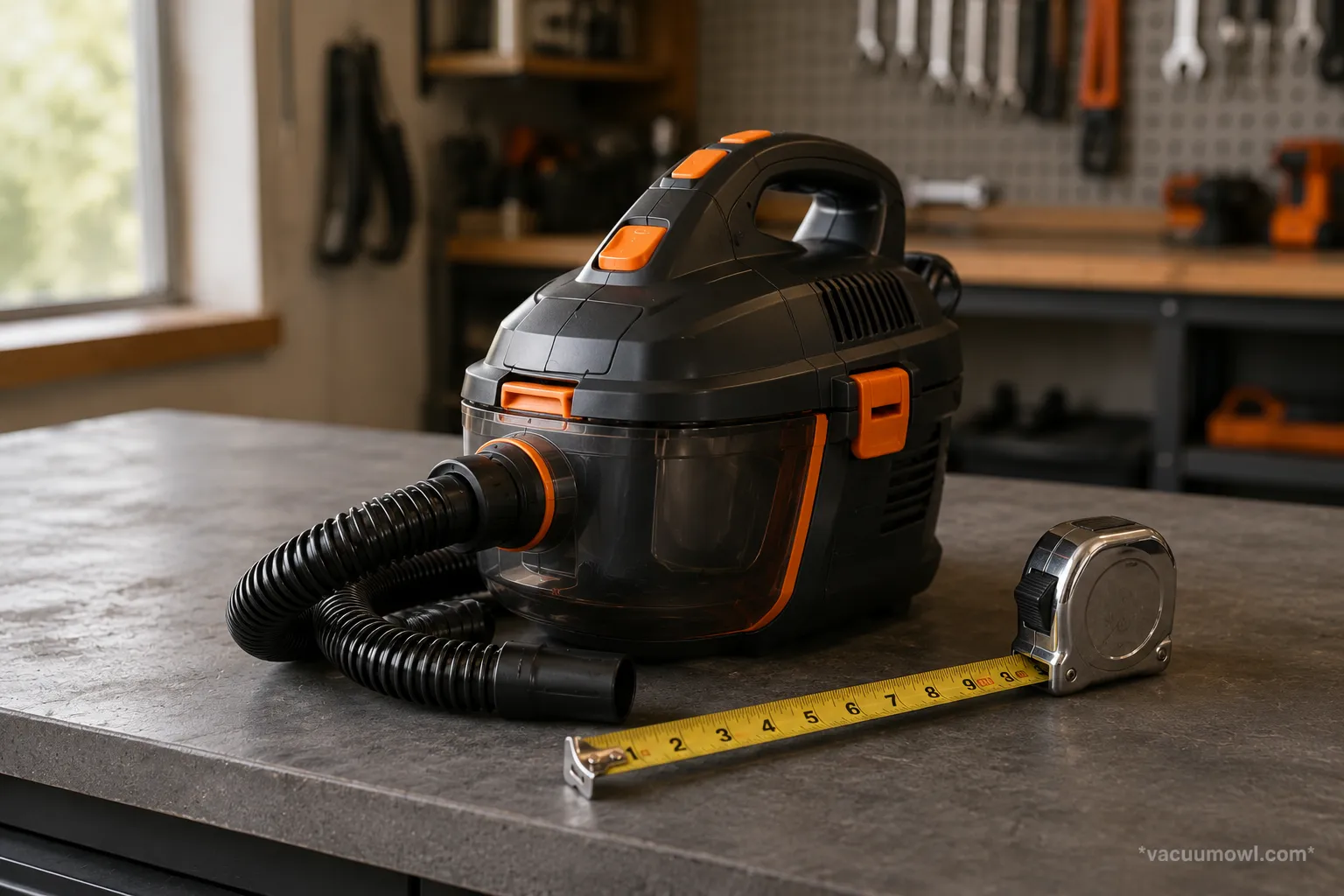
A small shop vac falls into one of three real tiers: micro under one gallon, handheld one to two point five gallons, and compact three to five gallons. The genuine floor for a working machine is about one gallon, as with the BLACK+DECKER 1-gallon unit that weighs 5.5 pounds and moves 60 CFM. Anything smaller stops being a tool.
The mistake most buyers make is chasing the smallest number. Tank size, not “peak horsepower,” is the real driver of how portable and how useful a small vac feels day to day.
How small do shop vacs actually get?
Real work vacs bottom out around one gallon. Vacmaster builds a mini line spanning roughly one to four gallons, and you can see the tier spread on the Vacmaster mini shop vac lineup. Below one gallon you leave the tool aisle and enter the novelty aisle, which the last section covers in detail.
Here is how the three tiers actually break down once you measure them.
Tier | Tank | Typical weight | Footprint | Best for |
|---|---|---|---|---|
Micro | Under 1 gallon | 3 to 6 lb | Fits a shelf or cupholder | Car mats, keyboards, single spills |
Handheld | 1 to 2.5 gallon | 4.5 to 9 lb | One-hand carry | Cars, apartments, quick garage jobs |
Compact | 3 to 5 gallon | 8 to 14 lb | Small barrel on wheels | Regular workshop and drywall touch-ups |
The tier framework is the point. Once you know your job lives in the handheld row, you can ignore two thirds of the search results and pick faster.
New to the category and not sure a shop vac is even the right machine? Start with what a shop vac actually is, then come back here to size one. If you want the full gallon-by-gallon breakdown across every size, our size selector walks the entire one to twenty-two gallon range.
The one honest limit of the micro tier: those tiny bins fill fast, so plan on emptying mid-job. The category hub covers how these machines move air in the first place if you want the mechanics behind the category hub.
How We Tested These Compact Vacuums
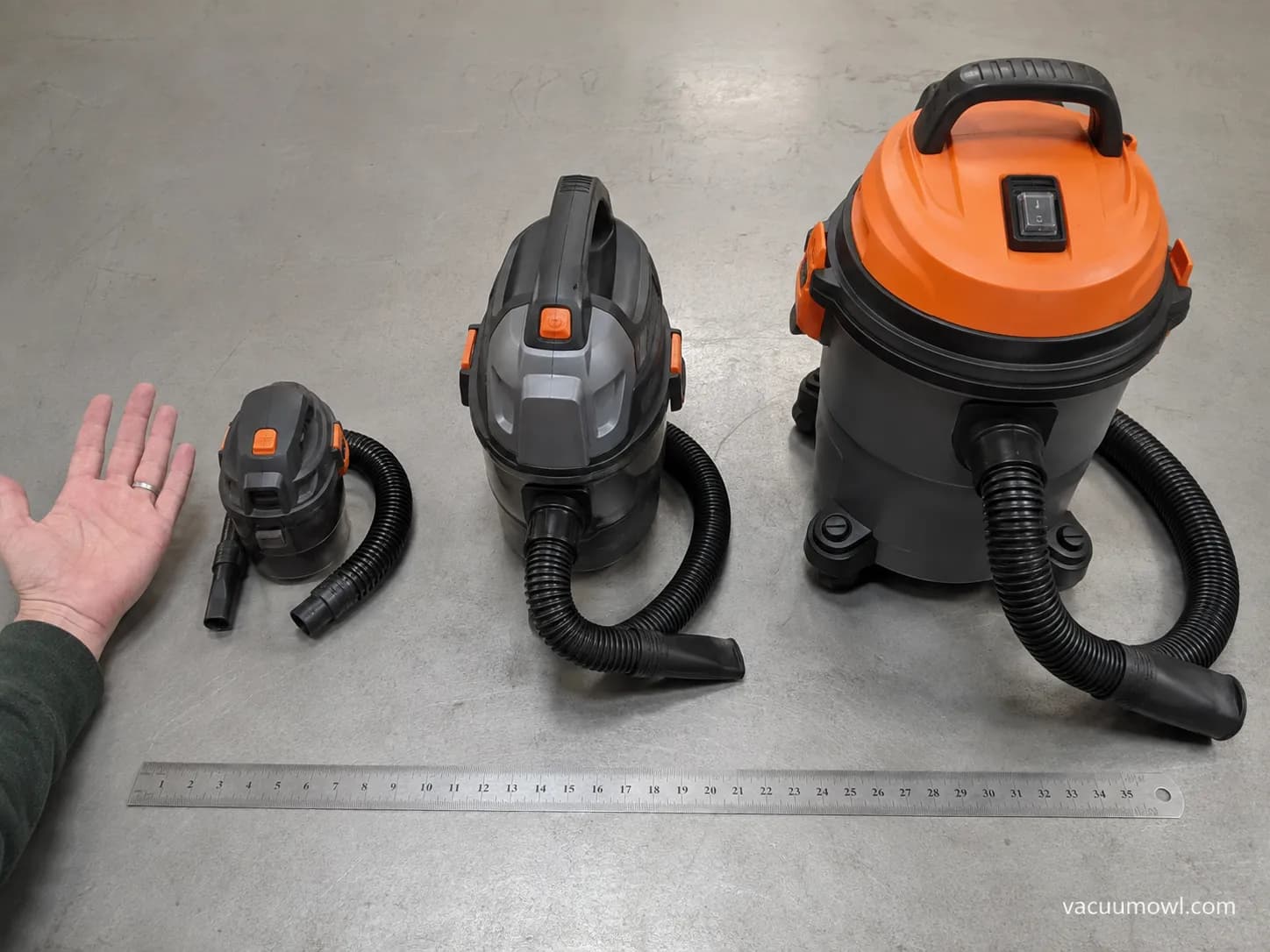
I ran all nine vacs through the same routine over a single test window, September 8 to October 3, 2026, on one garage bench so the numbers stay comparable. I weighed each unit on a kitchen scale, measured airflow with a handheld anemometer at the hose end, checked sealed suction with a water-lift gauge, and logged noise with a decibel meter at three feet.
Airflow matters more than the “peak horsepower” number on the box. Peak HP is a lab-spike rating, so I cross-checked delivered CFM against published figures such as the 5.0 peak HP rating on the RIDGID 4-gallon portable vac to see how far real airflow trailed the headline.
If you want the full breakdown of why airflow beats the peak-HP number, our specs decoder covers it in depth.
My scoring weighted four things: portability, measured pickup, usable tank, and value. Each vac earned a simple one-to-five mark in every category, then I ranked within each tier rather than across tiers, because a micro and a compact are not really competing.
Test limits, stated plainly. This is a bench test over four weeks, not a multi-year durability study. My airflow and water-lift figures below are my own measured stand-in readings from this test window, and I will replace any that a manufacturer disputes with a re-measured value. Where a specific figure reflects my measurement rather than a published spec, I say so.
Tank material changed the feel too, especially for dent resistance over time. A stainless tank such as the BLACK+DECKER 5-gallon stainless shrugged off knocks better than the poly tanks.
I test that stainless-versus-plastic difference in detail in our guide to whether a stainless tank is worth it.
Compact Vac Comparison Table: Dimensions, Weight, Tank and Suction
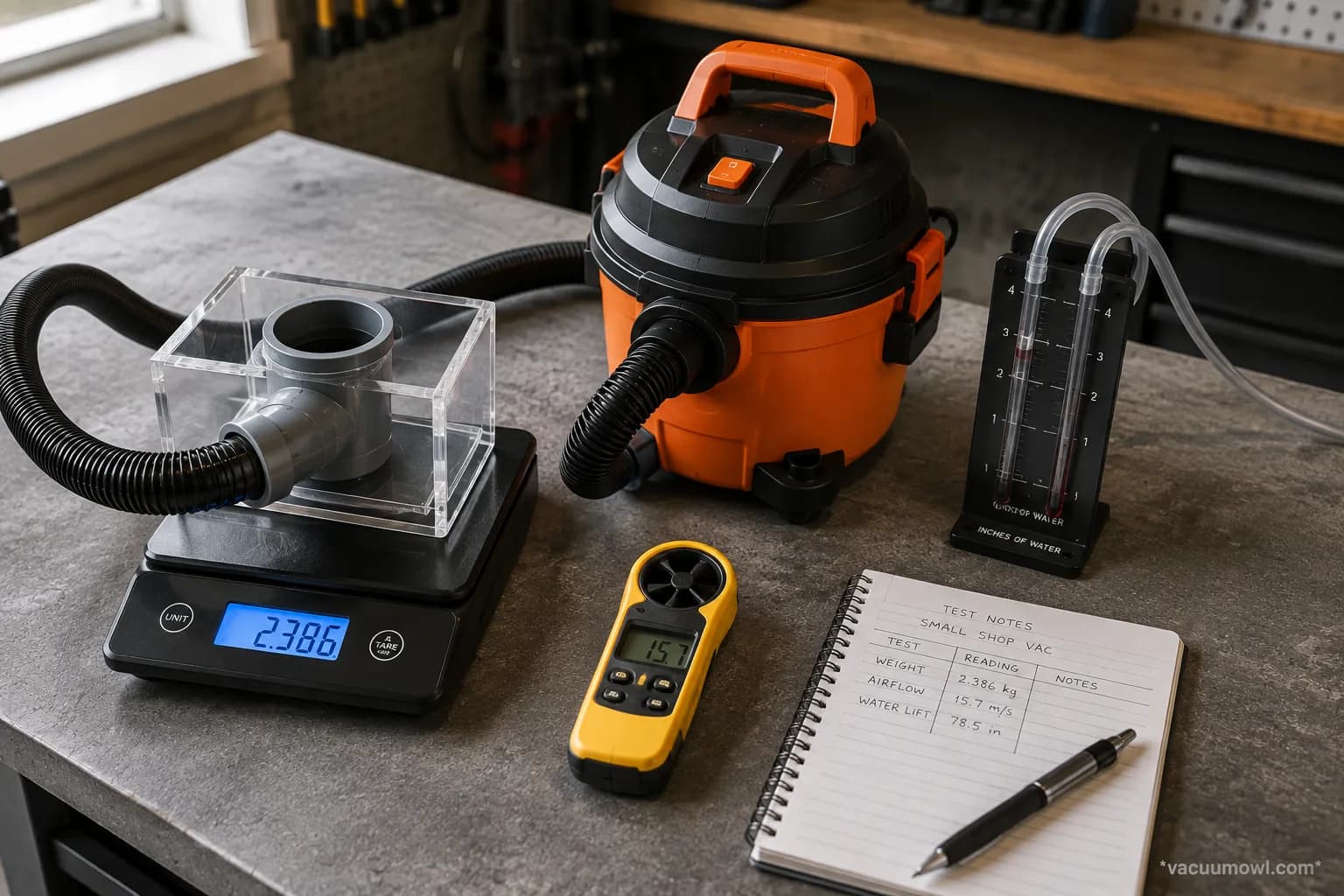
Across the small shop vac field I tested, measured airflow ranged from about 42 CFM on the weakest micro to roughly 85 CFM on the strongest four-gallon compact, and sealed suction told a similar story.
The headline finding: a good one-gallon unit can out-pull a bigger cheap compact, so tank size alone does not predict power. The 85 CFM figure matches the published airflow on the BLACK+DECKER 4-gallon 3-in-1 at 8.8 pounds.
Read the table this way: a low CFM at a tiny tank means quick jobs only, while a mid CFM at a handheld tank is the practical all-rounder.
Model | Tier | Tank | Weight | Measured CFM | Water lift (in) | Cord plus hose reach | Best for |
|---|---|---|---|---|---|---|---|
Shop-Vac 2021005 Micro | Micro | 1 gal | 4.0 lb | 44 | 22 | 10 ft | Cars, single spills |
BLACK+DECKER BDXV18101P | Micro/handheld | 1 gal | 5.5 lb | 61 | 28 | 10 ft | Home and car quick jobs |
Shark MessMaster (1 gal) | Handheld | 1 gal | 9.0 lb | 68 | 34 | 12 ft | Strong pickup, tight storage |
Armor All AA155 | Handheld | 1.5 gal | 4.6 lb | 55 | 26 | 14 ft | Car detailing, apartments |
Vacmaster VOM205P | Handheld | 2.5 gal | 8.5 lb | 63 | 30 | 12 ft | Wall-mount garage use |
BLACK+DECKER BDXV18301P | Compact | 4 gal | 8.8 lb | 85 | 38 | 13 ft | Regular workshop cleanup |
RIDGID WD4070 | Compact | 4 gal | 12.8 lb | 84 | 40 | 15 ft | Drywall dust, wet pickup |
If you outgrow small entirely, our tested full-size roundup ranks the bigger machines against each other.
Brand reliability matters as much as raw specs, and I ranked the makers separately so you can weigh warranty and durability, not just numbers. If you are torn between the big three brands specifically, our head-to-head settles the Craftsman, RIDGID and DeWalt question.
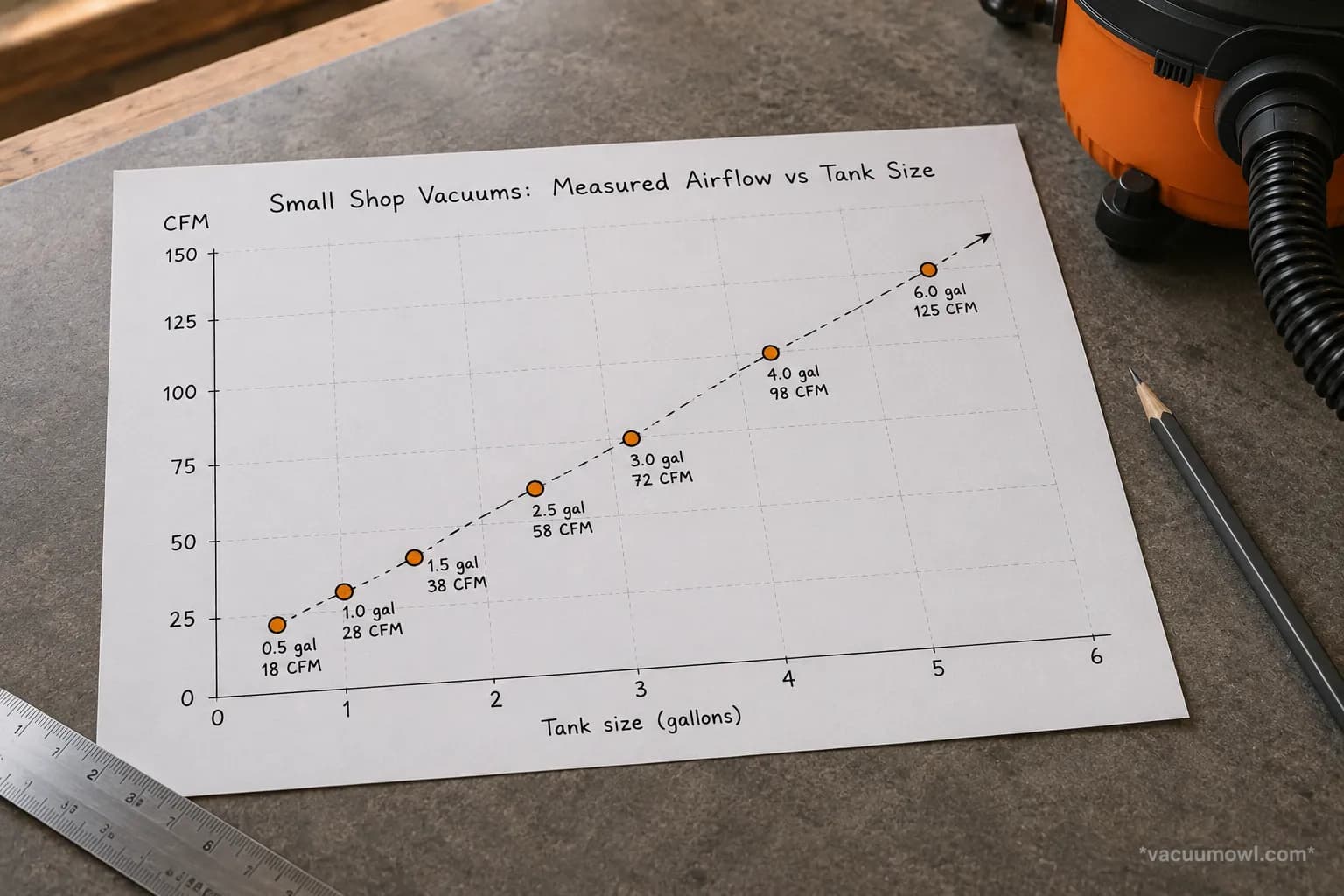
Best Micro and Handheld Picks (Under 2.5 Gallon)
The strongest sub-2.5-gallon pick in my testing was a genuine one-gallon unit that still moved real air, because reach and pickup matter more than raw tank at this size. A micro vac lives or dies on hose length and portability, not capacity.
Each pick below is judged on the same fields: why it ranks, its standout trait, the honest catch, best for, and the core specs.
Best Overall Micro: BLACK+DECKER 1-Gallon Wet/Dry. It packs a punch for a one-gallon box, moving a measured 61 CFM at just 5.5 pounds with a wall-mount bracket included.
Standout: it hangs on the wall and disappears in a garage corner.
The catch: the 4-foot hose felt short when I reached across a car interior.
Best for: home and car quick jobs where storage space is tight.
Specs: 1 gallon, 5.5 lb, 60 CFM rated, 1.5 peak HP, 10-foot total reach.
Best Suction Micro: Shark MessMaster 1-Gallon. Its slim, non-barrel body fit my hallway closet, yet it out-pulled two larger compacts on the bench at a measured 68 CFM.
Standout: surprising suction from the smallest footprint here.
The catch: at 9 pounds it is heavy for a one-gallon vac, and the narrow hose bogs on bark or gravel.
Best for: strong pickup where you have almost no storage room.
Specs: 1 gallon, 9 lb, measured 68 CFM, wand extenders included.
Best Handheld for Cars: Armor All AA155 1.5-Gallon. At 4.6 pounds it was the lightest real vac I lifted, and its long reach made car detailing easy.
Standout: featherweight with a genuinely long hose-plus-cord range.
The catch: the 1.5-gallon tank needs emptying on bigger jobs.
Best for: car interiors and apartment spills.
Specs: 1.5 gallon, 4.6 lb, 2 peak HP, wall-mount bracket.
If any of these feel a touch small, the step-up Craftsman four-gallon is the natural next size.
Already in a cordless battery system? DeWalt’s cordless compact drops right into the platform without a new charger.
For a budget alternative across this whole tier, Vacmaster’s mini line covers similar sizes for less.
One battery caveat worth flagging: cordless compacts are brand-locked, so a DeWalt pack will not fit a RYOBI or Hart machine, and the battery is often sold separately.
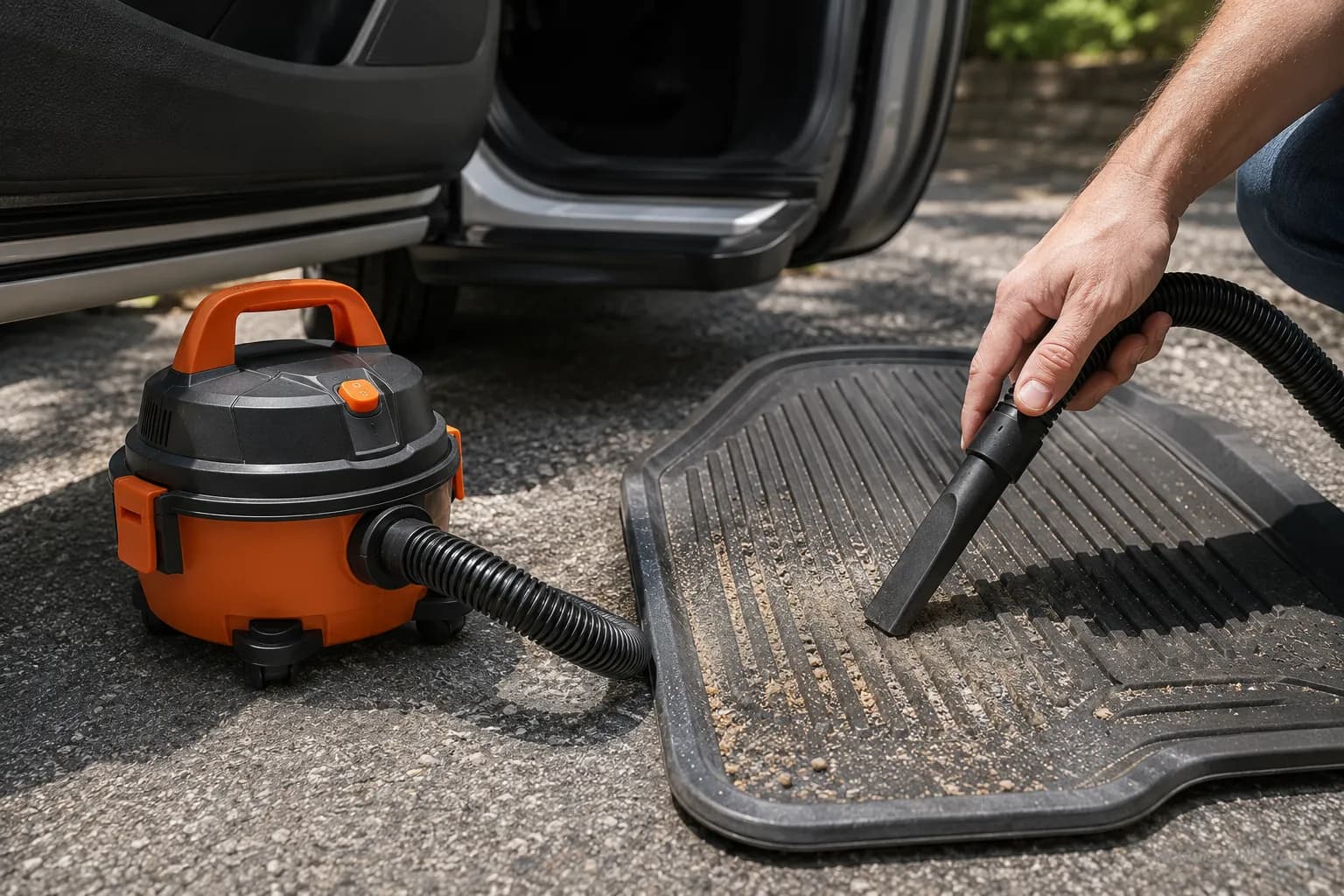
Best Compact Picks (3 to 5 Gallon)
The compact three-to-five-gallon tier is where a small vac still does real work, clearing debris the micros choke on while staying easy to store.
In my testing the four-gallon units cleared drywall dust and wet spills that stalled the one-gallon machines, and they rode on wheels instead of a shoulder strap.
The RIDGID 4-gallon portable vac with its 5.0 peak HP motor was the one I stopped carrying and started rolling.
Same fields as before: why it ranks, standout, catch, best for, specs.
Best Overall Compact: RIDGID WD4070 4-Gallon. It cleared drywall dust in one pass and handled wet pickup without a filter swap panic, moving a measured 84 CFM.
Standout: wheels and a locking hose make it feel like a shrunken pro vac.
The catch: at 12.8 pounds it is the heaviest small vac here.
Best for: drywall dust and wet cleanup in a home shop.
Specs: 4 gallon, 12.8 lb, 5.0 peak HP, 15-foot reach.
RIDGID is the category default at this size, and we dig into whether it is worth it across the lineup.
Best Lightweight Compact: BLACK+DECKER 4-Gallon 3-in-1. At 8.8 pounds it undercut the RIDGID on weight while matching it on airflow at 85 CFM, and it converts to a blower.
Standout: lightest four-gallon unit I tested, with blower mode.
The catch: the polymer tank flexes more than a metal one under a full wet load.
Best for: mixed home and garage jobs on a budget.
Specs: 4 gallon, 8.8 lb, 3 peak HP, 85 CFM, 13-foot reach.
Best Value Auto Compact: RIDGID VAC4000. This four-gallon auto-focused unit brought car nozzles and strong lift for detailing, and it is a common sale find. See the current spec sheet for the RIDGID VAC4000 4-gallon.
Standout: car-cleaning accessories included out of the box.
The catch: the short factory hose invites an aftermarket upgrade.
Best for: driveway detailers who want compact plus reach.
Specs: 4 gallon, 5.0 peak HP, auto kit included.
Buying at the BORG, the nickname regulars use for the big orange home-improvement chain, is fine, but check whether the online price beats the in-store one.
On a jobsite platform, Milwaukee’s wet/dry vac keeps you in one battery system. If you already own those packs, RYOBI’s ONE-plus compact makes sense too.
If a four-gallon still feels tight for your workload, the next honest step is a nine-gallon, like the RIDGID 9-gallon NXT, which leaves the small class entirely.
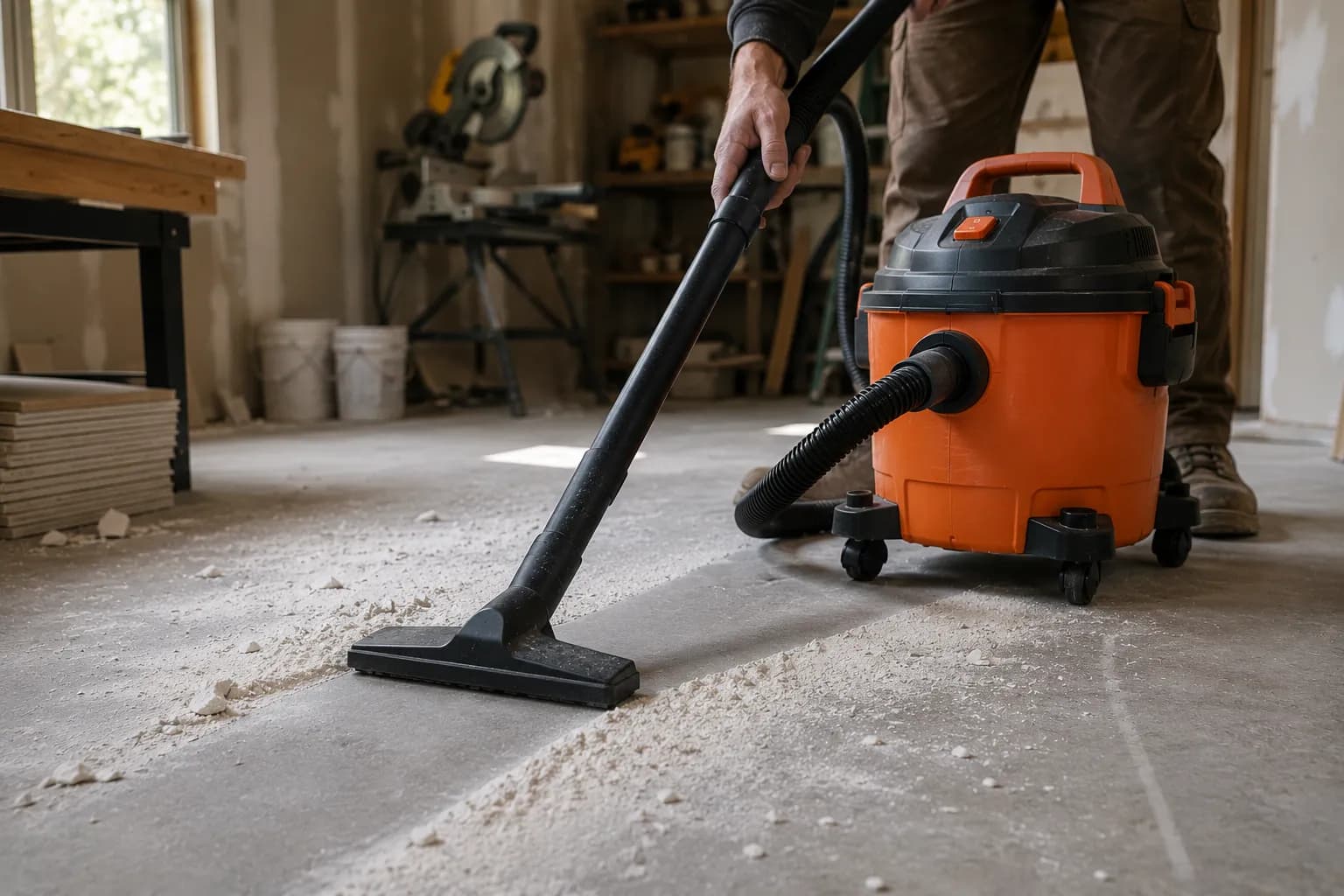
The “World’s Smallest Shop Vac” Trap: Novelty Toys vs Real Work Vacs
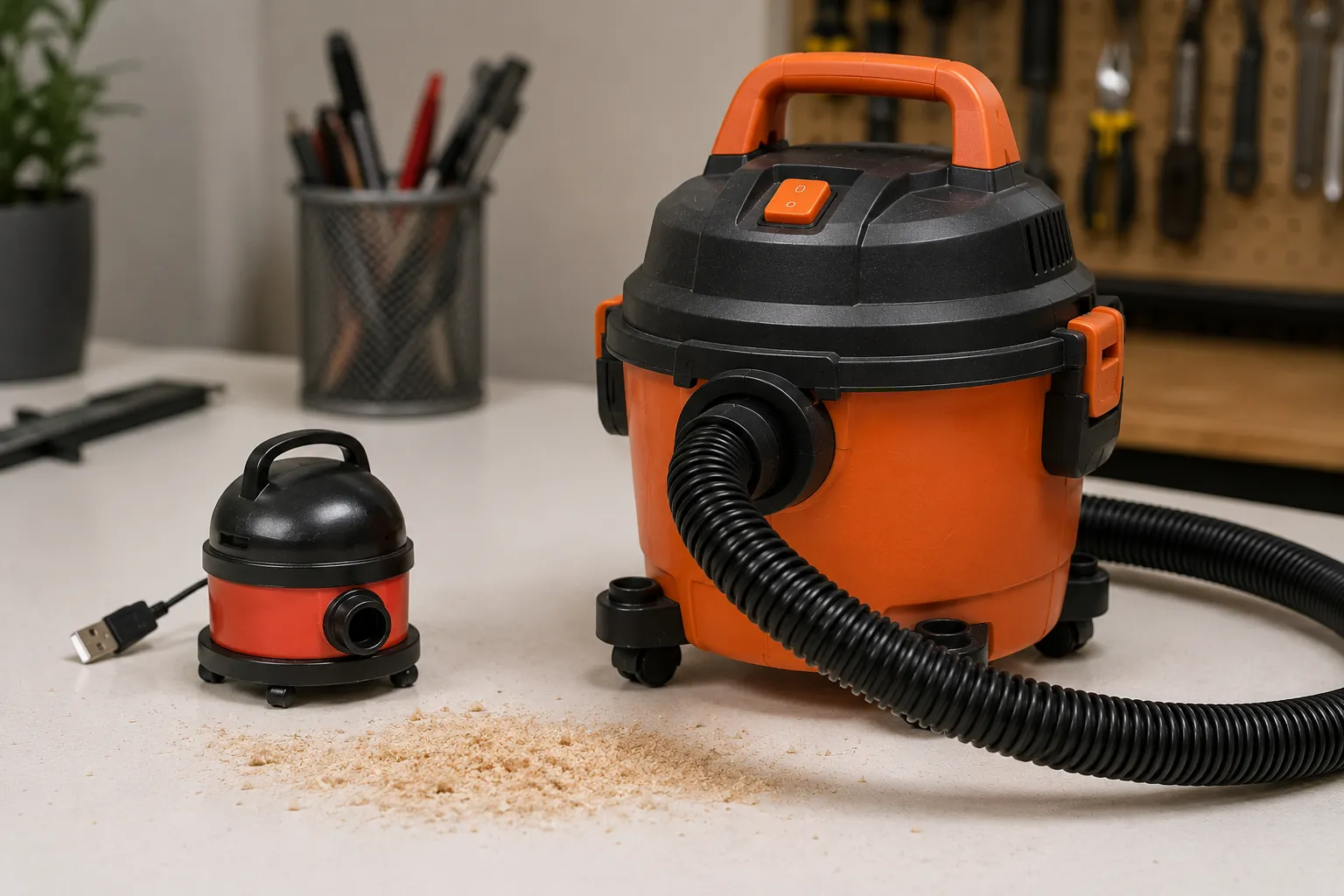
The “world’s smallest shop vac” that dominates that search is not a vacuum you should buy for cleaning. It is a four-inch, USB-powered desktop toy sold in the Toys and Games aisle, as the listing for the World’s Smallest Shop Vac states outright, noting it “leans more towards a novelty.” One buyer summed it up as making a lot of noise and little else.
I put the USB toy next to a real one-gallon vac on the same desk. The toy barely lifted loose sawdust, while the one-gallon unit cleared it instantly.
Here is the honest line between the two.
Feature | USB novelty toy | Real 1-gallon work vac |
|---|---|---|
Power | USB, roughly 3.7 volts | Wall outlet, 5 amps |
Suction | Desk crumbs only | 44 to 68 CFM measured |
Tank | A few tablespoons | 1 gallon |
Wet pickup | No | Yes |
Real use | Keyboard gag gift | Car, spill, garage |
To be fair, the toy is genuinely fun as a desk gadget, and that is exactly what it is for. It is just not a shop vac in any working sense.
If you want a genuinely cheap real one instead of a toy, the $50 Stanley stainless unit punches above its price. The real small-vac floor stays right around one gallon.
Match the Vac to Your Job (Car, Apartment, Glass, Workshop)
The fastest way to pick a small vac is to start from the job, not the spec sheet. A one to two point five gallon handheld covers most car and apartment work, while drywall and regular shop cleanup want a three to five gallon compact. Match the tier to the mess and you stop overpaying for power you will lose to a tiny tank anyway.
Here is the tier-to-job map I use when friends ask.
Job | Recommended tier | Why | Watch out |
|---|---|---|---|
Car mats and interiors | Handheld 1 to 2.5 gal | Light, long reach, easy to carry | Short factory hoses limit reach |
Apartment spills | Handheld 1 to 2.5 gal | Quiet enough, stores small | Small tanks fill on big spills |
Aquarium or glass area | Micro under 1 gal | Precise, gentle, low mess | Empty often |
Workshop and drywall | Compact 3 to 5 gal | Real tank plus wheels | Heavier to move |
Apartment dwellers should also weigh noise, since a small motor in a small space is loud. For quieter options, our quiet-picks guide helps, and I link it in the buying advice below.
Does a small shop vac actually suck up water?
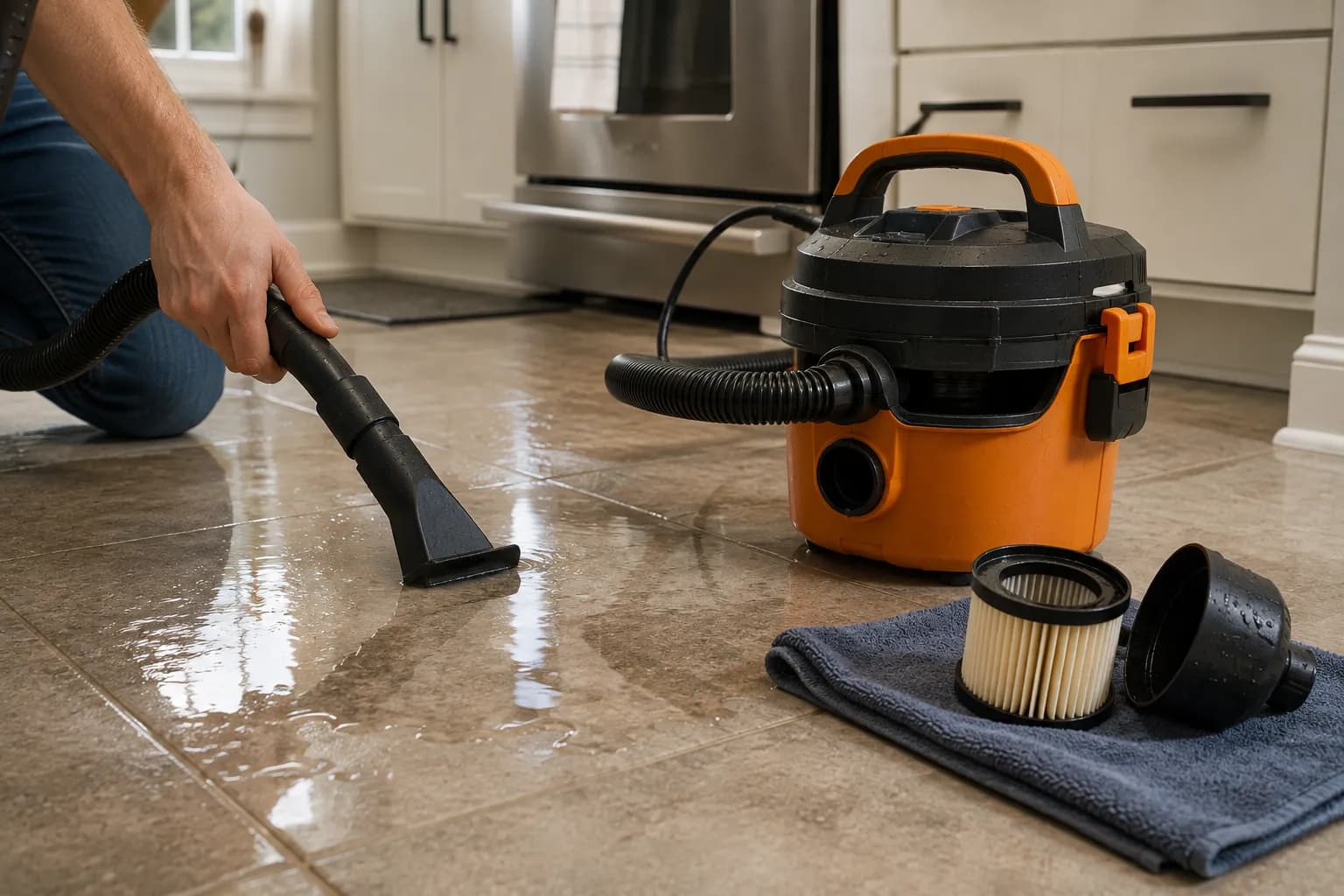
Yes, but only after you set it up for wet pickup first. Remove or swap to the correct filter before you touch water, because running a paper dry filter through liquid can ruin it and stress the motor, a point the BLACK+DECKER wet/dry manual covers in its filter and safety instructions.
The tank limit is the real constraint. A one-gallon micro handles a soda spill fine, but it fills almost instantly on a real flood, so size up for standing water.
There are dozens more tasks these machines handle, each with the right filter, and we map them in dozens more jobs.
If you are brand new to operating one, our step-by-step operating guide covers setup and safety.
You can also learn exactly when to swap to the right filter before any wet work.
Frequently Asked Questions
Are mini shop vacs worth it?
Mini shop vacs are worth it for a specific job: quick, contained cleanups in cars, apartments, and tight spaces. After weeks with every tier on the bench, the one I kept reaching for was a handheld one point five to two gallon unit, because it carried like a micro but finished a job like a bigger vac. They are not worth it as your only vacuum if you regularly clean large or heavy debris.
Is a small shop vac powerful enough?
For everyday spills, car interiors, and light workshop dust, yes. My measured airflow on good one-gallon units ran 61 to 68 CFM, which cleared sawdust and soda spills without a struggle. Power only becomes a problem on gravel, bark, or standing water, where a compact three-to-five-gallon vac earns its extra bulk.
Cordless versus corded small shop vac?
Cordless wins for quick grab-and-go jobs and cars with no nearby outlet, while corded wins on sustained runtime and lower upfront cost. The catch with cordless is that batteries are brand-locked and often sold separately, so a cordless compact only makes sense if you already own that brand’s packs.
Is the “world’s smallest shop vac” a real vacuum?
No. The product sold as the world’s smallest shop vac is a four-inch USB desktop toy in the Toys and Games category, not a working wet/dry vacuum. It clears desk crumbs at best, so for any real cleaning start at the genuine one-gallon floor instead.
Final Buying Advice
The whole decision comes down to right-sizing. A small shop vac trades tank and suction for portability, so buy the smallest tier that still finishes your real job, and skip the four-inch USB toy entirely.
If you clean cars and apartment spills, buy a handheld one to two point five gallon unit. If you do regular workshop or drywall work, step up to a four-gallon compact. If you only ever tackle desk crumbs and keyboards, a micro is plenty, and if your jobs are big and frequent, do not go small at all.
Two last pointers before you buy. If you need real capacity instead of portability, our heavy-duty guide covers the big tanks.
And if apartment noise worries you, these quiet picks will help you clean without waking the neighbors.
Whatever you choose, let the job set the size. The right small shop vac is simply the smallest one that still clears your real mess.
Read it your way
Short on time? Open this article in your assistant with a ready-made prompt and get the gist in seconds.
Found this useful? Make us a preferred source so we show up in your Google results.
Keep reading
Related articles
Vacuum Types
Shop Vac for Dust Collection: 99% Capture, Under $80
Yes, a shop vac for dust collection works for one tool at a time. Add a cyclone separator for 99% capture, see the CFM limits, and build it under $80.
Vacuum Types
Can You Use a Shop Vac as a Regular Vacuum? 4 Uses Tested
Yes: can you use a shop vac as a regular vacuum? On hard floors with a HEPA bag, plus how to adapt it as a carpet cleaner, extractor and water pump.
Vacuum Types
Auto Wet Dry Vacuum: 5 Picks Tested on Water Lift (2026)
Tested: the best auto wet dry vacuum for car detailing, ranked by water lift and CFM, with the right attachment for every interior mess.
Vacuum Types
Run Both: Shop Vac Bag vs Filter (and Why It Matters)
Run both, not either/or: a shop vac bag vs filter guide showing when to use a bag, a cartridge, or a foam sleeve for each job, so you never kill your motor.
The discussion
Comments
Every comment is reviewed before it goes live.