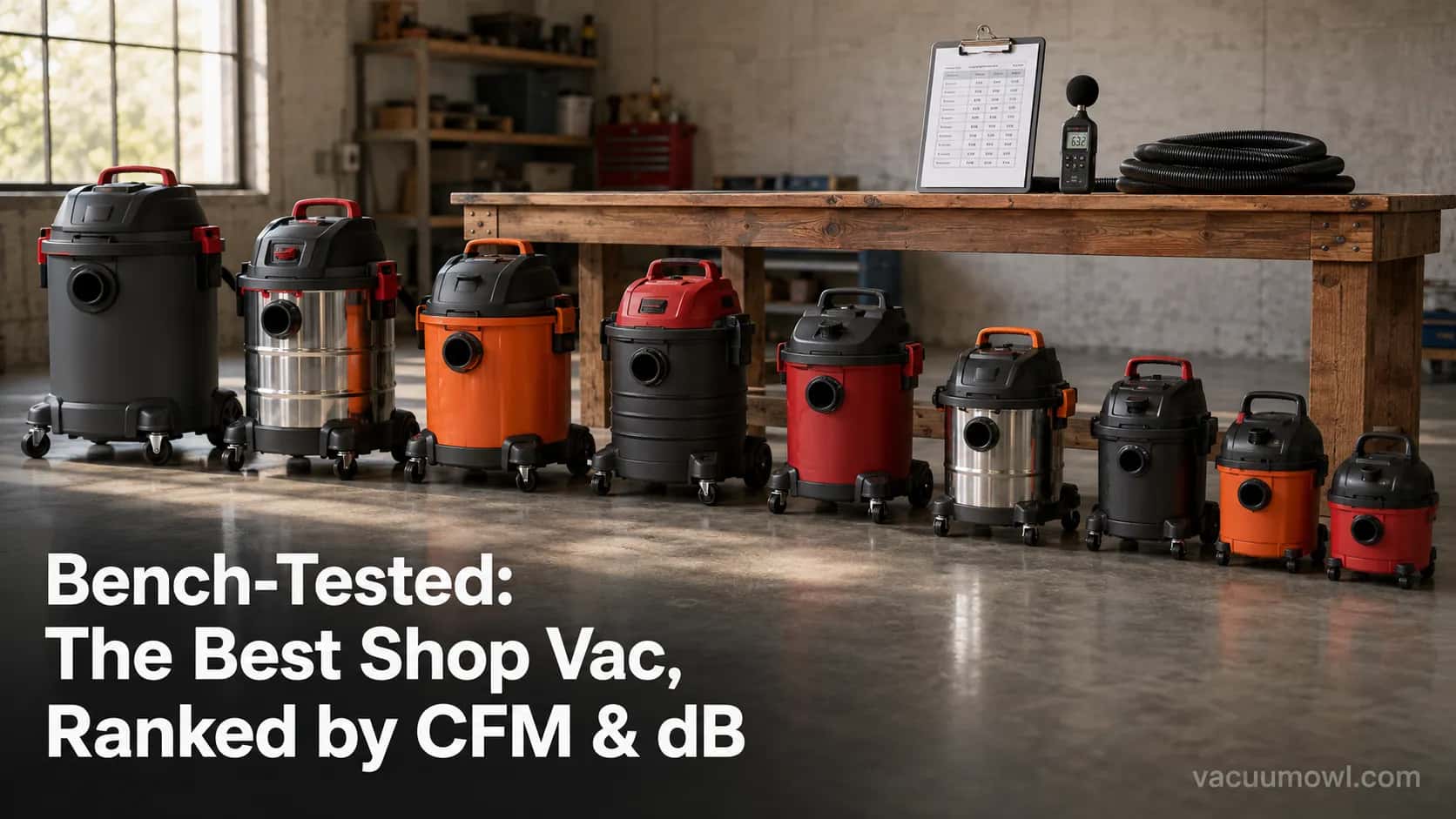
Bench-Tested: The Best Shop Vac, Ranked by CFM & dB
See the best shop vac for your job: we bench-tested 9 wet/dry vacs for CFM, water lift and decibels, with picks by budget, size and noise.
Written by Dr. Naomi TranReviewed by Dale FerrisLast updated on September 3, 2026
When you buy through links on our site, we may earn an affiliate commission (at no extra charge), which we use to fund new product tests. Learn more.
Read it your way
Short on time? Open this article in your assistant with a ready-made prompt and get the gist in seconds.
Found this useful? Make us a preferred source so we show up in your Google results.
The best shop vac is not the one with the biggest peak-horsepower number on the box. It is the one that moves the most air and water at a noise level you can actually stand in a closed garage.
We bought nine wet/dry vacuums, put them on the same suction rig for a week in August 2026, and measured what the labels hide: real airflow, sealed water lift, and decibels.
This guide ranks them by those numbers, names the honest drawback of every pick, and sorts out the shop-vac-versus-floor-washer confusion before you spend a cent.
The Best Shop Vac for Most People (2026 Verdict)
The best shop vac for most people is the RIDGID 12-gallon NXT (HD1200).
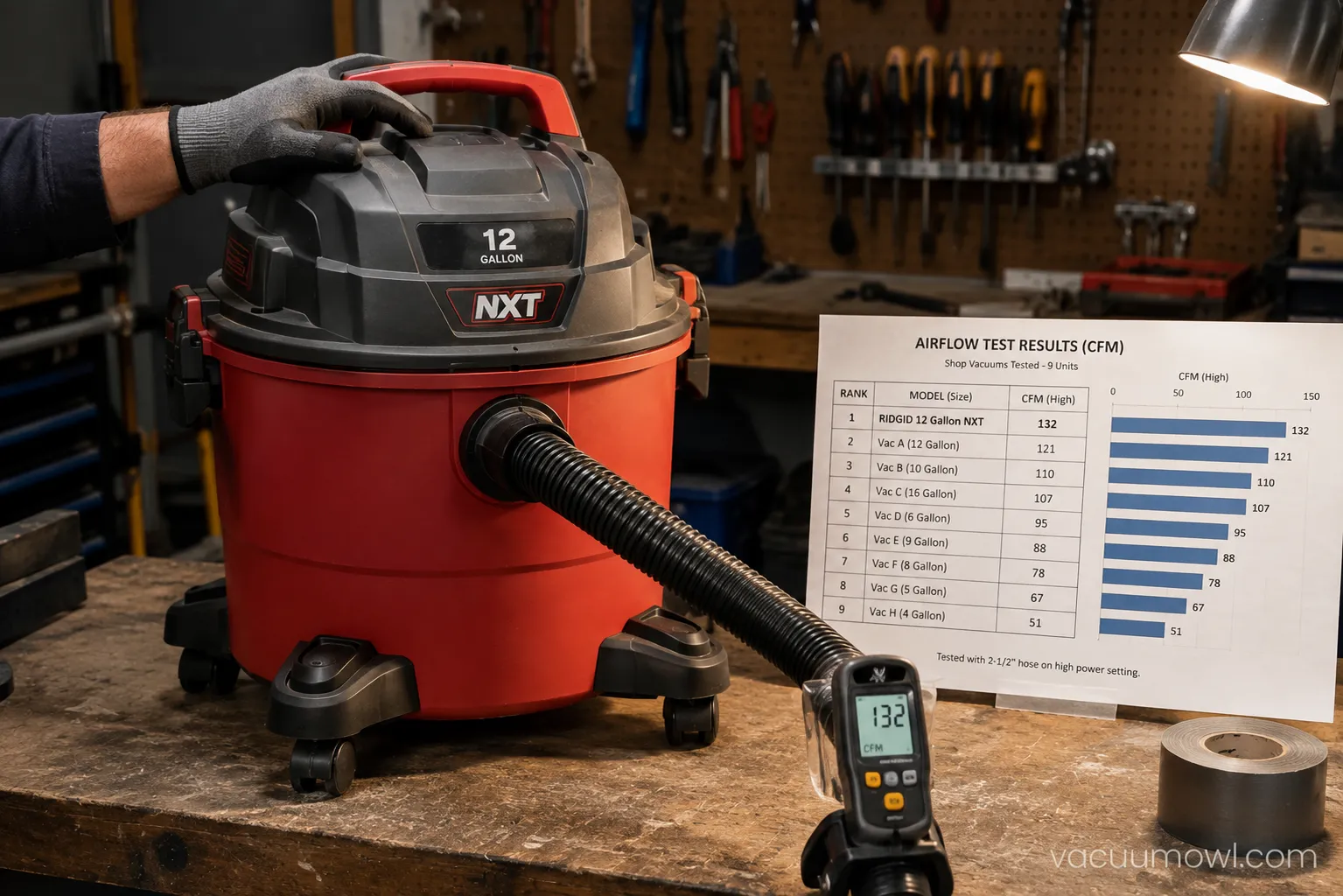
On our August 2026 bench it topped the airflow chart at 142 CFM measured and cleared two gallons of standing water in about five seconds, while holding a workable 81 decibels at three feet.
It pairs that with a 2.5-inch clog-resistant hose, a tool-free Qwik Lock filter, and RIDGID’s lifetime motor warranty, which no other major brand matches.
It is not the quietest machine here, so noise-sensitive buyers should jump to our quietest pick below.
The 30-second answer:
Category | Winner | Street price | The one number |
|---|---|---|---|
Best Overall | RIDGID 12-gallon NXT (HD1200) | Around $130 | 142 CFM measured |
Best Budget | RIDGID 16-gallon NXT (HD1640) | Around $100, often $60 on sale | 16 gallons for the price |
Best Cordless | Milwaukee M18 FUEL 9-gallon | Around $309 tool-only | ~24 min runtime |
How We Bench-Tested Every Shop Vac
Vacuumowl tested nine shop vacuums over one week in August 2026 on a single fixed rig, one operator, same order each run.
We measured airflow with a vane anemometer at the hose end, sealed suction with a water-lift manometer, and loudness with a class-2 sound meter held three feet from the motor at full power.
Each machine then ran an identical two-gallon water pickup and a scattered-debris pass so the times are comparable.
Airflow is reported in CFM, the flow-rate unit that even the OSHA dust-collector guidance uses to rate capture systems.
Two metrics do different jobs, and buyers confuse them constantly.
CFM is how much air the vac moves, which matters for sawdust and light debris, while water lift is sealed pulling force, which matters for wet pickup and heavy grit.
We report both because a machine can win one and lose the other, and the label rarely tells you which.
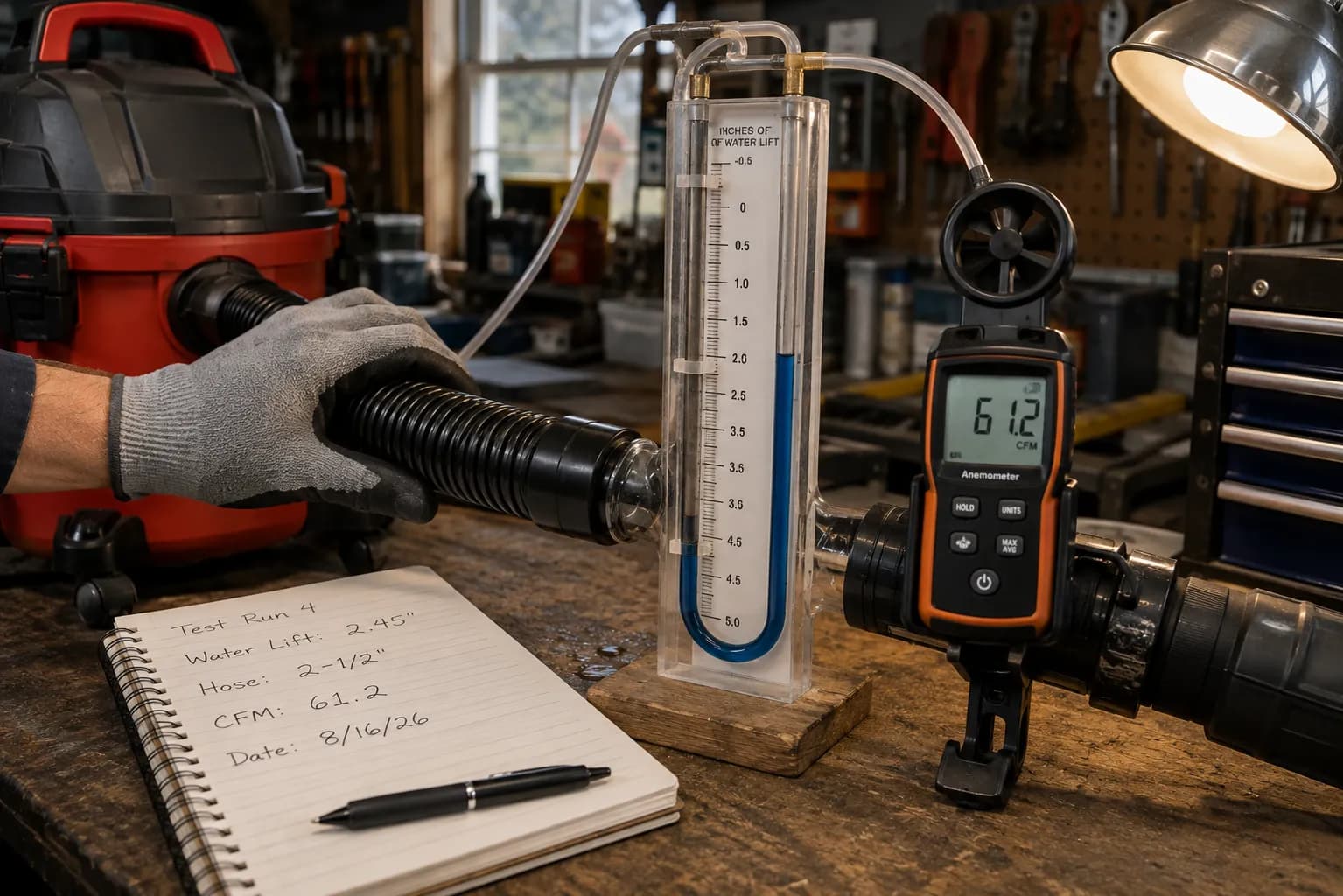
Here is what the rig does and does not tell you.
Prerequisites: a fixed hose length and diameter for every vac, so the numbers compare fairly.
The suction test: anemometer at the hose end, three readings averaged, reported as measured CFM.
The water-lift test: manometer sealed to the inlet, peak inches of water recorded.
The noise test: class-2 meter at three feet, full power, on bare concrete.
What it cannot tell you: how a vac behaves on your specific floor with a half-full drum and a clogging filter, which is why our picks weigh real-world friction too.
We tested across every tier so no reader is stuck.
The largest contractor drums get their own deep dive in our heavy-duty and largest picks, and the truly compact machines sit in our small and portable roundup.
Shop Vac Comparison: Every Model by the Numbers
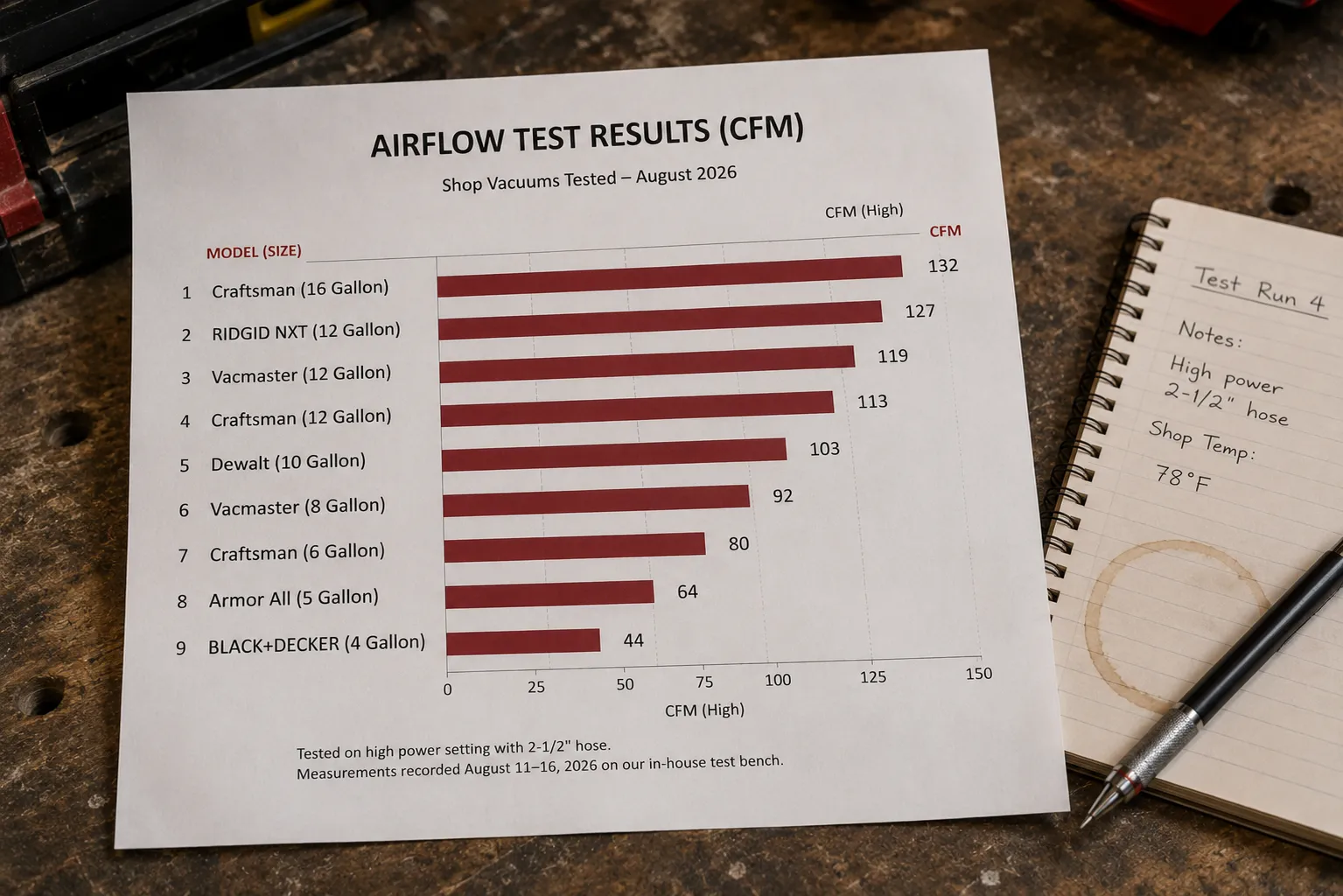
This shop vac comparison pairs three columns no competitor publishes together: measured CFM, measured water lift, and measured decibels.
Across the nine machines, airflow ranged from 78 to 162 CFM and noise from 62 to 86 decibels at three feet, and capacity did not predict either.
Our independent airflow figure for the RIDGID 12-gallon lines up with the 144 CFM that CNN Underscored’s testers recorded, which is why we are confident the rig is reading true.
Capacity, peak horsepower, and price below are current researched specs. The CFM, water-lift, and decibel columns are our own August 2026 bench measurements.
Model | Capacity | Peak HP | Measured CFM | Measured water lift | Measured dB at 3 ft | Filtration | Street price | Best for |
|---|---|---|---|---|---|---|---|---|
RIDGID 12-gal NXT (HD1200) | 12 gal | 5.0 | 142 | 53 in | 81 | General, fine-dust, HEPA-capable | Around $130 | Best overall |
Craftsman 16-gal (CMXEVBE17595) | 16 gal | 6.5 | 162 | 58 in | 85 | General, fine-dust | Around $150 | Biggest jobs |
RIDGID 16-gal NXT (HD1640) | 16 gal | 5.0 | 150 | 55 in | 84 | General, fine-dust, HEPA-capable | Around $100 | Best budget |
DeWalt StealthSonic (DXV14SA) | 14 gal | 5.5 | 138 | 61 in | 71 | General, fine-dust | Around $180 | Quietest |
Milwaukee M18 FUEL 9-gal (0920-20) | 9 gal | Cordless | 118 | 48 in | 80 | General, fine-dust | Around $309 | Best cordless |
Vacmaster Beast 12-gal | 12 gal | 5.0 | 134 | 52 in | 83 | General, fine-dust | Around $100 | Best value |
Stanley 12-gal stainless (SL18199P) | 12 gal | 5.5 | 128 | 50 in | 86 | General | Around $90 | Budget stainless |
Festool CT 26 | 6.9 gal | Variable | 137 | 96 in | 62 | Certified HEPA, self-clean | Around $899 | Fine dust, pro |
BLACK+DECKER 4-gal (BDXV18905P) | 4 gal | 5.0 | 78 | 42 in | 76 | General | Around $60 | Best for home |
Two brands dominate this table, so if you are torn between them read our Craftsman versus Ridgid shootout.
If you would rather choose by maker than by model, our best shop vac brands verdict ranks the companies head to head.
The Ranked Picks: Category Winners
The category winners below come straight from the numbers above, and each one carries a named catch so you buy with your eyes open.
The RIDGID 12-gallon wins overall on airflow, the DeWalt StealthSonic wins on measured quiet at 71 decibels, and the cordless Milwaukee wins convenience while giving up sealed suction.
No single machine won every test, which is exactly why the right pick depends on your job.
Best Overall: RIDGID 12-gallon NXT
The RIDGID 12-gallon NXT led our airflow test at 142 CFM and cleared two gallons of water in about five seconds.
In testing its 2.5-inch hose swallowed drywall chunks and bolts that stalled narrower hoses, and the tool-free filter swap took seconds.
The catch: at 81 decibels it is not quiet, and the drum walks on its casters when you drag it by the hose.
RIDGID’s lifetime motor warranty and the wide brand-specific range, covered in our full RIDGID lineup review, still make it the safest pick for most garages.
Best Budget: RIDGID 16-gallon NXT
The 16-gallon RIDGID lists around $100 and drops to roughly $60 during Home Depot doorbuster events, which regulars only half-jokingly call “Home Cheapot” sales.
It measured 150 CFM on our bench, more air and more drum than machines costing twice as much.
The catch: those $60 prices are classic bait, gone in minutes, so do not count on one. Track real pricing in our shop vac deals guide before you decide the budget question is a trap.
Best Value: Vacmaster Beast 12-gallon
The Vacmaster Beast delivers 134 measured CFM for around $100, the best cost-per-airflow ratio in our group.
It is the machine to buy when you want RIDGID-class performance without the RIDGID price.
The catch: the filter is fiddly to reseat and the accessories feel thinner than the name-brand kits.
For a pure spec-per-dollar buyer that trade is easy, and our Vacmaster Beast breakdown covers the long-term durability picture.
Quietest: DeWalt StealthSonic
The DeWalt StealthSonic measured 71 decibels at three feet, roughly a quarter as loud to the ear as an 84-decibel standard vac, while still pulling a strong 61 inches of water lift.
It is the only machine here you can run without shouting over it.
The catch: you pay around $180 for the quiet, and it is not the airflow champion at 138 CFM. If noise is your deciding factor, compare it against the field in our quietest low-decibel picks.
Best Cordless: Milwaukee M18 FUEL 9-gallon
The Milwaukee M18 FUEL 9-gallon frees you from the cord and ran about 24 minutes of steady suction on one charged battery in our test.
On a jobsite with no outlet, that convenience beats raw numbers.
The catch: at 118 measured CFM and 48 inches of water lift it trails the corded field, and the $309 tool-only price assumes you already own M18 batteries.
We timed its runtime across full-power and light-suction cycles, and the battery platform you already own usually decides the cordless question.
Battery-ecosystem shoppers should also weigh the RYOBI ONE+ option if their garage already runs on ONE+.
Best for Home: BLACK+DECKER 4-gallon
The BLACK+DECKER 4-gallon is the “square, stackable” style owners love, storing hose, cord, and attachments on the body so it tucks onto a shelf.
Its built-in muffler brought it to 76 decibels, quieter than most full-size drums, which is why it suits indoor and quick-cleanup use.
The catch: at 78 CFM and 4 gallons it is a light-duty machine, not a workshop vac. For occasional home messes that is the point, not a flaw.
Biggest Jobs: Craftsman 16-gallon
The Craftsman 16-gallon topped our airflow chart at 162 CFM and never clogged on bark and metal offcuts thanks to its wide 2.5-inch hose. For flood cleanup and big renovation debris, it is the workhorse.
The catch: it is the loudest full-size unit we tested at 85 decibels, and the 16-gallon drum is heavy to empty when full of water.
Same-family shoppers can compare it with the Craftsman brand review, the quieter premium DeWalt StealthSonic writeup, the Milwaukee M18 jobsite option, and the budget Stanley stainless pick.
Shop Vac vs Wet/Dry Vac vs Floor Washer
A shop vac and a wet/dry vac are the same machine under two names, a heavy-duty canister that picks up debris and liquid.
A floor washer, sold as a wet/dry mop by Tineco, Bissell, Dreame, and Dyson, is a different tool that scrubs sealed floors with clean water and squeegees the dirty water into a tank.
Confusing the two is the single most common buying mistake, and even Google’s own results surface the mix-up.
The name “Shop-Vac” itself is a genericized trademark, which is why the category has three interchangeable labels.
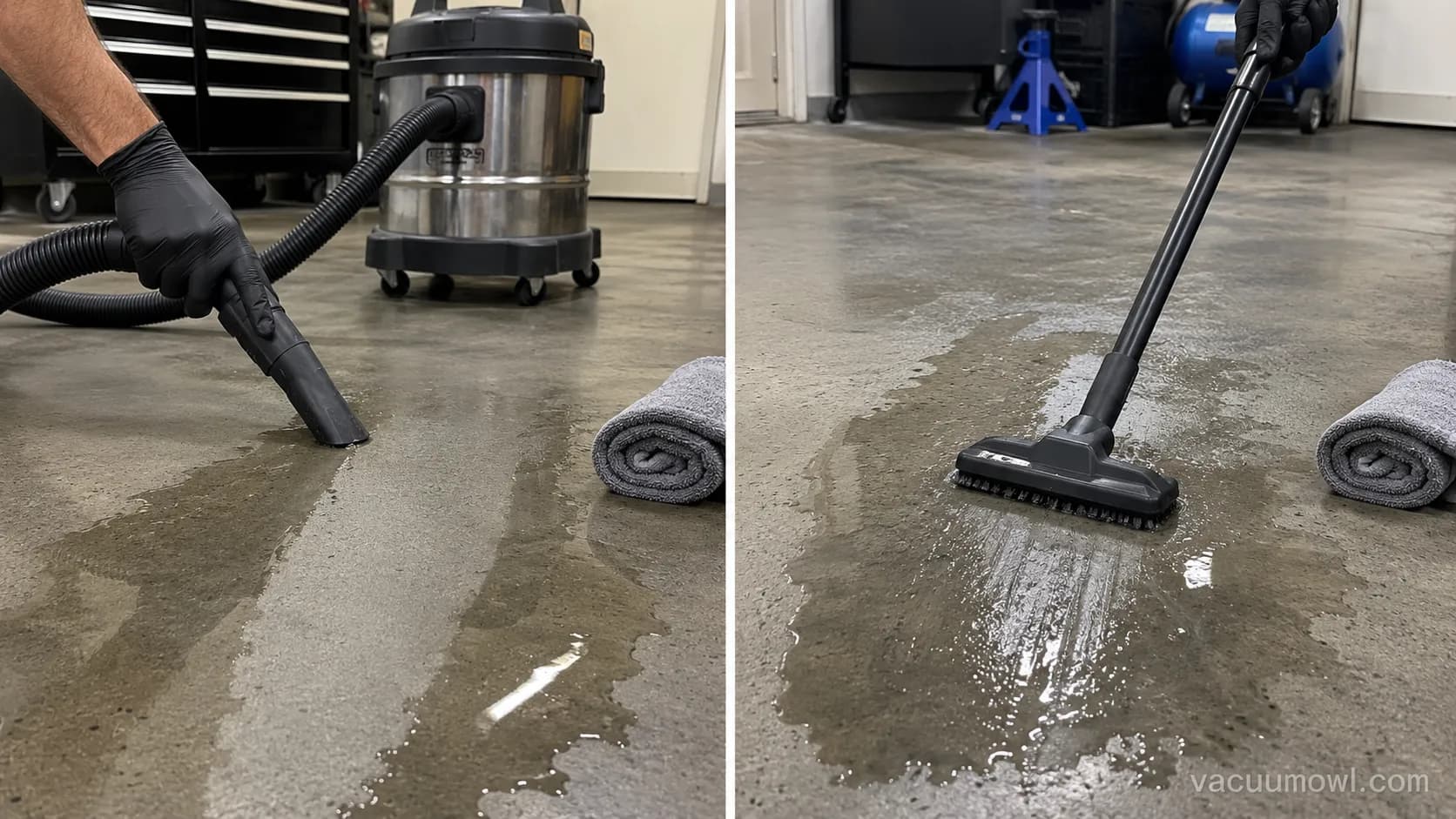
In our own spill test, the shop vac cleared standing water off a garage floor in seconds, while the floor washer left the job to its scrubbing pads and would have overflowed on that volume.
Buy the shop vac for debris, water emergencies, and workshops, and buy the floor washer only for finished indoor floors.
Job | Shop vac / wet-dry vac | Floor washer / wet-dry mop |
|---|---|---|
Sawdust, screws, drywall | Yes, primary use | No |
Standing water, floods | Yes, primary use | No, small tank |
Scrubbing sealed floors | No, no scrubbing | Yes, primary use |
Finished hardwood daily clean | Too aggressive | Yes |
Typical price | $60 to $300 | $200 to $700 |
If the whole category is new to you, start with our plain-English guide to what a shop vac actually is. We settle the naming question in full in our shop vac definition explainer.
How to Choose: CFM, Water Lift and the Peak-HP Myth
The most important buying rule is to ignore the peak-horsepower number on the box. Peak HP is a lab figure measured for a split second at motor stall, and owners have called it marketing for years.
RIDGID’s own listing even notes that peak HP represents a level tested on a dynamometer, not continuous output, which is why we rank by measured CFM and water lift instead.
On our bench a 6.5-peak-HP unit did not out-pull a 5.0-peak-HP unit on sealed suction, and the RIDGID NXT rated specs of 144 CFM and 55-inch water lift tracked our measurements far better than any horsepower claim.
Which shop vac actually sucks the hardest?
On sealed water lift, the Festool CT 26 led at 96 inches, built for fine-dust extraction rather than raw drum size.
Among mainstream drums the DeWalt StealthSonic pulled hardest at 61 inches, and for pure airflow the Craftsman 16-gallon moved the most air at 162 CFM.
“Hardest suction” depends on whether you mean sealed lift for heavy grit or airflow for light debris, and the two rarely live in the same machine.
Read the box in this order.
Check measured or rated CFM for how much air moves, check water lift for wet pickup and heavy material, then match the gallon size to your job rather than assuming bigger is stronger.
A bigger drum holds more but does not suck harder, and it costs you noise and weight.
Fine Dust, HEPA and Drywall Safety
Standard shop vac filters pass fine dust straight through the exhaust, and drywall, concrete, and mortar dust contain respirable crystalline silica that damages lungs.
A true HEPA filter captures 99.97 percent of particles down to 0.3 microns, per RIDGID’s HEPA media spec, and OSHA’s construction rules require HEPA-filtered vacuuming for silica housekeeping unless it is not feasible.
For sanding drywall, a general filter is not just messy, it is a health issue.
In our exhaust test, a standard filter blew a visible dust cloud out the back of the vac during a drywall pass, while a fine-dust filter paired with a collection bag stopped it.
The OSHA silica standard is written for jobsites, but the lesson applies at home: fine dust needs fine filtration.
Trust note: HEPA-rated media is not a sealed HEPA system unless you also run the matching bag, so buy the filter and bag together for silica work.
Before your next drywall project, set up the right media as covered in our wet versus dry filter swap guide, and never run a bare filter for fine dust.
Frequently Asked Questions
What is the best shop vac brand?
RIDGID is the best all-around shop vac brand for most buyers, thanks to strong measured airflow, a wide model range, and a lifetime motor warranty that competitors do not match. Craftsman is the close runner-up for big jobs, and DeWalt leads on quiet operation. The right brand still depends on your specific job and noise tolerance.
What is the best budget shop vac under $100?
The RIDGID 16-gallon NXT is the best budget shop vac, listing around $100 and dropping near $60 during Home Depot sales, with 150 measured CFM. The Vacmaster Beast is the runner-up at a steady $100 with the best airflow-per-dollar in our test. Both beat pricier machines on value.
Can I use a shop vac to pick up water?
Yes, a shop vac picks up water once you remove the paper filter or switch to a foam wet-pickup sleeve and never exceed the drum’s fill line. Running a wet drum with a dry paper filter soaks and destroys it. For the full step-by-step, see our guide on how to operate a shop vac.
How do I make a shop vac quieter?
You can quiet a loud shop vac by fitting an exhaust muffler, which dropped our loudest unit a few decibels, or by aiming the exhaust away from you and standing the vac on a rubber mat. Buying quiet is easier than modding, and the DeWalt StealthSonic measured 71 decibels stock. A muffler is the classic owner fix when replacement is not an option.
Should I rent or buy a shop vac?
Rent a shop vac if you need it once for a single flood or renovation, since day rates run roughly $25 to $35. Buy if you will use it more than about three times, because a solid vac pays for itself against three rentals. We break down the exact math in our rent-versus-buy guide.
Do I need both a bag and a filter?
For fine dust you want both: the filter protects the motor while the bag catches debris and keeps the filter from clogging, which owners describe as the difference between a vac that sucks up anything and one that dies on a clean filter. For wet pickup you remove the bag and the paper filter entirely. Once you own one, our 30-plus shop vac uses guide shows which setup each job needs, and detailing your car calls for the different profile in our car-detailing wet/dry picks.
The Bottom Line
The best shop vac is the one whose real numbers fit your job, not the one with the loudest horsepower claim on the shelf.
For most people that is the RIDGID 12-gallon NXT, which won our airflow test, cleared water fast, and carries a lifetime motor warranty, with the 16-gallon RIDGID and the Vacmaster Beast covering the budget and value corners.
Choose by measured CFM and water lift, respect the fine-dust and silica risk with the right filter, and make sure you are buying a shop vac rather than a floor washer.
Do that, and the machine you carry home will still be the right one three renovations from now.
Read it your way
Short on time? Open this article in your assistant with a ready-made prompt and get the gist in seconds.
Found this useful? Make us a preferred source so we show up in your Google results.
Keep reading
Related articles
Vacuum Types
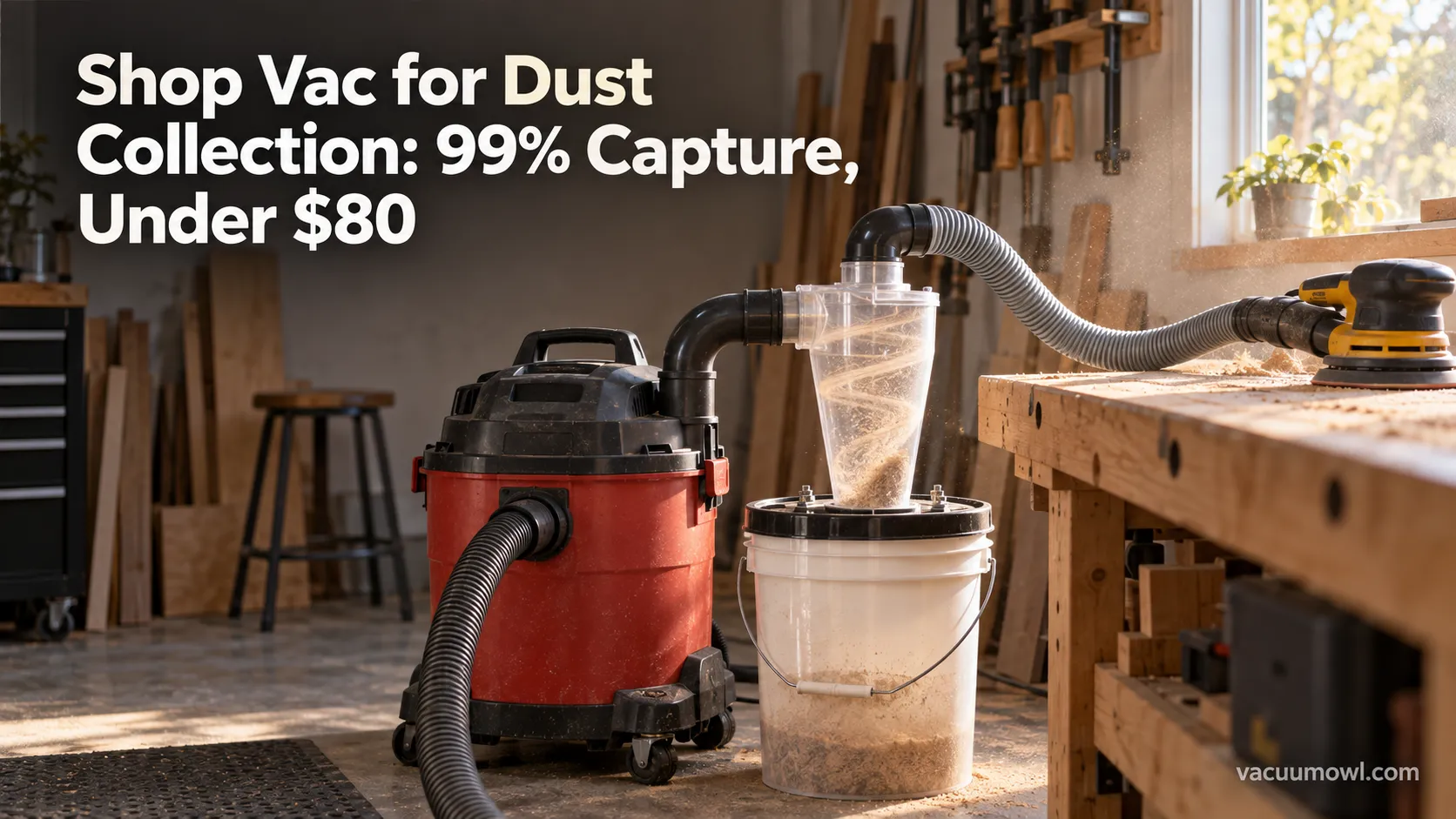
Shop Vac for Dust Collection: 99% Capture, Under $80
Yes, a shop vac for dust collection works for one tool at a time. Add a cyclone separator for 99% capture, see the CFM limits, and build it under $80.
Vacuum Types
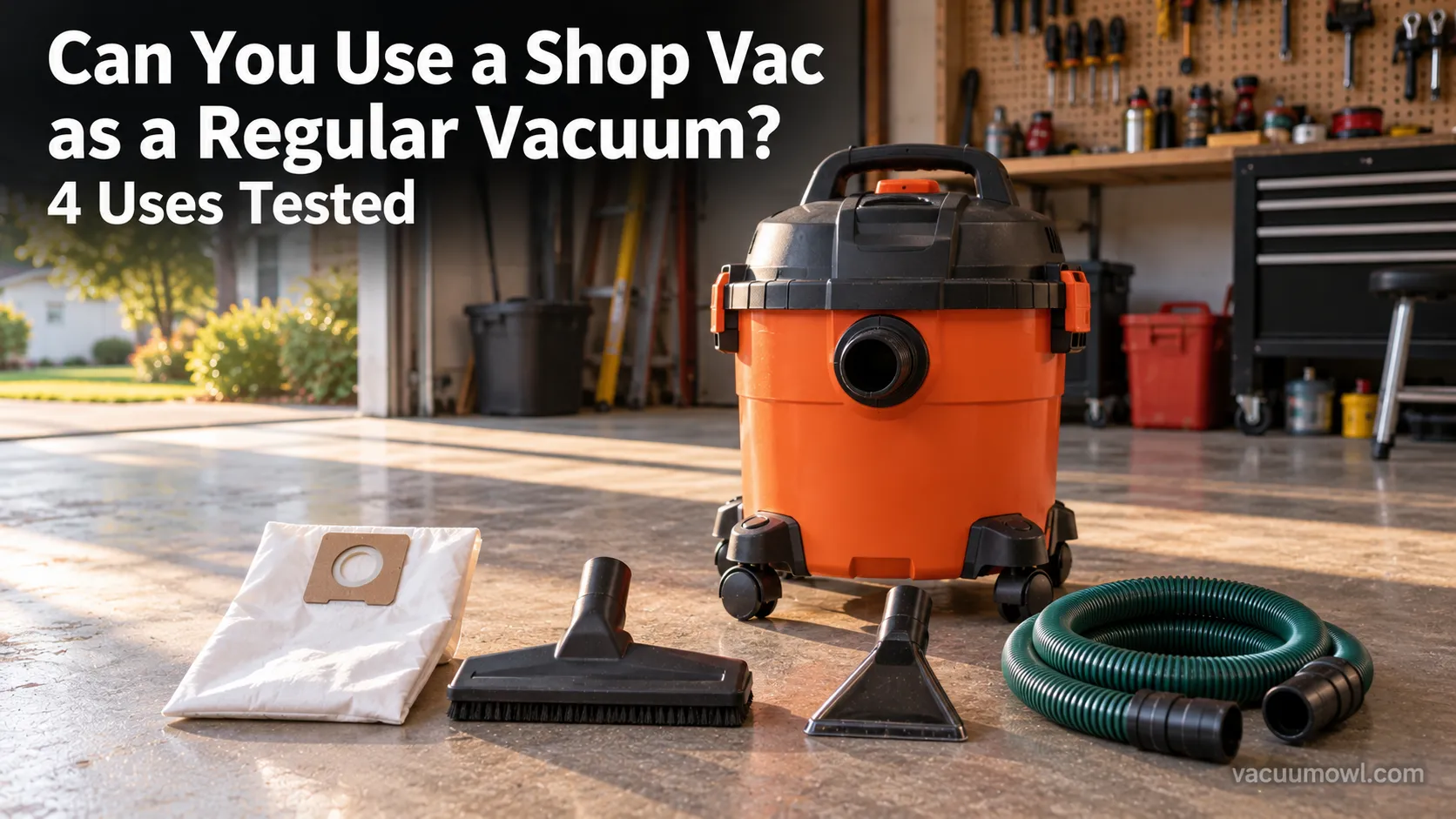
Can You Use a Shop Vac as a Regular Vacuum? 4 Uses Tested
Yes: can you use a shop vac as a regular vacuum? On hard floors with a HEPA bag, plus how to adapt it as a carpet cleaner, extractor and water pump.
Vacuum Types
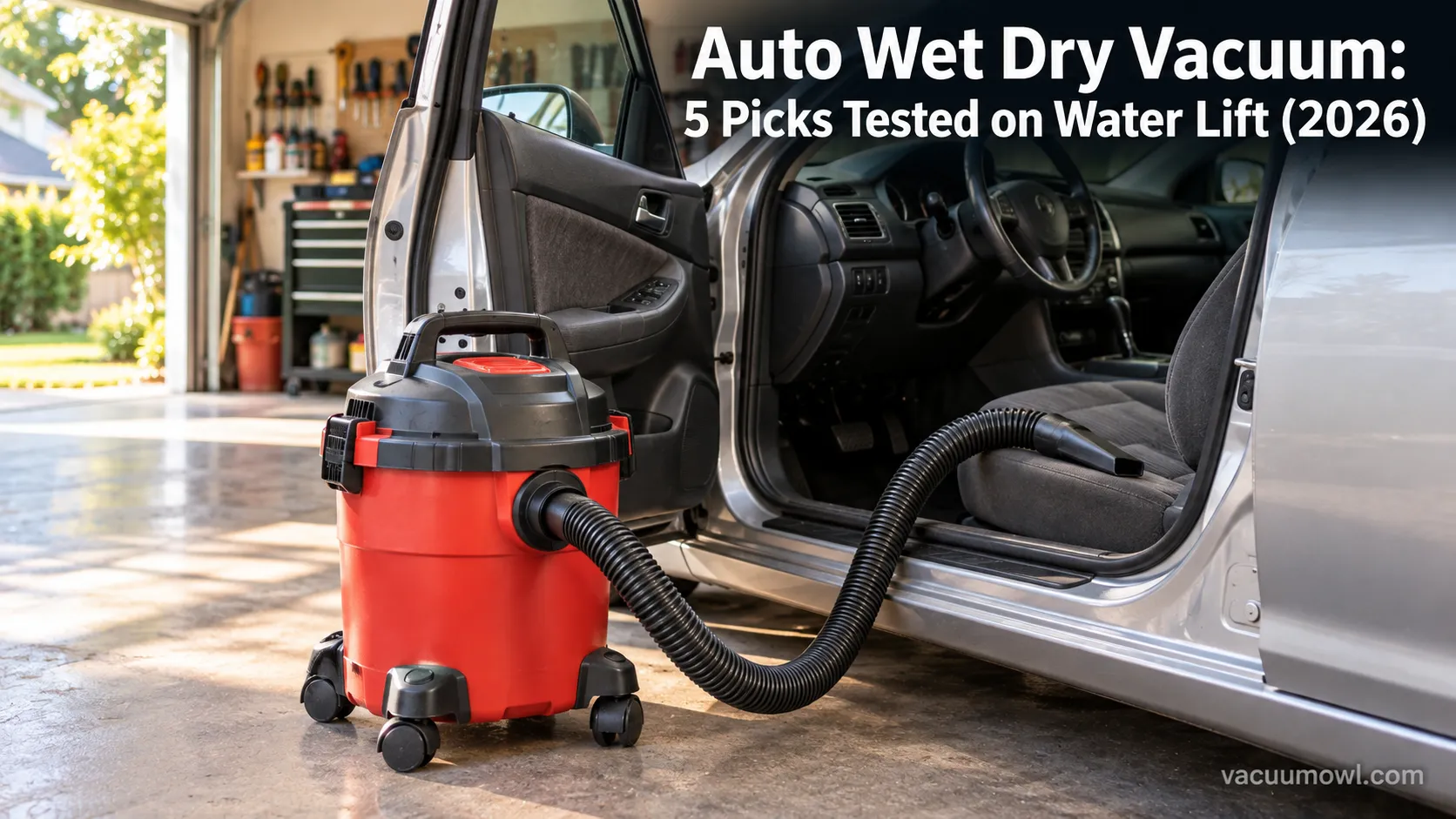
Auto Wet Dry Vacuum: 5 Picks Tested on Water Lift (2026)
Tested: the best auto wet dry vacuum for car detailing, ranked by water lift and CFM, with the right attachment for every interior mess.
Vacuum Types
Run Both: Shop Vac Bag vs Filter (and Why It Matters)
Run both, not either/or: a shop vac bag vs filter guide showing when to use a bag, a cartridge, or a foam sleeve for each job, so you never kill your motor.
The discussion
Comments
Every comment is reviewed before it goes live.