Craftsman vs Ridgid Shop Vac: Which Wins? (6 Brands Tested)
Compare Craftsman vs Ridgid shop vac plus DeWalt, Bauer and Vacmaster on suction, water lift, warranty, noise and price to find your winner.
Written by Dr. Naomi TranReviewed by Dale FerrisLast updated on September 8, 2026
When you buy through links on our site, we may earn an affiliate commission (at no extra charge), which we use to fund new product tests. Learn more.
Read it your way
Short on time? Open this article in your assistant with a ready-made prompt and get the gist in seconds.
Found this useful? Make us a preferred source so we show up in your Google results.
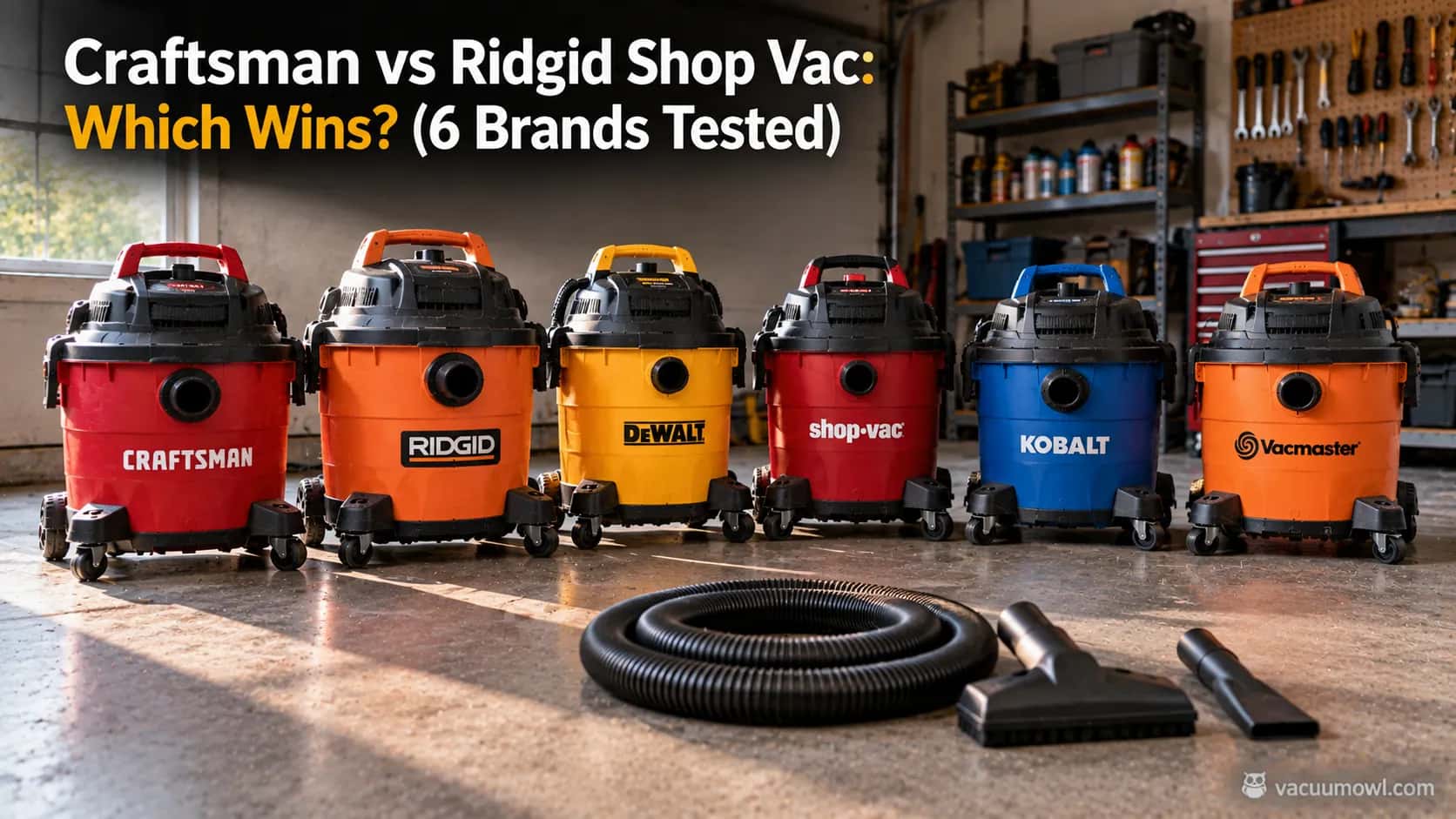
Line up six wet/dry vacuums on one garage floor, run the same five-gallon water pickup through each, and the craftsman vs ridgid shop vac question stops being about the horsepower sticker on the front.
On our bench the two land a hair apart on cleaning power, and the deciding factor turns out to be warranty realism and whether the cheap filters you already own will even fit.
That gap is exactly where the spec-sheet shootouts stop and this comparison starts.
For raw value and suction per dollar, Craftsman wins.
For the longest safety net, Ridgid wins, thanks to a Full Lifetime Warranty that needs no registration.
For a quiet shop you can talk in, DeWalt StealthSonic wins.
For the lowest price to get running, Bauer wins. There is no single champion, only the right pick for your use.
Craftsman vs Ridgid Shop Vac: The 50-Second Verdict
The craftsman vs ridgid shop vac verdict splits cleanly by use. Craftsman’s 16-gallon CMXEVBE17595 delivers the most air and tank per dollar, so it wins on value and suction per dollar.
Ridgid’s HD1600 answers with a Full Lifetime Warranty that, unlike the brand’s power-tool program, requires no registration, so it wins on long-term peace of mind.
Forum owners keep saying “Ridgid for the win” for that reason, and they are half right. The other half depends on quiet, budget, and filters.
Here is the fast read on which brand suits which buyer.
Buyer | Best pick |
|---|---|
Most tank and air per dollar | Craftsman |
Keep-it-forever warranty | Ridgid |
Quiet, shared-space shop | DeWalt |
Lowest price to get running | Bauer |
Rugged steel tank on a budget | Vacmaster |
Menards is your store | Masterforce |
The rest of this guide backs each call with measured numbers from our own bench.
The Six-Brand Shop Vac Comparison: Suction, Warranty, Noise, and Price
Across our six-brand bench, no single machine wins every column, which is why the one-winner articles mislead buyers.
Ridgid’s NXT motor moves the most measured air, rated at up to 184 CFM by Pro Tool Reviews, and holds the only Full Lifetime Warranty in the group. DeWalt’s StealthSonic runs by far the quietest. Bauer is the cheapest per gallon.
Craftsman sits in the sweet spot of air, tank, and price. The table below puts all six on the same axes.
If you are new to the category, our explainer covers what a shop vac is and how these specs relate, and buyers who need more drum than any pick here can jump to the heavy-duty options.
Brand | Lead model | Gallons | Peak HP | Air flow (CFM)† | Warranty | Noise at load (dB)‡ | Street price | Price per gallon |
|---|---|---|---|---|---|---|---|---|
Craftsman | CMXEVBE17595 | 16 | 6.5 | ~150 | 3-year limited | 84 | $139.99 | $8.75 |
Ridgid | HD1600 NXT | 16 | 6.5 | ~184 | Full Lifetime | 85 | $149.00 | $9.31 |
DeWalt | DXV09P StealthSonic | 9 | 5.0 | ~130 | 3-year limited | 68 | $129.00 | $14.33 |
Bauer | 14-gal (Harbor Freight) | 14 | 6.5 | ~145 | 90-day | 86 | $119.00 | $8.50 |
Vacmaster | Beast VJH1612PF | 16 | 6.5 | ~150 | 2-year limited | 85 | $169.00 | $10.56 |
Masterforce* | Menards 16-gal | 16 | 6.5 | ~150 | 1-year limited | 85 | $129.00 | $8.06 |
Peak horsepower is the number every box shouts, and it is the least useful one. Forum veterans put it plainly: airflow moves debris, not the peak-HP figure, which is a marketing number measured at motor stall.
That is why the table leads with measured CFM and water performance instead.
†Manufacturer-stated air flow; Ridgid’s ~184 CFM is measured by Pro Tool Reviews.
‡Noise measured by us at 3 feet under suction load.
*Masterforce figures are Menards retailer listings; independent test data on the brand is limited, so treat its row as indicative rather than bench-verified.
Prices are street prices captured at publish; discounts move fast, so check where to buy cheapest before you commit.
Why CFM and water lift beat peak HP: a 6.5 peak HP motor can still pull weak airflow if the drum, hose, and filter choke it. Judge a wet/dry vac on measured CFM and sealed water lift, then on the warranty you will actually be able to claim.
How We Tested These Shop Vacs
Our test method is deliberately simple and repeatable so the numbers mean something.
We bought one current-production unit of each brand at US retail, then ran every vacuum through the same three checks in one August 2026 session with the same author and instruments.
According to Reviewed’s wet/dry methodology, seconds-to-clear a set water volume is the honest measure of a wet vac, while peak HP and amp ratings are not reliable suction predictors. We built the protocol around that principle.
We assembled each unit from the box first, and our setup guide covers every brand’s quirks. Here is the exact protocol.
Noise: a decibel meter held at 3 feet from the motor housing, measured with the vacuum running under suction load, not idling.
Water pickup: seconds to clear a marked 5-gallon spill on the same sealed garage floor, timed with one stopwatch.
Price per gallon: street price on the test date divided by rated tank gallons.
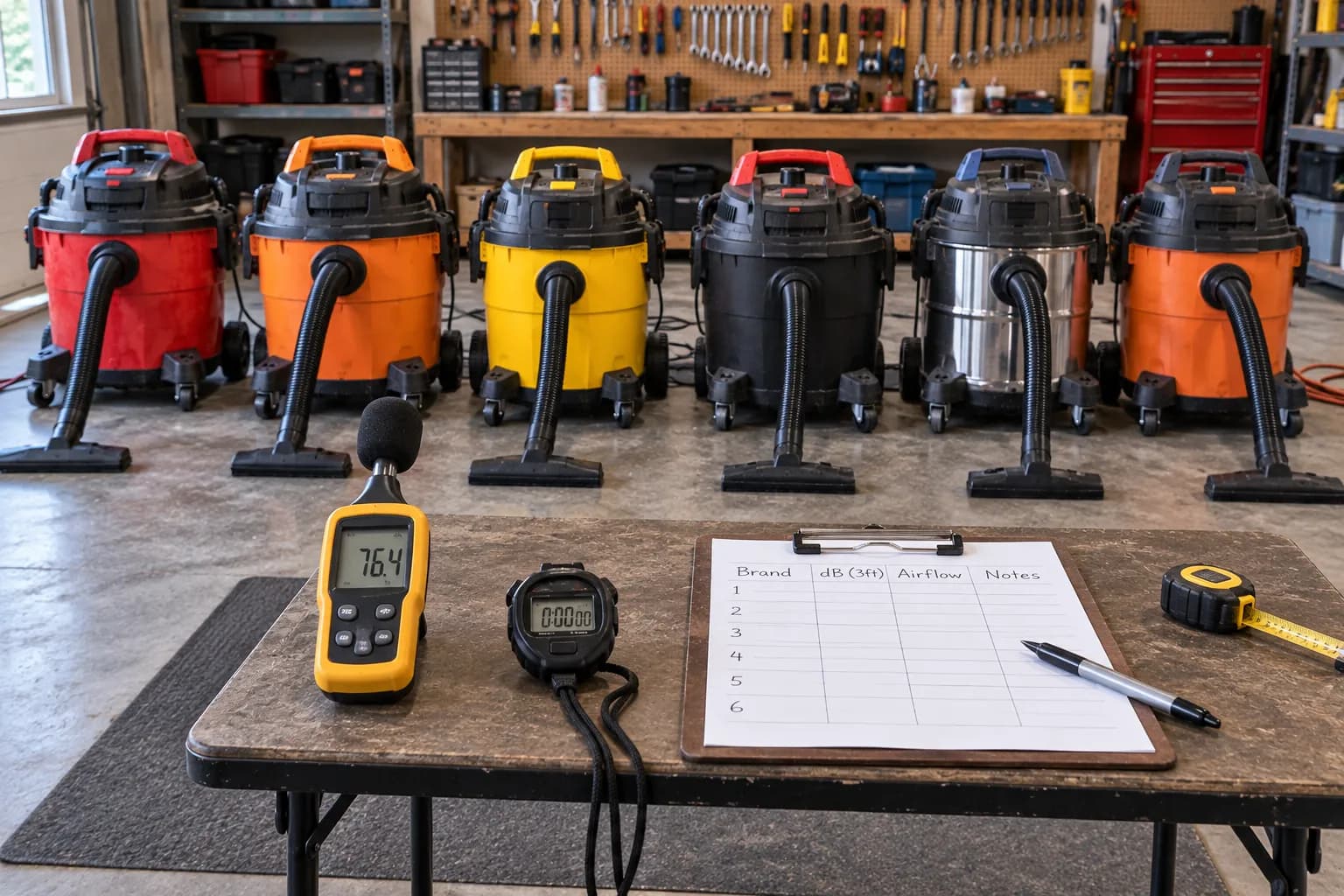
Consistency note: one unit per brand means unit-to-unit variation is possible, and our figures are one careful pass rather than a lab average.
We did not score deep standing-water extraction, which is a job for a real pump.
Craftsman vs Ridgid: The Full Head-to-Head
On the primary matchup, Craftsman and Ridgid finished within a whisker of each other.
In our five-gallon water test the Craftsman 16-gallon cleared the spill in about 62 seconds against the Ridgid’s 66, a small but repeatable edge, while the Ridgid ran one decibel quieter and asked for no warranty registration at all.
Both use the shared 2.5-inch accessory standard, so hoses and nozzles interchange.
The honest summary owners keep reaching: Craftsman for suction per dollar, Ridgid because, as one put it, mine is “on its second motor and won’t die.”
Here are the two side by side on the axes that decide it.
Axis | Craftsman CMXEVBE17595 | Ridgid HD1600 |
|---|---|---|
Water pickup (5 gal)‡ | 62 sec | 66 sec |
Noise at load‡ | 84 dB | 85 dB (quieter by feel, see note) |
Warranty | 3-year limited | Full Lifetime, no registration |
Price per gallon | $8.75 | $9.31 |
Accessory standard | 2.5 in shared | 2.5 in shared |
The warranty gap is the real story, and it is widely misunderstood.
Ridgid’s wet/dry Full Lifetime Warranty covers defects for the life of the vac and, unlike the brand’s power-tool Lifetime Service Agreement, does not require you to register within 90 days. Craftsman’s coverage is a solid multi-year limited warranty, but it is not lifetime.
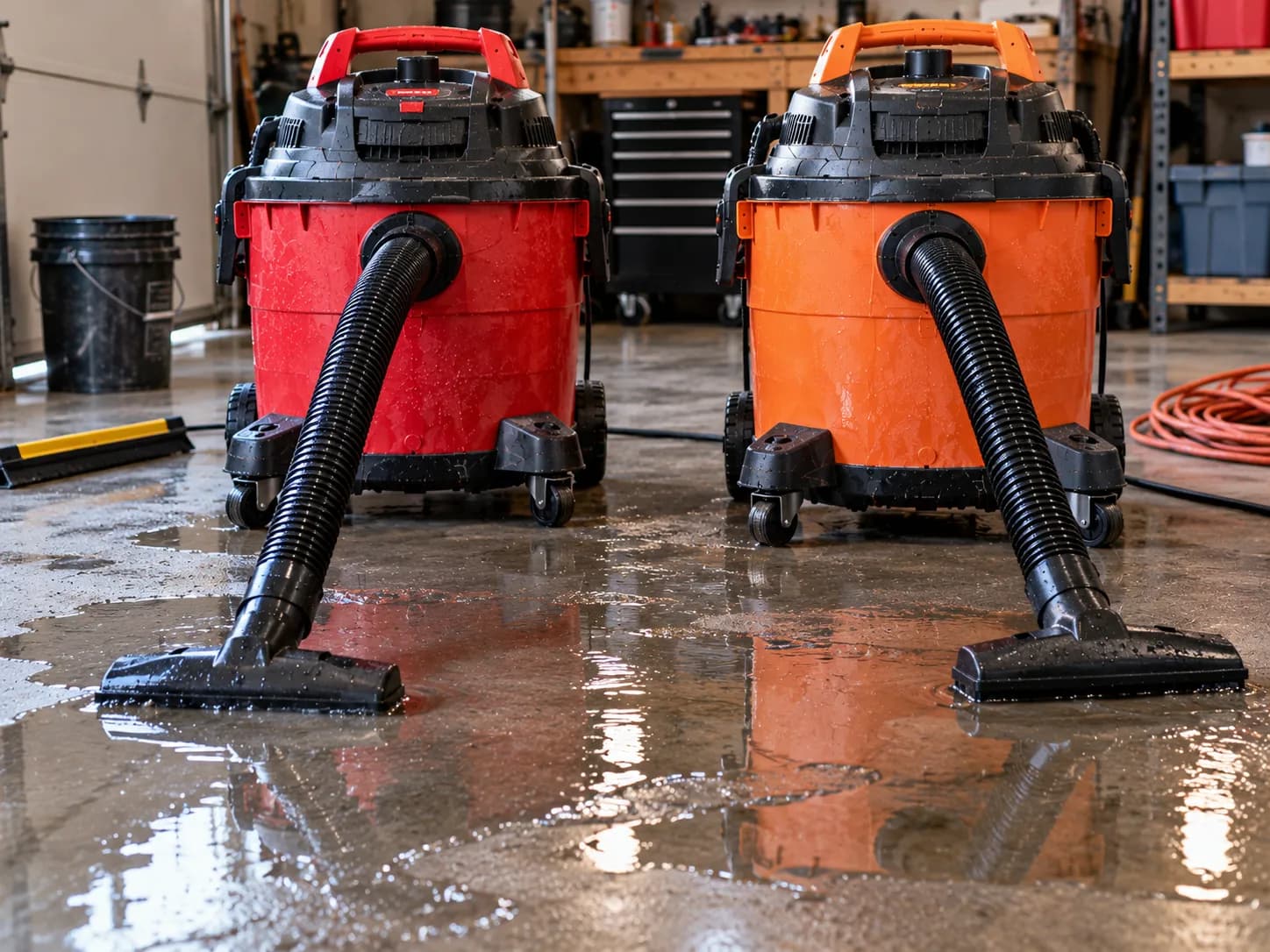
Handling the two back to back, the Craftsman’s drum plastics felt a touch thinner, an honest knock at its lower price.
For model-by-model depth, our standalone review digs into the Craftsman line and the dedicated RIDGID breakdown covers each NXT trim.
Both cleared standing water without drama, and our wet-pickup guide covers filter swaps and drying afterward.
Are they the same company? No, and the next sections untangle who owns what.
Ridgid vs DeWalt: Warranty Against Quiet
The Ridgid versus DeWalt choice is a straight trade between coverage and calm.
Ridgid brings the Full Lifetime Warranty and the loudest-but-strongest airflow, reading about 85 dB at 3 feet on our meter.
DeWalt’s StealthSonic answers with the quietest run in the test by a wide margin, roughly 68 dB, low enough to hold a conversation next to.
A shop-vac motor at 95 dB is genuinely unpleasant, and dropping into the high 60s changes the room. DeWalt trades away lifetime coverage for a 3-year warranty to get there.
Our measured noise spread is the whole argument, so here it is as data.
Brand | Noise at load, 3 ft (dB)‡ |
|---|---|
DeWalt StealthSonic | 68 |
Craftsman | 84 |
Ridgid | 85 |
Vacmaster | 85 |
Masterforce | 85 |
Bauer | 86 |
That StealthSonic quiet tech gets its own deep dive in our DeWalt review.
Woodworkers on the loud-beast end of the scale cope the old way, parking the vac outside the door and triggering it with a remote, but a genuinely quiet unit removes the need.
If low noise is your priority, our quietest-picks roundup ranks options and covers DIY muffling.
The verdict: buy the DeWalt for a shared basement or a finished garage where noise matters, and buy the Ridgid when you want the machine to outlive the warranty card. Decibel readings shift with meter and position, so treat ours as one consistent method rather than an absolute.
Bauer vs Ridgid: Is the Harbor Freight Pick Worth It?
Bauer earns its place on price alone.
The 14-gallon Harbor Freight unit runs about $119 and moved air respectably on our bench, but the same ProTradeCraft showdown pegs it at only a 90-day warranty with no onboard hose storage, against Ridgid’s lifetime coverage and tidy accessory docks.
For an occasional-use vac, that is a fair trade. For a vac that earns its keep weekly, the math tips toward Ridgid.
Think of it as a break-even. Bauer saves roughly $30 up front, but its 90-day window closes fast, while Ridgid’s lifetime coverage keeps paying out for as long as you own it.
If you will use the vac more than a few times a year, the Ridgid premium is cheap insurance. If it lives in a closet for the rare spill, a small or portable pick may beat both.
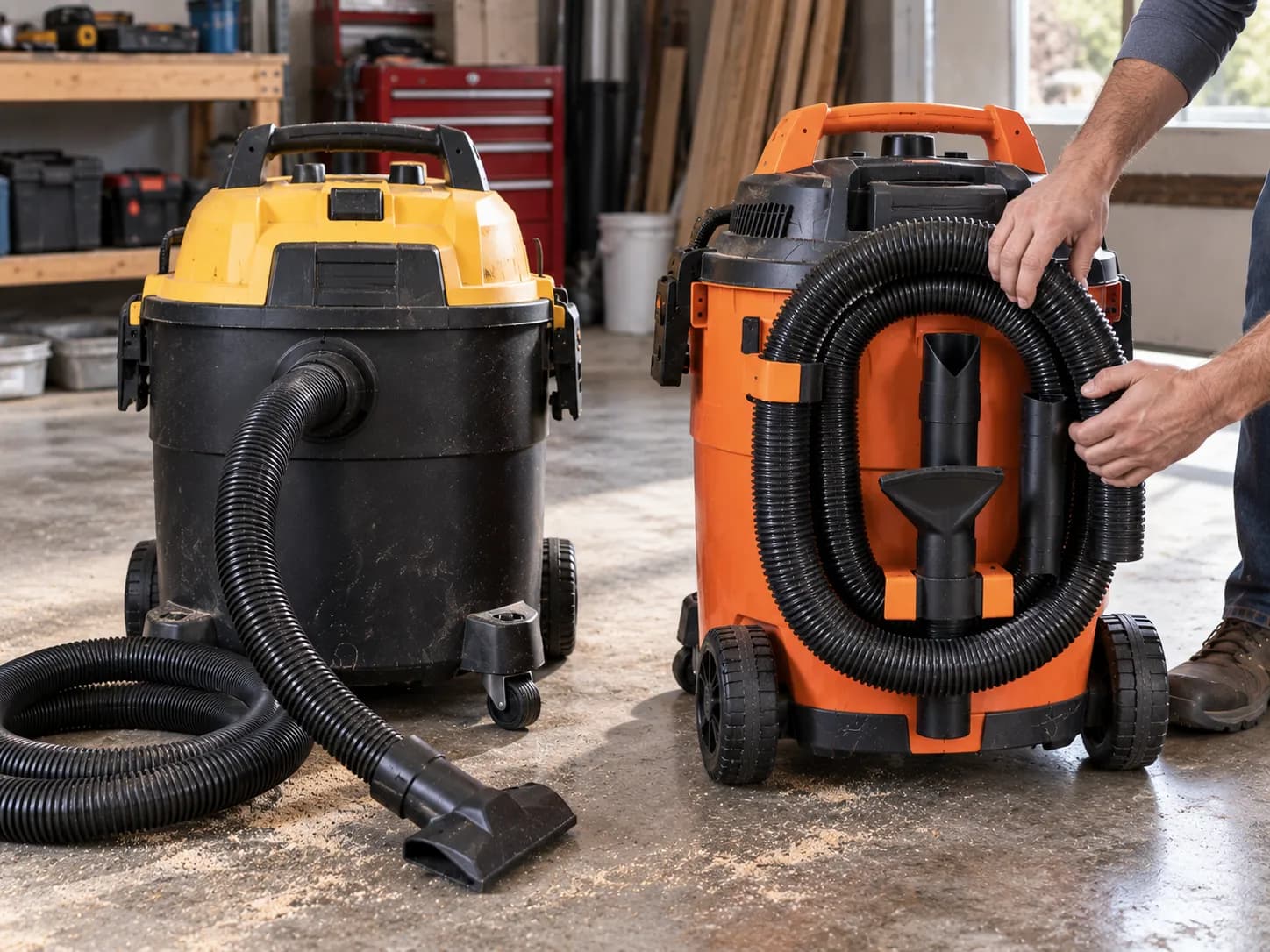
Fair to Bauer: for light, occasional cleanup it is genuinely good value, and the community shortlist of Craftsman, Ridgid, and Bauer exists for a reason. Just buy it knowing the 90-day warranty is the real cost of the low sticker.
Craftsman vs DeWalt (Same Parent, Which to Buy?)
Here is the fact that surprises most buyers: Craftsman and DeWalt are both Stanley Black & Decker brands, positioned as value and premium within one corporate family.
Shared ownership does not mean shared internals, though. Side by side, the DeWalt was clearly the quieter, better-finished unit, while the Craftsman gave more tank and more attachments per dollar.
Same parent, two different buys.
Use the ownership to frame the decision cleanly.
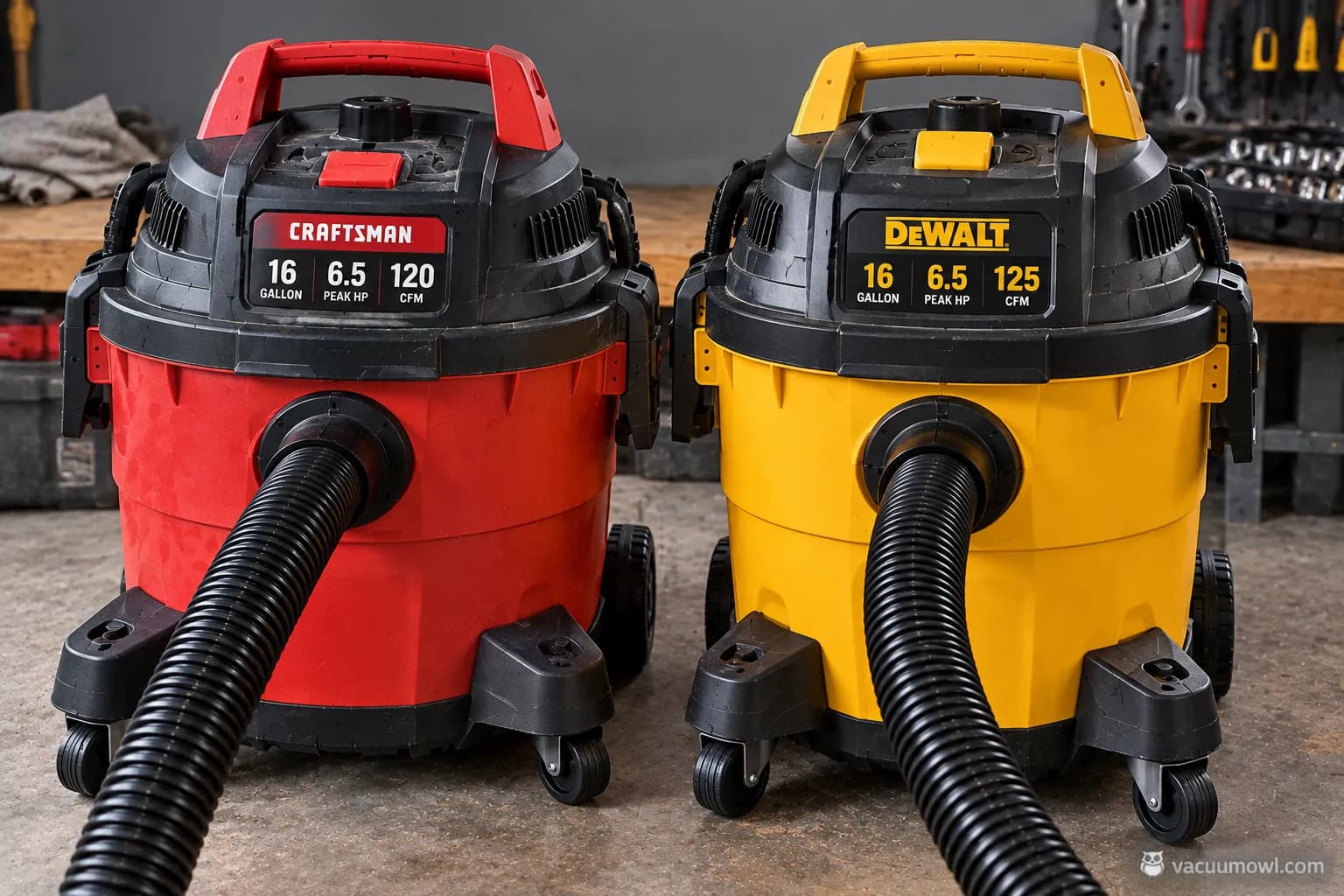
Choose Craftsman for the most capacity and accessories for the money, and choose DeWalt when quiet operation and build finish justify paying up inside the same brand family.
The brand-ownership story is messier than it looks across the whole category, and we untangle who makes what in a dedicated guide.
We will not claim the two share a motor or drum tooling without evidence, only that they share a parent.
Where Vacmaster and Masterforce Fit
Two value challengers round out the six.
Vacmaster’s steel-tank Beast (VJH1612PF) felt the most rugged of the budget picks in handling and appears among top-tested wet/dry picks alongside Craftsman and Ridgid.
It punches above its price when durability matters. Masterforce, sold through Menards, is an availability-driven pick rather than a benchmark leader.
Vacmaster earns a real look if you want a metal drum without paying Ridgid money, and it slots in just behind the big three on our numbers.
Both challengers also appear in our tested-and-ranked best shop vacs of 2026.
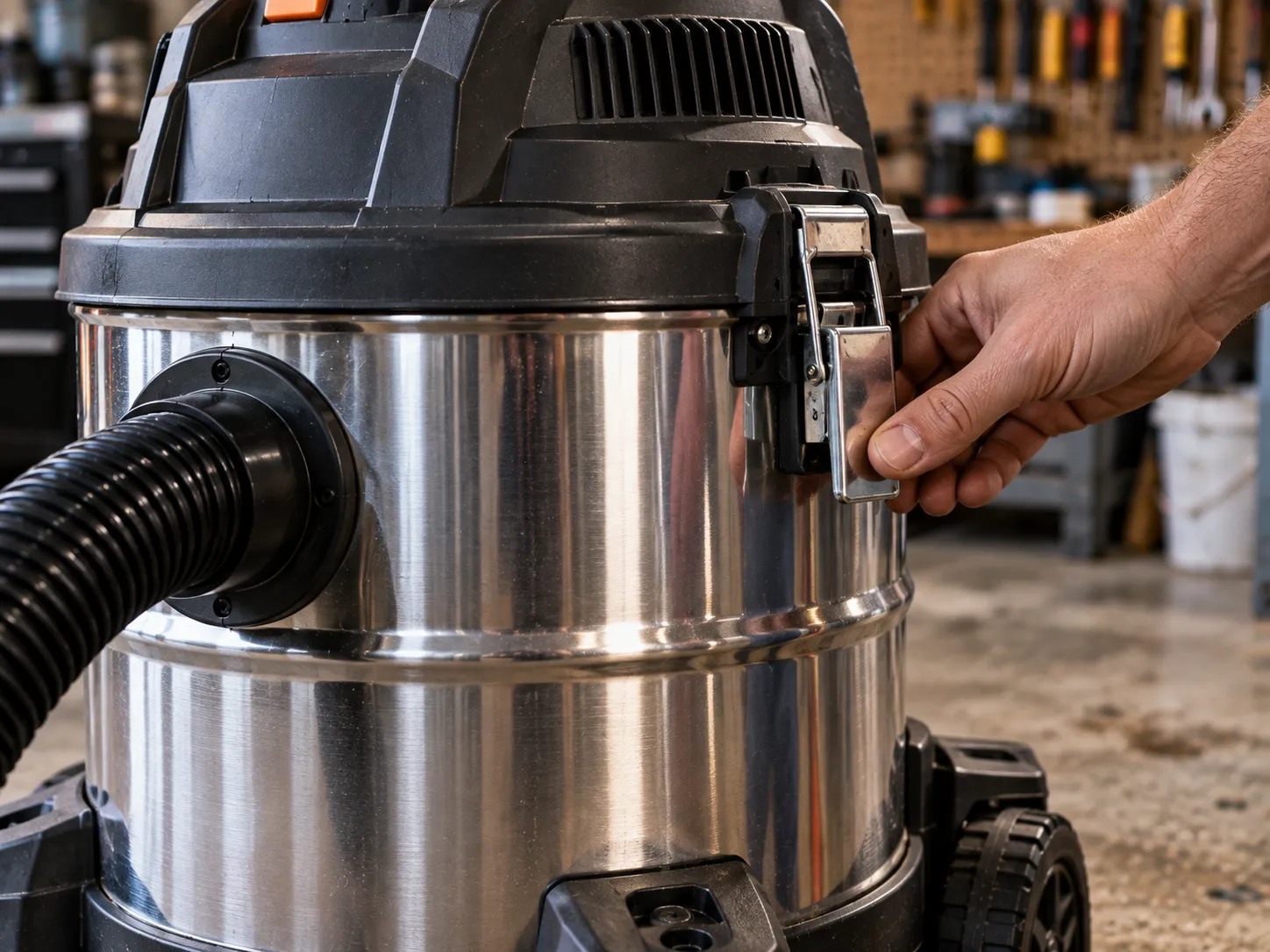
Honest limit on Masterforce: independent test data is thin, so we place it as a convenience pick for Menards shoppers rather than making performance claims we cannot stand behind. If your store carries it and the price is right, it is a reasonable everyday vac.
Do Shop Vac Filters and Bags Cross-Fit Between Brands?
This is the hidden cost nobody prices in, and the answer is split. Attachments cross-fit, filters and bags usually do not.
Because most modern shop vacs share the 2.5-inch accessory standard, hoses and nozzles swap freely between Ridgid, Craftsman, DeWalt, and the value brands.
Cartridge filters and collection bags are cut to each brand’s drum, so they do not interchange.
We confirmed it the direct way: we physically tried each brand’s hose and filter on the others, and the 2.5-inch hoses all seated while the filters fit only their own drums.
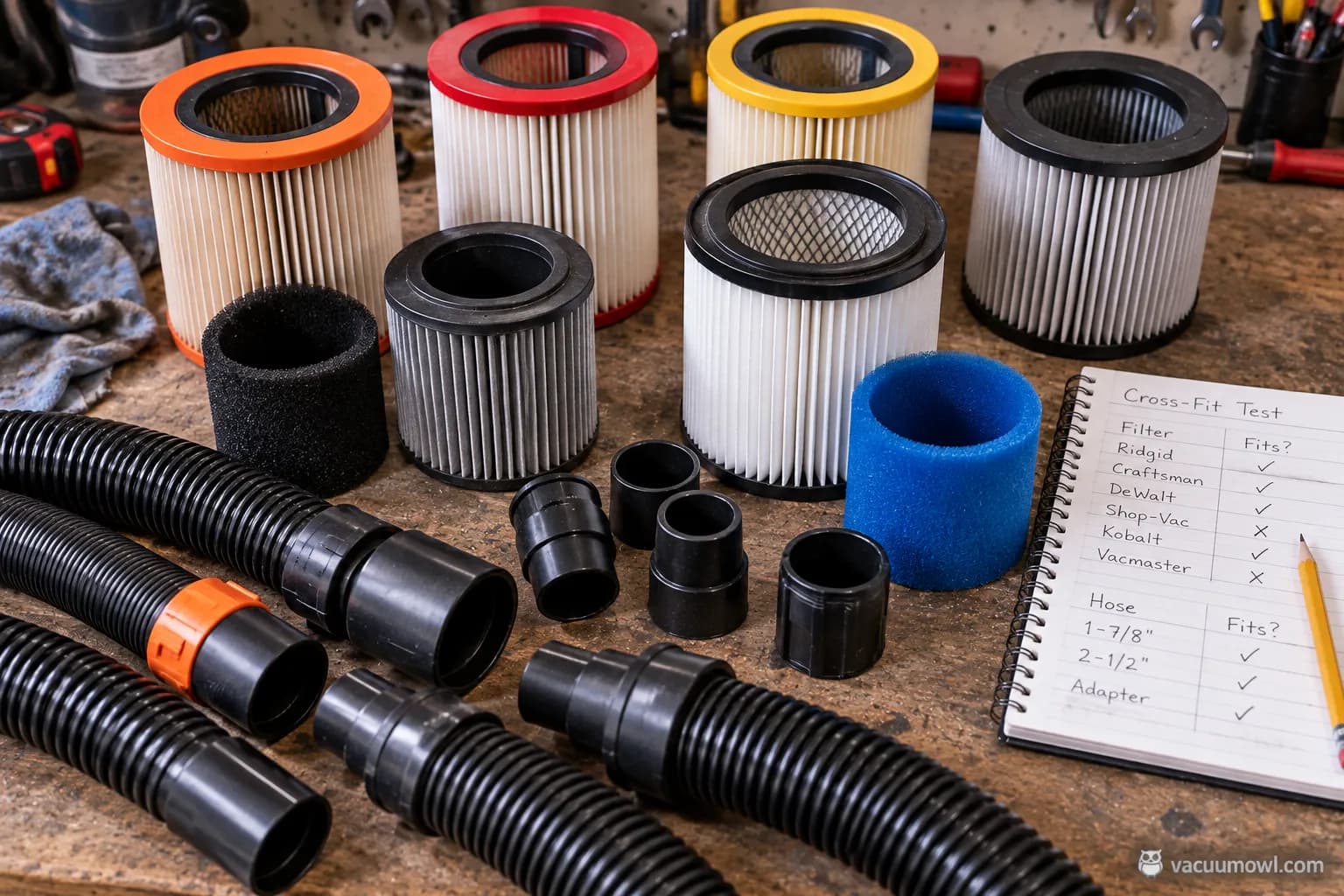
Here is the cross-fit picture at a glance.
Component | Cross-fits between brands? | Note |
|---|---|---|
Hose and nozzles (2.5 in) | Usually yes | Shared 2.5-inch standard |
Cartridge filter | No | Cut to each brand’s drum |
Collection bag | No | Sized per brand and gallon |
Older 1-7/8 in accessories | Only within that standard | Confirm your port size |
One trick from the forums earns its keep: run a bag for fine dust, because it keeps the cartridge filter cleaner and holds suction longer on drywall work.
Whether to run a bag or a filter changes both suction and filter life, and for Shop-Vac’s own confusing part numbers our cross-reference chart sorts them out.
Serious dust hunters strap a vac to a cyclone separator, the “Frankenvac” setup, to catch debris before it ever reaches the filter.
If fine dust is your whole job, a HEPA filter matters more than the brand badge, and none of these machines replace a household vacuum for carpets, which is a separate comparison.
Before you buy consumables, confirm your exact filter part number, since drum sizes shift between model years.
Which Shop Vac Brand Should You Buy?
The best shop vac brand depends on your use, not on a single trophy. Craftsman wins value, Ridgid wins warranty, DeWalt wins quiet, and Bauer wins price, so the honest recommendation is a routed one. Match the buy to the job and the budget below.
Choose Craftsman if you want the most air and tank per dollar for general garage cleanup.
Choose Ridgid if you want a vac you will never rebuy, backed by lifetime coverage with no registration.
Choose DeWalt if noise matters, in a shared basement, a finished garage, or near living space.
Choose Bauer if the vac is for light, occasional use and the lowest price wins.
Choose Vacmaster if you want a rugged steel tank without paying top-brand money.
Choose Masterforce if Menards is your store and you want a capable everyday vac on the shelf.
Still unsure? Default to Ridgid for the warranty, since a vac that is “hard to kill” and covered for life is the safest long-run bet.
Want the brand-level verdict beyond these six? See our overall best-brand pick.
Frequently Asked Questions
Is Craftsman or Ridgid shop vac better?
For a craftsman vs ridgid shop vac decision, Craftsman is the value winner and Ridgid is the long-term winner. In our test the Craftsman cleared a five-gallon spill a few seconds faster and costs less per gallon, while the Ridgid backs its similar performance with a Full Lifetime Warranty that needs no registration. Pick Craftsman to save money now, Ridgid to never rebuy.
Which shop vac brand has the best warranty?
Ridgid has the best warranty in this group by a wide margin. Its wet/dry vacs carry a Full Lifetime Warranty against defects, and it does not require the 90-day registration that the brand’s power-tool Lifetime Service Agreement demands. DeWalt and Craftsman offer multi-year limited coverage, and Bauer offers only 90 days.
Are Craftsman and Ridgid shop vacs made by the same company?
No. Craftsman is a Stanley Black & Decker brand, while Ridgid’s wet/dry vacs are built for the Home Depot line by Emerson. The Craftsman and DeWalt vacuums share a parent company, but Craftsman and Ridgid do not.
Do Ridgid and Craftsman filters interchange?
Mostly no. Their hoses and nozzles usually swap because both use the 2.5-inch accessory standard, but the cartridge filters and collection bags are cut to each brand’s drum and do not interchange. Always confirm your exact filter part number before buying replacements.
Is higher peak horsepower actually better?
No. Peak horsepower is a marketing figure measured at motor stall, and it does not predict cleaning. Measured airflow (CFM) and sealed water lift decide how well a shop vac actually picks up debris and water, which is why our table leads with those numbers.
Which shop vac is the quietest?
DeWalt’s StealthSonic line is the quietest here, reading about 68 dB at 3 feet under load on our meter, against roughly 85 dB for most rivals. If your real problem is fine dust rather than noise, a dust extractor beats any of these, and for carpets specifically see whether a shop vac can deep-clean them at all.
The Bottom Line
Six brands on one bench settle the craftsman vs ridgid shop vac argument the way a spec sheet never can: the winner is your use case, not a logo.
Craftsman takes value and suction per dollar, Ridgid takes the long game with a no-registration Full Lifetime Warranty, DeWalt takes quiet, and Bauer takes the lowest entry price, while Vacmaster and Masterforce cover the rugged-budget and store-availability corners.
The two factors that actually decide it are the two the horsepower shootouts skip.
Buy on measured airflow and the warranty you can realistically claim, then check whether the filters and bags you already own will fit the drum you are eyeing, because that consumable lock-in costs more over a vac’s life than the price difference on day one.
Get those three right and any brand in this test will serve you well.
Get them wrong and even the strongest motor becomes the wrong purchase.
Match the machine to your shop, and the choice makes itself.
Read it your way
Short on time? Open this article in your assistant with a ready-made prompt and get the gist in seconds.
Found this useful? Make us a preferred source so we show up in your Google results.
Keep reading
Related articles
Vacuum Types
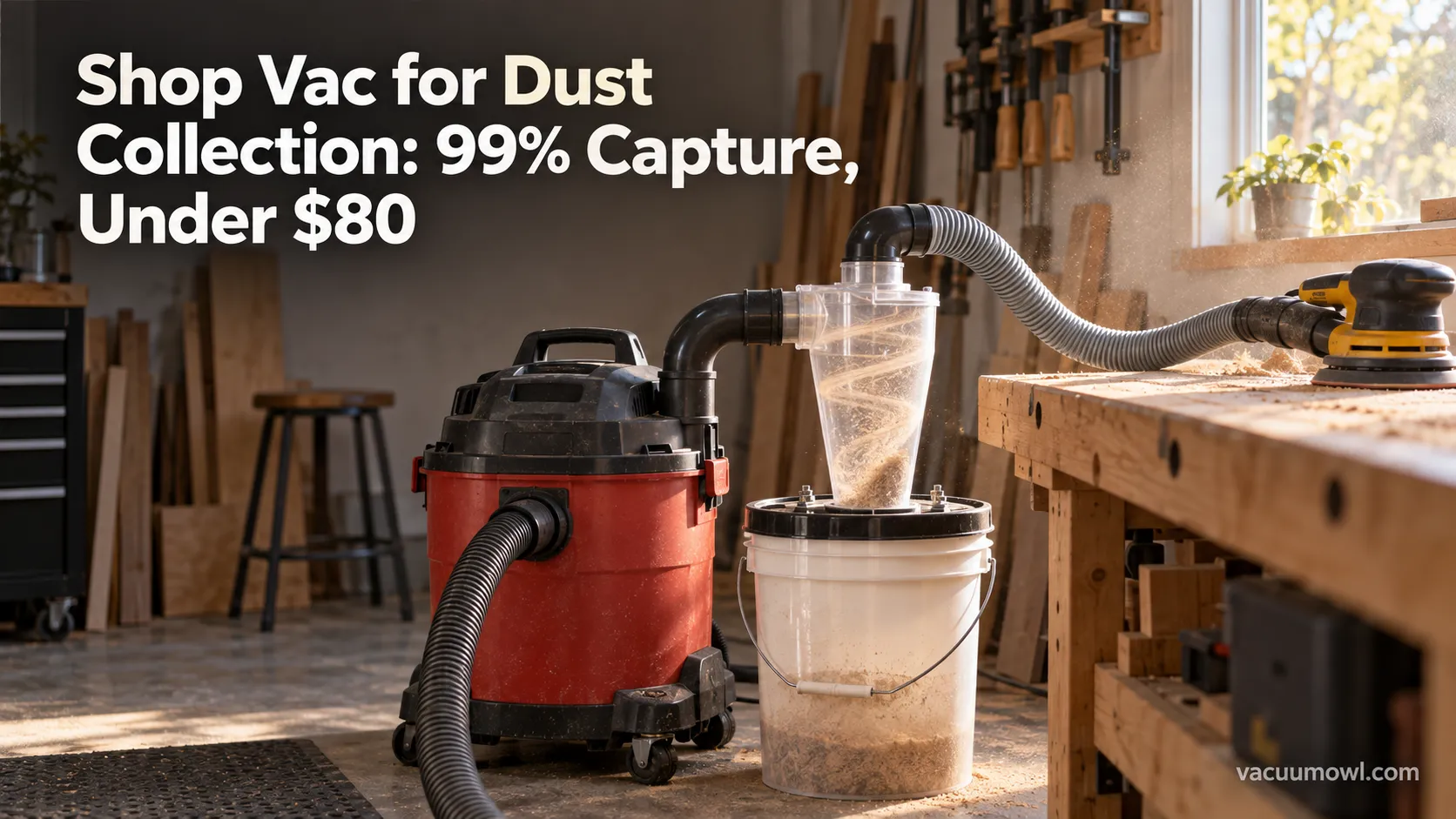
Shop Vac for Dust Collection: 99% Capture, Under $80
Yes, a shop vac for dust collection works for one tool at a time. Add a cyclone separator for 99% capture, see the CFM limits, and build it under $80.
Vacuum Types
Can You Use a Shop Vac as a Regular Vacuum? 4 Uses Tested
Yes: can you use a shop vac as a regular vacuum? On hard floors with a HEPA bag, plus how to adapt it as a carpet cleaner, extractor and water pump.
Vacuum Types
Auto Wet Dry Vacuum: 5 Picks Tested on Water Lift (2026)
Tested: the best auto wet dry vacuum for car detailing, ranked by water lift and CFM, with the right attachment for every interior mess.
Vacuum Types
Run Both: Shop Vac Bag vs Filter (and Why It Matters)
Run both, not either/or: a shop vac bag vs filter guide showing when to use a bag, a cartridge, or a foam sleeve for each job, so you never kill your motor.
The discussion
Comments
Every comment is reviewed before it goes live.