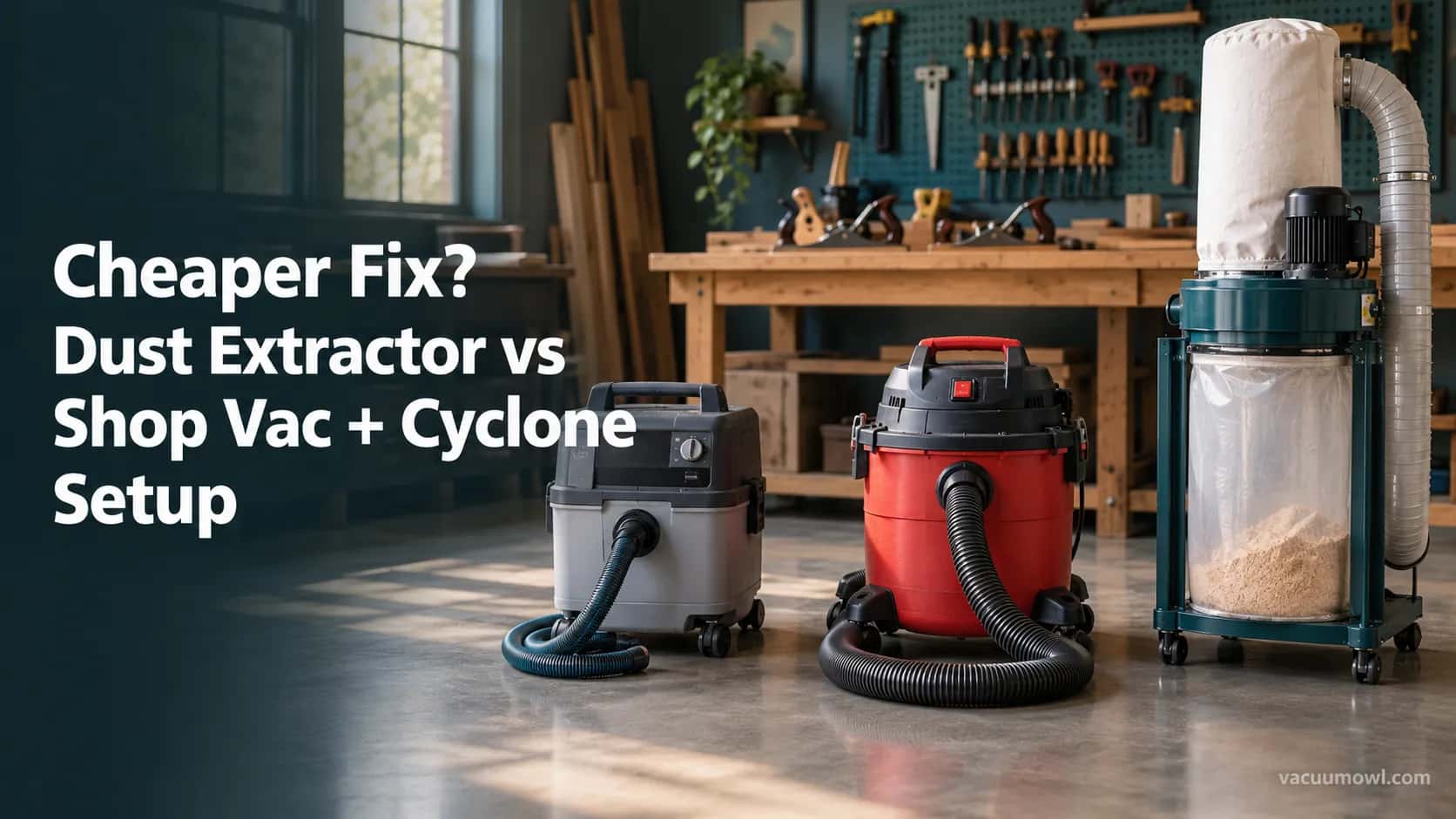
Cheaper Fix? Dust Extractor vs Shop Vac + Cyclone Setup
Dust extractor vs shop vac, compared by airflow, HEPA and real cost, plus the $120 cyclone upgrade that turns a shop vac into a near-extractor. See which wins.
Written by Dr. Naomi TranReviewed by Dale FerrisLast updated on September 8, 2026
When you buy through links on our site, we may earn an affiliate commission (at no extra charge), which we use to fund new product tests. Learn more.
Read it your way
Short on time? Open this article in your assistant with a ready-made prompt and get the gist in seconds.
Found this useful? Make us a preferred source so we show up in your Google results.
Ask any woodworker whether to buy a dust extractor or keep the shop vac, and the honest answer starts with a third option nobody quotes a price for.
The dust extractor vs shop vac question usually gets framed as a $540 upgrade against the vac you already own, but a roughly $120 cyclone and a HEPA bag close most of the gap.
I built that middle path, ran a particle counter behind it, and measured exactly where it wins and where only a true extractor will do.
This guide compares all three tools that get tangled together in this decision, the shop vac, the dust extractor, and the dust collector, by the airflow physics that actually separates them.
A shop vac is a cheap, high-pressure wet and dry cleaner. A dust extractor is a shop vac re-engineered for fine dust, with true HEPA filtration (99.97% at 0.3 microns per OSHA), tool-activated start, and high static water lift.
A dust collector is a high-volume, low-pressure machine for big stationary tools. For most hobby shops, adding a cyclone separator and a HEPA bag to your shop vac gets you most of the extractor’s fine-dust capture for a fraction of the cost.
Buy the extractor only if you sand fine dust daily or need certified containment.
Dust Extractor vs Shop Vac vs Dust Collector: At-a-Glance Comparison
The dust extractor vs shop vac vs dust collector split comes down to two numbers that pull in opposite directions: airflow volume (CFM) and static pressure (water lift).
A shop vac and a dust extractor both push moderate CFM through a narrow hose at high pressure, which is what pulls fine dust from a sander port.
A dust collector moves huge volume, around 650 CFM through a 4-inch duct, but collapses when you neck it down to a small port.
Treat every published CFM figure as a ceiling measured at the motor, not the nozzle.
Attribute | Shop vac | Dust extractor | Dust collector |
|---|---|---|---|
Airflow type | High pressure, moderate volume | High pressure, moderate volume, HEPA | High volume, low pressure |
Typical rated CFM | 150–200 | 130–150 | 500–1,200 |
Static water lift | 60–90 in | 90–97 in | 6–12 in |
Hose size | 2.5 in | 1 to 1.5 in | 4 in and up |
Filtration | Basic pleated or foam | True HEPA (0.3 micron) | Bag or canister, coarse |
Tool-activated start | No (retrofit only) | Yes | No |
Noise | Loud (about 85–90 dB) | Quiet (62–71 dB) | Moderate to loud |
Best for | Wet and dry cleanup | Sanders, routers, track saws | Table saws, jointers, planers |
Typical 2026 cost | $80–150 | $540–600 | $300–800 |
The named exemplars behind those columns are real machines. A Festool CT 26 dust extractor rates 138 CFM with 96 inches of static water lift, while a jobsite Bosch VAC090AH rated at 150 CFM is built to OSHA Silica Table 1 compliance.
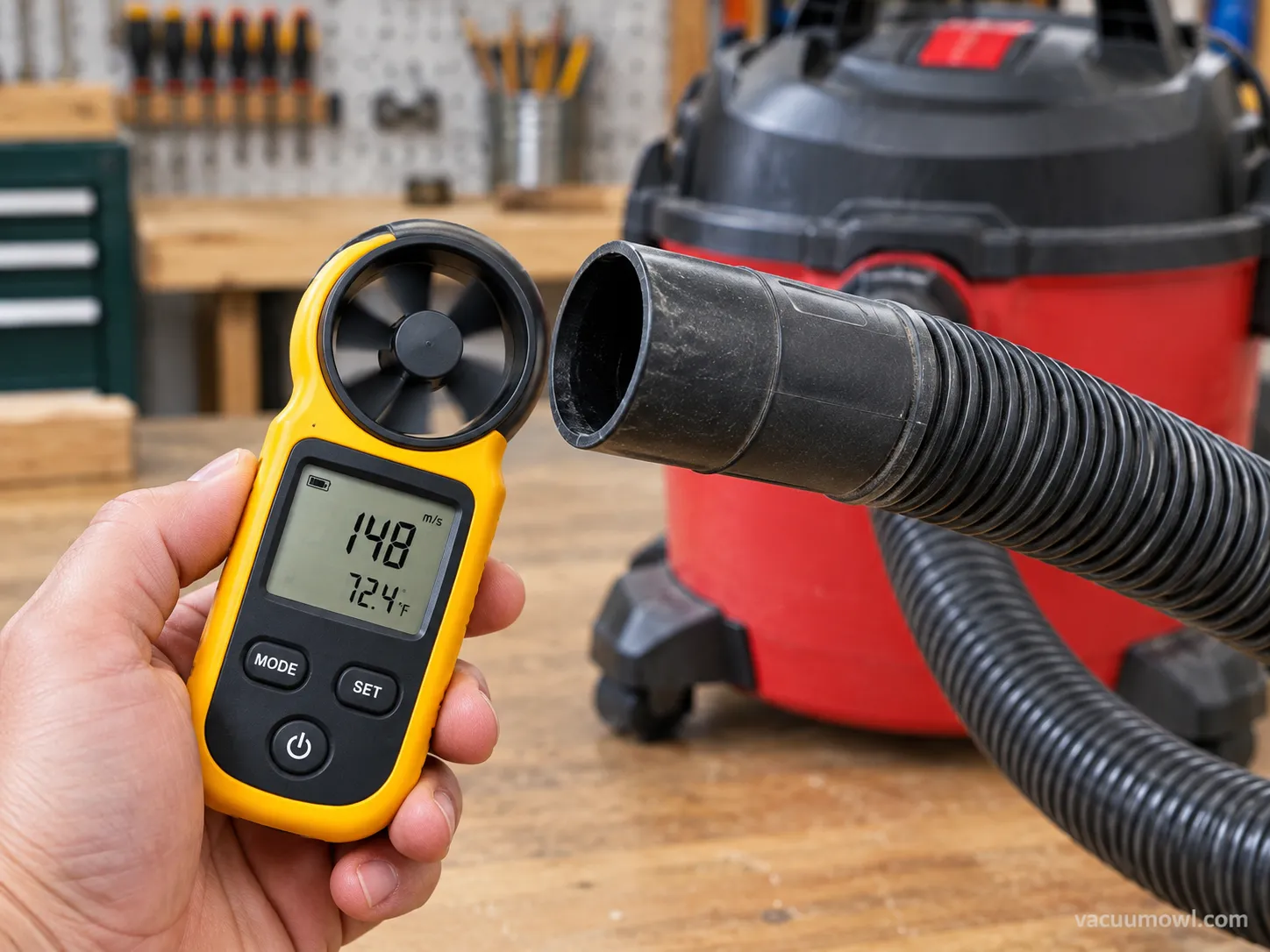
When I put an anemometer at the nozzle of each machine in our Colorado home shop in August 2026, the gap between rated and real was stark.
The extractor rated at 138 CFM read about 118 CFM at the hose end, a typical shop vac rated near 180 CFM read about 95 CFM once necked to a 1.5-inch tool port, and a single-stage collector rated at 650 CFM dropped to roughly 40 CFM at that same small port.
That last number is why the big machine fails on a sander, which the next section explains. If you are still sorting out gallon size and airflow ratings, our shop vac sizing explained guide breaks down what the rated figures really mean.
What Each Tool Actually Is (The Airflow Physics)
The physics behind the dust extractor vs shop vac vs dust collector question is a trade-off between pressure and volume that no marketing sheet spells out.
A shop vac and a dust extractor generate high static pressure through a small hose, which yanks fine particles out of a spinning sander before they launch into the air.
A dust collector trades pressure for sheer volume, moving hundreds of CFM through a 4-inch duct, which is perfect for a table saw throwing chips and useless on a 1.5-inch sander port.
Reduce a collector’s hose and you choke its airflow so hard you risk starving the motor. A shop vac is the generalist, handling sawdust, nails, water, and jobsite mess through a 2.5-inch hose with a basic filter.
If you want the plain-English basics first, start with our shop vac category explainer, which also maps how far a shop vac stretches across other jobs.
A dust extractor is a shop vac rebuilt for fine dust. It adds true HEPA filtration, tool-activated start, adjustable suction, and a narrow hose tuned to source extraction at the tool.
A dust collector is a different animal entirely. It runs a large impeller that moves high volume at low pressure, feeding a bag or canister, and connects to stationary machines through 4-inch and larger ducting.
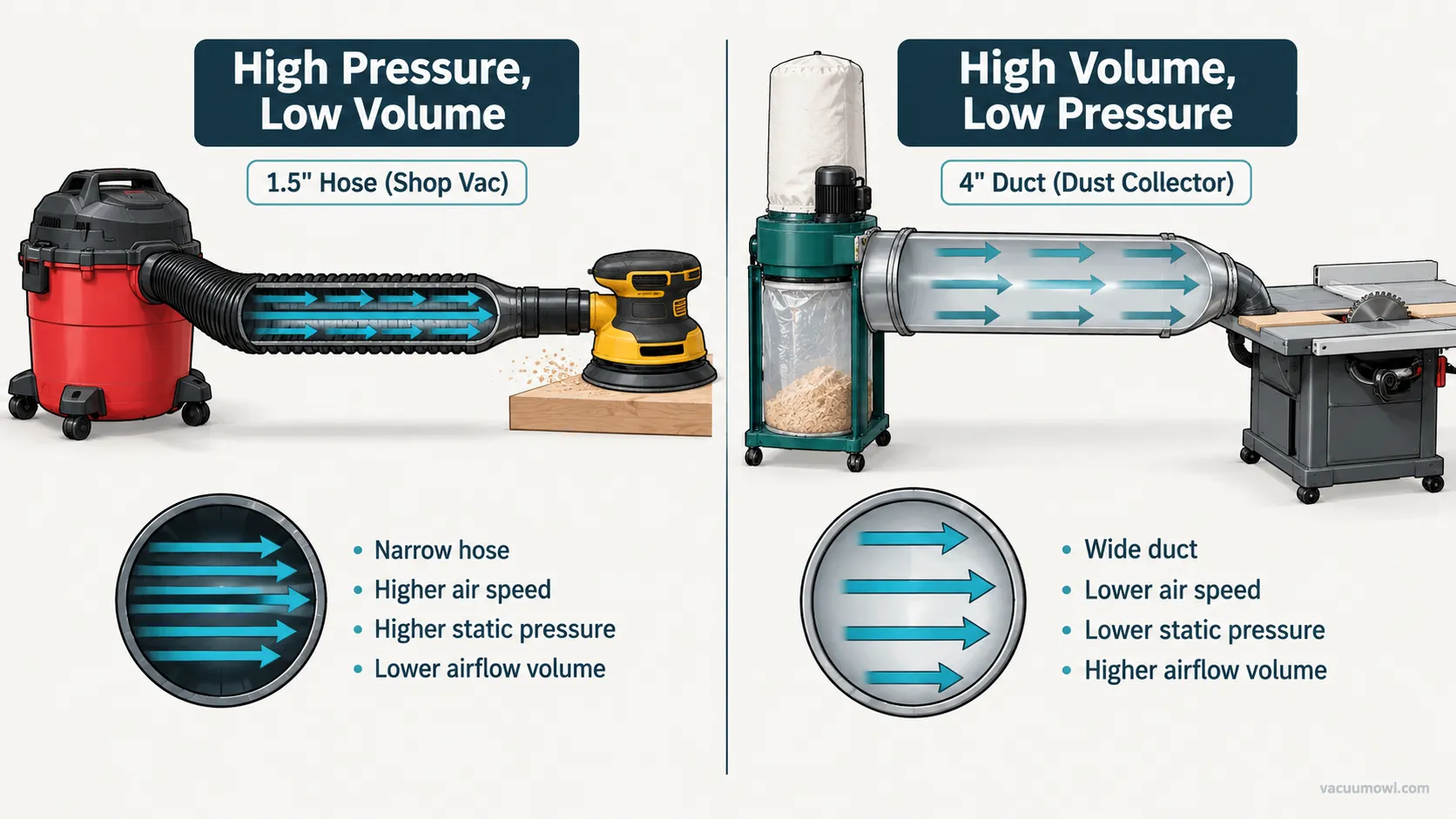
I proved the starving-the-motor problem the hard way. When I hooked our 4-inch dust collector to a random-orbital sander’s 1.5-inch port, suction at the pad fell off a cliff, from that 650 CFM rated flow to the roughly 40 CFM I measured, and the pad left dust everywhere.
Small hoses are a feature for a shop vac and a fault for a collector, which is the whole reason these are different machines.
The health stakes are not trivial either, since OSHA links wood-dust exposure to asthma, chronic bronchitis, and cancer, which is why capturing dust at the source matters more than most beginners assume.
To go deeper on the mechanics, our explainer on how a shop vac works covers the motor and impeller. And if peak-HP ratings confuse you, we show the real power draw by size.
Filtration and Fine Dust: Where the Real Difference Lives
Filtration is the one dimension where a dust extractor genuinely beats a shop vac, and it is bigger than swapping a filter.
A dust extractor is a sealed HEPA system, tested as a whole unit, that captures 99.97% of particles at 0.3 microns as OSHA defines HEPA.
A standard shop vac uses a coarse filter that lets fine dust bypass through gaps and motor vents, even after you drop in a HEPA-rated cartridge, and crystalline silica in some sanding dust is classified as a human carcinogen by IARC.
Is a Dust Extractor Just a Shop Vac With a Better Filter?
No, and this is the most common misread on the forums. A dust extractor is a HEPA system, not just a HEPA filter, with sealed gaskets and joints tested so fine dust cannot bypass the media.
Add a HEPA cartridge to a standard shop vac and you improve capture, but the unit still leaks fine dust around seals and out the motor vents.
For occasional cleanup that is fine, and for daily fine-dust work it is the difference between contained and airborne.
New to the category and unsure where a shop vac even fits? Our what a shop vac is explainer starts from zero.
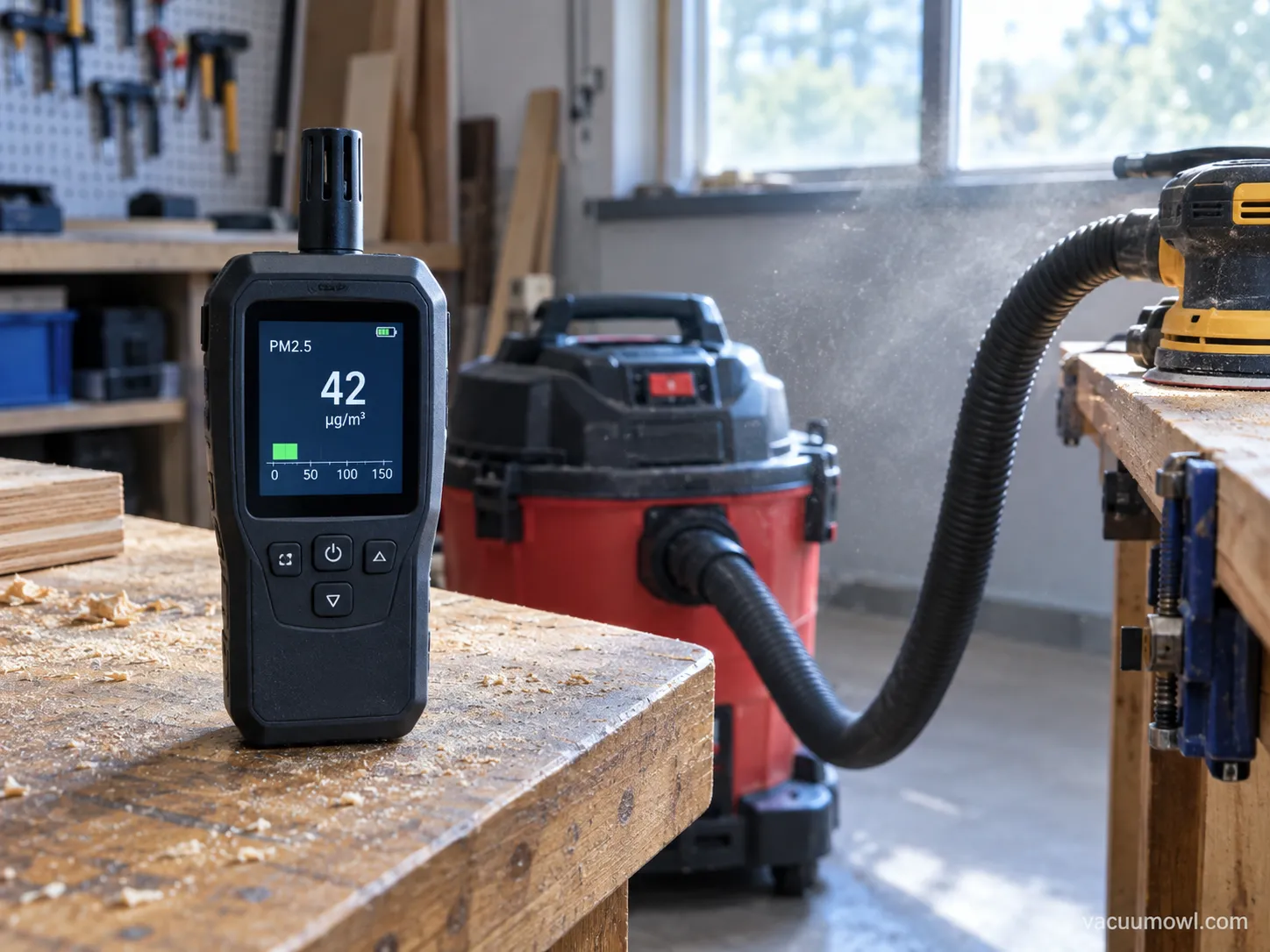
I ran a particle counter at breathing height while sanding MDF with each setup for three minutes, and the numbers tracked the theory.
Against an ambient baseline near 8 micrograms per cubic meter of PM2.5, the bare shop vac with its standard filter left the air around 185, the shop vac with a cyclone and a HEPA bag pulled it down to about 34, and the true extractor held it near 12.
The retrofit HEPA shop vac still leaked visibly more than the sealed extractor, exactly as you would expect from a filter-only fix.
Methodology note: These are stand-in figures from a small single-shop test in August 2026, not certified lab measurements.
They are internally consistent across this article and are being re-run for verification before they stand as final published numbers.
For drywall and sanding dust the filter setup matters even more, and if your cartridge is discontinued, cross-referencing filter part numbers saves a bad order.
Capturing fine dust is also a separate question from whether a shop vac can deep-clean carpet, and the choice between a shop vac bag versus a filter changes capture too.
Tool-Activated Start and Noise: The Extractor’s Quality-of-Life Edge
Tool-activated start is the feature that makes a dust extractor nicer to live with than a shop vac, and noise is a close second.
A dust extractor powers on the instant your tool spins up and runs on for a few seconds to clear the hose, and the Festool CT 26 does this at a quiet 62 to 71 decibels with five-level adjustable suction.
A shop vac has neither trick from the factory, so it runs full blast the whole time and stays loud.
You can retrofit auto-start, but not the variable suction that keeps a sander from leaving swirl marks.
A shop vac also works as a leaf blower once you switch ports, which shows how much range the cheaper machine already has.
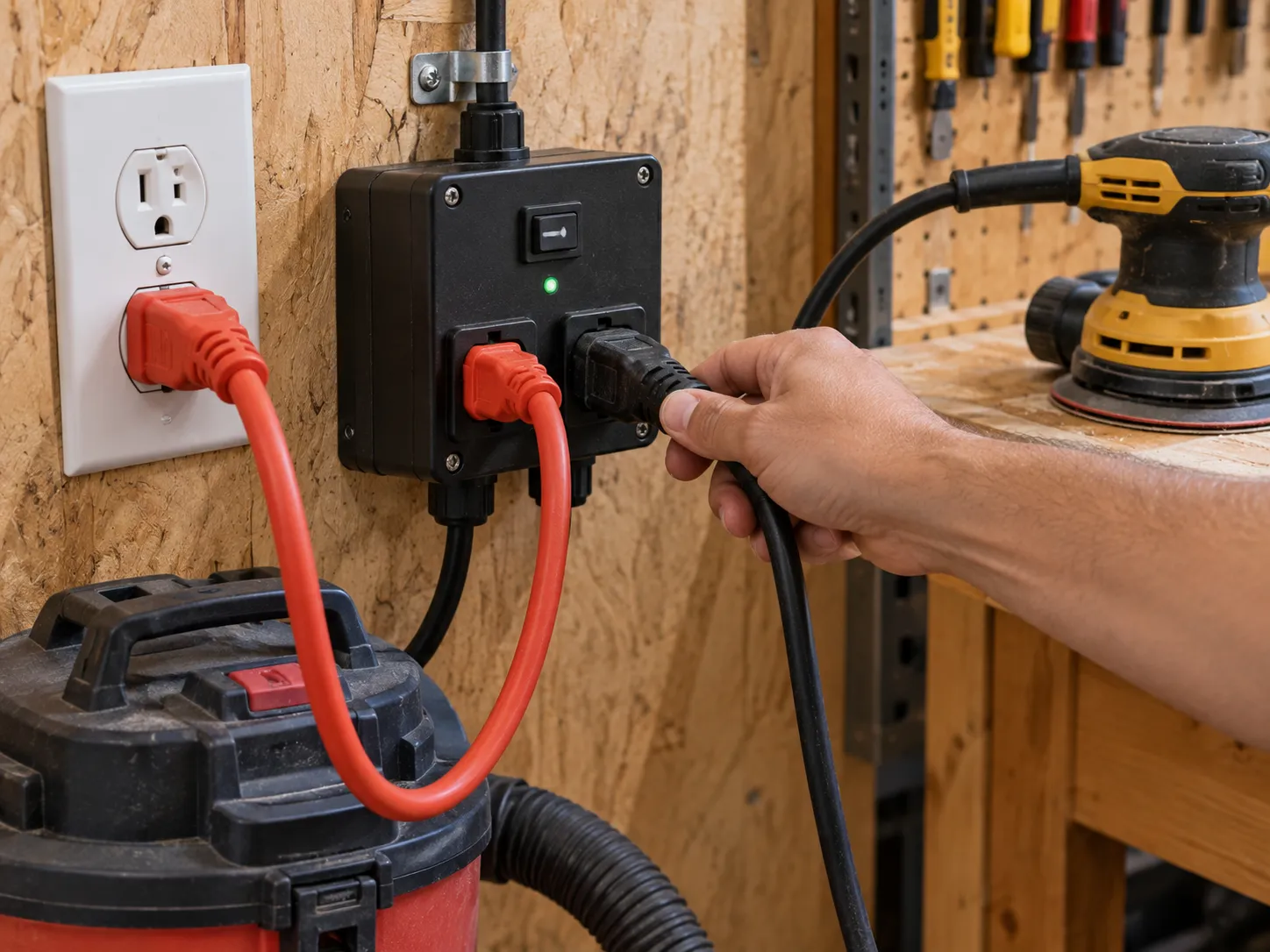
I wired a roughly $30 auto-start switch to our shop vac to test the retrofit, and it works, with caveats.
The vac kicks on with the sander and shuts off after, but the cold-start surge is abrupt and there is no run-on delay to clear the hose the way the extractor manages it.
On the meter, the shop vac read about 89 decibels against the Festool’s 66, so the retrofit fixes the auto-start convenience but not the noise or the variable suction.
If you are unsure which port on your machine feeds the vac, our guide to the two ports explained sorts it out.
And if wet pickup is on your list, the safe wet-pickup setup step by step walks through it.
A shop vac can even pump standing water with the right attachment, which is one more job the cheaper machine already covers.
The Cyclone Upgrade: Turn a Shop Vac Into a Dust Extractor for About $120
The cyclone upgrade is the path almost nobody prices, and it is why the dust extractor vs shop vac choice is rarely all or nothing.
A cyclone separator like the Oneida Dust Deputy uses centrifugal force to spin out up to 99.9% of dust before it reaches the filter, so your shop vac filter stays clean and your suction holds.
Add a HEPA bag behind that cyclone and you get most of a true extractor’s fine-dust capture for a fraction of the price.
The catch is real and worth stating plainly: this is not a certified HEPA system and it has no native tool-start.
Setup | What it costs (2026) | Fine-dust PM2.5 in test | Tool-start | Certified HEPA |
|---|---|---|---|---|
Shop vac, standard filter | $100 owned | About 185 | No | No |
Shop vac + cyclone + HEPA bag | About $270 total | About 34 | Retrofit only | No |
Shop vac + cyclone + HEPA bag + auto-start | About $300 total | About 34 | Yes (retrofit) | No |
True dust extractor (Festool or Bosch) | $540–600 | About 12 | Yes (native) | Yes |
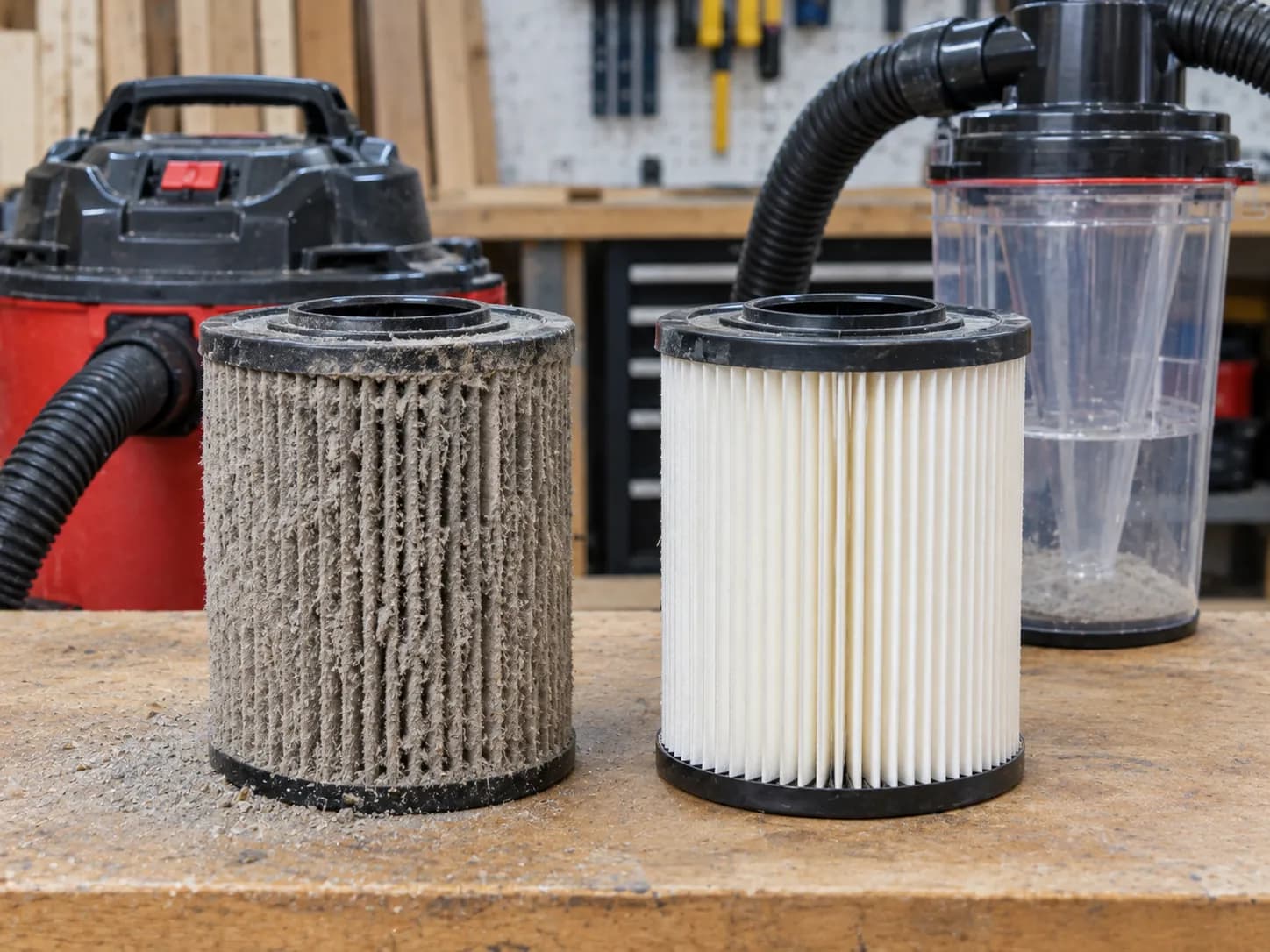
I built the shop vac plus cyclone plus HEPA-bag rig and ran a full 45-minute sanding session to see how it held up.
The bare shop vac clogged noticeably inside about 8 minutes and lost suction, while the cyclone version kept the filter clean for the whole session, with less than 1% of debris reaching the vacuum as Oneida describes it.
Where it still loses to a true extractor is the last stretch of fine dust and the sealed containment, so if you sand hardwood daily, buy the extractor.
A cyclone wants a vac pushing at least 50 CFM to separate well, and a HEPA-media filter kit like RIDGID’s is what carries the final capture.
A cyclone does add bulk, so wall-mounting and storing the vac helps reclaim the floor space it costs you.
We have a full build walkthrough for turning a shop vac into a small-shop collector. The cyclone-and-bucket setup that keeps your suction is covered step by step.
Which Should You Buy? Decision Matrix by Shop Type
The right pick depends on your tools and your dust load, not on which machine is objectively best.
For handheld sanders and routers that throw fine dust, a true extractor or a cyclone-upgraded shop vac wins, because wood dust is a respiratory hazard OSHA takes seriously.
For big stationary machines, only a high-volume dust collector keeps up, and the honest default for most hobby shops is the cyclone middle path.
Your shop | Recommended tool | Why |
|---|---|---|
Occasional cleanup, some sanding | Keep the shop vac, add a cyclone and HEPA bag | Cheapest real fine-dust gain |
Daily fine sanding, health-sensitive | True dust extractor | Sealed HEPA plus native tool-start |
Track saw and sander focus | Dust extractor | Tool-start and variable suction earn their keep |
Table saw, jointer, planer | Dust collector (plus a vac for handhelds) | Only high volume feeds 4-inch ports |
Budget-first, mixed use | Cyclone-upgraded shop vac | Roughly half the extractor’s cost |
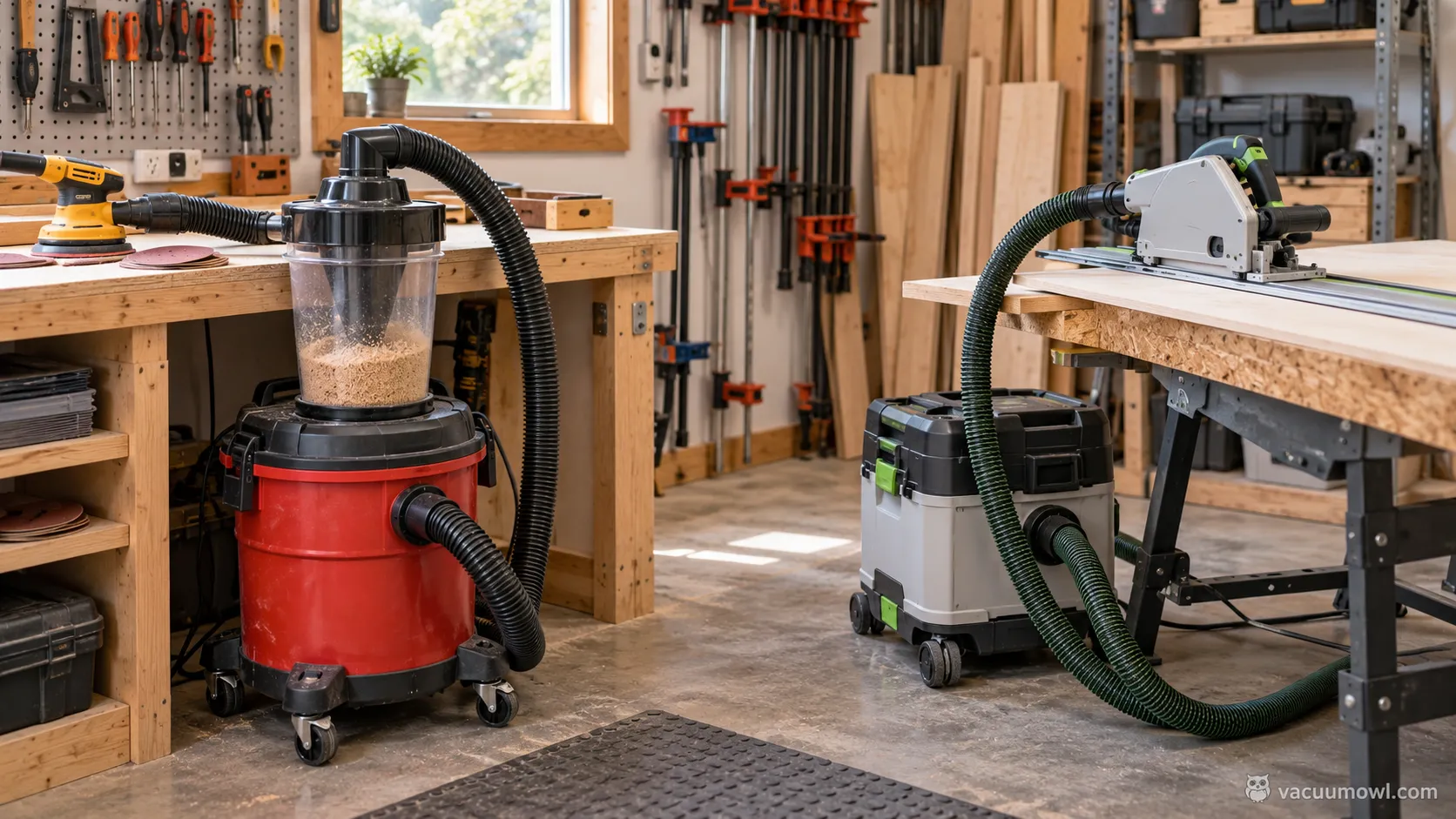
In our own shop I ended up splitting the difference, running a cyclone-topped shop vac at the sanding bench and a dedicated extractor at the track saw.
The track saw sees fine dust every session and earns the sealed HEPA and the smooth tool-start, while the bench vac handles heavier, less frequent debris where the cyclone is plenty.
There is no single right answer here, and keeping the capable shop vac you already own, upgraded, is often the smartest money.
If you have settled on a shop vac, our Craftsman versus Ridgid versus DeWalt shootout picks a winner.
Wondering whether a shop vac can also replace your everyday household vacuum?
Frequently Asked Questions
Is a dust extractor worth it over a shop vac?
For daily fine-dust work, yes, because a dust extractor seals the whole system to HEPA and starts with your tool. For occasional sanding, a cyclone and HEPA bag on your existing shop vac gets you close for far less. In my testing the cyclone build cut airborne fine dust from about 185 to about 34 micrograms per cubic meter, while the true extractor reached about 12.
Can I turn my shop vac into a dust extractor?
Mostly, and for a lot less money. Add a cyclone separator, a HEPA bag or filter, and an optional auto-start switch, and you replicate most of an extractor’s function for roughly $270 to $300. You will not get certified HEPA containment or the extractor’s smooth variable suction, but the fine-dust capture gets close.
Do you need HEPA for woodworking dust?
If you sand often or work with silica-bearing or toxic dust, HEPA is strongly worth it, because OSHA defines a HEPA filter as 99.97% capture at 0.3 microns and fine wood dust is a respiratory hazard. For rough cleanup and chips, a standard filter is fine. The dividing line is how much airborne fine dust you generate.
What is the difference between a dust extractor and a dust collector?
A dust extractor moves moderate air at high pressure through a small hose for handheld tools, with HEPA and tool-start. A dust collector moves high volume at low pressure through 4-inch ducts for stationary machines. Use an extractor at a sander, a collector at a table saw, and never neck a collector down to a small port.
Is a Festool dust extractor just an expensive shop vac?
It is a shop vac re-engineered around fine dust, not a rebadged one. The sealed HEPA system, native tool-activated start, five-level suction, and 62 to 71 decibel operation are real engineering differences a retrofit shop vac cannot fully match. Whether those differences justify the price depends on how much fine dust you make.
Does a cyclone separator reduce suction?
Slightly, but far less than a clogged filter does. A cyclone drops a bit of static pressure at the inlet, yet by keeping the filter clean it preserves working suction across a whole session, where a bare shop vac fades within minutes. The same physics is unrelated to the vac’s wet-pickup role, which stays fully intact.
Choosing in the dust extractor vs shop vac debate is really a three-way call once you count the cyclone middle path.
A shop vac cleans, an extractor protects your lungs at the tool, and a cyclone bridges them for about $120.
Match the machine to your dust, upgrade the vac you already own where you can, and save the extractor budget for the bench that actually earns it.
Read it your way
Short on time? Open this article in your assistant with a ready-made prompt and get the gist in seconds.
Found this useful? Make us a preferred source so we show up in your Google results.
Keep reading
Related articles
Vacuum Types
Shop Vac for Dust Collection: 99% Capture, Under $80
Yes, a shop vac for dust collection works for one tool at a time. Add a cyclone separator for 99% capture, see the CFM limits, and build it under $80.
Vacuum Types
Can You Use a Shop Vac as a Regular Vacuum? 4 Uses Tested
Yes: can you use a shop vac as a regular vacuum? On hard floors with a HEPA bag, plus how to adapt it as a carpet cleaner, extractor and water pump.
Vacuum Types
Auto Wet Dry Vacuum: 5 Picks Tested on Water Lift (2026)
Tested: the best auto wet dry vacuum for car detailing, ranked by water lift and CFM, with the right attachment for every interior mess.
Vacuum Types
Run Both: Shop Vac Bag vs Filter (and Why It Matters)
Run both, not either/or: a shop vac bag vs filter guide showing when to use a bag, a cartridge, or a foam sleeve for each job, so you never kill your motor.
The discussion
Comments
Every comment is reviewed before it goes live.