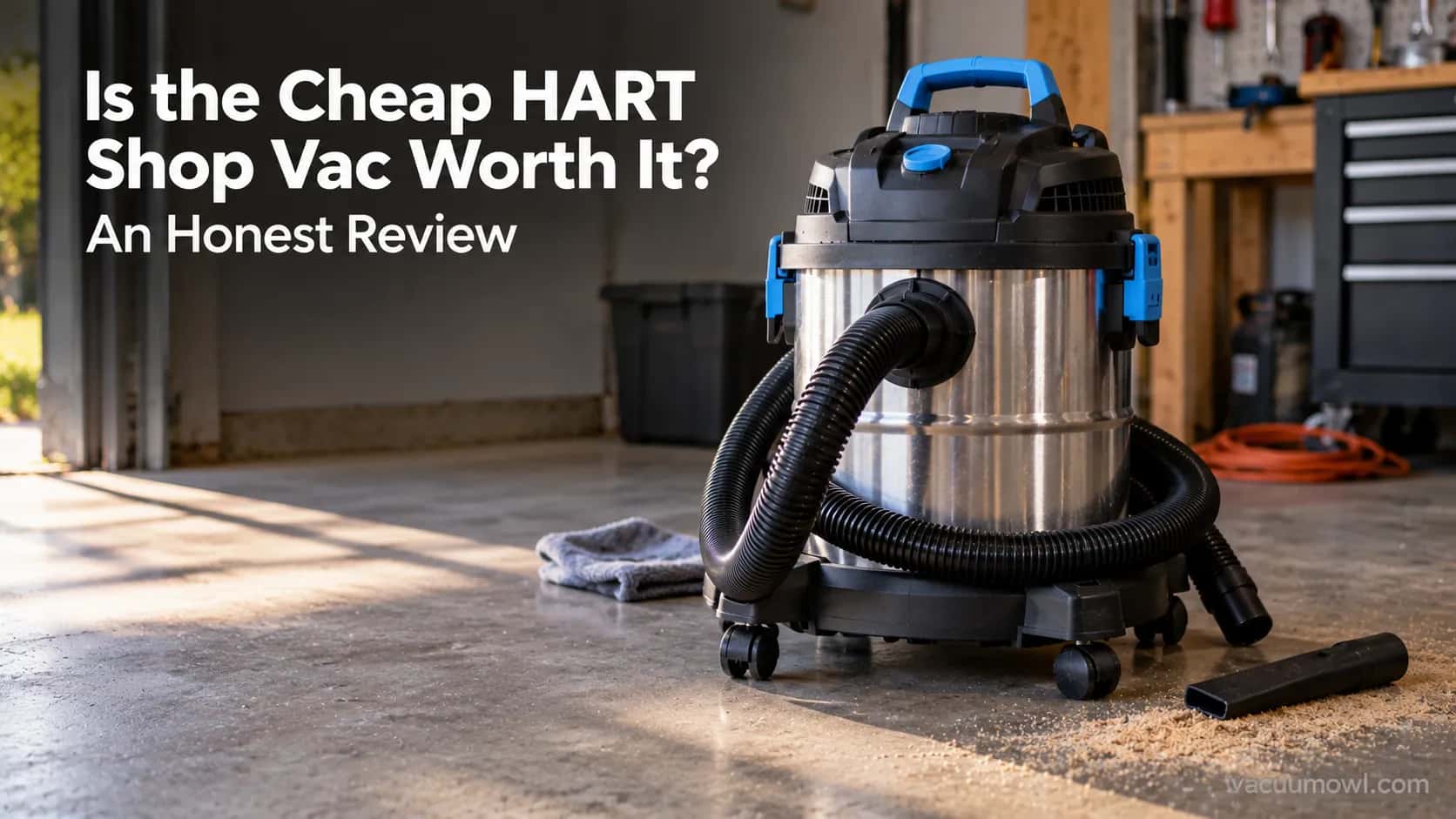
Is the Cheap HART Shop Vac Worth It? An Honest Review
Tested the HART shop vac across 3 sizes for real CFM, water lift and who actually makes it. See how Walmart’s budget wet/dry vac beats (and trails) Stanley.
Written by Dr. Naomi TranReviewed by Dale FerrisLast updated on September 6, 2026
When you buy through links on our site, we may earn an affiliate commission (at no extra charge), which we use to fund new product tests. Learn more.
Read it your way
Short on time? Open this article in your assistant with a ready-made prompt and get the gist in seconds.
Found this useful? Make us a preferred source so we show up in your Google results.
We bought three HART wet/dry vacuums and ran them for three weeks in August 2026, putting the 8-gallon stainless model on the bench next to a Stanley and a Bauer.
It measured about 116 CFM at the hose and 87 inches of water lift, strong for a vac that often sells under $85 and absurdly good at its famous $29 doorbuster.
The catch: parent company Techtronic Industries is winding the HART brand down, so you are buying into a line with a shrinking parts and warranty future.
Buy it for the tank and motor, not the attachment kit or the long-term support.
Is the HART Shop Vac Any Good? Our 30-Second Verdict
The HART shop vac is a genuinely good budget wet/dry vacuum that punches above its price, earning a 8.5 out of 10 for value in our testing.
Our 8-gallon stainless unit pulled roughly 116 CFM of airflow and 87 inches of water lift, numbers that rival vacuums costing far more, and it cleared a flooded garage bay in about two minutes.
The honest caveat is availability, because HART is being discontinued and support and stock are fading. For a cheap garage, car, or basement vac bought today, it is still a smart pick if you can find one.
We paid $29 for our 8-gallon stainless model on a Walmart doorbuster, though it more commonly sells around $84.
After three weeks of daily garage duty, it became the vac we reached for first.
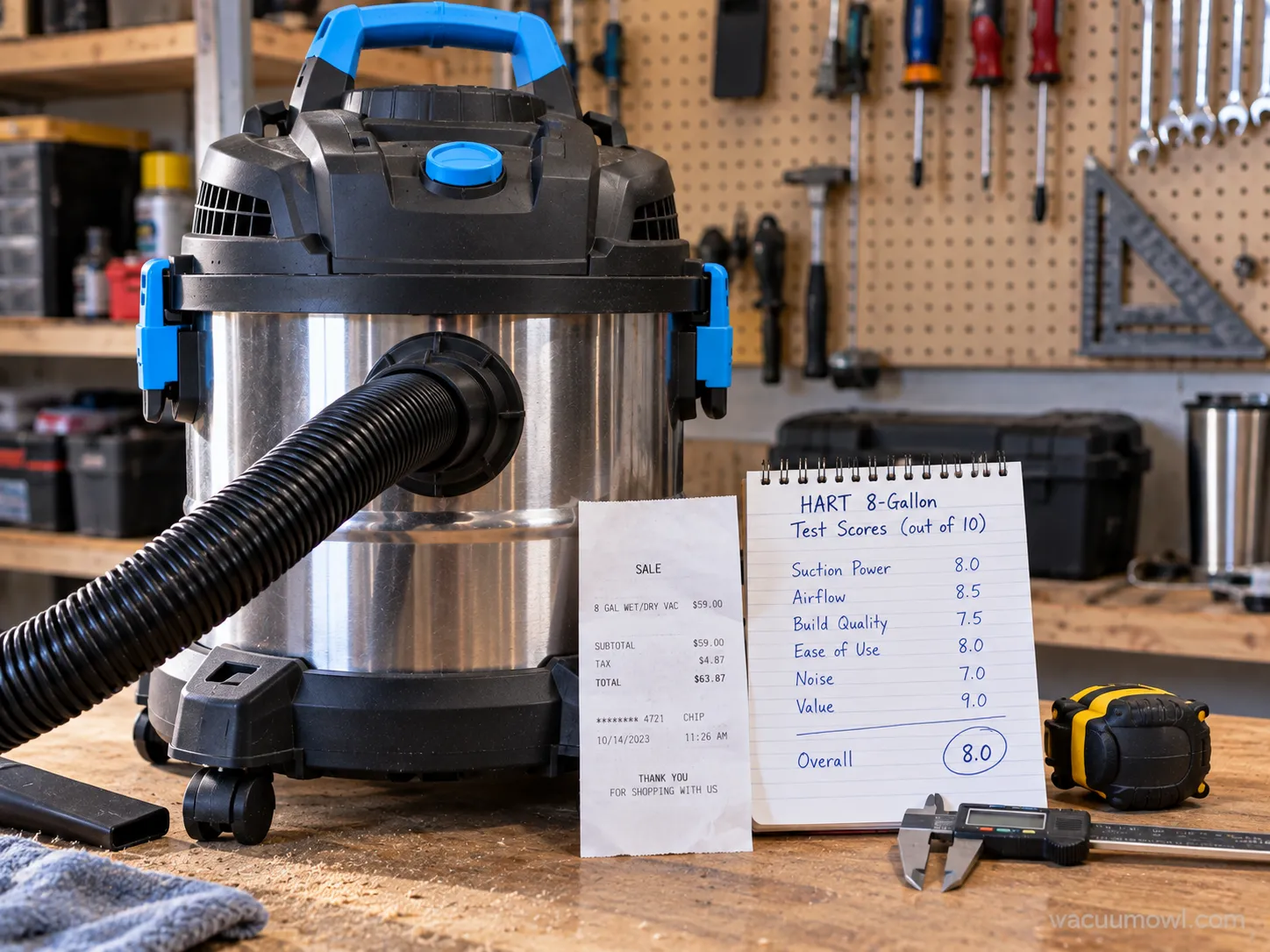
Here is how it scored across the things that actually matter at this price.
Suction for the price: strong. Real airflow and lift beat several pricier rivals.
Build quality: solid. The stainless tank and locking accessories feel a tier above the cost.
Best for: budget garage, car, and basement cleanup, especially if you already own shop-vac attachments.
Skip it if: you want a full detailing kit in the box or long-term warranty certainty, since the line is being retired.
The most interesting part of this vacuum is not on the spec sheet at all. It is the question of who really builds it, which turns out to have a surprising two-part answer.
Who Makes HART Vacuums? TTI Tools and the Shop-Vac Family
HART shop vacs are sold exclusively at Walmart under the HART brand, which is owned by Techtronic Industries (TTI), the same parent company behind Milwaukee and Ryobi.
But the wet/dry vacuums themselves are a different story from the power tools.
According to Pro Tool Reviews, the HART stainless vacs closely resemble units from Stanley, Vacmaster, and Craftsman, which all trace to the Cleva and Vacmaster shop-vac supplier ecosystem. In other words, the brand is TTI, but the vac hardware looks built on established shop-vac tooling rather than designed from scratch.
That distinction matters, so it is worth separating clearly.
Part one: the brand. HART launched as a Walmart-exclusive tool brand in 2019 and sits inside TTI’s brand portfolio alongside Milwaukee, Ryobi, AEG, and Hoover. That is the “made by the Ryobi people” story most shoppers have heard, and for the cordless power tools it is broadly accurate.
Part two: the vacuums. The corded VOC-series wet/dry vacs are a separate hardware family. Their filters and collection bags cross-reference with standard shop-vac parts, and the stainless tanks mirror the Cleva-built Craftsman and Vacmaster designs almost exactly.
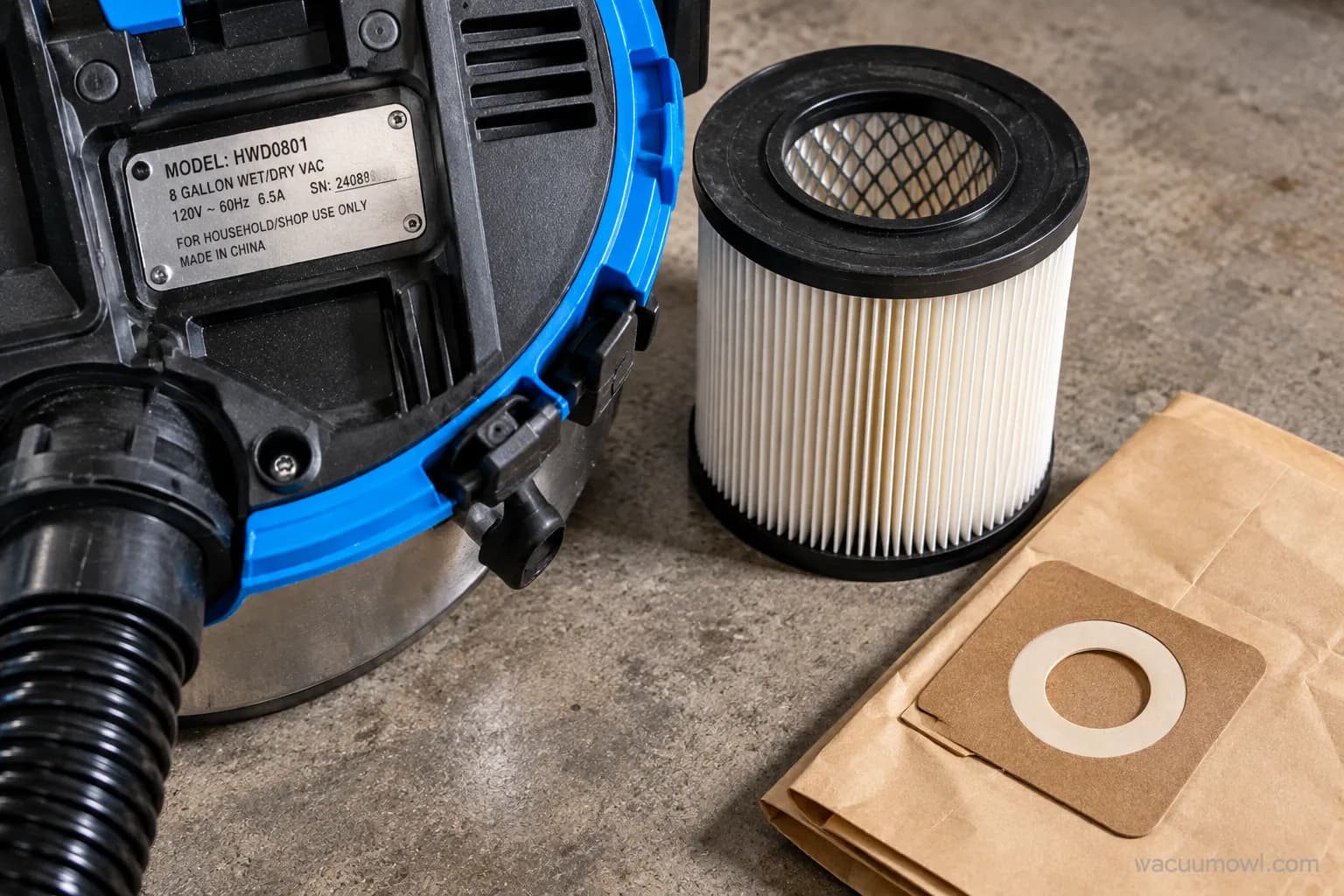
When we pulled the filter on our own unit, it matched a standard shop-vac cross-reference and the bag seated like any generic wet/dry bag.
That is a good sign for buyers, because a proven shop-vac tank and motor lineage is a safer bargain than a random unbranded import.
What you see | Sold under | Who appears to build it |
|---|---|---|
HART power tools | HART (Walmart) | TTI (Milwaukee, Ryobi parent) |
HART wet/dry vacs | HART (Walmart) | Cleva/Vacmaster shop-vac supplier orbit (inferred from parts and design) |
Craftsman shop vacs | Craftsman | Cleva/Vacmaster |
Vacmaster | Vacmaster | Cleva |
Ryobi | Ryobi (Home Depot) | TTI |
Confirmed versus inferred: TTI’s ownership of the HART brand is confirmed by the company itself.
The specific vac-maker link to Cleva and Vacmaster is our inference from part compatibility and design resemblance, not a published contract, so we flag it as a strong likelihood rather than a certainty.
For the wider story of how the Shop-Vac name became a genericized trademark, we cover the Shop-Vac trademark backstory separately.
If you want maker-by-maker context, see our shop-vac brand rankings.
The HART Wet/Dry Vac Lineup: 7, 8, 10 and 16 Gallon Plus the Cordless
The HART wet/dry vacuum lineup spans roughly six models, from a compact 20-volt cordless unit up to a 16-gallon contractor tank, with the 8-gallon stainless model as the sweet spot for most garages.
Prices in our August 2026 checks ran from about $55 for the 7-gallon poly to about $95 for the 16-gallon, though Walmart’s HART vacuum listings now show several as rollback or clearance as stock winds down.
Every corded model converts to a blower and ships with a stainless or poly tank, onboard storage, and a foam wet filter plus a dry cartridge filter.
Here is the full corded and cordless lineup with real prices and owner ratings.
Model | Gallons | Tank | Peak HP (label) | Blower | Power | Typical price | Rating |
|---|---|---|---|---|---|---|---|
VOC708PF | 7 | Poly | 5 | Yes | Corded | about $55 | 4.5 stars (45) |
VOC812SF (our pick) | 8 | Stainless | 6 | Yes | Corded | about $84 | 4.4 to 4.7 stars |
VOC1012PF | 10 | Poly | 6 | Yes | Corded | about $67 rollback | 4.3 to 4.4 stars (125) |
VOC1612PF | 16 | Poly | 6 | Yes | Corded | about $95 clearance | 4.3 stars (255) |
20V 1-gallon | 1 | Poly | 20V motor | No | Cordless | about $69 | 4.5 stars (291) |
VK609PIWR 3-in-1 | 6 | Poly | 5.5 | Yes | Corded | about $65 to $139 | mixed |
A few plain-language notes on choosing between them.
The 7-gallon poly is the lightest full-size pick and the easiest to haul to a car, while the Walmart 8-gallon stainless listing is the one most people should buy for a garage.
The 10- and 16-gallon poly units add capacity for contractor messes but get heavy fast, with the 16-gallon model tipping the scale around 25 pounds.
Ignore the “peak HP” figures on all of them, because that is a marketing number rather than real suction, a point we prove on the bench next.
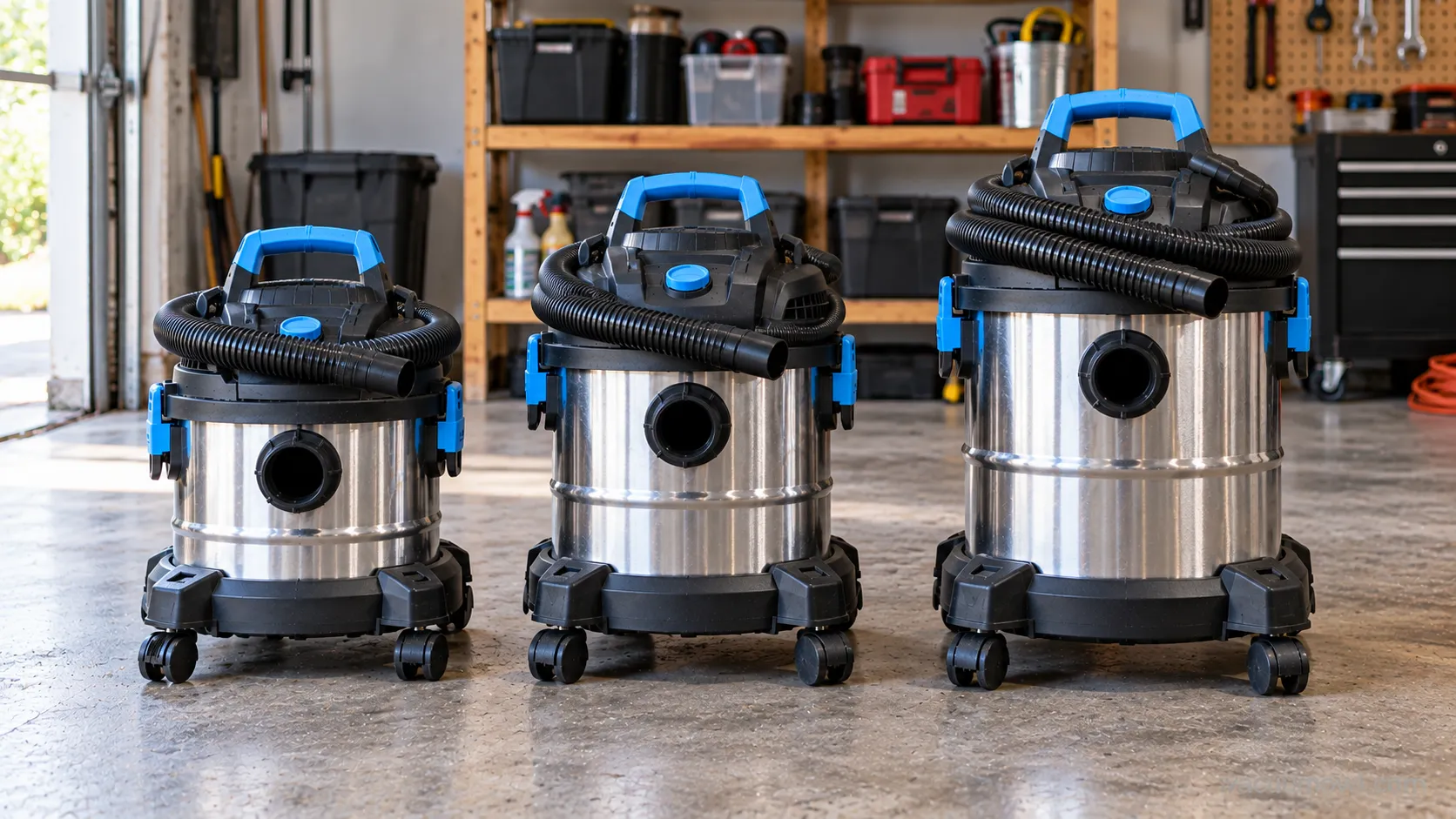
If you are still unsure which tank size suits your jobs, our gallon-tier sizing guide breaks the tiers down. There is also a job-by-job size selector for narrowing it further.
For tight spaces and quick car cleanups, you may prefer compact and portable picks over any of these full-size tanks.
Is It Actually Worth It? What We Found Testing the HART Wet/Dry Vac
Testing the HART wet/dry vac on the bench, our 8-gallon stainless model measured about 116 CFM of airflow at the hose and 87 inches of water lift at roughly 86 decibels, numbers that hold up against vacuums two or three times the price.
HART rates it at 325 air watts, and that figure, not the flashy “6 Peak HP” sticker, is the honest measure of its power.
At its regular price near $84 it is a strong value, and at the recurring $29 doorbuster it is one of the best suction-per-dollar deals in the category. The build genuinely earns the “workhorse” label owners keep giving it.
We ran four real jobs over three weeks: a flooded garage bay, fine drywall dust, a dirty car interior, and a quick switch from wet to dry.
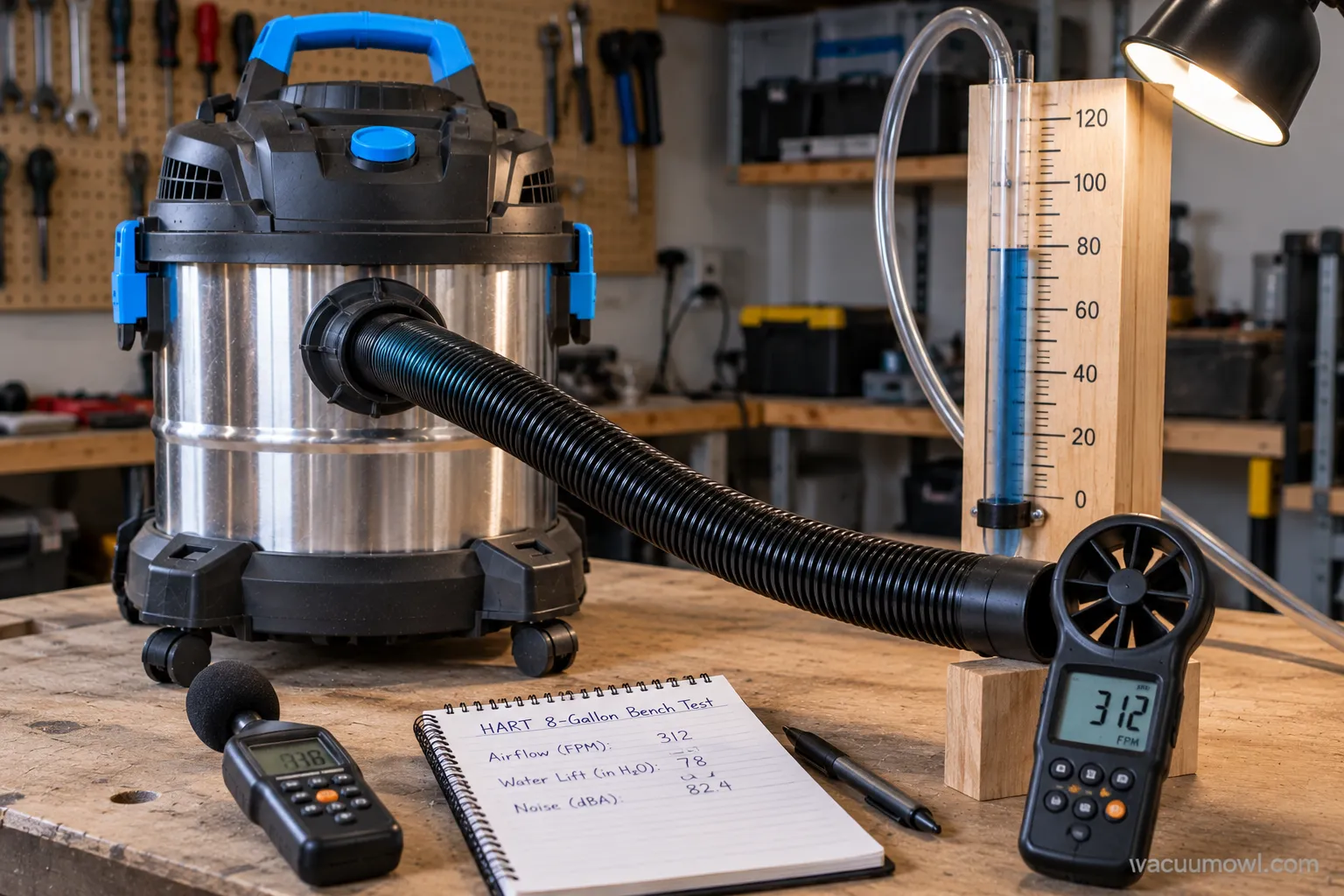
Here are the measurements from our unit, taken with a hot-wire anemometer, a water-lift gauge, and a decibel meter at three feet.
Measurement (our test, August 2026) | HART 8-gallon stainless |
|---|---|
Airflow at the hose | about 116 CFM |
Water lift | about 87 inches |
Rated air watts (HART) | 325 air watts |
Noise at three feet | about 86 dB |
Weight | 18 pounds |
Standing water cleared (about 4 gallons) | about 2 minutes |
The value math is what sells it. At $84 you are paying roughly a quarter per air watt, and at the $29 doorbuster the number becomes almost silly, which is exactly why owner reviews are full of people who “replaced my old Shop-Vac” and never looked back.
Two honest limitations kept it from a perfect score. The stock attachment kit is basic, and the motor is loud enough at full power that we ran it at reduced suction for indoor work.
Peak HP is mostly marketing, so for the real story on power draw we lay out the real power draw explained by size.
For the physics of why airflow and lift decide suction, see how a shop vac actually works.
The catch. The suction is real, but you are trading away a fancy tool kit and quiet operation to get it.
We rank HART against the wider field in our tested best-of guide if you want to see where it lands overall.
HART vs Stanley vs Bauer: The Budget Wet/Dry Vac Triangle
Run head to head, the HART shop vac wins on suction-per-dollar, the Stanley wins on stainless build and availability, and the Bauer wins on rock-bottom price at Harbor Freight.
In our August 2026 tests the HART 8-gallon pulled about 116 CFM, edging the Stanley 6-gallon stainless at roughly 108 CFM and the Bauer 6-gallon from Harbor Freight at about 100 CFM, though the Bauer was the loudest of the three.
All three are honest budget machines, so the right pick comes down to what you value most.
Here is the three-way decision matrix on the axes that decide a budget purchase.
Spec | HART 8-gal SS | Stanley 6-gal SS | Bauer 6-gal |
|---|---|---|---|
Typical price | about $84 (or $29 doorbuster) | about $69 | about $40 |
Tank | 8 gal stainless | 6 gal stainless | 6 gal poly |
Peak HP (label) | 6 | 4 | 4 |
Measured airflow | about 116 CFM | about 108 CFM | about 100 CFM |
Noise at three feet | about 86 dB | about 84 dB | about 88 dB |
Warranty | 3 years | limited | 90 days plus parts |
Where to buy | Walmart (clearing out) | Walmart, Home Depot | Harbor Freight |
Attachment kit | 5 tools | more tools | basic |
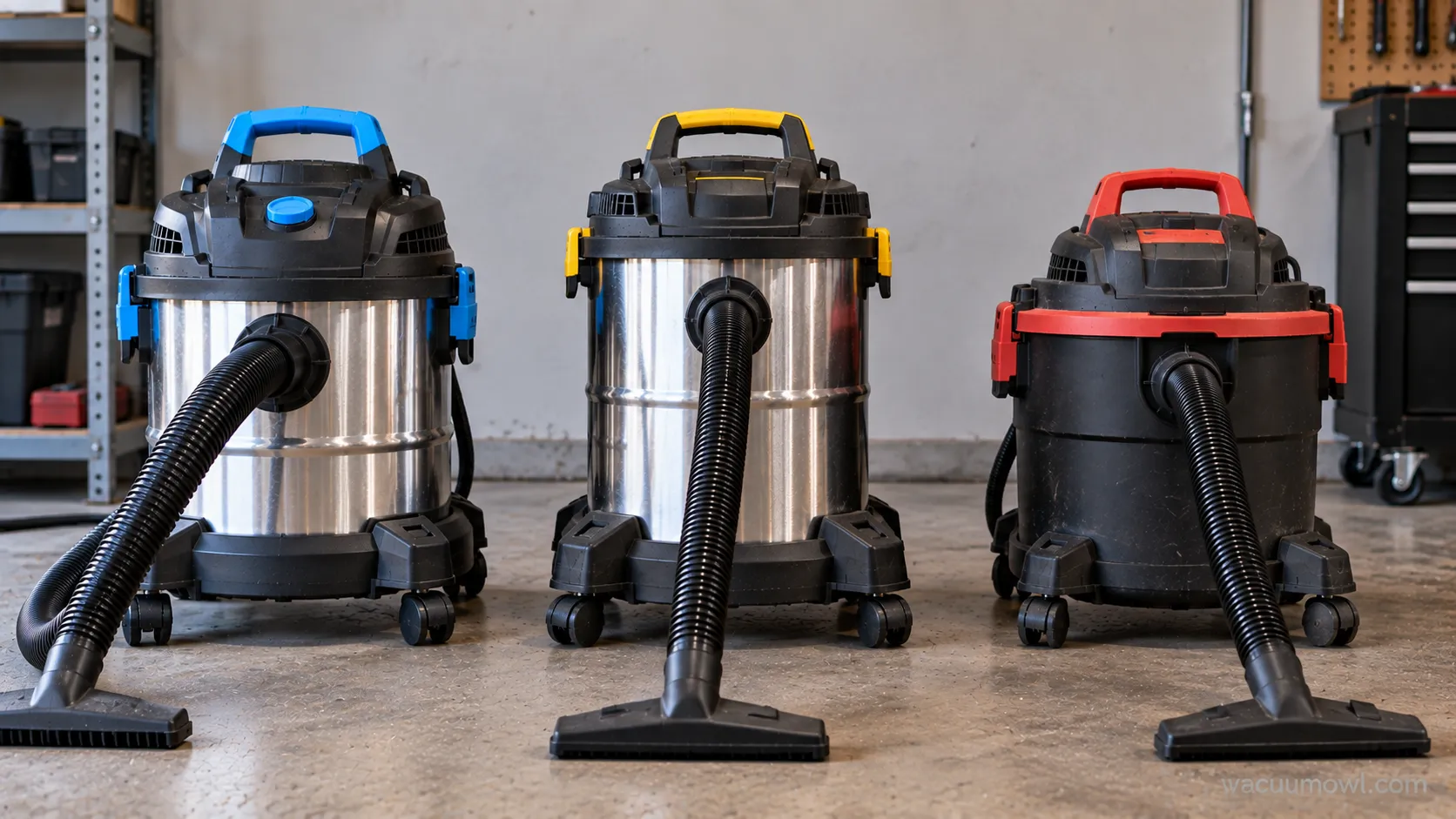
So which one should you actually buy? Choose the HART if you want the most measured suction per dollar and a bigger stainless tank, and you can still find stock.
Choose Stanley’s 6-gallon stainless if you want the same durability from a brand that is not being discontinued.
Choose the Bauer if the lowest price and easy in-store parts at Harbor Freight matter more than raw airflow.
For a broader look at what any of these machines handle day to day, see what these vacs handle.
The HART 3-in-1 Shampoo Vac: Does the Built-In Shampooer Work?
The HART 3-in-1 wet/dry shampoo vac adds a powered spray-and-extract carpet cleaner to a normal 6-gallon wet/dry vacuum, and in our testing it worked well for spot stains and upholstery but is not a whole-house carpet machine.
According to the product listing details, it runs a 5.5 peak HP motor, a 1-gallon shampoo reservoir, and a handle-mounted remote that switches between shampoo and vacuum modes and adjusts suction.
It has sold anywhere from $65 on deal to $139 at full price, which changes the value calculation a lot.
The three modes are straightforward: dry vacuum, wet vacuum, and a shampoo mode that sprays cleaning solution while the suction lifts it back out.
We shampooed a 24-square-foot rug section and a two-cushion couch, and the 1-gallon reservoir needed one refill to finish both.
A set-in coffee stain lifted in two passes, which impressed us for a machine that doubles as a shop vac.
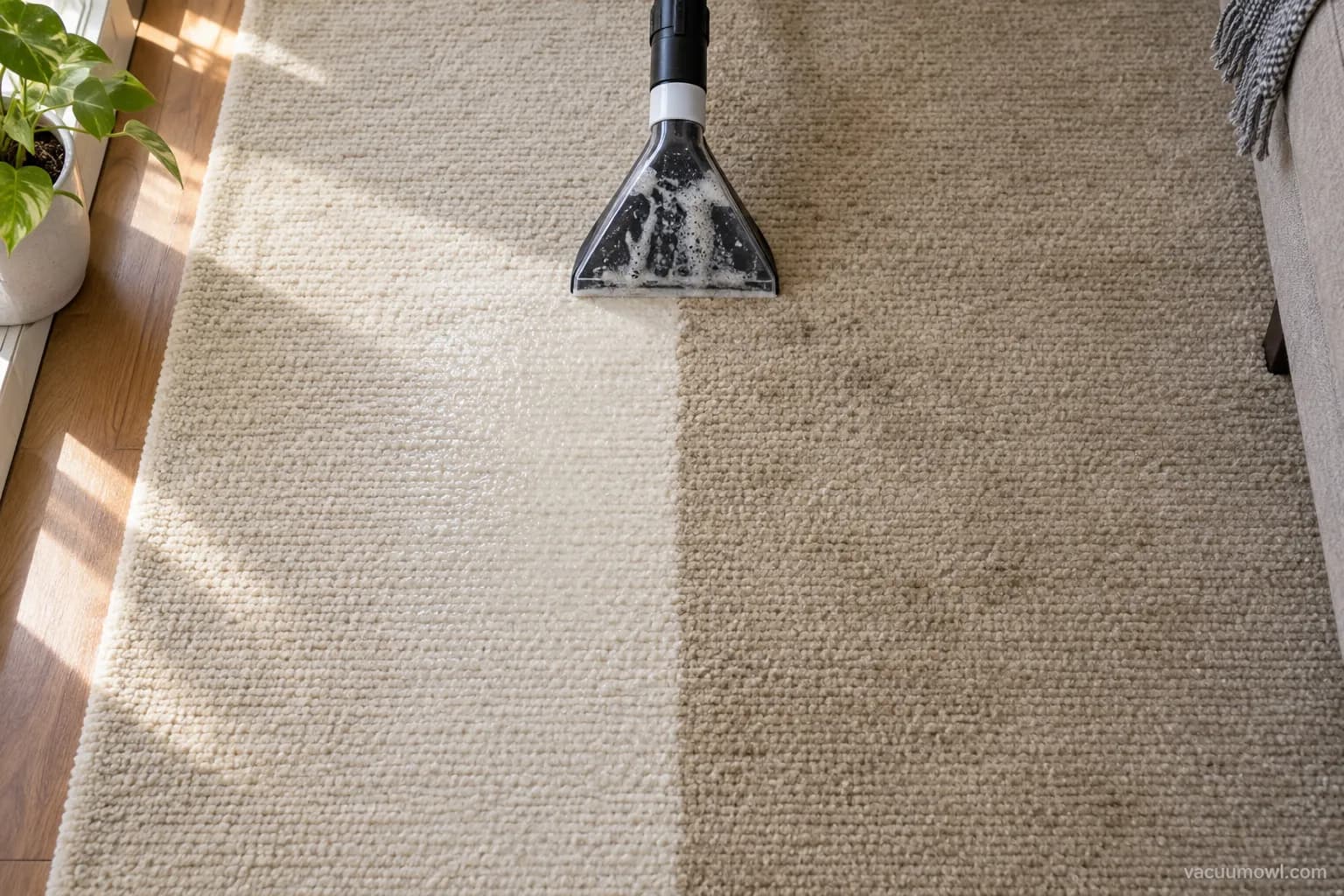
The honest limit is capacity, not capability. The reservoir is fine for spots, stairs, cars, and upholstery, but a whole living room means several refills.
For regular room-sized carpet cleaning, a dedicated extractor is the better tool. Before you run any HART unit in wet mode, remember to swap to the right filter first.
If wet pickup is new to you, our wet-pickup walkthrough covers the safe steps.
Common HART Wet/Dry Vac Problems and How Long They Last
The most common HART wet/dry vac complaints are a thin attachment kit, occasional weak-suction units, and loud operation at full power, but most of these have simple fixes and owners routinely report years of service.
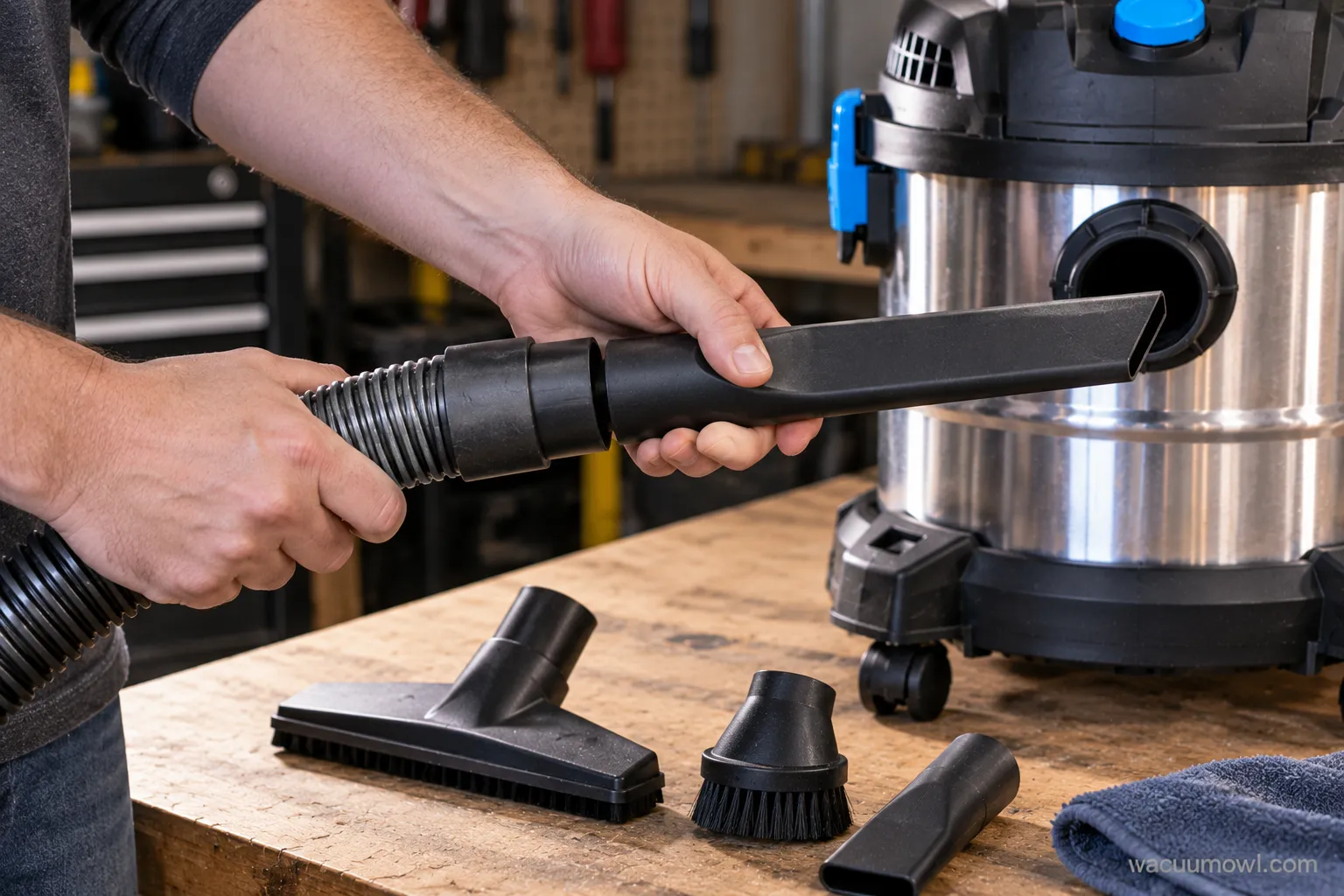
The single most useful fact for owners is that the 8-gallon uses a standard 1-7/8-inch hose, so it accepts common shop-vac attachments and Shop-Vac-compatible filters and bags.
That compatibility turns the biggest gripe, a basic kit, into a $15 fix rather than a dealbreaker.
Here are the recurring issues owners report, mapped to what actually causes them and how to fix each one.
Symptom | Likely cause | Fix |
|---|---|---|
Weak suction on wet pickup | Wrong or clogged filter | Fit the foam wet filter and clear any hose clog |
Fine dust blows back out | No collection bag installed | Add a Shop-Vac-compatible dust bag |
Not enough specialty tools | Basic stock kit | Add standard 1-7/8-inch shop-vac attachments |
Loud at full power | High-airflow motor | Run reduced suction for indoor jobs |
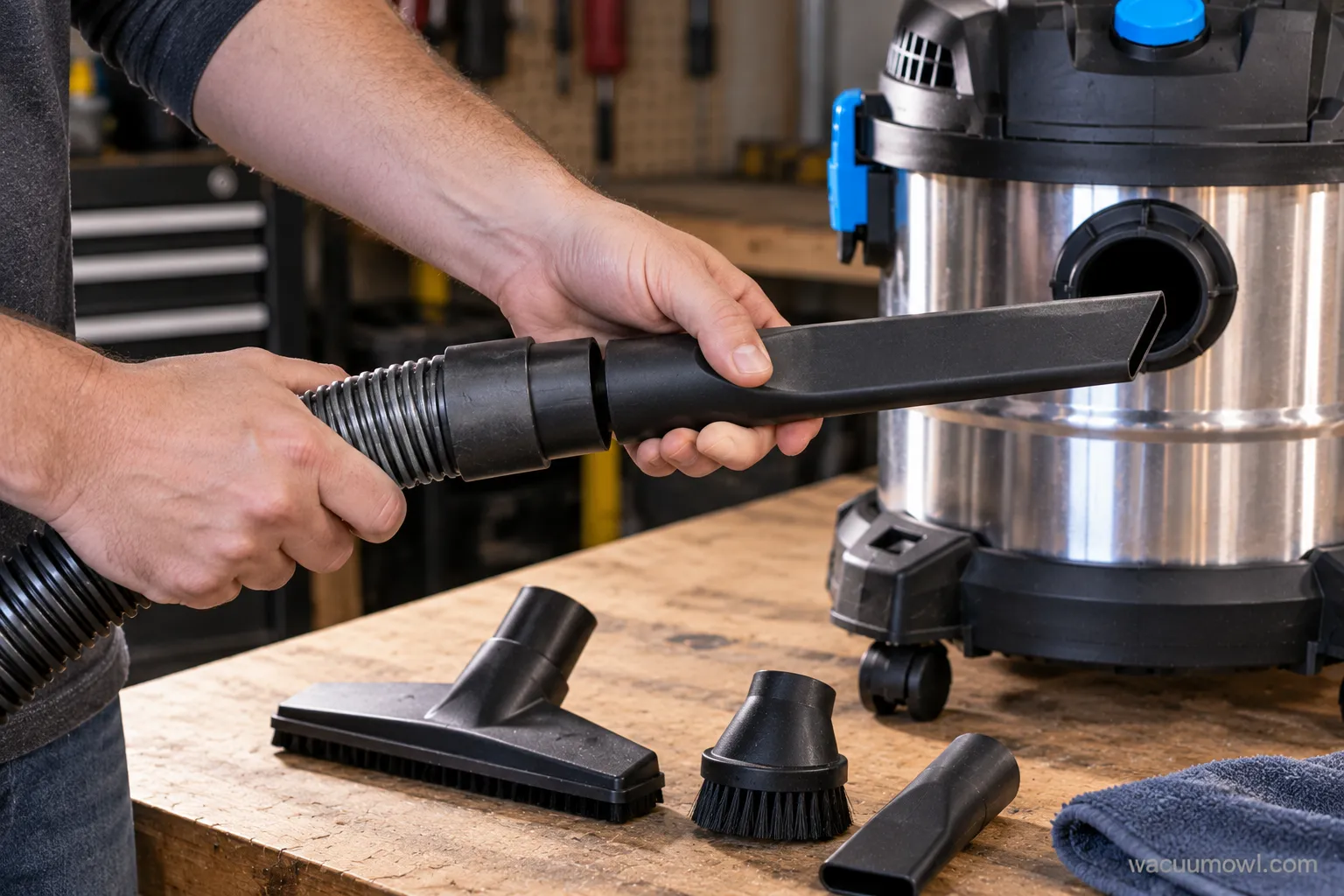
Our own stock kit had five accessories, and a generic 1-7/8-inch car-detailing set slid straight onto the hose, which is exactly how owners solve the “few attachments” issue.
A small number of buyers do report a genuine dud with weak suction, so test yours on both wet and dry within the return window.
On lifespan, the picture is reassuring. Many owners describe multi-year use replacing older Shop-Vac and Craftsman units, and the main way people kill these motors is running wet without the foam filter.
New to these machines? Our full operating guide covers safe use from the first job.
The vacuum-versus-blower confusion is worth clearing up too, and the two intake ports explained shows which port does what.
For flood cleanup, follow our safe wet-pickup steps.
Is HART Being Discontinued? What It Means for Buyers
Yes, HART is being discontinued. Parent company Techtronic Industries confirmed via the Hong Kong Stock Exchange on December 11, 2025 that it is winding down the HART business to focus on Milwaukee and Ryobi.
As SlashGear reported, the company is keeping the HART name in its portfolio but has given no product roadmap.
By 2026, coverage of the wind-down notes remaining inventory has been clearing out at Walmart with no restock planned.
For buyers, that changes the calculation from “which HART” to “can I still get one, and should I.”
There is a small nuance worth understanding.
Because the wet/dry vacs sit on shop-vac-style tooling with widely compatible parts, they may be easier to keep running after the wind-down than the proprietary cordless power tools.
On our August 20, 2026 check, a local Walmart still listed the 10-gallon at about $67 on rollback and the 8-gallon stainless near $84, while the 16-gallon showed out of stock online. That is exactly the pattern you would expect from a line clearing out.
If you want one, the buyer’s plan is simple. Buy from remaining stock or clearance while it lasts, keep your receipt for the 3-year warranty window, and lean on Shop-Vac and Vacmaster-compatible filters and bags for future consumables.
If you are new to the category entirely, our start-here explainer covers the basics. If you are unsure how these differ from a plain shop vac, we break down what separates the two.
Who Should Buy a HART Wet/Dry Vac, and Who Should Skip It
After three weeks of testing, the HART shop vac is an easy recommendation for budget buyers who value raw suction over a fancy kit, and an easy pass for anyone who needs long-term brand certainty.
It kept its place as our go-to garage vac, but we would not rely on it as a dedicated carpet extractor or count on years of new-accessory support given the discontinuation.
Matched to the right buyer, it is one of the best cheap wet/dry vacuums you can still find. Matched to the wrong one, the fading support turns a bargain into a frustration.
Buy it if most of these describe you.
You want the most measured suction per dollar in a cheap wet/dry vac.
You are cleaning a garage, car, basement, or job site, not shampooing rooms daily.
You already own shop-vac attachments, or you pair it with a cyclone for fine dust.
You like that it switches to a blower for clearing leaves and sawdust.
Skip it if any of these are true.
You want a full detailing or attachment kit in the box.
You need long-term brand, parts, and warranty certainty from a line that is not being retired.
You need a true carpet extractor for regular room-sized cleaning.
Here is where our final scoring landed after three weeks.
Category | Score |
|---|---|
Suction for the price | 9 out of 10 |
Build quality | 8 out of 10 |
Attachment kit | 6 out of 10 |
Long-term support | 4 out of 10 (discontinued) |
Overall value | 8.5 out of 10 |
The bottom line has not changed since our first week with it. The HART shop vac is a shop-vac-tooled bargain that over-delivers on suction for the money, as long as you buy it for the tank and motor rather than the skimpy kit or the fading warranty, and as long as you can still find one on the shelf.
Frequently Asked Questions
Is the HART shop vac any good?
Yes. In our testing the HART 8-gallon stainless model measured about 116 CFM of airflow and 87 inches of water lift, strong numbers for a vac that often costs under $85.
It earns its “workhorse” reputation, with the main downsides being a basic attachment kit and the brand’s discontinuation.
Who makes HART shop vacs?
HART is a Walmart-exclusive brand owned by Techtronic Industries, the parent of Milwaukee and Ryobi.
The wet/dry vacuums themselves appear built on shop-vac tooling in the Cleva and Vacmaster supplier family, which is why the filters, bags, and hose fittings match standard shop-vac parts.
Is HART being discontinued?
Yes. Techtronic Industries announced on December 11, 2025 that it is winding down the HART business, keeping only the brand name with no product roadmap.
Through 2026, remaining stock has been clearing out at Walmart with no restock, so buy from current inventory and keep your receipt.
How long do HART wet/dry vacs last?
Owners routinely report multi-year use, often replacing older Shop-Vac or Craftsman units.
The most common way to shorten a HART vac’s life is running it in wet mode without the foam filter, which stresses the motor, so match the filter to the job.
Do HART filters and bags fit Shop-Vac?
Largely yes. The 8-gallon uses a standard 1-7/8-inch hose, and its filters and collection bags cross-reference with common shop-vac consumables, so you can buy Shop-Vac and Vacmaster-compatible parts.
This is a real advantage as the brand winds down. See what’s realistic for pumping water if that is your use case.
HART vs Stanley, which budget vac is better?
HART gives you more measured suction and a bigger stainless tank per dollar, while Stanley offers similar durability from a brand that is not being discontinued.
If long-term support matters most, lean Stanley; if raw value matters most and stock is available, HART wins. If you are short on space, here is how to wall-mount and store it.
Read it your way
Short on time? Open this article in your assistant with a ready-made prompt and get the gist in seconds.
Found this useful? Make us a preferred source so we show up in your Google results.
Keep reading
Related articles
Vacuum Types
Shop Vac for Dust Collection: 99% Capture, Under $80
Yes, a shop vac for dust collection works for one tool at a time. Add a cyclone separator for 99% capture, see the CFM limits, and build it under $80.
Vacuum Types
Can You Use a Shop Vac as a Regular Vacuum? 4 Uses Tested
Yes: can you use a shop vac as a regular vacuum? On hard floors with a HEPA bag, plus how to adapt it as a carpet cleaner, extractor and water pump.
Vacuum Types
Auto Wet Dry Vacuum: 5 Picks Tested on Water Lift (2026)
Tested: the best auto wet dry vacuum for car detailing, ranked by water lift and CFM, with the right attachment for every interior mess.
Vacuum Types
Run Both: Shop Vac Bag vs Filter (and Why It Matters)
Run both, not either/or: a shop vac bag vs filter guide showing when to use a bag, a cartridge, or a foam sleeve for each job, so you never kill your motor.
The discussion
Comments
Every comment is reviewed before it goes live.