Two Holes, One Job: Shop Vac Blower Port Explained
See what the shop vac blower port does: the rear exhaust hole that makes your vac blow. Which hole to use, plus the drain-cap mix-up explained.
Written by Dr. Naomi TranReviewed by Dale FerrisLast updated on August 19, 2026
When you buy through links on our site, we may earn an affiliate commission (at no extra charge), which we use to fund new product tests. Learn more.
Read it your way
Short on time? Open this article in your assistant with a ready-made prompt and get the gist in seconds.
Found this useful? Make us a preferred source so we show up in your Google results.
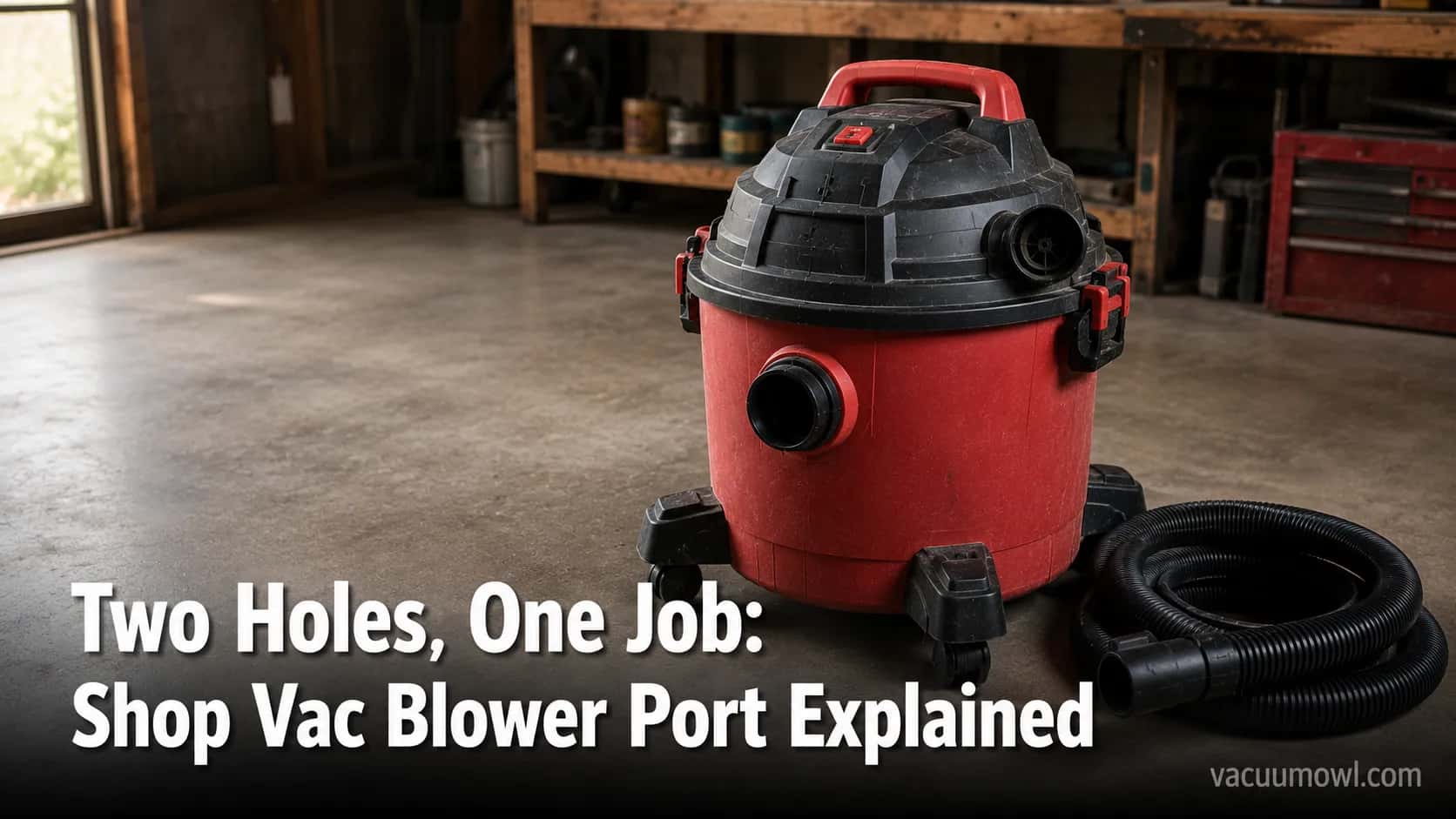
Stare at the back of a wet/dry vacuum and you will find a second opening that has nothing to do with the hose you already use. That extra hole is the shop vac blower port, and it is not a mystery, a defect, or a cooling vent.
A shop vac has two holes because it does two jobs. One pulls air in, and the other pushes air out, and that second one can double as a blower.
Shop Vac Two Holes: The 30-Second Answer
A shop vac has two holes because it does two jobs. One is the intake, where the hose pulls air and debris in. The other is the exhaust, the same air the motor pushes back out, and on many models that exhaust is a usable blower port. To vacuum, connect the hose to the intake. To blow, move it to the blower port at the top or rear of the motor head.
The front or side hole is the intake (suction). The top or rear hole is the exhaust, which doubles as the blower. The low cap at the bottom of the tank is the drain, and the hose never goes there.
The rule almost never changes: the hole you already vacuum with is the intake, and the quieter opening near the motor is the exhaust. If you want to see it on your own machine, the labelled photo further down points to every opening.
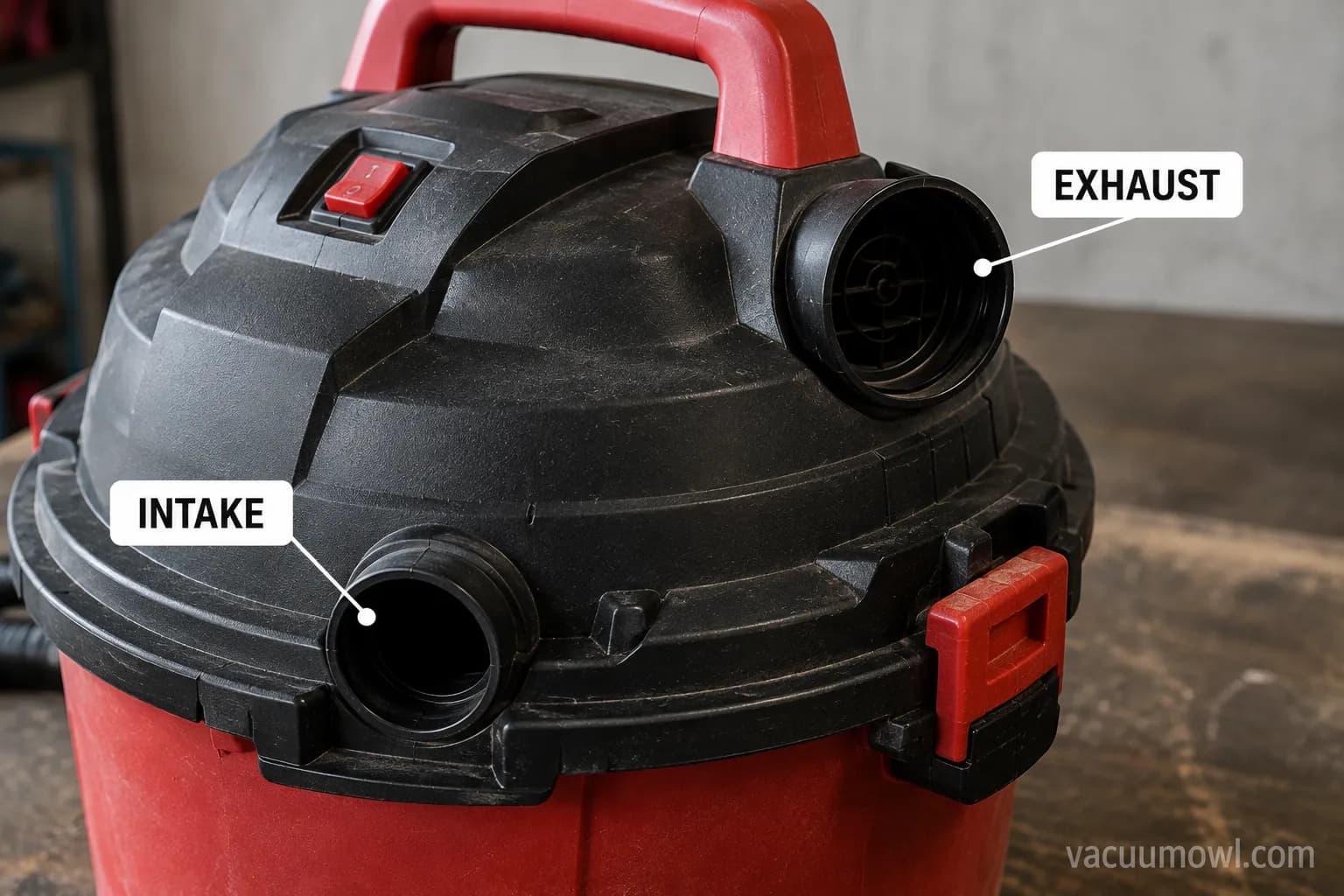
On the three vacs on our bench, the intake was always the front or side port we already reached for, and the second, quieter opening near the motor was the exhaust. One honest caveat before you go looking: not every shop vac’s exhaust is built as a usable blower port, and the model check later in this guide covers how to tell.
Shop Vac Blower Port: What It Is and Where to Find It
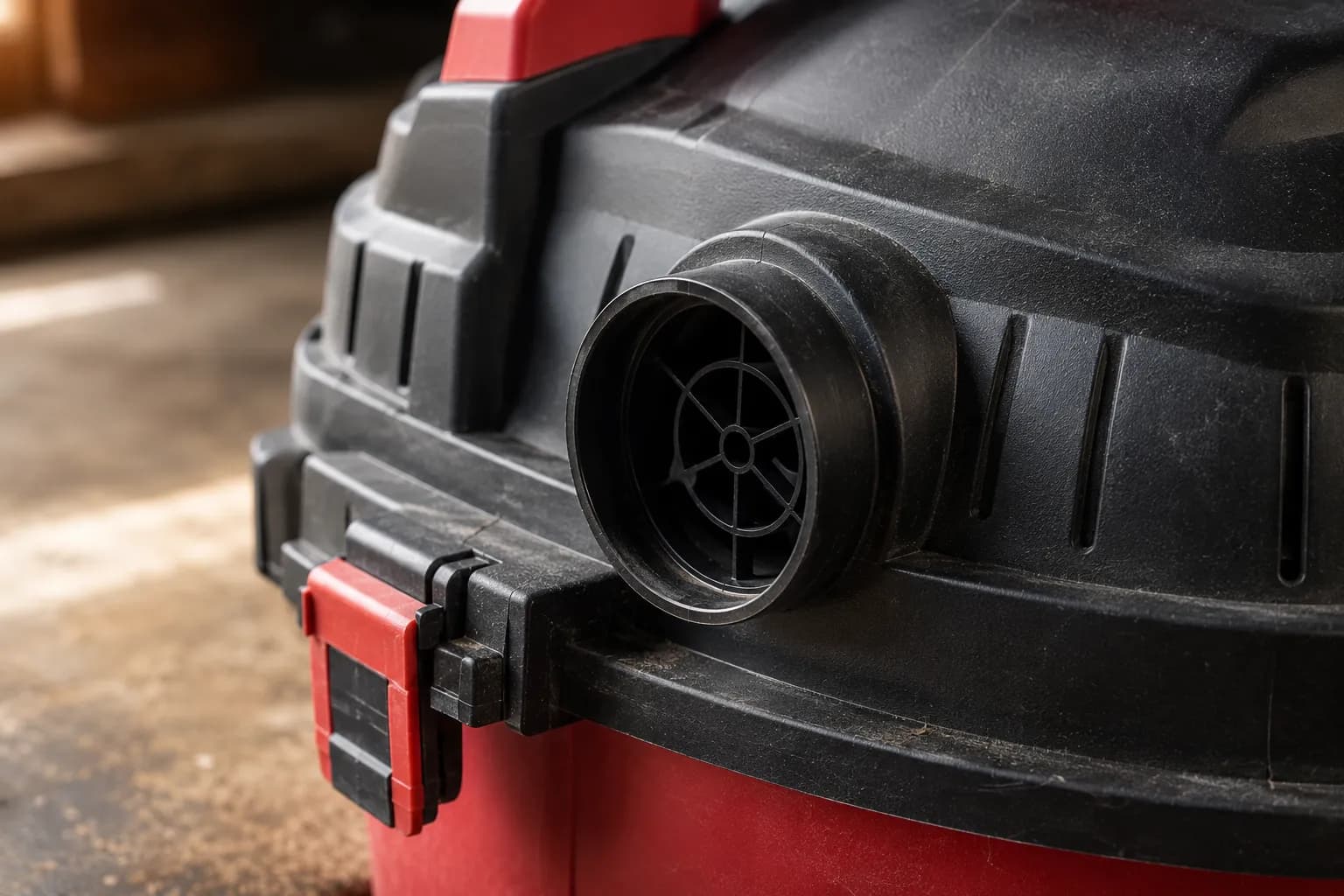
The shop vac blower port is the motor’s exhaust outlet, shaped so a hose can twist into it. It usually sits at the top or rear of the motor head, separate from the front intake you connect the hose to for suction.
Because a vacuum motor pushes out the same volume of air it pulls in, that exhaust can double as a blower. Shop-Vac’s own FAQ puts it plainly: this is the blower port, and you can connect your hose to it and use it to blow leaves or grass clippings.
Three names describe the same opening: blower port, exhaust port, and outlet. They all point to the spot where filtered air leaves the machine.
On our Shop-Vac unit the blower port is a smooth-lipped opening on the back of the motor housing. On the RIDGID NXT it is the entire detachable head, which is a different design for the same idea.
That reversed-airflow trick is exactly what lets you use it for using it to blow air. If you want the full step-by-step, we cover the full 30-second conversion separately so this guide can stay focused on the anatomy.
One thing it is not: the blower port is never the bottom drain cap. Those are two different openings, and the difference gets its own section below.
Intake vs Exhaust: How the Two Ports Move Air
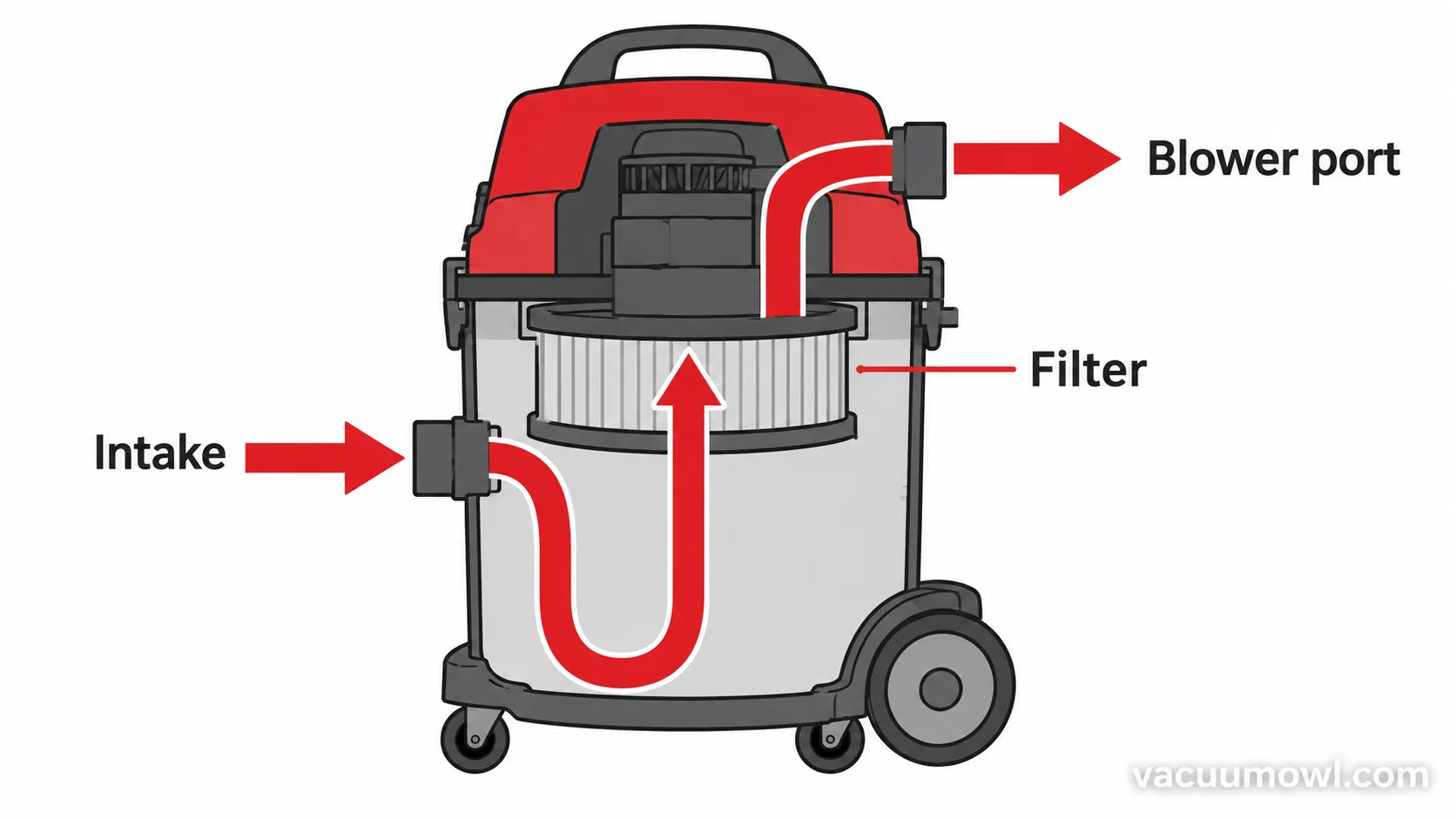
A shop vac has two holes because a vacuum motor both pulls air in and pushes it out. Spinning an impeller drops the pressure at the intake, so air and debris rush in through the hose.
The debris drops into the tank and the filter catches the fine stuff, and the now-clean air leaves through the exhaust. That exhaust is the blower port, so moving the hose there makes the same airflow blow outward instead of pulling in.
Why does a shop vac have two holes?
The short version is that the machine is a one-way air pump with an entrance and an exit. Air and debris enter at the intake, the tank and filter separate the mess from the air, and clean air exits at the exhaust.
As one engineering breakdown describes it, the motor and impeller move air out of the drum and create the pressure difference that drags debris in through the intake. The exit for all of that moving air is the blower port.
Want proof you can feel? Hold your hand a few inches from the exhaust while the vac runs, and you will feel the full airstream leaving. That is the blower already doing its job, even while the machine is vacuuming.
If you want the full motor-and-suction picture, we break the mechanics down separately. And for a plain-English primer on what these machines actually are, start there and come back.
A Labelled Look at Every Port and Cap on Your Vac
A shop vac has four openings worth knowing. The intake is the front or side port where the hose connects for suction. The blower port is the motor’s exhaust, usually at the top or rear.
The drain cap sits at the bottom of the tank to empty water, and inside the lid a float cage holds a valve that shuts off suction when the tank fills. Only the intake and the blower port ever take the hose.
We shot the same four callouts on three different vacs so you can match the layout no matter which brand you own. Here is the same information as a table you can scan against your own machine.
Part | Where it sits | What it does |
|---|---|---|
Intake (inlet) | Front or side of the tank | Where the hose connects to pull air and debris in |
Blower port (exhaust) | Top or rear of the motor head | Pushes filtered air out and takes the hose for blow mode |
Drain cap | Lowest point of the tank | Twists or pulls open to empty water, never takes the hose |
Float cage | Inside the lid, above the filter | Holds the float that cuts suction when the tank fills |
Filter | Around the motor inlet, under the lid | Traps dust so clean air reaches the exhaust |
To find yours, look front or side for the intake, top or rear for the blower port, and bottom for the drain. The float cage protects the motor, but the filter is what keeps dust out of the exhaust.
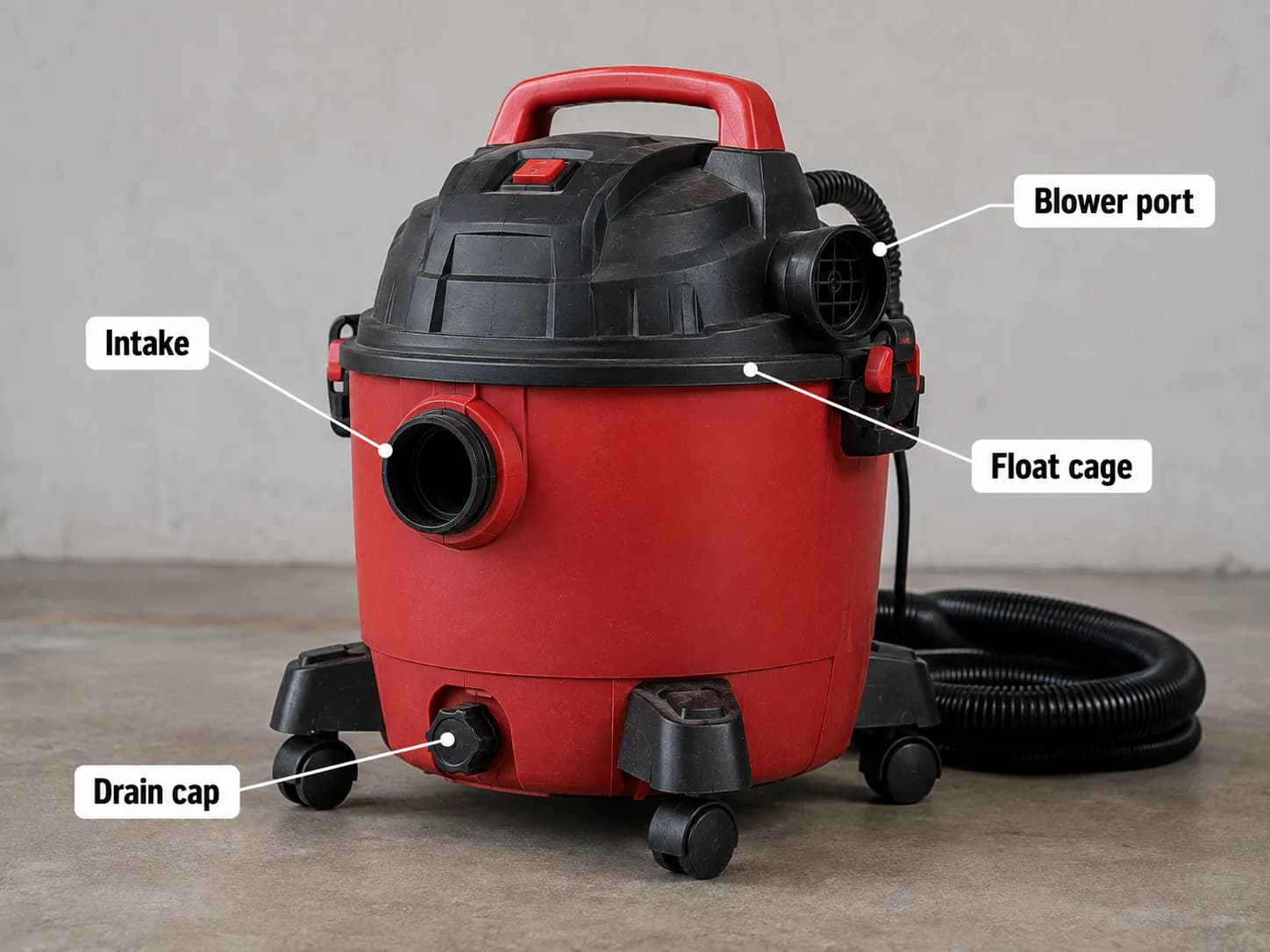
Intake diameters differ between models, which matters when you are matching a hose or an accessory. Each nozzle and wand clips onto that same intake, never onto the drain.
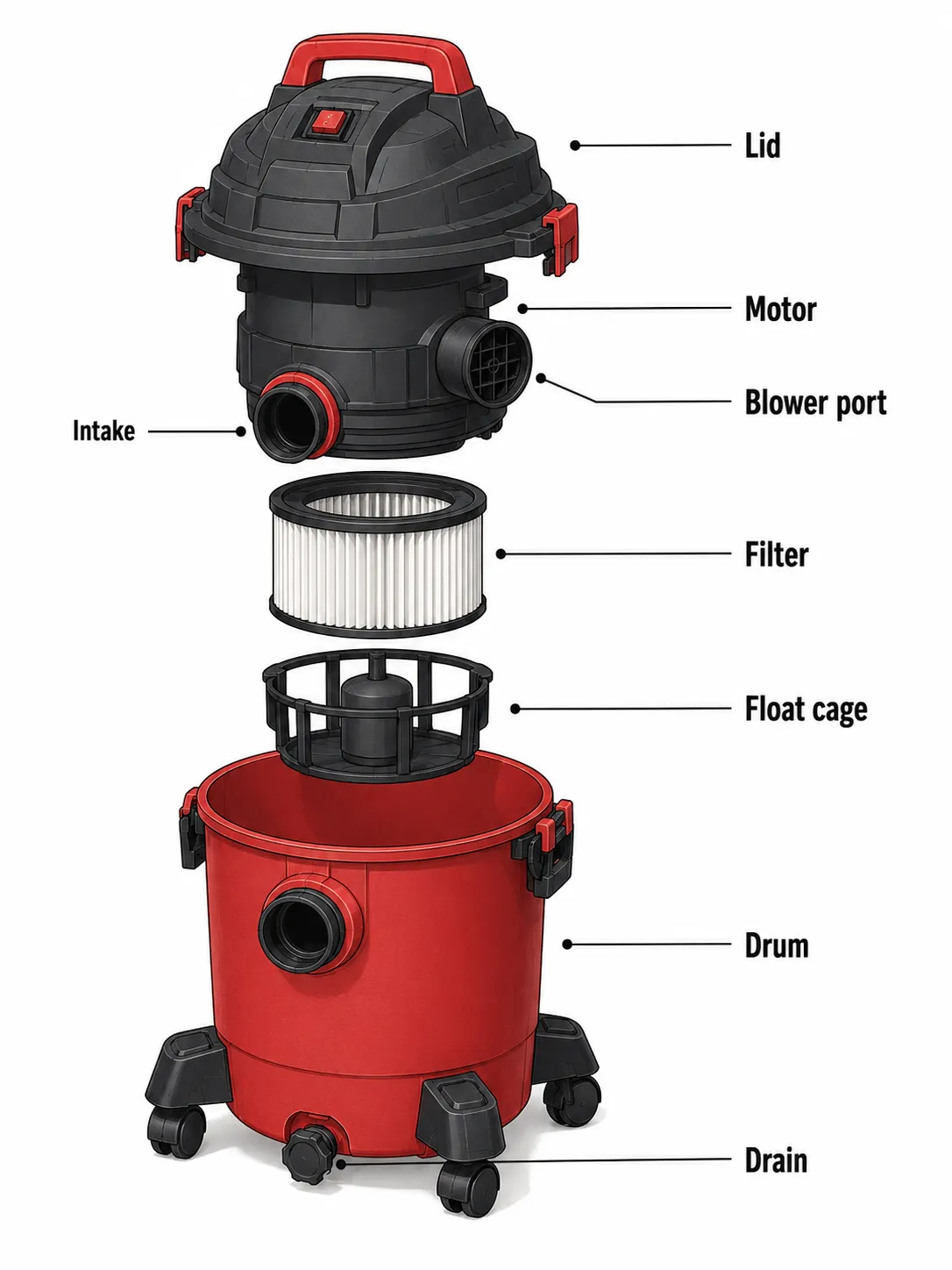
Layouts vary: your drain may be a twist cap or a pull plug, and a few small units skip a proper drain entirely so you tip the tank.
Blower Port vs Drain Cap: The Two Holes People Mix Up
The blower port and the drain cap are two different holes people mix up. The blower port is the motor’s exhaust, high on the top or rear of the head, and it accepts the hose for blowing. The drain cap is low on the tank, threaded or tethered, and it exists only to empty water. The simple rule: if an opening is near the bottom, it is the drain, not the blower port.
The mix-up happens because both are round openings on the same body. Telling them apart takes one glance once you know the tell.
Feature | Blower port | Drain cap |
|---|---|---|
Position | High, top or rear of the motor head | Low, at the bottom of the tank |
Feel | Smooth-lipped and hose-sized | Threaded or tethered plug |
Job | Pushes air out and takes the hose to blow | Empties water and never takes the hose |
Manufacturers put the drain at the lowest point on purpose so gravity empties the tank. RIDGID’s own spec sheet describes an oversized drain located at the lowest point of the drum for emptying water.
On our RIDGID the drain is a large low twist cap, while the blower port is the entire detachable head up top. Once you see both on one machine, they are impossible to confuse.
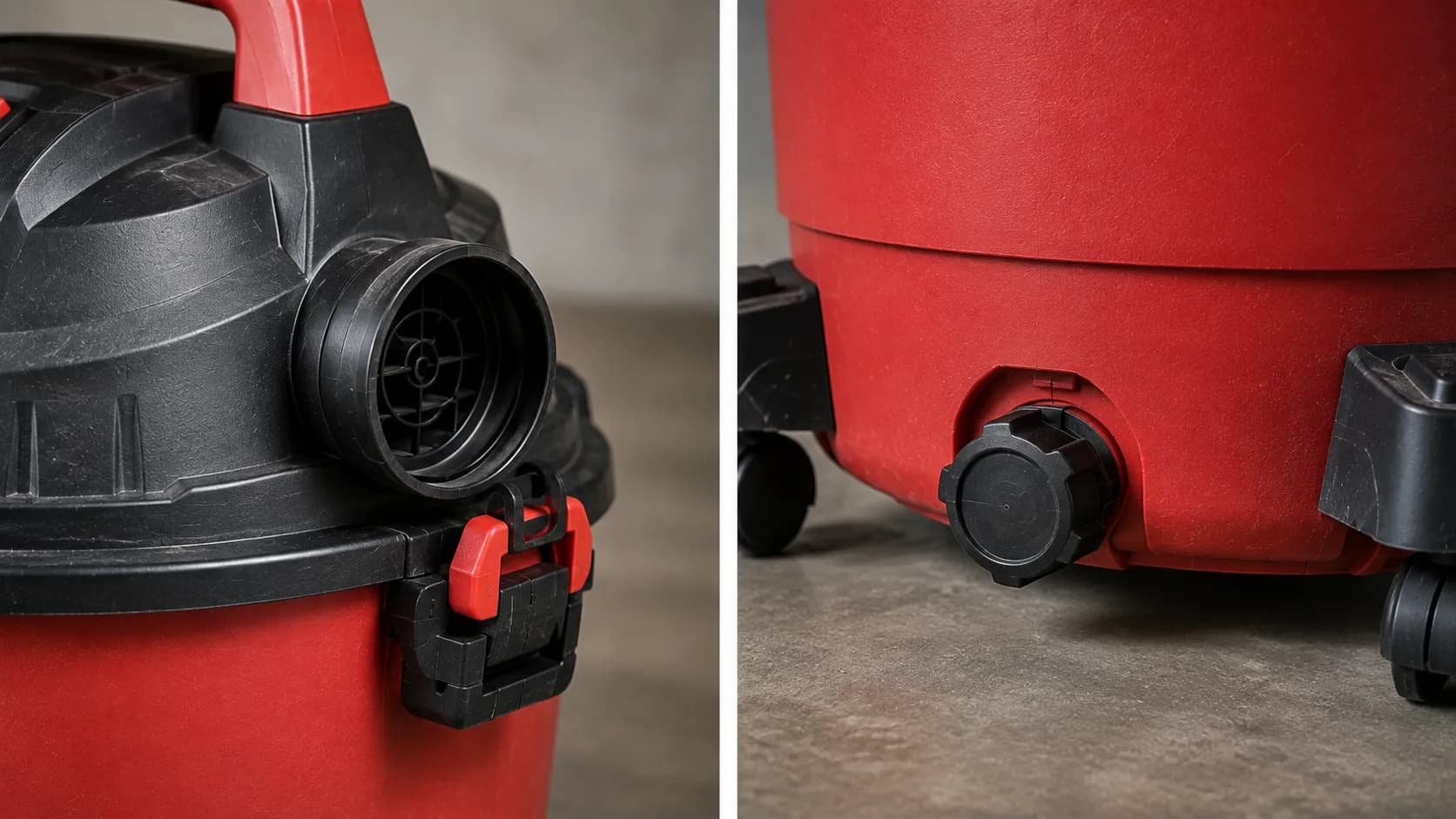
The drain and the removed filter both matter when you’re picking up water, since a wet pickup changes how you set the machine up. For big volumes, some models add a real pump instead of relying on a gravity drain.
Does Your Shop Vac Even Have a Blower Port?
Not every shop vac has a blower port. Three patterns exist. Many mid-size Shop-Vac models have a fixed exhaust port at the rear that accepts the hose. RIDGID’s NXT line uses a detachable power head that twist-locks onto a blowing wand.
Some small or budget units are suction-only and cannot blow at all. To check yours, look for a second hose-sized opening on the motor head, or test the hose in the exhaust while the vac runs.
Model type | How it blows | Example |
|---|---|---|
Fixed rear blower port | Move the hose to the rear exhaust port | Many mid-size Shop-Vac models |
Detachable blower head | Pop off the head and fit the locking blower wand | RIDGID NXT 12 and 16 gallon |
Suction-only | Cannot blow, no usable exhaust port | Many small or budget units |
Our Shop-Vac’s rear port took the hose directly. The RIDGID needed the head popped off and the blowing wand fitted, which is a genuinely different workflow.
RIDGID describes its NXT line as an all-electric blower that detaches from the top of the vac and attaches to an included locking blower wand. There are also smaller two-in-one machines, like a 2-in-1 handheld model, that split into a portable blower.
Tank size is a decent hint here, because bigger tanks usually pair with stronger motors, which changes how each type blows. If you are still choosing a machine, size drives most of this and is worth settling first.
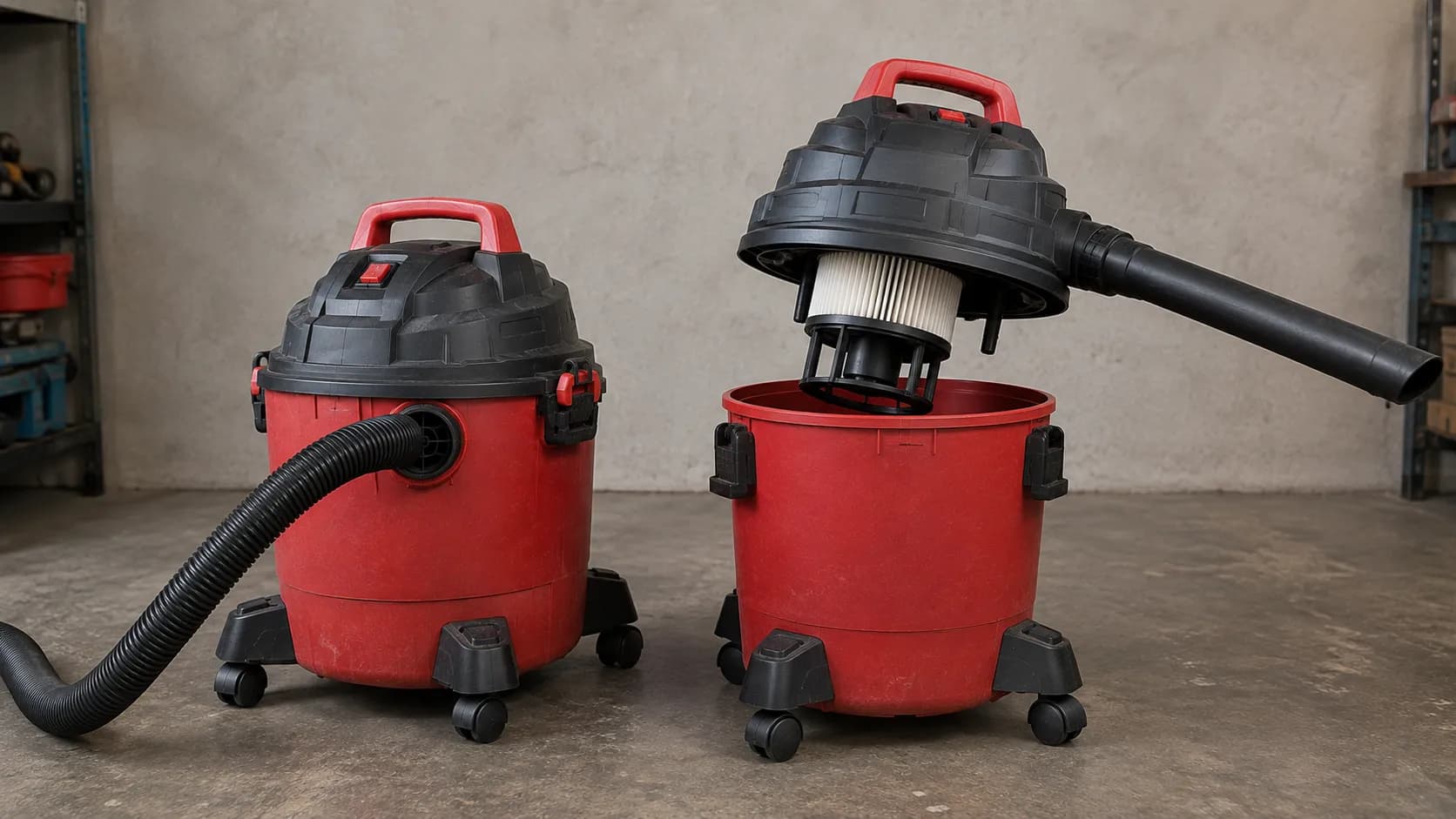
Tank material affects durability more than blowing, so tank material matters mainly for the long haul. However yours blows, storing it off the floor keeps the ports clean and the hose kink-free.
Peak-HP labels mislead: a bigger horsepower number does not promise stronger blowing, because airflow, not the label, decides how hard a vac pushes air.
How to Switch the Hose to the Blower Port
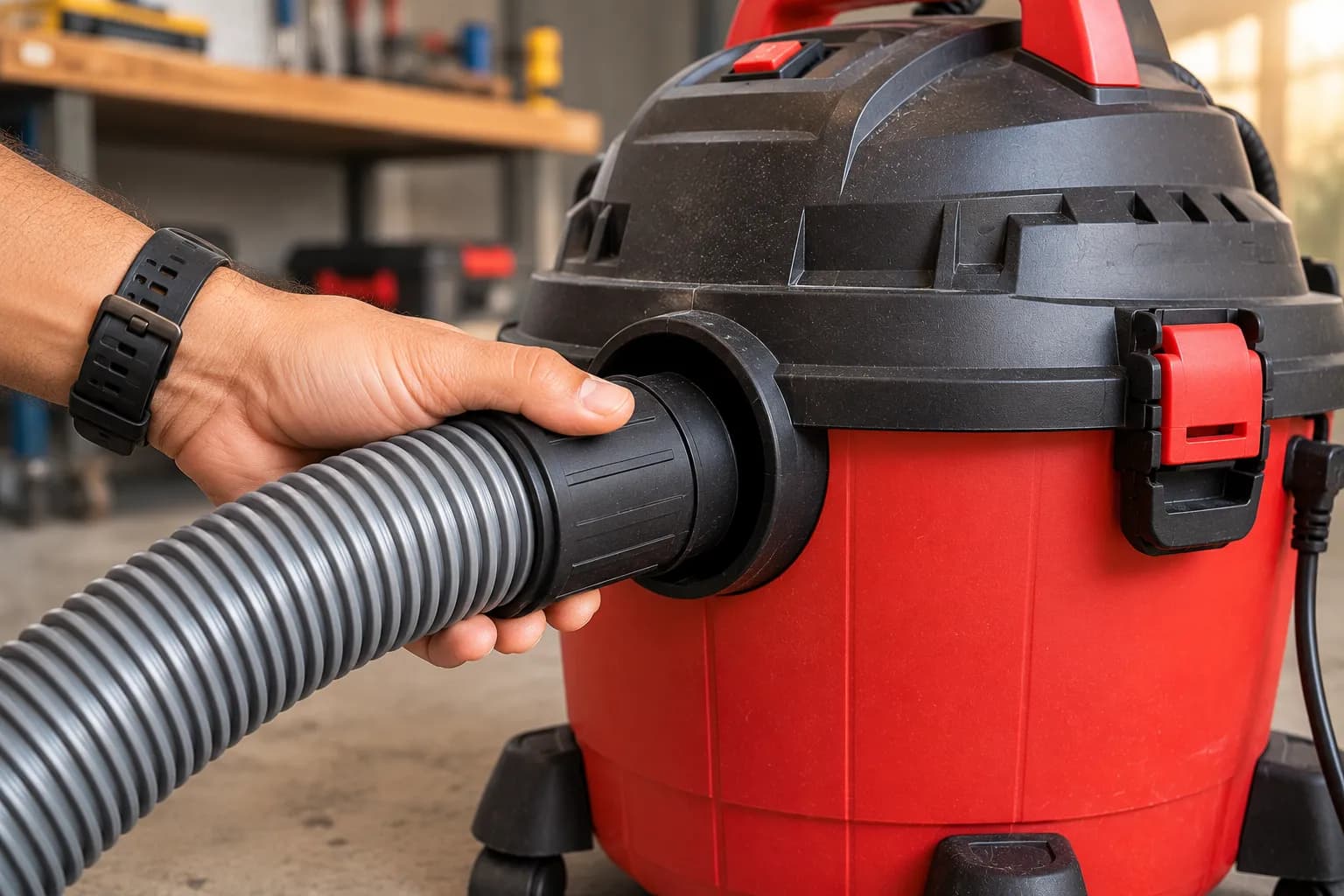
To use the blower port, empty the tank first so nothing sprays out, then move the hose from the intake to the blower port and twist to lock. On many models the intake closes automatically once the blower port is in use. If your vac has a detachable head, pop it off and fit the locking blowing wand instead, and the same motor now blows a focused stream of air.
As Today’s Homeowner shows, the whole switch is moving the hose from the vacuum port to the exhaust. Here is the short version:
Empty the tank of debris and water so blowing does not scatter it everywhere.
Pull the hose off the intake and seat it in the blower port, or detach the head and fit the blowing wand.
Note whether your intake flap closes on its own, which many models do.
Switch on, and check whether to keep or pull the filter depending on how fine your debris is.
On our unit the intake flap snapped shut the moment the hose seated in the blower port, so there was no need to cap it. Hunker’s RIDGID walkthrough describes the same behavior, noting the vacuum port closes automatically once the hose is in the blower port.
Clear the tank first: blowing kicks up whatever is sitting inside, so empty it before you start.
Blowing is only one of the many jobs these machines handle, and it is worth knowing where it fits. If you want maximum blowing force, airflow specs matter more than the horsepower on the box.
Blower Port Caps, Covers and Diffusers: Do You Need One?
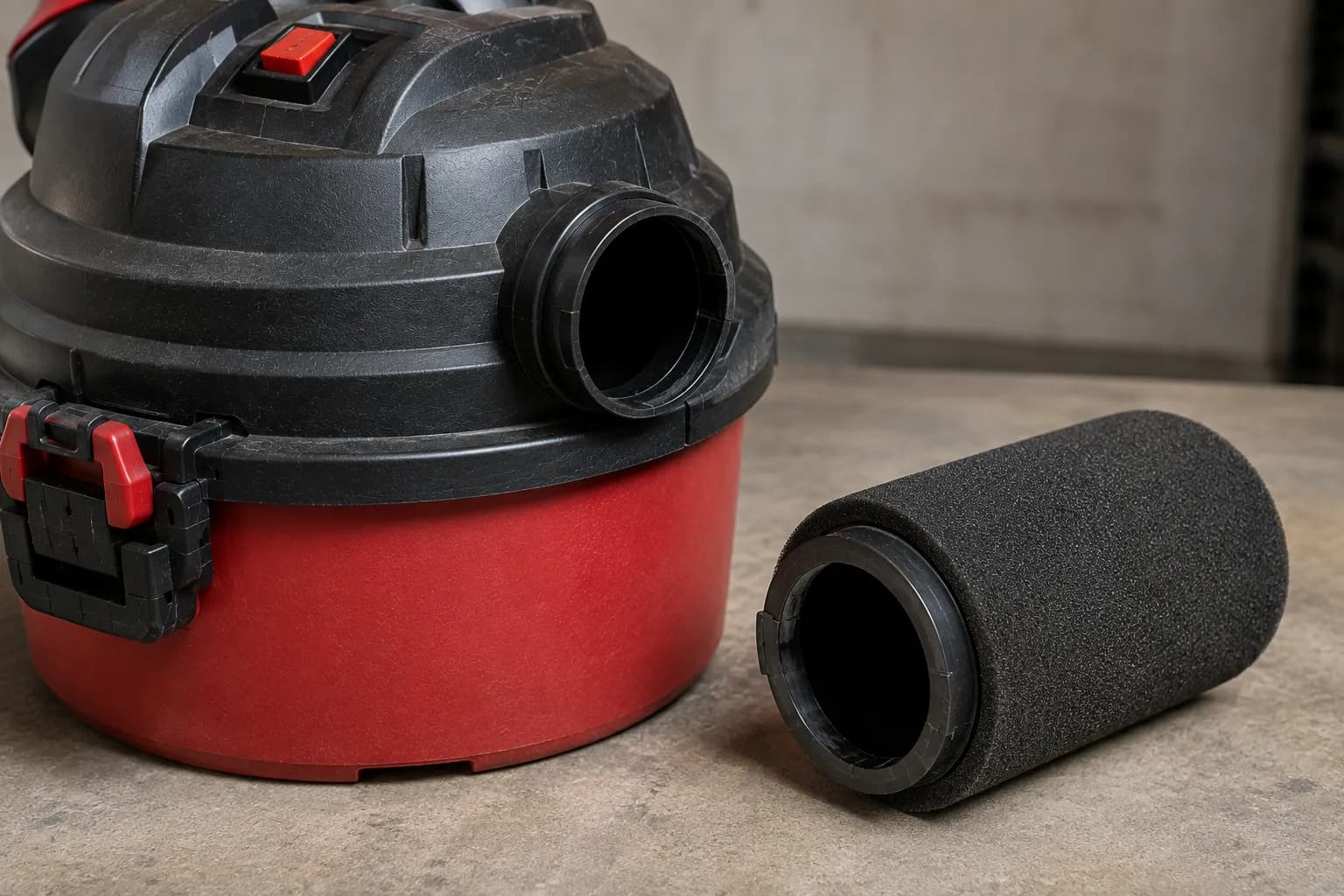
An open blower port is normal. On most shop vacs the exhaust has no cap, and Shop-Vac itself notes that many blower ports are open by design. Some models include a removable cap or a foam diffuser, but its job is to quiet the airflow, not to boost suction. If your port is uncapped, nothing is missing or broken, and a diffuser is worth buying only if the exhaust noise bothers you.
Is the blower port supposed to be open?
Yes. On the majority of machines the exhaust ships open, with no cap fitted and none needed.
If quieting the airstream appeals to you, a foam muffler or diffuser is the accessory to look at. A Shop-Vac diffuser patent describes a removable cap with a reticulated-foam roll that diffuses the discharge air and reduces noise, and one vacuum guide notes there usually is no cover, just an optional muffler that softens the airflow.
We measured exhaust noise with and without a foam diffuser on the same vac. The noise dropped by a few decibels, but suction held steady, because the exhaust sits downstream of the sealed drum and filter.
Condition | Exhaust noise at 1 meter | Sealed suction (water lift) |
|---|---|---|
Open blower port | 84 dBA | 62 in. |
Foam diffuser fitted | 80 dBA | 62 in. |
For fine dust, what matters far more than a cap is your filtration setup. And if quiet, dust-free running is the real goal, a dedicated extractor is a different class of tool built for it.
A diffuser cuts noise, not power: do not expect a muffler to add suction, because it only tames the exhaust airstream.
Common Myths About the Second Hole
The second hole on a shop vac is not a cooling vent, despite what some pages claim. It is the exhaust, the air the motor pushes out, and on many models it doubles as the blower port.
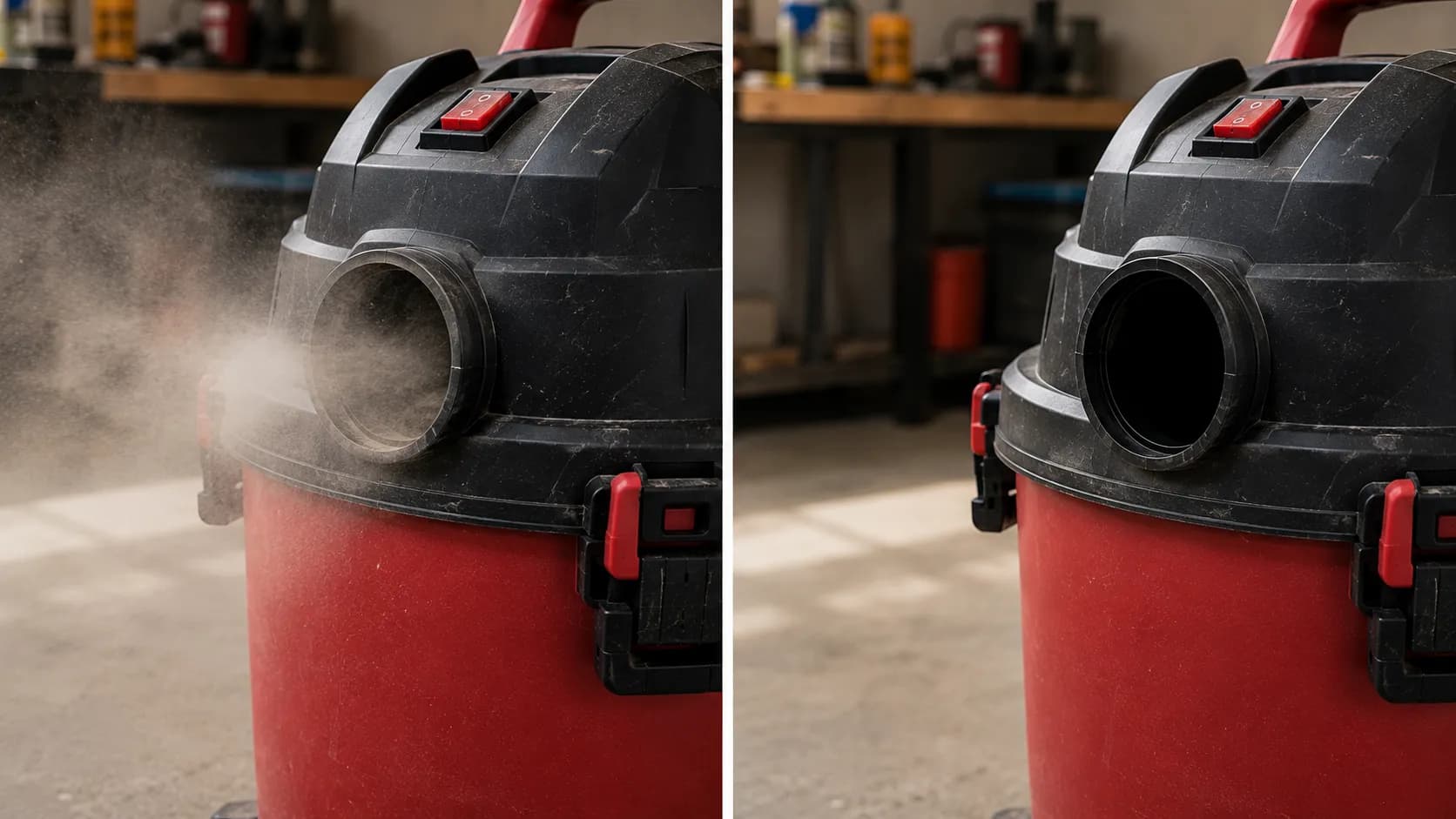
Blowing air through it is a designed function and does not harm the motor. If dust blows out of the exhaust during vacuuming, the cause is a torn, missing, or too-coarse filter, not the port itself.
What people say | What is actually true |
|---|---|
The second hole is a cooling vent | It is the exhaust and blower port. The airstream does pass the motor, but the hole is not a dedicated vent. |
Every shop vac can blow | No. Suction-only models have no usable blower port. |
An open port means it is broken | No. Most blower ports ship open by design. |
Blowing through it hurts the motor | No. Blowing is a mode the machine was built for. |
The most useful correction is about dust. When dust puffs out of the exhaust while you vacuum, the same Shop-Vac FAQ explains the filter is not stopping it, whether from a hole, a bad seat, or a filter too coarse for the debris.
When our vac started puffing dust from the exhaust, a reseated filter fixed it in seconds, and the port itself was fine. We had repeated the cooling-vent idea ourselves before testing, so it is an easy assumption to make.
Motors do run warm, but that heat is managed by the airflow, not by a separate hole, and the real power draw is usually smaller than the peak-HP label suggests.
The same reversed airflow is also why a shop vac blows far harder than a household vacuum. If any of this made you wonder what a shop vac even is, we define it from scratch.
The Bottom Line on the Two Holes
The confusion around a shop vac’s second hole comes from a single missing fact, and once you have it the whole thing settles. The top or rear opening is the exhaust, the low cap at the bottom is the drain, and the hose only ever belongs in the intake or the blower port.
Point to the shop vac blower port on your own machine, tell it apart from the drain cap, and the two-holes question answers itself. From there, whether you leave the port open, fit a diffuser for quiet, or switch the hose over to blow, you are working with the machine’s design instead of guessing at it.
Frequently Asked Questions
Why does a shop vac have two holes?
A shop vac has two holes because it moves air in one direction, in and then out. Air and debris enter at the intake, the tank and filter separate the mess from the air, and clean air leaves through the exhaust. That exhaust is the blower port.
Which hole do I use?
For vacuuming, connect the hose to the front or side intake. To blow, move it to the blower port at the top or rear of the motor head. Never connect the hose to the low drain cap, since that opening only empties water.
Is the blower port supposed to be open?
Yes, on most machines. Many blower ports ship open with no cap, and that is by design. A few models add a removable cap or a foam diffuser, but only to reduce exhaust noise, not to change suction.
What is the difference between the blower port and the drain cap?
The blower port is high on the top or rear of the motor head, is smooth-lipped, and takes the hose to blow. The drain cap is low on the tank, is threaded or tethered, and only empties water. If an opening is near the bottom, it is the drain.
Do all shop vacs have a blower port?
No. Many mid-size and larger models do, either as a fixed rear port or a detachable blower head, but plenty of small or budget units are suction-only. Check for a second hose-sized opening on the motor head, or test the hose in the exhaust.
Does using the blower port damage the motor?
No. Blowing is a designed mode, and the motor pushes the same air whether you vacuum or blow. If dust blows out during vacuuming, that points to a filter problem, not damage to the port or the motor.
Read it your way
Short on time? Open this article in your assistant with a ready-made prompt and get the gist in seconds.
Found this useful? Make us a preferred source so we show up in your Google results.
Keep reading
Related articles

Vacuum Types
Shop Vac for Dust Collection: 99% Capture, Under $80
Yes, a shop vac for dust collection works for one tool at a time. Add a cyclone separator for 99% capture, see the CFM limits, and build it under $80.
Vacuum Types
Can You Use a Shop Vac as a Regular Vacuum? 4 Uses Tested
Yes: can you use a shop vac as a regular vacuum? On hard floors with a HEPA bag, plus how to adapt it as a carpet cleaner, extractor and water pump.
Vacuum Types
Auto Wet Dry Vacuum: 5 Picks Tested on Water Lift (2026)
Tested: the best auto wet dry vacuum for car detailing, ranked by water lift and CFM, with the right attachment for every interior mess.
Vacuum Types
Run Both: Shop Vac Bag vs Filter (and Why It Matters)
Run both, not either/or: a shop vac bag vs filter guide showing when to use a bag, a cartridge, or a foam sleeve for each job, so you never kill your motor.
The discussion
Comments
Every comment is reviewed before it goes live.