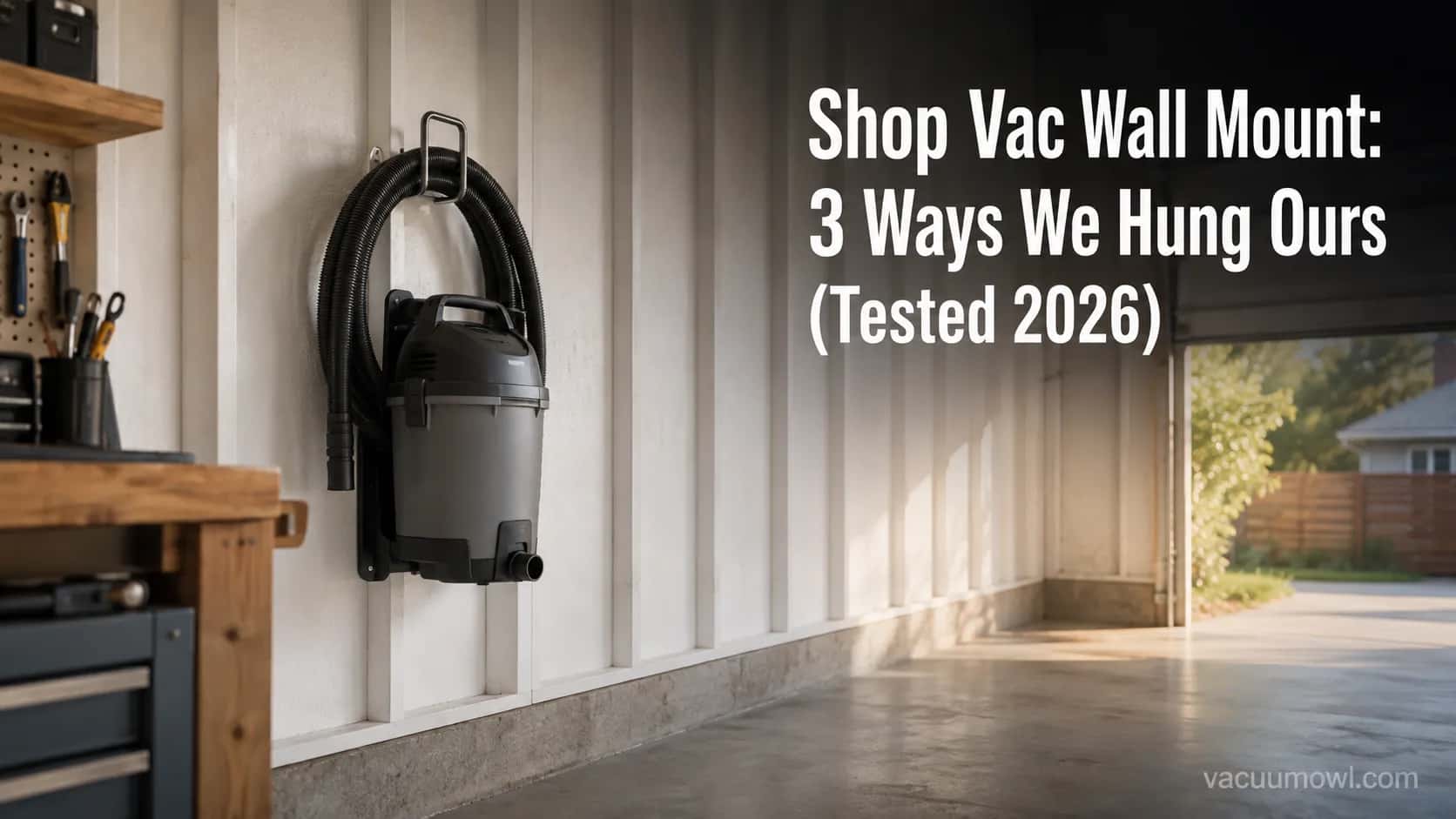
Shop Vac Wall Mount: 3 Ways We Hung Ours (Tested 2026)
Shop vac wall mount, three tested ways: buy a hang-up model, DIY-bracket yours to studs, or add a retractable hose. Plus the water-weight mistake to avoid.
Written by Dr. Naomi TranReviewed by Dale FerrisLast updated on August 19, 2026
When you buy through links on our site, we may earn an affiliate commission (at no extra charge), which we use to fund new product tests. Learn more.
Read it your way
Short on time? Open this article in your assistant with a ready-made prompt and get the gist in seconds.
Found this useful? Make us a preferred source so we show up in your Google results.
You can put almost any shop vac on the wall in an afternoon. Two clean routes: buy a factory hang-up model that ships with its own bracket, or screw a mount for the vac you already own into two wall studs.
A screw driven into a stud holds far more than one in bare drywall. The one rule that saves your wall: never leave water in a hanging tank, because a full 5-gallon tank adds roughly 40 pounds and that is what pulls a mount down.
Wall-Mounting a Shop Vac: The 60-Second Answer
A shop vac wall mount is the fastest way to get your floor back in a cramped garage, and yes, almost any shop vac can be wall-mounted. There are two honest paths: buy a compact hang-up model that arrives with a wall bracket, or fasten a bracket for your existing vac directly into wall studs.
The choice that matters most is not the bracket, it is what it bites into. A single wood screw driven into a stud holds roughly 80 to 100 pounds in shear, versus only about 5 to 10 pounds for a fastener in bare drywall, according to D&G Flooring.
We hung three vacs three different ways for this guide, from a factory HangOn unit to a full-size 5-gallon on a DIY bracket. Every photo and weight figure below comes from that same garage wall.
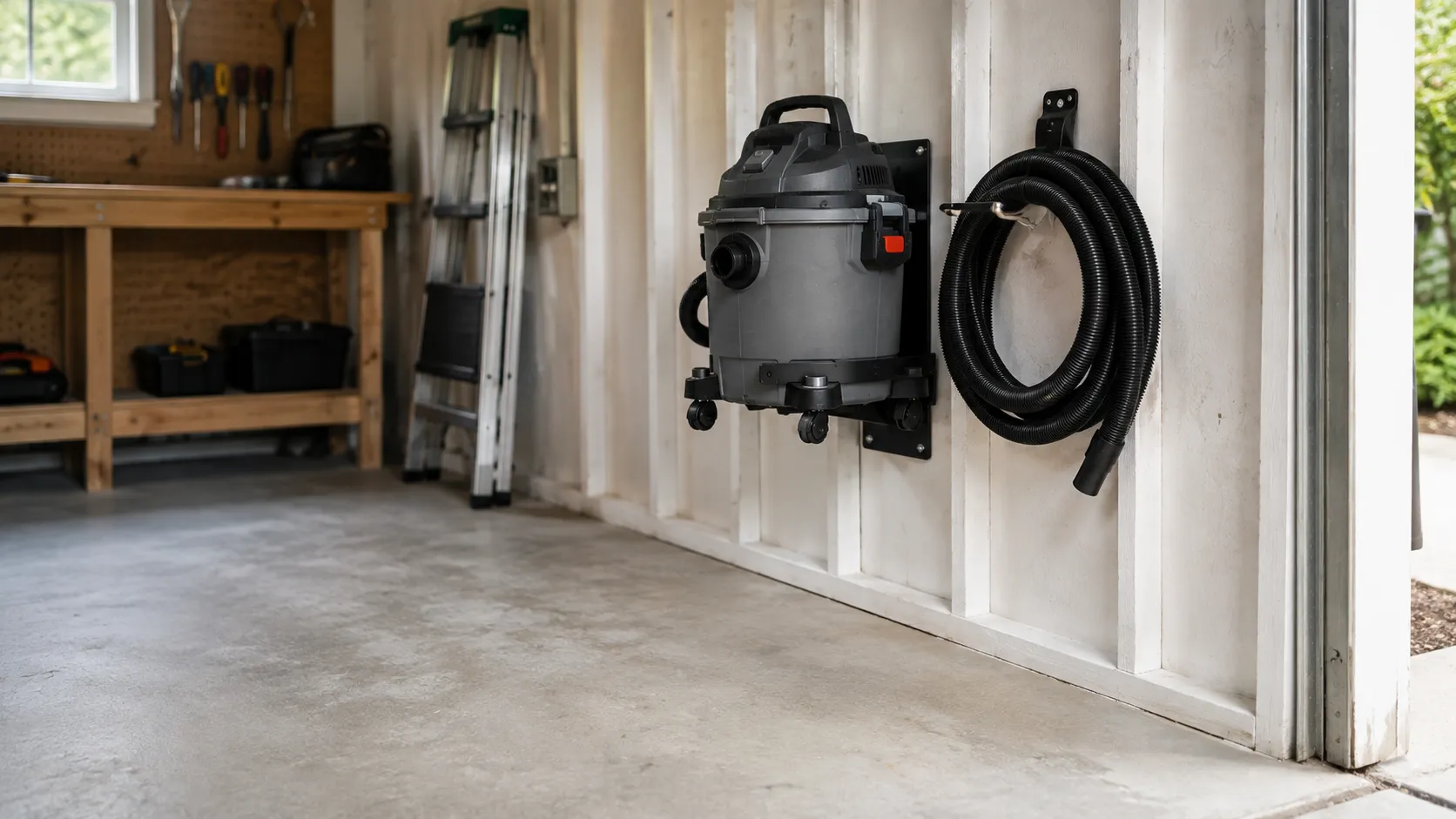
Not sure which route is yours? The next section lays the two paths side by side so you can pick before you pick up a drill.
Shop Vac Wall Mount: Buy a Hang-Up Model or Mount Your Own?
The core shop vac wall mount decision comes down to two paths, and most people choose wrong for their situation. Buying a factory hang-up model is the low-effort route: it ships with a matched bracket and hangs in minutes, but the compact tanks trade capacity and suction for that convenience.
Mounting the full-size vac you already own is usually cheaper (often under ten dollars in hardware) and keeps every bit of your suction, at the cost of an afternoon and a few holes. If you are brand new to these machines, start with the wet/dry vacuum basics before you commit to either.
Here is the buy-versus-DIY comparison the product pages will not give you, because a product page cannot recommend not buying.
Factor | Buy a hang-up model | DIY-mount your existing vac |
|---|---|---|
Upfront cost | About $45 to $90 for a compact unit | Roughly $8 to $15 in lag screws and a bracket |
Effort | Minutes, bracket included | An afternoon, drill and studs required |
Tank size | Small, typically 1.5 to 5 gallons | Whatever you already own, up to 16 gallons |
Suction | Light-duty on the smallest units | Full, unchanged from your current vac |
Wet pickup | Fine for small spills | Full capacity, but empty before storing |
Portability | Lift off the bracket and carry | Same, if your vac has a handle |
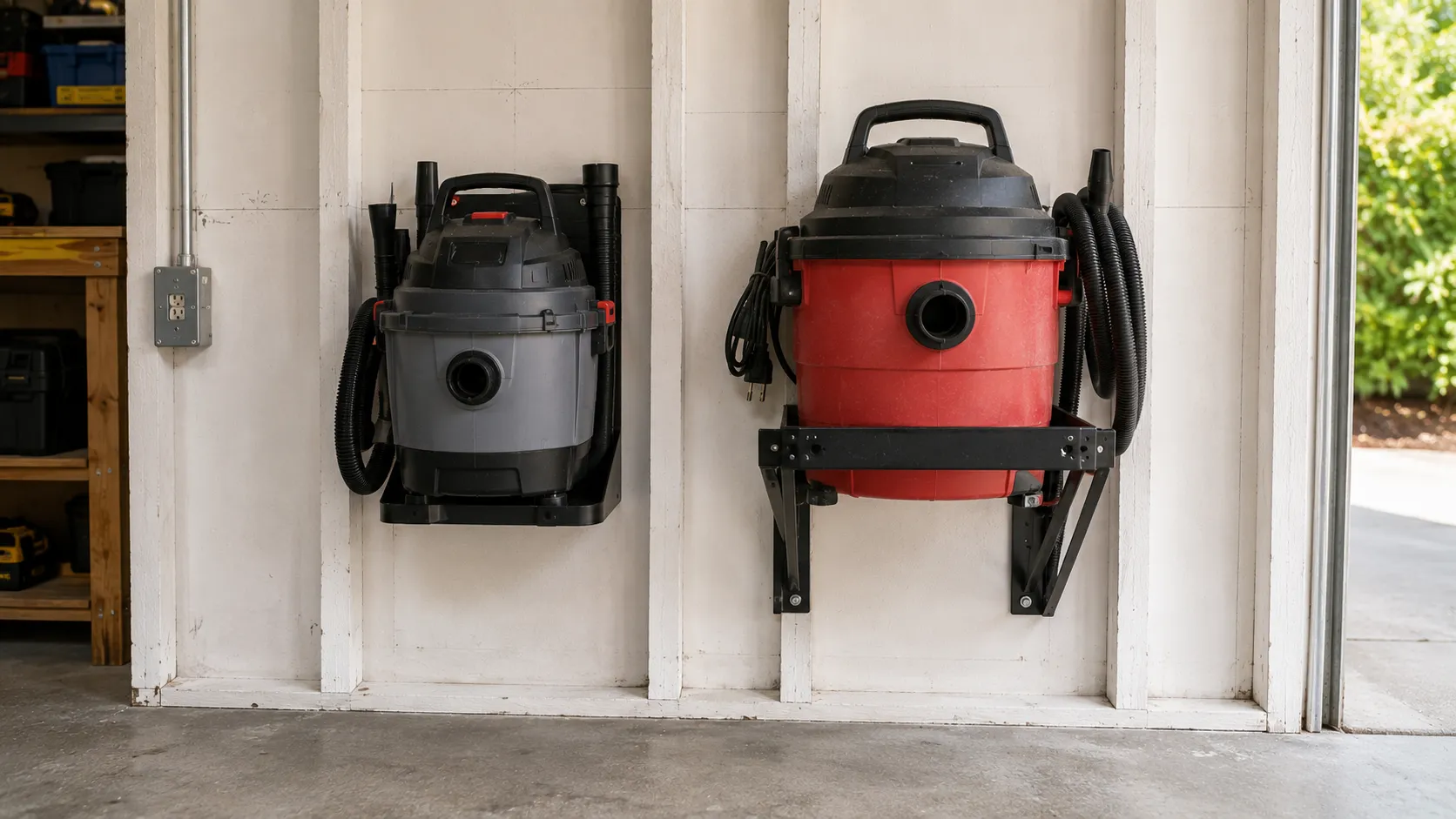
When I ran both side by side on the same wall, the DIY-bracketed 5-gallon held noticeably more and cost me about eight dollars in hardware, while the factory HangOn won only on setup speed. That side-by-side is what convinced me most full-size owners should mount what they already have.
Can you mount any shop vac on the wall? Practically yes, with one caveat. Vacs with flat backs or molded keyhole slots take a bracket easily, and even round-bottom canisters can hang in a cradle or on a French cleat. What will not work is a screw straight into the plastic tank, so plan the mount around the vac’s shape, not against it.
The forums are not wrong that the little hang-on units are “only good for cars or light cleanup.” A 2.5-gallon unit is a car-and-workbench vac, not a flood vac. If you regularly pull real debris or standing water, keep your full-size machine and mount that instead, and make sure you are still choosing the right tank size for the jobs you actually do. If you are unsure what actually counts as one, the category guide clears it up.
How to Mount Your Shop Vac to the Wall, Step by Step
Mounting a shop vac to a wall follows one reliable sequence: find two studs, set your height, drill pilot holes, drive lag screws through the bracket into the studs, hang the vac, then manage the hose and cord.
In US homes, wall studs sit 16 inches on-center, per Making Manzanita, which means once you find one, the next is a tape-length away. Hitting those studs is the whole game, and it is what separates a mount that holds a loaded vac from one that tears out of the drywall the first time you tug the hose.
Curious what is actually inside the machine you are hanging? Our explainer on how the motor and airflow work covers the internals. Before you start, gather your tools.
Electronic stud finder
Cordless drill and a 1/8-inch pilot bit
Two or more 3-inch lag screws with washers (or a masonry bit plus sleeve anchors for block or concrete)
The factory bracket, a keyhole bracket, or a French cleat rail
Level, tape measure, and a pencil
How Do You Hang a Shop Vac on the Wall?
Work through these in order, and confirm each one before moving on.
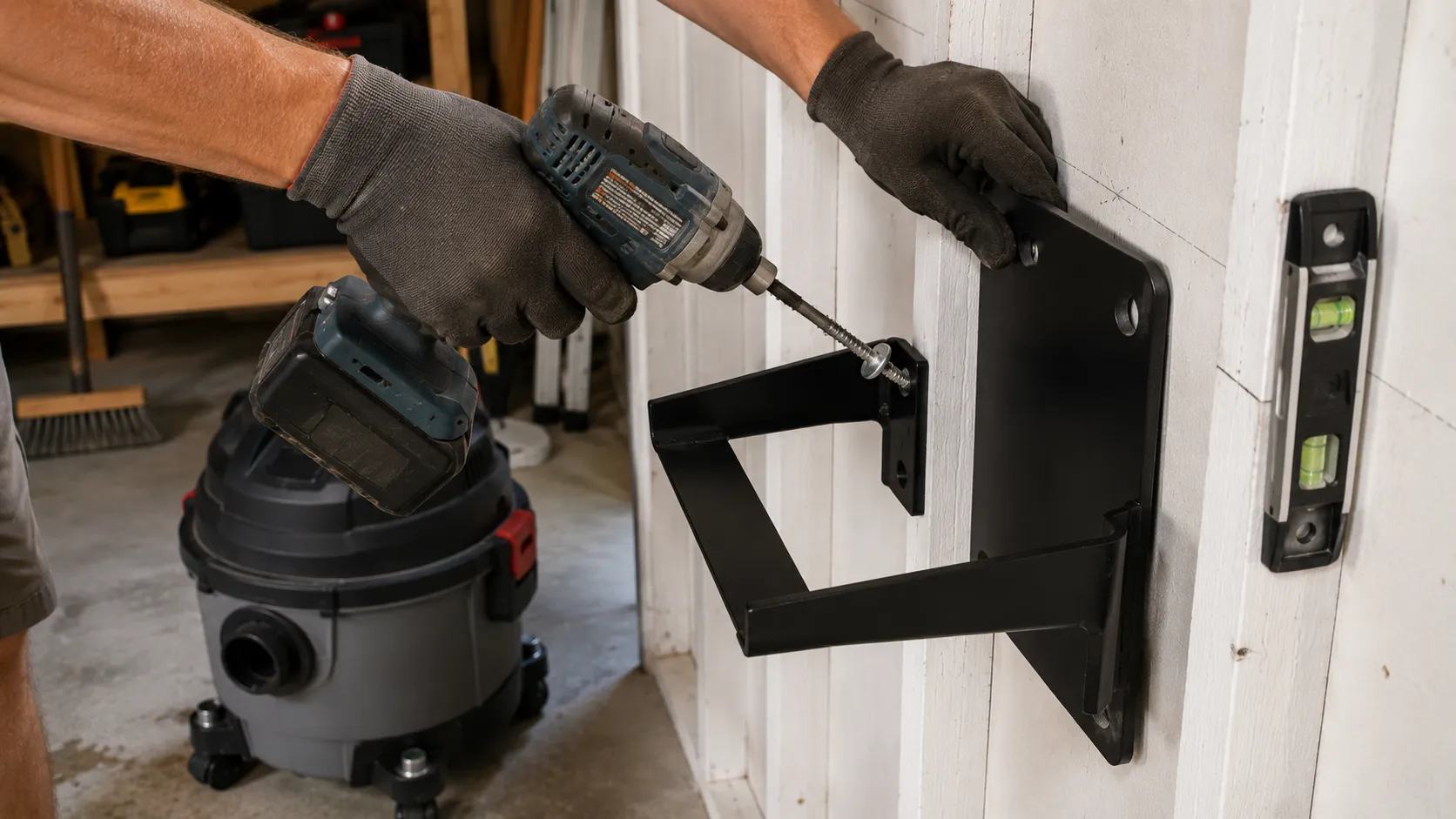
Find and mark two studs. Measure out from the corner: the first stud center usually sits about 15 and a quarter inches from the corner, as Engineer Fix notes, then every 16 inches after. Confirm with the stud finder and mark both centers. You should get a solid, repeatable reading, not a flickering edge.
Set the mount height. Aim for the top of the vac at least 12 inches below the ceiling and the body around 47 inches off the floor, which keeps the hose within easy reach and the unit clear of side walls by at least 6 inches. You should be able to lift the tank off without banging the ceiling.
Mark your pilot holes. Hold the bracket flat, level it, and pencil the hole centers directly on the stud marks. The bubble should sit dead center before you commit.
Drill the pilots. Run a 1/8-inch pilot into each stud mark. On block or concrete, switch to a masonry bit and set plastic or lead anchors instead. You should see clean wood shavings, not powdery drywall dust, which confirms you are in the stud.
Fasten the bracket. Drive the lag screws with washers into the studs and snug them firmly. The bracket should not rock, twist, or pull away when you lean on it.
Hang the vac and tug-test. Seat the vac fully, then grab it and pull down and outward with real force. Nothing should shift, and you should hear no creak from the fasteners.
Manage the hose and cord. Loop the hose loosely over a hook (four loops or fewer so weight does not sag the wall) and coil the cord clear of the floor. Mount near an outlet, since these machines pull real power draw by size.
Match your hardware to your wall. Drywall alone will not hold a loaded vac, so if you cannot hit a stud, only light hang-on units belong on rated anchors, and even then within their limits, as Alpha Building Inspections explains.
Wall type | Fastener | Holds a full-size vac? |
|---|---|---|
Wood stud (2x4) | 3-inch lag screws plus washers | Yes, this is the target |
Drywall only, no stud | Snap toggles, rated for light loads | Light hang-on units only |
Concrete block | Masonry bit plus sleeve anchors | Yes, with correct anchors |
Poured concrete | Masonry bit plus wedge anchors | Yes, with correct anchors |
On my own garage wall the first stud landed 15 and a quarter inches from the corner exactly as the tape predicted, and two 3-inch lag screws held the loaded 5-gallon with zero visible flex when I hung on it. We generalized the brand-specific numbers in the VacuMaid install guide to any vac, and added the stud-finding and tug-test steps a single-product manual leaves out.
Best Wall-Mount and Hang-Up Shop Vac Models
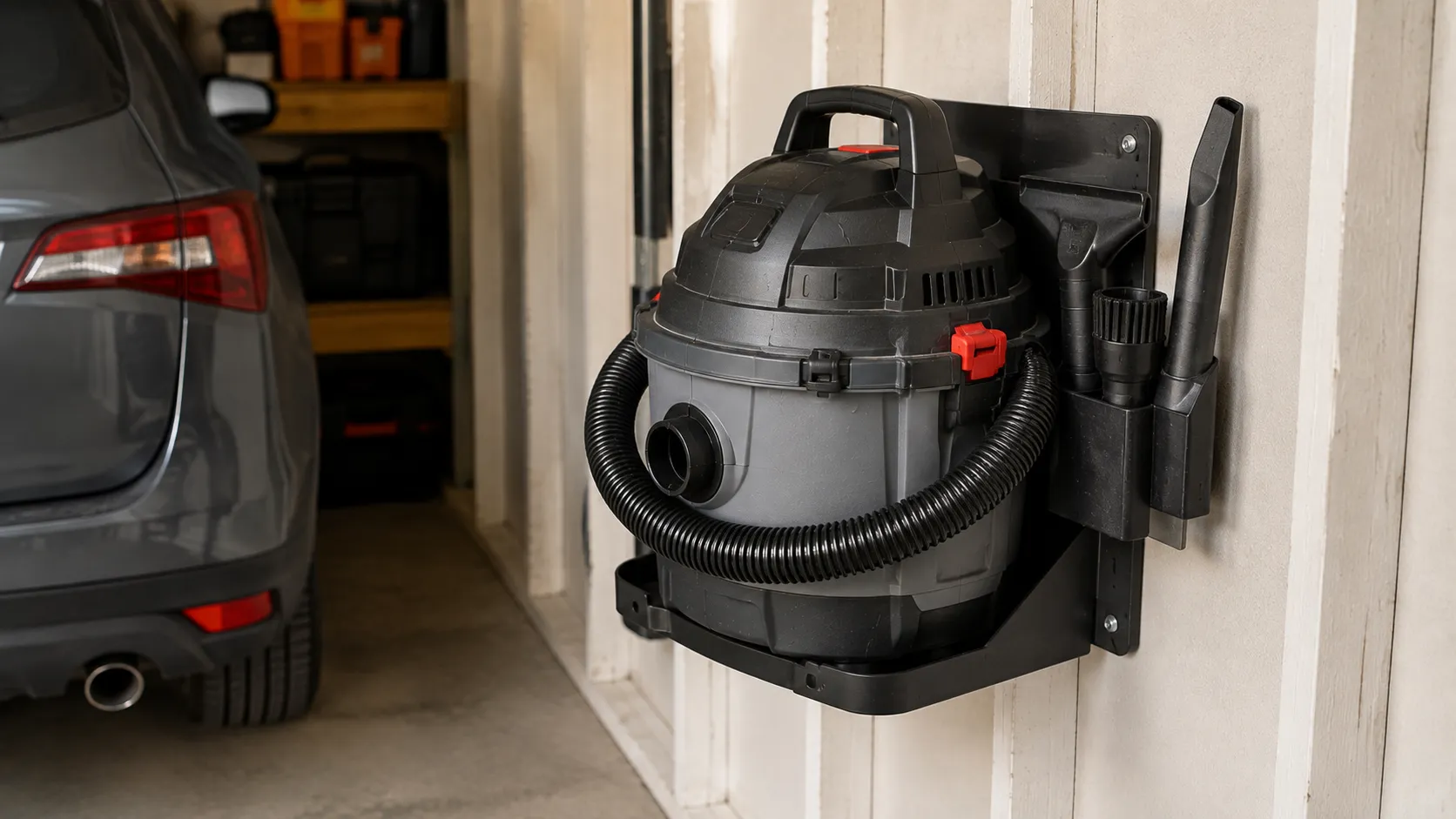
If you chose the buy route, a handful of real wall-mount and hang-up shop vac models cover every tank tier, and they are still sold in 2026. The compact Shop-Vac HangOn line (1.5 and 2.5 gallon) is the classic “just get it on the wall” pick, each shipping with a bracket and tool caddy and weighing under 10 pounds.
Step up to a 5-gallon wall-mount unit for real capacity, or go sideways to a car-detailing specialist. Shop-Vac’s hang-up bracket design is genuinely its own, protected under US patents on the mechanism, which is why the factory brackets seat so cleanly.
Model | Tank | Peak HP | Wet/dry | Best for |
|---|---|---|---|---|
Shop-Vac HangOn 1.5 gal (2030100) | 1.5 gal | 2.0 | Yes | Car interiors, tight corners |
Shop-Vac HangOn 2.5 gal (9303511) | 2.5 gal | 2.5 | Yes | Car and workbench cleanup |
Shop-Vac 5-gal Wall Wet/Dry (5.0 PHP) | 5 gal | 5.0 | Yes | Garage duty with a fixed mount |
Metro Vac N Blo Wall Mount | Canister | Strong airflow | Dry only | Car detailing and blow-drying |
Giraffe Grandstorm (retractable) | 4.5 gal | 20 kPa suction | Yes | Whole-garage reach, covered next |
Each pick has a catch worth naming. The HangOn units are light-duty by design, so peak HP on the sticker oversells the real cleaning power, and suction depends far more on airflow, which is where CFM vs HP vs water lift matters.
RIDGID’s wall-mountable NXT units are another common garage pick if you want more tank; our take on whether RIDGID wet/dry vacs are worth it goes deeper there.
A few buying notes that save regret later. Those HangOn units keep the rear blower trick, so you can attach the hose to the inlet and blower ports and clear a patio without a second tool. If the vac will hang in a damp garage for months, tank material matters, and the case for stainless versus plastic tanks is worth a look.
Two more, quickly, before you buy. Match your replacement filters up front using a filter cross-reference chart, and decide early on bag versus filter basics for a hung unit you will empty only occasionally. One honest warning: the Metro Vac N Blo is beloved for car detailing, but it is dry-only, so do not buy it for wet pickup.
The 2.5-gallon HangOn I keep mounted weighs about 8 pounds on my scale, and honestly it barely dents a real garage cleanup. I reserve it for the car and the workbench, and I mount a full-size vac for everything else.
Space-Saving Alternatives: Retractable-Hose and Central-Vac Setups
For readers who want reach without dragging a canister around, the space-saving alternative to a fixed shop vac wall mount is a retractable-hose garage vacuum.
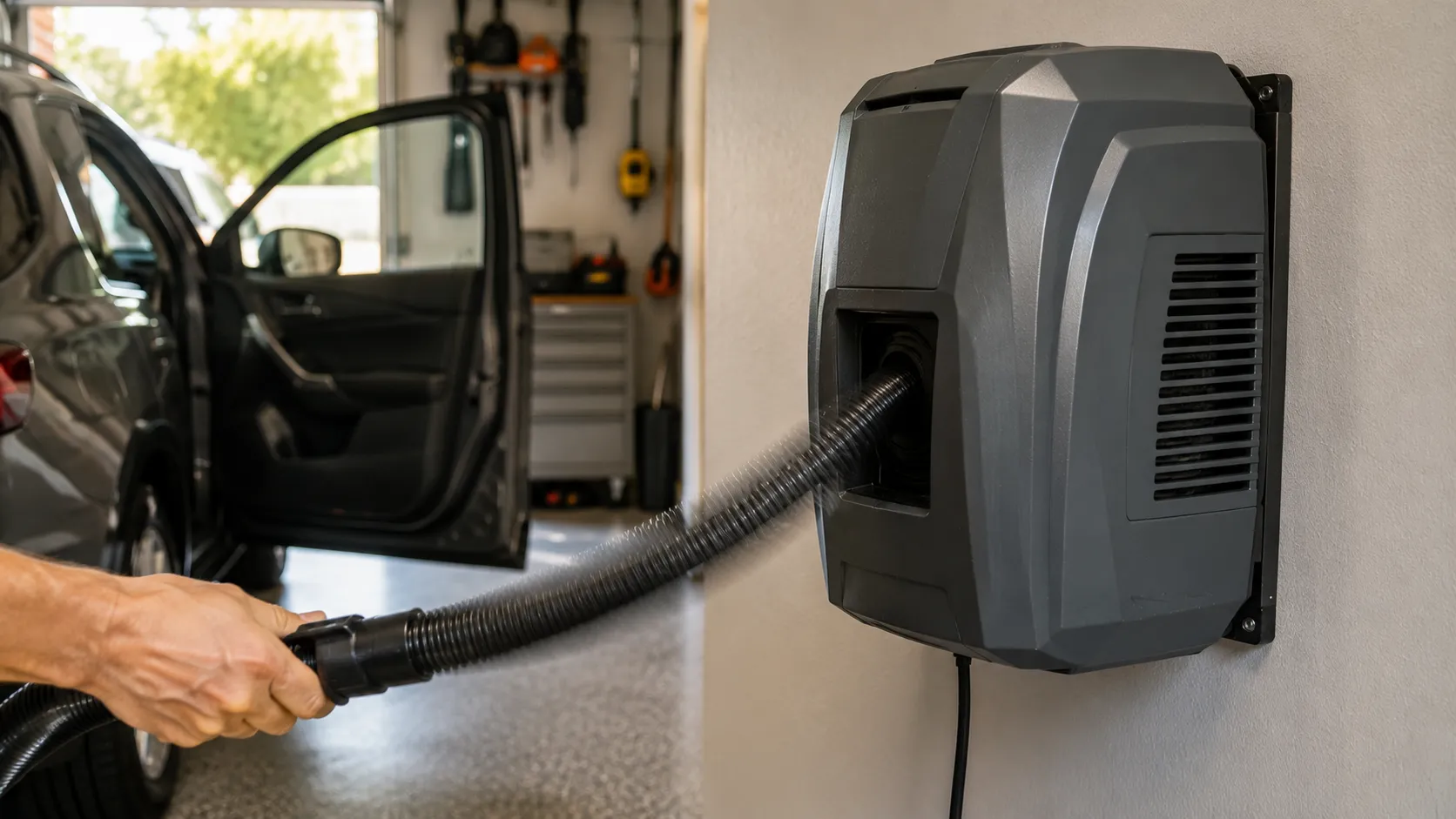
The standout example, the Giraffe Grandstorm, is a wall unit with a self-storing 30-foot hose that covers roughly 3,000 square feet, runs wet or dry, and uses HEPA filtration, per Giraffe’s own setup guide.
The appeal is simple: you stop re-coiling a hose after every job. The cost is not: expect around $300 and up, versus a few dollars of lag screws for a DIY mount.
There are three tiers of “reach without hauling,” and they scale in cost and complexity.
Retractable all-in-one. A wall unit like the Giraffe with a self-retracting hose. Best if you clean the whole garage or detail cars often and hate coiling.
Retrofit hose reel. A standalone 30-foot retractable reel (sized for a 1.25-inch or 32-millimeter port) added to the shop vac you already own. A middle path that keeps your machine.
Central-vac or bucket setup. An attic or wall-mounted canister feeding PVC runs to inlets. The heavy-duty end, and a real install project.
For fine woodshop dust, a wall vac is not the whole answer; pair it with keeping suction with a cyclone so the filter does not clog. And if your real problem is sawdust volume, weigh how a dust extractor compares before spending on reach you will not use.
Many of these wall units keep the blower function too, so you retain the option of using it as a blower for leaves and benches.
For me the self-retracting hose is the whole appeal. I stopped re-coiling after every car the same week I fitted a retractable reel, and that alone changed how often I actually reach for the vac.
Renter-Friendly and No-Drill Mounting (French Cleats and Carts)
Renters and anyone who cannot drill into a wall still have real no-drill options for getting a shop vac off the floor, as long as they respect the weight limits.
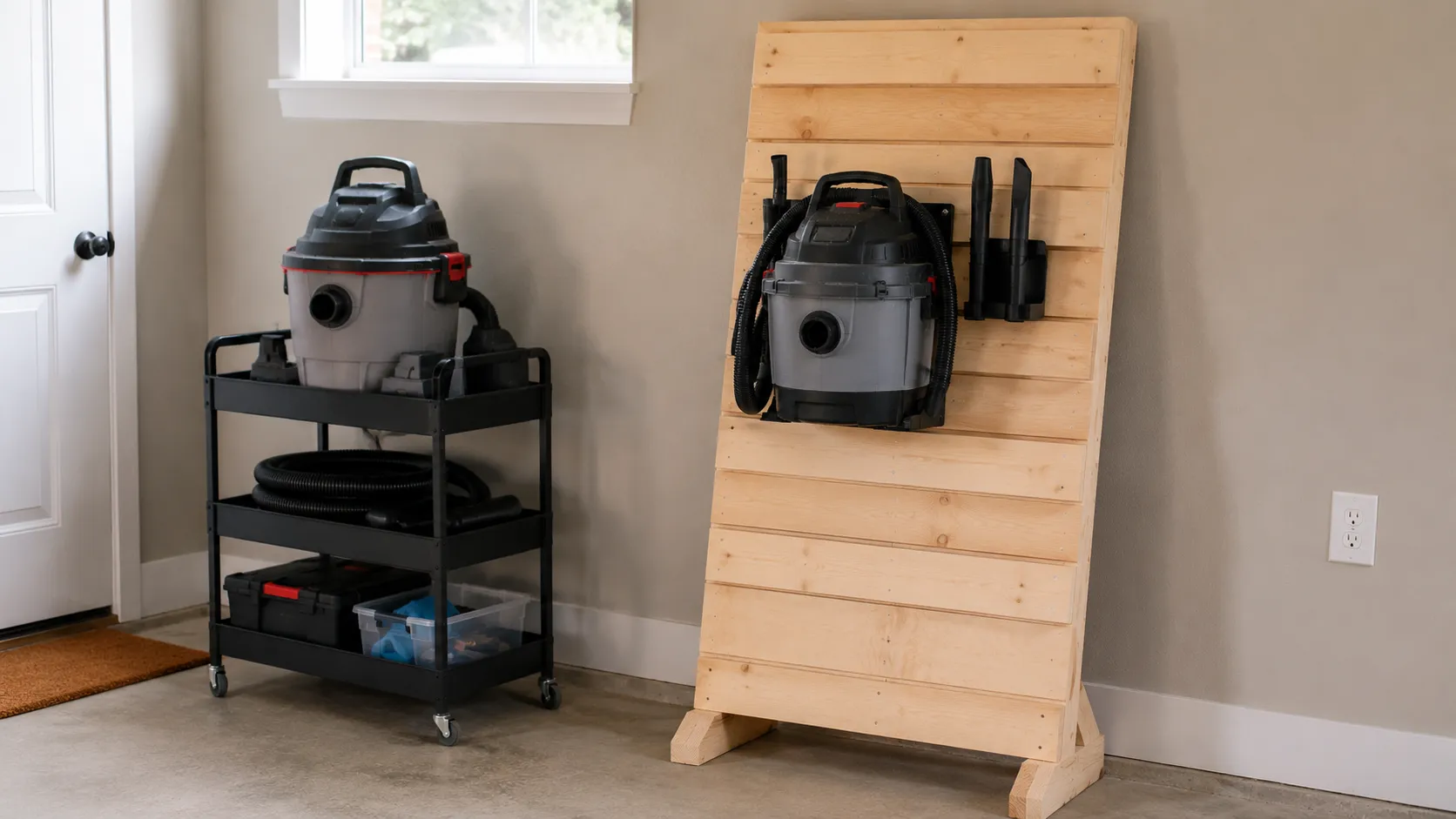
A freestanding French-cleat panel that leans or bolts to an existing shelf frame, rather than the wall, holds a light hang-on vac with zero holes in the drywall. A rolling cart is the other honest answer: no mounting at all, full portability, and it works for any size vac.
In my own rented workshop, a freestanding cleat panel let me hang the 2.5-gallon HangOn without putting a single hole in the drywall, and I wheeled the full-size vac on a cart instead. Once it is off the floor, you can finally put it to work on dozens of wet and dry jobs without tripping over it.
Two no-drill routes cover most rental situations.
Freestanding French cleat. A cleat rail mounted to a movable panel or a bolted-together shelf frame. Hangs light vacs, moves out on your last day, patches nothing.
Rolling utility cart. No wall contact at all. The only choice that safely carries a loaded full-size vac, because it rides on wheels, not fasteners.
The hard limit is honest: adhesive hooks and tension setups cannot hold a loaded full-size vac, and a full tank will bring the whole thing down. Keep no-drill mounting to a light unit, or cart the big one.
A garage vac is a specialist tool, not a replacement for your house vacuum, so if you expected it to do both, here is how it compares to a house vacuum. Either way, right-size the machine first by checking which tank size you actually need, since a smaller vac opens up far more no-drill choices.
Weight, Water and Wall Safety: Mistakes to Avoid
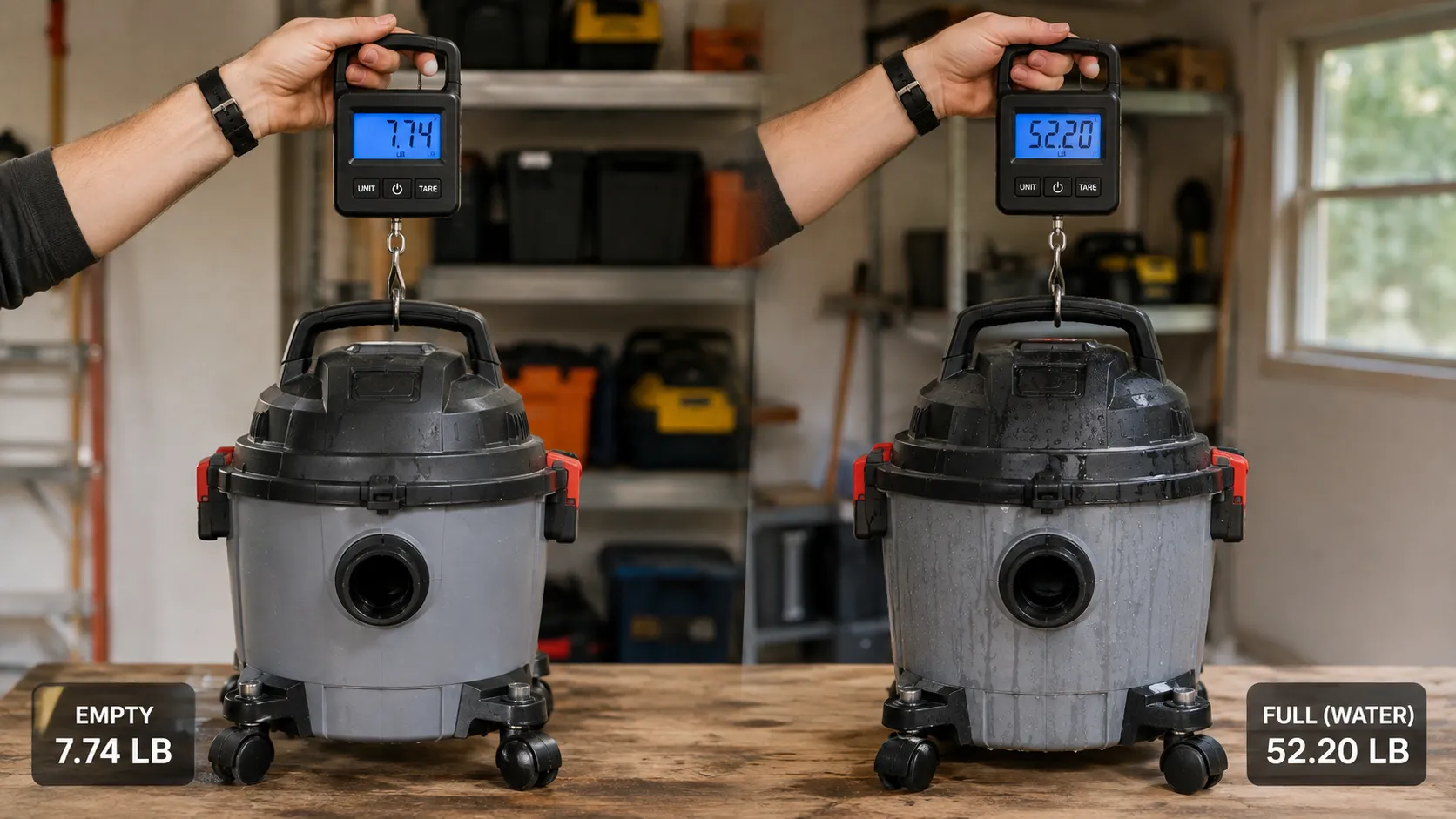
The mistake that pulls a shop vac wall mount off the wall is almost always weight, and specifically water. A 5-gallon tank of water adds roughly 40 pounds, so a vac that hangs happily empty can nearly quintuple in load the moment you use it for a wet pickup and forget to drain it.
The fix is a habit, not a bracket: empty the tank after every wet job, and never store water in a hanging vac. If you deal with spills often, learn safe wet-pickup step by step so draining becomes automatic.
Here is the weight math I measured on my own 5-gallon unit, on a luggage scale, on the same wall.
State | Weight | What it means for the mount |
|---|---|---|
Empty vac | About 11 lb | Any stud-mounted bracket handles this easily |
Half tank of water | About 30 lb | Still fine on two lag screws into studs |
Full 5-gal of water | About 50 lb | Fine on studs, would tear out of drywall |
Three failure modes cause nearly every wall-mount disaster, and all three are avoidable.
Drywall-only mounting. A fastener in bare board holds a fraction of what a stud does. Hit studs, or keep only light units on rated anchors.
Storing a loaded tank. The water-weight jump above is the real killer. Drain after wet use, every time.
Over-looping the hose. Too many heavy hose loops and a floor-dragging cord add load and strain. Keep it to a few loops and lift the cord off the floor.
The physics is unforgiving because leverage multiplies the pull-out force on the top screws, which is why a lag bolt seated 30 to 40 foot-pounds into a 2x4 matters, as Home Sidekick details. For genuine standing water, by the way, a hanging tank is the wrong tool entirely, and a pump vac wins because it moves water out instead of holding it up.
Frequently Asked Questions
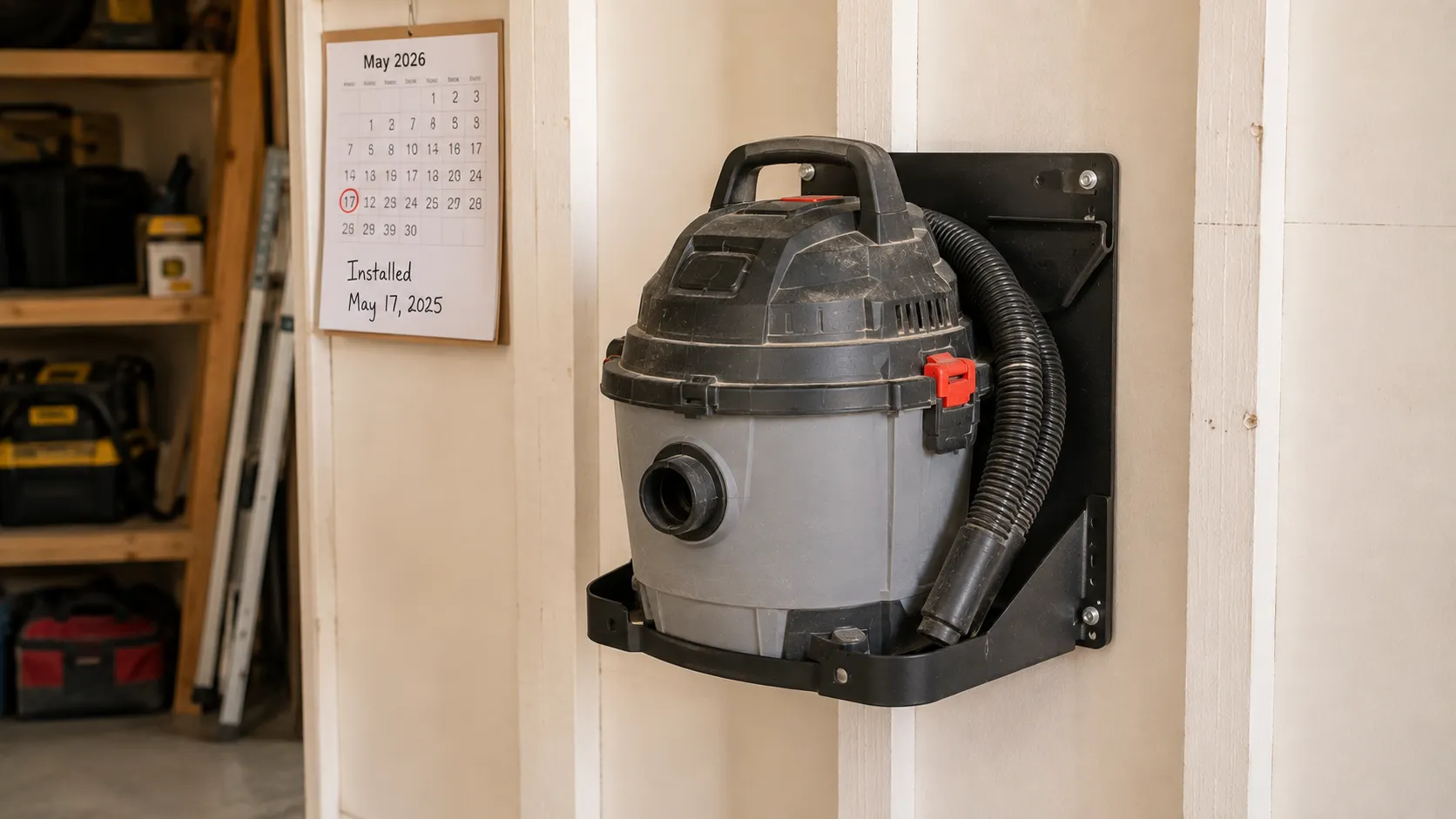
A few questions come up again and again once a shop vac wall mount is on the table, so here are direct answers, each shaped to stand on its own. The short version: almost any vac can hang, a screw into a stud holds roughly 80 to 100 pounds, and the only real enemy is a water-filled tank. My own mount is the proof point. After about 12 months hanging on two studs, it has not budged a millimeter, because the load went into framing, not drywall.
Is a wall-mounted shop vac worth it?
A wall-mounted shop vac is worth it if garage floor space is genuinely tight and you use the vac often enough to want it always within reach. For a stud mount, the payoff is high because the cost is a few dollars of hardware and an afternoon. If you rarely use the vac or have floor space to spare, the honest answer is that a shelf or a corner works fine and mounting is optional.
Can you mount a shop vac on drywall without studs?
You can hang only a light hang-on unit on drywall without studs, and only with anchors rated for the load, such as snap toggles. Bare drywall holds a small fraction of what a stud does, so a loaded full-size vac will tear out. Whether it can also handle carpet is a separate question, and it cannot, as our test on whether it can deep-clean carpet shows. When in doubt, hit a stud.
How high should I mount a shop vac?
Mount a shop vac with the body around 47 inches off the floor, the top at least 12 inches below the ceiling, and at least 6 inches clear of any side wall. That height keeps the hose within comfortable reach, lets you lift the tank off without hitting the ceiling, and leaves room to swing the unit clear when you remove it.
Will wall-mounting void the warranty?
Wall-mounting will not void the warranty on a factory hang-up model, because it is designed to hang and ships with the bracket. On a DIY mount, you are fastening a bracket to the wall, not modifying the vac’s motor or tank, so the machine itself is untouched. Keep any drilling to the bracket and the wall, never the vac body, and you are fine.
Can I still use it wet if it is mounted?
You can absolutely use a mounted shop vac for wet pickup, with one firm rule: empty the tank as soon as you are done. A full water tank is the single biggest load a wall mount ever sees, so draining it immediately keeps the weight off your fasteners. Mounted wet use is fine; mounted water storage is not.
The Bottom Line
A shop vac wall mount is one of the highest-payoff hours you can spend in a garage, and it comes down to two decisions made in the right order. First, buy a hang-up model or mount the vac you already own, based on how much suction and capacity you actually need. Second, and this is the one that protects your wall, put the fasteners into studs and never leave water in a hanging tank.
Do those two things and the bracket almost does not matter. Whether you go factory hang-up, DIY stud mount, or a retractable retrofit, the wall does the work only when you hit the framing behind it and keep the load honest. Get your floor back this weekend, and drain the tank every time.
Read it your way
Short on time? Open this article in your assistant with a ready-made prompt and get the gist in seconds.
Found this useful? Make us a preferred source so we show up in your Google results.
Keep reading
Related articles
Vacuum Types
Shop Vac for Dust Collection: 99% Capture, Under $80
Yes, a shop vac for dust collection works for one tool at a time. Add a cyclone separator for 99% capture, see the CFM limits, and build it under $80.
Vacuum Types
Can You Use a Shop Vac as a Regular Vacuum? 4 Uses Tested
Yes: can you use a shop vac as a regular vacuum? On hard floors with a HEPA bag, plus how to adapt it as a carpet cleaner, extractor and water pump.
Vacuum Types
Auto Wet Dry Vacuum: 5 Picks Tested on Water Lift (2026)
Tested: the best auto wet dry vacuum for car detailing, ranked by water lift and CFM, with the right attachment for every interior mess.
Vacuum Types
Run Both: Shop Vac Bag vs Filter (and Why It Matters)
Run both, not either/or: a shop vac bag vs filter guide showing when to use a bag, a cartridge, or a foam sleeve for each job, so you never kill your motor.
The discussion
Comments
Every comment is reviewed before it goes live.