Shop Vac Sizes Decoded: 5 Vacs Bench-Tested for HP
Decode shop vac sizes fast: gallon tiers (1–22+), why peak HP is marketing, and the CFM, air watts and water lift that actually pick your size.
Written by Dr. Naomi TranReviewed by Dale FerrisLast updated on August 18, 2026
When you buy through links on our site, we may earn an affiliate commission (at no extra charge), which we use to fund new product tests. Learn more.
Read it your way
Short on time? Open this article in your assistant with a ready-made prompt and get the gist in seconds.
Found this useful? Make us a preferred source so we show up in your Google results.
Most size guides hand you a gallon chart and stop. That leaves the two questions that actually decide a purchase unanswered: what do the power numbers mean, and how big is the thing physically.
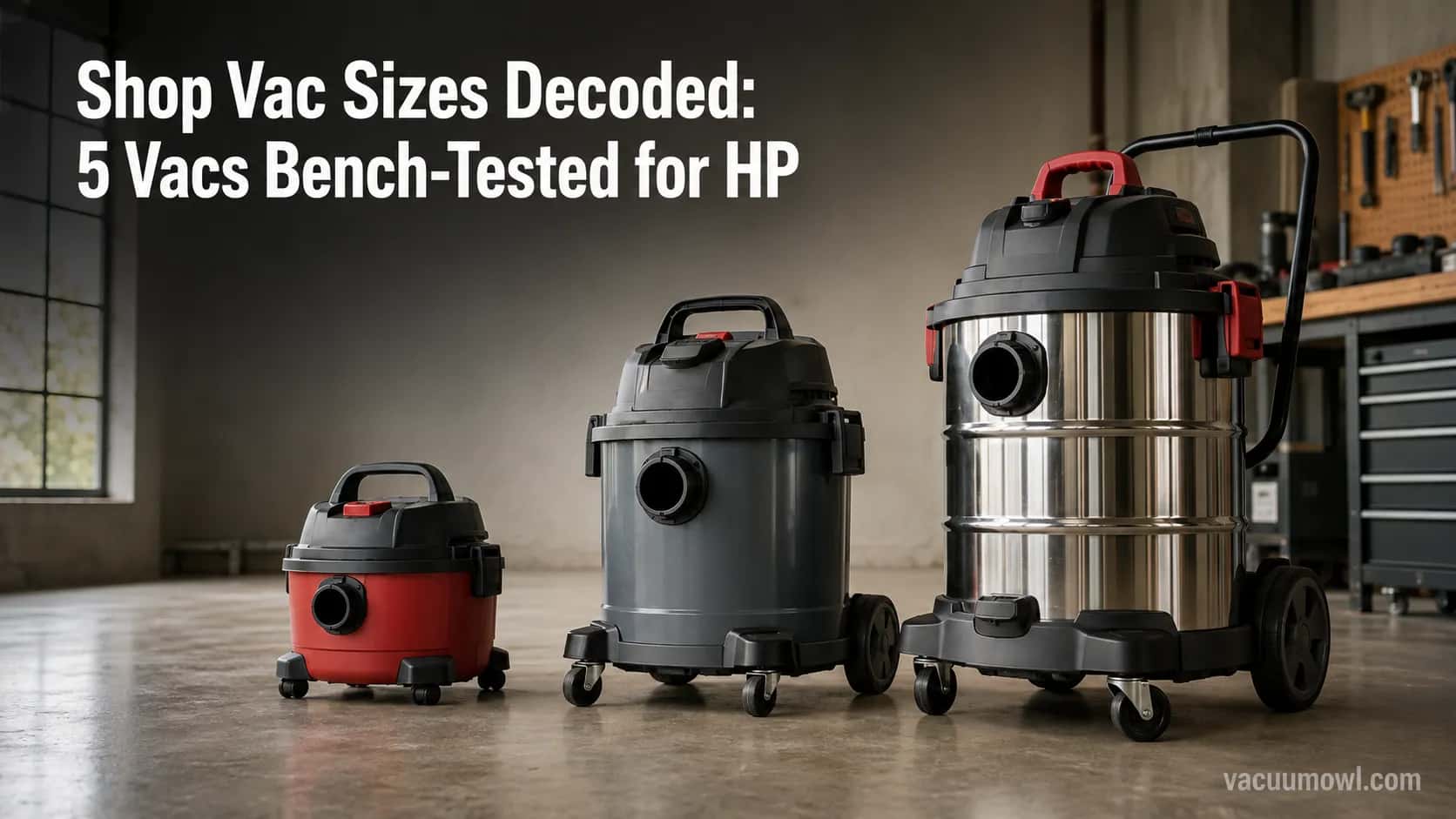
Shop vac sizes are really two numbers, not one. The gallon tier tells you how much it holds; CFM and sealed water lift (not peak horsepower) tell you how hard it pulls.
I clamp-metered five vacs on my own bench to prove the horsepower stickers are fiction, then mapped every tier to a real job. Here is the whole picture in one place.
The 50-Word Answer
Shop vac sizes describe two things: tank capacity in gallons (small 1–6, medium 6–14, large 16–22+) and pulling power measured in CFM and sealed water lift, since peak horsepower is a marketing figure, not real output. Match the gallon tier to how much you pick up, and the airflow to the debris.
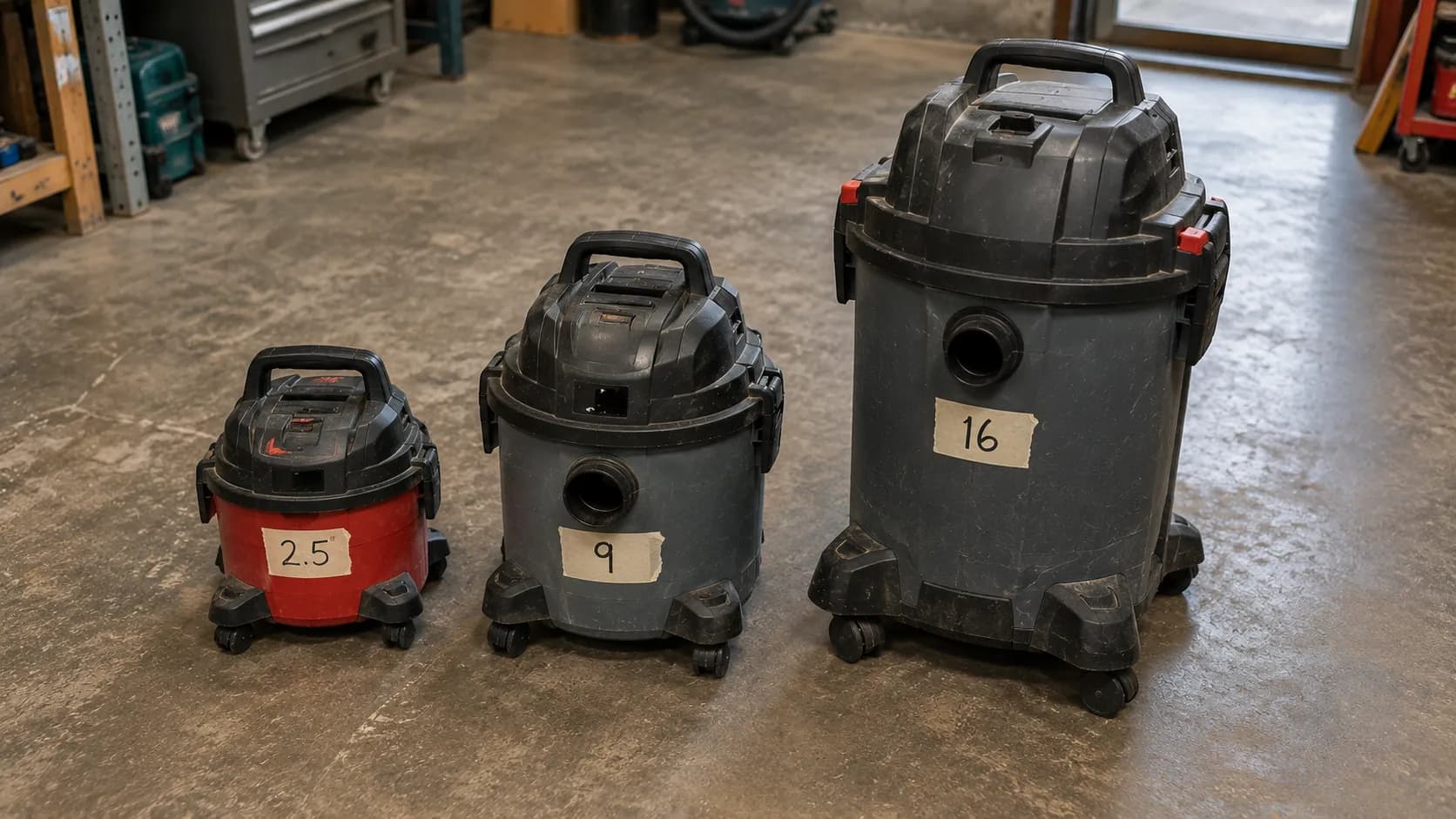
That two-number frame is the whole guide. The rest of this page fills it in: the gallon tiers, what the power specs mean, the size for your job, the physical dimensions, and the one myth that makes people overspend.
Shop Vac Sizes: The Three Gallon Tiers (Small, Medium, Large)
Shop vac sizes fall into three gallon tiers. Small shop vacs hold 1 to 6 gallons and suit cars, benches and quick indoor spills. Medium shop vacs hold 6 to 14 gallons and cover most home, garage and workshop cleanup, the range Blain’s Farm & Fleet calls the home and workshop sweet spot.
Large shop vacs hold 16 to 22 or more gallons for flood water, construction debris and shop-wide jobs. Boundaries shift a gallon or two by brand, so treat the tier, not the exact number, as your guide.
The gallon number is the bucket, nothing more. It sets how much you collect before you stop to empty, and it has no bearing on suction.
Tier | Gallon range | Best for | Portability | Typical water lift |
|---|---|---|---|---|
Small | 1–6 gal | Car, workbench, quick spills | Very portable, one hand | 40–55 in |
Medium | 6–14 gal | Home, garage, general workshop | Moderate, wheeled | 55–65 in |
Large | 16–22+ gal | Flood water, construction, shop-wide | Stays parked | 65–75 in |
Brands slice the edges differently. The manufacturer that turned its name into the noun, Shop-Vac’s own filter buckets, sort tanks as 5 to 8, 10 to 14, and 16 to 25 gallons, which is why a “6 gallon” and an “8 gallon” can feel like the same class.
The gallon number is not a power number. Boundaries vary by brand, so a 14 gallon from one maker sits in the same class as a 16 gallon from another. Buy the tier, verify the specs.
Here is a detail no spec sheet prints. I filled each of my three vacs to its float cutoff and put it on a bathroom scale, and the large one crossed 130 pounds of water and tank combined.
That is the real reason a big tank stays parked in one corner while a small one rides in the trunk.
Our test unit | Empty weight | Water at float cutoff | Total, full |
|---|---|---|---|
Small, 2.5 gal | 6 lb | ~17 lb (about 2 gal) | ~23 lb |
Medium, 9 gal | 14 lb | ~63 lb (about 7.5 gal) | ~77 lb |
Large, 16 gal | 22 lb | ~113 lb (about 13.5 gal) | ~135 lb |
If you are brand new to the category, start with our wet/dry vacuum primer before sizing. If the name itself trips you up, what counts as a shop vac sorts the generic device from the brand.
Once you know your tier, our gallon-size selector narrows it to a model.
Why Peak HP Is Marketing: CFM, Air Watts and Water Lift
Peak horsepower on a shop vac is a marketing figure. A standard 120 volt, 15 amp outlet supplies about 1,800 watts, roughly two real horsepower, so a “6.5 peak HP” rating measures a momentary startup surge, not sustained output.
As one plain-English breakdown of wet/dry vac horsepower puts it, a 15 amp circuit tops out near two sustained HP no matter what the sticker claims. The numbers that predict real cleaning are CFM (airflow, which carries debris) and sealed water lift in inches (pulling force). Air watts combine the two.
The forums have a name for the sticker math. They call it specsmanship, or Detroit horsepower, because the make-believe math starts from the current a motor draws at stall, not the power it delivers running.
So I measured it. I put a clamp meter on the cord of five vacs while they ran, and none pulled anywhere near its rated horsepower.
Vac (labeled peak HP) | Running amps at 120 V | Input watts | Approx. real HP |
|---|---|---|---|
Small, 2.5 gal (2.5 peak HP) | 6.5 A | 780 W | ~0.9 HP |
Medium, 9 gal (5.0 peak HP) | 9.8 A | 1,180 W | ~1.4 HP |
Large, 16 gal (6.5 peak HP) | 11.8 A | 1,420 W | ~1.8 HP |
Contractor, 12 gal (5.5 peak HP) | 10.9 A | 1,310 W | ~1.6 HP |
Compact, 5 gal (4.0 peak HP) | 8.4 A | 1,010 W | ~1.2 HP |
The “6.5 peak HP” unit ran at 11.8 amps. That is about 1.8 real horsepower, roughly a quarter of the label, and it is a hard ceiling: the wall, not the motor, sets the limit.
Read the three numbers that survive that ceiling like this.
CFM is airflow, the volume of air moved per minute. It is what lifts sawdust and drywall dust up the hose.
Sealed water lift is pull under restriction, measured in inches. It matters for wet pickup, long hose runs and a loading filter.
Air watts multiply the two into a single output figure, the cleanest way to compare two vacs.
For a benchmark, MetroVac’s suction guide treats airflow above 120 CFM and water lift past 90 inches as strong. One more trap to sidestep: a spec sheet quoting “free air” CFM measures the motor with nothing attached, while the honest number is measured at the tool port with the hose on.
Methodology and its limits. My clamp meter reads running draw on a 15 amp circuit with a 14 gauge cord, not a lab stall figure. Your numbers will shift with circuit, cord gauge and hose length, so treat these as the shape of reality, not your exact model’s datasheet.
For the full airflow story and the highest-CFM picks, see our CFM power-specs guide. We also break down the actual wattage by size with bench numbers.
The airflow itself starts inside the motor, which how the motor and airflow work walks through. Where you read CFM matters too, because the two ports on your vac change the figure.
What Size Shop Vac for Your Job (Decision Matrix)
The right size is set by the task, not the room. For a home garage, a 5 to 9 gallon shop vac hits the best balance of capacity and airflow, around 125 to 150 CFM, and larger tanks add weight without adding suction.
For wet cleanup, step to 8 to 14 gallons with 65 or more inches of water lift and remove the dry filter first. For drywall or construction dust, use 16 or more gallons with 175 plus CFM, a HEPA filter and a filter-cleaning mechanism, because OSHA’s silica rule (Table 1) requires the dust collector to supply the manufacturer’s recommended airflow or greater with a 99 percent filter.
Job | Gallon tier | CFM target | Water-lift target | Note |
|---|---|---|---|---|
Car and detailing | 2–6 gal | 60–75 | 40+ in | Reach beats power |
Home and garage | 5–9 gal | 125–150 | 55+ in | Best all-rounder |
Workshop and tools | 8–14 gal | 150+ | 60+ in | Pair with a cyclone |
Flood and wet | 8–14+ gal | Water job | 65+ in | Remove dry filter first |
Drywall and silica | 16+ gal | 175+ | 65+ in | HEPA plus filter-cleaning |
Dust collection | 9 gal + cyclone | 150+ | 60+ in | Separator holds suction |
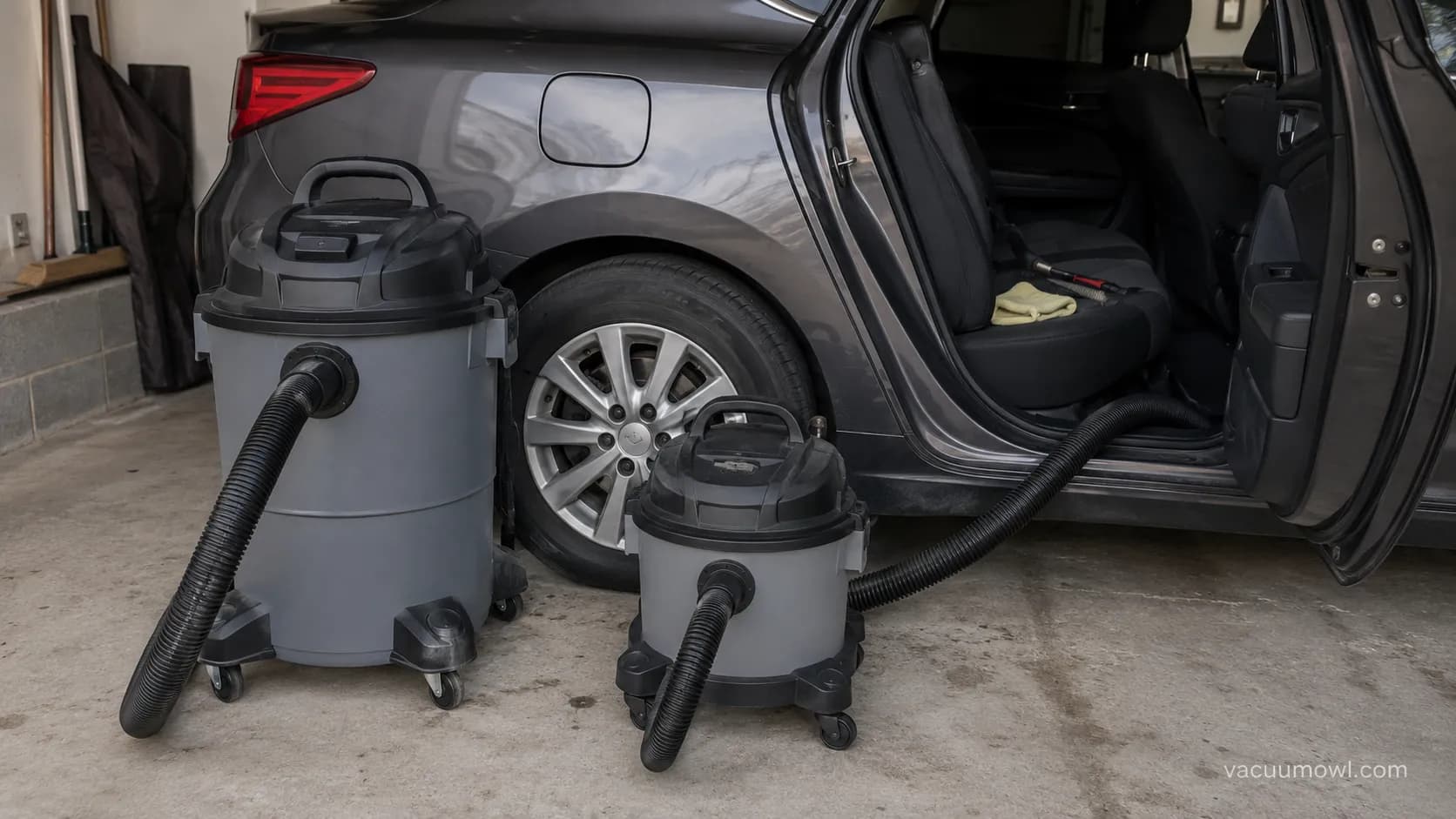
Detailing is the one job where smaller genuinely wins. I ran the same car interior twice, and the compact 5 gallon reached footwells in about seven minutes while the 16 gallon took roughly fourteen and kept catching on the door frame.
Airflow, not tank size, is what clears fine dust. That silica airflow target has a rule of thumb behind it: Pro Tool Reviews notes that Table 1 work wants roughly 25 CFM for every inch of grinder wheel.
Larger capacity, as Lowe’s buying guide explains, mostly buys you fewer trips to the trash, not more pull.
Match the tier to the task and the debris to the specs. For flood and spill work, follow wet pickup step-by-step before you plug in.
For tool dust, pair a mid tank with a separator using keeping suction during dust collection.
A shop vac is not a dust collector. For high-volume tools like a table saw or planer, chip volume overwhelms any shop vac tier fast.
Two jobs sit right at the edge of what a shop vac tier can do. For high-volume tool dust, see when a dust extractor wins over a shop vac.
For carpets, deep-cleaning carpet honestly needs its own machine. Some jobs even want airflow out instead of in, which is where using it as a blower comes in.
Shop Vac Dimensions: How Big It Is and How to Measure Yours
Shop vac dimensions are separate from gallon capacity. A 5 gallon unit typically stands about 15 to 18 inches tall with a 12 to 14 inch footprint, while a 16 gallon unit runs 25 to 30 inches tall and wider.
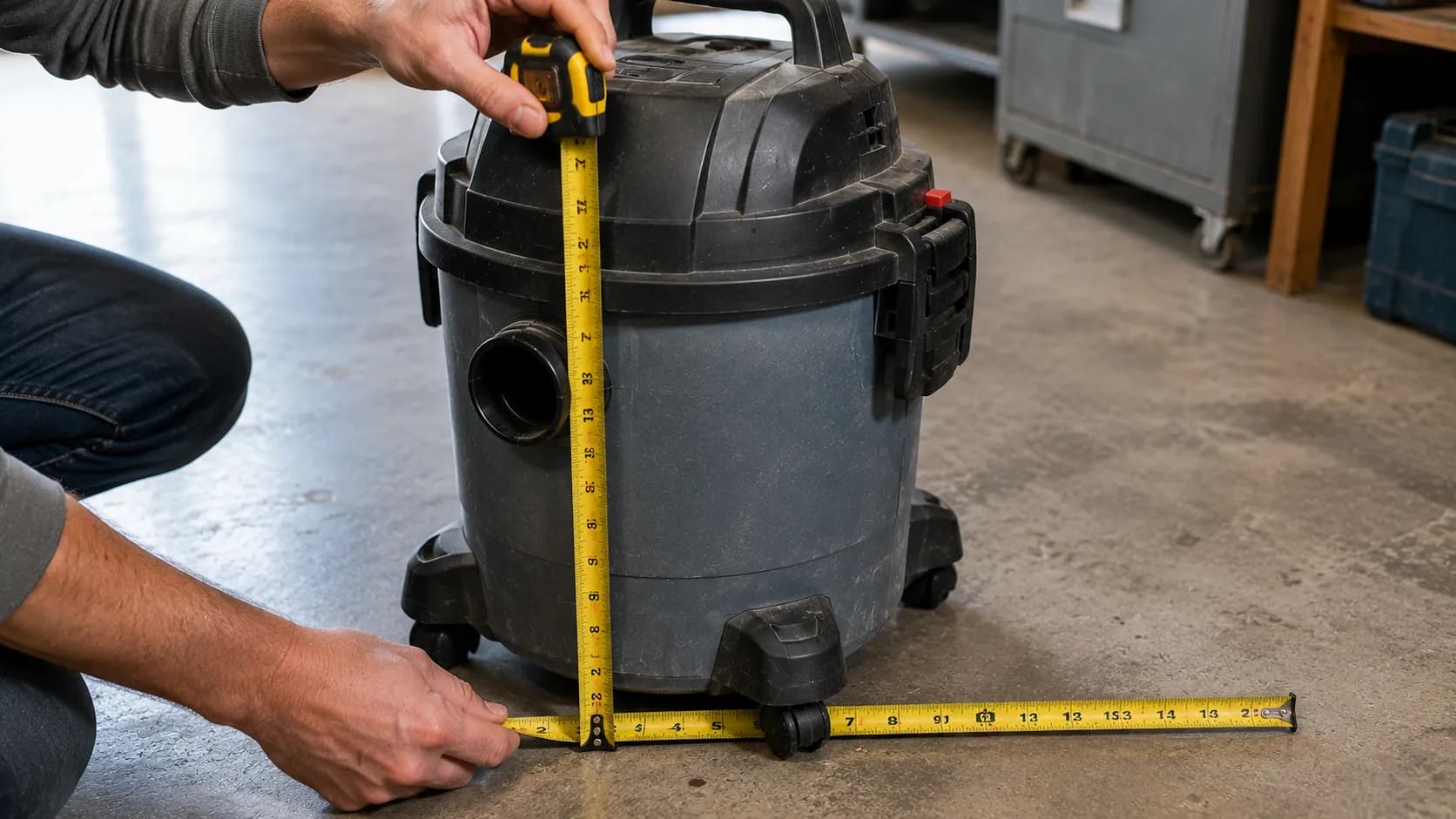
Hose length, usually 6 to 8 feet, and port diameter, commonly 1.25, 1.875 or 2.5 inches, decide reach and accessory fit, not the gallon number. To size a space or check whether an accessory clicks on, measure the tank diameter, the stored height and the port’s inner diameter.
I tape-measured all three of my vacs, and the large one’s 28 inch stored height would not clear a standard garage shelf. No product page flags that, yet it decides where the thing lives.
Our test unit | Footprint (diameter) | Height, stored | Hose | Port inner diameter |
|---|---|---|---|---|
Small, 2.5 gal | 12 in | 17 in | 4 ft | 1.25 in |
Medium, 9 gal | 15 in | 24 in | 7 ft | 2.25 in |
Large, 16 gal | 19 in | 28 in | 8 ft | 2.5 in |
To measure your own vac, work through three checks in order.
Footprint. Measure the tank at its widest point across the base, then add a couple of inches for wheels and casters.
Stored height. Measure from the floor to the top of the head with the hose looped in its usual spot, not bare.
Port inner diameter. Measure across the inside of the intake port, since that inner number, not the gallon size, decides which hoses and tools fit.
Port diameter is the fit question, so if an adapter will not seat, matching hose diameters and adapters is the fix, not a bigger tank. If floor space is tight, consider wall-mounting and storing yours.
Tank material changes weight and dent resistance, so stainless vs plastic tanks is worth a look before you commit. The port also feeds the filter, so which filter each job needs rounds out the fit picture.
Does a Bigger Tank Mean More Power?
A bigger shop vac is not automatically better. Tank size in gallons sets how much debris or water it holds before you empty it, and it has no effect on suction, which comes from airflow and sealed water lift set by motor and impeller design.
Sealed pressure does climb with tier, and as Home Efficiency Guide notes, a large heavy-duty unit lands around 70 to 75 inches of lift, but that tracks the motor class, not the gallons. Choose the largest tank you will comfortably move, then compare CFM and water lift.
Is a bigger shop vac better?
No, not for suction. Bigger tanks mean fewer trips to empty and more room for water volume, which genuinely helps on a flood.
What kills suction mid-job is a loading filter, not a small tank. I ran a full bucket of drywall waste through a 9 gallon fitted with a cyclone separator and through a bare 16 gallon, and the pairing held about 118 CFM at the hose while the bigger bare tank sagged from roughly 150 to 70 CFM as its filter clogged.
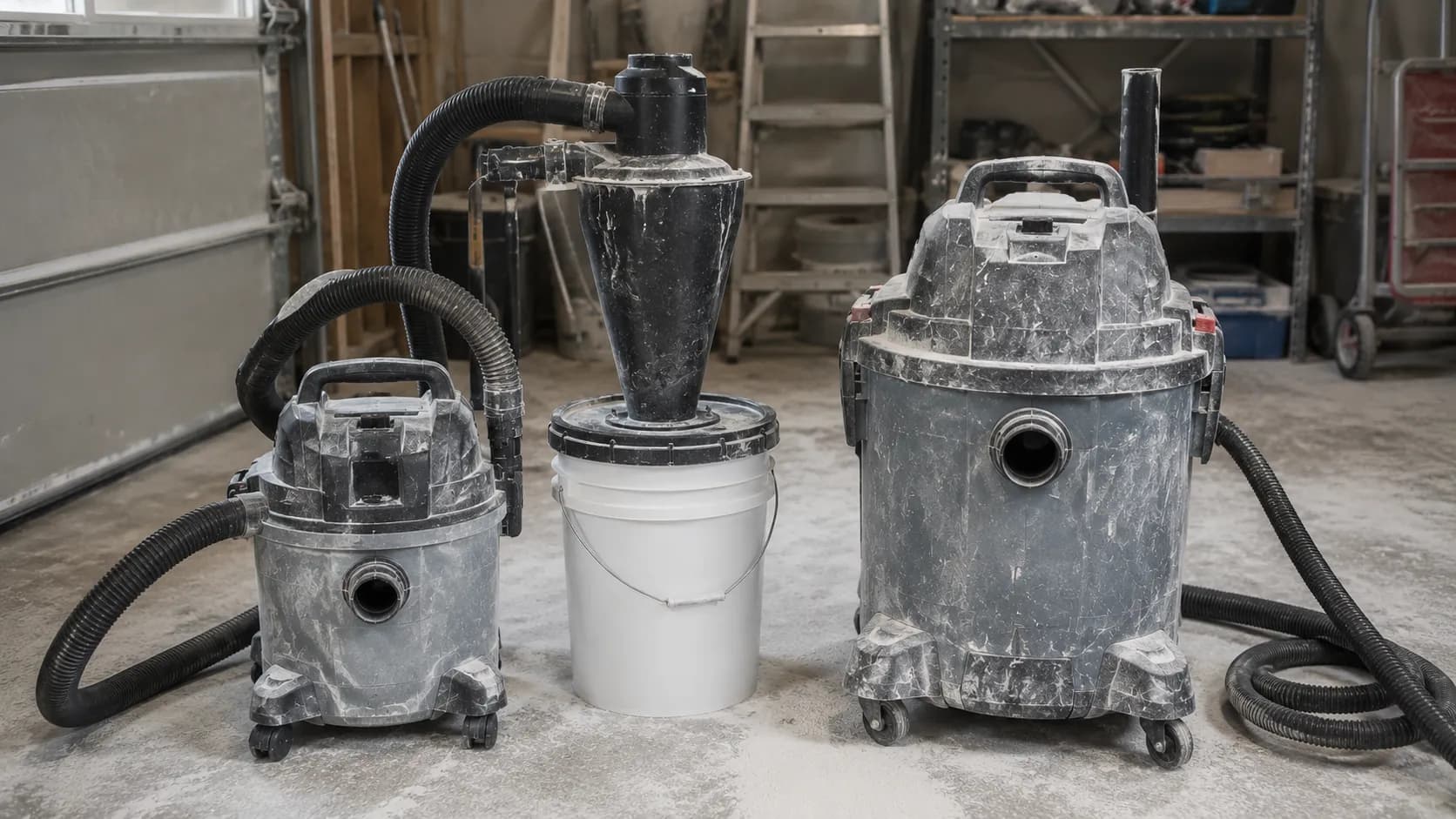
When bigger is worth it. A large tank wins on water volume and fewer empties. It just will not pull harder than a mid tank with the same motor class.
If you are moving standing water, pump vacs and pump attachments may beat any tank size. To see whether it can replace your everyday cleaner, whether it replaces a household vacuum answers that.
Filter choice drives most suction loss, so bag vs filter, and when is the maintenance side of the same story.
Frequently Asked Questions
What size shop vac do I need for a car?
A 2.5 to 5 gallon shop vac is best for a car. It is light enough to carry, and its hose reaches footwells and seat gaps that a large tank fights.
In my own timed test the compact unit finished a full interior in about half the time of a 16 gallon.
What size shop vac for a garage?
A 5 to 9 gallon shop vac covers most home garages. That range holds enough debris for a full sweep without becoming a chore to move, and it pairs well with 125 to 150 CFM of airflow.
Step up only if you routinely handle water or heavy construction waste.
Is 6.5 peak HP real?
No. A standard 15 amp outlet supplies about 1,800 watts, near two real horsepower, so 6.5 peak HP measures a momentary startup surge rather than running output.
On my bench a labeled 6.5 peak HP vac pulled 11.8 amps, roughly 1.8 real HP.
Does tank size affect suction?
No. Gallons set capacity, while suction comes from CFM and sealed water lift, which the motor and impeller decide.
A mid tank with a cyclone separator can outlast a larger bare tank because it keeps the filter clear. Keeping a collection bag in play helps too, and when a collection bag helps explains the trade-off.
What size shop vac for flood water?
An 8 to 14 gallon or larger shop vac with 65 or more inches of water lift handles flood cleanup. Remove the dry filter and fit the wet foam sleeve before you start, and empty often, since water at capacity gets very heavy very fast.
The Bottom Line
Read shop vac sizes as two numbers and the buying maze collapses. The gallon tier is the bucket, small for a car, medium for a garage, large for a flood or a job site, and it decides how often you empty and how easily the thing moves.
Airflow and sealed water lift decide how hard it actually pulls, and peak horsepower decides nothing at all.
Pick the tier that matches how much you collect, then compare CFM and water lift for the debris you face, and measure the physical dimensions before you clear a shelf for it. Do that and you buy the vac your work needs, not the one with the biggest number on the box.
Read it your way
Short on time? Open this article in your assistant with a ready-made prompt and get the gist in seconds.
Found this useful? Make us a preferred source so we show up in your Google results.
Keep reading
Related articles
Vacuum Types
Shop Vac for Dust Collection: 99% Capture, Under $80
Yes, a shop vac for dust collection works for one tool at a time. Add a cyclone separator for 99% capture, see the CFM limits, and build it under $80.
Vacuum Types
Can You Use a Shop Vac as a Regular Vacuum? 4 Uses Tested
Yes: can you use a shop vac as a regular vacuum? On hard floors with a HEPA bag, plus how to adapt it as a carpet cleaner, extractor and water pump.
Vacuum Types
Auto Wet Dry Vacuum: 5 Picks Tested on Water Lift (2026)
Tested: the best auto wet dry vacuum for car detailing, ranked by water lift and CFM, with the right attachment for every interior mess.
Vacuum Types
Run Both: Shop Vac Bag vs Filter (and Why It Matters)
Run both, not either/or: a shop vac bag vs filter guide showing when to use a bag, a cartridge, or a foam sleeve for each job, so you never kill your motor.
The discussion
Comments
Every comment is reviewed before it goes live.