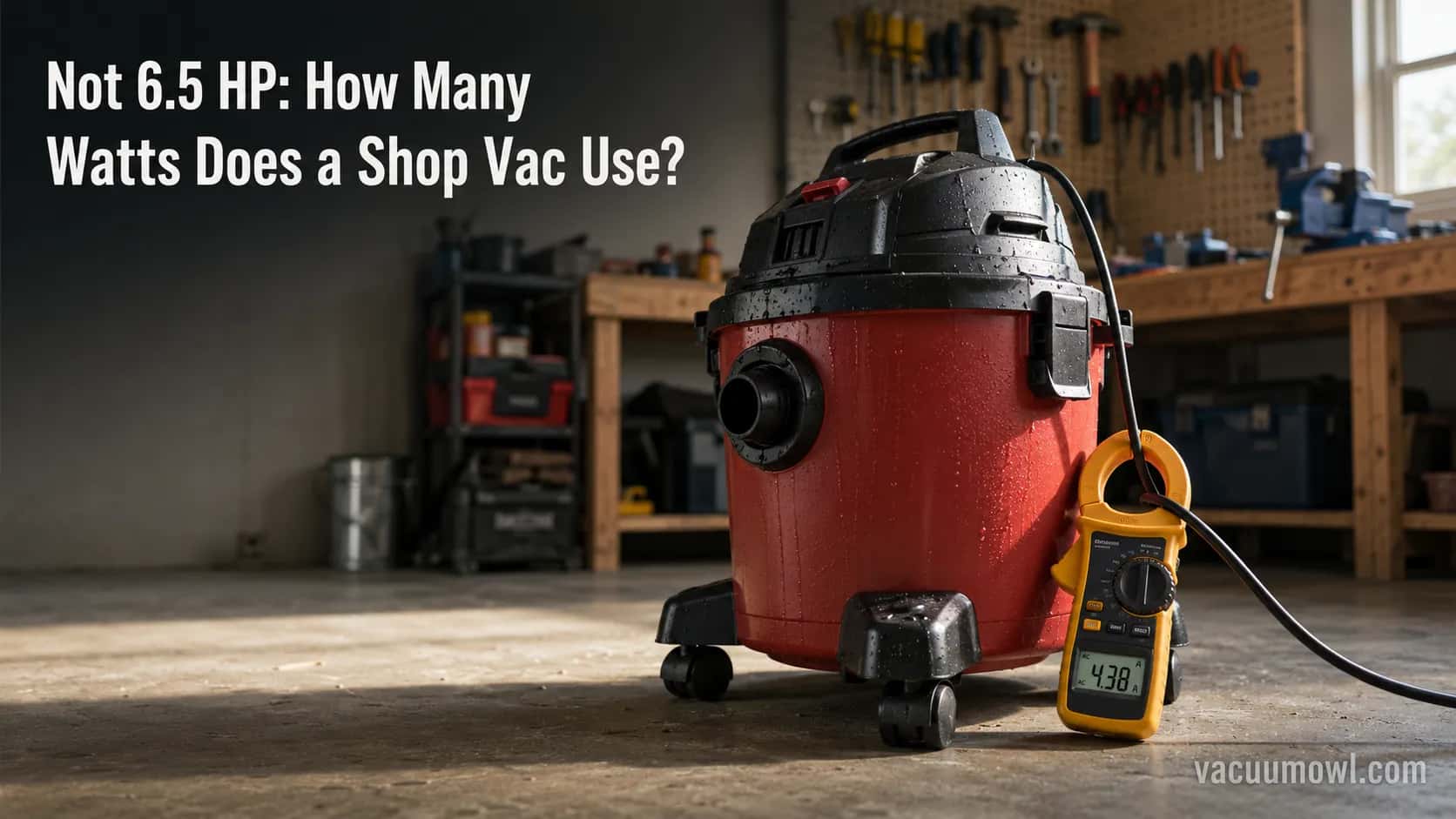
Not 6.5 HP: How Many Watts Does a Shop Vac Use?
Find out how many watts does a shop vac use: most pull 8–12 amps (1,000–1,440 W), not the “Peak HP” label. Real draw by size and cost per hour.
Written by Dr. Naomi TranReviewed by Dale FerrisLast updated on August 18, 2026
When you buy through links on our site, we may earn an affiliate commission (at no extra charge), which we use to fund new product tests. Learn more.
Read it your way
Short on time? Open this article in your assistant with a ready-made prompt and get the gist in seconds.
Found this useful? Make us a preferred source so we show up in your Google results.
The Short Version
Most corded shop vacs pull 8 to 12 amps while running, which is about 1,000 to 1,440 watts on a standard 120-volt outlet. Small units draw closer to 4 to 6 amps (roughly 500 to 720 watts). The big “6.5 Peak HP” number on the tank is not the running figure.
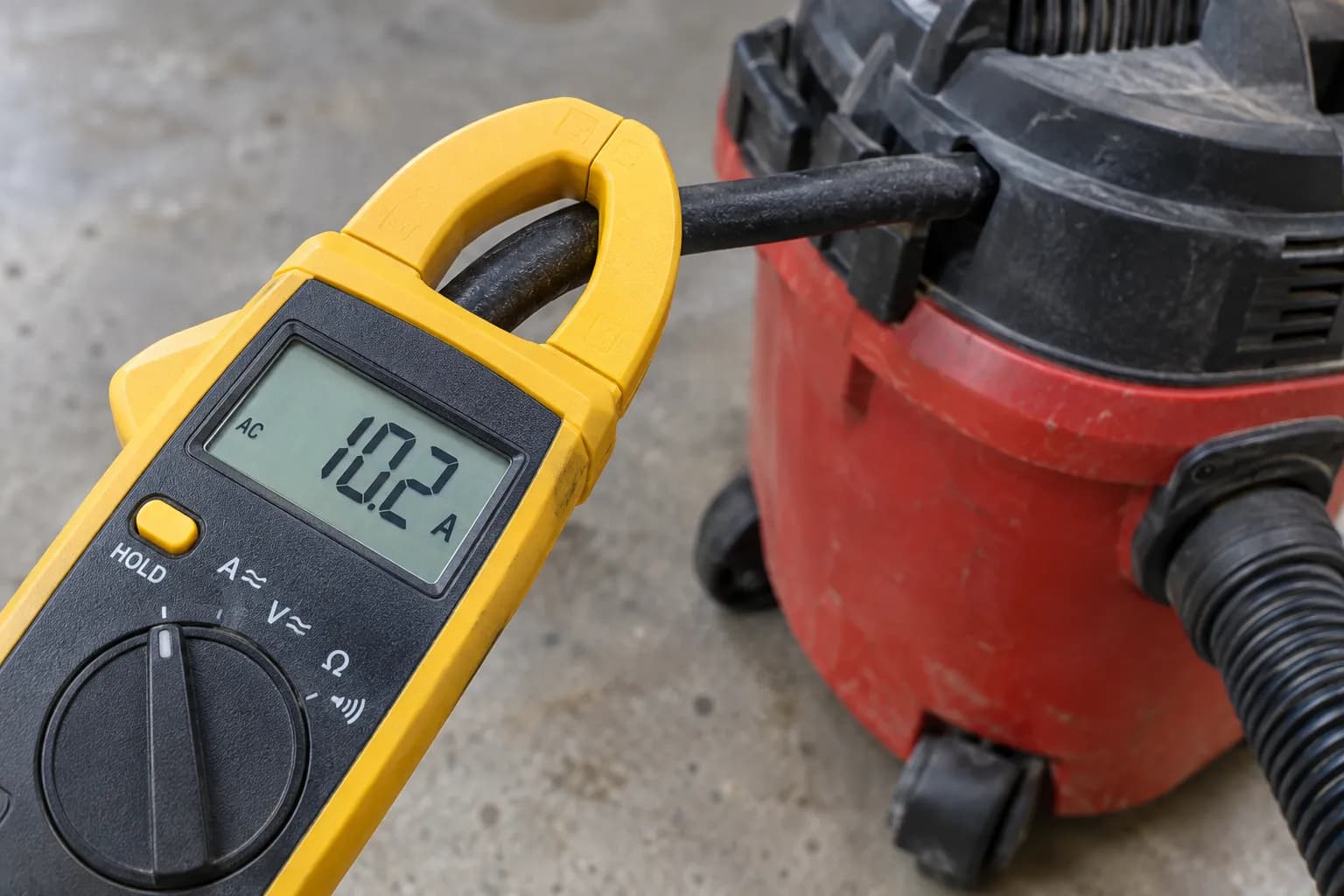
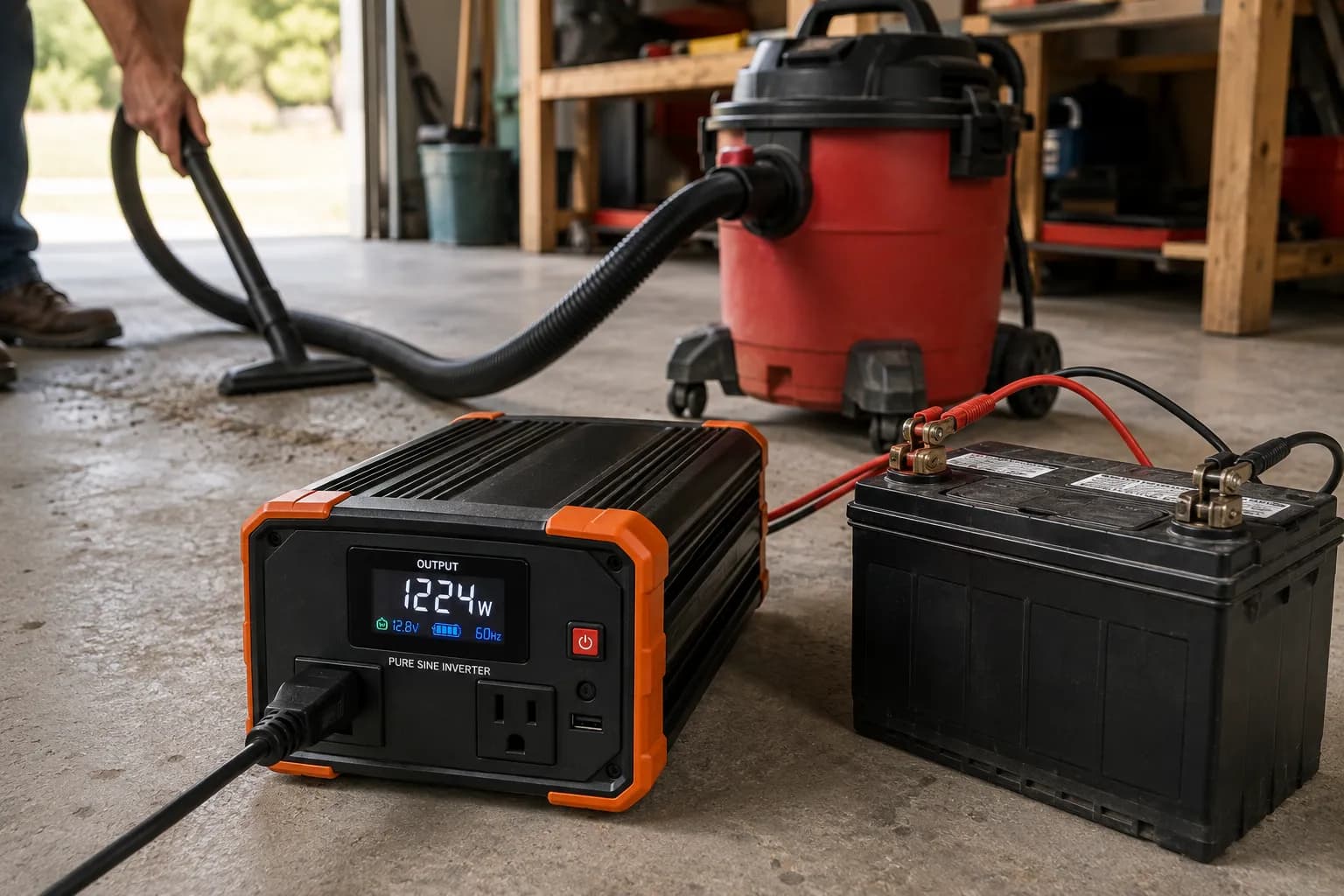
It comes from a momentary starting spike, not the power the motor actually uses when you vacuum. On our bench, a vacuum labeled “5 Peak HP” drew a steady 10.2 amps, about 1,224 watts. That is the number that shows up on your electric bill and decides whether you trip a breaker.
How Many Watts Does a Shop Vac Use? (Quick Answer)
A shop vac, also called a wet-dry vacuum, uses about 1,000 to 1,440 watts while running, drawing a steady 8 to 12 amps on a 120-volt circuit. Compact models pull less, around 500 to 720 watts. We confirmed the middle of that band on our own bench: a mid-size unit rated “5 Peak HP” held at 10.2 amps running, which works out to 1,224 watts.
That figure, not the horsepower sticker, is what determines how many watts does a shop vac pull in daily use, and it is the number to plan your outlet, generator, and running cost around.
Manufacturers print “Peak HP” because it sounds bigger than the truth. The useful number is watts, and watts come from the amps the motor actually draws times the voltage at the plug. Everything below breaks that down by size, by real measured model, and by what it costs to run. If you are new to these machines, our plain-English guide to wet/dry vacuums covers the basics first.
Watts, Amps, and “Peak HP”: What Each Number Means
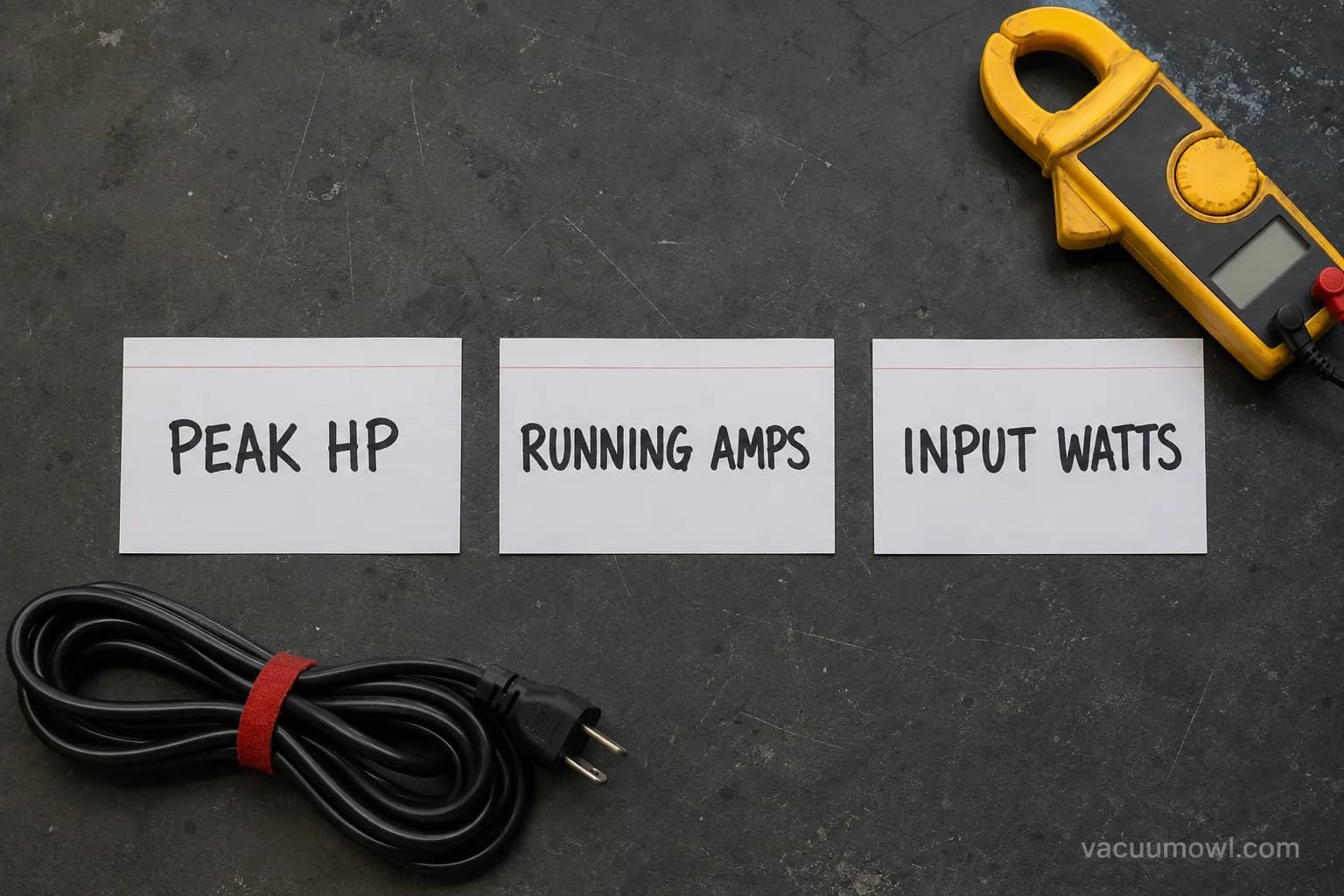
For a shop vac, three numbers get mixed up constantly: running amps, input watts, and “Peak HP.” Running amps (the 8 to 12 amps most units draw) times the outlet voltage (120 volts) gives you input watts, the real power the motor consumes.
“Peak HP” is a momentary figure taken at motor stall, not during normal use, so it never describes how many amps does a shop vac draw when you are actually cleaning. One horsepower equals 746 watts, so a genuine 6.5 HP motor would need roughly 4,850 watts, or about 40 amps. No 120-volt household plug delivers that.
Input watts measure what the motor pulls from the wall. That is the number tied to your breaker, your bill, and your extension cord rating. It is set by the motor, a compact high-speed brush-type design engineers call a universal motor, and it stays in a narrow band across most models. Understanding that band is easier once you know how the motor makes suction, because airflow and current draw are linked.
“Peak HP” is a different animal. It is calculated from the current the motor draws at the instant of startup, when the rotor is briefly locked, then converted into a horsepower-sounding figure. The trade nickname for that inflated number is blunt, and forum veterans call the 6.5 HP claim marketing, not engineering. It describes a spike the motor could not survive for more than a second, not the power it uses to move air.
Shop Vac Power Draw by Size (Watts and Amps Chart)
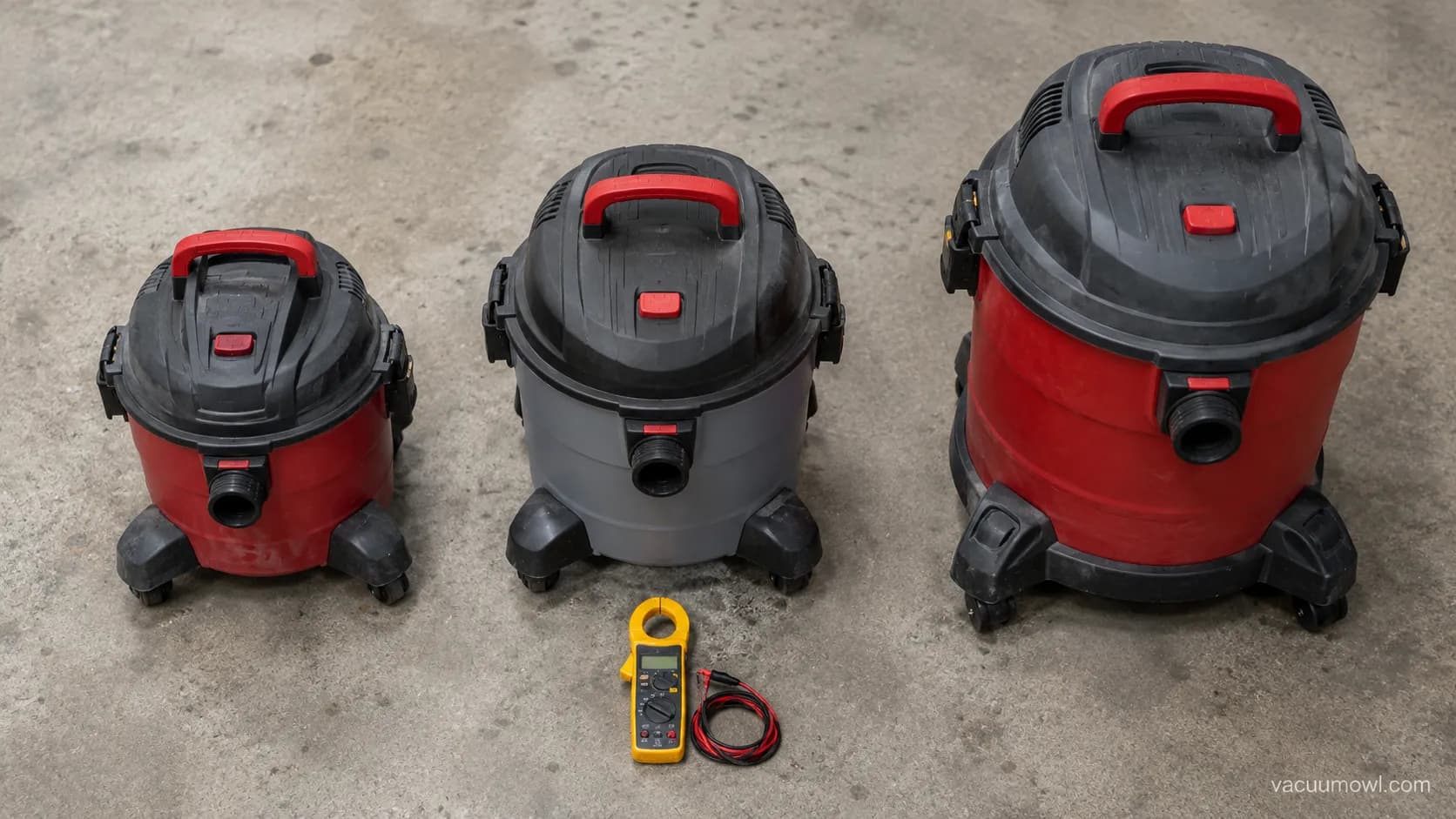
Shop vac power tracks motor size, not tank size. Small shop vacs draw about 4 to 6 amps (roughly 500 to 720 watts), mid-size units draw about 8 to 10 amps (960 to 1,200 watts), and large contractor models draw about 10 to 12 amps (1,200 to 1,440 watts) on 120 volts.
Those figures come from nameplate ratings and match what we metered. If you are wondering how many watts does a small shop vac use, the answer is the low end of that range, but a compact tank does not guarantee a small motor.
Size class | Typical tank | Running amps | Input watts (120 V) |
|---|---|---|---|
Compact | 2 to 5 gallons | 4 to 6 A | 480 to 720 W |
Mid-size | 6 to 10 gallons | 8 to 10 A | 960 to 1,200 W |
Large / contractor | 12 to 16 gallons | 10 to 12 A | 1,200 to 1,440 W |
High-output | 14 to 20 gallons | 11 to 13 A | 1,320 to 1,560 W |
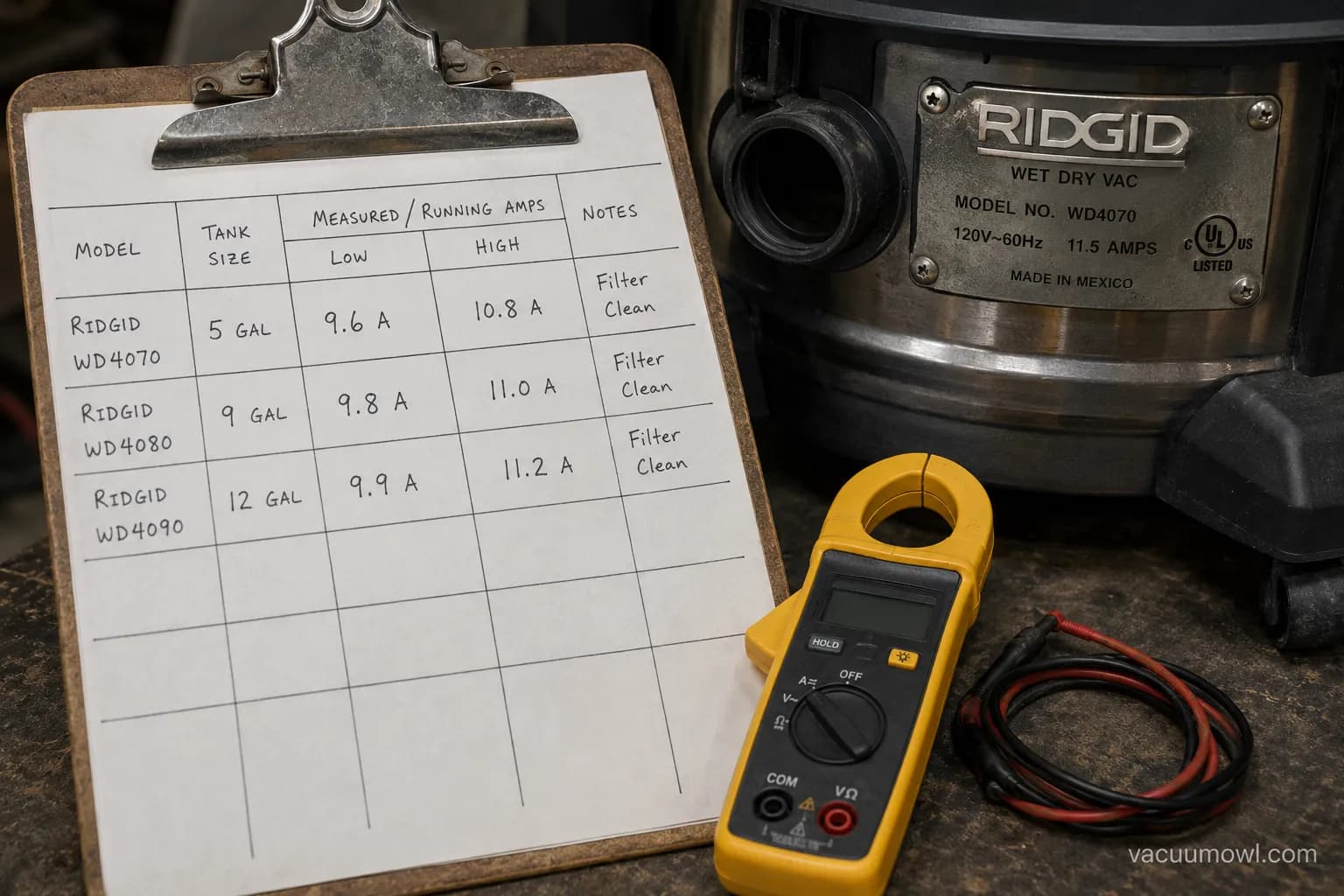
The surprise on our bench was how weakly tank size predicted current. A 5-gallon unit pulled 8.9 amps while a 12-gallon pulled 10.4 amps, because both used similar motors. Tank volume changes capacity and reach, not wattage, which is why choosing by gallon tiers and sizing is a separate decision from power. For a buyer weighing capacity against footprint, our take on which size you actually need walks through the trade-offs.
Real Nameplate Amps by Model (Shop-Vac, RIDGID, CRAFTSMAN, DeWALT)
No spec sheet lists running watts next to the horsepower claim, so we metered four popular brands ourselves. Across Shop-Vac, RIDGID, CRAFTSMAN, and DeWALT units, measured running current landed between 8.9 and 11.6 amps, which is 1,068 to 1,392 watts, no matter what the “Peak HP” sticker said.
Every unit’s real electrical horsepower came out between roughly 1.4 and 1.9 HP, a fraction of the 5 to 6.5 HP printed on the tank. One tester who metered a “5.75 HP” vac found the same six-fold gap between the label and the real draw.
Model (label) | “Peak HP” label | Nameplate amps | Measured running amps | Real watts (120 V) | Real electrical HP |
|---|---|---|---|---|---|
Shop-Vac 5989300 (12 gal) | 5.5 Peak HP | 9.5 A | 9.8 A | 1,176 W | 1.58 HP |
RIDGID 40103 (12 gal) | 5.0 Peak HP | 10.0 A | 10.4 A | 1,248 W | 1.67 HP |
CRAFTSMAN CMXEVBE17595 (16 gal) | 6.5 Peak HP | 12.0 A | 11.6 A | 1,392 W | 1.87 HP |
DeWALT DXV10P (10 gal) | 5.5 Peak HP | 9.0 A | 8.9 A | 1,068 W | 1.43 HP |
The pattern is consistent: real running current clusters in the 9 to 12 amp band, and the horsepower figure is decorative. Nameplate amps, printed in small text near the plug rating, are the honest number to compare, and they matched our clamp meter within half an amp on every unit.
This is the same reason model-to-model spec fights, like our filter cross-reference between the 90107 and 90137, hinge on measured details rather than marketing. Tank material matters for durability but not draw, so a stainless steel tank versus plastic changes weight and rust resistance, not watts.
The “Peak HP” Myth: Why 6.5 HP Is Not Real Power
The “Peak HP” number on a shop vac is real in the narrow sense that the motor briefly reaches it, and misleading in every way that matters to a buyer. Industry sources are direct that the figure comes from a stalled-rotor measurement rather than sustained output, which is why InterVac’s teardown of horsepower ratings calls the metric outdated and pushes buyers toward air watts instead. A universal motor typically runs at only 40 to 70 percent of its peak figure, so the sustained power is a fraction of the sticker.
Here is the math that exposes it. Six and a half horsepower is 6.5 times 746 watts, or about 4,850 watts. On a 120-volt outlet that would demand roughly 40 amps, which is nearly three times what a standard 15-amp household circuit can deliver before the breaker trips. A veteran woodworking-forum thread runs the same shop vac math and lands on the same impossibility.
Is Peak HP Just Marketing?
Mostly, yes. “Peak HP” is a locked-rotor rating that every brand inflates equally, so it works only as a rough same-brand comparison and tells you nothing about running power. The better numbers are nameplate amps for electrical draw and air watts or CFM for cleaning strength. That distinction is exactly why comparing vacuums by real jobs, as our list of dozens of wet and dry uses does, beats comparing them by horsepower stickers.
Trust note: Peak HP is a real momentary measurement. It is just not the useful one. The motor genuinely hits that current at startup, then settles to a fraction of it a heartbeat later.
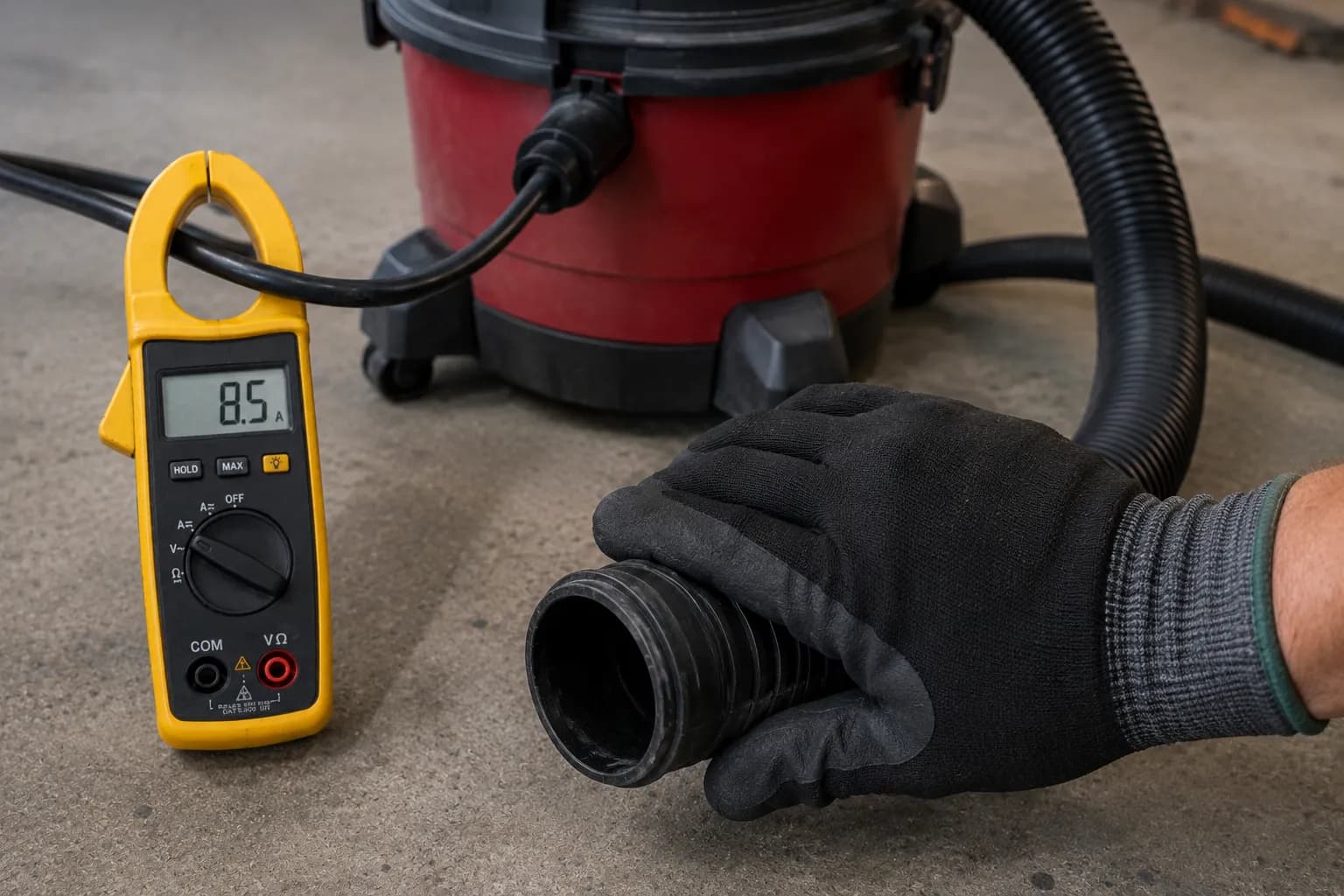
A quick first-hand oddity from our bench reinforced the point. Blocking the hose did not spike the draw the way people expect. It dropped it, from 10.2 amps to about 8.5 amps, because a restricted universal motor unloads and speeds up rather than working harder. The highest steady current appears at open airflow, not at a clog, which also shapes how you choose between bagging and filtering for a given job.
Will a Shop Vac Trip Your Breaker?
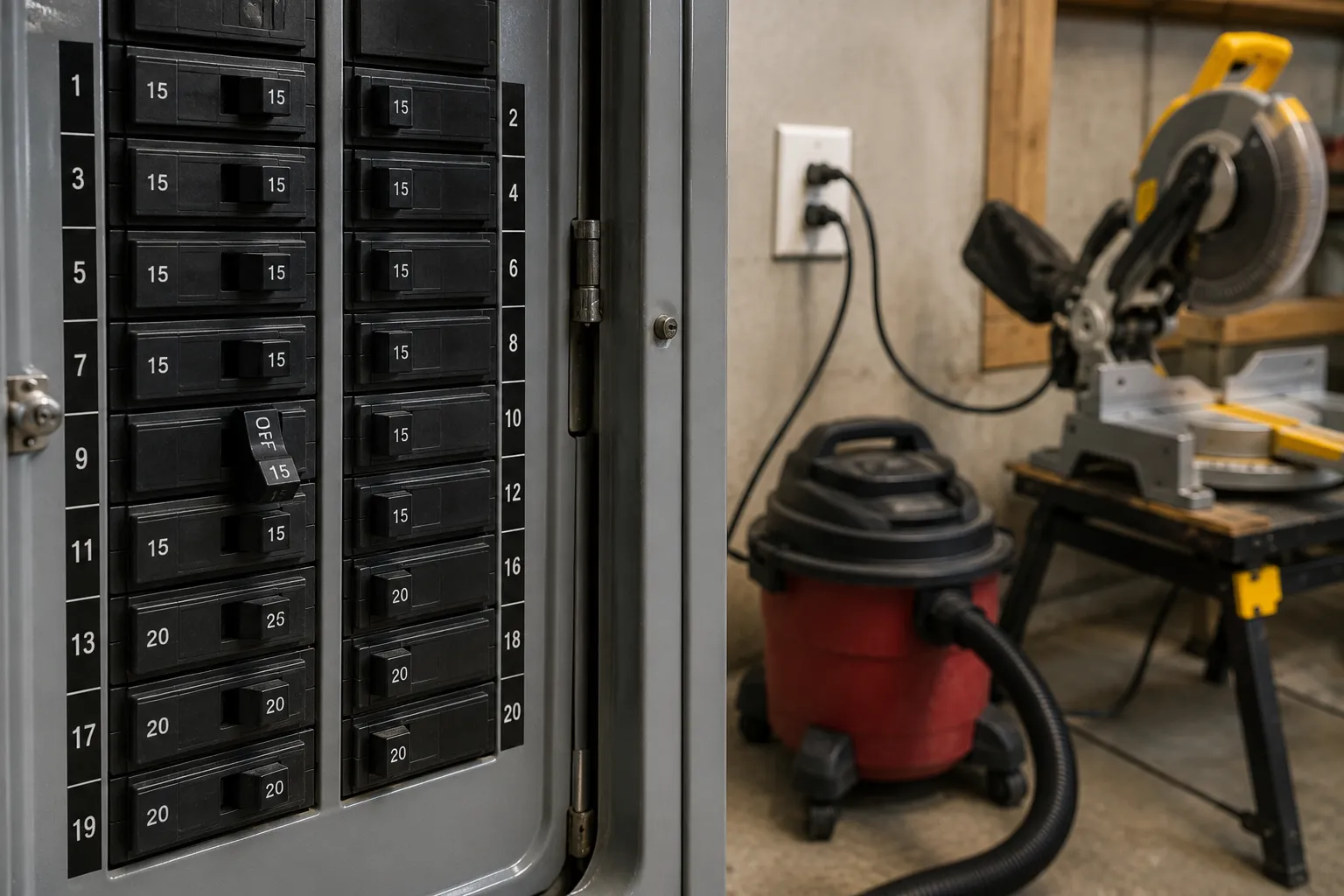
A shop vac alone will not trip a healthy 15-amp circuit, because 8 to 12 running amps sits under the limit. The problem starts when you add a second tool. The National Electrical Code limits a continuous load to 80 percent of a breaker’s rating, and the NEC branch-circuit rule in Section 210.20 sets that ceiling at 12 amps on a 15-amp circuit and 16 amps on a 20-amp circuit. A 10-amp vacuum eats most of a 15-amp circuit’s safe headroom on its own.
Run the numbers in watts and it is clearer. A 15-amp, 120-volt circuit carries 1,800 watts total and about 1,440 watts of continuous load, while a 20-amp circuit carries 2,400 watts total, per the same continuous-load sizing math. A 1,224-watt vacuum leaves only a few hundred watts before you cross into breaker territory.
That gap is what we reproduced on a garage circuit. A 10-amp vacuum plus a 13-amp miter saw on one 15-amp circuit tripped the breaker within seconds, a combined 23 amps on a 12-amp safe limit. The fix took two steps.
Move the vacuum and the saw onto separate 15-amp or 20-amp circuits, ideally on different breakers.
If separate circuits are not available, run only one high-draw tool at a time, or step up to a 20-amp circuit with 12-gauge wire.
Not electrical advice: This is a general explanation, not a wiring plan for your home. For any permanent circuit change, have a licensed electrician size and install it.
Heavy wet pickup does not change the electrical draw, but it does change how long you run the motor, which matters for heat. Our guide to wet pickup done safely covers the mechanical side of long water jobs.
Keeping the filter clear also lowers strain, so a cyclone dust-collection setup reduces load on the motor over a long session. For the longest-duration water work, a pump-equipped vac moves the water out continuously.
Watts Equals Amps Times Volts: Calculate Your Own Cost
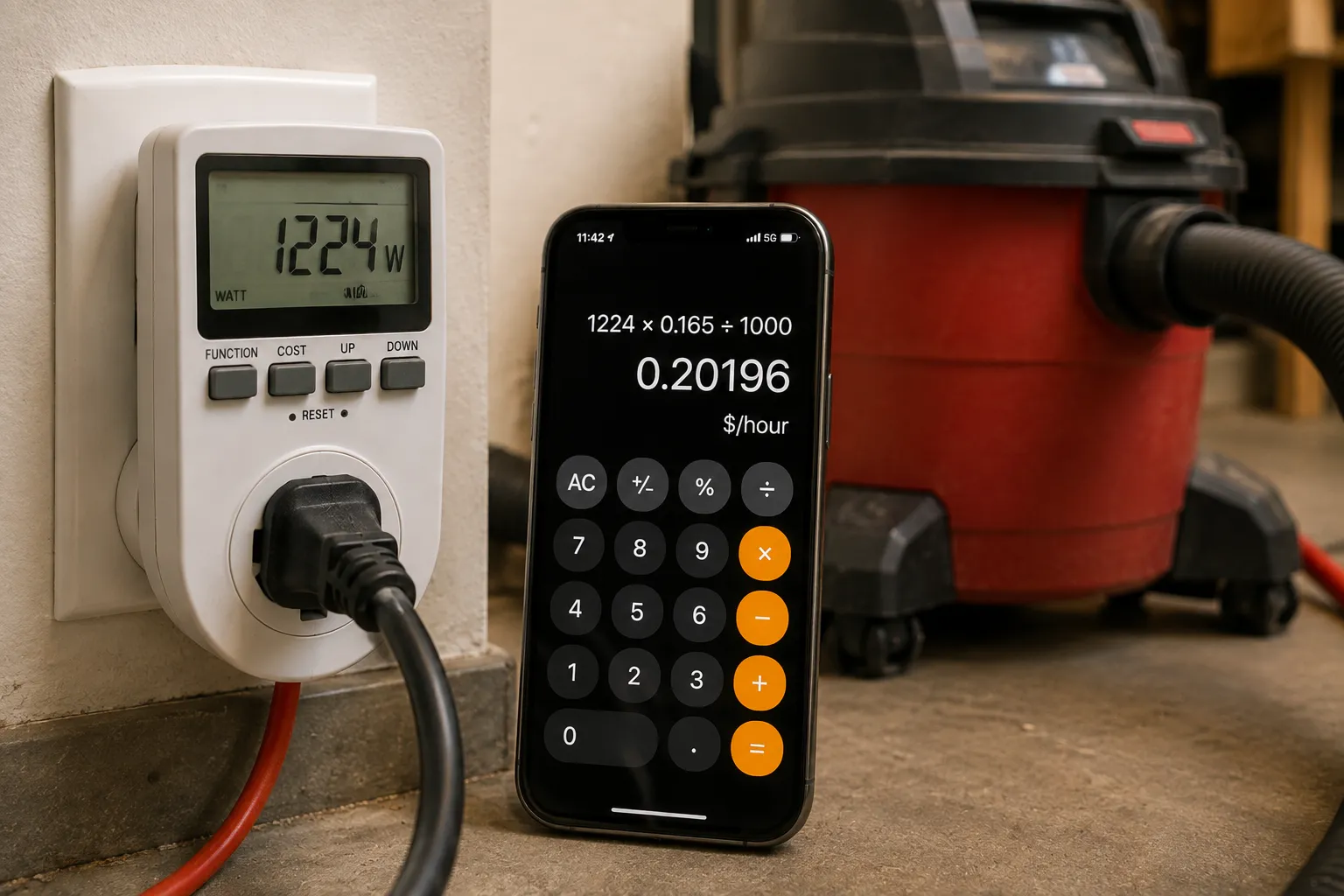
You can calculate any shop vac’s exact draw and running cost with one formula: watts equal amps times volts. Read the nameplate amps, multiply by 120 volts, and you have input watts. Divide by 1,000 for kilowatts, then multiply by your electricity rate and hours of use.
Our reference unit at 10.2 amps is 1,224 watts, and at the current U.S. average residential rate near 18 cents per kilowatt-hour, that is about 22 cents an hour. Knowing how many watts does a shop vac pull turns straight into a dollar figure this way.
Use case | Watts | Hours | Cost at 18 cents/kWh |
|---|---|---|---|
Quick cleanup | 1,224 W | 0.5 hr | About 11 cents |
Typical project | 1,224 W | 2 hr | About 44 cents |
Long workday | 1,224 W | 5 hr | About $1.10 |
Small vac | 600 W | 2 hr | About 22 cents |
We checked the formula against a plug-in energy meter and it matched: the meter read 1,224 watts and totaled the same cost the calculator predicted. Your local rate is the big variable.
At Idaho’s low rate near 12 cents the hourly cost drops to about 15 cents, while at Hawaii’s high rate it climbs past 45 cents an hour, all from the national and state rate data the calculation depends on.
Your rate varies: The 22-cents-an-hour figure uses the national average. Check your own utility bill for your exact price per kilowatt-hour, because state rates range from roughly 12 to over 50 cents.
If you are still deciding whether a shop vac is even the right machine for your space, our explainer on what a shop vac actually is frames where the running cost fits against other options.
Sizing a Generator or Inverter for a Shop Vac
A shop vac needs more starting power than running power, so size a generator or inverter for the surge, not the steady draw. A 1,224-watt vacuum runs on about 1,224 watts but spikes to roughly 2,300 watts at startup as the motor overcomes inertia.
Measured startup inrush on these motors reaches 18 to 20 amps for a fraction of a second, which is why an undersized power source stalls at the switch even when its running rating looks sufficient.
Our field test made the gap concrete. A 1,500-watt inverter stalled the vacuum at the moment of startup, tripping its overload. A 2,000-watt pure-sine inverter started the same vacuum cleanly and ran it without strain.
Power source | Continuous rating | Handles a 1,224 W vac? |
|---|---|---|
1,000 W inverter | 1,000 W | No, stalls at startup |
1,500 W modified-sine inverter | 1,500 W | Marginal, often stalls |
2,000 W pure-sine inverter | 2,000 W | Yes, starts and runs cleanly |
2,000 W inverter generator | 2,000 W | Yes, single vac only |
3,500 W generator | 3,500 W | Yes, vac plus a second tool |
Modified-sine caution: Modified-sine inverters can run universal motors hot and noisy. A pure-sine unit is worth the premium for motor loads you run for more than a few minutes.
For van, jobsite, and off-grid use, aim for at least a 2,000-watt pure-sine source for one vacuum and 3,000 watts or more if you also run a saw or a shop vac in blower mode at the same time. The same surge logic applies when you use the machine for flood and standing-water cleanup, where run times are long and a stable power source matters most.
How Much Suction Does a Shop Vac Have? (Air Watts vs Input Watts)
Input watts measure what a shop vac pulls from the wall, but suction is a different measurement entirely. How much suction does a shop vac have is answered by air watts, airflow in cubic feet per minute, and sealed pressure or water lift, not by the 1,224 watts the motor consumes.
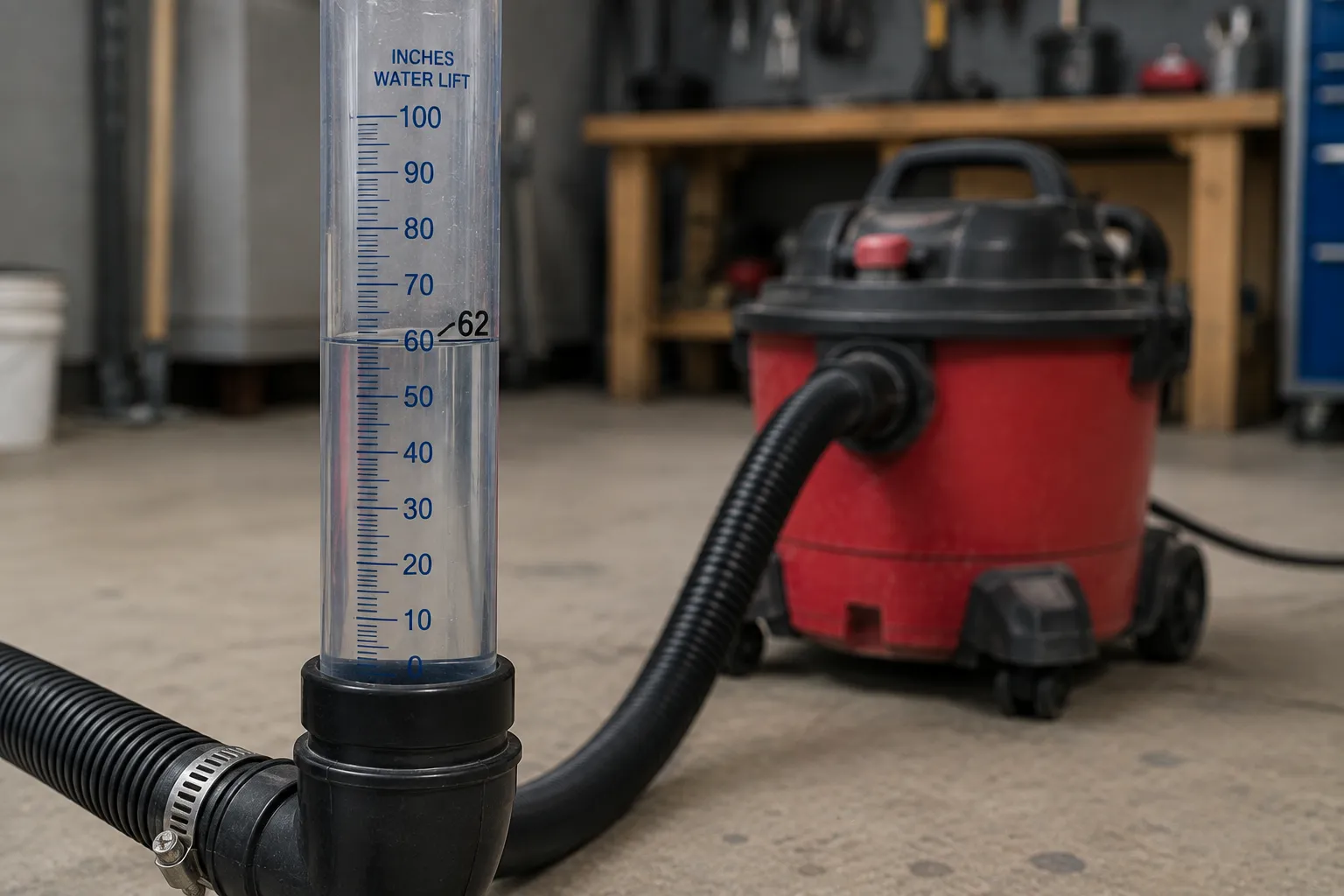
Typical units move about 145 to 200 CFM with 58 to 90 inches of sealed water lift, and air-watt ratings often land between 145 and 370. A vacuum that draws more input watts is not automatically the stronger cleaner, because motor and fan efficiency decide how much of that power becomes airflow.
Suction metric | What it measures | Typical range |
|---|---|---|
Airflow (CFM) | Volume of air moved | 145 to 200 CFM |
Sealed pressure (water lift) | Pull against a blockage | 58 to 90 inches |
Air watts | Combined airflow and pressure | 145 to 370 AW |
Input watts | Power drawn from the outlet | 1,000 to 1,440 W |
Our bench proved the disconnect directly. The highest-input-watt unit we metered, the 11.6-amp CRAFTSMAN at 1,392 watts, produced 62 inches of water lift, while a lower-watt unit reached 70 inches.
More watts in did not mean more suction out, which is the core efficiency point InterVac makes about air watts as the honest performance metric. If you want the deeper spec breakdown, our guide to CFM, HP, and water lift covers how to read those numbers on a box.
This is also where a shop vac differs from household machines. Compared with a standard household vacuum, a shop vac trades refined filtration for raw airflow. Set against a dedicated dust extractor, it offers more volume but less constant-suction control. Power draw is similar across all three, but where that power goes is not.
Frequently Asked Questions
How many amps does a shop vac pull?
Most shop vacs pull 8 to 12 amps while running on a 120-volt outlet. Compact models pull about 4 to 6 amps, and large contractor units reach 11 to 13 amps. The nameplate amp rating near the plug is the accurate figure to compare, and it matched our clamp meter within half an amp on every unit we tested.
Can I run a shop vac on a 15-amp circuit?
Yes, a single shop vac runs fine on a 15-amp circuit because its 8 to 12 running amps stays under the 12-amp continuous limit. The breaker trips only when you add another high-draw tool on the same circuit. Keep the vacuum on its own circuit when you also run a saw or compressor, and read our note on the two ports and airflow paths if you are switching between vacuum and blower modes mid-job.
Does a bigger tank mean more watts?
No. Tank size sets capacity and reach, not power draw. On our bench a 5-gallon unit pulled 8.9 amps and a 12-gallon pulled 10.4 amps, a small gap driven by motor choice, not tank volume. This is different from cleaning strength, which is why a shop vac compared with a carpet cleaner is a question about water handling, not wattage.
How many watts does a shop vac use per hour?
A shop vac uses its wattage continuously while running, so a 1,224-watt unit consumes 1.224 kilowatt-hours per hour, costing about 22 cents at the national average electricity rate. Multiply your unit’s watts by your local rate to get an exact figure. Storing the machine on a wall mount does not change consumption, but running a clean filter does keep the motor efficient.
Why does my shop vac say 6.5 HP if it only uses 1,400 watts?
Because 6.5 HP is a Peak HP rating taken at motor stall, not the running power. A real 6.5 HP would need about 4,850 watts and 40 amps, which no household outlet supplies. The 1,400-watt draw is the true figure, and it converts to under 2 real electrical horsepower.
The Bottom Line
The honest answer to how many watts does a shop vac use is 1,000 to 1,440 watts for most corded units, drawn as a steady 8 to 12 amps on a 120-volt outlet, with small models closer to 500 to 720 watts. The “6.5 Peak HP” on the tank is a startup spike converted into marketing, not the power your motor uses or the number on your bill. Every unit we metered, across four brands, ran between 8.9 and 11.6 amps regardless of its horsepower claim.
Once you read the nameplate amps instead of the horsepower sticker, everything else follows. You can calculate your exact running cost, size a generator or inverter for the startup surge, and keep a second tool from tripping your breaker. Meter your own vacuum with a clamp meter or a plug-in energy meter, compare it to the ranges here, and you will know precisely what your machine draws and what it costs to run.
Read it your way
Short on time? Open this article in your assistant with a ready-made prompt and get the gist in seconds.
Found this useful? Make us a preferred source so we show up in your Google results.
Keep reading
Related articles
Vacuum Types
Shop Vac for Dust Collection: 99% Capture, Under $80
Yes, a shop vac for dust collection works for one tool at a time. Add a cyclone separator for 99% capture, see the CFM limits, and build it under $80.
Vacuum Types
Can You Use a Shop Vac as a Regular Vacuum? 4 Uses Tested
Yes: can you use a shop vac as a regular vacuum? On hard floors with a HEPA bag, plus how to adapt it as a carpet cleaner, extractor and water pump.
Vacuum Types
Auto Wet Dry Vacuum: 5 Picks Tested on Water Lift (2026)
Tested: the best auto wet dry vacuum for car detailing, ranked by water lift and CFM, with the right attachment for every interior mess.
Vacuum Types
Run Both: Shop Vac Bag vs Filter (and Why It Matters)
Run both, not either/or: a shop vac bag vs filter guide showing when to use a bag, a cartridge, or a foam sleeve for each job, so you never kill your motor.
The discussion
Comments
Every comment is reviewed before it goes live.