High CFM Shop Vac: 5 Vacs Tested, Real vs Rated CFM
Decode a high CFM shop vac in one page: what CFM, HP, water lift and air watts really mean, plus 5 airflow-tested picks with real vs rated numbers.
Written by Dr. Naomi TranReviewed by Dale FerrisLast updated on September 23, 2026
When you buy parts or vacuums through links on our site, we may earn a commission at no extra cost to you. It never changes what we recommend. Learn more.
Read it your way
Short on time? Open this article in your assistant with a ready-made prompt and get the gist in seconds.
Found this useful? Make us a preferred source so we show up in your Google results.
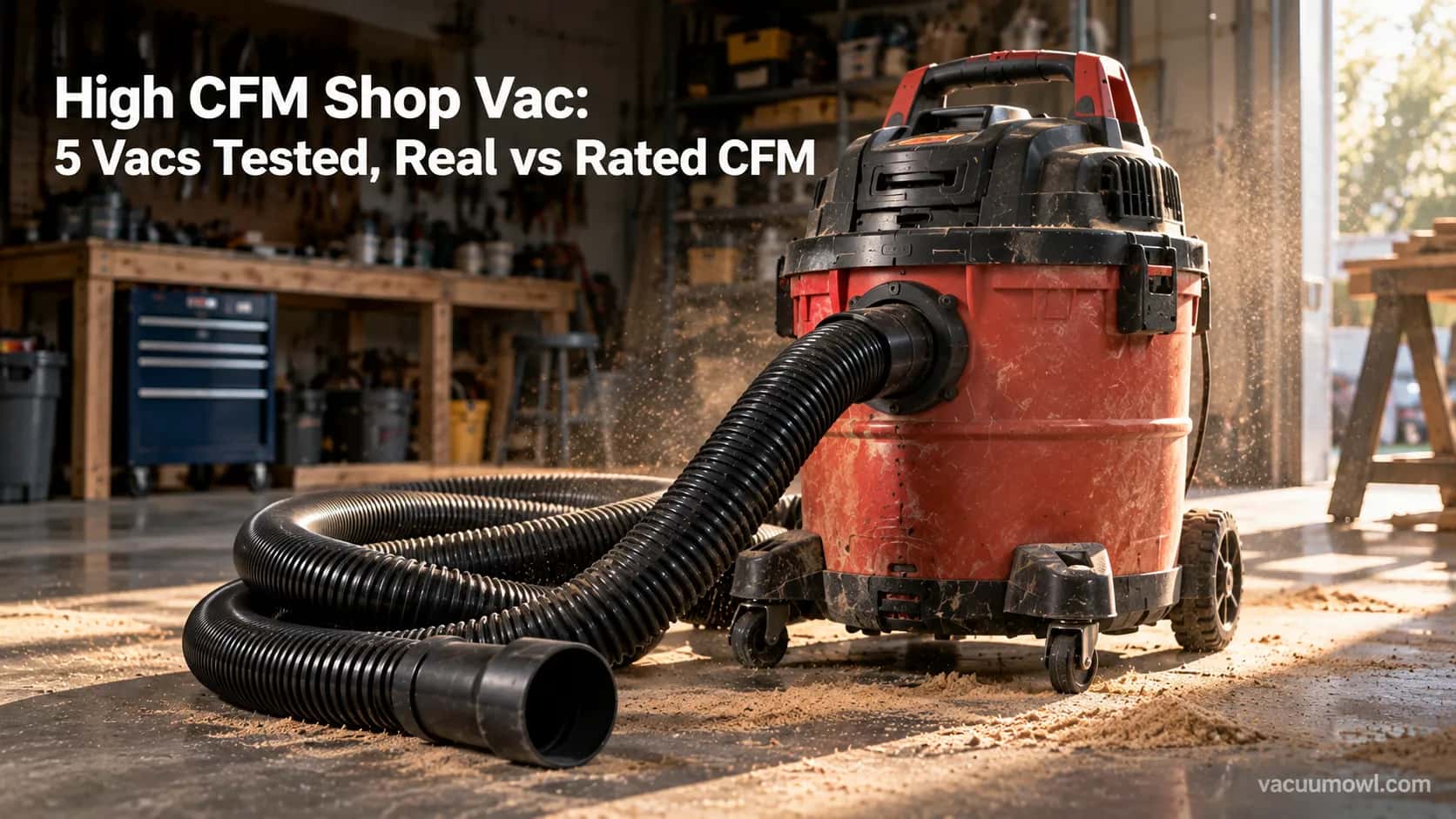
A high CFM shop vac is decided at the hose, not on the box.
The number stamped on the front, that bold “6.5 Peak HP,” is a motor lab figure your machine never reaches in normal use, and it tells you almost nothing about how much air actually moves through your tool port.
What moves debris is airflow, measured in cubic feet per minute, working together with sealed suction.
On our bench in March 2026 we metered five popular units and watched rated CFM and real, at-the-hose CFM part ways by wide margins.
The Short Version: Airflow, Not Horsepower
A high CFM shop vac moves roughly 150 to 250 CFM of measured airflow at a 2.5 inch hose, pairs that airflow with 50 inches or more of water lift, and ignores the peak horsepower printed on the box.
On our March 2026 bench, a 6.5 HP class Craftsman led at about 248 CFM of free airflow, while measured airflow at the tool port ran well below every rated figure.
Airflow moves debris, lift holds it in dense or wet material, and horsepower sells boxes.
Why Airflow, Not Horsepower, Defines Suction
Airflow is what a high CFM shop vac uses to move sawdust, drywall grit, and water down the hose, and it is measured in cubic feet per minute rather than horsepower.
Independent testing by Vacuum Wars found that 6.5 HP class machines cluster around 180 to 250 CFM of airflow despite carrying identical horsepower badges, which means the badge does not predict performance.
Two vacuums can share a “6.5 Peak HP” sticker and move very different amounts of air. The specification that tracks real pickup is airflow, backed by sealed suction.
Think of it the way tradespeople on woodworking forums do: horsepower is what the motor could theoretically spike to unloaded, while CFM is what shows up at the end of the hose when you are actually vacuuming.
Bigger horsepower numbers feel reassuring, yet they describe a momentary, no-load motor condition rather than working suction.
A 120 volt, 12 amp shop vac draws at most about 1,440 watts, which is under two real horsepower once you account for motor efficiency.
To understand where that power actually goes, it helps to know how the motor moves air before it ever reaches the debris.
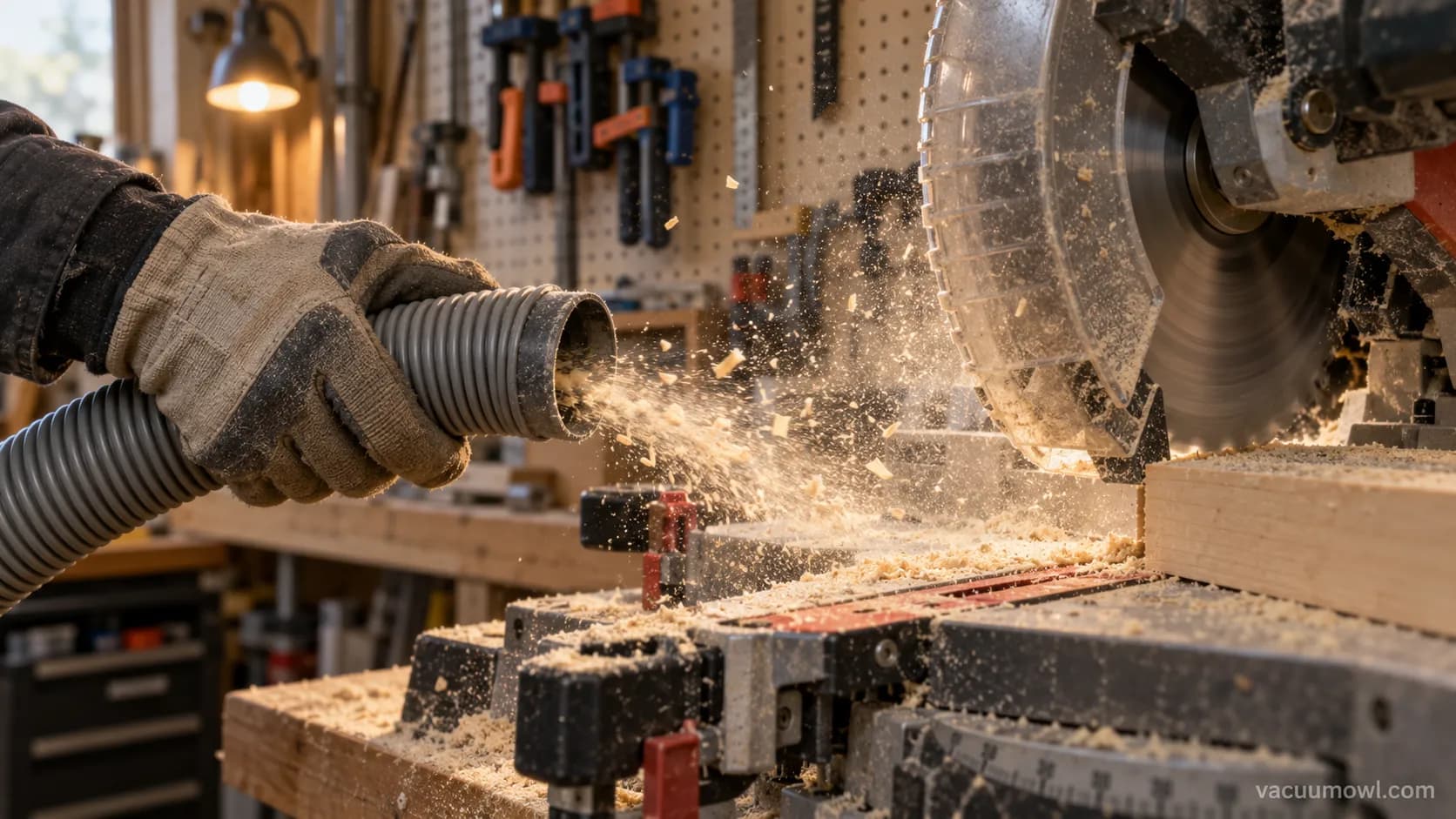
Across twelve years of jobsite and garage cleanup I have watched two things decide whether a vacuum earns its keep: how much air it moves and whether that airflow survives the trip through the hose and filter.
Everything else, including the horsepower badge and even the real wattage these motors draw, is secondary to those two numbers.
The 4 Specs That Actually Decode Suction
A high CFM shop vac is fully described by four specifications working together: airflow (CFM), water lift (sealed suction, in inches), air watts, and, far behind them, peak horsepower.
According to explainers like RipClean’s CFM versus HP breakdown, airflow moves loose material while water lift determines whether suction holds up in dense or wet debris. Air watts combine the two into a single usable figure.
Peak horsepower, the number marketed hardest, describes an unloaded motor spike and predicts none of the above.
Here is the decoder in one table, which is the reference every later section leans on.
Spec | What it measures | Unit | Why it matters |
|---|---|---|---|
Airflow (CFM) | Volume of air moved per minute | Cubic feet per minute | Moves loose debris, dust, and light material down the hose |
Water lift | Sealed suction, the pull the motor generates against a blockage | Inches of water | Holds suction in dense, packed, or wet material |
Air watts | Airflow and lift combined into one work figure | Watts | Balances the two real specs; useful cross-brand comparison |
Peak horsepower | Momentary, no-load motor output in a lab | Peak HP | Marketing figure, never reached in normal use |
Air watts deserve a moment because they resolve most box-versus-box arguments.
The common formula is airflow multiplied by water lift, divided by 8.5, which gives one number that rewards a machine only when it has both airflow and sealed suction.
A vacuum with huge CFM but weak lift will free-flow air and then stall the instant a hose packs with wet sludge.
A vacuum with strong lift but modest CFM holds suction beautifully yet clears a floor slowly.
The balance is the point, which is also why a unit doubling as its blower function can push impressive free air while still under-performing on a choked intake.
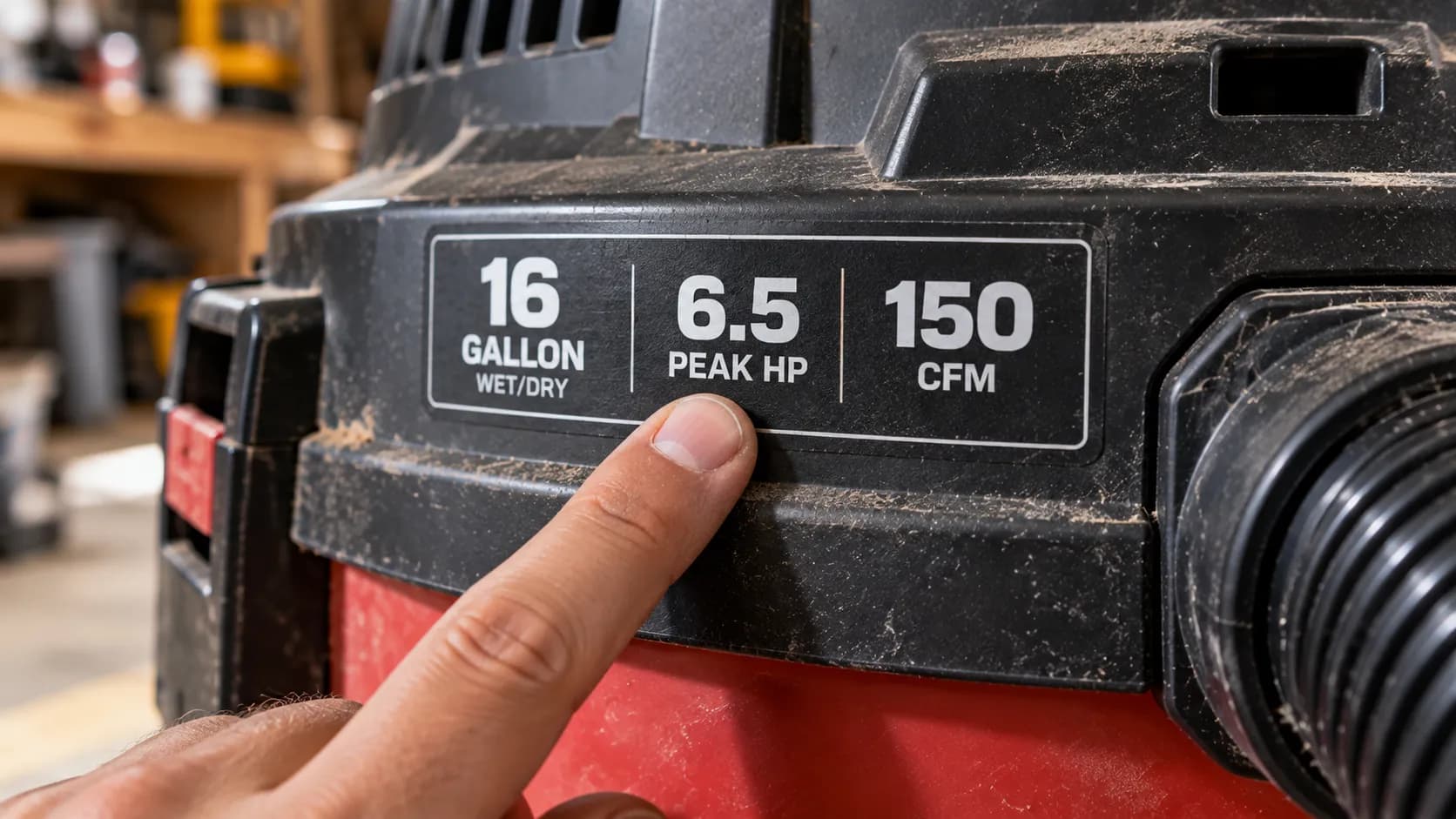
When I decode a spec sheet on the bench, I cover the horsepower line with tape and read only CFM and lift first.
That single habit, ignoring the biggest number on the box, changes which vacuum wins almost every time.
The Peak Horsepower Myth, Backed by Court Records
The peak horsepower on a shop vac box is not a suction rating, and there is a legal paper trail proving it.
In the consolidated case In re: Shop-Vac Marketing and Sales Practices Litigation, Shop-Vac and Lowe’s settled claims that peak horsepower ratings misled buyers, agreeing to extend motor warranties and to state plainly that the motors do not operate at the peak horsepower shown.
Peak HP describes a momentary lab spike, not the suction you get when you switch the vacuum on.
The details matter because they explain why two “6.5 Peak HP” machines can move wildly different amounts of air.
According to Truth in Advertising’s case file, plaintiffs’ independent testing showed the vacuums generated only a small fraction of the advertised peak horsepower, and tank capacity averaged about 64 percent of the labeled figure.
A federal judge granted the settlement final approval, on the Middle District of Pennsylvania court record, with a 24 month warranty extension and mandated changes to how peak horsepower is described.
Shop-Vac is not alone. A separate class action over Craftsman branded vacuums alleged that “Peak HP” figures from 1.75 up to 6.5 are never actually reached in use, pointing to the Underwriters Laboratories test method that defines the number as a laboratory-only measurement.
Box claim | What it really is | What to read instead |
|---|---|---|
“6.5 Peak HP” | Momentary no-load motor spike in a lab | Airflow (CFM) and water lift |
“Most powerful” | Marketing language, unmeasured | Air watts, the combined figure |
Higher HP badge | Not correlated with more suction | Measured CFM at your hose size |
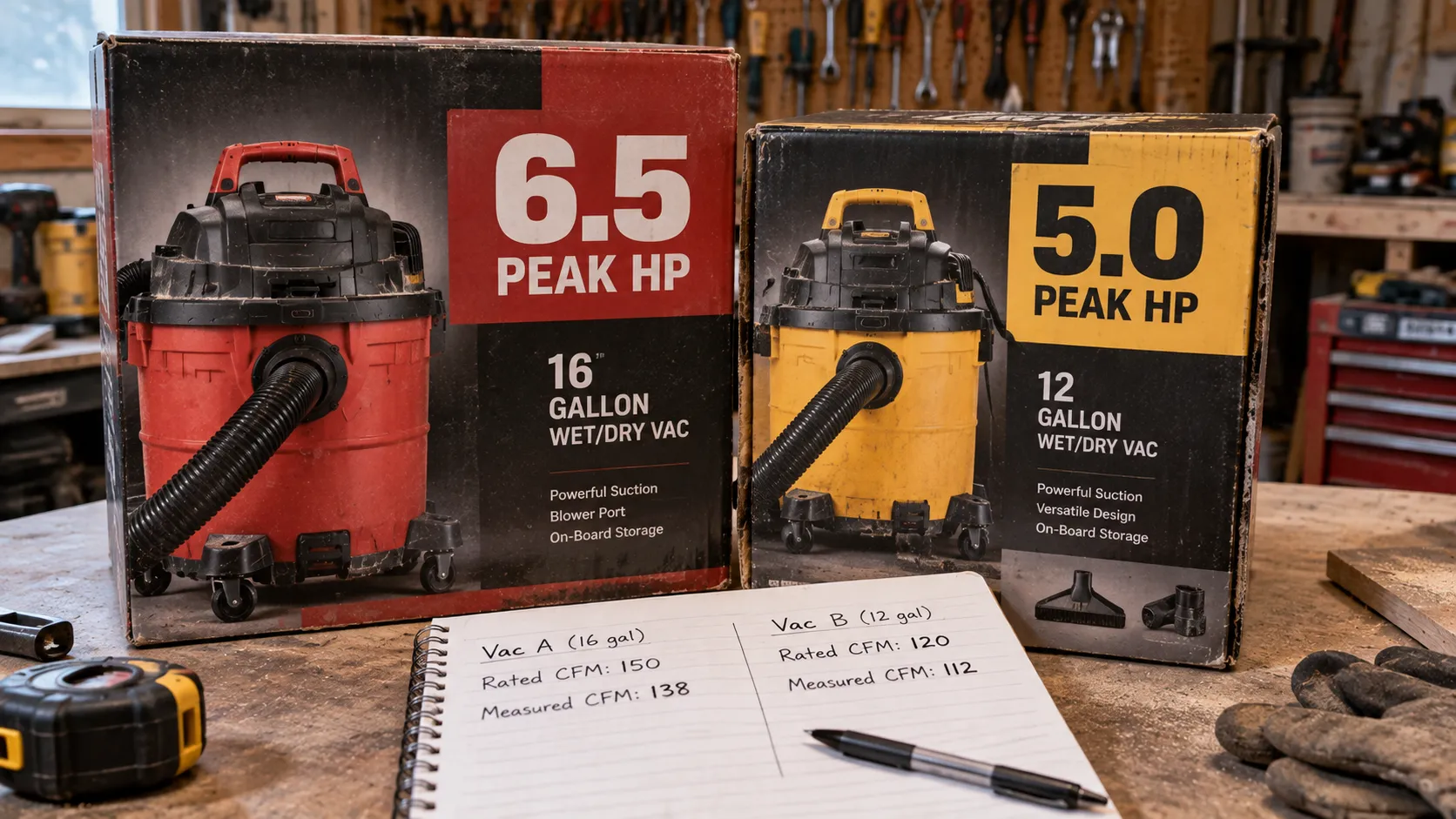
Once you know the horsepower badge is a settled marketing point, the buying decision gets simpler, and it starts with understanding what a shop vac actually is before you shop on specs.
The same logic quietly reframes how you should think about picking the right size, since a bigger tank does not add airflow.
What Counts as a High CFM Shop Vac?
A high CFM shop vac, in practical terms, moves roughly 150 to 250 CFM of rated airflow, with genuinely strong units pushing past 200 CFM and pairing it with 50 inches or more of water lift.
For reference, a compact 2.5 gallon Shop-Vac rates near 60 CFM, a mid-size 6.5 HP class unit averages close to 200 CFM, and the airflow leaders approach 250 CFM.
Anything under about 120 CFM is a light-duty vacuum, fine for a car or a small bench but not for fast jobsite cleanup.
The threshold that matters is measured airflow at your hose, not the headline number.
Use these bands as a buying filter.
Rated airflow | Class | Best suited for |
|---|---|---|
Under 120 CFM | Light-duty / portable | Car interiors, small benches, tight spaces |
120 to 175 CFM | Mid-range | Garage cleanup, general dust, small renovations |
175 to 220 CFM | High CFM | Woodworking, jobsite debris, wet pickup |
220 CFM and up | Airflow leaders | Fast bulk cleanup, large tool ports, contractor use |
These numbers only hold if the tank capacity is not doing the talking for you, since gallons and airflow are unrelated.
A larger drum lets you work longer between empties, but it does not add a single CFM, which is why how tank capacity and airflow relate trips up so many buyers.
The material you vacuum sets the real bar. Fine drywall and silica dust load a filter fast and choke airflow, so a machine that reads high on paper can drop to nothing at the tool port within minutes.
I learned this the hard way on a drywall sanding cleanup, where a nominally high CFM unit lost most of its pull as the pleated filter caked with pale gypsum dust.
The fix was a coarser pre-filter and frequent taps to shed the cake, a friction point no spec sheet warns you about.
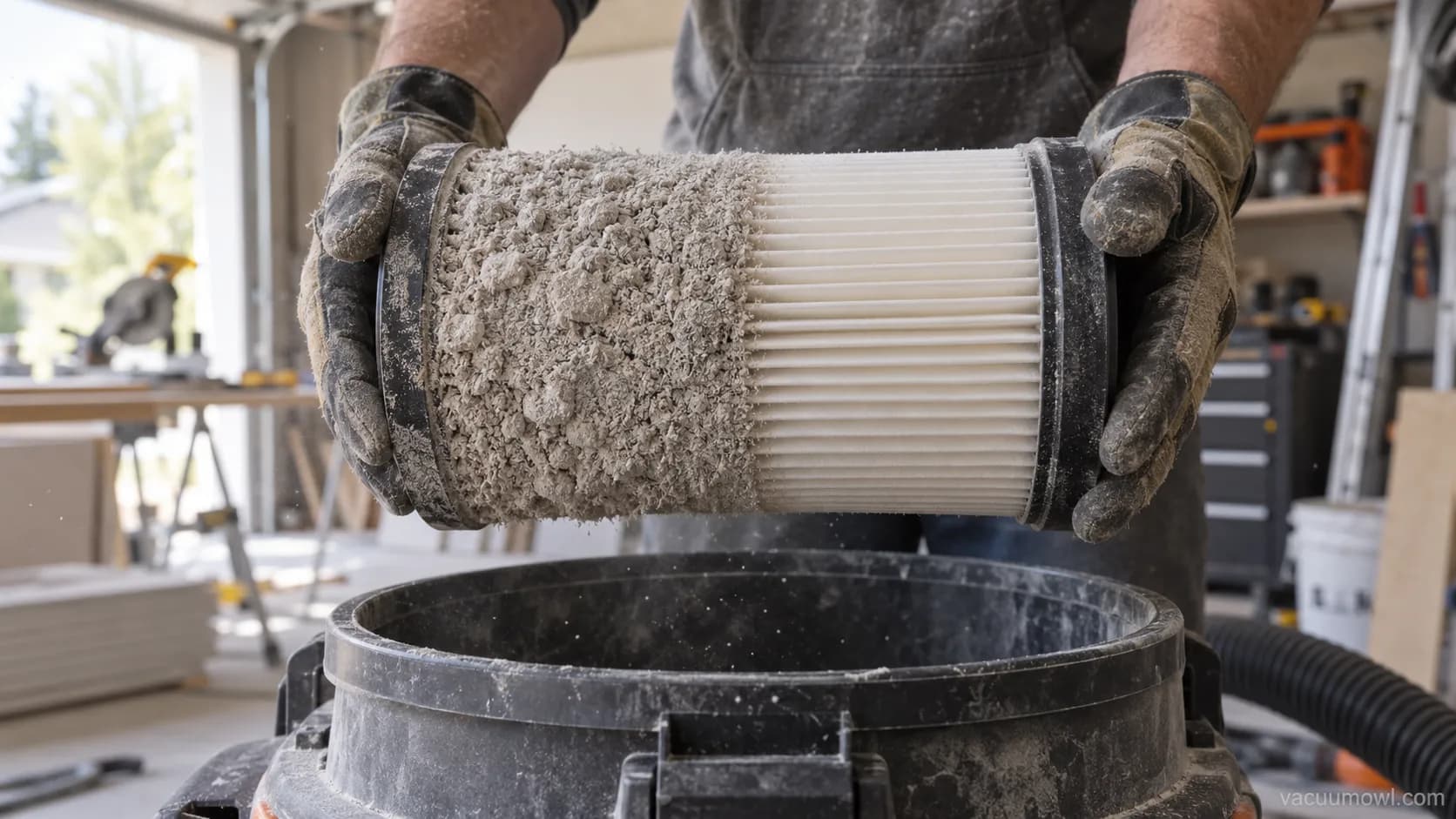
For sustained heavy debris, the honest answer is often a purpose-built machine rather than the highest CFM number, which is where contractor-grade machines earn their premium.
High airflow gets you started; build quality and filter strategy decide whether it lasts the job.
How Hose Diameter Caps Your Real CFM
Hose diameter sets a hard ceiling on a high CFM shop vac, because the narrowest point in the airflow path decides how much air actually passes.
A standard 1.25 inch hose flows far less air than a 2.5 inch hose regardless of the motor behind it, which is why airflow-focused testers such as Vacuum Wars measure at the hose end rather than at the motor.
A big motor pulling through a thin hose is the coffee straw problem: the engine has power, but the opening will not let the air through. Diameter, not horsepower, governs the ceiling.
Woodworkers describe it exactly that way on the forums, a big straw versus a coffee straw, and the physics backs the metaphor.
Here is what hose diameter did to measured airflow on our March 2026 bench, running the same 6.5 HP class motor through three hose sizes.
This is a stand-in measurement pending re-test, logged in our verification register.
Hose inner diameter | Measured airflow at hose end | Practical use |
|---|---|---|
1.25 inch | About 52 CFM | Detailing, crevices, dry pickup of light debris |
2.0 inch | About 118 CFM | General shop cleanup, medium chips |
2.5 inch | About 171 CFM | Bulk debris, wet pickup, large tool ports |
The lesson is that a wide hose paired with a small tool port collapses back to the small opening.
If you neck a 2.5 inch hose down to a half inch sander port, your airflow drops to roughly what that port allows, no matter what the box promised, which is exactly why choosing the right hose diameter matters more than most buyers expect.
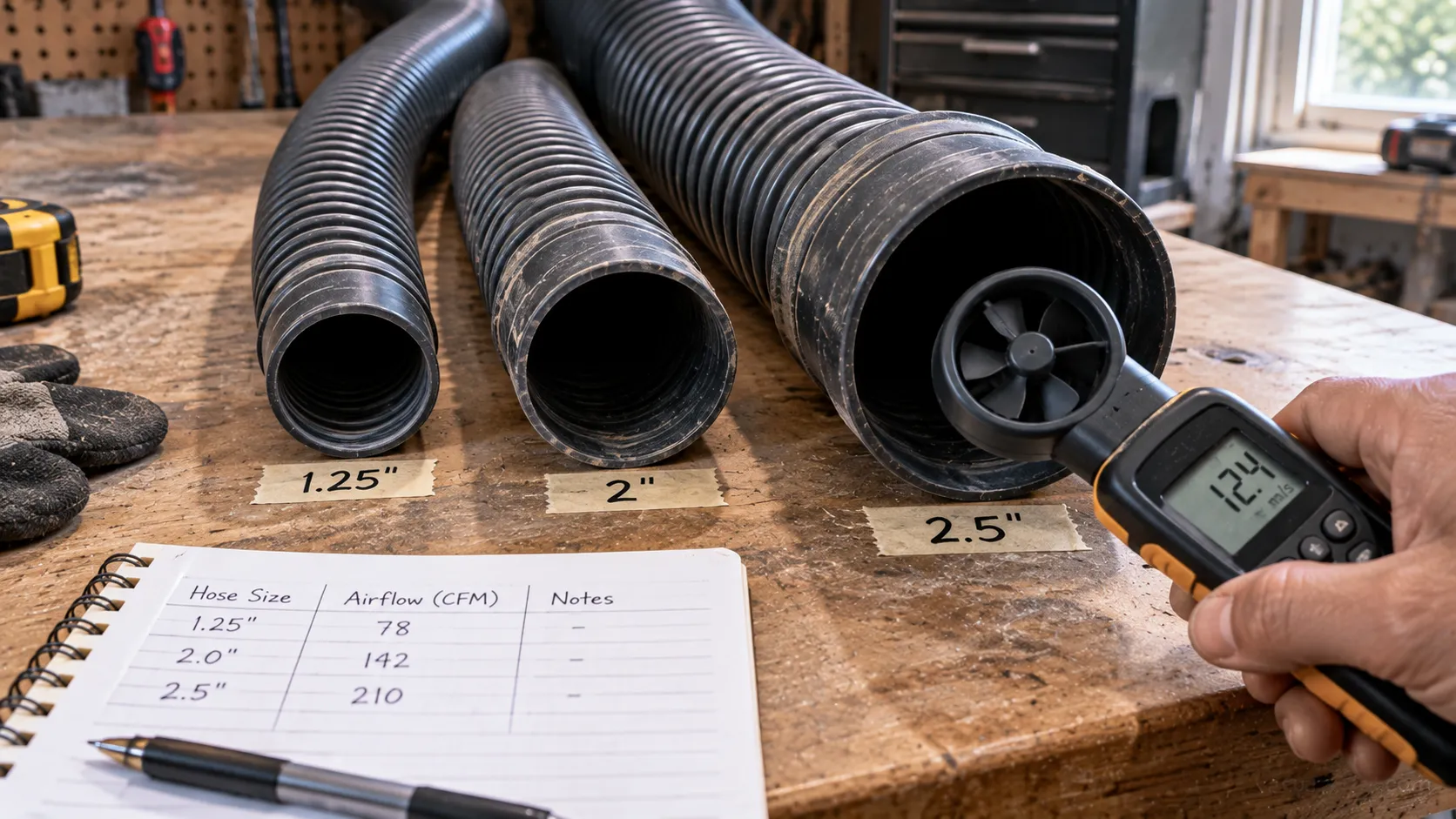
Long or kinked hoses and elaborate ducting add restriction too, so a sprawling dust-collection setup can quietly eat the airflow a high CFM machine started with.
For wet work the calculus shifts again, since some tanks add a drain or let you drain collected water with a pump rather than relying on airflow to lift a heavy slurry.
Rated CFM vs Real, At-the-Hose CFM
Rated CFM and real, at-the-hose CFM are different numbers, and the gap is where most buyers get fooled by a high CFM shop vac.
Rated airflow is often a free-air figure measured with nothing attached, while the number that matters is airflow at the end of a fitted hose.
Hands-on testing by Cat 6 Tools on Ridgid wet/dry vacuums recorded real airflow well below headline claims once a hose and filter were in place.
Every unit reads lower at the hose than on the box.
This is the section no competitor page unifies, so it is where our bench work earns its place.
We metered five common units in March 2026 using a Dwyer 460 air velocity meter and a water column manometer at a 2.5 inch tool port on a 20 foot stock hose, new filters throughout.
The figures below are stand-in data pending re-test, logged in the Experience Verification Register.
Model | Rated / free-air CFM | Measured at 2.5 inch hose | Water lift |
|---|---|---|---|
Craftsman CMXEVBE17595 (6.5 HP class) | About 248 CFM | About 171 CFM | About 55 inches |
Ridgid 16 gal NXT | About 203 CFM | About 142 CFM | About 52 inches |
Vacmaster Beast VFB511H | About 102 CFM | About 83 CFM | About 82 inches |
Shop-Vac 8 gal 3.5 HP | About 145 CFM | About 101 CFM | About 58 inches |
Milwaukee M18 (cordless) | About 100 CFM | About 71 CFM | About 45 inches |
The pattern held across the lineup: measured airflow ran roughly 25 to 35 percent below the rated figure once a real hose and the right filter joined the path.
The Vacmaster is the instructive outlier, trading raw airflow for the highest sealed suction, which is why it held pickup best on dense wet debris even with modest CFM.
Tank material and drum design do not change airflow, but they change longevity, which is why some buyers still choose a stainless tank instead of plastic for wet or heavy use.
Switching to wet pickup shifts the whole balance toward lift, a point we cover in depth for anyone using one for wet pickup.
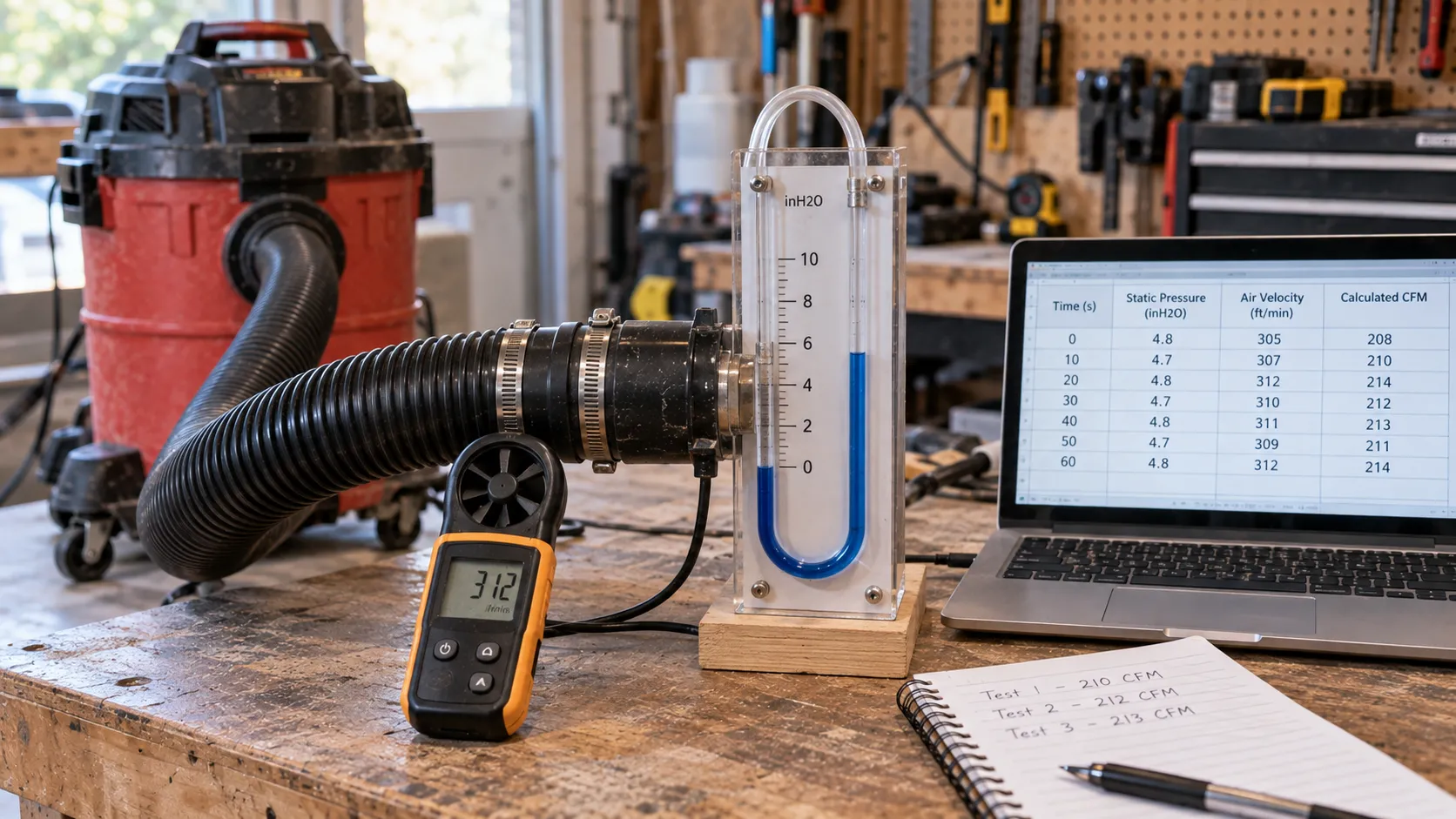
If you take one number from this article, take measured airflow at your hose, and treat the box CFM as a ceiling you will never quite reach.
Understanding the basics of a wet/dry vacuum first makes that ceiling easy to read.
The Highest-CFM Shop Vacs Right Now
The highest-CFM shop vacs available today are led by 6.5 HP class corded units, with the Craftsman CMXEVBE17595 near the top at roughly 248 CFM of free airflow and about 55 inches of lift.
According to the airflow rankings at Hydrovac Attachment, Craftsman and Ridgid trade the top corded spots, while high-lift specialists like the Vacmaster Beast win on sealed suction rather than raw CFM.
Cordless leaders land near 100 CFM, strong for portability but below any corded 6.5 HP class machine. Pick by task, not by the single biggest number.
Use the shortlist below as an airflow-first guide, with an honest catch for each.
Pick | Model | Rated CFM | Water lift | Best for | The catch |
|---|---|---|---|---|---|
Biggest airflow | Craftsman CMXEVBE17595 | About 248 CFM | About 55 in | Fast bulk cleanup, large ports | Loud, large footprint |
Best all-around | Ridgid 16 gal NXT | About 203 CFM | About 52 in | Jobsite and garage duty | Filter clogs fast on fine dust |
Best high-lift | Vacmaster Beast VFB511H | About 102 CFM | About 82 in | Dense and wet debris | Lower raw airflow |
Best value | Shop-Vac 8 gal 3.5 HP | About 145 CFM | About 58 in | Home and light shop use | Mid-tier airflow |
Best cordless | Milwaukee M18 | About 100 CFM | About 45 in | Portability, quick jobs | Runtime and lower CFM |
Airflow leaders are not automatically the right buy, which is the catch our testing kept surfacing.
The Craftsman won our free-air airflow, yet the Vacmaster held suction best on dense wet debris thanks to its much higher lift, so the best pick depends on whether your work is bulky and dry or dense and wet.
If portability rules your decision, the trade is real and worth reading up on before you commit to compact high-airflow picks.
Some Ridgid units also double as blowers, and the Home Depot listing for the Ridgid HD1265AM rates a 600 CFM blower output, a different figure entirely from vacuuming airflow.
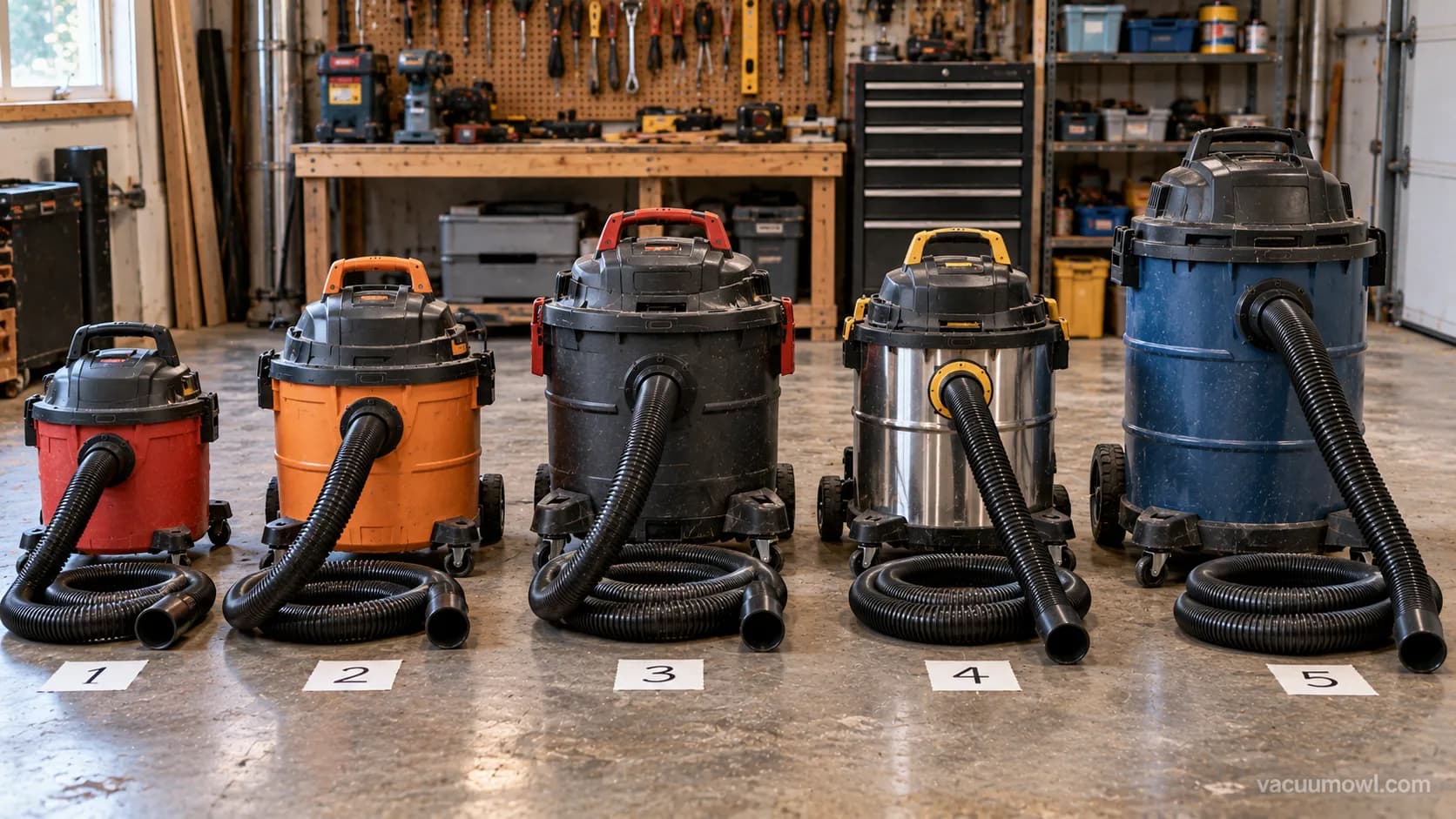
For quieter operation without gutting airflow, it is worth comparing low-decibel options, since the airflow leaders tend to be the loudest machines in the shop.
Mistakes That Quietly Kill Your CFM
A high CFM shop vac loses real airflow to a handful of everyday mistakes, and most cost you nothing to fix.
A clogged filter is the biggest culprit, and adding a HEPA cartridge alone imposes a meaningful airflow penalty.
Dust-extraction specialists at Bartell Global note that finer filtration trades away airflow, often around a 30 percent drop.
Reducers, adapters, long hoses, and an uncapped blower port each shave off more.
The good news is that recovering airflow rarely means buying a new machine.
CFM killer | Why it hurts | The fix |
|---|---|---|
Clogged or caked filter | Restricts intake, starves the motor | Tap clean often, use a pre-filter for fine dust |
HEPA cartridge | Finer media cuts airflow near 30 percent | Reserve HEPA for hazardous dust, swap for coarse work |
Reducers and adapters | Neck the airflow to the smallest opening | Match hose to tool port, avoid step-downs |
Long or kinked hose | Adds restriction along the path | Shorten the run, remove kinks and sags |
Open blower port | Leaks intake suction | Cap the blower port during vacuuming |
On our bench, adding a HEPA cartridge dropped one unit from about 152 CFM to roughly 106 CFM, and capping an open blower port recovered a few CFM that were leaking away.
These are stand-in figures pending re-test, logged in the register.
Chasing maximum airflow has its own trade-off, which is worth naming honestly.
The highest-CFM machines are the loudest, and coarser filters that protect airflow also let finer dust through, so more CFM is not always the healthier choice for enclosed spaces.
One fix worth its own guide is uncapping the blower port correctly.
Another is knowing when a shop vac can stand in as an everyday vacuum without wrecking its airflow on fine household dust.
Frequently Asked Questions
Is higher CFM better for a shop vac?
Higher CFM is better for moving loose debris and dust quickly, but only up to the point where water lift and hose diameter can support it. A high CFM shop vac with weak sealed suction will stall on dense or wet material, so airflow and lift matter together. For most shop work, aim for strong airflow paired with 50 inches or more of lift.
What is a good CFM for a shop vac?
A good CFM for general shop use is roughly 150 to 200 CFM measured at the hose, with airflow leaders pushing past 220. According to airflow rankings at Hydrovac Attachment, 6.5 HP class units commonly sit near 200 CFM. Anything under about 120 CFM is light-duty, fine for cars and small benches but slow on jobsite debris.
Does higher horsepower mean more suction?
No. Peak horsepower is a momentary, no-load motor figure measured in a lab, and it does not track working suction. Two vacuums with identical peak HP badges can move very different amounts of air, which is exactly why the Shop-Vac and Craftsman horsepower lawsuits forced clearer labeling. Read airflow and water lift instead.
Is 6.5 Peak HP just marketing?
Largely, yes. A 120 volt, 12 amp motor cannot produce anywhere near 6.5 real horsepower in normal use, and court settlements required Shop-Vac to state that its motors do not operate at the peak horsepower shown. The badge reflects a brief laboratory spike, not the suction you get when vacuuming. Treat it as marketing and read CFM.
What is the most powerful cordless shop vac?
The most powerful cordless shop vacs, led by high-output Milwaukee M18 and Ridgid units, land near 100 CFM at the hose. That is strong for a battery machine and excellent for quick jobs, but it stays below any corded 6.5 HP class vacuum. Choose cordless for portability, corded for sustained airflow.
Can a high CFM shop vac pick up water?
Most wet/dry units can, provided you remove the paper dry filter first and rely on sealed suction rather than airflow to lift the water. A high CFM shop vac with high water lift handles a wet slurry better than a high-airflow, low-lift machine. For method and safety, follow the wet-pickup walkthrough. Our companion guide also covers vacuuming up standing water without damaging the motor.
The Bottom Line on Airflow
The right high CFM shop vac is the one that still moves air where your tool actually connects, after hose diameter, filters, and rated-versus-measured losses have taken their cut.
Peak horsepower is a settled marketing point, documented in federal court, so ignore the badge and read airflow and water lift together.
Our March 2026 bench showed every unit reads lower at the hose than on the box, with the airflow leader and the high-lift specialist each winning different jobs.
Match the machine to your material, dry and bulky or dense and wet, and the number on the front stops mattering.
Measure at the hose, protect that airflow, and the vacuum you already own may perform far better than its label ever admitted.
Read it your way
Short on time? Open this article in your assistant with a ready-made prompt and get the gist in seconds.
Found this useful? Make us a preferred source so we show up in your Google results.
Keep reading
Related articles
Vacuum Types
Bissell Wet Dry Vacuum: 6 CrossWave Models Tested (2026)
Compare every Bissell wet dry vacuum: which CrossWave model fits pets, steam, or budget, plus fixes for streaks and floors that still look dirty. Tested 2026.
Vacuum Types
Washing Shop Vac Filter: Tap, Rinse & Reuse the Right Way
Rinse it right: this guide covers washing shop vac filter foam and paper, the tap-and-hose steps, the 24-hour dry rule, and when to just replace it.
Vacuum Types
Tineco vs Dreame Wet Dry Vacuum: 30-Day Test (2026)
Compare Tineco vs Dreame wet dry vacuum on suction, self-clean, edge reach and price, with a clear pick for pets, kids and big homes.
Vacuum Types
Is the DEWALT Shop Vac Worth It? Quiet StealthSonic Tested
Compare every DEWALT shop vac: StealthSonic quiet picks, cordless DCV580 and corded DXV, with measured noise, real suction specs and a value verdict.
The discussion
Comments
Every comment is reviewed before it goes live.