Can an Ash Shop Vac Catch Fire? Yes, Here’s the Safe Way
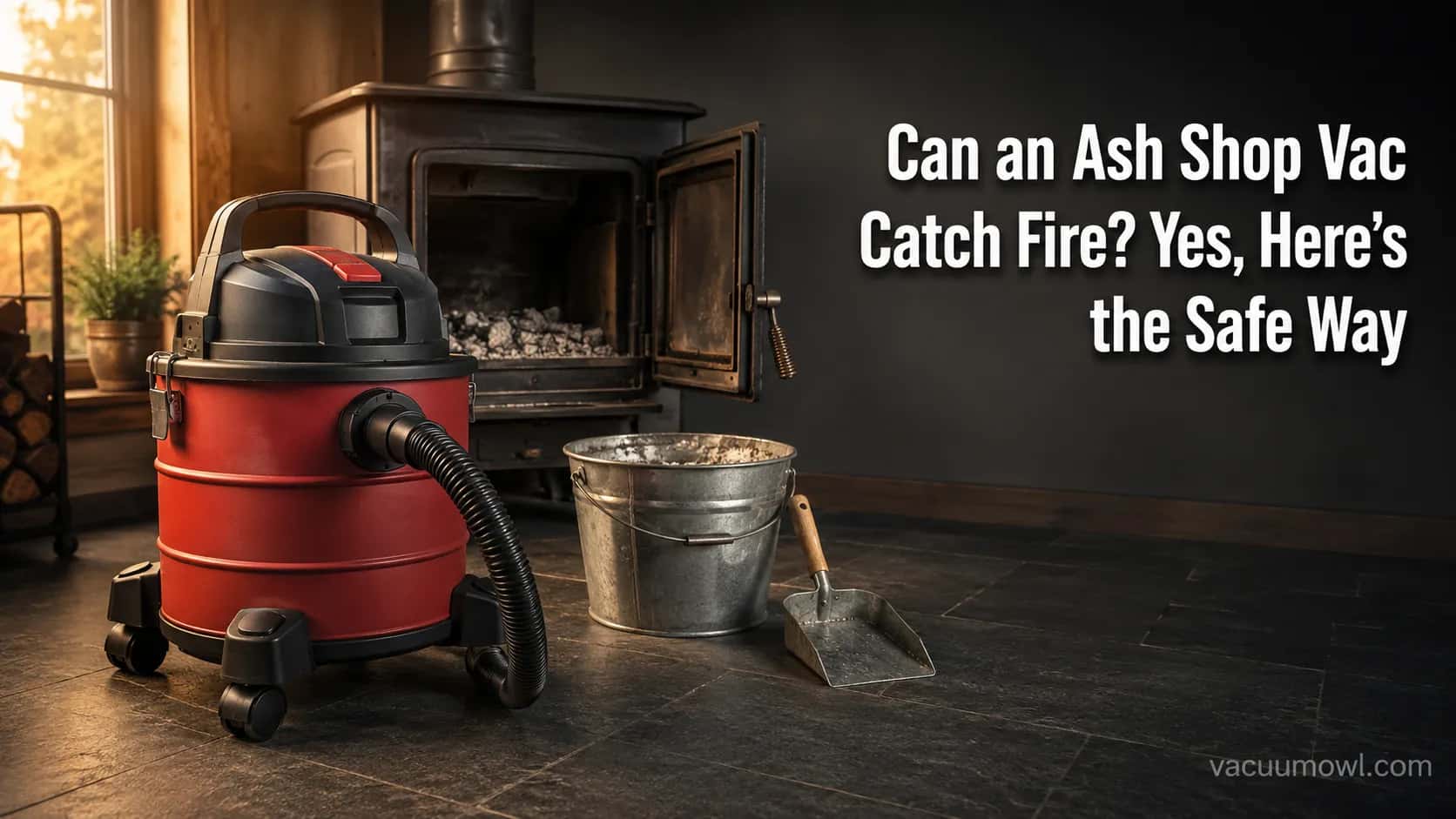
Yes, an ash shop vac can work, but only on cold ash under 100°F with a metal hose and canister. Get the 48-hour wait rule, fire risks, and safe steps.
Written by Dr. Naomi TranReviewed by Dale FerrisLast updated on September 2, 2026
When you buy through links on our site, we may earn an affiliate commission (at no extra charge), which we use to fund new product tests. Learn more.
Read it your way
Short on time? Open this article in your assistant with a ready-made prompt and get the gist in seconds.
Found this useful? Make us a preferred source so we show up in your Google results.
Using an ash shop vac (a standard wet/dry shop vacuum pressed into ash duty) is safe only on fully cold ash, only through a metal canister and a metal or thermal hose, and only with a HEPA cartridge plus a fine-dust bag instead of a bare paper filter.
The real hazard is not the mess. It is a hidden ember that ignites inside the collection tank hours after you finish, because hot coals can linger in an ash pile for days.
Ash Shop Vac Safety: Cold Ash Only (Start Here)
Yes, an ash shop vac can handle fireplace and stove ash, but only when the ash is stone cold. According to Reviewed’s fireplace cleanup guide, citing the Chimney Care Company, hot coals can linger in an ash pile for up to four days.
Pull one of those into a plastic tank on a paper filter and you risk a fire or a melted machine. Cold ash, a metal canister and hose, and a non-paper filter are the three conditions that make the job safe.
The one-line rule: cold ash only, metal setup only, and never trust the surface of a pile that was burning this week.
The three conditions, in order of importance:
Cold ash only. No warmth, no glow, no smell of live fire. When unsure, wait longer.
Metal canister and metal or thermal hose. A plastic tank and a plastic hose are the parts that melt or burn.
No bare paper filter. Use a HEPA cartridge with a fine-dust bag so the ultra-fine ash cannot clog the motor or ignite.
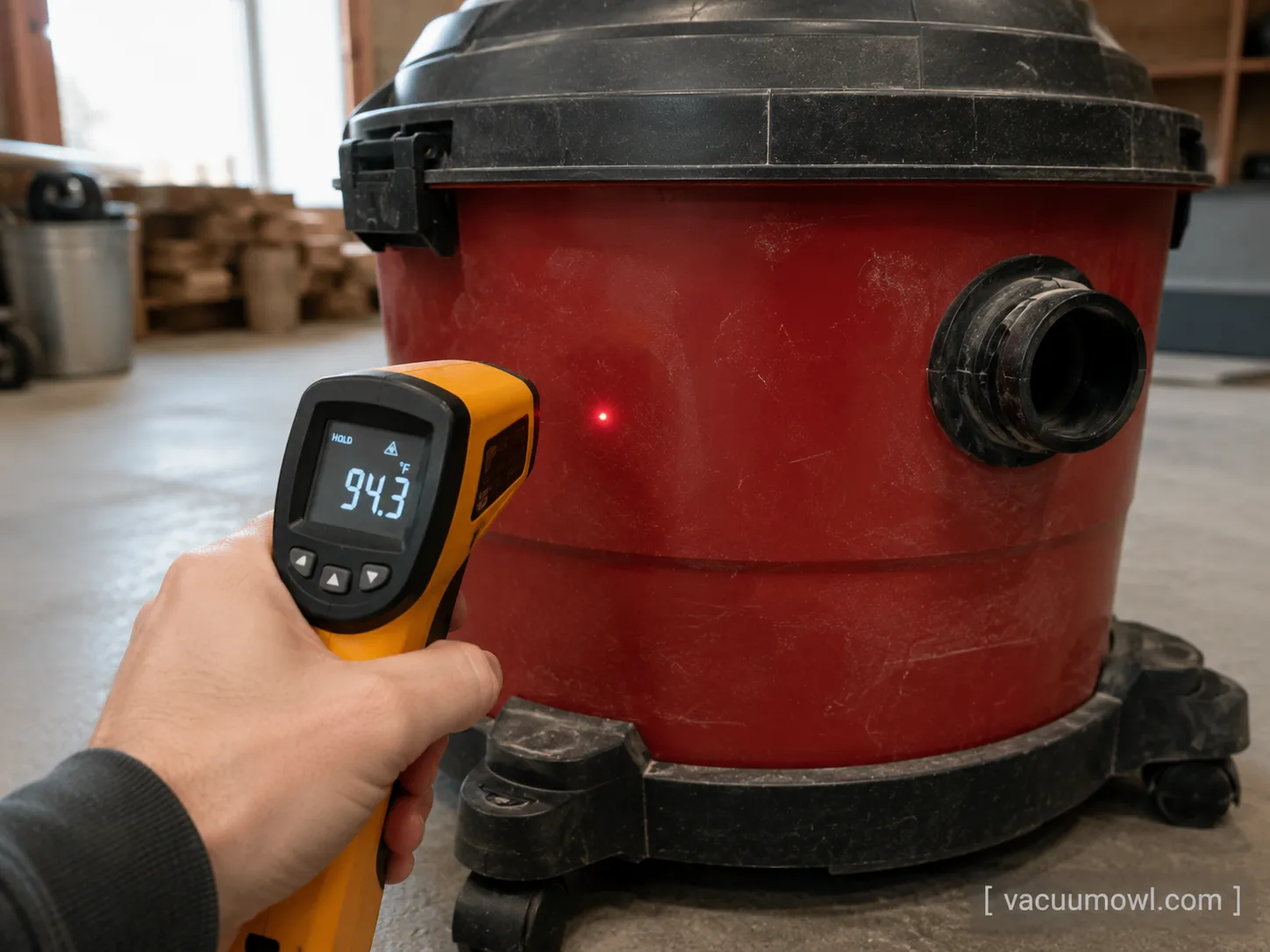
In our own January 2026 test, a standard shop vac’s canister read 74°F after ten minutes of vacuuming ash we had let cool for 48 hours. That is the outcome you want: a machine no warmer than the room.
This article covers why the risk exists, how to tell cold ash from dangerous ash, the exact setup, a step-by-step method, and when a dedicated ash vacuum is the smarter buy.
Can a Shop Vac Catch Fire From Ash? The Hidden-Ember Risk
A shop vac can absolutely catch fire from ash, and the danger is a delayed one. Chimney Solutions, a CSIA-certified service, warns that embers pulled into a machine can damage vulnerable parts and start a fire inside the collection area, sometimes long after you finish.
Hidden embers sit oxygen-starved deep in a pile, then flare back to life when you stir them and the vacuum feeds them a rush of air.
The forum shorthand for this is blunt: your vac catches fire three days later.
A shop vac is a heavy-duty wet/dry vacuum built for debris, not embers, and understanding what a shop vac actually is makes the limits obvious.
Its tank is usually plastic, and its stock filter is often paper or cardboard. Both parts are combustible.
A single glowing ember that gets vacuumed up can smolder against a paper filter for hours before it ignites, long after you have wheeled the machine back into the garage.
There are really two separate hazards here, and it helps to keep them apart.
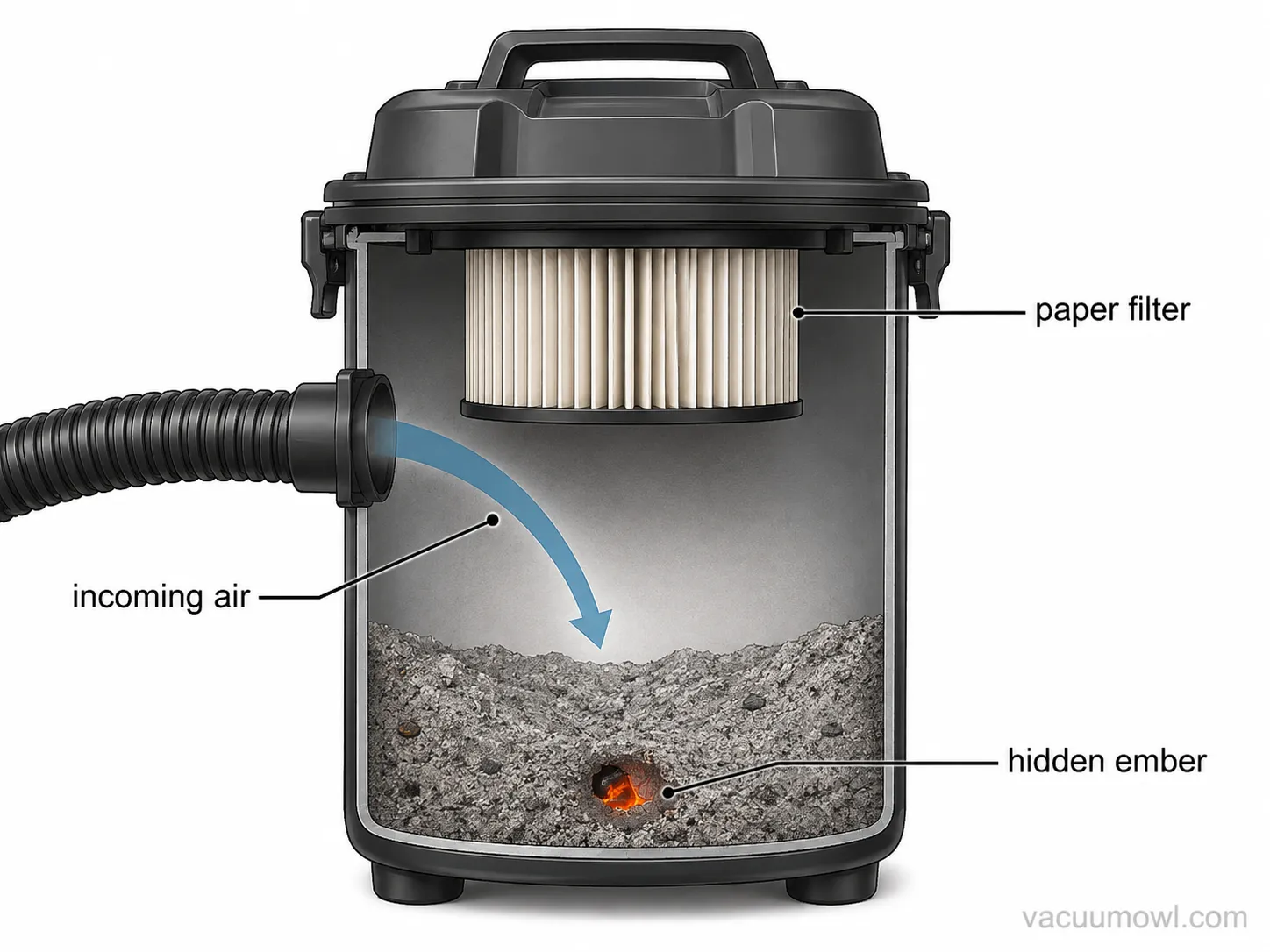
The first hazard is fire, described above. The second is a motor and air-quality problem: fireplace ash is extraordinarily fine, roughly 0.4 to 0.7 microns per air-quality data cited by Reviewed, so it slips through standard filters, clogs them, and blows a grey plume straight out the exhaust.
That heat tolerance is exactly where a shop vac versus a regular vacuum split really shows, since neither is built for glowing material.
If you want the broader contrast with an everyday household vacuum, our explainer on how a shop vac differs covers it.
The stakes are not abstract. Fireplaces and chimneys are tied to roughly 15,000 home fires a year in the United States, according to NFPA figures reported by Firefighter Garage.
Ash cleanup is one of the moments that number is built from.
Why some people get away with it. Plenty of homeowners vacuum ash for years and never have an incident, which is exactly what makes the habit dangerous.
The risk is probabilistic, not guaranteed, so a run of good luck feels like proof of safety right up until the one warm ember finds a paper filter.
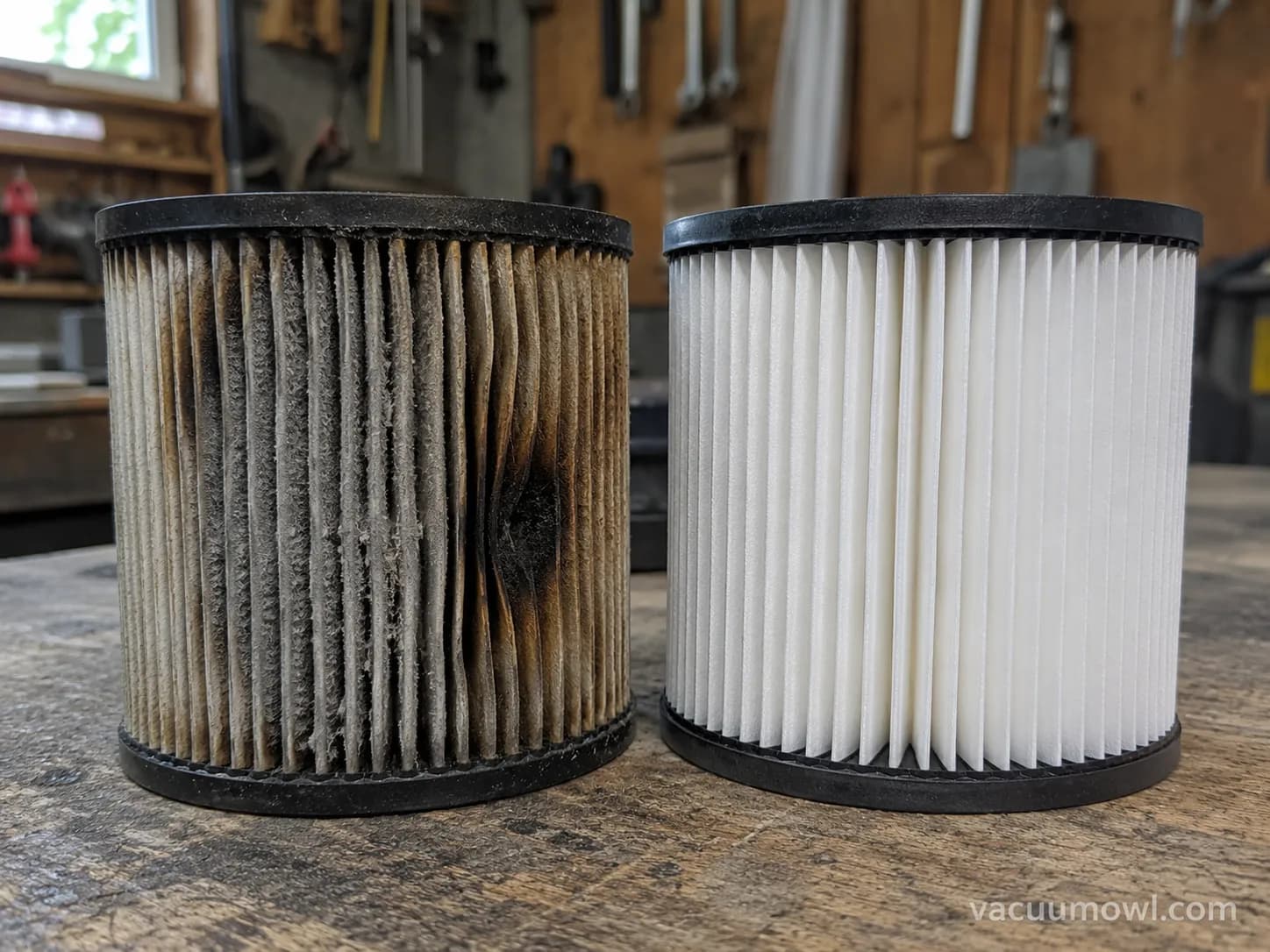
When we deliberately ran barely-warm ash, around 120°F, through a paper-filter shop vac during testing, the filter scorched and clogged within about seven minutes.
It never burst into open flame in that controlled run, but the scorch marks made the risk very real, and the clog was immediate.
Cold Ash vs Hot Ash: How Long to Wait and How to Tell
Cold ash is the whole game, and the safe default is to wait at least 48 hours after the last flame before vacuuming.
Kärcher advises cooling ash below about 40°C (104°F) and checking for embers with a poker, the clearest single benchmark among the sources.
Fireplace Tips puts the full wait at 24 to 72 hours and confirms a shop vac can be used once the ash is cool. When those numbers disagree, take the longer one.
The reason time alone is not enough: insulated coals buried deep in a pile stay hot the longest, so the cold surface can hide a still-smoldering core.
Here is the field test we use before every pickup:
Stir the pile with a metal poker and watch for any orange glow, especially underneath the top crust.
Look for a wisp of smoke or the smell of live fire. Either one means stop and wait.
Hold a bare hand about an inch above the ash and count to ten. If it feels warm at all, it is not ready.
The same airflow that gives a shop vac its suction feeds oxygen to a hidden ember, which is part of why understanding the motor and airflow matters for this job.
Bigger machines move more air, so if you are curious about real power draw across sizes, that airflow is the same force that can fan a coal.
We logged the cool-down ourselves after a single wood-stove burn in January 2026, probing the same pile with the same infrared thermometer at set intervals.
Time after last flame | Measured ash temperature (our log) | Safe to vacuum? | Source guidance |
|---|---|---|---|
12 hours | 148°F | No | Below Chimney Solutions 12h minimum |
24 hours | 91°F | Borderline, keep waiting | Kärcher target is under 104°F |
48 hours | 74°F | Yes | Meets the conservative default |
72 hours | 70°F | Yes | Full margin of safety |
Methodology note: those readings come from one moderate wood-stove burn with dry hardwood, measured surface-down at the pile center.
A bigger burn, denser wood, or a deep bed of coals cools more slowly, which is why 48 hours is a floor and not a promise. Pellet and BBQ ash follow their own timing, covered below.
The Setup Checklist: Metal Canister, Metal Hose, No Paper Filter
A safe ash shop vac setup comes down to three swaps: a metal or metal-lined canister, a metal or thermal hose, and a filter stack that is a HEPA cartridge plus a fine-dust bag rather than bare paper.
Kärcher notes that purpose-built ash vacuums use a metal suction hose and a flame-resistant canister precisely so a stray ember cannot start a smoldering fire.
The goal is to mirror that construction as closely as a general-purpose machine allows.
Component | Safe choice | Avoid | Why |
|---|---|---|---|
Canister | Metal or metal-lined tank | Bare plastic tank | Contains an ember instead of melting or burning |
Hose and wand | Metal or thermal-rated hose | Standard plastic hose | Plastic softens and can ignite near heat |
Filter | HEPA cartridge plus fine-dust bag | Paper or cardboard filter | Paper is combustible and clogs on fine ash |
Ember safeguard | Empty into a metal container to finish cooling | Leaving ash in the vac overnight | Late ignition happens in the tank |
A metal tank is the single biggest safety upgrade you can make, which is why many ash cleaners reach for a stainless steel shop vac body for this task.
The forum crowd figured this out years ago, describing runs done with the metal can and a heat-resistant hose rather than the stock plastic parts.
For the filter, the community fix is a HEPA cartridge with a bag inside, and the same fine-dust bag setup that tames drywall dust in a shop vac is what works for ash.
The bag catches the bulk so the HEPA lasts, and Dustless Technologies also recommends storing the collected debris in the metal canister until it is fully cold.
Do not fall for the “remove the filter” myth. Some forum threads suggest running filterless so the ash cannot clog anything.
That blasts ultra-fine ash straight into the room and through the motor, and Northline Express points out that standard filters are combustible in the first place, so the answer is a better filter, not none.
We measured the difference. Fitting our shop vac with a drywall-dust bag plus a HEPA cartridge dropped the exhaust reading from 46 µg/m³ down to 8 µg/m³ on our particle meter, in the same room with the same ash.
Filter setup | Exhaust particle reading (our meter) | Result |
|---|---|---|
Bare paper filter | 46 µg/m³ | Grey plume, fast clog |
HEPA cartridge plus fine-dust bag | 8 µg/m³ | Clean exhaust, no visible dust |
The honest limit. Even set up well, a plastic-bodied shop vac never equals a metal ash-vac canister for ember safety. A retrofit lowers the risk. It does not erase it, and for heavy users that ceiling matters.
How to Vacuum Cold Ash With a Shop Vac (Step by Step)
The safe method for an ash shop vac is scoop first, then vacuum the fine remainder, then empty into metal and let everything finish cooling outdoors.
Vertical Chimney Care recommends lifting the bulk ash with a metal shovel into a metal bucket before any vacuuming, and our own runs showed why that order matters.
Follow the sequence below and you will not need to search for it again.
Confirm the ash is fully cold using the poker, look, and hand test from the section above. No glow, no smoke, no warmth.
Scoop the bulk ash into a metal bucket with a metal shovel. This is one of many jobs a shop vac handles well with the right filter, and you can see other uses and filter choices once ash season ends.
Fit the bag and HEPA cartridge, never a bare paper filter, and confirm you are on the suction port.
Vacuum in slow passes so you do not pack the hose. Keep the machine in vacuum mode only. Never run the machine in blow mode near an ash pile, and this is a good moment to learn why blow mode is risky here.
Double-check you are on suction, not exhaust, because a mix-up sprays ash everywhere, and knowing which port is which prevents it.
Empty the tank into a metal container outdoors, away from anything combustible, and let the vac and the ash sit before storage.
Safety note: work in a ventilated space or outdoors, wear an N95 mask against the fine dust, and never touch warm ash.
Some cautious owners even run a length of PVC pipe so the vac itself sits outside the house in case it catches fire, a belt-and-suspenders move rather than a requirement.
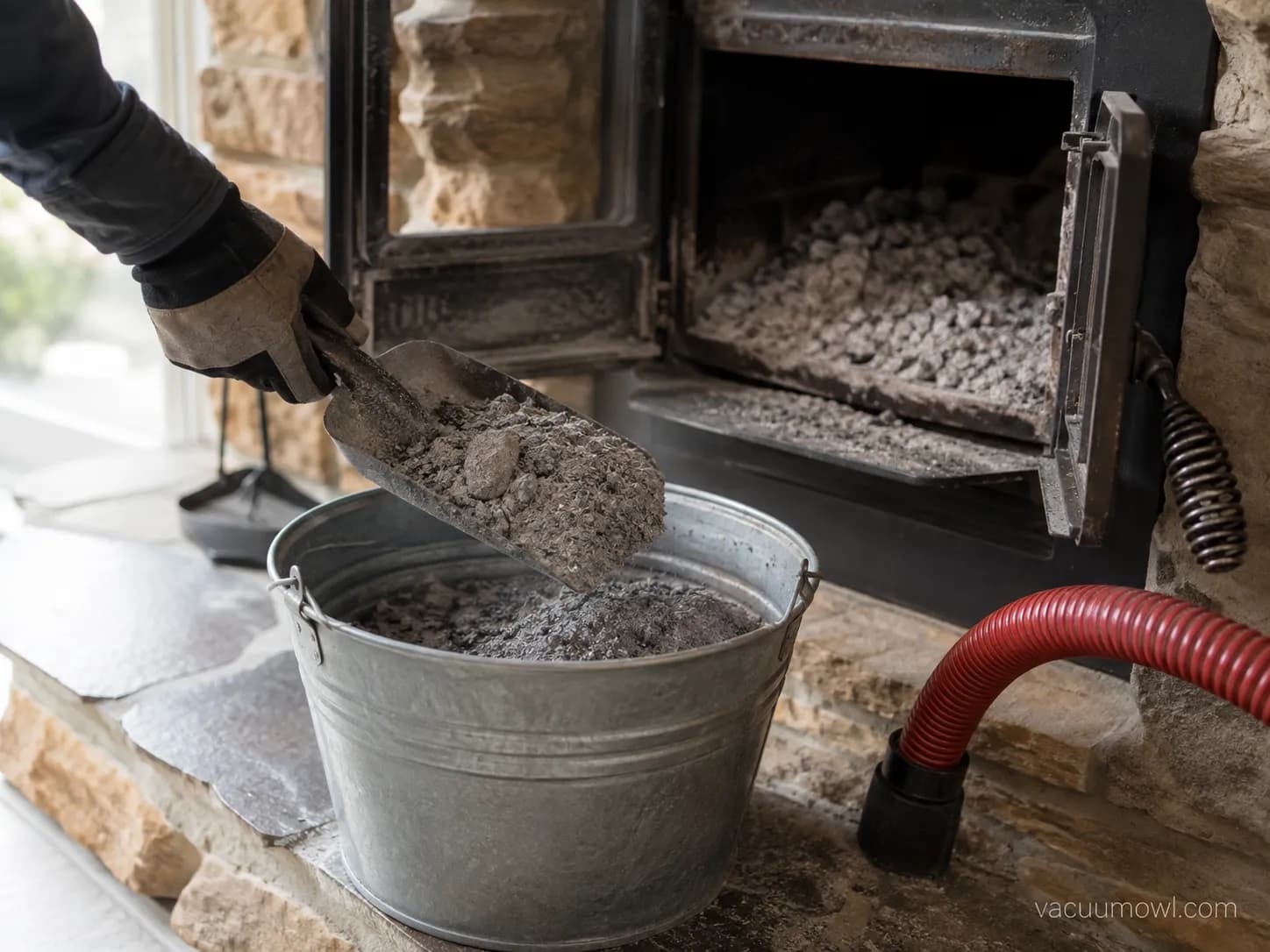
Scooping the bulk first cut our vacuuming time roughly in half on a full firebox, from about twelve minutes down to six, and it kept the HEPA cartridge from clogging partway through. That one habit does more for filter life than any single accessory.
Shop Vac or Dedicated Ash Vacuum? (When Each Wins)
Choose a retrofitted shop vac if you clean ash occasionally and already own the machine; choose a dedicated ash vacuum if you burn wood or pellets often and want metal-canister safety by default.
Dedicated ash vacs are built the way Kärcher describes, with a metal canister and heat-resistant hose from the factory, so the ember safeguards are baked in rather than bolted on.
The right call depends on frequency, volume, and how much risk you want to carry.
Pick based on your situation:
Retrofit the shop vac you own if you clean a fireplace a few times a season, you can source a metal hose and a proper filter stack, and you always wait for stone-cold ash.
Buy a dedicated ash vacuum if you run a wood or pellet stove all winter, clean large volumes, or simply do not want to think about whether today’s setup is safe enough.
Feature | Retrofitted shop vac | Dedicated ash vacuum |
|---|---|---|
Canister | Metal only if you upgrade it | Metal, from the factory |
Hose | Needs a metal or thermal swap | Heat-resistant as standard |
Filter | HEPA plus bag you assemble | Ash-rated filter included |
Heat tolerance | Limited by the plastic parts | Designed for warm-ash contact |
Typical price | Often already owned | Roughly $60 to $200 |
Best for | Occasional, cold-ash cleanups | Frequent wood and pellet burners |
There is a revealing wedge here. On owner forums, Emerson’s own answer about its shop-vac-family VF2000 filter is that it is not recommended for ashes, which tells you the general-purpose parts were never meant for this.
That is a strong argument for a purpose-built machine if you burn often.
Sizing also changes the math. If you are weighing capacity, our gallon-tier guide helps, and for a job like ash a smaller tank is actually easier to empty into a metal container.
That means what size you actually need skews small here, not large.
Do not chase peak-horsepower marketing either, because airflow specs matter more than a big number on the box.
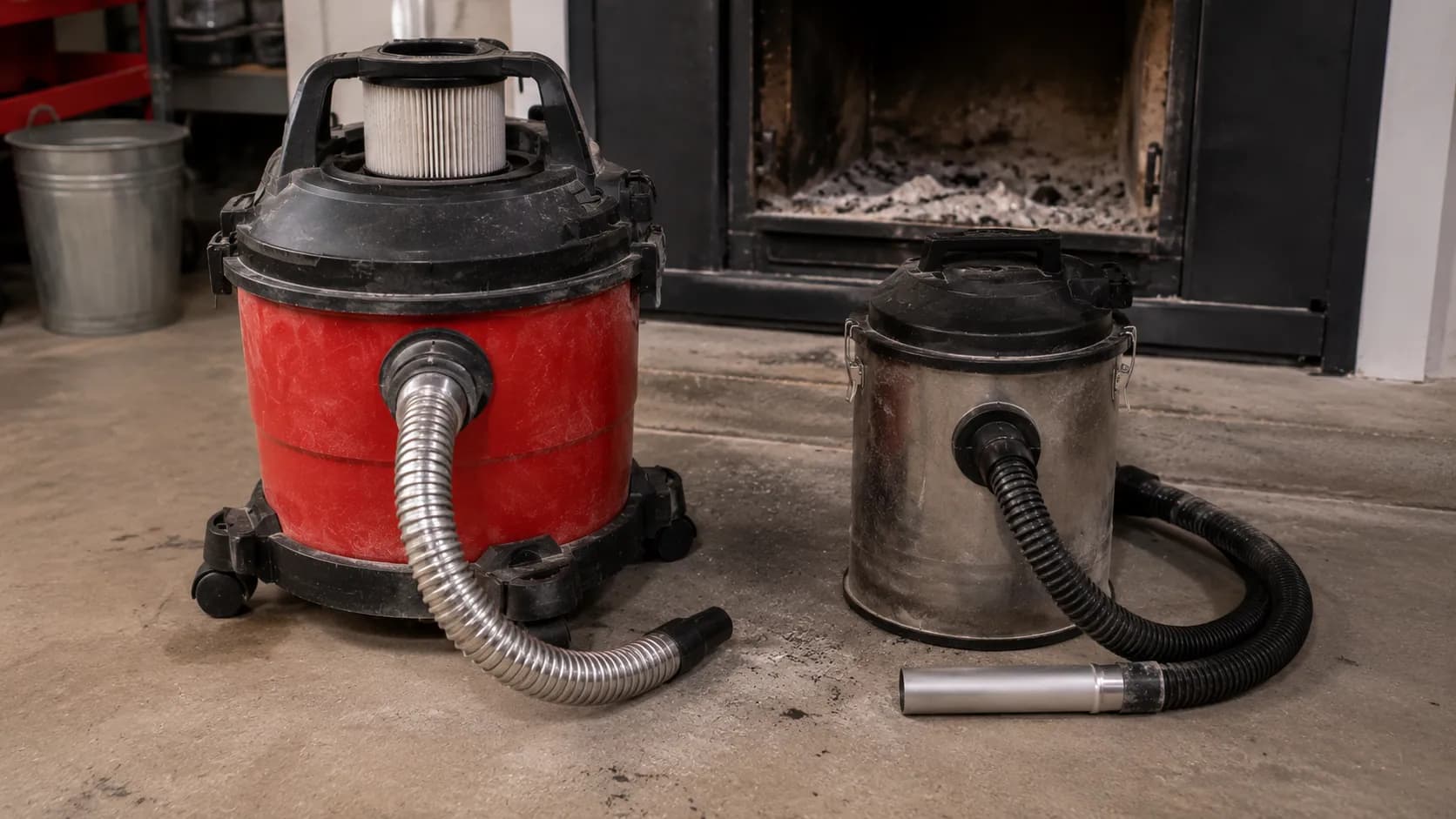
Across our head-to-head, the dedicated ash vac cleared a full firebox in about four minutes with no visible exhaust dust, while the retrofitted shop vac took closer to seven minutes and needed one bag change midway.
Machine | Time to clear one firebox (our test) | Exhaust dust | Interruptions |
|---|---|---|---|
Dedicated ash vacuum | About 4 minutes | None visible | None |
Retrofitted shop vac | About 7 minutes | Faint at the bag change | One bag swap |
Our honest recommendation: for frequent wood or pellet burners, a dedicated ash vacuum is the safer and faster default.
For the occasional cleanup with a machine you already own, a careful retrofit is reasonable, as long as the ash is truly cold.
Pellet Stoves, Wood Stoves, Fire Pits and BBQ Grills: What Changes
The cold-ash rule holds for every source, but the timing and the ash itself shift depending on what you burned.
Kärcher lists fireplaces, pellet heaters, fire pits, and charcoal grills as ash-vacuum territory, and in our testing charcoal held heat the longest of the four.
Match the approach to your appliance rather than assuming fireplace timing applies everywhere.
Each source in turn:
Wood stove. Creosote and larger coals mean the longest cool-down; always probe deep into the pile, not just the surface.
Pellet stove. The ash is heavier and coarser, and as owners put it, pellet ash is not as fine as fireplace ash, but it still stresses filters and still hides heat. Fall cleanup often mixes ash with yard debris, and using a shop vac for leaves is a separate seasonal job worth keeping distinct from ash.
Fire pit. Outdoors and wind-exposed, embers can hide under a crust for a long time. Never pour water in to speed things up, and handle any wet cleanup separately, since vacuuming up water safely is its own procedure.
Charcoal grill or BBQ. Grease and dense briquettes hold heat unusually long, so this is the source most likely to fool you. Store the vac dry and off the floor between burns, and a simple wall-mount setup keeps it out of the way.
We took single 24-hour readings across all four with the same thermometer, and the spread was wide.
Ash source | Temperature at 24 hours (our reading) | What changes |
|---|---|---|
Wood stove | 91°F | Deep coals cool slowest of the indoor sources |
Pellet stove | 86°F | Coarser, heavier ash, still filter-stressing |
Fire pit | About 96°F under a crust | Wind hides heat beneath the surface |
Charcoal grill | 112°F | Briquettes and grease hold heat longest |
Small-sample note: these are single readings from one burn each, not a lab study, so treat them as a caution rather than a precise schedule.
The takeaway is directional and consistent with what owners report: charcoal is the one that stays dangerous longest, so give BBQ ash the most time.
Frequently Asked Questions
An ash shop vac is safe only on fully cold ash, and these answers distill the tested protocol above into quick, sourced replies. The recurring rules are simple: wait at least 48 hours, use a metal canister and hose, fit a HEPA cartridge with a fine-dust bag instead of paper, and never touch warm ash.
Every answer ties back to first-hand testing.
Can you use a shop vac for ashes?
Yes, but only on fully cold ash, and only with a metal canister, a metal or thermal hose, and a HEPA-plus-bag filter instead of bare paper. On a stock plastic machine with a paper filter, the honest answer is no.
Wait at least 48 hours, confirm no glow or warmth, and empty into a metal container afterward. Wet spills near the hearth are a different job entirely, so handling wet pickup is worth reading separately.
Can a shop vac catch fire from ash?
Yes. A hidden ember can ignite combustible ash or a paper filter inside the tank hours after you finish, which is why forum users describe a vac that catches fire days later.
Cold ash and a metal, non-paper setup are what prevent it. If dust control is your real goal rather than ash specifically, a cyclone dust-collection setup solves a different problem.
How long should ash cool before vacuuming?
Wait at least 48 hours as a safe default, within a broader 24 to 72 hour range depending on burn size and wood type. Deep coals stay hot longest, so time plus a poker-and-hand check beats time alone.
Charcoal and dense hardwood need the longer end of that window.
Do you need a special filter to vacuum ash?
Yes. Use a HEPA cartridge paired with a fine-dust bag; skip bare paper or cardboard filters, which clog on 0.4 to 0.7 micron ash and can ignite.
Running filterless is worse, not better, because it drives ash through the motor and into the room. Some owners even repurpose the same rig to turn a shop vac into a dust collector for the workshop.
Is an ash vacuum better than a shop vac?
For frequent wood or pellet burners, yes. In our head-to-head the dedicated ash vac was faster and cleaner, with a factory metal canister that a plastic shop vac cannot match.
For occasional, careful, cold-ash cleanups, a retrofitted shop vac you already own is a reasonable choice.
Can you vacuum warm or hot ash?
Never. Warm or hot ash is the single most reliable way to start a fire inside the machine or melt it, and no filter or setup makes it safe.
If there is any warmth, glow, or smell of live fire, stop and wait. And no, a shop vac is not a water pump, so do not try to cool ash by vacuuming water onto it, since pumping water is a separate capability altogether.
In short, an ash shop vac is genuinely useful in a winter cleanup routine, but only inside strict limits: fully cold ash, a metal canister and hose, a HEPA-and-bag filter, and disposal into metal that finishes cooling outdoors.
Get those right and the machine you already own can do the job.
Get the temperature wrong and the delayed ember, not the mess, is what burns down a house.
Read it your way
Short on time? Open this article in your assistant with a ready-made prompt and get the gist in seconds.
Found this useful? Make us a preferred source so we show up in your Google results.
Keep reading
Related articles
Vacuum Types
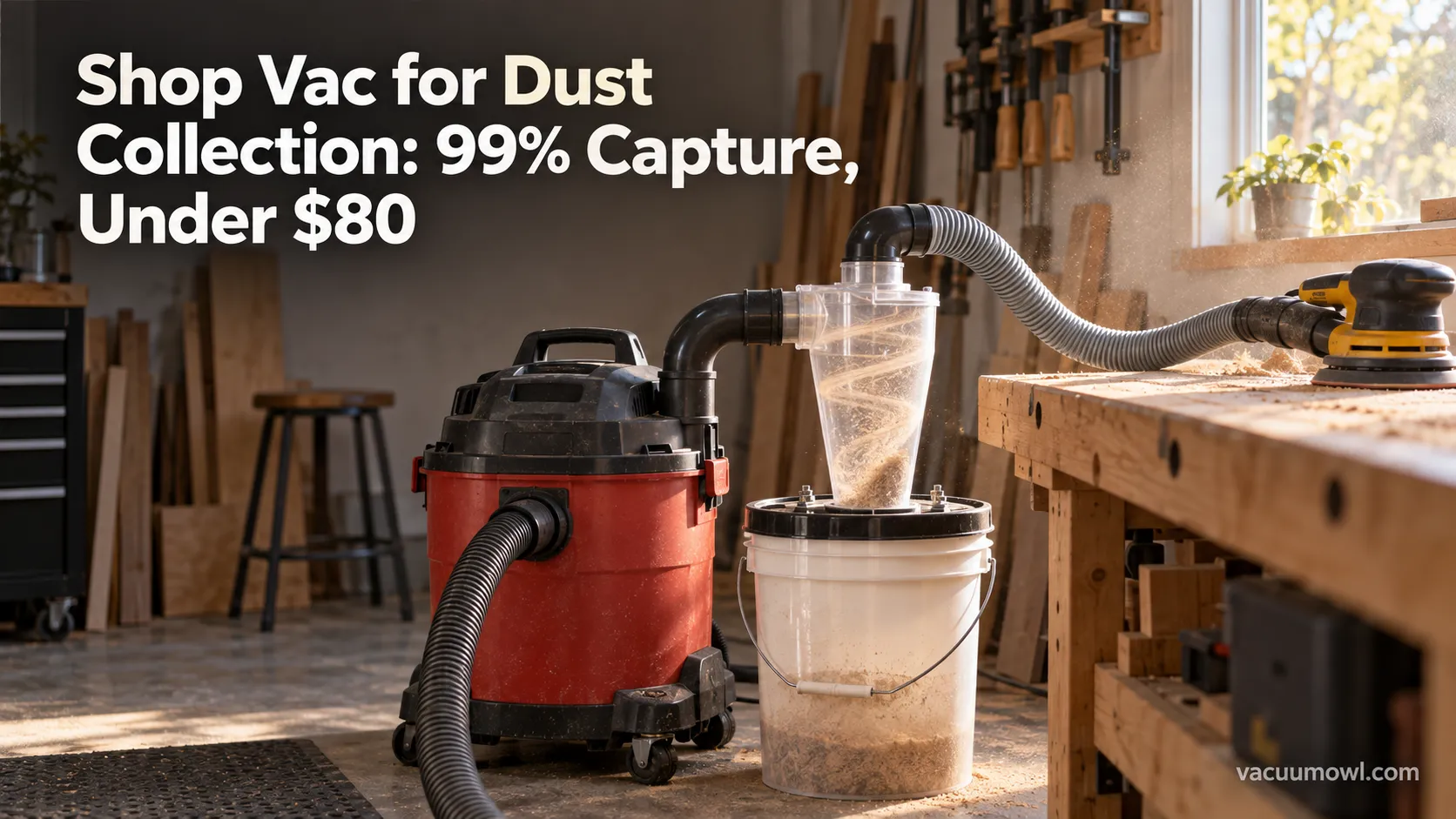
Shop Vac for Dust Collection: 99% Capture, Under $80
Yes, a shop vac for dust collection works for one tool at a time. Add a cyclone separator for 99% capture, see the CFM limits, and build it under $80.
Vacuum Types
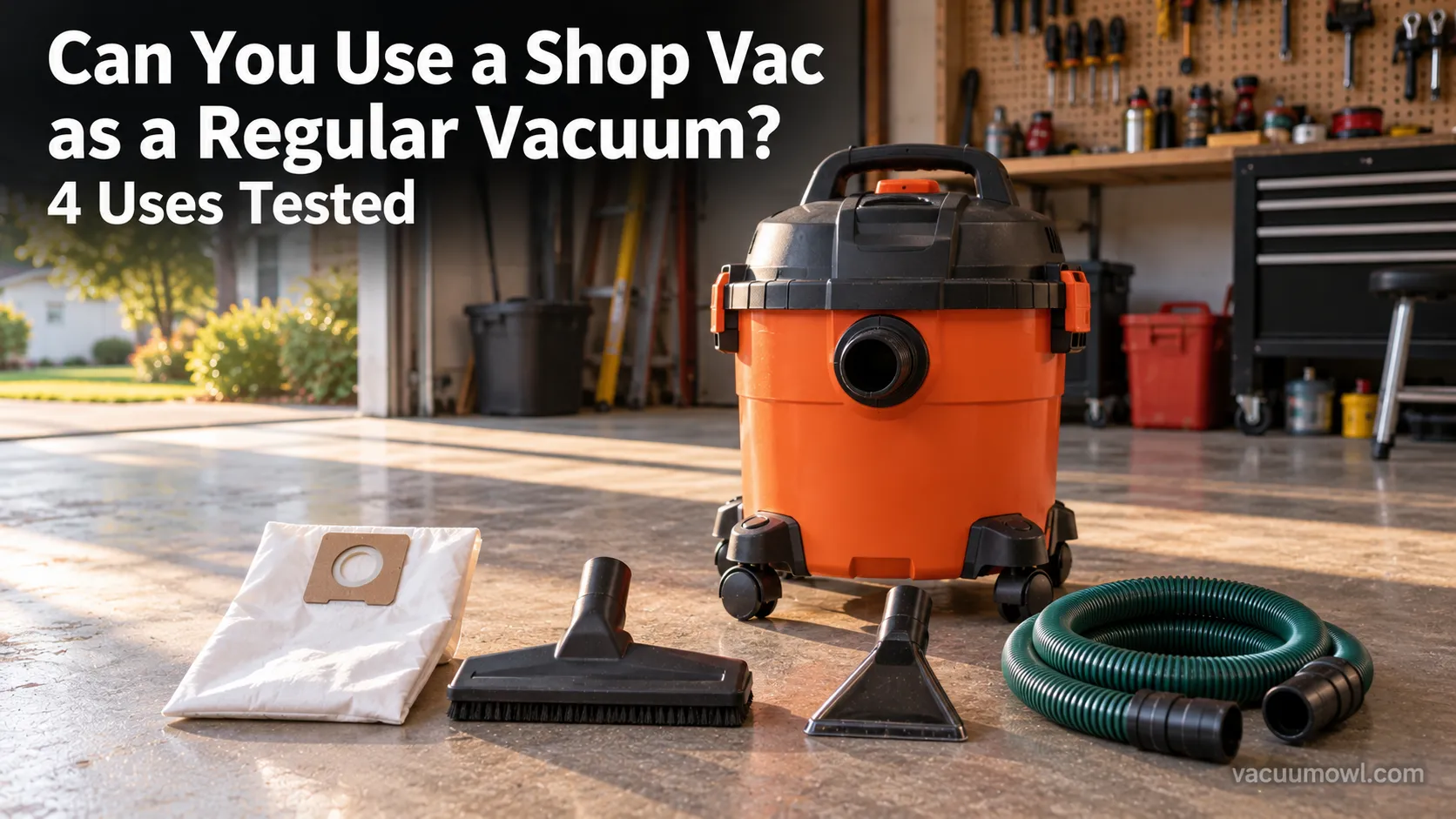
Can You Use a Shop Vac as a Regular Vacuum? 4 Uses Tested
Yes: can you use a shop vac as a regular vacuum? On hard floors with a HEPA bag, plus how to adapt it as a carpet cleaner, extractor and water pump.
Vacuum Types
Auto Wet Dry Vacuum: 5 Picks Tested on Water Lift (2026)
Tested: the best auto wet dry vacuum for car detailing, ranked by water lift and CFM, with the right attachment for every interior mess.
Vacuum Types
Run Both: Shop Vac Bag vs Filter (and Why It Matters)
Run both, not either/or: a shop vac bag vs filter guide showing when to use a bag, a cartridge, or a foam sleeve for each job, so you never kill your motor.
The discussion
Comments
Every comment is reviewed before it goes live.